
Fayoum · Egypt
The Real Oasis of The Alchemist: Al-Fayoum and the Dream Coelho Borrowed
Paulo Coelho sent his shepherd to a real place in Egypt. What Santiago would have found there and where the story of the treasure at home came from.
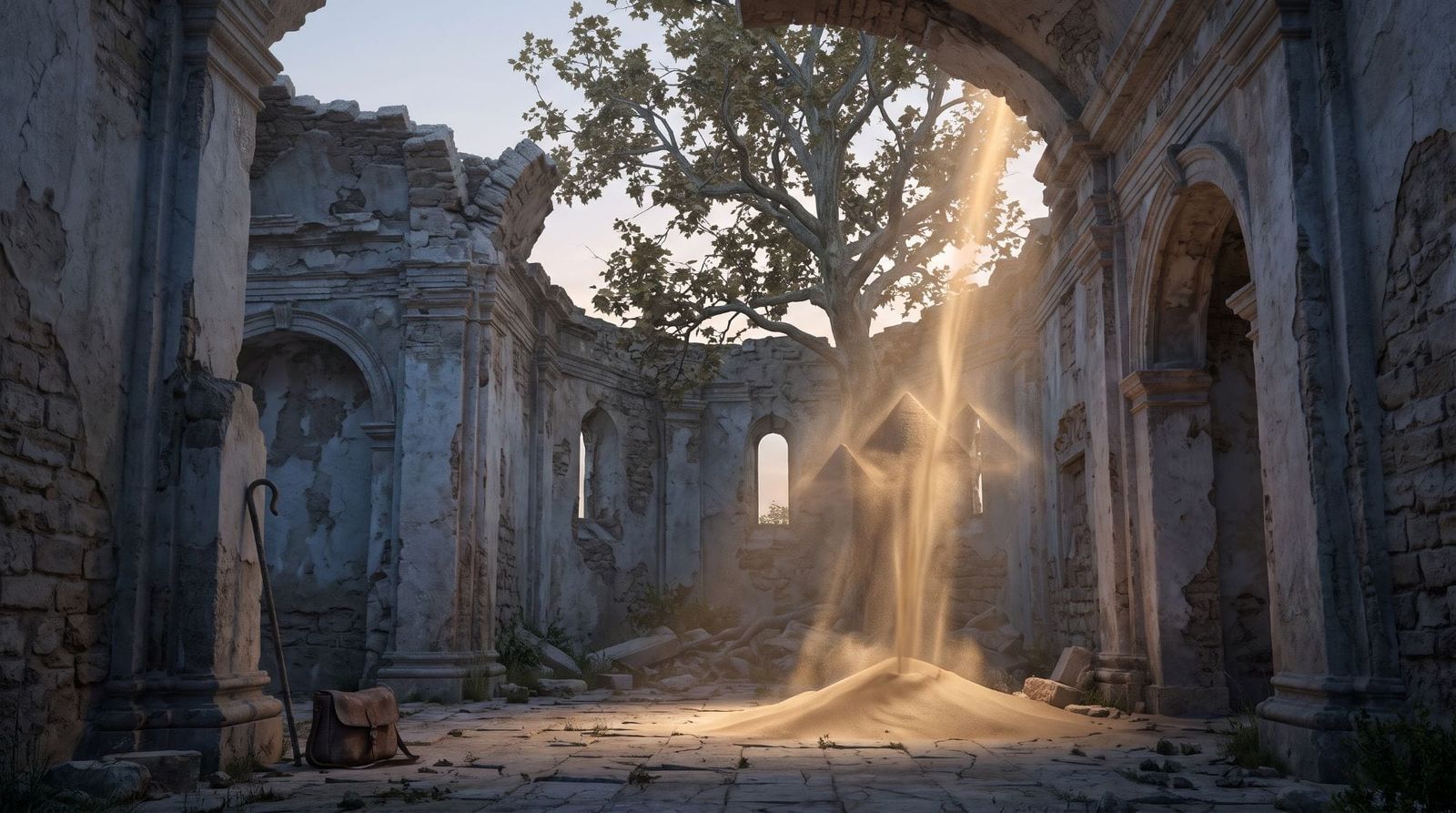
A shepherd falls asleep in a ruined church in Andalusia, under a sycamore that has grown up through the roof. He dreams of a child who takes his hand and shows him a treasure buried near the pyramids of Egypt. That is how The Alchemist begins. Paulo Coelho published it in Portuguese in 1988 and it has since travelled much further than its hero.
Most readers remember the route as a feeling: Spain, then Africa, then sand. But the stops are real. Santiago meets the old king in Tarifa, is robbed in Tangier and works for a crystal merchant until he has the fare for a caravan. The caravan crosses the desert to the oasis of Al-Fayoum. There he finds the alchemist, falls in love with Fatima and learns to read the omens before he goes on to the pyramids.
Al-Fayoum is on every map of Egypt, about two hours by road from Cairo. This is what the book takes from it, what it leaves out and where the story itself came from.
The dream is older than the book
Start with the ending. Near the pyramids Santiago is beaten by men who want his gold. One of them laughs at him: he too once dreamed of treasure, under a sycamore in a ruined church in Spain. He was not fool enough to cross a desert for it. Santiago walks home and digs.
The turn is centuries older than the novel. In the sixth book of his Masnavi the thirteenth-century poet Jalal al-Din Rumi tells of a man in Baghdad who has spent his inheritance. A dream tells him the treasure is in Cairo. He travels there, is caught by the night watch while begging in the street and beaten. When he explains himself the watchman mocks him. He has often dreamed of a treasure buried in a house in Baghdad, in such a street. He has never gone. The house is the dreamer's own. He goes home and finds it.
The One Thousand and One Nights include a version of it, known in Richard Burton's English as "The Ruined Man Who Became Rich Again Through a Dream". Its details match Rumi's closely: a ruined man of Baghdad, a dream that sends him to Cairo, a beating at the hands of the police, an official who laughs at the dream and describes the treasure in the dreamer's own house. In 1935 Jorge Luis Borges retold it as "The Story of the Two Dreamers", citing the 351st night as his source.
Stories with the same shape turn up far beyond the Middle East, in Turkish and French tellings and in England as the Pedlar of Swaffham, who walks to London Bridge to hear about the treasure in his own garden. Folklorists group them as tale type 1645, the man who becomes rich through a dream. The number marks a family of similar stories, not a proven line of borrowing from one to the next. Whether Coelho took it from Borges, from the Nights or from somewhere else, the shape is the same.
What Coelho kept is the skeleton: the dream, the long road, the beating, the stranger who mocks the dreamer with his own dream, the treasure at home. What he changed is the direction and almost everything in between. His dreamer leaves Spain for Egypt instead of Baghdad for Cairo. The alchemist, Fatima and the omens are his. So is the oasis, the one stop the older versions never make.
For more on how the Nights travelled, see One Thousand and One Nights as a visual network and the story of Aladdin's real teller in The Real Aladdin.
The oasis Coelho chose
In the novel Al-Fayoum is neutral ground in the open Sahara: palm trees, wells, tents, warriors leaving their weapons at the edge. The real Fayoum is an oasis too, though of a particular kind. It is a wide depression in the Western Desert, roughly 80 km across, just west of the Nile Valley and below sea level. Its lowest point is Lake Qarun, more than forty metres below the sea.
Its water comes from the Nile, through the Bahr Yussef canal. Its fields are the work of irrigation rather than of a single spring. Pharaohs and Ptolemaic kings drained and watered it for centuries, so what you see today is a managed landscape of wheat, palms, olive groves and waterwheels, with desert on every side.
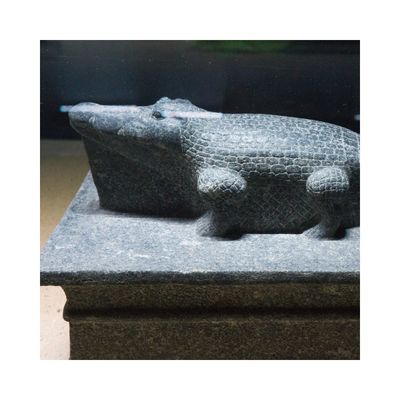
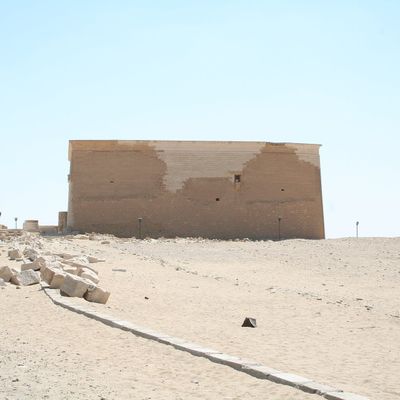
Coelho's caravans had a real counterpart. On the western shore of the lake stands Qasr Qarun, a Ptolemaic temple of the crocodile god Sobek at the ancient town of Dionysias, a stopping point on the routes from the Fayoum to the oases of the Western Desert. The temple is almost bare of carving. Inside it is a maze of dark rooms, low doorways and stairs. Every year on the winter solstice, around 21 December, the early morning sun travels along the temple's axis and falls on the Holy of Holies at its far end for a short while. Egypt's antiquities ministry now announces the date in advance.
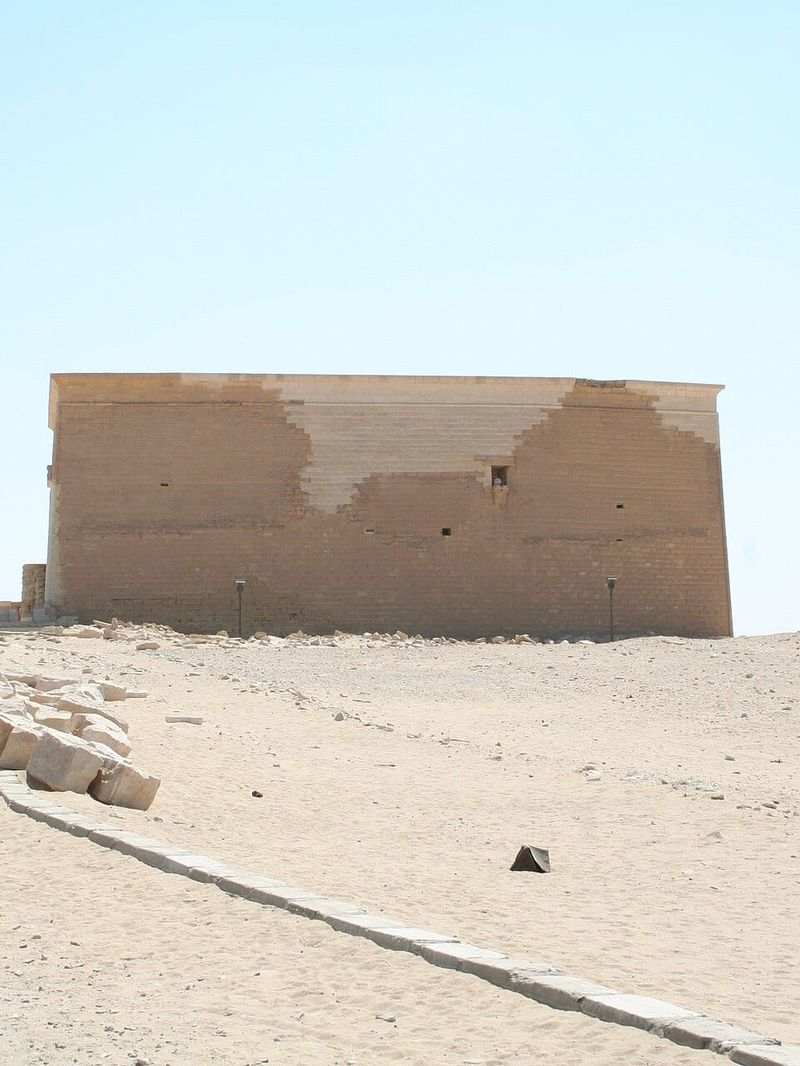
Qasr Qarun (Temple of Sobek at Dionysias)
A late Ptolemaic temple of the crocodile god on the western edge of the Fayoum, with dark corridors and a rooftop view.
Qasr Qarun is a temple for exploring rather than reading. There is almost nothing carved on it. Instead there are shadows, low doorways, tight stairs and rooms that open onto other rooms, with a torch beam as the only light. Children treat it as a maze. So do most adults. Climb to the roof at the end of the afternoon and look out over the ruined town towards the lake. If you are in the Fayoum near the winter solstice, come at dawn for the sun reaching the sanctuary. It pairs easily with a day at Wadi el-Rayan or Tunis.
The faces of Hawara
Santiago goes to Egypt for gold. The Fayoum is famous for something else that came out of its sand.
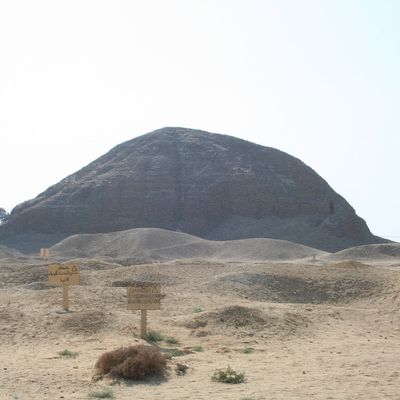
At the south-eastern entrance to the depression stands the pyramid of Hawara, a slumped mound of dark mud brick built for Amenemhat III in the nineteenth century BC. Beside it stood his mortuary temple, so vast that Herodotus called it the Labyrinth and rated it above the pyramids. Only foundations and scattered stone are left.
In the winter of 1887–88 the British archaeologist Flinders Petrie came to Hawara hoping for early pharaonic tombs. Instead he opened a Roman-period cemetery. Its mummies wore portraits painted on wooden panels and bound into the wrappings over the face. From that first season he catalogued 81 portraits. He returned in 1910–11 and found about seventy more.
They are the faces of people who lived in Roman Egypt between the first and third centuries AD. Young men with curly beards. Women with gold earrings and their hair pinned up. Men with gilded wreaths. Most are painted in encaustic, pigment mixed with hot wax, others in tempera. They were made for burial in a mixed Greek and Egyptian society that wrapped its dead in the old Egyptian way and painted them in the Roman manner. When Petrie showed them in London in 1888, visitors and critics hailed them as the first lifelike portraits of real people to come down from antiquity. Today they are one of the largest surviving groups of painted portraits from the ancient world, which is why historians of early Christian art keep coming back to them when they study how late antique portrait painting relates to the first icons.
The portraits did not stay in the Fayoum. Petrie's finds were shared among the people who funded his digs and the museums that asked for them. The largest collection outside Egypt is at the Petrie Museum at University College London, with others in the British Museum, Berlin and New York. Egypt kept only part of what was found. In Cairo they are on show at the Egyptian Museum in Tahrir. In the Fayoum itself you can see a few at the Kom Aushim Museum, on the desert road from Cairo.
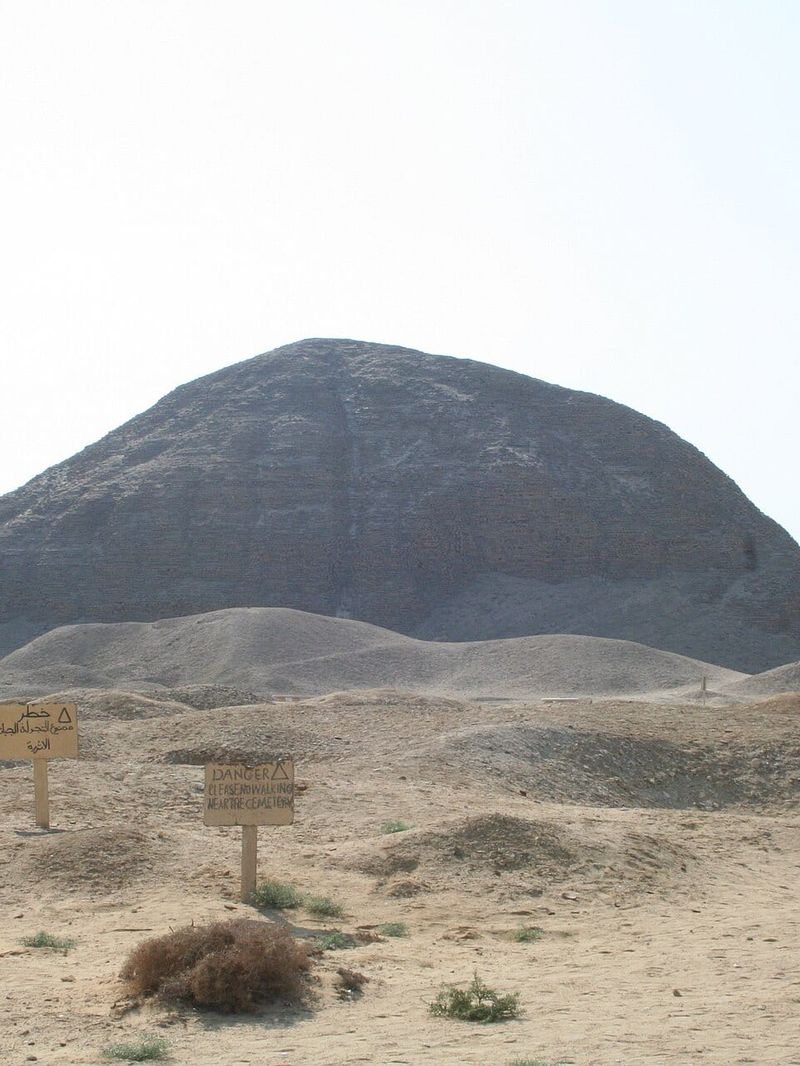
Hawara Pyramid
The mud-brick pyramid of Amenemhat III, the site of Herodotus's Labyrinth and the cemetery of the Fayoum portraits.
At first sight Hawara is a letdown: a slumped hill of dark brick in the desert. Then you remember what surrounded it. Under the sand to the south stood the building Herodotus rated above the pyramids. In the cemetery beside it Petrie lifted out the painted faces of Roman Egypt, young men with curly beards, women with gold earrings, all looking straight back at the viewer. Come for the story more than the sight. Walk round the pyramid, cross the field where the Labyrinth stood, then go and find the portraits in a museum. They read differently once you have stood here.
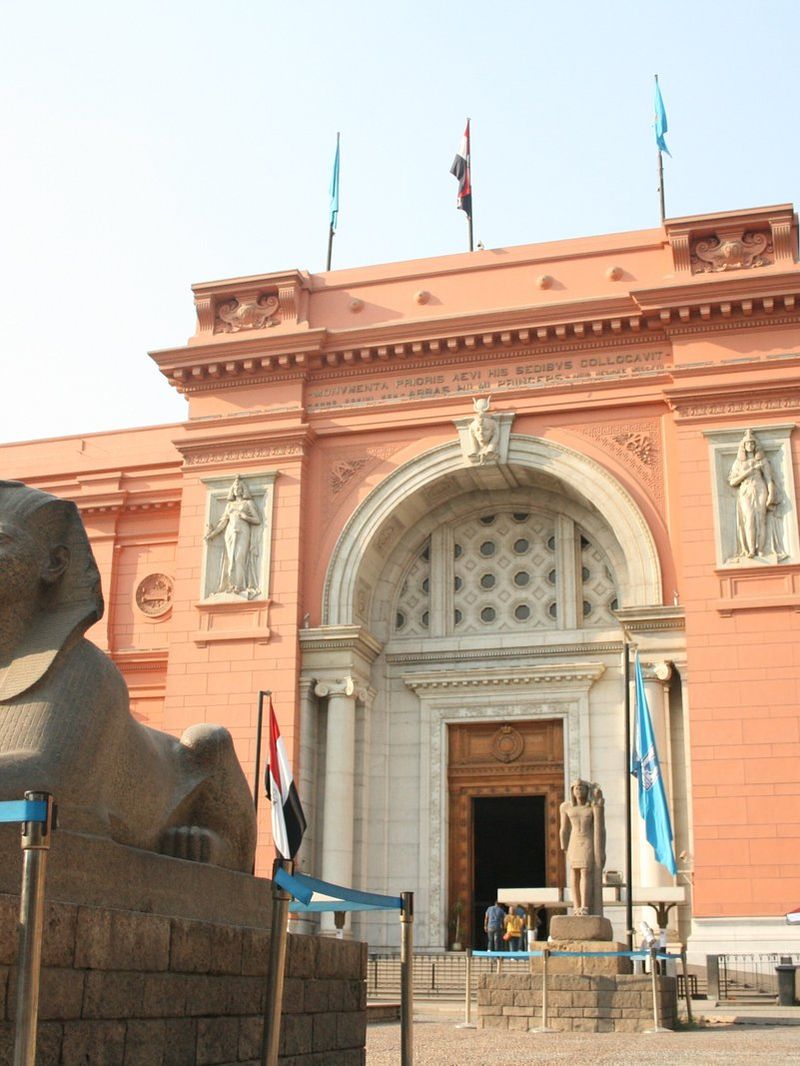
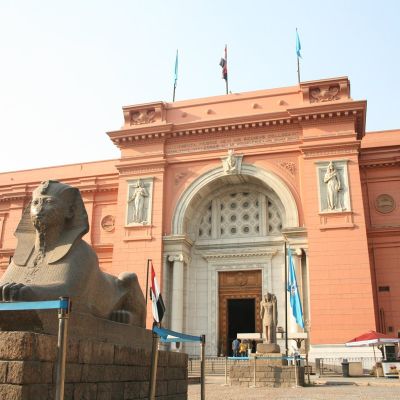
Egyptian Museum
The Egyptian Museum on Tahrir Square in downtown Cairo is the oldest archaeological museum in the Middle East. Its collection runs from prehistory to the Greek and Roman period. It was also the first building in the Middle East and North Africa designed from the start as a museum. The collection began in the nineteenth century with the French archaeologist Auguste Mariette. In 1858 he settled in Egypt as conservator of monuments. He persuaded the viceroy to open a museum at Bulaq, on the Nile north of central Cairo. The collection later moved to a palace of Khedive Ismail in Giza. In 1895 the government launched an international competition for a new building, the first of its kind. The French architect Marcel Dourgnon won it. The cornerstone was laid on 1 April 1897. Khedive Abbas Helmy II opened the museum in 1902. Dourgnon chose not to imitate an ancient temple or tomb. His Beaux-Arts building covers about 13,600 square metres and holds more than 100 halls on a basement and two floors. A rotunda opens behind the entrance. Double-height rooms under skylights were planned so that daylight would fall on the objects, with natural ventilation instead of machinery. Over the entrance arch is a head of the goddess Isis. Two female figures on either side stand for Upper and Lower Egypt. Marble panels on the façade carry the names of Egyptologists. A monument to Mariette stands in the garden. The building is on Egypt's Tentative List for UNESCO World Heritage. In recent years two of its most famous groups have moved. On 3 April 2021 the Pharaohs' Golden Parade took 22 royal mummies across Cairo to the National Museum of Egyptian Civilization in Fustat. The Tutankhamun collection went to the Grand Egyptian Museum at Giza. Much of the core of Egyptology remains here. The Narmer Palette from Hierakonpolis, of about 3100 BC, carries some of the earliest hieroglyphic inscriptions found. A 7.5-centimetre ivory statuette from Abydos is the only confirmed contemporary statue of Khufu, builder of the Great Pyramid. Flinders Petrie found it in 1903 without its head. He ordered a search and the head turned up three weeks later. The Old Kingdom holdings include statues of Khafre, the triads of Menkaure and the wooden statue of the priest Ka-aper. In the family group of the dwarf official Seneb, the sculptor placed the two children where Seneb's legs would have been. The colossal limestone group of Amenhotep III, Queen Tiye and three of their daughters is the largest known ancient Egyptian family statue. The museum also keeps the burials of Yuya and Thuya, the treasures of Tanis including those of Psusennes I, papyri, coffins and jewellery. The museum is open daily from 9:00 to 17:00. The ticket office closes at 16:00.
Karanis: an oasis town on paper
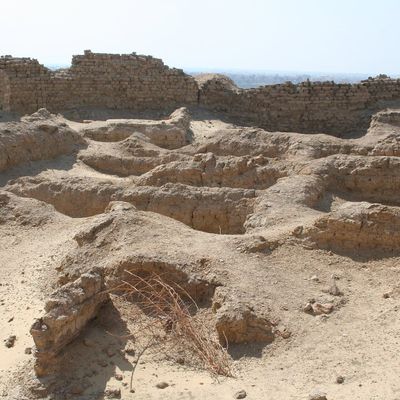
The Kom Aushim Museum stands at the gate of Karanis, a farming town founded under Ptolemy II in the third century BC. You walk down lanes between mud-brick houses, past granaries, to a stone temple of the crocodile gods.
The University of Michigan dug here between 1924 and 1935. The houses gave up tools, toys, textiles, baskets and thousands of papyri: tax receipts, contracts, letters home, complaints to officials. The papyri are in Greek, Latin, Demotic and Coptic. Most were written by or for ordinary farmers, soldiers and officials rather than kings, which is why historians of Roman Egypt lean on Karanis so heavily: here you can follow who paid how much tax, who owed whom and who took a neighbour to court. Many of the finds are now in the Kelsey Museum of Archaeology in Ann Arbor.
The dated documents stop in the middle of the fifth century AD, so the town was long thought to have been abandoned then. In 2024 a team working with the Kelsey Museum published the first radiocarbon dates for the town, taken from thirteen samples of crop remains. They show that people were still living at Karanis after the middle of the fifth century. The team's reading is that parts of the town stayed inhabited into the seventh century, long after the papyri fall silent.
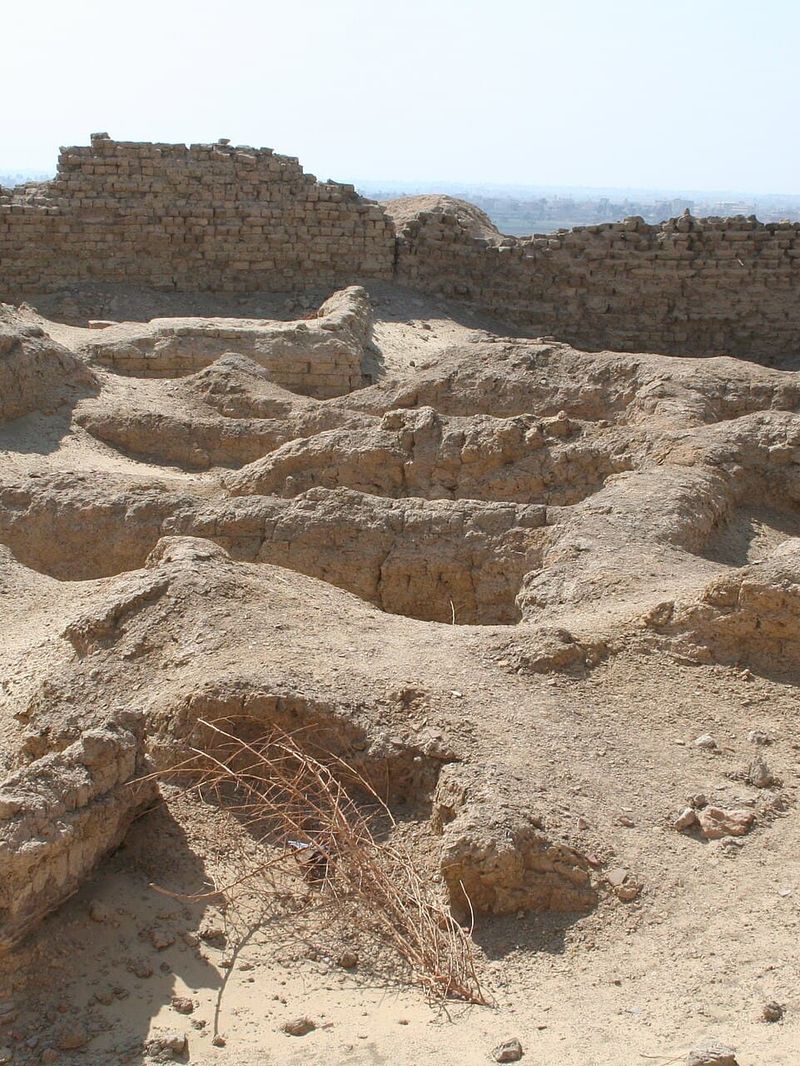
Karanis (Kom Aushim)
A Greco-Roman farming town on the edge of the Fayoum, with crocodile-god temples and the houses where thousands of papyri were found.
Karanis is a town you can walk through. Lanes between crumbling houses, the stair of a granary, a doorway opening onto nothing, the stone temple of the crocodile gods in the middle. The desert is on one side and the green fields of the Fayoum on the other. What makes it more than ruins is the paperwork. A great deal of what we know about ordinary life in Roman Egypt comes out of these houses: what people paid in tax, what they wrote home, what they took each other to court over. Start at the little museum by the road, then go in and find the house you would have wanted.
Omens in the desert
Santiago learns to read omens: two hawks fighting in the sky, then a vision of an army riding on the oasis. The desert around the Fayoum is full of signs of a more literal kind.
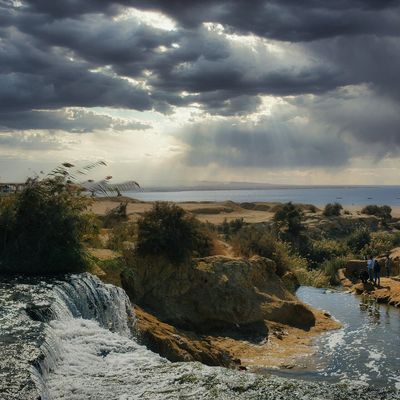
South-west of the cultivated land lies the Wadi el-Rayan Protected Area. Its two lakes are recent. They formed from the 1970s, when surplus drainage water from the Fayoum's fields was channelled into an empty desert basin. A short run of low waterfalls now joins them. The Magic Lake further on changes colour through the day as the light moves over the dunes. Blue water in open sand is the nearest the Fayoum comes to the picture-book oasis.
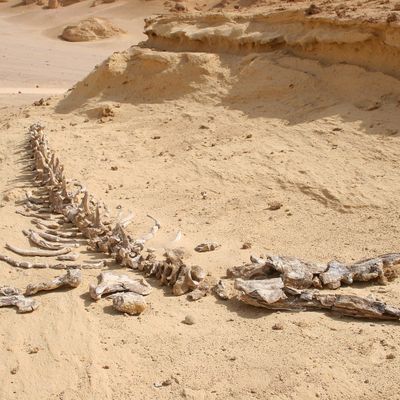
Further in lies Wadi el-Hitan, the Valley of the Whales. Around forty million years ago this desert was the floor of a shallow sea. The skeletons of early whales, mostly Basilosaurus and Dorudon, lie half out of the sand. Some still have small hind legs, feet and toes, left over from ancestors that walked on land. UNESCO inscribed the valley as a World Heritage Site in 2005. The last stretch needs a four-wheel-drive vehicle.
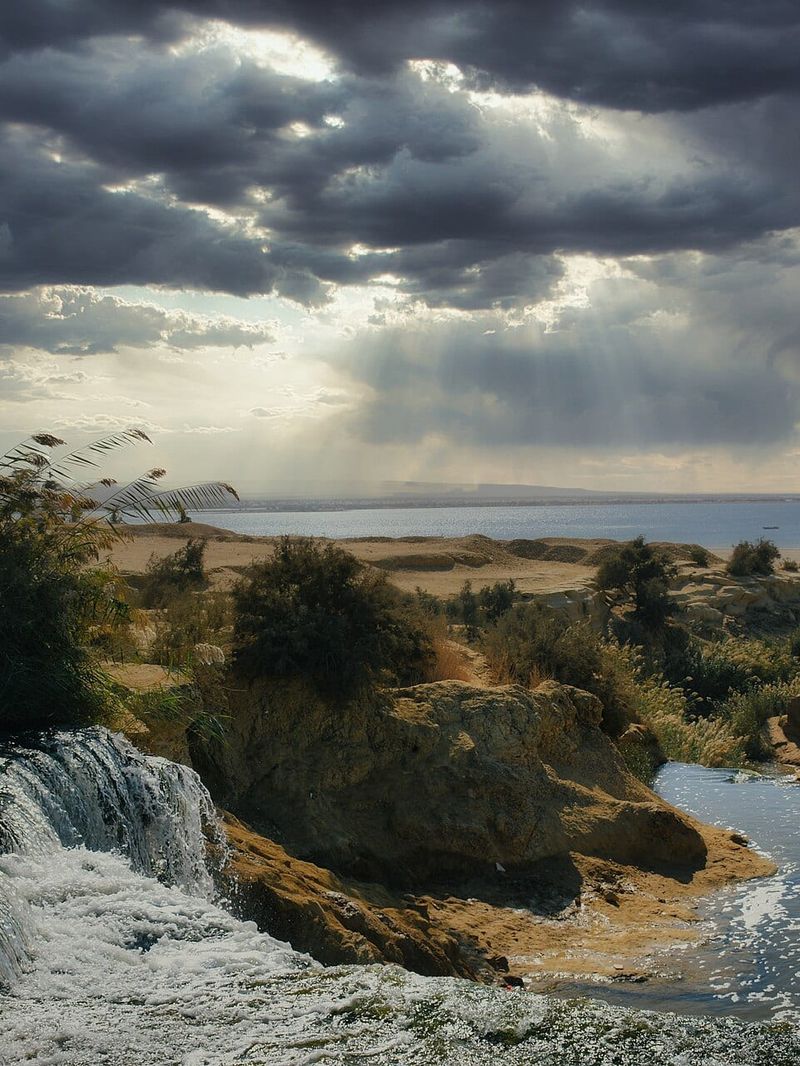
Wadi el-Rayan Waterfalls and Magic Lake
Egypt's only waterfalls between two desert lakes, dunes and the colour-changing Magic Lake in the Fayoum's protected area.
It is not Niagara. The falls are a few metres of white water between rocks. But the setting does the work: two blue lakes in the middle of the Sahara, ringed with sand, families picnicking on the banks and small boats out on the water. It feels improbable in the best way. The better moment comes later. Drive on to the Magic Lake as the sun drops and watch the water change colour against the dunes, or climb Mudawara for the view over all of it. Go on a weekday if you want quiet. Pair it with the whales.
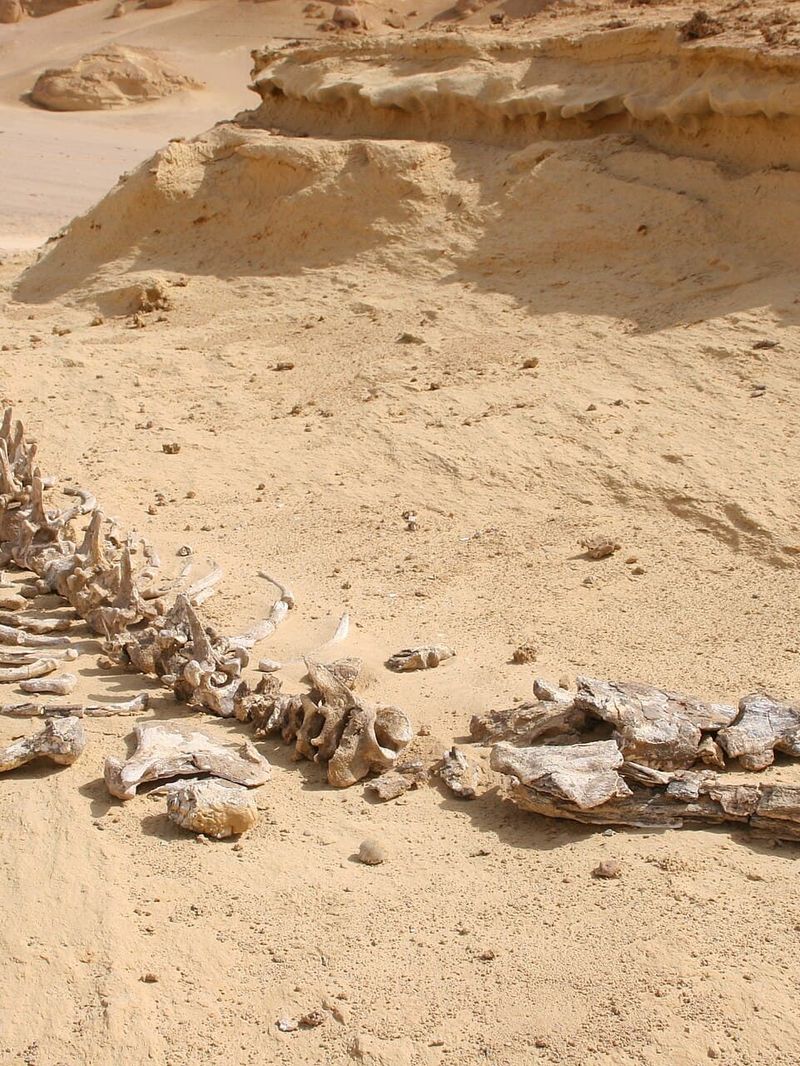
Wadi el-Hitan (Valley of the Whales)
A UNESCO desert valley of 40-million-year-old whale skeletons with legs — and a museum of fossils and climate change.
You walk across open desert and there it is, half out of the sand: the spine of a whale, longer than a bus, with tiny back legs. Wadi el-Hitan is one of the strangest places in Egypt. A whole chapter of evolution lies on the ground in a landscape of wind-carved rock that looks like another planet. Start in the museum so you know what you are looking at. Then walk the trail in the late afternoon, when the rock turns gold and the shadows stretch across the bones. If you can, stay for the night sky.
Tunis, the potters' village
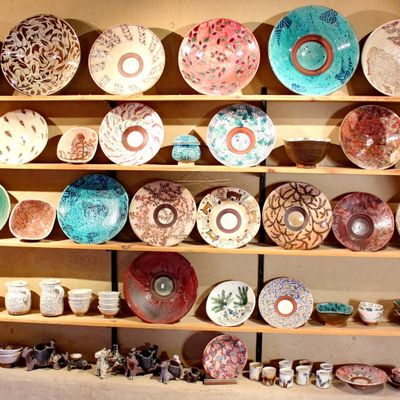
The Fayoum is also a living region. Some of its best known culture is only a few decades old. On the hill above the southern shore of Lake Qarun is Tunis. In the 1960s the Swiss potter Evelyne Porret settled here with her husband, the poet Sayed Hegab. In the 1980s she opened a pottery school for the village children. They grew up to open workshops of their own and Tunis became one of Egypt's best known pottery villages. The main street is lined with studios where you can watch potters at the wheel and buy bowls and plates painted with fish, birds and palms in blues, greens and yellows. Porret died in 2021 and was mourned in the village she had changed. Pottery now supports many families in Tunis, the village holds an annual pottery festival and its potters sell well beyond Egypt.
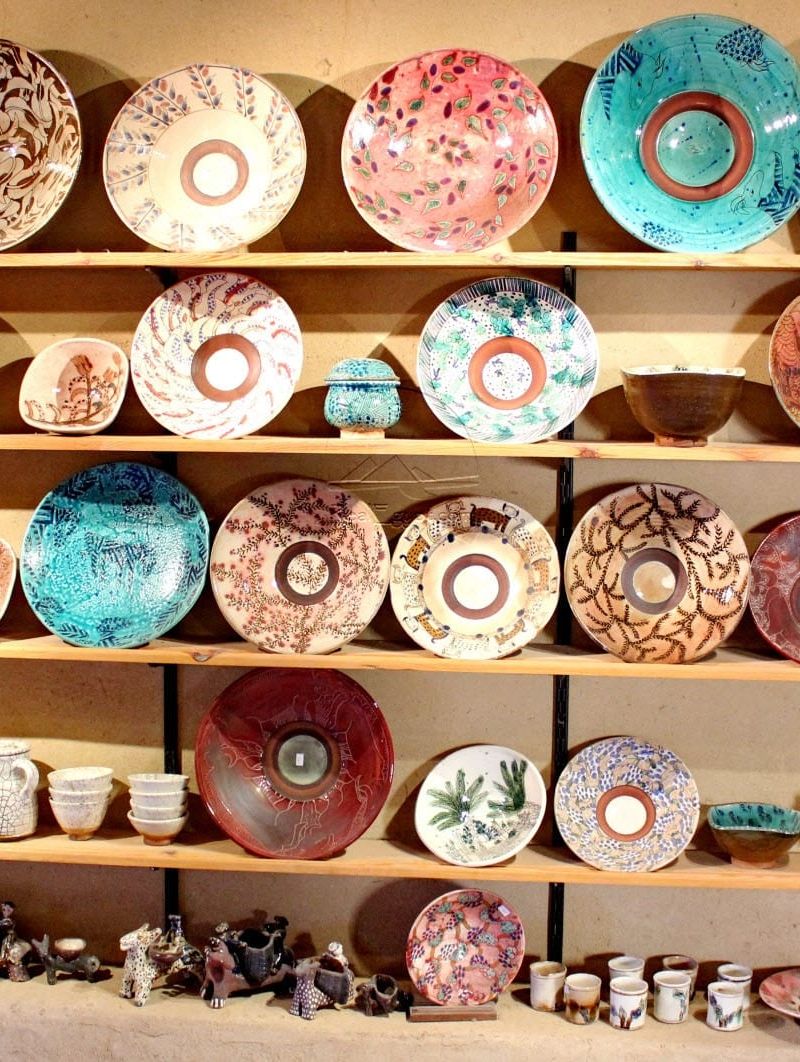
Tunis Village Pottery
The Fayoum village transformed by a Swiss potter into Egypt's pottery capital — workshops, a pottery school and lake views.
Tunis is the gentlest place in the Fayoum. Dusty lanes and domed mud-brick houses. Every few doors a workshop with plates and bowls stacked in blues, greens and yellows. Below the village the lake stretches away to the desert. It is a village shaped by one woman's work and carried on by the children she taught, now masters with studios of their own. Take a class. Buy something from the person who made it. Stay a night and watch the sun go down over the lake.
How the places fit together
If you go looking for Santiago's oasis, plan on a car and a driver: the sites are spread across a large region. With transport and an early start, Karanis, Hawara, Qasr Qarun and Tunis can fit into one long day, though not at a leisurely pace. Wadi el-Rayan and Wadi el-Hitan need a second. Karanis and the Kom Aushim Museum are one stop on the desert road as you arrive from Cairo. Hawara is on the south-eastern side, near Fayoum city. Tunis and Qasr Qarun sit on the southern and western shores of Lake Qarun. Wadi el-Rayan is about an hour south-west of the city and Wadi el-Hitan beyond it, on a desert track. Access and opening hours at museums and archaeological sites change, so check both with the antiquities ministry before you go.
From the Fayoum it is about 100 km back to the pyramids, where Coelho turns his hero for home. The Grand Egyptian Museum beside them in Giza opened officially on 1 November 2025, with Tutankhamun's tomb treasure shown together for the first time since its discovery in 1922.
The portraits of Hawara survived because they were buried. They were painted to stay with the dead, face to face, inside the wrappings. Today many of them hang in museum cases thousands of kilometres from the cemetery and from the families who commissioned them.
Sources and further reading
Britannica, "The Alchemist", novel by Paulo Coelho.
EBSCO Research Starters, "The Alchemist" by Paulo Coelho.
Jalal al-Din Rumi, Masnavi, Book VI, trans. R. A. Nicholson.
The Book of the Thousand Nights and a Night, trans. Richard F. Burton, "The Ruined Man Who Became Rich Again Through a Dream".
D. L. Ashliman, "The Man Who Became Rich through a Dream: folktales of type 1645", University of Pittsburgh.
Jorge Luis Borges, "The Story of the Two Dreamers", in A Universal History of Infamy (1935).
W. M. Flinders Petrie, Roman Portraits and Memphis IV (1911) and The Hawara Portfolio (1913).
Petrie Museum of Egyptian and Sudanese Archaeology, UCL, "Hawara mummy portraits".
Motta et al., "Redating Roman Karanis, Egypt: radiocarbon evidence for prolonged occupation until the seventh century AD", Antiquity 98 (2024).
University of Michigan, Kelsey Museum, "New article recasts Karanis timeline" (2024).
Kelsey Museum of Archaeology, Karanis Revealed.
Egyptian Ministry of Tourism and Antiquities, "The solar alignment every year" (Qasr Qarun).
UNESCO World Heritage Centre, Wadi Al-Hitan (Whale Valley), inscribed 2005.
Ahram Online, "Famous potter Evelyne Porret mourned in Tunis village" (2021).
Al Jazeera, "Egypt unveils Grand Egyptian Museum dedicated to its ancient civilisation" (1 November 2025).
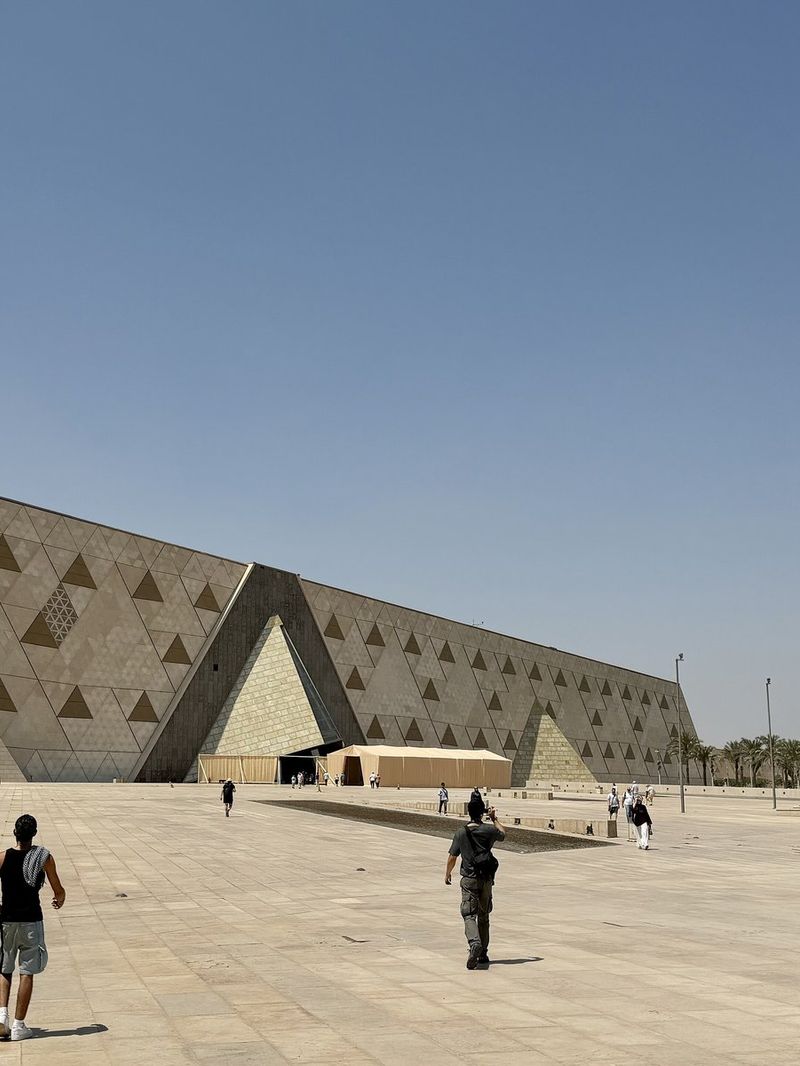
Grand Egyptian Museum
The Grand Egyptian Museum (GEM) is Egypt's national museum of ancient Egyptian civilisation, from prehistory to the end of the Greek and Roman periods. It stands on the edge of the desert plateau at Giza, about 2 km from the pyramids, on a site of roughly 50 hectares. It presents itself as the largest museum in the world devoted to a single civilisation. About 50,000 objects are on display across 24,000 square metres of permanent galleries. The project took more than three decades. Land near the pyramids was set aside in 1992. The foundation stone was laid in 2002. A year later the Dublin firm Heneghan Peng won the international design competition. Construction began in 2005 but stopped after the 2011 revolution. The Conservation Centre opened in 2010, long before the galleries, to prepare the collection for the move. The Grand Stairs opened in part in 2023 and the twelve main galleries in 2024. The museum was officially inaugurated on 1 November 2025. The Tutankhamun galleries opened to the public three days later. The complex cost close to a billion dollars. The building takes its cues from its neighbours. Its long façade is patterned with triangles that echo the pyramids. The entrance is clad in translucent alabaster panels. The windows at the top of the Grand Stairs look out towards the pyramids themselves. Visitors are met in the forecourt by the Hanging Obelisk of Ramesses II. The granite obelisk is 16 metres tall and weighs 87 tonnes. It was the tallest obelisk at Tanis in the eastern Delta. It now rests on four pillars above a glass floor, so visitors can see the king's cartouche carved into its base. Inside, the Grand Hall is dominated by a colossal granite statue of the same king, about 11 metres tall and 83 tonnes. It was found near Memphis, the ancient capital. In the 1950s it was brought to Cairo. For about fifty years it stood in Ramses Square in front of the main railway station. In August 2006 it was carried 35 km overnight to Giza. In January 2018 it became the first object installed in the museum. The Grand Stairs rise from the hall in four sections. They are titled Royal Image, Divine Houses, Gods and Kings, Journey to Eternity. Monumental statues of pharaohs and deities line the way. The galleries beyond are arranged by period and by themes such as religion, rulers and society. The Tutankhamun galleries show the entire contents of his tomb together for the first time since Howard Carter found it in 1922. That is about 5,000 objects, including the gold mask, the throne, three funerary beds and six chariots. The burial goods of Queen Hetepheres I, mother of Khufu, are also here. Her travertine canopic chest still holds remains of her embalmed organs. Khufu's first boat has its own building on the site. The vessel, 42.32 metres long, was found dismantled in a sealed pit beside the Great Pyramid in 1954. Reassembling it took more than ten years. In August 2021 it was moved here intact, 8 km on a specially built vehicle. The second boat is being conserved and reassembled there, with the work planned as a live display for visitors. The campus also includes a children's museum, gardens, restaurants and a conference centre. The galleries are open from 9:00 to 18:00. On Wednesdays and Saturdays they stay open until 21:00.
Museums mentioned
Places mentioned
Related reading
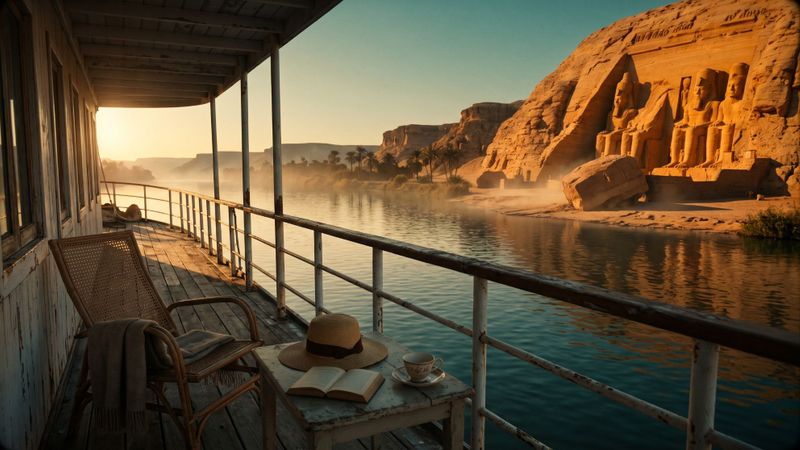
Agatha Christie's Egypt: Three Abu Simbels, a Pharaoh and a Murder on the Nile
Christie set one famous murder on the Nile and two lesser-known stories in ancient Egypt. The temples, letters and film sets behind all three.
Sinbad and the Real Trade Routes of Oman and Basra
A ninth-century ship sewn together without nails, a hold of Chinese porcelain, and the sailors’ yarns of Basra, Siraf and Sohar: the real sea behind the fantasy.
Why the Middle East Keeps Building Venice
From the Red Sea to the Gulf, canal towns keep getting called Venice. The water was usually about something else — and Venice was never quite Venice either.