
Baghdad · Iraq
One Thousand and One Nights as a Visual Network
The book that taught Europe to picture the East arrived with no pictures at all. Three centuries of illustrators — Dutch, Egyptian, Persian, French, German, Iraqi — each gave it a face, and every face was a self-portrait.
Open the first edition of the book that taught Europe to dream of the East, and there is nothing to look at. Antoine Galland's Les Mille et Une Nuits, the twelve volumes that appeared in Paris between 1704 and 1717 and conquered the continent — no plates, no picture of a genie or a lamp or a girl telling stories to stay alive. The most visually imagined book in the world began, for its European readers, blind. When the University of Glasgow's special collections hold up their English Galland of 1763, they note it plainly: true to Galland and the Arabic manuscripts, the copy contains no illustrations.
That absence is the whole story. Much of the visual canon now attached to the Nights was created outside the cultural worlds in which its stories actually circulated. It has a thousand faces and no face. Every culture that met the text painted it — and painted itself. What you get, tracing those pictures across three centuries, is not a history of illustration. It is a network: nodes in Baghdad and Paris and Tehran and Berlin and Los Angeles, edges running between them, each borrowing from, ignoring, or forging the others, and all of them reaching past the tales toward the same handful of borrowed grammars. Pull any famous image of the Nights and it comes apart in your hands into other images.
A book can be pinned to a single wording and still have no face at all. This one is. That is why the pictures never stop coming.
The text was fixed before the picture ever was
Start with the thing being pictured, because it too has no stable body. The Nights is old — the collection is named and described by the historian al-Mas'udi in the tenth century, and by the bookseller Ibn al-Nadim soon after — but it lived for centuries as a shifting thing, talk and manuscript together, in parallel branches, with no fixed number of tales and no settled text. The earliest physical trace is a ninth-century Arabic fragment of sixteen lines, identified by the scholar Nabia Abbott in 1948, on which a character named Dinazad asks Shirazad to tell a story. The earliest extensive surviving manuscript, one of the copies Galland drew on, is a Syrian one now in the Bibliothèque nationale in Paris — arabes 3609 to 3611, its date so uncertain that its modern editor placed it around 1291 and another scholar put it after 1450. It breaks off mid-sentence in the Tale of Qamar al-Zaman. There was no single complete, canonical Nights for an illustrator ever to reproduce.
The text only got a fixed printed body late, and in the machinery of empire. The first surviving printed Arabic edition came off a British East India Company press in Calcutta between 1814 and 1818 — the first two hundred nights only, with an English title page, an Arabic book made in India for a colonial readership. The version that became the standard was the Bulaq edition, printed in Cairo in 1835 on Muhammad Ali's state press — which the Library of Congress calls the first Muslim printing press in the Arab world — two volumes with woodcuts on the opening page and the text boxed in double rules. The scholar Ulrich Marzolph calls that edition the last decisive act in the textual history — the printed base most later editions would rest on. A copy sits today in the Library of Congress. Calcutta printed a fuller Arabic edition again between 1839 and 1842, scholars have argued over the recensions ever since, but the Nights now had a body most readers could agree to point at.
Notice the sequence. The wording found a standard in 1835. The face never did. A book can have a settled printed text and no settled look at all — and this one does, which is why the network never closes.
The first face was a mistake
Someone had to draw it early, and the early attempts got it wrong in the most instructive way. Around 1714, a Dutch engraver named David Coster illustrated one of the pirated Continental editions of Galland, and — faced with a world he did not know visually — he filled the blank with the world he did know, drawing the characters in European dress, on European furniture, inside European rooms. Scheherazade tells her tale to a Shahryar who could be a Dutch burgher; the fisherman and the jinni meet in a parlour. One of the first faces the Nights wore in print was a face from Amsterdam.
It is easy to laugh, and easy to miss the point, which is that Coster demonstrates a mechanism the whole network would run on. He was not simply an ignorant European inventing a fake East; he was a working engraver with no established visual grammar for these tales, and so he reached for the conventions he had — European dress, European rooms, the repertoire of the Dutch print trade. Faced with a blank, the illustrator fills it with the vocabulary closest to hand, which is usually his own world. What changes over the next two centuries is not that painters stop doing this. It is that they get better at disguising it, and that they start borrowing each other's disguises.
One of the first faces the Nights wore in print was a Dutch one. What Coster did in ignorance, later illustrators would do in full knowledge; the mechanism never changed, only the polish.
The disguise turned into a claim to accuracy with Edward Lane. Lane had lived in Egypt, spoke Arabic, and produced his translation between 1839 and 1841 with 635 woodcuts by William Harvey, drawn under his close instruction and meant to instruct — to show the British reader how the East supposedly looked, down to the lamp and the latticed window. Lane's Nights was ethnography with a plot. Its images claimed the authority of the eyewitness. But the tales he was illustrating were a Syrian manuscript filtered through a French best-seller, and the Egypt he drew was the Egypt of the 1830s dressed as the Baghdad of the caliphs. Lane packed his notes with Cairo's guilds and weddings and superstitions as if the medieval tales were a field guide to the living city outside his window — and the picture that resulted, however carefully observed, reads now as one Englishman's Egypt of one decade, standing in for a timeless East. Even the documentary face was a composite.
One book, a nursery face and a pornographic one
Here is where the network splits according to who is allowed to look. The same tales, in the same language, in the same decades, grew two opposite faces — sorted by class and price.
Lane's was the drawing-room Nights: expurgated, softened, safe to read aloud to children by the fire. At the other end sat Richard Burton's. Burton, who had circled the Arab world for decades as soldier, pilgrim and spy, printed his translation in 1885 — unabridged, unexpurgated, footnoted with essays on Eastern sexual customs and closed with a "Terminal Essay" that lingered on them — through a body he and his friend Forster Fitzgerald Arbuthnot had invented for the purpose: the Kama Shastra Society, a legal fiction dreamed up to slip past the Obscene Publications Act of 1857. Ten volumes, a guinea apiece, limited to a thousand subscribers only. The scholar Colette Colligan has placed Burton's Nights within the history of pornography in English. That first edition carried no pictures at all — its scandal was entirely in the words. The images came a dozen years later: in 1897 the London publisher H. S. Nichols issued an illustrated edition reproducing seventy-one oil paintings by Burton's friend Albert Letchford, bound in gold-tooled morocco stamped with Arabic script — a luxury object for men who could afford to be shocked in private.
So the same stories were, at once, a book you gave a child and a book you hid from one. The picture followed the price.
The same tales, the same decade, wore a nursery face and a pornographic one. Which one you saw depended on what you could pay.
And the borrowing that would define the visual network had a textual twin: the scholar Paulo Lemos Horta, in Marvellous Thieves, and a later stylometric study of the prose both argue that Burton leaned far more heavily on John Payne's earlier translation than he ever admitted — reworking, in places lifting, the words of the quieter scholar who had got there first. Text borrowing text, as image would borrow image. The Nights has always been a machine for borrowing — a tale that belonged to no country, and now a look that belonged to no one either.
The jewelled face, and a grammar borrowed again and again
By the turn of the twentieth century the Nights had become the great showcase for the gift book — the lavish, colour-plated volume made to be given, not just read, born of a printing revolution that could suddenly reproduce watercolour in tipped-in plates on heavy paper. Its two masters were Edmund Dulac and Kay Nielsen. Their images are the ones most people still see when they close their eyes and think Arabian Nights: flat planes of jewel colour, no shadow, no European modelling, gold borders, figures pressed toward the picture plane.
That look was borrowed too, and openly. Dulac built his Stories from the Arabian Nights of 1907 and his Sindbad of 1914 — twenty-three plates tipped into gold-stamped borders for Hodder and Stoughton — on the Persian miniature. A contemporary critic watched him do it and named the method: Dulac had discarded modelling by shadow and adopted the Eastern convention of flat colour. He was reaching past the tales, past the Arabic world they came from, to the court painting of Safavid Iran — the same flat, jewelled grammar an earlier essay in this series traced through Disney's blue. The Englishman's "Arabian" plate was, underneath, an Iranian one.
Nielsen went further, and his story is the strangest in the network — the images that almost never existed. Working in a Europe wrecked by the First World War, the Danish illustrator made his Thousand and One Nights between 1918 and 1922, some two dozen watercolours of deep blue and red and gold leaf. No commercial edition appeared. The plates went unpublished for decades; the story that has come down has Nielsen dying in obscurity in Los Angeles in 1957 with the pictures still unplaced — a fate that stops you cold now, when the surviving set sits at the Grunwald Center at UCLA and the Art Institute of Chicago. Rescued, eventually, and printed, long after the hand that made them was gone.
And look at what Nielsen's "Arabian" images are actually made of. To the eye that knows the traditions, the flat, patterned compositions read as Persian manuscript miniature; the dense floral ornament as Mughal court painting; the piled, receding hills as the logic of classical Chinese landscape; and over all of it lies the line of Japanese woodblock and European Art Nouveau. A Dane painted the Nights out of Iran and Mughal India and China and Japan and Paris. Its "Arabia" is assembled almost entirely from visual traditions that came from somewhere else, and it is one of the most beautiful things ever made from the book.
The most beloved "Arabian" images in the world contain no Arabia — they are Persia and Mughal India and China and Japan, assembled in Denmark.
Then, having moved to California in 1936, Nielsen joined Walt Disney Productions around 1939 — the gift-book network flowing bodily into the animation machine that would, half a century later, assemble a city called Agrabah.
Stop on the thing they kept reaching for, because it is the hinge of the whole network. Coster reached for his own parlour; Lane for his Egypt; but from Dulac onward the illustrators of the Nights reached, again and again — among Ottoman motifs and Mughal painting and Japanese prints and their own Art Nouveau — for one grammar above the rest: the Persian miniature, the flat jewelled convention of Safavid and Timurid court painting. And here is the catch that makes the network a network rather than a line: the Persian miniature is not the look of the Nights either. It is the art of the Iranian court — kings and gardens and epics, the Shahnameh and the Khamsa, painted for princes — pressed into service for a body of folk tales that its own tradition had largely declined to illustrate. So the visual source that felt most "authentically Eastern" to Dulac and Nielsen and, later, Disney was itself a transfer: a courtly grammar draped over street stories, an aristocrat's brush lent to the tales of the marketplace. Reach down through the network for the original face and you keep meeting another borrowing. It is mirrors most of the way down.
The Shah in the tale
Everything so far is the West filling a blank with itself, which is the easy half of the story and the one usually told. The harder half is that artists in the societies the Nights itself came from did the same — remade the book in their own present — and one Iranian painter did it more literally than any European ever dared.
Between 1852 and 1859, at the order of Naser al-Din Shah of the Qajar dynasty, the court painter Sani ol-Molk — Abu'l-Hasan Ghaffari — led some thirty-four artists for seven years in illustrating a six-volume Hezar o yek shab, the Thousand and One Nights, thousands of small watercolours now kept in the Golestan Palace Library in Tehran. It is one of the most ambitious illustrated Nights ever made — and it is worth pausing on why grand painted cycles of these tales are so rare. The Islamic world had illustrated books lavishly for centuries; it simply had rarely lavished that effort on these tales, which never enjoyed the manuscript prestige given to courtly epics and canonical literary texts like the Shahnameh or the Khamsa — the Nights lived closer to the storyteller's mat than the royal library. When Iran finally gave the Nights a great painted face, it gave it its own.
Sani ol-Molk dressed the tales in the Tehran of his own moment — nineteenth-century Qajar coats and sashes and interiors, the streets and rooms of the Shah's capital — and did something no European would have thought to. One scholarly reading of the manuscript identifies the caliph's son in the story, Zu al-Makan, with a likeness of the reigning Shah himself — the monarch who commissioned the book threaded through it as a character in it. This is, on its face, the same move David Coster made in 1714 — fill the tale with your own world — but done in full command rather than in ignorance, by the finest painter of the Persian court, as deliberate self-portraiture. And the painter was no stranger to Europe: Sani ol-Molk had studied in Italy, and brought a European eye home to Tehran. Even the most Iranian Nights ever made already had Rome in its training.
The gesture is shared; the relationships are not. Coster knew nothing of the world he was drawing and reached for the nearest furniture; Sani ol-Molk was painting his own living culture onto tales it had long owned; Dulac was a Frenchman studying Persian court art from books. To say they all localise the Nights in their own present is true, and it is not to say they are doing the same thing with the same knowledge or the same right. What they share is only this: the book left the space open, and each filled it with the world nearest to hand.
This is the node that breaks the easy story. There is no authentic Eastern Nights being distorted by a fantasizing West. There is Coster's Dutch Baghdad and there is the Shah's Tehran, and at the level of the gesture they rhyme — a culture painting a faceless book in its own image — separated by everything except that.
The most literal act of painting oneself into the Nights was not European. It was a Persian court painter giving the caliph's son the face of his own king.
The face leaves the book
Then the network jumped off the page entirely, and the Nights stopped being something you read and became something you wore, watched, and danced.
On the fourth of June, 1910, at the Paris Opéra, Diaghilev's Ballets Russes premiered Schéhérazade — Rimsky-Korsakov's music, choreography by Fokine, Ida Rubinstein and Nijinsky on the stage, and sets and costumes by Léon Bakst that hit Europe like a detonation. Bakst's East was a Russian painter's fantasy assembled from Ottoman and Persian dress — caftans, turbans, harem trousers, the torso bared, a stage drowned in emerald canopies and blue rosettes and colour turned up past anything the ballet had allowed. It became one of the company's signature productions, revived for years. And it did not stay on the stage. It walked straight into fashion: Paul Poiret — who admired Bakst and courted him for designs — put women in harem pants and jewelled turbans and freed them from the corset, and the photographer Cecil Beaton said that to enter Poiret's salon was to step into the world of the Arabian Nights. In 1911 Poiret threw a "Thousand and Second Night" party, his guests costumed as sultans and slaves, and had the evening illustrated by George Barbier. The look of the Nights was now something a woman in Paris could put on her body and wear down the street — a book become a wardrobe.
By 1911 the Nights was no longer only something you read. It was something you wore, danced, decorated a room with — a text that had walked off the page into life.
Sixteen years later it learned to move. In Berlin in 1926, the German animator Lotte Reiniger released Die Abenteuer des Prinzen Achmed — the oldest surviving feature-length animated film in the world, three years of frame-by-frame labour, drawn from the Nights: a prince, a flying horse, Aladdin, a witch, the sorcerer. And its "Arabian" images were made, once again, from somewhere else entirely. Reiniger cut her figures from black cardboard and thin sheets of lead, hinged them with wire, and animated their silhouettes one frame at a time on a back-lit glass table, the backgrounds shimmering with wax and sand, the whole thing colour-tinted — a method of her own devising that drew on the visual logic of Chinese and Javanese shadow-puppet theatre. Her multiplane rig, backlighting layers of cut-out and glass, ran a full decade ahead of anything at Disney. So the Nights, moving on a screen for the first time, did so in a European animator's idiom that borrowed the look of East Asian shadow-play — a technique adapted from one side of Asia laid over tales carrying Persian, Arabic and Indian layers from another. It struggled to find a distributor at home and found its audience in Paris, championed by Jean Renoir among others, who saw what it was.
Paris, one of the workshops
It is worth saying plainly how much of this map runs through one city. Galland's manuscript sits in Paris; so does al-Wasiti's. Bakst detonated in Paris and dressed Poiret's Paris salon. Reiniger struggled to find a distributor in Germany and found her audience in Paris. Dulac was French. The Syrian storyteller Hanna Diyab, who told Galland the tales that became, in Galland's French, the European Aladdin and Ali Baba, did so in a house in Paris in the winter of 1709. Paris was one of the great workshops in which the visual East was assembled — the domes, the harem silks, the flat jewelled colour, the flying horse cut and stitched in French libraries and theatres and studios from parts shipped in from everywhere else. When the Nights needed a face, the workshop was as often on the Seine as on the Tigris. But it was never the only one, and this piece has already shown as much: the most audacious painted Nights was made in Tehran, not Paris — and the visual line's first city and last reckoning, as the final turn will show, are both Baghdad.
The face that was never lost
Which brings the network back to Baghdad, where a version of it began, and where the sharpest loop of the whole story closes.
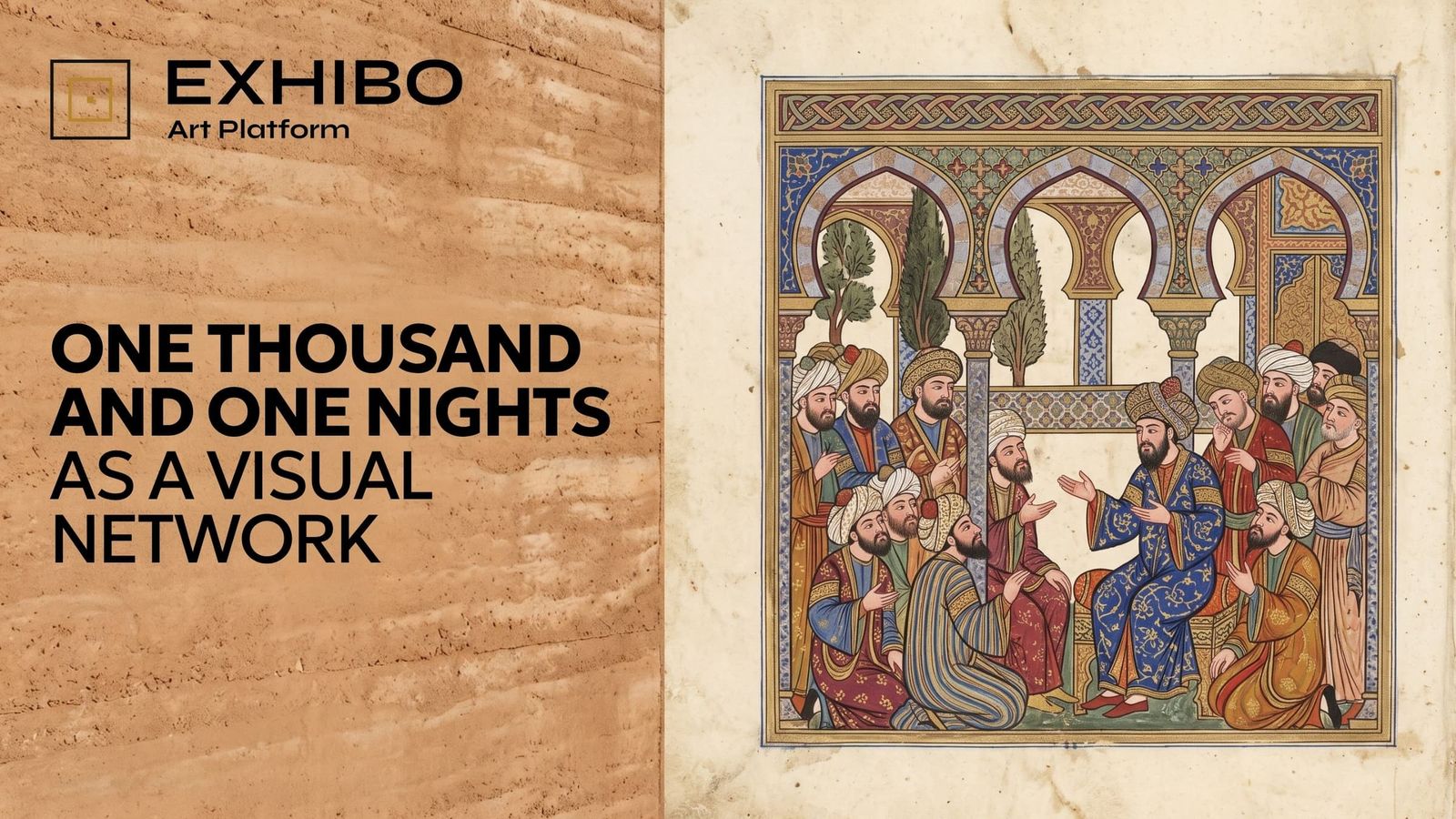
In 1237, in Baghdad, a painter and calligrapher named Yahya al-Wasiti copied and illustrated the Maqamat of al-Hariri — not the Nights, but the same idea: fifty Arabic tales of a silver-tongued rogue, given ninety-nine miniatures of astonishing life. Al-Wasiti painted crowds and courtrooms, a library of scholars bent over books, a pilgrim caravan, and — in the eleventh assembly — a Muslim burial, mourners before two domed mausolea, the very tomb-architecture a later essay in this series chased across a cartoon city. He has often been described as the founder of what later European scholarship would call the Baghdad school, and his naskh calligraphy is as fine as his figures. His images make the point the whole article has been circling — figural manuscript painting flourished in many secular Islamic book traditions, even while Qur'anic manuscripts followed different conventions of ornament rather than figure. The painted tradition existed, richly. It simply, mostly, left the Nights alone.
That manuscript now sits in the Bibliothèque nationale in Paris — it belonged to the French orientalist Charles Schefer, whose collection the library acquired in 1899 — in the same building as Galland's Nights. The manuscript that embodies the older Arabic painting tradition and the Western best-seller that remade the tales for Europe now share a reading room. And here the loop tightens to a point. In 1951, in Baghdad, the painter Jewad Selim and the writer Shakir Hassan Al Said founded the Baghdad Modern Art Group, one of whose defining ideas was a single phrase — istilham al-turath, drawing inspiration from heritage. Selim had trained at the Slade in London, Al Said at the Beaux-Arts in Paris; they came home to a country that had been a nation-state for less than twenty years and asked what a modern Iraqi art would look like. Their answer was to fuse the abstraction they had learned in the West with al-Wasiti's seven-hundred-year-old miniatures — to build a modern national face out of one of the oldest surviving Baghdad traditions of figural painting. They reached back to the Baghdad school. Except that the "Baghdad school," the art historian Saleem al-Bahloly has shown, was itself a category named retrospectively by the European scholars who had "discovered" al-Wasiti and gathered his scattered pages. The Iraqi modernists reached back through a European invention to touch their own past. The network eats its own tail.
And then the ending nobody would dare invent. In 2003, in the chaos of the American invasion, Baghdad's Museum of Modern Art was ransacked — works looted or damaged, the collection scattered, much of it never recovered, some of it surfacing later in the diaspora where the survivors and scholars of the movement now largely are. The reckoning with the Baghdad Group happens today at Bard College, at NYU Abu Dhabi, far from the city that made it. Real Baghdad, the city that opened the visual line in 1237, loses its art a second time: its modernism after its miniatures, its twentieth century after its thirteenth.
So where is the face of the Nights? It was never lost, because it was never found — there was never one to begin with. The book arrived without a picture and every generation drew it as themselves: the Dutchman his parlour, the Victorians their nursery and their pornography, the Dane his Persia-and-China-and-Japan, the Shah his own face, the Russian his stage, the German her shadows, the studio its Agrabah, the Iraqi modernist his lost-and-found Baghdad.
And the drawing has not stopped. It is worth noticing, too, who has mostly been holding the brush: the network this article has traced is almost entirely male — Coster, Lane, Burton, Dulac, Nielsen, Sani ol-Molk, Bakst, Selim — with Reiniger the sharp exception, which makes the direction of the newest work pointed. In Beirut in 2019, a gallery opened its doors with a show called simply The Thousand and One Nights — seven American artists each painting the tales anew, one of them a "black Scheherazade" on a field of colour, the storyteller reimagined for a different century and continent. And somewhere right now a research team is training a machine to reimagine the Nights — a Virginia Tech project drawing on original texts, historical illustrations and period art to generate immersive environments built around Scheherazade and the women's voices the tradition so often pushed to the edge, its makers openly wrestling with the biases the models bring. The newest node in the visual network is a generative model, and it too is being handed a research file so it can paint the book as something. Scheherazade, who invented herself a face every night to keep the dawn away, would recognise the problem exactly.
The picture keeps changing because the text left a blank where its face should be, and a blank is an invitation. The Nights has a thousand and one faces. Not one of them is the book's. Every one of them is a mirror.
Related reading
When Defending Heritage Becomes a Crime: The Arrest of Iraqi Archaeologists
Whistleblowers targeted over corruption claims and controversial investment legislation
Detentions of leading experts raise alarms over censorship, rapid site clearance, and the future of Iraq's archaeological record.

Where Is Agrabah? The City Disney Assembled From Real Places
Agrabah was going to be Baghdad. A war made it fictional — and then Disney built it back out of real places, from a tomb in Agra to a valley in Jordan that usually plays Mars.
The Sultan's palace where Princess Jasmine feels trapped has the silhouette of the Taj Mahal — which is not a palace at all, but a tomb. That is how Agrabah works. Disney's fairy-tale city was going to be Baghdad, until the Gulf War made the name impossible; the studio invented a place that could not be found on a map, then quietly rebuilt it out of real ones — Isfahan and Agra, Marrakesh and Mandalay, a Jordanian desert that has played both Arabia and Mars.
The Real Aladdin: The Story That Belonged to No Country
Aladdin has no Arabic manuscript older than its French translation. Behind the gap stands a young man from Aleppo, catalogued for a century as anonymous.
The most famous "Arabian" tale in the world is missing from the oldest Arabic manuscript of the Thousand and One Nights — because before a French translator wrote it down in Paris, there was no manuscript of it to be missing from.