Arabian Myths, Jinn & Folklore
The real stories behind the genies, ghouls and Arabian Nights. Where Aladdin actually came from, why Disney made the genie blue, where Agrabah is, what the jinn were before Hollywood — the folklore untangled from the cartoon, and traced back to the manuscripts and the art.
Almost everything you think you know about the Arabian Nights was added later, by someone else, often in Paris. The genie you picture is blue because of a studio colour chart. The lamp, the flying carpet, the city of Agrabah — each has a real history, and it is stranger and better than the cartoon. This series takes the myths, jinn and folktales of the Arab and Persian world and separates the source from the retelling: what the stories actually were, who changed them, and how they were pictured in manuscripts centuries before animation got to them. The folklore, untangled.
Where did Aladdin actually come from?
Aladdin was not in the original Arabic Nights. It has no early Arabic manuscript at all. The French translator Antoine Galland added it in 1712, after a young Syrian traveller named Hanna Diyab told him the story in Paris — and modern scholars, working from a memoir of Diyab's found in the Vatican in 1993, now argue Diyab was closer to its author than its source. Ali Baba arrived the same way. These essays follow the "orphan tales" that everyone thinks are ancient and Arabian, and turn out to belong to no single country at all.
Why does the genie look like that?
The jinn of tradition are not lamp-bound wish-machines. They are beings of smokeless fire, morally ambivalent, woven through pre-Islamic belief and named in the Quran — and the essay on why Disney made the genie blue is really about how a rich theology got flattened into a colour and a punchline. We read the jinn, the ghoul before it was a zombie, and the ifrit before it was a video-game boss, back to what they meant before the screen simplified them.
Where is Agrabah?
Nowhere and everywhere. Agrabah is a Hollywood composite, assembled from Cairo's streets, Isfahan's domes, Samarkand's tilework and Agra's Taj Mahal — a skyline of real places with the labels filed off. These pieces take the imagined geography of "the Orient" apart and put the actual cities back, asking why every fantasy kingdom, from cartoons to game maps, still defaults to the same borrowed Islamic silhouette.
What did the objects and monsters really mean?
The props carry histories too. The flying carpet was never really about flying — it was about status, the carpet as diplomatic gift and coded map. The lamp, the ring and the sealed bottle trace back to real Islamic-era objects and the Seal of Solomon. The roc sent Marco Polo chasing giant birds; Bahamut was a world-bearing fish long before it was a dragon. Each essay reads a piece of the mythology as material culture, not just story.
How were the stories actually pictured?
Long before film, these tales were a visual tradition. The Nights lived in illustrated manuscripts across Baghdad, Isfahan and Istanbul; the Hamzanama was a graphic epic painted five hundred years ago; hakawatis performed the stories aloud in the coffeehouses of the souq. And North African folklore — Aisha Qandisha, the Gnawa spirit world — runs on its own track entirely. Each essay ends where Exhibo begins, with the manuscripts, works and places near you, so a story you thought you knew opens onto the art that first imagined it.
Articles in this series
- EditorialFolklore
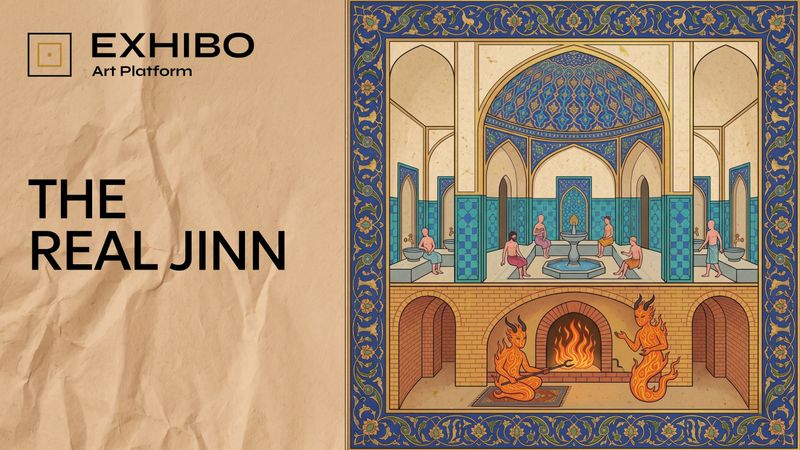
The Real Jinn: How the Middle East Imagined Them Before Disney
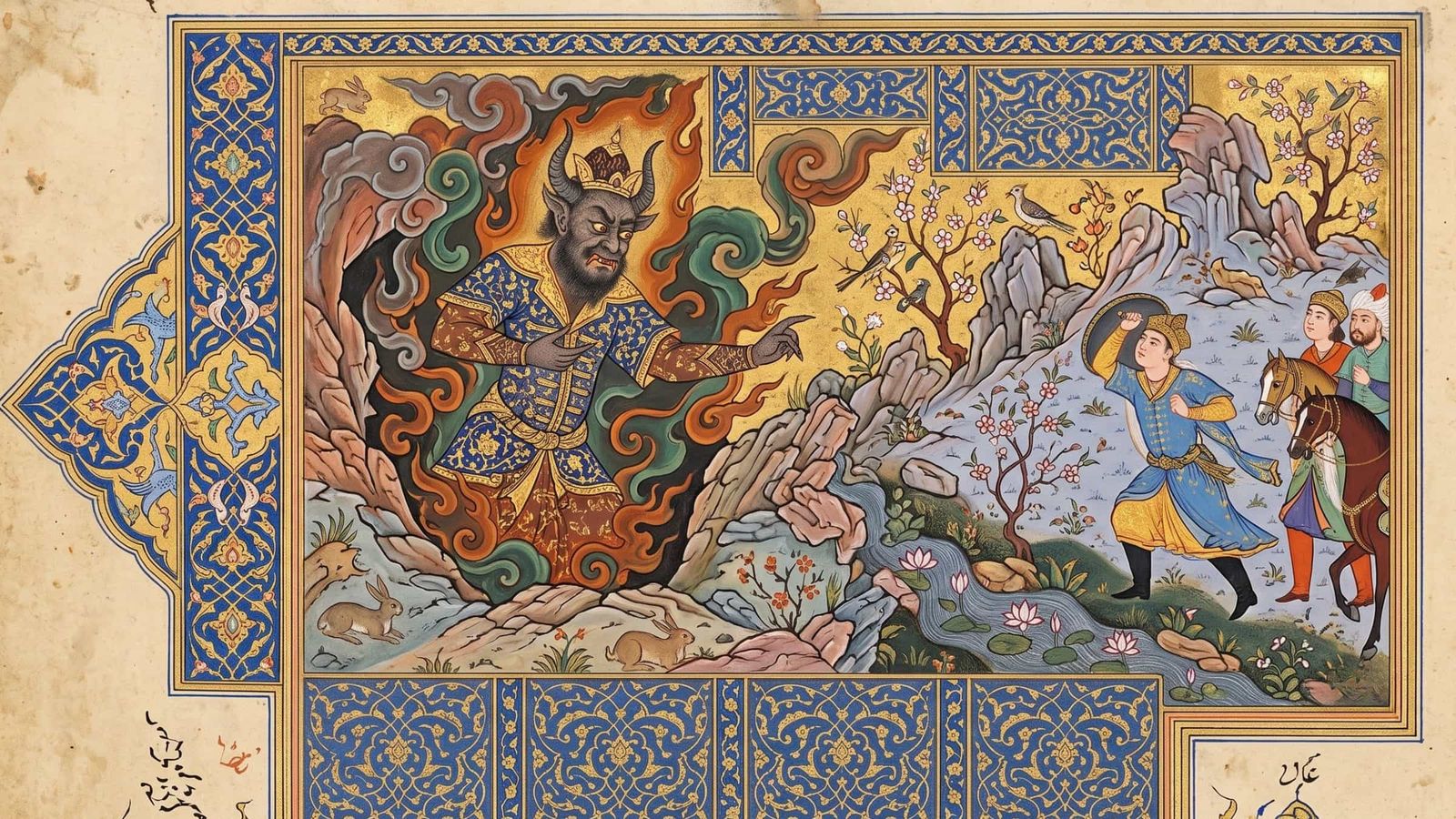
Seven kings, one for each day of the week. A portrait of Fever. Two spirits keeping a bathhouse warm. What the manuscripts actually show — and what the lamp replaced.
Folio 35v of a manuscript in Oxford shows the public baths at Tiberias in cutaway. Upstairs, people washing. Downstairs, two jinn tending the furnace, mid-conversation. It is not what most of the world expects — and it is much closer to what the unseen was actually understood to be for. A long read across twelve centuries of manuscripts, fieldwork, survey data and horror cinema.
- EditorialFolklore
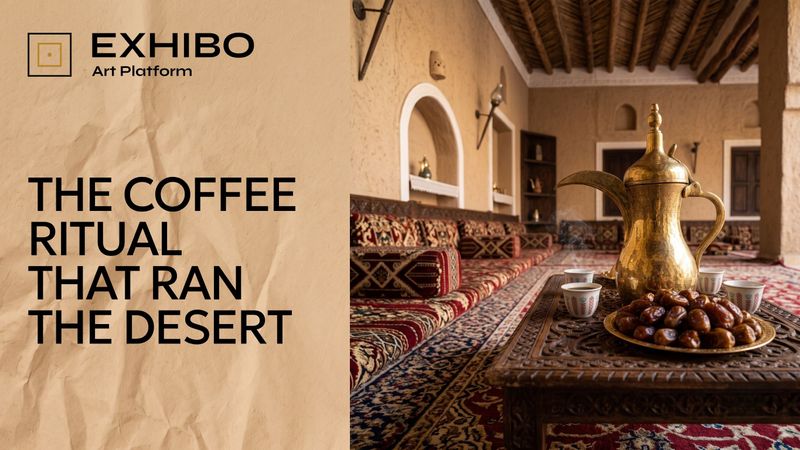
The Coffee Ritual That Ran the Desert
A cup of coffee in the desert was a contract, a test, a truce, and a promise of protection — a whole social order in the tilt of a small white cup.
Among the Bedouin of Arabia, serving coffee was never just hospitality — it was a code. The order of the cups, the amount poured, the shake of the wrist that says enough: a whole unwritten language for turning a dangerous stranger into a guest, and sometimes an ally. The story of Arabic coffee as the social law of the desert — and how it lives on in the region's museums and art.
- EditorialFolklore
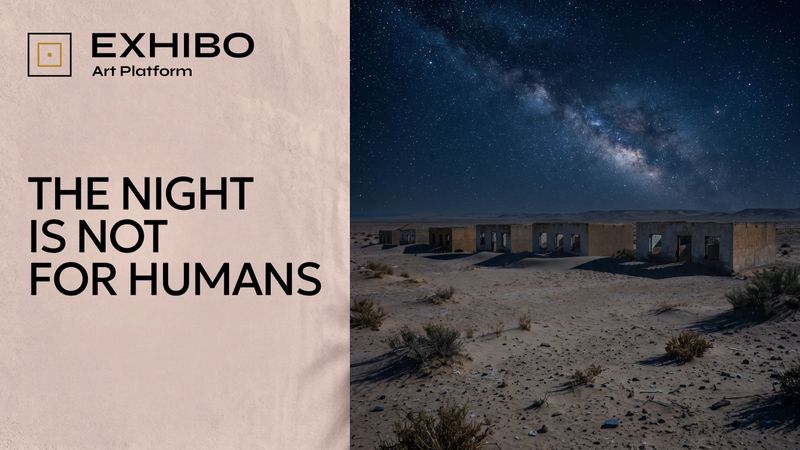
The Night Is Not for Humans: Umm Al Duwais and the Women of Emirati Folklore
A village half-buried in sand an hour from Dubai, a name that means "she of the little sickle," and what Emirati sources actually say.
The houses at Al Madam went up around 1980 and stood empty by the mid-1990s. People will tell you she lives there — not in the old stories, though. That attachment is recent, and it is the interesting part.
- EditorialFolklore
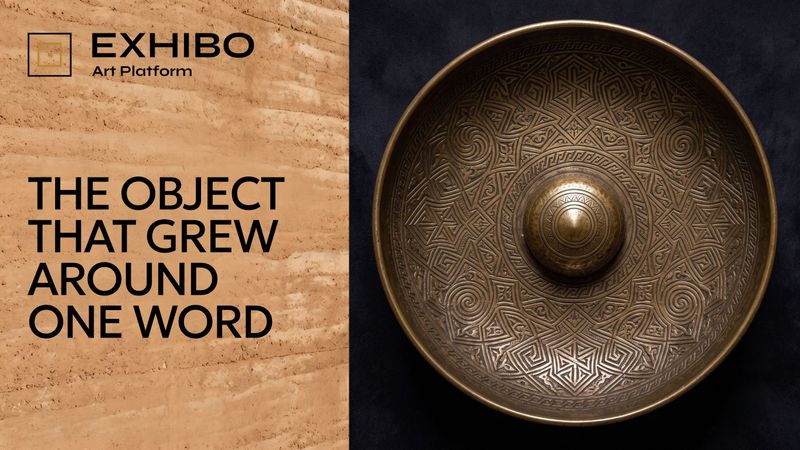
The Seal of Solomon: The Object That Grew Around One Word
The Qur'an never mentions a ring. What grew in that gap instead: a demon, a seal, seven signs nobody can trace, a thousand years of amulets, and a star that ended up on a flag.
A fisherman pulls up a copper jar stopped with lead, and the mark of a signet ring is pressed into the lead. Everyone hearing this in ninth-century Baghdad knew what came next — they knew it from the lid. The strange part is that the ring they all knew about is not in the Qur'an.
- EditorialFolklore
Seventy Thousand Solomons: The Empire That Performed a Legend
A demon catalogue in the conqueror's library, a sixteenth-century text where kingship is an office held seventy thousand times, and the columns a sultan dragged across three provinces to prove he held it.
Mehmed II kept a Greek catalogue of demons in his library at Topkapı. Seventy years later a sultan named for a prophet was rebuilding the walls of Jerusalem and hauling Roman columns out of Egypt and the Lebanon into a mosque above the Golden Horn. In between, Ottoman writers turned Solomon from a warning into a job — and the empire applied for it in stone.
- EditorialFolklore
Why Disney Made the Genie Blue
The long material and colonial history behind the most recognizable blue body in popular culture.
Almost everyone remembers that Disney's genie is blue. Fewer ask why. The answer runs backward through five thousand years — Egyptian blue standing in for lapis, cobalt on a Mongol palace, the eye that guards against envy, the last color most languages learned to name, and a layout artist photographing Isfahan just before a war — to a color that was rarely, in this part of the world, quite what it claimed to be.
- EditorialFolklore
The Real Aladdin: The Story That Belonged to No Country
Aladdin has no Arabic manuscript older than its French translation. Behind the gap stands a young man from Aleppo, catalogued for a century as anonymous.
The most famous "Arabian" tale in the world is missing from the oldest Arabic manuscript of the Thousand and One Nights — because before a French translator wrote it down in Paris, there was no manuscript of it to be missing from.
- EditorialFolklore
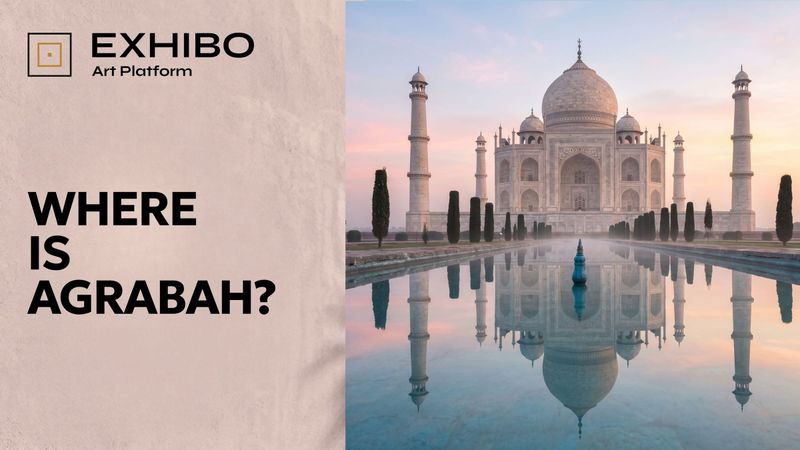
Where Is Agrabah? The City Disney Assembled From Real Places
Agrabah was going to be Baghdad. A war made it fictional — and then Disney built it back out of real places, from a tomb in Agra to a valley in Jordan that usually plays Mars.
The Sultan's palace where Princess Jasmine feels trapped has the silhouette of the Taj Mahal — which is not a palace at all, but a tomb. That is how Agrabah works. Disney's fairy-tale city was going to be Baghdad, until the Gulf War made the name impossible; the studio invented a place that could not be found on a map, then quietly rebuilt it out of real ones — Isfahan and Agra, Marrakesh and Mandalay, a Jordanian desert that has played both Arabia and Mars.