
Baghdad · Iraq
Where Is Agrabah? The City Disney Assembled From Real Places
Agrabah was going to be Baghdad. A war made it fictional — and then Disney built it back out of real places, from a tomb in Agra to a valley in Jordan that usually plays Mars.
Stand in front of the Sultan's palace in Aladdin for a moment — the one that rises over the city with its onion dome and its cluster of slender towers, the white marble catching a cartoon sunset. It is the home of a living princess. It is where Jasmine paces the balconies and feeds the tigers and complains, with reason, that she is trapped. Children have wanted to live there for thirty years.
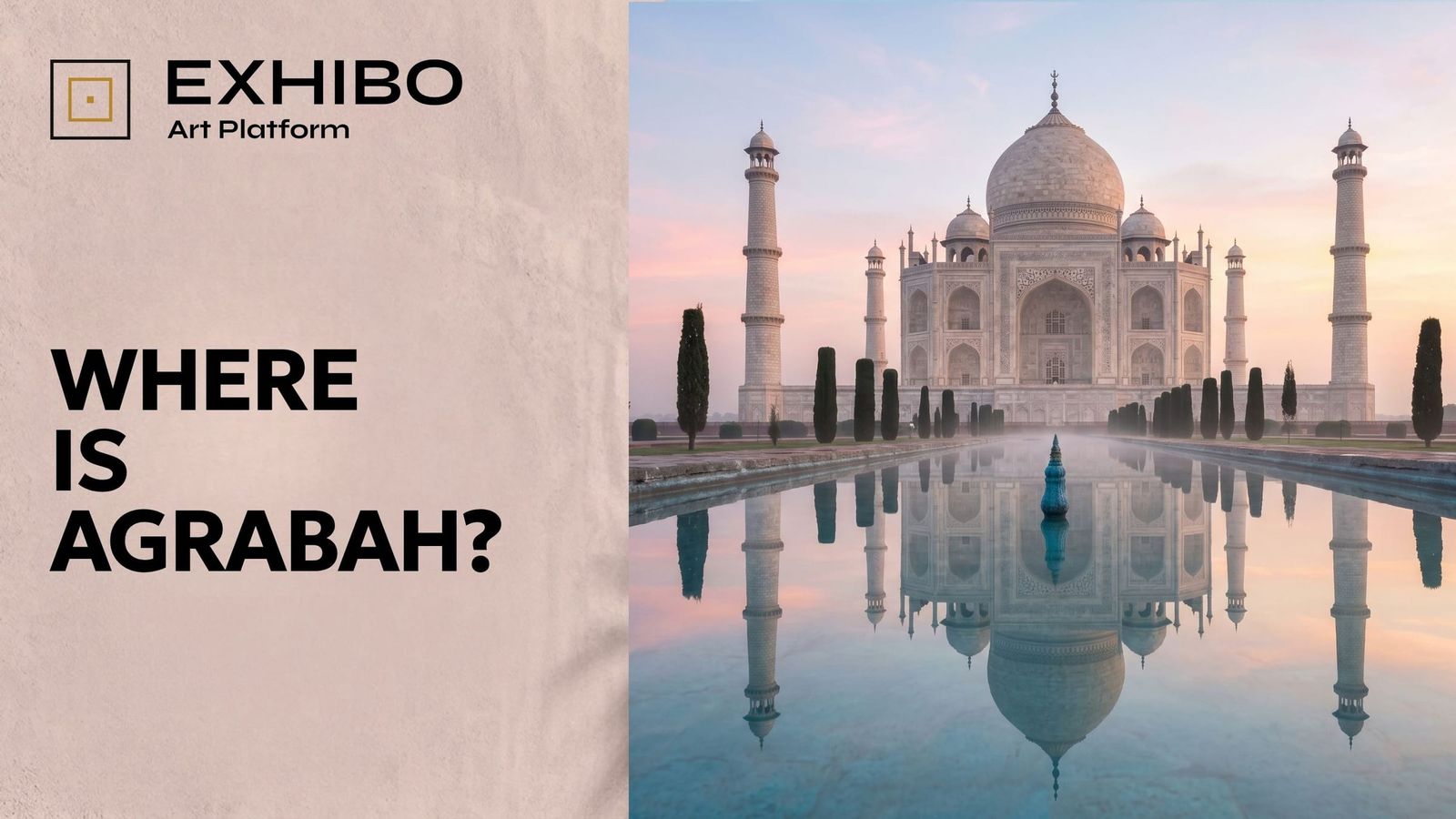
Now look at the building it calls to mind. The dome, the framing towers, the mirrored arches, the marble — the silhouette is unmistakably reminiscent of the Taj Mahal, in Agra, and the Taj Mahal is a tomb. Shah Jahan built it, between 1631 and 1648, over the body of his wife Mumtaz Mahal, who had died giving birth to their fourteenth child. The real graves lie in a crypt below; the cenotaphs upstairs are decoys. It is, in the words of one art historian, the ultimate vision of paradise on earth — a mausoleum, yes, and a monument to a dead empress, but also an imperial statement in marble, a dynasty announcing itself, a whole cosmology of paradise built at the scale of a grave.
So one of the most familiar fictional palaces in the world has the shape of a grave. Disney gave a teenage girl a home whose silhouette is a mausoleum, and almost nobody noticed the strange inheritance, because nobody was meant to. That is how Agrabah works. It is a city assembled, quietly, out of real places that were never meant to stand next to each other — and once you start pulling the pieces apart, the whole gorgeous, coherent-looking city comes away in your hands.
Agrabah is not a place the film invented. It is a place the film assembled — from cities that have never touched, in countries that are each other's opposites, none of them the one the story actually came from.
A palace that is a grave
Here is the part that should not be overlooked. Nobody who made the 1992 film is on record calling the palace a Taj Mahal. Disney's own account of the production talks about Persian miniatures and Arabic calligraphy, about production designer Richard Vander Wende's insistence on "graphic unity," about the Sultan's palace "perched above Agrabah" — but it does not say Taj. The identification comes from the rest of us. It is what the eye does when it sees a white central dome flanked by four towers and mirrored across a perfect axis: it says Taj Mahal, because the Taj taught the world that shape.
And the shape carries its history whether the animators intended it or not. The Taj is not a palace pretending to be a tomb; it is a tomb the world has half-forgotten to read as one. Millions of people a year visit what is, structurally, a grief monument — a man's marble letter to a wife who had died giving birth to their fourteenth child. Everything about the building is funerary once you know to look. The complex is laid out to evoke the Islamic garden of paradise, the tomb the reward at the end of the walk; over the gateway the calligraphy quotes the Qur'an's invitation to the faithful — enter thou My garden. Inside the chamber, the two carved cenotaphs of Mumtaz and Shah Jahan are decoys: the real graves lie in a crypt directly below, out of sight, the illusory tombs above and the true ones beneath, a Mughal convention for imperial burial. The marble is inlaid with pietra dura, semi-precious stone cut into flowers — a garden that will not die worked into the walls of a house for the dead.
Turn all of that into a Sultan's residence and you have done something stranger than borrow a silhouette. You have moved a family into a mausoleum, hung curtains in a crypt, and called it home.
The rhyme goes deeper, and it is almost too neat to be true. Shah Jahan spent his last years a prisoner. His son Aurangzeb deposed him and held him in the Agra Fort until his death, across the river from the tomb he had built — and the tale, endlessly retold for visitors, has him spending those years gazing at the Taj from his window, always in view and forever out of reach. In the film, the girl who lives in the palace shaped like that tomb calls it a prison too. When the 2019 live-action remake came to dress its Jasmine, the costume designer independently described her as a peacock trapped in a royal garden. There is no evidence that anyone intended the correspondence; it is an accidental rhyme, the kind history throws up when you set two things side by side. But once seen it will not leave: the model and the copy turn out to be about the same thing, a woman and a gilded enclosure she cannot leave.
And here is the twist under the twist. Even the Taj is not a single place. Mughal architecture is a fusion — Persian, Indian, Islamic, held in one marble body — and the tomb has ancestors, a whole line of them running north and west out of India. The nearest is Humayun's Tomb in Delhi, built around 1560, which the Archaeological Survey of India calls the first distinct example of proper Mughal style, planned by a Persian architect, Mirak Mirza Ghiyath, and laid out in a four-part Persian garden of a kind still new to the subcontinent. Behind that stands the Gur-i Amir in Samarkand, the tomb of Timur — Tamerlane — with its fluted azure dome, one of the Timurid buildings the early Mughals looked back to. And the garden the Taj sits in is a Persian idea, the charbagh, the quartered paradise garden Babur, the first Mughal, brought with him in 1526.
So one architectural lineage runs backward from Agra to Delhi to Samarkand: a tomb after a tomb after a tomb, Persia flowing into India the whole way down. The silhouette Disney's palace ended up wearing was never a pure "Indian" form to begin with — it was already an assembly, Persian bones and a Central Asian dome and a Mughal body shaped in India and a paradise garden imported from Kabul. Push back to the origin and the origin is already a crossroads. This will keep happening; it is, in a sense, the only thing that happens in this whole story.
And the real Agra deserves better than to be a silhouette on loan. It was the Mughal capital for much of the sixteenth and seventeenth centuries, the seat from which an empire that stretched from Kabul to the Deccan was run. A mile upriver from the Taj stands the Agra Fort — the vast red-sandstone palace-city where Shah Jahan actually lived, and where, deposed, he actually died, in a marble tower with the tomb of his wife in view. The genuine Mughal palace, in other words, is right there, a short walk from the tomb — a real royal residence, with real audience halls and private mosques and a river terrace. The cartoon palace took the shape of the mausoleum instead, and there is something telling in that, whether or not anyone chose it: the form the West reaches for, when it wants to picture royalty in the East, is not the working seat of a living government but the beautiful, melancholy monument to a love that is safely over.
There is a stranger footnote still. If you go looking for a real building that actually carries the name Aladdin, you will not find a palace anywhere. You will find a tomb. About forty kilometres south of Tehran, in the town of Varamin, stands the Gunbad-i 'Ala al-Din — the Tomb Tower of 'Ala al-Din, finished in 1289, a slender brick cylinder ringed with thirty-two triangular flanges, its surface worked in the hazarbaf brickwork whose name means "thousand-weaving," glazed tile mosaic set into the bare baked clay. It was built over the grave of a man named 'Ala al-Din, and it is officially known as the Mausoleum of Aladdin. The name has nothing to do with the folk-tale hero; the two Aladdins are strangers. But the coincidence is hard to shake once you have seen it. The most famous palace called Aladdin's is a tomb in India that isn't named after him. The one real building that is named after an Aladdin is a tomb in Iran. Reach for the name in the real world and your hand closes, twice, on a grave.
The city a war made up
Agrabah does not exist for a strange reason: it was supposed to be Baghdad.
The film began as a story set in Baghdad — the Baghdad of the Nights, caliphs and bazaars and lamplight. Then the world intervened. As the film was moving into production, Iraq invaded Kuwait, and the first Gulf War made Baghdad a city a Disney musical could no longer cheerfully name. Directors Ron Clements and John Musker needed somewhere that could hold all the romance of Baghdad and none of the evening news. So they invented a place.
How they named it is a small, perfect illustration of the whole problem. One origin is documented: Musker told E! News in 2015 that once Baghdad was off the table he took the letters and "did a jumbled anagram and came up with Agrabah" — a scramble of Baghdad. Another reading emerged later, worked out backward from the film itself: Agra, the Indian city of the Taj, plus Arabah, the biblical desert that runs down the Jordan Rift toward the Dead Sea — a reading the narrator seems to invite when he welcomes you to Agrabah, "city of mystery," on "this side of the River Jordan." The second is suggestive, and it is not evidence of how the city was actually named; it is the audience doing to the word exactly what the film did to the map — finding real places inside a made-up one. Documented or invented, the effect is the same. The name was built to sound like everywhere and resolve to nowhere. It does its job so well that even its etymology refuses to settle.
Which leaves the film in a peculiar position. It went to enormous trouble to not be set in a real place — and then built its unreal place out of real ones, brick by borrowed brick. The desert that was too politically hot to name is still there under the fiction.
Agrabah is Baghdad with the address scratched off. A war took the name; the map stayed.
Two Agrabahs, no shared map
Here is the cleanest proof that there is no real Agrabah to get right: Disney has now built it twice, and the two cities have almost nothing in common.
The 1992 Agrabah was assembled from a specific and traceable kit, and the assembling started early. Richard Vander Wende, the production designer, was put on the film in 1989 with no finished script to work from, and he began where the film's whole method would stay: researching the original folk tales and hunting through art and historical material for references to build the look on. One of its principal architectural sources was Isfahan — the layout supervisor, Rasoul Azadani, an Iranian animator, went home and shot nearly 1,800 photographs of his own city, and those photographs became the reference for the streets and walls and archways of Agrabah. (Azadani's Isfahan is the subject of another story in this series; here it is enough to say that the film's home city is a real one, photographed by a man who grew up there, and that his name is on the film twice — once in the credits, once as Razoul, the captain of the palace guard.)
On top of Isfahan the animators laid two more real things. Persian miniatures — the intimate, silhouetted, densely patterned paintings of the Safavid and Timurid courts — were, by Disney's own account, the most frequently referenced source in the whole production, and you can see them in the flattened, jewel-toned way Agrabah stacks its rooftops toward the palace. Arabic calligraphy supplied another part of its visual grammar: production designer Richard Vander Wende noticed that the flowing, swooping strokes of the script rhymed with the curves he wanted everywhere, and pushed for what he called "graphic unity," a single visual language running from the tilework to the shape of Jasmine's own body. Add the palace's Agra silhouette and the ghost of the abandoned Baghdad, and you have a city of Iran and India and Iraq and a page of calligraphy, drawn in Burbank.
The 2019 Agrabah, built for Guy Ritchie's live-action remake, was assembled from a radically expanded and differently assembled set of references — and this time we have the designers saying so out loud. Production designer Gemma Jackson turned Agrabah into a port city, Ritchie's idea, a trading centre where "people come and go" — the opposite of the desert-locked town of 1992. She painted its walls pink, a colour she associated with Marrakesh; she and Ritchie had first wanted to shoot in Morocco. For the palace, by her own account, the spark came from an old monastery in Burma, in present-day Myanmar — "all carved wood and painted gold," run down and lovely, with balconies and an indoor-outdoor life she wanted the Sultan's palace to have. She likened the whole city to Namibia, "where the desert literally goes down to the sea." The interiors of that one palace, she said, drew on Persian and Indian miniatures, Iznik ceramics, Turkish architecture and pottery, and Byzantine forms. And then the whole thing — the pink port city, the Burmese-inflected palace, the borrowed interiors — was built on soundstages and backlots at Longcross Studios in Surrey, England, worked out between the art department and the visual-effects team "with mathematical precision." Agrabah's teeming streets, its tanneries and rose-water and spice, were carpentry and paint in the English weather.
The costumes matched the method. Michael Wilkinson, who dressed the film, sourced fabrics "from Morocco, Turkey, India, Jordan, and Iran," put Afghan shirts and Indian saris and Omani daggers on the crowd, and stated the working principle plainly: "we didn't want to be slavish to any one time or place." Agrabah, he explained, sat "on the Silk Road, where East and West meet to trade" — which is a real trade network and also a convenient way to justify sourcing a costume from anywhere between Venice and Xi'an. The projecting wooden lattice windows leaning over Agrabah's streets are real too: mashrabiya, the carved oriel screens of Cairo and the wider Ottoman world, built so that women could look out without being seen. The city was, by design, given no time period at all — a thousand years and five thousand miles of real building, dissolved into one warm, plausible, impossible street.
Line the two cities up. The 1992 kit: Isfahan, Agra, the idea of Baghdad, Persian miniatures. The 2019 kit: Marrakesh, a Burmese monastery, Namibia, Wadi Rum, a throne room of borrowed interiors, an English backlot. They share a name and a silhouette and essentially nothing else — two cities triangulated from two completely different sets of real coordinates, both labelled Agrabah with total confidence.
If there were a real place under the name, the second film would have had to answer to it. There wasn't, so it didn't. It simply assembled a different city and kept the sign.
The desert that plays every desert
The 2019 film needed real sand, and it found it in Wadi Rum, the great valley of southern Jordan, where the desert exteriors and the approach to the Cave of Wonders were shot. The Royal Film Commission of Jordan spent months preparing the ground and staffed the shoot with a hundred and fifty locals; the cave's entrance was filmed at the rock formation called the Seven Pillars of Wisdom, its arch at Jebel Kharazeh.
Wadi Rum is not nowhere. It is one of the most specifically somewhere places on earth. A UNESCO World Heritage Site, protected across seventy-four thousand hectares, it holds twenty-five thousand rock carvings and twenty thousand inscriptions, a record of twelve thousand years of human beings living in it, and the traces of four different North Arabian scripts taking shape on its walls. People have been writing on this valley since before writing. It is about as far from an empty backdrop as a landscape can be.
And yet the movies use it as exactly that — as the universal elsewhere, the place that can be any place. The valley has been cast, over and over, as somewhere it is not: Arabia in Lawrence of Arabia, Mars in The Martian, distant planets in Rogue One and Prometheus. Hollywood keeps returning to Wadi Rum, repeatedly asking the same landscape to stand in for somewhere else — which is only possible if you ignore everything particular about it.
Agrabah's empty desert is one of the most inhabited, most inscribed, most protected landscapes in the Middle East, hired to perform emptiness.
Even its most famous landmark wears a borrowed name. The rock formation at the valley's mouth is called, in English, the Seven Pillars of Wisdom — but the phrase is the title of T. E. Lawrence's memoir, which took it from the Book of Proverbs and had nothing to do with this rock; the name drifted onto the formation later, an English literary label fixed to a Jordanian cliff. A landscape rebranded in the language of a British memoir, cast as everyone's imaginary Arabia and occasionally as Mars.
The desert Agrabah borrowed is a palimpsest of other people's stories about it, which makes it, oddly, the most honest location in the whole enterprise: a real place that has spent a century openly being other places. When the Bedouin guides at Wadi Rum walk visitors past the arch at Jebel Kharazeh, they can point to where the Cave of Wonders swallowed Aladdin, where Matt Damon grew potatoes on Mars, where the rebels flew in Rogue One. The valley wears all of it lightly. It was here twelve thousand years before any of the film crews, and it will be here after. That is more than Agrabah can say, because Agrabah is only ever the film crews.
There is one more turn worth noticing, a short drive north. Tourists reliably call Petra's great rock-cut façade a real-life Cave of Wonders, and it is easy to see why — the narrow gorge, the treasure hidden in stone. But the building at the end of the gorge, Al-Khazneh, "the Treasury," never held any treasure. Its name comes from a local legend that the urn carved high on its face concealed a pharaoh's gold. The building itself is a Nabataean funerary monument, carved two thousand years ago, most likely a royal tomb. Even the cave of riches, when you chase it to a real place, turns out to be a grave that someone mistook for treasure. The motif will not let go.
The real cities under the invented one
Pull the thread marked Baghdad and you reach the strangest irony of all.
The city Disney erased to invent Agrabah was not a vague oriental backdrop. It was one of the most deliberately planned cities of the early Islamic world. When the Abbasid caliph al-Mansur founded his new capital in 762, he called it Madinat al-Salam, the City of Peace, and he built it as a circle — a round walled city organised around the caliph's palace and the great mosque at its centre. Its four principal gates were named for the roads that left them, toward Kufa, Basra, Syria and Khorasan; its geometry has often been read as a political diagram, power at the core and the empire arranged around it. It was, in effect, closer to a government machine than to the sprawling city we now imagine — a statement in brick: here is the middle of the world, and here, exactly, is who rules it.
Before the first brick, the story goes, al-Mansur had the outline of the walls traced on the ground in ashes, then had cotton seeds soaked in oil laid along the lines and set alight, so he could stand and watch his city burn its own shape into the night before a single stone was cut. It was one of the great urban construction projects of the early Abbasid age — a synthesis of Persian royal tradition and older forms raised into something new. And it was the setting of an extraordinary intellectual flowering: in the translation and scholarly culture of Abbasid Baghdad, later popularly associated with the House of Wisdom, scholars working in Arabic translated, argued over and extended the Greek and Persian and Indian sciences.
That city is gone. The Mongols took Baghdad in 1258 and ended the caliphate; the Round City itself vanished over the centuries that followed, until almost nothing of al-Mansur's perfect circle survived above ground. There is no perfect circle left to visit. And so the situation, told plainly, is almost unbearable in its symmetry: Disney invented a city so that it would not have to name Baghdad — and the Baghdad it declined to name was itself a city all but erased above ground, the most carefully imagined capital of its civilisation, surviving now mainly as an idea of lost splendour and a plan on paper. Two cities that are nowhere. One made up to avoid a war; one destroyed by them.
The rest of the "classical" city the film gestures at is real too, and worth naming precisely rather than blurring into a generic Orient. The great spiral minaret at Samarra, the Malwiyya, climbing in a helix beside the enormous Great Mosque of Samarra — built when the caliphs moved their capital and their Turkish troops sixty miles up the Tigris. The Mosque of Ibn Tulun in Cairo, whose builder had grown up in Samarra and carried its forms west — the Abbasid visual language travelling on, its brick piers and spiralling minaret a distant echo of the capital. And after 1258, when a branch of the Abbasid family was installed as ceremonial caliphs in Cairo under the Mamluk sultans, even the title of caliph had, in a sense, changed cities — the centre of a world relocating, one might almost say, like a production scouting a new set.
The film flattens all of it into one sandstone silhouette. The actual map underneath is specific, and it is magnificent, and it belongs to particular places with particular names — Samarra, Cairo, Isfahan, the vanished circle of Baghdad — each of which the word "Agrabah" was built to let you not have to learn.
The tale was pointing somewhere else the whole time
There is one more relocation, and it undoes the ground beneath all of them.
The Aladdin of the Thousand and One Nights — the one that reached Europe through the Syrian storyteller Hanna Diyab and the French translator Antoine Galland, as this series has told elsewhere — is not set in Arabia at all. In Galland's version, the story unfolds in China: an unnamed Muslim city somewhere in a Chinese province, with its own sultan and vizier and magic lamp, thousands of miles from the Baghdad Disney started with or the pan-Arabian nowhere it ended with. And that setting is itself part of the tale's strange history — the story came to Galland from Diyab's telling in Paris, not from any established Arabic manuscript of the Nights, which is exactly why its geography was never anchored to begin with.
So the full journey of this story runs: a tale set in China, told by a man from Aleppo, written down in Paris in French, absorbed into the Western idea of the "Arabian" Nights, and finally rebuilt by an American studio into a desert city assembled from Iran and India and Morocco and Burma and Jordan — a city that took its abandoned name from Baghdad, its palace-silhouette from a tomb in Agra, and its sand from a valley in Jordan that usually plays Mars. At no point in that entire chain does the story pass through a single, coherent, real Agrabah, because there has never been one to pass through. There is only the assembling.
Between fact and fantasy
In June 2026 the Metropolitan Museum opened Orientalism: Between Fact and Fantasy, its first exhibition devoted to the subject — some hundred and eighty objects, hung so that Europe's nineteenth-century fantasies of the East stand in the same rooms as the real Islamic objects and buildings they were dreamed out of. It begins with Napoleon in Egypt and ends on Osman Hamdi Bey, the Ottoman painter, archaeologist and museum-founder who had trained in Paris under the great Orientalist Gérôme and then went home and painted the East from inside it — "the most Parisian of Ottomans, and the most Ottoman of Parisians." Among the works in the show is one of his late canvases, Vieil Homme devant tombeaux d'enfants — an old man before children's graves — a robed figure seated in the walled enclosure of an Ottoman türbe, among low headstones. Osman Hamdi was a complicated endpoint for such a show: trained inside the Orientalist tradition and never fully outside it, he painted the East as a man who belonged to it, at once the fantasy's product and its most searching reviser. The first Met exhibition on the imagined Orient closes, as it happens, on his painting of a tomb — which is where this article began, and where the most familiar of fictional palaces has been standing all along. Setting the fantasy beside the real thing, and letting the seams show, is the whole exercise. A museum does it with wall labels. This article has been doing it to a cartoon.
None of this is to relitigate the film's manners, which have been argued over since 1992, when Roger Ebert noted the "odd use of ethnic stereotypes" and the opening song called the place barbaric — a line the 2019 remake quietly changed to chaotic. That argument is real and it belongs to other essays, including earlier ones in this series. The point here is narrower and, I think, stranger.
Because the honest way to see Agrabah is more interesting than catching Disney out. The people who made it were not hiding the assembly; the 2019 designers will tell you cheerfully that they took the pink from Marrakesh and the palace from Burma and the interiors from four traditions and the time period from nowhere. The city is a collage, and collage has long been one of the ways Western visual culture builds an imagined East — a little Persia, a little India, a dome from a tomb, a desert that is really Jordan wearing the costume of Arabia. Assembling an imagined elsewhere out of borrowed parts is not a uniquely Western habit; every empire and every film industry has done it, and the Nights themselves were stitched together across centuries and languages. But the version that reaches the most children wears Disney's colours, and it is worth following its seams. The trouble was never that Agrabah is made of real places. The trouble is that the real places are extraordinary, and specific, and each other's opposites — Isfahan is not Agra, Agra is not Baghdad, Baghdad is not Marrakesh — and the finished city works to make you forget that they are different at all.
The film did not flatten one country into a stereotype. It flattened a collection of real places, each with its own centuries, into a single skyline — and made the flattening look like a world.
Where is Agrabah? It is in Agra, and Isfahan, and the vanished circle of Baghdad, and the pink walls of Marrakesh, and a monastery in Burma, and a valley in Jordan that has been inhabited for twelve thousand years and keeps getting cast as an empty planet. It is everywhere the movies went shopping. It is nowhere you can buy a ticket to. And the palace at the centre of it, the one the children want to live in, still has the silhouette of a tomb.
Related reading
One Thousand and One Nights as a Visual Network
The book that taught Europe to picture the East arrived with no pictures at all. Three centuries of illustrators — Dutch, Egyptian, Persian, French, German, Iraqi — each gave it a face, and every face was a self-portrait.
When Defending Heritage Becomes a Crime: The Arrest of Iraqi Archaeologists
Whistleblowers targeted over corruption claims and controversial investment legislation
The Real Aladdin: The Story That Belonged to No Country
Aladdin has no Arabic manuscript older than its French translation. Behind the gap stands a young man from Aleppo, catalogued for a century as anonymous.