
Damascus · Syria
The Real Aladdin: The Story That Belonged to No Country
Aladdin has no Arabic manuscript older than its French translation. Behind the gap stands a young man from Aleppo, catalogued for a century as anonymous.
In a climate-controlled room in Paris, in the manuscript department of the Bibliothèque nationale de France, there are three worn volumes of Arabic prose catalogued as arabes 3609, 3610, and 3611. They are the oldest substantial surviving Arabic manuscript of the Thousand and One Nights — a fourteenth- or fifteenth-century copy from the Syrian tradition, the only earlier trace being a ninth-century scrap of sixteen lines. Antoine Galland had its three volumes brought from Aleppo in 1701. He built the book that made the Nights famous in Europe out of them. In the margins you can still see his handwriting.
Even the age of the thing refuses to settle. Muhsin Mahdi, its modern editor, dated it to around 1291; Heinz Grotzfeld argued later, from the coins mentioned in the text, for a manuscript copied after the 1420s — a wide spread, adjudicated by loose change, over a book whose whole business is the untraceable. This is the bedrock of the tradition, and the bedrock is contested. Keep that in mind; it is the condition of everything that follows.
Turn through those two hundred and eighty-two nights and you will not find Aladdin.
You will not find Ali Baba either, or the forty thieves, or the flying horse of ebony, or the fisherman who — no. Those are elsewhere in the tradition, or nowhere. The point is the absence. The single most famous "Arabian" tale in the world is missing from the oldest substantial Arabic manuscript of the Nights we have. It is missing from the second-oldest, and the third. No authenticated Arabic manuscript of it predating Galland is known to survive at all — because before a French orientalist wrote it down in Paris, in French, there was no manuscript of it to be missing from.
This is a story about that gap. Not the gap itself — the series has stood at its edge before, and promised to come back and climb down into it — but what is actually at the bottom. And what is at the bottom is a person: a young man from Aleppo who told the story, and then spent the next two hundred and eighty years disappearing from it.
The man catalogued as anonymous
His name was Hanna Diyab. We can be more precise than that, because the archive is: Anṭūn Yūsuf Ḥannā Diyāb, born in Aleppo around 1688, a Maronite Christian from a family on the poorer edge of the city's mercantile world. He spoke Arabic, Turkish, French, Italian; as a Maronite he had a church whose liturgy carried Syriac. He lost his father young. He tried a monastery on Mount Lebanon and left. And then, early in 1707, having set out from Aleppo meaning to return to that monastic life, he met a Frenchman instead — and turned, without knowing it, down a completely different road.
For most of the time since, none of this was knowable. Diyab existed, if he existed at all for you, as four words in another man's diary — "Hanna, a Maronite from Aleppo" — and those four words stayed inside a private notebook, unpublished, until Galland's journal was printed in 1881. He wrote his own life down, in old age, in a single Arabic manuscript. That manuscript then did something almost too apt to bear.
It entered the Vatican Library in 1928, part of the collection of a priest and manuscript collector from Aleppo named Paul Sbath. It came with its opening folios already lost — the beginning of the work gone, the author's name with it — so that the codex began mid-sentence, with nothing to say who had written it. And so the cataloguers did the only thing cataloguers can do with a book that will not say who wrote it. Paul Sbath filed it as anonymous. The great bibliographer Georg Graf, compiling his history of Christian Arabic literature, filed it as anonymous too. It sat under that non-name, on a shelf marked Sbath 254, for the better part of a century.
Sit with that arrangement for a moment. The man who supplied the world with its most recognizable Arabian tale was himself, in one of the world's great libraries, filed under no name at all — not suppressed, not destroyed, just quietly missing his first pages, which is a more modern kind of erasure. The absence in the Paris manuscript and the anonymity in the Vatican one are the same fact wearing two costumes. The tale has no author on record; the author has no name on the record.
The tale has no author on record; the author has no name on the record. The same erasure, filed twice, in two of the world's great libraries.
Both were waiting for someone to read carefully — and the reading came in stages, not a single stroke. Galland's diary was printed in 1881, by the orientalist Charles Schefer, which is when the name "Hanna" first surfaced in the published record. Within a few years Hermann Zotenberg, working from that diary, had identified the Aleppan traveller as the source of the orphan tales — so the storyteller was not wholly unknown to specialists by 1888. What no one could do, until much later, was connect that half-glimpsed source to the anonymous memoir in the Vatican. Jérôme Lentin made that identification in the early 1990s: reading through the Sbath codex, he matched its anonymous author to Galland's "Hanna." The date usually attached to the recovery is 1993 — which means that for the better part of three centuries between the telling and the full identification, one of the most consequential storytellers in the history of the Nights had, functionally, no name.
A cage of jerboas
Rewind to the Frenchman on the road. His name was Paul Lucas, and he was a naturalist, numismatist, and hunter of antiquities for the cabinet of Louis XIV — one of those early-eighteenth-century figures whose job was to bring the exotic home for a king who collected it. He needed a servant who could translate, guide, and read the region. Diyab could do all three. Lucas hired him, dangled a post at the Royal Library in Paris, and turned him into a travelling companion for two and a half years — Cyprus, Egypt, Tripolitania, Tunis, Italy, and, at the far end, France.
It was not a small journey and Diyab was not a passive parcel on it. His memoir has him dodging pirates, sitting in the Bardo palace at Tunis, passing through Livorno and Genoa and Marseille — a young man with an appetite for the marvellous and a good eye for how a scene is built. One episode is worth pausing on. In a tomb-cave along the way, Lucas pays a goatherd to climb down and bring up what he finds; the man emerges with a plain ring and an old lamp, the lamp "similar to those used by the butter merchants." Diyab watched. Years later, in the tale he would hand Galland, a boy goes down into an enchanted cave and comes back up with a ring and a lamp — a resemblance scholars have long noticed, and one of the reasons the question of Diyab's authorship is more than sentimental. This matters, because the person Lucas was carrying to Paris as an interpreter was already, by temperament and training, a collector of wonders himself. The naturalist filled crates with coins and curiosities. The interpreter filled his memory with stories. Only one of those cargoes is still famous.
They reached Paris early in 1708, and here the story of the man who first told Aladdin acquires a detail no novelist would risk. Diyab arrived at court as a kind of exhibit. Lucas dressed him in "oriental" costume and had him carry, through the halls of Versailles, a cage containing two jerboas — small long-tailed desert rodents, picked up in Tunis and presented at court as a curiosity for the royal menagerie, that standing theatre of the exotic. Picture it. The young Aleppan, in borrowed costume, holding a cage of little jumping animals, produced before the Sun King as one more marvel from the East — months before he would sit in a Paris apartment and hand France the raw material for its entire idea of the East.
He was the marvel carrying the marvels. And nobody in that room, Diyab least of all, could have known that the durable export from this encounter would not be the jerboas, or the coins, or the antiquities in Lucas's crates, but the stories the interpreter was carrying in his head.
The promise that had brought him — the post at the Royal Library — never materialized. Diyab waited in Paris for the better part of a year, then gave up on Lucas making good, and went home: out through Istanbul, back to Aleppo the following summer, to a life nobody would have thought to record. He had been shown to a king and promised a career, and he left France with neither. What he did not know — what he could not have known, sitting on the road back to Syria — was that he had already, in a handful of spring evenings, done the thing that would matter. He just wouldn't be in the room, or the book, when the world noticed.
The month the stories were told
The apartment belonged to Galland, and Galland was in trouble of a particular literary kind. He had been publishing his Mille et une nuits since 1704, translating from those three Syrian volumes, and by 1709 he had run out of manuscript. The Syrian codex simply stops, mid-tale, at two hundred and eighty-two nights. His publisher had just padded a volume with unrelated Turkish stories to keep the series going, which enraged him. He needed more Nights, and there were no more Nights to be had.
Paul Lucas brought his interpreter to dinner.
The diary records it in stages. Galland first met "Hanna" on 17 March 1709, noting a Maronite from Aleppo who spoke French, Provençal, and Turkish; about a week later, on 25 March, he heard him tell "several very beautiful Arabic stories" and asked for them in writing. Then, on 5 May 1709, Galland recorded that Hanna had finished the tale of the lamp — and that he received it in written form, a text that has since been lost. Over the following weeks, into early June, Hanna gave him more, some told aloud and summarized in the diary, some promised on paper. Modern reconstruction counts sixteen tales from Diyab across that spring, of which Galland kept about ten and worked up over the winter of 1709–10, printing Aladdin, eventually, in the ninth volume, in 1712. Among the sixteen: Aladdin itself, Ali Baba, the ebony horse, the two sisters who envied the youngest, the prince and the fairy Peri-Banu, and others less famous now.
The exact tally shifts a little depending on how you group Galland's diary entries — where one telling ends and another begins is not always clean — but the modern reconstruction is steady enough: sixteen tales from Diyab, about ten kept. What is not in dispute is the shape of the exchange. An old French scholar, short of nights, sat across from a young Syrian traveller who had them to spare, and the book was completed out of the traveller's memory. And then the traveller's name went into a private diary and out of the printed book entirely.
The diary is worth pausing on, because it is the only reason we know any of this. Galland kept a working journal, and into it went the dates and the abstracts — Hanna told the ebony horse on the thirteenth of May, this tale on that evening, batches of them across late May and into June — a scholar's scaffolding, never meant for anyone's eyes, and unread by anyone else for a hundred and seventy years. The tale went out into the world under the sign of the Nights; the man who supplied it stayed folded inside a private notebook. First the tale had no source. Then the source had no name. Then the name had no reader.
First the tale had no source. Then the source had no name. Then the name had no reader.
Here is how Diyab himself remembered it, writing more than fifty years afterward in the memoir that would spend a century as Anonymous, Sbath 254. He does not call Galland by name. He calls him an old man who often visited, who was in charge of the library of Arabic books, who was translating the Nights and found that some were missing — so, Diyab writes, I told him the stories that I knew, and the old man completed his book and was pleased. Read the two accounts side by side and the hierarchy the world assumed simply inverts. From Paris, it looks like a French author with a native informant. From Aleppo, half a century later, it looks like a young man who once did a favour for a grateful librarian who could not find enough nights.
A book that made a genre
What Galland did with Diyab's evenings was not a quiet scholarly supplement. It was a detonation. The Mille et une nuits had been a sensation since its first volumes in 1704, issued by the bookseller Barbin into a Paris already primed for it, and the tales Diyab supplied arrived at the crest of that wave and lifted it higher. Within a few years the "oriental tale" was a European genre with its own shelf: Pétis de la Croix answering the Nights with his Thousand and One Days, Gueullette with Tartar and Chinese and Mughal imitations, a whole industry of manufactured Easts printed for readers who could not get enough of the one Galland had opened. The book was translated, pirated, abridged, and versified across the continent faster than anyone could track.
None of those readers were reaching for Aleppo. They were reaching for a mood — lamplight and viziers and cities that shimmered and dissolved — and the mood had detached itself from any actual place almost at the moment of printing. This is the part that turns a footnote about sourcing into something larger. The orphan tales did not just lack an origin; they were consumed, from the very start, by an audience that did not want one. The pleasure was in the elsewhere, and an elsewhere with a fixed address is no longer quite elsewhere. Aladdin succeeded because it came from nowhere in particular, and it would keep succeeding on those terms for three hundred years.
The orphans
There is a term of art for what Diyab handed Galland, and it is unexpectedly tender: the orphan tales. Contes orphelins. The name marks exactly the thing this essay keeps circling — a tale with no parent manuscript, no Arabic text standing behind it older than Galland's French, a story that arrives in the world already cut loose from its origin. Aladdin is the famous orphan. Ali Baba is the other. Around them sit the less-remembered ones Diyab told across that spring: the prince and the fairy Peri-Banu, the ebony horse that flies, the two sisters who envied their youngest — each carrying, in the catalogues folklorists keep, an international tale-type number that ties it to cousins scattered across Europe and Asia, and none of them anchored to a source page in Arabic.
It is worth being precise about the boundary, because the temptation is to sweep everything unfamiliar into the same bin. Sinbad is also absent from the old Syrian manuscript — but Sinbad is not one of Diyab's orphans; Galland had that one by another route. "Orphan" does not mean "invented from nothing," either. It means unfathered: no manuscript to point to, which is not the same as no history. The orphan tales carry old motifs, old bones. What they lack is papers. And a story that cannot prove where it came from is, it turns out, uniquely portable — which is the quality that will matter most by the end.
How to forge a birthplace
For a long time the awkwardness of Aladdin was managed by not looking at it. The early tales in Galland's collection could be traced to Arabic manuscripts; the late, wildly popular ones — Aladdin, Ali Baba — could not, and the absence was left politely unexamined. Then, across the nineteenth century, the absence was filled. Twice. By hand.
The first filling was the work of a Syrian priest in Paris named Dom Denis Chavis — Dionysios Shāwīsh — who was employed, as it happens, at the same royal library Diyab had once been promised a place in. Around 1787 Chavis copied most of the genuine old Galland manuscript, adapting as he went, and then produced a further manuscript he presented as newly identified fourth and fifth volumes of it, complete with the orphan tales in Arabic — some of it, it would later turn out, translated back out of Galland's French. His copy and that fabricated continuation sit in the BnF today as arabes 3613–14 and 3616. The second filling came a generation later, around 1805–08, from Mikhāʾīl Ṣabbāgh, a Melkite Catholic from Acre, also a library man, who produced an Aladdin he attributed to a lost manuscript supposedly written in Baghdad in 1703. That copy, too, is in the BnF, as arabe 4678–79; the Bibliothèque nationale acquired it, and on the strength of it the first printed Arabic Aladdin appeared in 1888.
It had not. When Muhsin Mahdi produced his critical edition of the Nights in 1984 — the great modern reckoning with the manuscript tradition — he showed what both of these "originals" really were. They were back-translations. Someone had taken Galland's French Aladdin and rendered it into Arabic, then presented the result as the Arabic source Galland had supposedly worked from. The birth certificate was written after the birth, in the wrong language, and post-dated.
The birth certificate was written after the birth, in the wrong language, and post-dated.
The strange part is who was holding the counterfeit. Hermann Zotenberg, the orientalist who published that 1888 Arabic Aladdin, was no dupe working in the dark: he already knew Galland's diary, already knew from it that Diyab had supplied the tale — and yet he put the Sabbagh-derived text forward as an Arabic Aladdin all the same. The manuscript tradition and the diary evidence sat on the same desk and pointed in opposite directions, and the manuscript — the thing you could hold, catalogue, shelve — won. An Arabic source was exactly what the field expected the tale to have, and here, apparently, one was. The result was that a derivative could be shelved as its own ancestor.
Stay with how strange this is, because it is the strangest turn in the whole account and it is easy to read past. A story is so successful, and so obviously ought to have an origin, that the absence of the origin becomes intolerable — and what these learned men did, whatever they told themselves, was to supply one, translating the derivative backward into the ancestor it never had. It is tempting to read the act as something other than cynical, almost tender — the scholarly version of insisting that so beloved a child must have had the proper parents, and supplying them when the record won't. We don't actually know the forgers' motives well enough to be sure. But whatever drove it, the effect is the same and it is the thing to hold onto: a tale with no country had people willing to counterfeit its passport.
Whose story is it, then?
You can feel the pull, reading all this, toward a clean correction — toward saying that the tale was stolen, that Galland took a poor Christian's stories and a rich Frenchman's credit, and that the real author was the man from Aleppo all along. Half the recent writing on Diyab leans that way, and the impulse is decent, and it is not quite right.
It is not quite right because the evidence is stranger than theft. Take the language of the telling. We assume, because the tales are "Arabian," that Diyab told them in Arabic — but Ruth Bottigheimer, who has argued the case most sharply, reads Galland's own journal to mean that Hanna told his stories in French, the shared language of the two men. If she is right, the foundational "Arabian" tale was first spoken to its recorder in the language of the country that would be accused of stealing it. Bottigheimer goes further, and more controversially — she traces "the two sisters who envied their cadette" back to the Italian of Straparola, and reads Diyab's whole repertoire as steeped in the European fairy tales he could have absorbed in his travels. Her larger theories have been contested hard by folklorists, and should be held at arm's length. But the specific unsettling suggestion stands: the young Syrian may have been carrying European material east-to-west even as he carried it west, a courier whose cargo was already mixed at the border.
Against the flattening that makes Diyab a mere mouth, Paulo Lemos Horta has argued the opposite and more generous case — that Diyab should be treated as a creative storyteller and shaping author rather than a passive informant, and that Aladdin may draw on his own life. The poor young man of obscure family who is taken up by a powerful stranger, dazzled by a palace of impossible wealth, raised by luck and cleverness and then nearly ruined — Horta reads Versailles into the genie's palace, and Diyab's own precarious rise into Aladdin's. He is careful about it, too: the resemblance, he grants, does not prove Diyab "wrote" Aladdin as autobiography, and the influence could run more than one way. The scholar Ulrich Marzolph, who has spent years on Diyab's tales, makes the case for him as a deliberate artist with a repertoire far larger than the two everyone remembers. These are readings, not findings — Horta's Versailles is an interpretation, offered as one, and it should be held that way. But they change the temperature of the question. The question stops being who owns Aladdin and becomes something better.
Because the honest answer is that nobody does, and the reasons are structural rather than sad. The best way to read it — not the only way, but the one the evidence keeps pushing toward — is as something co-produced, in a Paris apartment, by a French pen and a Syrian memory, from materials that may already have been crossing between traditions before either man was born, with no complete written version known to survive from before Diyab's telling. It is not an Arabic tale that Europe stole. It is not simply a French invention wearing Eastern dress. It is the thing that happens in the seam between two worlds — a story with, quite literally, no known pre-Galland written version and no single author, which is also a fair description of the Nights as a whole, and which the Nights had simply never before admitted quite so nakedly.
The translator Yasmine Seale, who has thought about this as carefully as anyone, puts the exit from the trap precisely. The question of who wrote Aladdin, she says, is usually posed as a choice — orientalist fantasy invented by Galland, or genuine Arab story with an Arab author — and the memoir's discovery lets us set the choice down. It helps us see the tale, in her phrase, as a Franco-Arab collaboration.
Not French, not Arab. Both, and neither, and something made in the space between.
The book that came home
There is a detail in the physical history of Diyab's memoir that I have been saving, because it is the one that finally makes him solid.
The manuscript now called Sbath 254 did not go straight from Diyab's hand to a Vatican shelf. It stayed, for generations, in his family. On one of its pages there is an ownership note, in a later hand, recording that this book of travels by my grandfather had passed to one Jibrīl, son of Dīdkūz Diyāb, of the Maronite community, on the nineteenth of April, 1840. A grandson, writing his own name into his grandfather's book in 1840 — the ordinary domestic afterlife of a manuscript that the wider world had entirely forgotten held anything of interest. The man who told Aladdin was, to his own descendants, simply the grandfather who had written down his travels.
And the travels are wonderful, which is the last of the reversals. When you finally read The Book of Travels — available in English since 2021, translated by Elias Muhanna, edited by Johannes Stephan, with Seale's foreword — what you find is not the raw ore of a genius who didn't know what he had. You find a storyteller. Pirates and shipwrecks, a tower of skulls, tobacco smuggled into Corsica in a mattress, quack cures, the opera in Paris, near escapes narrated with the timing of a man who knows exactly when to slow down. Diyab finished it in Aleppo around 1763–64, when he was about seventy-five, decades after he had come home from France with none of what he was promised — no library post, no fortune, just the long way back through Istanbul and a life as a cloth merchant in the famous suq, which he ran for more than twenty years. He turns up in a marriage contract of 1717 and an Aleppo census of 1740, an ordinary prosperous Aleppan who happened, once, in a foreign apartment, to have completed a Frenchman's book.
The manuscript itself is a small linguistic miracle, and this is the part that would sit well in a vitrine. Diyab did not write in the high literary Arabic that medieval travel-writers used — the impersonal register of place-lists and quotation. He wrote in a hybrid Middle Arabic close to the spoken language of eighteenth-century Aleppo, with Turkish and Aramaic/Syriac influence, sliding between vernacular and standard. Medieval Arabic travel writing tends to hold the traveller at arm's length. Diyab's holds him close; you hear a man talking. Which means the object on the shelf marked Sbath 254 is not only the birth record of Aladdin's source — it is an unusually valuable written witness to the spoken Arabic of eighteenth-century Aleppo, set down late in life by the merchant himself. The tale that conquered the world and the voice of one Aleppo street corner are preserved in the same lost-and-found codex.
The manuscript was, in a sense, discovered twice — once as a text, once as its author's. The scholar Paul Lunde came across the codex in the Vatican in the early 1970s, translated it, and — for reasons that went with him — chose never to publish; his version appeared only after his death in 2016. It was Lentin, two decades on, who read the anonymous traveller's name back out of it. A book that had spent a century mis-shelved without an author had to be found as an object and then, separately, recognized as a life. Some texts resist their own recovery. This one had to be brought back twice.
Belonging to no country
The tale, meanwhile, went everywhere, which is what tales with no country do. Unmoored from any single tradition, Aladdin could be adopted by all of them, and was — pantomime in London, oriental tale in Paris, and eventually a blue genie in Burbank, each new owner free to treat it as something authentically ancient and authentically elsewhere. The rootlessness that ought to have been a weakness turned out to be the engine of the reach. A story that belongs to no one is free to belong to anyone, and the price of that freedom is simply that its author disappears into the machinery of everyone else's ownership.
Which is why the current chapter matters more than a footnote-correction should. Yasmine Seale — a British-Syrian poet, and the first woman to translate the Nights into English from both the French and the Arabic — did something the tradition had not done. In the Annotated Arabian Nights she edited with Horta in 2021, she placed the Diyab tales explicitly alongside the evidence of their transmission through him, translating them attentively from Galland's French while restoring the women the later English versions had shrunk: Marjana, who actually outwits the forty thieves; the fairy Peri-Banu; the clever Parizad. For centuries the Nights had reached English through men — Lane, Burton, Payne — each layering on the exoticism the last had established. Seale, working from Arabic and French at once, is well placed to see the seam for what it is, because she lives on it: raised partly in France, schooled in Arabic, at home in the doorway the tale was made in. The Diyab tales travelled a long road in reception — first read as simply part of Galland's Nights, then troubled by the missing Arabic source, then "authenticated" by forged manuscripts, then unmasked by Mahdi — and are now, largely through her and Horta's work, read through Diyab's own Arabic-speaking world and storytelling practice, rather than forced into the old binary of authentically Arab versus invented by Galland: not by finding the manuscript that never existed, but by finally accepting the man who stood in for it.
There is even, now, a shelf of Diyab's own — the memoir in French since 2015, in English since 2021, and a separate English The Man Who Wrote Aladdin built from Paul Lunde's long-buried translation. The man who was catalogued as anonymous now has his name on the cover of several books. It took three hundred years and the loss of a title page and a double discovery, but the byline exists.
The museums are catching up to the same recognition. When the Institut du monde arabe mounted its major 2012–13 exhibition on the Nights, it traced the tales' route across India, Persia, and the Arab world before Galland — the many countries behind the one label. A 2023 show at the Courtauld took the Nights as a body of stories with no single authoritative version, a fourteenth-century Syrian manuscript at the bottom and a thousand hands since. A 2024 exhibition in Gwangju set itself the explicit task of dislodging the European frame the stories arrived in. The scholarship, the translation, and the exhibitions are beginning to converge on the same recognition: this material was never one country's, and the pretense that it was cost a specific man his name.
Go back, one more time, to the three volumes in Paris — arabes 3609, 3610, 3611 — and the tale that isn't in them. For three centuries that absence read as a scandal to be covered up, a hole someone needed to fill with a forged manuscript or a French author or a studio's beautiful nowhere. It reads differently now. The gap in the oldest Arabic manuscript of the Nights is not where Aladdin fell out. It is where Hanna Diyab walked in — a young man with a cage of jerboas and a head full of stories, standing in the most French room in the world, about to give away the thing that would outlast him and take his name off it on the way out. The tale belonged to no country because the version that conquered the world was made in the doorway between two of them. And the man in the doorway, nameless in the record for most of three centuries, has over these last decades — the memoir found, published, translated, argued over — finally been let back inside.
Related reading
The Seal of Solomon: The Object That Grew Around One Word
The Qur'an never mentions a ring. What grew in that gap instead: a demon, a seal, seven signs nobody can trace, a thousand years of amulets, and a star that ended up on a flag.
A fisherman pulls up a copper jar stopped with lead, and the mark of a signet ring is pressed into the lead. Everyone hearing this in ninth-century Baghdad knew what came next — they knew it from the lid. The strange part is that the ring they all knew about is not in the Qur'an.
Sharjah Biennial 17 Unveils Curatorial Vision and Opening Schedule
Angela Harutyunyan and Paula Nascimento frame the 2027 edition around archival residue and spatial memory
The seventeenth iteration of the Sharjah Biennial runs from January to June 2027, presenting a dual curatorial methodology that examines historical legacies and infrastructural critique across multiple emirate locations.
One Thousand and One Nights as a Visual Network
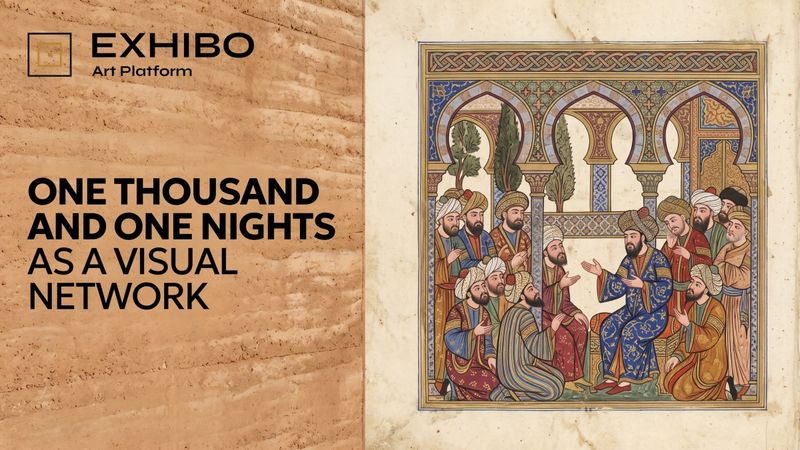
The book that taught Europe to picture the East arrived with no pictures at all. Three centuries of illustrators — Dutch, Egyptian, Persian, French, German, Iraqi — each gave it a face, and every face was a self-portrait.
Open Galland's Thousand and One Nights, the edition that conquered Europe, and there is nothing to look at: no genie, no lamp, not one illustration. The most visually imagined book in the world began blind — and because its text was never fixed either, no picture of it could ever be a copy.