
Baghdad
The Real Jinn: How the Middle East Imagined Them Before Disney
Seven kings, one for each day of the week. A portrait of Fever. Two spirits keeping a bathhouse warm. What the manuscripts actually show — and what the lamp replaced.
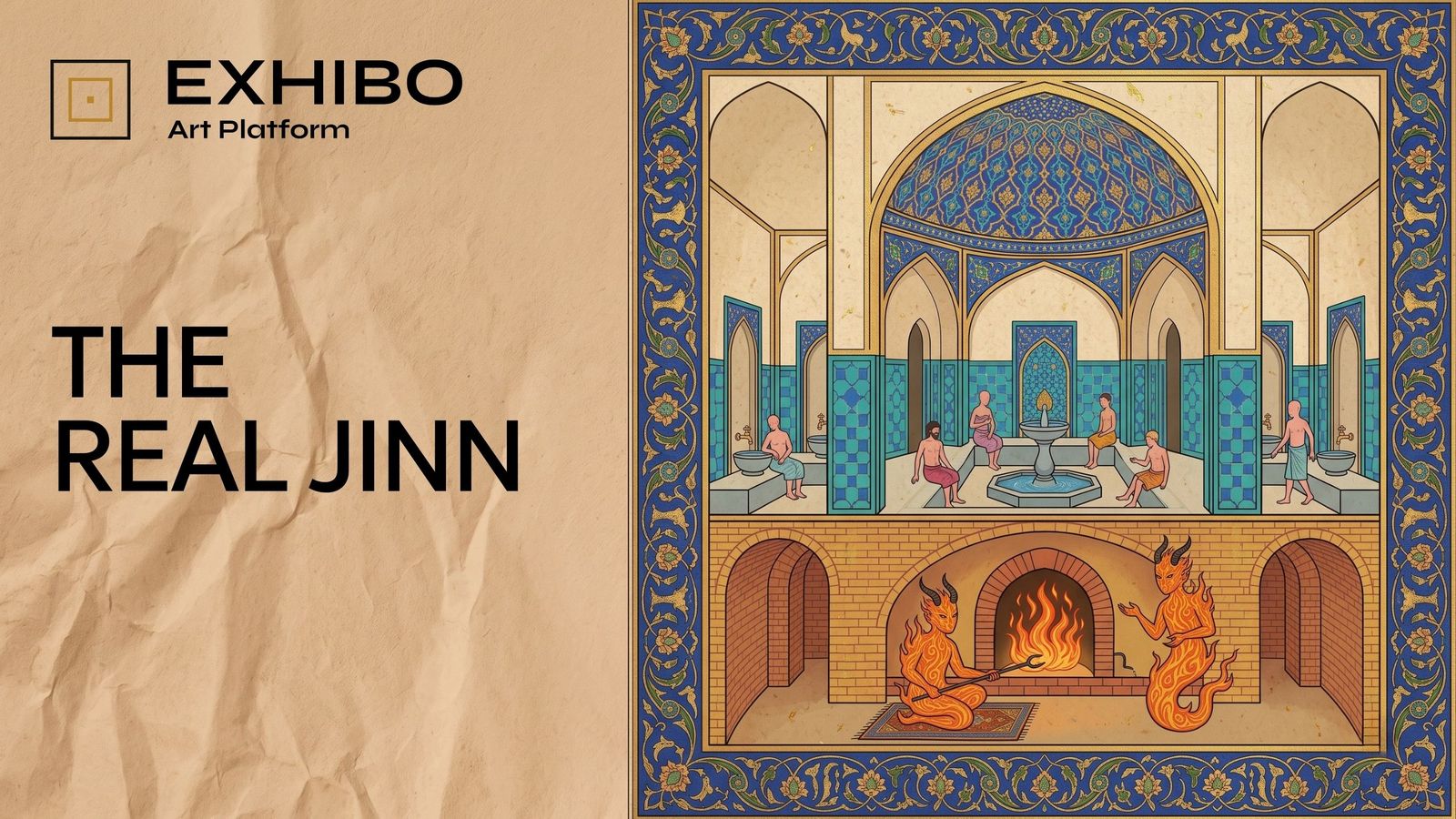
Folio 35v of a manuscript in Oxford shows the public baths at Tiberias, on the western shore of the Sea of Galilee. It is a cutaway drawing, the kind an architect might make. Upper floor: the bath itself, attendants, the ordinary business of getting clean. Lower floor: the underground, the furnace, and two jinn, shown deep in conversation, tending the fire.
That is the whole picture. No terror, no bargain, no one being punished. Two beings made of smokeless fire, doing shift work, keeping the water hot, apparently mid-argument about something.
The manuscript is the Kitāb al-Bulhān, the Book of Surprises, compiled in Jalayirid Baghdad at the end of the fourteenth century and now catalogued at the Bodleian Library as MS. Bodl. Or. 133. One hundred and seventy-six leaves, eighty-three illustrations, a jumble of astrological and divinatory treatises rebound at some point in the wrong order. It contains what may be the most extraordinary sequence of jinn paintings that survives anywhere — and the reason the baths of Tiberias stayed warm all year, in the manuscript's account, was that somebody down there was minding the fire.
This is not the jinn most of the world knows.
If you grew up in Cairo or Karachi or Casablanca, some of what follows will be family vocabulary rather than news — the word said before pouring hot water on the ground, the reason nobody sat under that particular tree, the aunt everyone agrees not to discuss. Both readers are in the room here. One of you may find the archive unfamiliar. The other may find the belief unfamiliar. This is written for the distance between them.
The jinn most of the world knows arrives in a puff of blue smoke, offers three wishes, and makes jokes. He is one of the most beloved characters in animation history, and there is nothing wrong with loving him. But he is a very recent arrival — younger than the Eiffel Tower, younger than the automobile — and the thing he replaced was not a story. It was an entire system of thinking about place, illness, sleep, luck, the calendar, and the limits of what a person is entitled to know.
And it did not end. Twelve hundred years after the poetry, Turkey supports three long-running horror franchises built on this material, Iran made one of the decade's most admired ghost films out of it, and in none of them does anyone grant a wish. We'll get there.
That system — not the lamp — is what this piece is about.
A word that means hidden
Start with the word, because the word already tells you most of it.
The Arabic root ج-ن-ن, j-n-n, carries the sense of covering, concealing, hiding from view. From it: janna, garden — an enclosed place, screened off. Junūn, the state of being overtaken, the mind veiled. Janīn, the foetus, hidden inside the body. And jinn: the hidden ones. Not the fiery ones, not the wicked ones, not the wish-granting ones. The concealed.
This matters more than it looks. A category defined by what you cannot see is a category with soft edges. It can hold a great many things — and in the earliest layers of Arabic usage it did. William Lane's nineteenth-century lexicon, still the standard reference for medieval Arabic, records the word being applied not only to spirits but to anything obscured, whether by darkness, distance, or status.
There is a competing etymology that circulates widely online, and it deserves a careful sentence rather than a confident one. Aramaic inscriptions from Palmyra refer to ginnāyē, tutelary beings — one inscription from the area is regularly cited as honouring them as good and rewarding gods. Some scholars, including Robert Hoyland in Arabia and the Arabs, have drawn the connection; others hold to the native Arabic root. What you can say safely is that the parallel exists, that Palmyra sat exactly where Aramaic and Arabic speakers met, and that the direction of borrowing is not settled. Anyone who tells you it is settled has read one Wikipedia paragraph and stopped.
The English word, though, has a documented and slightly absurd origin.
When Antoine Galland began publishing Les mille et une nuits in Paris between 1704 and 1717, he needed a French word for jinnī. He reached for génie — from Latin genius, the attendant spirit of a Roman household, a person, a place. The two words had nothing to do with each other. They simply sounded alike. The translation stuck, crossed into English as genie, and three centuries later a Roman house-spirit and an Arabian hidden one are permanently fused in the imagination of most of the planet.
Almost everything that follows in this series is a variation on that accident.
Before the Book
Here is the honest problem, and it is worth putting up front rather than burying it.
Almost everything commonly said about jinn in pre-Islamic Arabia comes from texts written two to six centuries after the fact, by scholars in Baghdad, Basra and Kufa who were describing a religious world they understood to have ended. The foundational European studies — Julius Wellhausen's Reste arabischen Heidentums (1887), A. S. Tritton's 1934 paper on spirits and demons in Arabia, Toufic Fahd's work on angels, demons and jinn, Joseph Henninger's long survey of pre-Islamic belief in spirits (reprinted in English in Emilie Savage-Smith's Magic and Divination in Early Islam) — all work from that same literary material. They are excellent scholarship built on late evidence.
The last two decades have opened a second door: epigraphy.
Ahmad al-Jallad's The Religion and Rituals of the Nomads of Pre-Islamic Arabia (Brill, 2022) reconstructs the religious life of the northern Arabian steppe from tens of thousands of Safaitic rock inscriptions scratched into the basalt of what is now eastern Jordan and southern Syria. The point he keeps making is a methodological one, and it is sharp: these texts were produced by practitioners of traditional Arabian religion themselves, not by later authors looking back. Prayers, curses, petitions, notes on grief and rain and revenge. Eyewitnesses rather than reconstructions.
What emerges from the combined picture is not a pantheon of demons. It is something closer to a theory of place.
In the surviving literary and folkloric material, jinn appear again and again as the owners of ground you have not been given permission to use. Ruins. Wadis. Certain trees, certain wells, certain stretches of the road after dark. Abandoned settlements above all — a place people once lived in and then left is, in this way of thinking, not empty. It is occupied by someone else now. The obligation running through the folk material is not avoid evil spirits; it is closer to announce yourself. Say the word before you pour hot water on the ground. Say it before you enter the ruin. You are not fighting anything. You are being polite in a house that is not yours.
Territoriality is the whole grammar. A jinn in this framework is not wicked. A jinn is disturbed — and the difference is the difference between a monster and a neighbour with a grievance.
The second function is stranger and, for anyone who cares about art, more interesting.
Poetry, in these accounts, was credited to jinn. Not metaphorically. The classical sources describe individual poets as having their own attendant spirit, and the kāhin — the seer, the oracle — as speaking in sajʿ, rhymed and cadenced prose, precisely because the utterance was understood not to originate with him. Fluency that arrives unbidden, in a rhythm the speaker did not choose, was evidence of company. Scholars including al-Jallad have traced continuities of this "poetic jinn" idea into living Yemeni tradition.
Think about what that means for a moment. One of the most prestigious cultural acts available in that society — composing verse that would outlive you — was understood as collaboration with something you could not see. Inspiration was not a mood. It was a visitor.
The desert, in this picture, was not empty. It was densely, complicatedly inhabited, and the rules for living in it were rules of etiquette.
The turn
Then comes the Qur'an, and the thing it does with jinn is far more interesting than the thing people assume it does.
On the plain sense of the passages, it does not abolish them. It re-situates them.
Chapter 72 of the Qur'an is named al-Jinn, twenty-eight verses, and it opens with a group of them listening to the recitation and being moved by it. They report back to their own people. Elsewhere in the same chapter, the text turns on a specific pre-Islamic practice: men who sought refuge with jinn, it says, gained nothing from it — a direct address to a habit that the audience would have recognised immediately.
Chapter 55, al-Raḥmān, does something structurally remarkable. Its famous refrain — asking which of the Lord's favours the listeners would deny — is repeated thirty-one times, and it is addressed grammatically to two audiences. Humans and jinn, together, as parallel communities receiving the same address, bearing the same obligations, facing the same accounting.
There is also the passage in chapter 72 that explains falling stars: jinn had been eavesdropping at the gates of heaven, gathering fragments to pass to fortune-tellers, and found the sky guarded and lit with flames. It is one of the most vivid images in the text, and what it describes, functionally, is a security perimeter. Meteors as the sound of a door being closed.
Add the surrounding material — jinn made from fire, humans from clay; the prohibition on associating them with God; the accounts of Solomon and the beings who worked at his command — and a coherent picture appears.
Read together, these passages present jinn not as powers to be bargained with but as a community standing inside the same moral order as people. They have obligations. They are addressed. They are answerable.
The late Patricia Crone made a related argument about the Qur'an's polemical use of the category. In her study of the religion of the Qur'anic pagans (Arabica 57, 2010; collected in The Qurʾānic Pagans and Related Matters, Brill, 2016), she reads certain passages as telling an audience that believed itself to be venerating angels that the objects of that veneration were something else entirely. Whether or not you follow Crone all the way — and plenty of specialists don't — the observation stands that the word is doing argumentative work, not just descriptive work.
The comparison people reach for is Christianity and the classical gods, which were reclassified downward into demons. But that comparison is imprecise, and the imprecision is the point.
Jinn were not turned into devils. They were given a status, a jurisdiction, and a court date.
The scholars who catalogued them
Once you have a category with legal standing, you get lawyers. And zoologists. And sceptics.
Picture the first of them for a moment, because he is worth picturing.
Abū ʿUthmān ʿAmr ibn Baḥr was born in Basra around 776, into no money at all, in a port city where Indian Ocean cargo and Greek philosophy arrived up the same waterway. He was not handsome and nobody pretended otherwise; the name history knows him by, al-Jāḥiẓ, refers to his eyes. He wrote about misers, about singing girls, about the rhetoric of the pulpit, about camels, about envy — at enormous length, in a prose so alive that Arabic stylists have been trying to sound like him for eleven hundred years. For the Kitāb al-Ḥayawān, the Book of Animals, the vizier Muḥammad ibn ʿAbd al-Malik al-Zayyāt is reported to have paid him five thousand gold dinars. Tradition says he died in Basra, very old, crushed under a collapsing stack of his own books — a story almost certainly too good to be true, and repeated for a thousand years regardless.
This is the man who sat down and worked out why people see things in the dark. We will come back to that.
It is in the Book of Animals that he takes up jinn, which tells you something already: he handled them as a subject for natural history rather than for the pulpit. His scheme is less a taxonomy of species than a gradation by disposition and strength: a being wholly good and undefiled belongs to one order; a treacherous and hostile one to another; one strong enough to lift great weights and listen at the gates of heaven is a mārid; anything beyond that, an ʿifrīt.
Read that again if you have ever played a role-playing game. The ladder — jinn, then marid, then ifrit — that eventually filtered into Final Fantasy, into Dungeons & Dragons, into a thousand fantasy bestiaries, traces back to a ninth-century Basran scholar's gradation, by way of The Thousand and One Nights and the long European reception that followed.
Al-Jāḥiẓ also gives us the siʿlāt, whom he distinguishes from the ordinary ghūl by method: she plays with her victims before killing them, which makes her the intelligent one. She has a weakness, and it is wolves. (The ghul, and what happened when Hollywood turned her into a shuffling corpse, is also its own essay.)
Then the encyclopaedists. Al-Qazwīnī (d. 1283) placed a section on divs and shayāṭīn at the end of the terrestrial half of his ʿAjāʾib al-makhlūqāt, the Wonders of Creation — after minerals, after animals, at the edge of the known. Al-Damīrī did something similar in his life-of-animals compendium. And in the fourteenth century al-Shiblī wrote Akām al-marjān, an entire juridical treatise on the legal status of jinn: whether a marriage between a human and a jinn is valid, whether their testimony can be accepted, what a contract with one would even mean.
That is not folklore. That is a legal system taking a question seriously enough to work through the edge cases.
And running alongside it, from the very beginning, is doubt.
Al-Jāḥiẓ, as promised, is the sharpest of them, and his account is recognisably a psychological one: solitude sets the mind playing, a frightened person sees what is not there, and these experiences get told to children in bedtime stories and verses — so that when those children grow up and find themselves alone or afraid, the stories are already waiting for them, ready to furnish the encounter. Al-Masʿūdī, a century later, took a cooler line still: the descriptions were not necessarily false, he allowed, but they were improbable.
The tradition was arguing with itself in the ninth century, in Arabic, in public, with better arguments than most of what is written on the subject today. Any account that presents "belief in jinn" as a single undifferentiated thing has already lost the plot.
How do you draw something invisible?
Here is where it gets good, and where most popular writing on the subject simply stops.
There is a persistent assumption that Islamic visual culture did not depict jinn, because it did not depict beings. This is not right, and the way it is wrong is fascinating.
They were depicted, often and in detail. With names, ranks, attributes, and colour. But almost never in what we would now call art. You will not find them in the illustrated romances, the hunting scenes, the poetry manuscripts made for princes. You find them in technical literature: astrology, talismanic handbooks, cosmographies, divination manuals, geomancy.
Which means the correct comparison for these images is not painting. It is schematics. An engineering diagram of equipment you might have to operate.
The Book of Surprises
Return to MS. Bodl. Or. 133, because nothing else in the corpus comes close.
The manuscript was copied and compiled by ʿAbd al-Ḥasan ibn Aḥmad al-Isfahani, born in Baghdad to a family from Isfahan, trained in the demonstrative sciences. It was made for — and partly copied by — Shaykh al-Ḍiyāʾ Ḥusayn al-Irbilī, whose family came from Irbil near Mosul, and who sold it on in Shaʿbān 812, which is December 1409 or January 1410. Stefano Carboni, who wrote his dissertation on it and later published an accessible study of it in The La Trobe Journal, argues for reading the title as The Book of Surprises and placing it within the ʿajāʾib, the literature of wonder.
The jinn section is unlike anything else of its period. Full-page paintings with no accompanying text — there never was any — identified only by a heading in large letters at the top. You are meant to recognise what you are looking at. The image is the entry.
It opens with Iblīs, seated frontally and enthroned, in the posture reserved for a ruler.
Then comes the sequence that reorganises how you think about the whole subject: seven Kings of the Jinn, one for each day of the week. Each attached to a planet, an angel, a metal — and each accompanied, inside the frame of his own painting, by the talismanic symbols required to manage him. The kings of Sunday and Monday, the Gold King and the White King, are lost from the Bodleian copy but survive in the later Ottoman versions.
What remains is a cast you will not forget.
The Red King of Tuesday, on folio 31r, tied to Mars: a monstrous figure riding a lion, sword in one hand, severed head in the other, the picture crowded with obsessive repetitions of a single Arabic letter and with the looped "spectacle" signs that recur across this magical tradition. The Black King of Wednesday, folio 30v, with an elaborate talisman and a retinue Carboni calls extraordinary. Shamhūrash of Thursday, folio 32v — and the heading specifies that he is naṣrānī, Christian, which is a detail worth sitting with, because it means this demonology was interconfessional; he is also known as Father of the Child, and he is shown holding an infant upside down, with the six-pointed Seal of Solomon among his symbols. Zawbaʿa of Friday, folio 31v, four-headed, seated in a posture of authority, monstrous horned heads combined with placid horse-faces. And Maymūn of the Clouds of Saturday, folio 32r, whose name also means monkey — one of the flying jinn, also carrying a child.
Around the seven kings sit the specialists.
Kābūs, the Nightmare, folio 28r: an interior, a bedroom, a sleeping man, and a dark figure standing over him. That is, in effect, a fourteenth-century image of what we would now call sleep paralysis, painted six hundred years before anyone had a clinical name for it, and it is one of the most quietly frightening things in the manuscript. The Evil Eye, folio 28v — the title damaged, recovered from the Ottoman copy. Ṭābiʿa, folio 29v, a female jinn whom Carboni links to the Lilith tradition and to the queen-of-witches figure in Christian demonology, making the single image a junction of three religious literatures. And Humā, the Fever, folio 30r: three heads, seated frontally, arms thrown wide to gather in the surrounding space, ready to take hold of a body and heat it.
Fever has a portrait. Nightmare has an address. The evil eye has a face.
This is not decoration. It is a reference system for things that happen to people — illness, bad sleep, bad luck, the sense of being watched — organised, named, dated, and given a countermeasure. Carboni notes a detail that clinches it: talismans of this period were normally folded up small and carried in metal cases around the neck. These pages were never detached and never folded. They stayed in the book.
Which makes the Kitāb al-Bulhān not an amulet but a manual. A catalogue. Perhaps the closest thing medieval Islam produced to an illustrated field guide to the unseen.
The lineage is traceable, too. Two Ottoman copies were made around 1582, for Ayşe Sultan and Fatma Sultan, daughters of Sultan Murad III, under a new title — Maṭāliʿ al-saʿāda, the Ascension of Propitious Stars — translated by the court poet Seyyid Mehmed ibn Amir Hasan al-Suʿūdī. One is now in the Morgan Library in New York, one in the Bibliothèque nationale de France in Paris. Because the Bodleian original was later rebound out of sequence and lost leaves, those Ottoman copies are how we know what the complete series looked like.
A Baghdad manuscript, copied for Ottoman princesses two centuries later, reconstructed by a Venetian-trained scholar in the twentieth century, now free to browse on the Internet Archive. The jinn have had good luck with archives.
The Anatolian grimoire
Older still, and just as strange, is the Daqāʾiq al-Ḥaqāʾiq — the Degrees of Truths — dated 10 Ramaḍān 670, which is 10 April 1272, and produced at Aksaray in central Anatolia by a man with a name that is itself a job description: Naṣīr al-Dīn Muḥammad al-Rammāl al-Muʿazzim al-Sāʿātī al-Haykalī. The geomancer. The conjurer. The clock-maker.
It is now BnF Ms Persan 174, it carries fifty-one paintings, and it was presented to Kay Khusraw III, one of the last Seljuk rulers of Rum, while he was still a child. Kings of the jinn, angels, the spirits of the lunar mansions. Multi-armed personifications of the planets, unusual enough in Islamic painting to raise the question of an Indian astrological model behind them. And a series of mandal diagrams for summoning specific spirits — geometric figures with gates marked in red ink and designated zones, in black, for sacrifice and for ritual bathing.
Marianne Barrucand's study called the miniatures a testimony to the cultural diversity of medieval Anatolia, which is a polite way of saying that Greek, Persian, Turkic, Arabic and Indian material are all visibly present in the same book. The manuscript travelled to New York in 2016 for the Metropolitan Museum's Court and Cosmos: The Great Age of the Seljuqs.
A gift for a child king, containing floor plans for conjuring.
Wonders, and the long tail
Al-Qazwīnī's Wonders of Creation is the mass-market end of this world — copied, translated into Persian and Turkish, and illustrated for five centuries. One of the earliest illustrated copies, the so-called London Qazwini, was made in Mosul in the early fourteenth century and shows Solomon enthroned among attendants, angels and jinn. A Persian translation now in Manchester, finished in 1632, carries three hundred and fifty-five illustrations in the Isfahan style. Sixteenth-century Shiraz workshops turned out loose leaves from the section on divs and shayāṭīn that still surface at auction.
And the tradition does not stop with manuscripts. It goes into print. A lithographed edition produced around Tabriz in 1848 includes an image of Solomon receiving the seal from the angel Gabriel — the seal with which he would command the demons. Mechanical reproduction, mid-nineteenth century, same iconography.
The black pen
Then there is the outlier, and the most artistically astonishing body of work in the entire story.
In the Topkapı Palace Library, bound into albums H.2153 and H.2160, sits a group of paintings attributed to a figure who may never have existed: Muḥammad Siyah Qalam, Black Pen. Around seventy sheets, mostly ink with red and gold, depicting nomadic life in Central Asia, Sufi gatherings, and beings variously identified as jinn or as divs.
They do not look like anything else. Demons sawing a tree. Demons dancing. Demons resting at a camp, playing instruments, drinking, arguing — semi-naked, barefoot, in short skirts, wearing scarves and jewellery. Wiry, muscular, individuated. They have the quality of drawings made from life, which is a disorienting thing to say about a picture of a demon.
Nobody agrees on where they came from. The albums seem to have been assembled in Istanbul under Selim I; much of the content is thought to have arrived after Mehmed II's victory over the Aqqoyunlu in 1473, or Selim's over the Safavids in 1514. And one line of interpretation is genuinely provocative: that the jewellery on these creatures — the necklaces, the earrings, the anklets — points at Sufi practitioners, and that the paintings may be a satire of religious figures during a period of political upheaval.
Which would mean that some of the most famous demon paintings in Islamic art are, possibly, drawings of people.
Div is not jinn
One correction that matters, especially for anyone writing about images.
The Persian div comes from a different root entirely — from the Zoroastrian daēva — and arrives in Persian literature through the Shāhnāma, where Rustam fights the White Div in Mazandaran. Over centuries the div and the Arabic jinn converge in painting until they are visually indistinguishable. So when you look at a "jinn" in a Persian miniature, you are usually looking at an iconographic div: horned, hoofed, dappled or striped, fanged, often collared or chained, often carrying something.
And the single most common context for that figure is not horror at all. It is Solomon on his throne.
The Harvard Art Museums hold half of a Safavid double-page frontispiece made in Shiraz around 1575–90: Solomon enthroned with his vizier Asaf, surrounded by animals, birds, angels and divs, with the Queen of Sheba on the facing page. The museum's own catalogue note is the useful part — the scene is not illustrating the text it sits in front of. It is an emblem of ideal rulership, and versions of it open manuscript after manuscript across the Safavid period.
So one of the most widely reproduced settings in which jinn appear in Islamic painting is a picture of good government. Everything in creation — beasts, birds, angels, and the beings made of fire — arranged in order, at peace, under a just king.
Nobody is screaming. It is a photograph of a functioning state.
The vocabulary, and where to see it
If you want to read these images rather than just look at them, a short grammar helps.
Frontality and symmetry signal authority, not motion — a jinn shown facing you straight on, arms spread, is being presented as a ruler or a power, in the same visual language used for enthroned kings. Horns, hooves, tusks, dappled or flame-patterned skin, multiple heads mark category. Collars, chains and belts mark subordination: something has already been bound. And in talismanic contexts, the surrounding field fills with apparatus — magic squares, repeated single letters, the hexagram, and those looped "spectacle" characters, which Carboni traces most plausibly to Ibn Waḥshiyya's Nabatean Agriculture from around the turn of the tenth century, where each sign corresponds to a letter of the alphabet. He notes their survival, essentially unchanged, in work by the Ethiopian calligrapher Gera Mawi Mazgabu, who died in 2006.
A thousand-year continuity in a decorative sign that most people now read as a squiggle.
The best single introduction to the material culture around all of this remains the Ashmolean's Power and Protection: Islamic Art and the Supernatural, which ran in Oxford in 2016 and then travelled to the Aga Khan Museum in Toronto — over a hundred objects from Morocco to China, spanning the twelfth to the twentieth century, including astrological charts, dream books, talismanic shirts meant to be worn into battle, and magic-medicinal bowls. Francesca Leoni's catalogue, with essays by Pierre Lory, Christiane Gruber and Leoni herself, is the book to buy if you buy one book on this subject.
The scholarly frontier is currently occupied by people like Travis Zadeh at Yale, whose published papers are freely available and whose work on the sorcerer in early Islamic thought is the place to go if you want to understand how commanding jinn was theorised, contested and policed. Emily Selove at Exeter has been editing al-Sakkākī's thirteenth-century magic handbook, summoning rituals and all.
This is a live field. It has been quietly excellent for twenty years, and almost none of it has reached a general audience.
The jinn who never left
None of this is archaeology.
It is also not consensus. Every practice described below is argued over from the inside — by scholars, by neighbours, by families — and those arguments are part of the material rather than a footnote to it. Nothing here is one community's settled position on anything.
In Morocco, the figure of ʿĀʾisha Qandīsha runs through folk narrative, through Sufi practice, and through the therapeutic life of whole communities. Vincent Crapanzano's The Ḥamadsha (1973) documented two linked brotherhoods tracing back to saints of around 1700, and described their particular relationship with her — a relationship in which her place in the order's cosmology sits almost level with the saints themselves. Descriptions vary by region: a beautiful woman with black or red hair, sometimes an old woman, always with the legs of a goat or camel, always appearing at dusk in empty or half-empty places. His later book Tuhami is the life history of a tile-maker who understood himself to be married to her.
There is another layer to her, harder to document than the ethnographic material and worth treating as tradition rather than record. In parts of Morocco she is remembered not only as a spirit but as a woman who fought the Portuguese during the occupations of the fifteenth and sixteenth centuries — luring soldiers from their posts, using beauty as tactics. Over time the two accounts fused. A resistance figure and a jinniyya, occupying the same name.
In Sudan and Egypt, there is zār. Janice Boddy's Wombs and Alien Spirits (1989), built on nearly two years of fieldwork in a northern Sudanese village, is one of the great works of modern anthropology, and its argument is that possession here functions as a language. Through the spirit, a woman makes demands of her husband and household and comments on village affairs — including, Boddy notes, on the growing reach of formal religious authority and on encroaching Western economic power. Boddy reads it as a veiled and allegorical discourse about subordination, conducted by people with limited access to any other kind. For Cairo, Barbara Drieskens's Living with Djinns (2008) and Gerda Sengers's Women and Demons (2003) do comparable work.
In Iran, Alireza Doostdar's The Iranian Metaphysicals (Princeton, 2018) follows the figure of the rammāl — formally a geomancer, practically a specialist consulted about affliction and about jinn — and the very mixed reception he receives from religious authorities. One of Doostdar's chapters is titled simply Do Jinn Exist?, which is a fair summary of the book's honesty. He also traces something few people have noticed: how classical occult sciences in Iran have been in conversation with imported parapsychology, mesmerism, spirit photography and New Age vocabulary since the late nineteenth century, producing a framework in which people can compare across systems.
In the Gulf, the best-known figure is Umm al-Duwais. Emirati accounts describe a beautiful jinniyya, richly dressed and heavily perfumed, who appears to men at night — and she belongs to a wider cast that includes Bu Darya of the sea and Umm al-Hilan. This corpus is thinly published academically and very heavily circulated online in unsourced versions; the Sharjah Institute for Heritage, under Abdulaziz Almusallam, has done more than anyone to record it properly.
For Palestine, there is Celia Rothenberg's Spirits of Palestine (2004), on gender, society, and the stories people tell.
And then there is Delhi.
Anand Vivek Taneja's Jinnealogy (Stanford, 2017) describes what happens every Thursday at Firoz Shah Kotla, the ruined fourteenth-century palace complex that sits between a cricket ground and the inner ring road in the middle of modern Delhi. People come — Muslims and Dalits, mostly from working-class neighbourhoods of the old city, women above all — and they leave letters.
Not prayers. Petitions. Written in the form of a shikwa, the Perso-Islamic genre of direct appeal to a sovereign, photocopied in multiples, and pasted into the niches and alcoves of the ruin, addressed to jinn understood as saints. Taneja describes the accumulated result as a transient archive of the pathos of life in Delhi — a chronicle, in his words, of "loveless marriages, alcoholism, unemployment, disease, promises broken, debts unpaid, love unrequited." His earlier essay on the site is open access and worth reading first.
A city where the state's paperwork does not answer, and where people file with a different authority.
Taneja is careful, and the care is what makes the book great: he records that the practice is contested by other Muslims, including the imam of the mosque at the site itself, who regards the petitions as misguided. He does not resolve it. That is the right decision.
The generation that argues about it
There is a version of this that does not happen in a ruin or a village, and it may be the one closest to home for a good number of the people reading.
A study of Bangladeshi families in East London, published in Transcultural Psychiatry, found the community divided along a line anyone raised between two countries will recognise instantly. The older generation explained certain illnesses through jinn. The younger — second and third generation, schooled in Britain — regarded that as their parents' superstition, and frequently as un-Islamic besides. Sharp about it, too.
And then almost every informant in the study, sceptics fully included, could produce an instance of a jinn doing harm.
That is not hypocrisy. That is what an inheritance actually looks like. You can reject the entire framework in an argument at dinner and still know exactly which house on the street you do not walk past after dark. The vocabulary you dismiss in daylight is the vocabulary that arrives first at two in the morning — and it arrives in your grandmother's voice, which is precisely why it is so hard to put down.
The same pattern turns up wherever the research has looked: in the Netherlands, in France, in the Gulf cities where three nationalities share a stairwell. Nobody is simply believing or simply not.
What the numbers actually say
In 2012 the Pew Research Center published The World's Muslims: Unity and Diversity — thirty-nine countries, more than thirty-eight thousand face-to-face interviews with self-identified Muslims. Chapter four asked about jinn. Every figure below is for Muslim respondents only.
More than half of those surveyed in thirteen of the twenty-three countries where the question was posed affirmed that jinn exist. In South Asia the figure runs at seventy per cent or above; Bangladesh reached eighty-four. Malaysia came in at seventy-seven, Indonesia at fifty-three, Thailand at forty-seven. Across the Middle East and North Africa the range ran from eighty-six per cent in Morocco to fifty-five in Iraq. In Central Asia, Turkey stood out at sixty-three, with most of the region far lower; across southern and eastern Europe, no surveyed country passed forty.
Now the two figures that almost nobody quotes.
Asked whether they had ever seen a jinn, fewer than one in ten of the Muslims surveyed said yes in twenty-one of the twenty-three countries. The highest responses were twelve per cent in Bangladesh and ten in Lebanon.
And asked whether appealing to jinn is an acceptable practice, only in Bangladesh did more than a fifth of Muslim respondents — twenty-eight per cent — say yes. In eighteen countries, the figure was no more than one in ten.
Sit with the shape of that.
Among the Muslims surveyed, belief is widespread. Encounter is rare. And the specific act of making use of a jinn — asking one for something, striking a bargain, calling one up — is regarded across most of the surveyed world as something you should not do.
Which is a fairly precise description of the one thing the popular Western genie exists to do.
The argument that never ended
The nineteenth and twentieth centuries did not settle any of this. They intensified it.
Muhammad ʿAbduh (d. 1905), the Egyptian jurist and reformer, took the position that when reason and the literal surface of a text appear to conflict, reason should guide the reading. Applied to jinn, he made an argument that is still startling: since the word itself means the hidden, and since microscopy had just revealed a population of living things hidden from the eye, it was permissible to consider microbes as one kind of what the text calls jinn. He extended the same method elsewhere — angels as natural forces, the seven heavens as planets. He was answered, sharply, by scholars such as Mustafa Sabri, and the exchange is still cited on both sides.
Whatever you make of it, notice what ʿAbduh was not doing. He was not denying the text. He was proposing that its terms be re-read against new instruments. That is a move with a long history in every scriptural tradition, and the people who made it were not outsiders to the tradition — they were among its most senior figures.
Meanwhile, a very different current was reorganising practice on the ground. Ruqya sharʿiyya — treatment through Qur'anic recitation — expanded substantially through the twentieth century, and a considerable scholarly literature now traces its rise partly in relation to reformist currents that regarded older syncretic practices, zār among them, as departures from correct belief. Dissertations by Sofiane Bououne and Fatima Zohra Cherak examine this in Algeria, Egypt and France; Mohammed Muslim Eneborg documented its growth in East London; a detailed study in Contemporary Islam follows one practitioner in Stockholm through his method and his patients, including a woman who does not personally believe in sorcery but finds the sessions more helpful than the alternatives available to her.
That last detail is worth more than a shelf of theory. People are not always doing what their stated beliefs would predict. They are doing what helps.
The clinical literature has grown up around this, and its tone has changed for the better. A paper in The Psychiatrist on jinn possession in modern psychiatric practice argues for something quite specific: that clinicians should distinguish carefully between different phenomena, should consult the patient's own religious community, and should engage with rather than override the patient's explanatory model — including by treating ruqya as a complementary option rather than an obstacle. A Dutch study in a transcultural outpatient clinic found the attribution far more common among Muslim patients than had been assumed, and also found that a majority of eligible patients declined to take part at all — many citing fear of stigma.
There is a whole essay in that refusal, and it is not an essay about jinn. It is about what it costs to be asked the wrong question by the wrong institution.
The jinn on screen
Now the part that surprised me most while researching this, and that almost nobody has written up properly.
The jinn has become the region's most productive horror figure — and since roughly 2004, it has supported something close to an industry.
Turkey is the epicentre. Büyü (2004) is usually named as the starting gun, and what followed were three long-running cycles: Dabbe, from 2006, directed by Hasan Karacadağ, who had studied filmmaking in Japan and whose first entry took its premise from eschatological material about the creature that emerges as the end approaches, reaching people through radio, television, telephone and internet; Siccîn, from 2014, directed by Alper Mestçi; and Üç Harfliler, from 2010. Academic work on them — including a study of djinn films and toxic kinship in post-millennial Turkish horror, and Zeynep Koçer's chapter on Musallat — reads the recurring themes as revenge, grief and class conflict, almost always routed through damaged family relationships. There is also a substantial survey of how young Turkish audiences actually receive these films, which is a rarer thing than it should be.
Iran produced the film that made the international critical case. Under the Shadow (2016), the debut of Babak Anvari, sets a mother and daughter in a Tehran apartment block during the War of the Cities in the 1980s. Anvari has been clear about where it came from: as a child in Tehran, the war was largely invisible — sirens, tape across windows, distant blasts — and when you cannot see what is happening to you, you supply your own explanation. Something like a jinn. The film's other quiet achievement is visual restraint: the presence is conveyed mostly by moving fabric rather than by prosthetics. The BFI's interview with Anvari is worth reading in full.
Across the Arab world, the University of Michigan's Islamic studies centre ran a festival in 2019 that mapped the terrain neatly — noting Turkey's franchises and then pointing to what it called a possible Arab horror renaissance: The Blue Elephant (Egypt, 2015), Dachra (Tunisia, 2018), 122 (Egypt, 2019), Kandisha (Morocco, 2008). Add Achoura (Morocco, 2018) and the Egyptian Netflix series Paranormal (2020), adapted from Ahmed Khaled Tawfik's beloved Ma Waraa Al Tabiaa novels, and the picture fills in fast.
The Emirates got there early and awkwardly, with Djinn (2013), directed by Tobe Hooper and built loosely on the Umm al-Duwais material. Critics were not kind, and the comparison with Under the Shadow is the one that keeps being made: a Western director bringing a familiar plot to an unfamiliar setting, versus a filmmaker working from inside the memory.
And then Netflix. Jinn (2019), the platform's first Arabic original, shot in Jordan: teenagers on a school trip to Petra who encounter both benign and hostile jinn. What happened next was less about jinn than about everything else. Jordan's public prosecutor sought to halt the broadcast over scenes viewers found inappropriate; institutions issued statements; a genuinely national argument followed. It was not one-sided. Prince Ali bin Al Hussein, chair of the Royal Film Commission, publicly questioned why so much energy was being spent on a fictional series rather than on the country's real problems, and called for respect across differences. The journalist Daoud Kuttab pointed out that the platform's actual subscriber base in Jordan was around one per cent of the population. Others noted that the criticism fell far harder on the young actress than on her male co-stars.
And as Arab News reported, the show had been expected to open a new chapter for Jordanian production — a second Jordan-based series was already in the pipeline.
Now stand back and look at that whole body of work, and notice what is missing from every single title.
Nobody grants a wish.
Not in Istanbul, not in Tehran, not in Cairo, not in Amman: the wish-granting jinn, the comic servant of the lamp, is essentially absent from the region's own genre cinema. What appears instead is the older grammar, intact: somebody crossed a line. They went into the ruin. They took the house. They opened the ground. They brought something home.
The regional jinn is not about desire. It is about trespass — which is exactly what it was in the sixth century, in the poetry, on the basalt of the Ḥarra.
Twelve hundred years, and the grammar has barely shifted. The figure to fear is still the neighbour whose ground you took.
What Disney changed, and what it kept
Which brings us, finally, to 1992, and to a film that a great many people in the region grew up loving. Including, for what it's worth, a great many of the people who have written most sharply about it. Those two facts sit together comfortably, and any account that requires you to pick one is selling something.
Start with the source, because the source is not what you think.
Aladdin is not in the medieval Arabic manuscript tradition of the Nights. He arrives with Galland — the story was not in the Syrian material he was translating — and comes, we now know, from a Syrian storyteller named Hanna Diyab who told it to Galland in Paris in 1709. That is a whole essay of its own, and it is next in this series.
The flying carpet is the same story. Marina Warner, in Stranger Magic — still the best book on what the Nights did to the Western imagination — points out that the carpet arrives in the tale of Prince Ahmed and the fairy Peri Banu, one of the stories most likely to have been assembled by the translator himself, and that it went on to shape Lotte Reiniger's Adventures of Prince Achmed, both versions of The Thief of Bagdad, and Disney. Warner is also very good on why jinn are useful in narrative at all: they bring, she writes, the energy of unpredictability to the plots.
So: the carpet is French. The boy is Syrian, told in Paris. The word is Latin.
Three of the four load-bearing elements of the modern genie took their familiar shape in Europe, long before anyone drew a single frame.
What Disney added was the fourth: the contract. Three wishes, fixed rules, a service relationship with terms and conditions. And underneath the comedy the film is unusually direct about the terms — the character is bound, he serves whoever holds the lamp, and his freedom is the film's emotional payoff. Critics have long noted that this arrangement carries a weight of association the film does not fully address, even as it resolves it warmly.
There was also a public argument at the time, and it is a matter of record. In 1993, following representations from the American-Arab Anti-Discrimination Committee — with the media scholar Jack Shaheen among those involved — Disney altered two lines of the opening song. The theatrical version had described the setting through casual mutilation and then shrugged it off as simply the way home was; the revised lines replaced that with a description of heat and flat terrain. Shaheen's essay of the same year argued that the framing did a disservice to a very large number of people. The ADC had also asked for changes to accents and to a scene involving a threatened punishment; those requests were not met, and the two sides gave different accounts of how the lyric change came about. By the 2019 live-action remake, the opening verse had been rewritten again, this time toward a portrait of a crossroads city full of languages.
None of that is the interesting part, though. Studios revise. Audiences push. That is how popular culture has always worked.
The interesting part is the substitution.
What the popular genie replaced was not a scarier monster. It was a way of organising the world — one in which the invisible had jurisdiction, a calendar, and a legal status; in which fever had a portrait and nightmare had an address; in which the underground of a bathhouse might be staffed; in which the highest form of art was understood as something you received rather than something you produced; and in which the correct response to the unseen was not to summon it but to be careful, and to say the word before you disturbed the ground.
That system was replaced by a service.
Back to the baths
I keep returning to folio 35v.
Not because it is the most beautiful page in the manuscript — it isn't; the Red King on his lion is the showpiece, and Kābūs standing over the sleeper is the one that follows you home. Folio 35v is a cutaway of a public bath in a provincial town, drawn by someone in Baghdad who had probably never been there.
But it tells you the whole thing in one image.
Upstairs, people are washing. Downstairs, two beings made of fire are handling the boiler and talking to each other about something we will never know. Nobody upstairs is in danger. Nobody downstairs is being punished. The building simply works, and the reason it works is that the world has more staff than you can see.
That is the picture, in the end. Not that the dark is full of enemies — but that the world is fuller than it looks, that most of what is in it is minding its own business, and that the polite thing is to knock.
Everything else in this series — the lamp, the ring, the bottle, the carpet, the ifrit who became a summon in a video game, the roc that sent Europeans looking for an island, the ghoul who became a zombie, the city Disney assembled out of Baghdad and Isfahan and Agra — is a variation on a single process. A piece gets lifted out of a working system and turned into a prop.
The props are wonderful. I am not campaigning against the props.
But somebody built the system, argued about it in Basra, painted it in Baghdad, translated it for two Ottoman princesses, and left it in a library in Oxford where you can look at all of it right now, for free, in high resolution.
That seems worth knowing.
Related reading
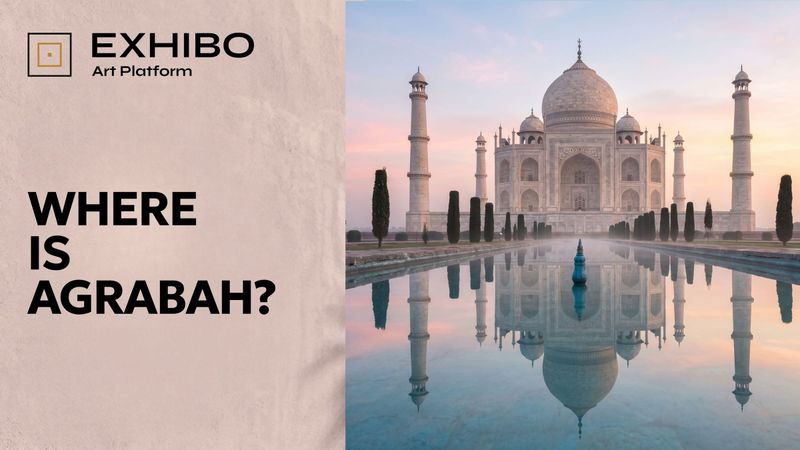
Where Is Agrabah? The City Disney Assembled From Real Places
Agrabah was going to be Baghdad. A war made it fictional — and then Disney built it back out of real places, from a tomb in Agra to a valley in Jordan that usually plays Mars.
The Sultan's palace where Princess Jasmine feels trapped has the silhouette of the Taj Mahal — which is not a palace at all, but a tomb. That is how Agrabah works. Disney's fairy-tale city was going to be Baghdad, until the Gulf War made the name impossible; the studio invented a place that could not be found on a map, then quietly rebuilt it out of real ones — Isfahan and Agra, Marrakesh and Mandalay, a Jordanian desert that has played both Arabia and Mars.
The Real Aladdin: The Story That Belonged to No Country
Aladdin has no Arabic manuscript older than its French translation. Behind the gap stands a young man from Aleppo, catalogued for a century as anonymous.
The most famous "Arabian" tale in the world is missing from the oldest Arabic manuscript of the Thousand and One Nights — because before a French translator wrote it down in Paris, there was no manuscript of it to be missing from.
Why Disney Made the Genie Blue
The long material and colonial history behind the most recognizable blue body in popular culture.
Almost everyone remembers that Disney's genie is blue. Fewer ask why. The answer runs backward through five thousand years — Egyptian blue standing in for lapis, cobalt on a Mongol palace, the eye that guards against envy, the last color most languages learned to name, and a layout artist photographing Isfahan just before a war — to a color that was rarely, in this part of the world, quite what it claimed to be.