
Istanbul · Turkey
Nasreddin: The Trickster Everyone Claims
A padlocked gate with no walls, two rival graves, and stories told among two dozen peoples: how the wise fool of the Islamic world became a shape every culture fills with itself.
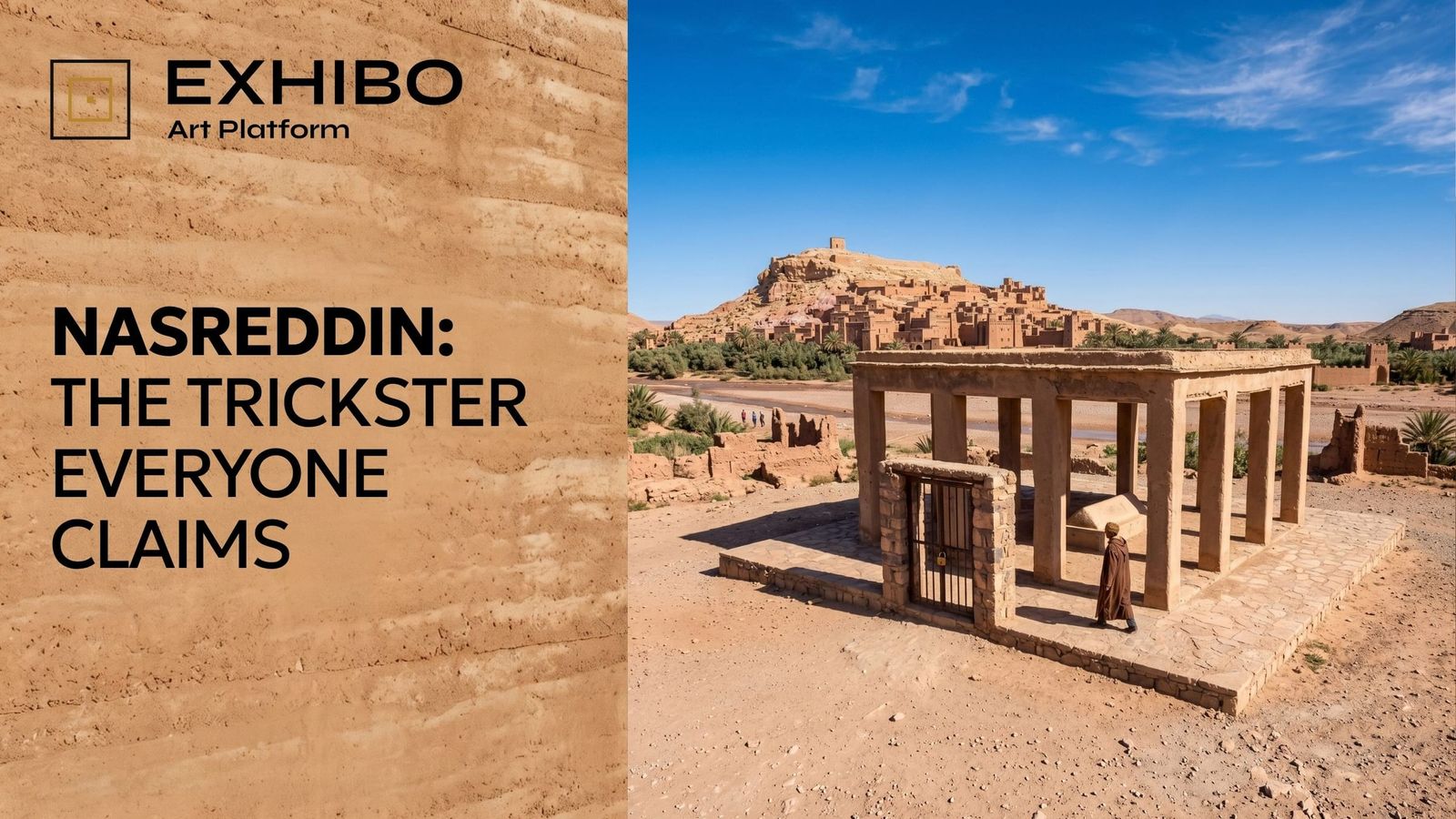
In Akşehir, in west-central Turkey, there is a domed pavilion held up on columns, open to the wind on every side, and in the middle of it a tomb. On one side, between two of the columns, someone has hung an iron gate with an enormous padlock. The gate is locked. The pavilion around it is not walled. You can walk right up to the locked door, and then simply step around it, because there is nothing on either side but air.
This is said to be the grave of Nasreddin Hodja, and the joke is his. A locked door guarding nothing, a barrier you defeat by ignoring it — it is exactly the kind of thing the tales say he did in life: solemnly securing the wrong thing while the point wanders off unguarded. The people of Akşehir built him a monument that is also one of his own gags. It is perfect. It is also, quite possibly, guarding the wrong man. In 2013, in Sivrihisar, sixty miles north, a philological study of a stone sarcophagus kept at the town's Ulu Mosque identified it as Nasreddin's, by comparing its inscription with that of a gravestone attributed to his daughter. Local officials now present this as fact; it remains a claim, not a settled verdict. But if they are right, he was born and died somewhere else entirely.
Two tombs, then, for one man. It is a fitting number, in the sense that it is far too low. The truer figure is far higher. One Azerbaijani folklorist gathered Nasreddin's stories as they are told among twenty-three peoples, and a good many of them will tell you he was theirs.
A locked door in an open pavilion, over a grave whose occupant no one can quite name — and two towns competing to hold the body. The joke was his; everyone else is still telling it without noticing.
The man who was several men
Start with the thing everyone assumes and almost no one examines: that there was a man.
The later Turkish biographical tradition is confident and precise. The evidence underneath it is not. He was born in the village of Hortu, near Sivrihisar, in 1208; he studied, became a kadi — an Islamic judge — and an imam; he settled in Akşehir under the Seljuks and died there around 1284. A nineteenth-century mufti of Sivrihisar helped fix the dates in the later biographical tradition. There are two waqf documents from thirteenth-century Konya that mention a man named Nasreddin, though whether either is the Nasreddin of the stories is disputed. A tombstone gives a date. It has the texture of a life.
It also has a hole in the middle where the proof should be. There are fragments a believer can hold onto — the two waqf documents, a tomb inscription at Akşehir dated to the 1390s, gravestones said to be his daughter's — and some Turkish scholars read them as evidence of a real thirteenth-century Nasreddin. More cautious folklorists read them as later attempts to anchor a floating legend to a real place. What no one has is a chain of evidence connecting the anecdotes to a documented life. One of the earliest surviving Turkish written sources to tie anecdotes explicitly to Nasreddin Hoca is the Saltuk-nâme, completed in 1480 — two centuries after he is supposed to have died. Some of the most famous later stories pair him with Timur — Tamerlane — the conqueror who humiliates the Ottomans at Ankara and gets outwitted, in the bathhouse and the throne room, by a fat man on a donkey. Timur died in 1405. A man who died in 1284 cannot trade jokes with a warlord who rose more than a century later. A leading scholar of the Muslim wise-fool, Ulrich Marzolph of Göttingen, treats such pairings as part of the later narrative formation of Nasreddin rather than evidence of his biography — a magnet drawing free-floating jokes toward a convenient name. The stories did not happen to Nasreddin. They accumulated on him.
And they came from everywhere, including from people who were not him. Long before the Anatolian Hodja, the Arabic-speaking world already had Juha — Joha, Djoha, later the Egyptian Goha — a much older wise-fool tradition of its own. There was Buhlul, another wise fool of Arab and Persian lore. And some of the joke-patterns later attached to Nasreddin have parallels in literature far older than Islam: Marzolph has traced parallels, through medieval Arabic collections, back to the Philogelos, the "Laughter-Lover," a Greek jest-book of late antiquity. The wise fool is not a person. He is a very old container, and the tales kept getting decanted into whatever container was nearest.
You know the tales even if you have never heard his name. He loses his ring in the house and searches for it in the street, because the light is better out there. He is asked to preach, says "do you know what I am going to say?" — the congregation says no — so he leaves, saying there is no point talking to people who don't know what he means; next week they say yes, so he leaves again; the week after, half say yes and half say no, so he tells the half who know to explain it to the half who don't. He ferries a pedantic scholar across a lake, mangles his grammar, and is asked, "have you never studied?" No, says the Hodja. "Then half your life is wasted." A storm comes up; the boat is sinking; the Hodja asks the scholar, "have you ever learned to swim?" No. "Then all of your life is wasted." These are not simply Turkish jokes, or Persian, or Arab. Versions of the same joke-types have circulated across all three traditions, and some have far older parallels in Greek and other literatures — retold in each place with the local fool's name pinned to the front, which is the whole mechanism of him in a single habit.
What holds the jokes together is not a plot but a stance. In later readings he became a kind of holy fool, the man whose stupidity keeps turning out to be a slower kind of sense. Tradition places him in Akşehir near the dervish Seyyid Mahmud Hayrani, and later traditions, and Sufi interpreters above all, increasingly read him through a mystical lens — and read that way, the best of the tales work like a Sufi teaching-story, leaving you with the laugh first and the unease afterward, when you notice the fool was the only one in the room being honest. Asked why he is riding his donkey backwards, he explains that it is not he who is turned the wrong way; it is the donkey. That is a children's joke and a small demolition of everyone's confidence about which way is forward, and it is doing both at once. He is funny in the way that survives translation, and wise in the way that survives it too, which is a large part of why so many peoples found him so easy to take in.
What we call Nasreddin is the result of that decanting — a figure welded together, across languages, comparatively late. One influential strand of scholarship puts the composite we recognise today surprisingly recent: in the Cambridge study of the tradition he is described as a composite figure who emerged in the late nineteenth century, even as the same scholarship notes that a Nasr al-Din is present in the Persian tradition far earlier, near the start of the second millennium. The claim is not that Nasreddin was invented in the nineteenth century; it is that the composite recognisable across several traditions today consolidated relatively late. The welding was done by the joke-books, and print accelerated it: a first Turkish printed edition in 1837, an Egyptian one around 1860, a Persian one in Tehran in 1881 — each new book collecting, translating and setting side by side stories that had lived apart under different names. Nobody decided to merge them. The presses of the nineteenth century consolidated a mixing that was already old, the way rivers merge — by flowing into the same low place. That first Egyptian edition put the seam right on its title page, calling him Nasr al-Din Hoca "surnamed Joha al-Rumi" — Joha the Anatolian, two tricksters introduced to each other on the cover and told to share a body. The title Molla he carries in half his languages is, as the same study puts it, "a semantic chimera" to begin with — not a fixed rank but any figure with a little learning and a little authority, which is to say a slot, not a man.
So the premise of the quarrel dissolves on contact. The problem is not that we cannot agree on which man Nasreddin was. The problem is that the stories told under his name clearly belong to more than one tradition and more than one century — the figure we argue over is larger than any single historical life could have been. They are not really arguing over one biography. They are arguing over a shape.
He is not a person who spread across the world. He is a shape the world kept filling — a man-sized space that each culture poured itself into and then called the pouring a biography.
Everyone's homeland
Which does nothing to cool the argument. If anything, a shape is more contested than a man, because a man can only have been born in one place, and a shape can be born wherever it is needed.
The Turkish tradition is the most institutionally established: Anatolian, Seljuk, buried at Akşehir, honoured with an annual festival there since 1959, now the face on fridge magnets from Konya to Istanbul. In Azerbaijan he is Molla Nasreddin, the name that would carry a whole modern magazine. In Iran the Persian tradition of Molla Nasreddin is old and deep, and scholarship has added a disputed birthplace: the Turkish historian Mikail Bayram has argued that the "real" one was Nasir al-Din Mahmud al-Khoyi, whom he reconstructs as born in Khoy, in what is now Iran's West Azerbaijan, educated at Herat, and sent west by the caliph in Baghdad to stiffen Anatolian resistance to the Mongols — a highly contested identification. The Arab world has its own, independently rooted trickster, Juha, associated with Kufa, in Iraq, and mentioned in Arabic sources as early as the start of the eighth century — not simply an earlier Nasreddin, but a related figure whose stories later flowed together with his. These are not identical claims to one historical person: some are Nasreddin under another name; others are older or locally grown trickster traditions that became entangled with his. The Uzbeks put him in Bukhara, where a bronze Hodja rides his donkey to this day, sitting backwards, facing the tail. In Xinjiang, the Uyghurs grew an Afanti with a local life of his own.
Lay the claims end to end and the traditions attached to the name stretch across many centuries, and the places from Iraq to China. That is not a biography with some uncertainty around the edges. It is a coat-rack — and each tradition that walks past hangs its own coat on it and calls the coat the man.
Give a real man contested dates and you have a historical puzzle. Give a legend contested dates spanning many centuries and thousands of miles and you have something else: proof that the dates were never the point, and the belonging always was.
His name is the map
The surest way to see how far he travelled is to try to say his name, because the name changes at every border, and the list of the changes is a map of everyone who took him in.
To a Turk he is Nasreddin Hoca. To an Azerbaijani, Molla Nəsrəddin. In Uzbek he is Afandi, or just Nasriddin Afandi; in Kazakh, Kozhanasyr. Cross into the Uyghur regions and China and he becomes Äpändi, then Āfántí — a name that etymologists trace through Turkish efendi and medieval Greek back to the ancient Greek authéntēs, "master": even the Chinese name of the Turkic trickster is wearing a Greek word. In Albania he is Nastradin Hoxha, in Bosnia Nasrudin hodža. Across the Arab world his kindred Juha — in Egypt, Goha — tells many of the same jokes. In Sicily, carried over by centuries of contact, related trickster tales live under the name Giufà; in Malta, Ġaħan; in Greek and Serbian and Croatian, some worn-down form of Nastradin.
Read that list aloud and you have drawn the borders of half the Old World — Anatolia, the Caucasus, Iran, Central Asia, Xinjiang, the Balkans, the Arab lands, North Africa, southern Italy — not by conquest but by laughter. He has no authenticated contemporary text, no fixed version, no verified face. What he has instead is a name in dozens of spellings, and each spelling is a place that decided he belonged to it.
Empires drew this map with armies and lost it again. He drew the same map with a donkey and a joke, and has not lost it yet.
The uniforms of the century
Here is where a beloved joke turns into something stranger and more revealing: because he was empty, one political and cultural project after another could put him in its own uniform — and many did.
In 1906, in Tiflis — Tbilisi, then a city of the Russian Empire — a group of Azerbaijani intellectuals began publishing a satirical weekly and named it after him: Molla Nasreddin. Under the cover of the wise fool's name, its editor Jalil Mammadguluzadeh ran full-page colour lithographic cartoons — with major contributions from the Tiflis cartoonists Oskar Schmerling and Josef Rotter — that went after the hypocrisy of the clergy, the greed of local elites, the colonial condescension of Europe and Russia, and the treatment of women, at a time and place where any of it could be dangerous to print. The drawings themselves are extraordinary — a Caucasian Daumier, sardonic and modern, able to carry a political point without a block of text — and they helped establish a modern visual language of political caricature across the region, one more instance of an image tradition assembling itself out of local grievance and imported technique. The magazine ran, on and off, until 1931, from Tiflis to Tabriz to Soviet Baku, and its editors paid for the freedom the mask gave them: the offices were attacked, the staff harassed, and Mammadguluzadeh more than once had to escape angry crowds. In 1910, according to a letter from a Russian diplomat in Tehran quoted by the magazine's historians, an entire sitting of the Iranian parliament had been spent on a deputy trying to clear his name of the magazine's mockery; its caricatures of the Ottoman sultan drew complaints from the Ottoman consul, and in 1907 the authorities briefly suspended it. The trickster's name was a licence to say the unsayable — which is precisely what the trickster had always been for, now printed in colour and sold at newsstands. A Shi'i-Azeri weekly, published in Georgia and briefly in Iran and then in the Soviet Union, drawn partly by European-trained artists, named for a fool two dozen peoples tell: the masthead alone is the whole map.
Then the century got heavier, and so did the uniforms. In the Soviet Union, the writer Leonid Solovyov recast him as a folk hero who defies the rich and the emir: his 1940 novel The Disturber of the Peace sends Nasreddin back to old Bukhara to rob the rich, free the oppressed, and humiliate a fat emir — folk wisdom read as class struggle, the trickster handed a program. Solovyov, who had grown up in Central Asia and knew the material in his bones, was arrested in 1946 and spent eight years in the camps, where he was allowed, as an exception, to write in his free hours. He asked his family to send nothing but paper — "I must be a dervish," he wrote home, "nothing superfluous" — and finished the sequel, The Enchanted Prince, there by the end of 1950: the man who gave the Soviet Union a trickster who defies tyranny finished the book inside the machinery of one, and the irony is so exact it could be one of the Hodja's own. Uzbekfilm put the rebel Nasreddin on screen in Tashkent in the middle of the Second World War. And in 1979 the Shanghai Animation Film Studio introduced Afanti, a puppet version of the trickster drawn from Xinjiang Uyghur folklore, and followed it with a thirteen-episode series, The Story of Afanti, made between 1981 and 1988 — a goateed sage on a donkey who outwits landlords and officials, and a major, enduring work of Chinese animation. A figure rooted in Xinjiang Uyghur folklore became a widely recognised character in Chinese children's culture — a fact that reads differently now than it did in 1979, and cannot be made to read only one way.
Turkey formalised him with the full apparatus of a nation: a fixed birthplace and death date, a restored tomb, a museum, a statue, and an annual festival at Akşehir established in 1959, turning a floating regional fool into a fixed figure of Turkish national heritage. He has also been studied as a Turkish lieu de mémoire, a site of memory the nation uses to think about itself. It is not a costume for a decade but a permanent address, a man relocated once and for all to one town in one country, with the paperwork to prove it. It has also helped keep the tradition unusually visible: the festival, the museum, and generations of Turkish folklorists have collected, published and kept circulating the stories.
The pattern recurs. The Azerbaijani reformers made him a moderniser; the Soviets recast him as a people's champion against the rich; Chinese adaptations turned him into a popular champion who outwits landlords and officials; many Western readers encountered him in the 1960s through Idries Shah's explicitly Sufi interpretation, his jokes reframed as instruments of enlightenment. Europe had started even earlier: a Nasreddin anecdote appeared in a French scholarly journal as early as 1834, fuller French, German and English collections followed in the 1870s and 1880s, and after the First World War the German orientalist Otto Spies naturalised him for German readers as "the Turkish Eulenspiegel" — measuring the Anatolian fool against a Low German one, the way you translate a currency. The pioneering comparative collection came in 1911: Albert Wesselski's two volumes, whose subtitle lists Turkish, Arabic, Berber, Maltese, Sicilian, Calabrian, Croatian, Serbian and Greek tales — the map again, printed on a title page. Each age reached for the empty man and dressed him in what it needed. None of them was lying, exactly. That is the unnerving part. He really does hold all of it.
He can even wreck a film. In the 1960s the animator Richard Williams, who had illustrated Idries Shah's Nasreddin books, began an animated feature about him; the project foundered in a dispute with the Shah family, Williams had to drop Nasreddin as his hero, and the wreckage was salvaged, reworked, and dragged across three decades into the notorious unfinished epic The Thief and the Cobbler. Even as a cartoon the trickster would not be pinned; he took the film down with him and walked off with his own name.
There is a cost to the dressing, and it surfaces the moment anyone tries to keep the costume clean. The broader corpus that came down through the manuscripts and the coffeehouses carries a substantial bawdy, transgressive layer — obscene anecdotes, crude bodily jokes, the fool as often lecherous or ridiculous as sage. Scholars who work on that layer, like the Turkish folklorist İlhan Başgöz, have documented how much of it there is; and as the stories moved into print, the Cambridge study notes, the sexually and religiously transgressive tales were gradually shed, until the survivor is a dignified philosopher fit for a schoolbook and a tourism brochure. The purification is one of the clearest signs that he has been claimed. You take the fool, you keep the wisdom, and you bin the parts that embarrass the flag.
Again and again, the same small operation: keep the wisdom, lose the obscenity, and call what remains the real Nasreddin. The laundering is one of the surest signs he has been claimed.
Shared on paper
In December 2022, in Rabat, the contradiction reached the institution designed to recognise and safeguard shared heritage — which settles not who owns a man, only who keeps a tradition alive. UNESCO inscribed on its Representative List of the Intangible Cultural Heritage of Humanity an entry with a title that is itself the whole essay compressed: "Telling tradition of Nasreddin Hodja / Molla Nesreddin / Molla Ependi / Apendi / Afendi Kozhanasyr Anecdotes." Five of his names, strung together with slashes, because no single one of them could be allowed to stand for the rest.
It was a joint nomination by seven states: Azerbaijan, Kazakhstan, Kyrgyzstan, Tajikistan, Turkmenistan, Turkey, and Uzbekistan — seven countries agreeing to safeguard a shared tradition together, to put a shared trickster on the same piece of paper. It sounds like the happy ending to the quarrel, the wise resolution the fool himself might have brokered. Look again at the list and you see the shape it took. The seven are six Turkic-majority states plus Tajikistan. Iran is not among them, despite long-standing Persian traditions of Molla Nasreddin. Nor are the Arab countries, whose Juha tradition is attested centuries before the Anatolian one. Nor is China, whose Afanti generations of children grew up on. Nor the Balkans, nor Greece, nor Sicily. The inscription documented one transnational safeguarding framework; its list of participating states inevitably gave that shared tradition a particular geopolitical shape — and left many of the places where related Nasreddin and Juha traditions live outside it. No one was forbidden to tell the stories. But paperwork, unlike laughter, has to stop somewhere.
Which is the last and best of his jokes, and he did not have to be alive to tell it. Nasreddin spent centuries becoming a figure that many different parts of the region could each recognise as their own — everyone's uncle, everyone's fool, the shape that fit every mouth — and the instant a committee tried to write down whose tradition he was, the list fractured along the exact lines the jokes had spent centuries laughing across. You cannot lock him down. Every attempt to do it produces another version of the tomb at Akşehir: a heavy padlock, a solemn gate, and no wall on either side, so that anyone who wants him simply steps around the lock and helps themselves. He belongs to all of them because he belongs to none of them, which is the only way a fool ever belongs to anyone. The door is locked. Walk around it. He would want you to.
Related reading
Contemporary Istanbul Expands Footprint and Eyes Anatolian Markets
Founder Ali Güreli outlines spatial upgrades, Asian focus, and proposed fiscal incentives for the growing fair

Contemporary Istanbul Expands Its Global Footprint Amid Shifting Markets
The twenty-first edition welcomes seventeen new exhibitors while navigating regional economic headwinds
Olivo Barbieri: Time Space Geometry
Aerial surveys and optical distortions reshape how we perceive landscape and history