
Istanbul · Turkey
Seventy Thousand Solomons: The Empire That Performed a Legend
A demon catalogue in the conqueror's library, a sixteenth-century text where kingship is an office held seventy thousand times, and the columns a sultan dragged across three provinces to prove he held it.
In the library that Mehmed II assembled at Topkapı after taking Constantinople, among the Greek manuscripts he collected and kept, there was a copy of the Testament of Solomon.
It is a strange book to own. Written in Greek, probably in the first centuries of the common era though the date is genuinely disputed, it opens with a complaint about labour: a demon named Ornias is taking half the wages of a boy working on the Temple and drawing the life out of him through the thumb of his right hand. Solomon prays. The archangel Michael brings him a ring. What follows is a catalogue — thirty or so demons, interviewed one at a time, each giving its name, the illness it causes, the star it answers to, and the angel whose name will stop it.
It is, in form, a reference manual for an invisible administration, with a section on staff discipline.
The conqueror of Constantinople had one on the shelf.
The provenance rests on Julian Raby's study of Mehmed's Greek scriptorium, and it sits at the head of a story that Carlos Grenier tells in the Bulletin of SOAS, and it is one of the most interesting arguments about Ottoman self-understanding I have read. The short version is this. Over roughly a century, Ottoman court culture moved from reading the Solomon legend to inhabiting it — and the physical evidence of that shift is still standing in three cities, and you can walk into most of it.
If you know Istanbul, you have already been inside part of this argument without anyone mentioning it, which is the usual condition of standing in that city. If you don't, the useful thing to know is that Süleyman the Magnificent was named for a prophet, ruled in the shadow of that prophet's reputation, and spent the last thirty years of his reign building things that were meant to be read as a claim about it.
First, a doubling
Solomon arrives in Ottoman Turkish already carrying someone else.
Across Persianate literary culture, in which the Ottomans participated deeply, Solomon was often conflated with Jamshid, the fourth king of the world in Iranian myth.
Jamshid's career, as the Shahnama has it, is worth knowing because of how the second half goes. He teaches metalworking, weaving, medicine, the division of society into estates. He builds. He rules over demons and sets them to work. He has a throne that the demons lift into the air, and he rides it up so that he seems to sit in the sun, and the world gathers below to look at him and scatters jewels on the day. And then, precisely at that point, he tells his people that he is the source of everything they have — and the divine favour that had made him what he was, the farr, leaves him. What follows is collapse, usurpation and a very bad death.
Prophet and cautionary tale, occupying the same slot. The identification was so ordinary that the fifteenth-century historian Mirkhwand went out of his way to defuse it, pointing out that centuries separated the two men and that Solomon should not be held responsible for Jamshid's failings.
He was arguing against the current. Grenier's reading is that Solomon had absorbed Jamshid's darker aspects and could not shed them — including the one that matters most for a ruler, which is what happens to a king who begins to believe his own dominion is his own doing.
That doubling is why Ottoman writing about Solomon is not simply flattering. One strand of it is a warning.
Solomon as a warning: the Dürr-i Meknūn
A text called the Dürr-i Meknūn — the Hidden Pearl — sets out a version of the Solomon story that reads as anything but imperial propaganda. Its date is itself part of its history: long placed in the 1450s, within a few years of the conquest, it has more recently been argued into the early 1470s by Ebru Turan, and its author, traditionally the Sufi writer Ahmed Bīcān of Gallipoli, is now generally treated as unknown. The reading of it as an anti-imperial text is especially associated with Stéphane Yerasimos, whose Légendes d'Empire is the foundation everything here is built on.
In it, Gabriel delivers the seal ring after David's death, and Solomon begins to build. He divides the jinn and the demons into three companies, each with its foremen. They bring marble out of the sea, and more from the purple mountains at the edge of the world. Twenty thousand men carry timber up from Beirut.
And then he builds a palace for a foreign princess, in a place the text names.
Aydıncık. In antiquity Cyzicus, on the southern shore of the Sea of Marmara, a few hours from Constantinople. The princess installs an image of her father in gold in her private rooms and keeps his cult there. Asaf, the vizier, finds out. What follows destroys her, and the palace falls into ruin, and the ruin is understood to be cursed.
By the sixteenth century the ruins at Aydıncık were popularly called Qaṣr-i Süleymān — Solomon's Palace.
Now the part that makes this more than a legend. The Dürr-i Meknūn holds that the green and porphyry marbles the jinn had raised from the seabed went, eventually, into Aya Sofya.
And that is not fantasy. Justinian's builders really did quarry the ruins of Cyzicus for the Great Church. The columns and revetments that people crane their necks at in Ayasofya today genuinely did come, in part, out of a dead Roman city on the Marmara.
So the legend attached itself to a real supply chain. The result is close to the reverse of an archaeological discovery: an existing ruin was absorbed into an older Solomonic story whose components, as Grenier notes, were not devised with the Marmara landscape in mind at all — and the actual movement of stone gave that story something solid to hold on to.
The tale is doing what tales do: reverse-engineering a mystery from the evidence lying around. The evidence, in this case, was load-bearing.
The warning, on Yerasimos's reading, is not subtle. A great king builds a great capital using powers not his own, indulges a foreign wife, and leaves behind cursed rubble that other empires cannibalise. Whichever decade it was written in, it reads very differently when set against a city that had recently changed hands.
Then a reversal: Solomonhood as an office
Fifty years later the same material comes out looking completely different.
Uzun Firdevsī — Firdevsī-i Rūmī, born 1453 — wrote for Bayezid II, and his output is a portrait of a particular kind of mind. A treatise on chess. A treatise on military arts. A verse history of the campaign for Lesbos. A manual for summoning spirits and angels, the Daʿvetnāme, studied and published by Fatma Büyükkarcı. And an epic on Solomon so enormous that its most complete surviving copies run to eighty-one volumes — which internal evidence suggests is only part of a projected three hundred and sixty, a number chosen to evoke the Solomonic arts of geometry and architecture.
Grenier's observation about that bibliography is worth keeping: the range betrays a consistent preoccupation with the join between the spiritual world and material, technological manipulation — which is precisely the profile of the mythic Solomon, exorcist and builder at once.
Two things in the Daʿvetnāme are worth having.
The first is a scene. A master of the science of talismans, called the Western Solomon, commissions a jeweller to make him a gold box. At a particular astrological conjunction he asks the jeweller whether the box moves by itself. The jeweller replies, reasonably, that nothing without a spirit moves. The master slides a gold coin underneath, and the box begins to move — and he explains that once every thirty years, wherever in the world a hidden treasure lies, he will find it and it will come into his hands.
An astrological automaton for locating capital. Spirit and matter under the same management, which is the whole Solomonic proposition in one gold box.
The second is structural. The Daʿvetnāme is a Turkish book. The instructions are in Turkish, the preparations are in Turkish, the timing and the conditions are in Turkish. But at the centre of the operation sits the ʿahdnāme-i Süleymān, the covenant of Solomon — and that is in Arabic, and it stays in Arabic, and without it the rite does not work.
A Turkish manual administering an Arabic instrument. The observation is Grenier's, and it is the sharpest thing in his article: the Arabic, mixed with Syriac names for the jinn, is administered by the Ottoman imperial idiom, which sets an Abrahamic Semitic past inside the linguistic frame of the new empire. Reciting it correctly gives the Turkish speaker, as Grenier puts it, a way of taking on Solomon's own role as translator.
He also wrote a short book on the Solomonic art of doing laundry. Solomon stained his clothes, ordered the jinn to work out how to clean them, and they came back having compounded soaps out of the raw materials of the world and taught him to lift any stain. It is a ridiculous text and it makes the point better than the serious ones: for this author, every useful technique on earth traces back to a king who had the right staff.
And in Uzun Firdevsī's hands the myth flips. Solomon stops being a cautionary figure and becomes an office.
The word is süleymānlıq, Solomonhood. Not a man; a recurring position in the order of things, held in succession by an enormous number of people. Seventy thousand of them, in his account. Each new Solomon, coming into his inheritance, discovers an underground city built of diamond bricks, on which every predecessor has inscribed his own history. He reads them. Then he adds his own stone.
Which produces a line I have not been able to stop thinking about:
Under every patch of this earth, there is a powerful Solomon.
The section closes with a poem in the voice of one of these ancient Solomons, and its last move is to take the whole edifice away again: worldly kingship, it says, is a lie. The office endures. No particular holder of it does.
Sixteenth-century Ottoman Turkish — four hundred years before Borges built his own imaginary libraries out of comparable machinery.
The political implication is hard to miss. If Solomonhood is an office rather than a person, it is vacant between holders — and someone is going to fill it. In texts by writers like Firdevsī, Bayezid II is already addressed as Süleymān-i Sānī, the Second Solomon.
Two books with the same name
One bibliographic detail says everything.
Uzun Firdevsī's epic is called the Süleymānnāme — the Book of Solomon — and it is about the prophet.
Ârifi's Süleymānnāme, completed around 1558 and covering the sultan's reign from 1520 to 1555, is an official illustrated history running to six hundred and seventeen folios with sixty-nine large illustrations, four of them spread across two pages, and it is about the sultan.
By the middle of the sixteenth century, if someone in Istanbul mentioned the Book of Solomon, you would have had to ask which one they meant. The name had stopped distinguishing between them.
What that looked like in stone
The reign of Süleyman I is where the argument stops being literary.
In Topkapı he built a fountain and had it inscribed with the formula that had been circling him for decades: sultan of the worlds, Solomon of his time.
Then he went to Jerusalem.
Between roughly 1537 and 1541 he rebuilt the walls of the Old City — twelve metres high, some four kilometres around, thirty-four towers, seven gates, following the earlier Ayyubid line closely. Much of the circuit standing there today belongs to that programme; most photographs of the Old City are, in part, photographs of his building works. He restored the Dome of the Rock, replacing the exterior mosaics with polychrome tilework of Iranian design; surviving dated tiles run from the mid-1540s into the 1550s, and the work continued through the middle of the century.
And into the new walls, on Milstein's reading as reported by Grenier, six-pointed seals associated with Solomon were cut.
The logic is not obscure. He carried the prophet's name; the prophet was Jerusalem's builder-king; and the sultan rebuilt Jerusalem. The sequence would have been legible to a sixteenth-century court audience without anyone spelling it out.
The mosque assembled out of other places
Then Istanbul, and the Süleymaniye, built by Mimar Sinan from 1550, the complex completed in 1560, on the hill above the Golden Horn where it would be seen against Aya Sofya.
Sinan called it his journeyman work, which from a man with hundreds of works behind him is a joke of a particular kind. The plan looks back deliberately to Aya Sofya — a central dome on pendentives with two semi-domes, a scheme Ottoman architects had been moving away from in the preceding decades. The choice was an argument. Gülru Necipoğlu's work on the complex reads it as a bid to take Justinian's church, remake it and better it — the short version is at Smarthistory.
Gülru Necipoğlu has argued that it was designed deliberately to echo the Dome of the Rock as well — the building on the site of the Temple — so the same structure is arguing with a Byzantine emperor and claiming a prophet at once.
But the detail that gives it away is the columns.
The documentary record here is unusually good, reconstructed by Ömer Lütfi Barkan and later by İlknur Aktuğ Kolay and Serpil Çelik in Muqarnas, and the procurement reads like a military operation.
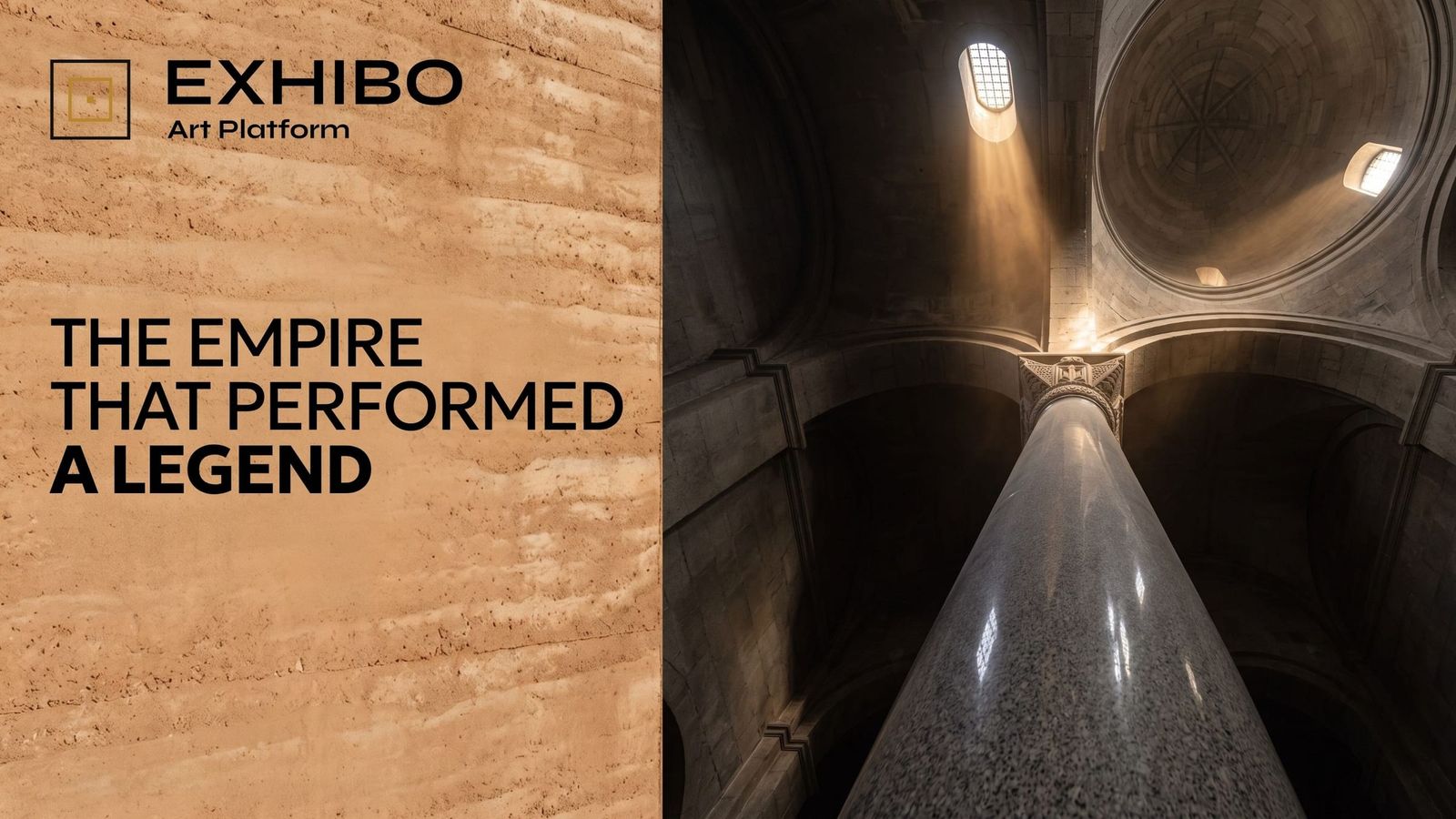
Four giant granite columns were quarried at Aswan in Upper Egypt and brought down to Alexandria. Between 1550 and 1552 a barge was purpose-built at Galata to carry them to the capital. Two of them sank on the way. The two that arrived stand in the domed chamber.
The following year a second expedition went to Baalbek, to the ruins of the Temple of Jupiter, for red granite. In Muslim memory that site was associated with Bilqis, the Queen of Sheba — and Sinan's own account says so outright, that most historians held the columns to be left over from the palace of Solomon's Bilqis. They went up in the north portico in 1553.
And one came from Istanbul itself: from the Kıztaşı, the Virgin's Column.
This one needs a note, because the name is a trap. A late-antique column standing in Fatih today is also called Kıztaşı — it is the Column of Marcian, put up by the city prefect Tatianus around 450–452, its imperial statue long gone, its Turkish name apparently owed to the two winged Victories carved on the pedestal. The critical edition of Sinan's texts warns explicitly against confusing the two. The column that went into the Süleymaniye was most likely a different late-antique monument, associated with the Church of the Holy Apostles and now lost, and the identification remains disputed.
What is not in doubt is what the Ottoman accounts describe: prestigious antique stone gathered from across a conquered geography and rebuilt into a mosque, with a legend supplied for each piece as it arrived.
Material was also brought across the Marmara from the ruins of Cyzicus — which is to say, from the place Ottoman tradition had already turned into Solomon's Palace.
The Tezkiretü'l-Bünyān calls the great columns emblems of the Four Chosen Friends, meaning the four Rightly Guided Caliphs, and says of them that each came from a different land. Which is the whole operation in one sentence: stone taken from defeated orders, renamed after righteous ones.
Justinian had done the same thing a thousand years earlier, hauling columns to Constantinople from across his empire to build Aya Sofya. Süleyman's builders were not only borrowing Justinian's architectural language; they were working inside the same imperial practice of gathering prestigious stone from across a conquered landscape.
Who actually lifted it
In the Tezkiretü'l-Bünyān — the account of Sinan's buildings recorded by the poet Mustafa Saʿi Çelebi — there is a line about raising the great columns into place.
It describes many thousands of cadets entering the treadmill, and thousands of the demons of Solomon — from among the Frankish prisoners — shouting together as they hauled. Later in the same passage, the demons of Solomon mount the column on boat chocks and bring it to the building.
That is a figure of speech, and it is also a description of the labour force, which included the sultan's acemioğlanları and prisoners of war. The text reaches for the most flattering metaphor available — the jinn who built for Solomon, the image at the centre of everything above — and applies it to captives hauling a pagan column across a city.
I do not think there is a cleverer way to put this than simply leaving it visible. The myth was a compliment to the sultan and, in the same breath, a description of what was being done to somebody else.
The Solomonic metaphor was not only how the empire flattered itself. It was also how the empire described its labour force.
And in the painting
The visual side developed alongside, and it can be located precisely.
A manuscript of Uzun Firdevsī's Süleymānnāme copied around 1500, now Chester Beatty Library, ms. Turk 406, carries on folio 2b what the art historian Rachel Milstein identifies as possibly the earliest Ottoman painted representation of Solomon.
Milstein has shown how thin the line became. In a richly illustrated dynastic history of 1558 there is a detached illustration of the prophet Solomon seated beneath a dome, a hoopoe perched on its pinnacle, and an inscription on the wall reading that he is the Solomon of his time and holds Solomon's kingdom in his days. Milstein reads the image as a visual conflation of the prophet with the sultan.
Behind it sits a broader fashion. Serpil Bağcı has traced how, from the 1480s in Aqqoyunlu and then Safavid Shiraz, painters increasingly favoured a particular frontispiece: Solomon holding his dīvān, his court of animals, birds, angels and demons, paired on the facing page with Bilqis, the Queen of Sheba.
And Bağcı noticed something about these frontispieces that ought to stop anyone who works on patronage. They were frequently dedicated not to the person paying for the manuscript, but to Solomon himself.
Bağcı links the preference to a particular attachment to Solomon among Shirazi painters, for whom the Achaemenid ruins nearby — the Takht-i Jamshīd, the Throne of Jamshid, which we call Persepolis — were sacred ground.
The Ottoman versions kept coming. Ârifi — the same court historian responsible for the sultan's Süleymānnāme — produced an Anbiyānāma, a book of the prophets, and a folio from it showing Solomon is in the collection at LACMA. The Zübdetü't-Tevârih, a late sixteenth-century universal history in the Topkapı Palace Library, includes a scene labelled the works of Solomon among its forty miniatures.
The iconography settles into a formula that anyone who has looked at a Persian or Ottoman frontispiece will recognise on sight. The king enthroned, frontally, centrally. Asaf at his side. Birds above. Animals below. Angels at the upper corners, and, at the lower ones, the demons — horned, hooved, collared, and entirely at peace, doing nothing at all except being visibly under management.
Which closes the circle this piece opened with. Solomon and Jamshid, fused into one figure, with a real ruin outside town to prove it, and painters sometimes dedicating their finest opening images to him rather than to the patron who paid for them.
Meanwhile, in Spain
One last thing, because it is too good to leave out and because it complicates any story about this being a peculiarly Ottoman obsession.
While Süleyman was rebuilding Jerusalem and raising the Süleymaniye, his principal adversary in the Mediterranean was doing the same thing from the other end.
Philip II of Spain built El Escorial between 1563 and 1584, with Juan de Herrera as architect, and the building has long been read in relation to Solomon's Temple — a reading so established that it now shapes the site's own official presentation. It remains an interpretation rather than a settled fact, and specialists still argue about how far it goes. Later in the century the Jesuits Jerónimo Prado and Juan Bautista Villalpando produced the most influential scholarly reconstruction of the Temple, published between 1596 and 1605, under Philip's patronage.
The chronology does not line up neatly and the two projects were not synchronised. But across a generation, in two rival imperial capitals, the same vanished building was being used to make the same kind of claim.
The formula is still in production
The thing that surprised me most in all of this is that the iconography did not stop. It is being made in Istanbul now, by hand, using the same materials, and it is still about power.
In 2020 Halil Altındere, who has been working in Turkey since the early 1990s and rarely makes anything comfortable, produced a folding album of miniatures under the title The Lawyer of Sultan Süleyman Going to Friday Prayer. Fourteen watercolours with gold on vegetal-dyed paper, bound as a muraqqa, which is the same album format the Ottoman court used for its own collections. It is not a pastiche of the sixteenth century. It is made in collaboration with practitioners of the miniature tradition — Filiz Adıgüzel, Fatma Akdaş and Ayşe Yılmaz Öztürk among them — using that tradition's materials and visual grammar in the present.
It has grown into an ongoing series in which ceremonial Ottoman court processions are populated with Teslas, Segways and Star Wars characters. Altındere has said in interviews that he now uses artificial intelligence in the production process as a kind of assistant, which puts three separate technologies of image-making into the same object.
He works the same seam elsewhere. There are textile pieces that borrow the form of the Afghan war rugs of the 1980s and put Turkey's Bayraktar drones where the Soviet and American jets used to be, woven by robot. There is Mobese (2011), a gold-plated pole hung with surveillance cameras. Works from these series were selected for Art Basel's Qatar edition in 2026.
Look at what the court procession scene actually does, in any century. A ruler at the centre. An ordered retinue arranged by rank. Everything in the frame under visible control, and the whole composition existing to say so.
The formula for depicting legitimate power outlived the state that developed it, and it is still the best available container for a picture about who is watching whom.
He is not alone in the technique — Murat Palta has built a following by miniaturising Star Wars, Kill Bill and The Godfather in full Ottoman convention — but Altındere is the one using it to say something about surveillance, and it is the use, not the revival, that matters here.
In Uzun Firdevsī's telling, süleymānlıq is an office concerned with the join between the unseen world and technological control. Five centuries later an artist in Istanbul is making pictures in the imperial format about drones and cameras.
The office everybody wanted
Which is, in the end, what the süleymānlıq idea was describing. Not a legend about one king, but a vacancy that keeps reopening, and a queue.
The Safavid Shah Ismaʿil, writing in the Turkic of Safavid Iran, put his own bid in a form that leaves nothing to interpret. He runs through the names — Faridun, Khusraw, Jamshid — and then arrives at the object itself, and calls himself the signet ring on Solomon's finger.
Not the king. The ring. The thing that made the king work.
Seventy thousand Solomons, each finding the diamond city, each reading what the last one wrote, each adding a stone. Uzun Firdevsī meant it as cosmology. Read back from Istanbul in the 1550s, it starts to look like a job description — and on that reading, a good deal of the visible fabric of three cities is somebody's application for the post.
You can go and stand under the columns. They are still holding up the roof, and they are still from somewhere else.
Related reading

Contemporary Istanbul Expands Its Global Footprint Amid Shifting Markets
The twenty-first edition welcomes seventeen new exhibitors while navigating regional economic headwinds
A look at how the Istanbul fair balances local momentum with international growth against a backdrop of macroeconomic volatility.
Olivo Barbieri: Time Space Geometry
Aerial surveys and optical distortions reshape how we perceive landscape and history
Borusan Contemporary presents Olivo Barbieri's first Turkish solo show, examining how elevated perspectives and manipulated focus transform familiar terrains into abstract compositions.
The Fruit We Are Sure We Recognize
How the pomegranate became one of the most confidently named motifs in Islamic ornament — and one of the least confidently identified — across a thousand years of tile, silk and stucco, with meanings we mostly attached later.
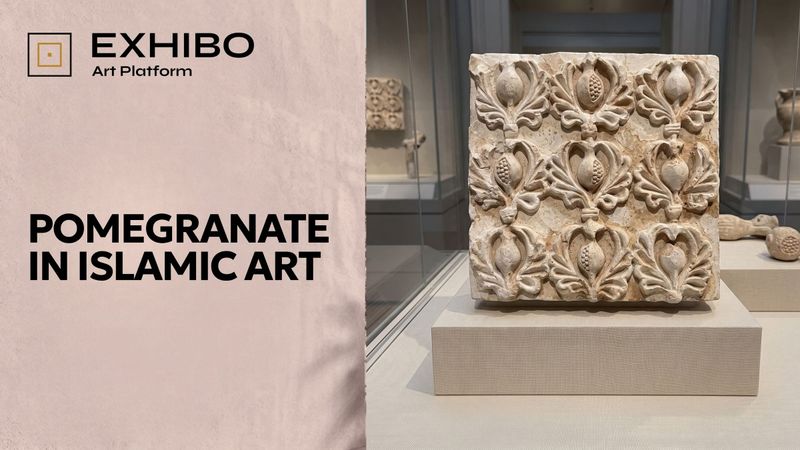
A slab of sixth-century plaster in the Met shows a fruit you recognise at a glance: a pomegranate, and surely it means paradise. Hold that certainty up to the light and it dissolves. Across a thousand years of tile, silk and stucco, the pomegranate is the shape we name most confidently and identify least — blurring into the artichoke and the palmette, its meanings attached by later viewers, its very name partly a nineteenth-century invention