
Sharjah · United Arab Emirates
The Night Is Not for Humans: Umm Al Duwais and the Women of Emirati Folklore
A village half-buried in sand an hour from Dubai, a name that means "she of the little sickle," and what Emirati sources actually say.
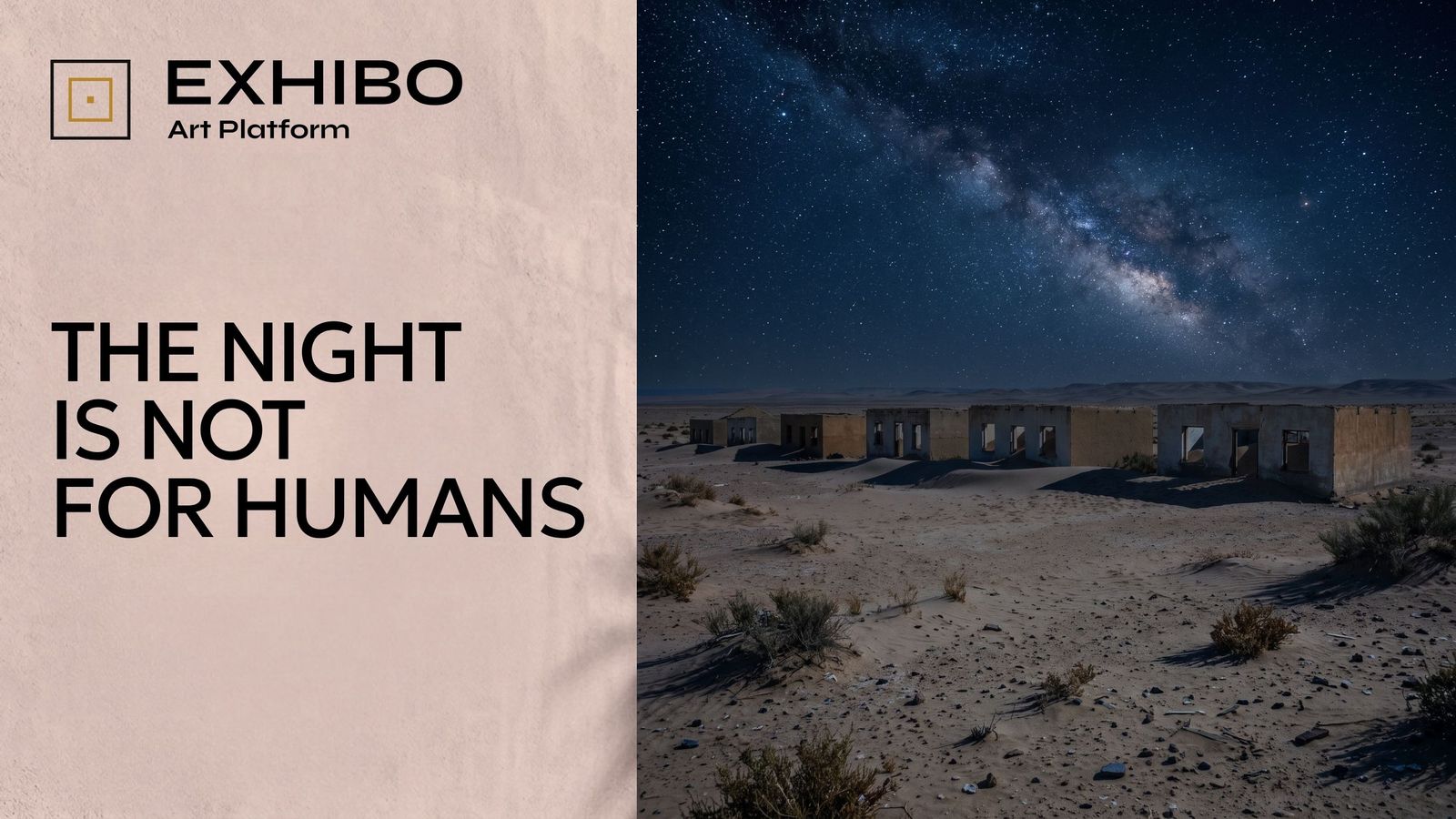
An hour inland from Dubai, past the last of the truck stops on the Al Ain road, there is a village half-buried in sand. Two rows of low houses facing each other across what used to be a street, a mosque sitting exactly in the middle of the two rows, and everywhere the dunes coming in through the doorways and the window frames and up the interior walls, room by room, at their own pace.
It is called Al Madam, and people will tell you she lives there. Not in the old stories — this is a recent attachment, a piece of contemporary local lore rather than a traditional localisation — but told often enough now that the village has a second name in English: the Ghost Village.
Here is the part that stops you. The houses went up around 1980. Local accounts place the abandonment in the mid-1990s, after shifting sand made the settlement increasingly difficult to live in — though no official explanation appears to have been published, and other accounts circulate alongside the sand: poor siting, awkward infrastructure, resettlement, some combination of all of them.
Either way the abandonment is not ancient. It is younger than the compact disc.
Which means that within roughly one generation, a figure who has been frightening people on this coast for a very long time gradually became associated with a housing project built in the 1980s. Folklorists have a name for what happens next: legend tripping, the practice — documented by Bill Ellis and others since the early 1980s — of travelling to a site because a story is attached to it, and thereby attaching the story more firmly. Cars go out to Al Madam at dusk. The going is part of the telling.
That is the thing about this material that almost nothing written in English gets across. It is not a museum.
If you grew up in Sharjah or Ras Al Khaimah or Ajman, some of what follows will be your grandmother's vocabulary rather than new information, and you may well have a version that contradicts mine — which is how oral tradition works and is not a problem to be fixed. If you did not, you are about to meet a figure who is genuinely famous across a stretch of the world and almost entirely unknown outside it, and who has been badly served by nearly every English-language article ever written about her.
Including, until recently, by the one I would have written.
Her name is a tool
Start where the Arabic starts, because the English never does.
Emirati folklorists generally derive the name from a tool. Al-das (الداس) is a curved blade, a knife shaped like a harvesting sickle, and it is the ordinary word for one in Emirati and wider Gulf colloquial. Take that word and put it in the diminutive — the grammatical form Arabic uses for smallness and sometimes for affection — and you get al-duwais (الدويس).
Those two words carry this section, and they are the ones worth checking against Almusallam's own entry, which sets out the origin of the name.
On the explanation Emirati sources most commonly give, the name has nothing to do with temptation. It means something closer to "she of the little sickle."
This is the most likely reading rather than a demonstrated one. Folk etymologies are notoriously unstable — names get re-explained by each generation that inherits them — and nothing here amounts to proof. What can be said is that Emirati sources repeat this derivation consistently and that the morphology makes it plausible. If it holds, she is named for her equipment rather than for her effect.
Descriptions in Arabic sources are remarkably stable, far more so than the English ones. She appears as a young woman of extraordinary beauty, elegantly dressed, preceded by scent — musk, amber, oud, incense — which is how you know she is coming before you see her. One leg is a donkey's leg and the other is a das; or both legs are donkey's hooves and both hands are dīsān — the Arabic dual, meaning two sickles. She appears in inhabited neighbourhoods, in cities and villages, in gardens and orchards and open country — anywhere, in short, that there are people to be led away.
And then the detail that recurs across many Emirati tellings and appears in almost no English one.
She has the eyes of a cat.
Not at the end. Not after the trap has closed. The whole time. However perfect the face, if you look carefully at the eyes, they are a cat's.
That detail invites a different reading. Many English-language retellings run: beautiful woman, man follows, woman transforms into something horrifying, man dies — a story about deception. Many Emirati tellings run differently: the sign was visible from the beginning, and he did not look.
Read that way, it becomes less a story about being fooled than a story about not paying attention. Someone else might reasonably read it as deception anyway. Both are available in the material.
And one more thing that many Emirati tellings include and the English versions leave out: in most tellings she avoids women, and appears almost exclusively to men.
"The night is not for humans"
In 2021 the Emirati writer Maitha AlSuwaidi published an essay in Postscript Magazine's Gulf issue that is, as far as I can find, the single best thing written about Umm Al Duwais in English. It is also, characteristically, the piece that has been most plagiarised — at least one wiki has lifted her opening paragraph word for word without credit. Read the original.
AlSuwaidi describes watching horror films as a child in her grandparents' house in Sharjah, and her grandmother getting up at three in the morning for a snack and shuffling into the majlis where the cousins were all piled together. And every night, she writes, her grandmother reminded them of the same thing:
الليل مب حق البشر
"The night is not for humans."
Six words. That is the whole system.
Not there are monsters out there. Not be careful. A statement about ownership of the hours. The night belongs to somebody else, and if you are out in it, you are the one who is trespassing.
AlSuwaidi also gives, almost in passing, the clearest picture anyone has published of how this material actually moves between people. Her grandmother told her the story first. Her father skims past Umm Al Duwais when the family reminisces about jinn. Her mother senses spirits in rooms that feel heavy and wards them off with prayer. And AlSuwaidi herself, by her own account, thinks and writes about her more than she should.
Four people in one family. Four completely different relationships to the same figure. Anyone who tells you what "Emiratis believe" about jinn has not been in a room with an Emirati family.
This is not disorder, and folklorists stopped treating it as such decades ago. Linda Dégh spent a career arguing that legend is not, as the old definition had it, a story believed to be true — it is a debate, sustained in the tension between belief and disbelief, and she reached for a courtroom to describe it: advocates of belief and non-belief facing one another like parties to a lawsuit. Her Legend and Belief (2001) is the fullest statement of it. On that account a family that cannot agree about Umm Al Duwais is not failing to preserve a tradition. It is performing one.
Her essay also contains a story I have not found anywhere else, told to her by her father on a beach in Sharjah when she was around nine. A family with five sons and one empty bedroom, decorated and waiting. A mother desperate enough to travel to a distant town and find a witch in a hut among wild palms — black cloak, gold burqa across the nose and mouth — who hands over a potion without needing to be asked. Nine months later a daughter arrives. She does not cry when she is born. She does not cry when her father recites the call to prayer into her ear.
She is born with a full set of teeth.
Then the food starts disappearing. The rice, the dates stored for Ramadan, the sugar and salt and cardamom and saffron. The family tries to take turns staying awake, and every single one of them falls asleep at exactly three in the morning.
I will not spoil the ending, but it is not a happy one, and there is nobody left in the town.
Thirty-seven entries and who they are
The reason English coverage of this subject is so thin is not that the material is undocumented. It is that the documentation is in Arabic, and hardly anyone has bothered.
The essential source is Abdulaziz Almusallam, chairman of the Sharjah Institute for Heritage, novelist, and the man The National once called the fairy-tale man for going into schools to tell jinn stories. He began systematic collecting with a book called Kharareef in 2007, and in 2017 the Sharjah Institute published the result: Mawsuʿat al-kaʾinat al-khurafiyya fi al-turath al-Imarati, the Encyclopedia of Mythical Beings in Emirati Heritage, a bilingual Arabic–English volume of thirty-seven entries, illustrated by four artists working from research rather than imagination. Entries rather than creatures, strictly — a few of them are places, and a few are closer to named characters than to species.
Almusallam has said in an interview with Gulf News that he never expected it to travel. It has been translated into English, French, Portuguese, Italian and Russian; at the Moscow book fair, six hundred of a thousand copies sold and the rest went to public libraries, and the president of an association devoted to hidden animals asked to meet him.
Each entry follows the same structure, and it is a good one: the creature's name, the environment it belongs to, the origin and meaning of the name, the sources that transmitted it, and — separately — whether it has roots in classical Arabic literature. Almusallam traces a number of them back as far as al-Mustatraf min kull fann mustazraf, the fifteenth-century compendium of al-Ibshihi.
The table of contents is a document worth having on its own. A dozen of the thirty-seven, to give the flavour: al-siʿluwa, the shapeshifter; al-shabih, the double; al-dabʿa, the hyena; bu al-salasil, father of chains; baba daryah, the sea spirit; baʿir bila ras, the headless camel; jinni al-raqqas, the dancing jinn; sidrat al-sanam, the idol's lote tree; ʿifrit al-qurm, the mangrove ifrit; hessa wa ʿayalha, Hessa and her children; umm al-sibyan, mother of boys; and umm al-duwais herself.
Something like a quarter of the entries are female figures — the exact count depends on where you draw the line, which is itself part of the problem. That is the subject of this piece, and it turns out they have something in common that the men do not.
What the women guard
Look at the male figures and they are, overwhelmingly, places and elements. Bu Darya is the sea. The mangrove ifrit is the mangrove. The headless camel is the road. Father of Chains is a sound.
Look at the women and something different is happening.
Umm al-sibyan, mother of boys, takes infants. Hmarat al-qayla, the noon donkey, comes at the hour of the midday nap. Umm Al Duwais works after dark. Hessa wa ʿayalha is a mother travelling with her brood.
I want to be careful here, because the neat version of this observation does not survive contact with the material. The noon donkey is as often hmar al-qayla, masculine, as it is feminine. The Saudi umm al-saʿaf wa-l-lif is tied to wind in the palm branches rather than to any clock. The pattern is real but it is not a rule.
One way of reading what is left is this. Several of the most prominent female figures seem less concerned with territory than with hours.
A number of them read less like guardians of a place than guardians of a timetable.
The hours when the household is asleep. The hours when everyone should be indoors. The moment of birth, when a woman and a newborn are at their most exposed. The creature is not defending a patch of ground from intruders. It is enforcing a schedule — and specifically, the parts of the schedule that concern the house rather than the world.
One possible interpretation is that these figures track the rhythms of domestic life, assigning supernatural guardianship to the hours traditionally associated with the household — which is to say, to the part of the day that women were largely responsible for. This remains an interpretation rather than an established conclusion, but it fits several of the recurring patterns in the material.
Noon is worse than midnight
The most surprising thing in this corpus is that in much of it, the dangerous hour is not the middle of the night. There is no shortage of nocturnal spirits in Arabic tradition — Umm Al Duwais is one of them. But the daylight ones are the ones nobody outside the region expects.
Hmarat al-qayla — the noon donkey, the donkey of the gayla, the midday hour — is a creature with a human head, a human body and a donkey's legs, and she eats children who go outside at noon or refuse to sleep during the summer siesta. She is not local to the Emirates. She is documented across Saudi Arabia, Kuwait, Bahrain, Qatar, and also Morocco, Algeria and Libya. From Morocco to Oman, grandmothers have used the same creature for the same purpose.
There is a religious text sitting underneath this, and it is worth handling carefully. A saying attributed to the Prophet and transmitted by al-Tabarani advises taking the qaylulah, the midday rest, on the grounds that the devils do not take it. The chains of transmission for this and similar reports are widely graded weak by hadith scholars, with al-Albani among the modern exceptions who accepted it. So it is a contested text rather than a settled one.
But notice the shape of what is going on regardless. There is a saying that the devils stay awake at noon. And there is a creature whose entire job is making sure children are asleep at noon. No causal line runs between them that I can demonstrate — but they perform similar cultural work from two directions.
Arab News collected some of the neighbouring Saudi material, including umm al-saʿaf wa-l-lif, the mother of palm-fronds and fibre, an old woman with wild hair who lives at the top of a palm tree, followed by cockroaches, and who is understood to be preparing to snatch children whenever the wind shakes the branches. A retired history teacher from Dhahran, Hilah Al-Subaie, made the observation that explains the whole genre: the surroundings shape the tales, and the witch lives in a palm tree because the Eastern Province is full of palm trees.
Often enough, the monsters are built out of whatever is standing nearby.
And one more thing, for scale. Slavic folklore has Poludnitsa, Lady Midday: a young woman in white who walks the field boundaries at noon and brings heatstroke, pain in the neck, and sometimes madness. The Christian tradition has the noonday demon of the Psalm. Across several unrelated traditions, the same hour.
The most feared time of day in a great deal of the world is not midnight. It is lunchtime.
The legend predates the country, and reaches beyond it
Two corrections to the way this figure is usually presented.
The first: she is not uniquely Emirati. She is a Gulf figure with local names. In Qatar she is Umm Ghannan. Bahrain and Oman have their own counterparts. Kuwait knows her by the Emirati name. And two thousand miles west, in Morocco, Aisha Qandisha shows striking structural similarities — a beautiful woman, an animal's legs, a lethal encounter for men who follow her — though what they share is structure rather than historical origin. Whatever this figure is, she is not the product of one coastline.
The second correction is that her ancestry is literary as well as oral. The siʿluwa sits in Almusallam's list alongside her — and the si'lat is a creature the ninth-century Basran polymath al-Jahiz was already discussing, distinguishing her from the ordinary ghul by her method: she plays with her victims first. Al-Qazwini adds that wolves hunt her, and that when one catches her she offers a thousand dinars to whoever will save her, and people walk on, because they know what she is.
Umm al-sibyan has among the deepest literary records of any of them — the ghul, the siʿlat and the qarina all have long written histories of their own — and for an art platform she is the important one, because she has a portrait. The Hill Museum & Manuscript Library holds a Beirut manuscript — USJ 00277, from the Bibliothèque Orientale at the Université Saint-Joseph — a compilation of charms and spells in which she is drawn on folio 43r, accompanied by instructions for a protective amulet written in a secret alphabet. The scholarly trail runs through Anne Regourd on her appearances in Yemeni tales, W. Ivanow's 1926 paper on child-killing demons, and Jean-Charles Coulon on ʿAnāq bint Ādam.
And there is a lovely late chapter to her story: the name became a diagnosis. Umm al-sibyan was eventually used in Arabic medicine for infant colic, for epilepsy, and for scarlet fever. The demon that took children turned into the illness that took children, and the charms turned into treatments.
For the wider literary history, the recent scholarly entry point is Ahmed Al-Rawi's Supernatural Creatures in Arabic Literary Tradition (Routledge, 2023), which works through the ghoul and its derivations and argues for pre-Islamic roots across the family.
Why the ghosts live in Ras Al Khaimah
A striking number of contemporary tellings locate her in the same emirate. AlSuwaidi writes that she was born — or perhaps fabricated — in Ras Al Khaimah. The 2013 horror film set her there. So does the artist we are about to get to.
There is no mystery in this, and it is not worth inventing one. Ras Al Khaimah has more emptied places than anywhere else in the country: abandoned pearling towns, abandoned forts, and the famous deserted village of Al Jazirah Al Hamra, where the 2013 film was shot.
A spirit who lives in abandoned houses will often end up located wherever there are the most abandoned houses. That is not history repeating itself so much as available real estate.
The film that got her wrong, and the five minutes that got her right
In 2013, Image Nation Abu Dhabi released Djinn, directed by Tobe Hooper of The Texas Chain Saw Massacre, premiered at Emirates Palace, set in Ras Al Khaimah. It had sat on the shelf for three years.
What is interesting about it is not that it was poorly received. It is what it did to her.
In the film's version, Umm Al Duwais kills a fisherman's baby and substitutes a half-human child of her own; the swap is discovered, the child is locked into human form by a religious figure and hidden away, and she has been searching for it ever since. A grieving mother looking for a stolen child.
That is a changeling story. It belongs to La Llorona and The Grudge and a hundred Western horror films about women destroyed by loss. It is not how the legend is usually told in Gulf folklore, where Umm Al Duwais has no children, wants none, and is not looking for anything except men out after dark.
This is worth stating carefully, because it is not a case of outsiders getting the folklore wrong. Image Nation was building an export film — an American genre director, a co-production budget, versions in both Arabic and English, an international release in mind. The rewrite looks deliberate. The production took the most recognisable supernatural figure in the country and gave her a motive the international market already understood.
Now the other film.
Um Duwais (2012) runs five minutes. It was directed by Sarah Zohair and Majida Al Safadi, and it is discussed in the scholarly literature on Emirati genre cinema — see the Quarterly Review of Film and Video survey of the country's emerging film movement, which also notes the popular fiction the legend has produced, including work by Shahd Thani and Ali Bulreesh.
As The National described it: the animation opens with Umm Al Duwais polishing her scythe hand and tucking her donkey hooves under her abaya. She introduces herself to the new neighbours with home-made khameer bread. She endures the husband's terrible singing. She endures being insulted about her hairy legs. Only then does she remove his head.
She explains herself to his wife, Khadija: she couldn't help it, he was being an ass. Khadija looks at her husband's head, remembers him cruising in his 4x4 with the stereo up trying to attract someone, and offers to put the coffee on.
Five minutes against a feature. The five minutes won.
The same article quotes Marina Warner, who was teaching at NYU Abu Dhabi at the time, placing this within a much broader movement in fairy-tale culture: the reclaiming of negative female stereotypes and the search for what is good in them. A generation of young Emirati filmmakers, artists and writers — most of them women — had begun asking an obvious question that nobody had asked out loud. If she cuts the heads off men who chase strangers into the dark, is she actually the problem?
Forty-two minutes under a bedsheet
The best known contemporary artwork made from this material is Farah Al Qasimi's Um Al Naar (Mother of Fire), 2019, forty-two minutes, premiered at the MIT List Visual Arts Center and shown regionally at The Third Line in Dubai from 18 September to 23 November 2019 in a show called Arrival. It has since screened at the Hammer Museum and at NYU Abu Dhabi, where it was paired with a conversation between the artist and Gayatri Gopinath.
The conceit is a reality television special. A fictional network has produced a segment on Um Al Naar, a jinn based in Ras Al Khaimah, and she talks to camera.
What she talks about is history. Portuguese ships, then British ones, then a country assembling a national identity around tolerance and cultural production. And then, in the same breath, the small things: how young people spend their time and how strictly that is divided by gender, how trust in older forms of spirituality and medicine is thinning out, how history gets mislaid in the rush toward the new. She follows a woman running an Instagram bakery making buttercream roses. She sits in on dance parties where all the dancers are men. Found footage runs between the segments — exorcisms going wrong, people dancing themselves out of themselves.
And she is played by an actor draped in a patchwork of cheap floral bedsheets with a face crudely appliquéd on the front.
Artforum's review caught what that costume is doing, and it is the best single observation anyone has made about this whole field. It looks like a bad DIY Halloween outfit crossed with a Sesame Street puppet — and the review reads it as recalling zār, the healing ritual in which the possessed person is covered with sheets and rocks beneath them while the spirit is drawn out with music. The parallel is the critic's rather than the artist's stated intention, and it is a good one.
If it holds, the joke and the ritual are the same object. You can laugh at it and it is still working.
The same review opens with a line that explains the entire moment better than a paragraph could: the Persian Gulf is beginning to feel decidedly witchy — artists and filmmakers across the region turning toward folklore and toward supernatural practices that were once ordinary and are now increasingly awkward to discuss.
Al Qasimi's own account of why, given to Arab News, is the most honest sentence in the literature: everyone in the Emirates has a jinn story, or a family with one, and everyone wavers in their belief. She has said she is less interested in the jinn than in what belief in the unseen permits people to do. And that she wanted to present Um Al Naar as something that might simply have been misunderstood, with a fear of change as her real problem.
She is not the only one working this seam. Shaikha Al Ketbi's Sigh and Al Ukhra, both 2019, are photographs and videos of faceless figures haunting drained swimming pools and abandoned playgrounds — which is to say, the exact real estate. Zeinab Al Hashemi's Kharareef takes its title from the bedtime fables and builds around seven women who stand in for the jinnat. Salama Nasib has painted Bu Darya, the sea spirit whose threat was serious enough that pearling ships posted a night watch.
Much of this work travelled together to Seoul for Proximities, organised by the Abu Dhabi Music and Arts Foundation with the Seoul Museum of Art: more than 110 works by 47 UAE-based artists, 33 of them Emirati, running from December 2025 to March 2026 and drawing over seventy-five thousand visitors.
From bogeyman to policy
The last turn in this story is the strangest one.
The Sharjah Institute for Heritage was created by Emiri decree in December 2014. It documents and disseminates the country's intangible heritage, runs the Sharjah International Narrator Forum, and hosts a UNESCO Category II International Centre for capacity building in intangible cultural heritage — which makes Sharjah a node in the global machinery for exactly this kind of material.
Sharjah Heritage Days reached its twenty-second edition in February 2025 under the theme Roots: twenty-seven folk troupes — seven Arab, fifteen Emirati, five international — fourteen academic lectures, fifteen book launches, and an International School of Storytelling. The twenty-third edition ran in February 2026 with Portugal as guest of honour, twenty-seven participating countries, more than 265 artisans working in forty crafts, forty-one folk groups, and over three hundred workshops. Among the sessions at the Cultural Café: folk narratives, Arabic dialects, traditional games, and how heritage gets represented in the visual arts.
Set that against the beginning of this piece.
A creature invented — or inherited, or both — to keep children indoors at noon and men indoors at night, transmitted by grandmothers with no institutional support whatsoever, is now the subject of a state-published bilingual encyclopaedia, a UNESCO-affiliated research programme, and academic panels.
There is a version of that sentence that sounds like a loss. I do not think it is one, and neither, evidently, do the people running it. But something does change when a story stops being told at three in the morning by someone who half-means it and starts being told at two in the afternoon by someone with a lanyard. What changes is not the accuracy. It is the stakes.
Back to the sand
Al Madam is about an hour from Dubai and you can walk into it. There is no gate and no ticket. The houses are ordinary — concrete, small, the kind of thing built quickly in the early eighties for people who were expected to stay. The sand is chest-high in some rooms and ankle-deep in others, and it is still moving.
No published investigation has found evidence that anything supernatural emptied that village. Sand and circumstance did, thirty years ago, and the people who left are still alive to be asked about it.
And yet the story attached itself anyway, fast, within a generation, and it attached itself to a woman — as these stories in this part of the world so often do, whether the woman in question is a spirit with cat's eyes, a widow in a Sharjah neighbourhood, or a beautiful stranger at a wedding whom somebody's aunt is already comparing to Umm Al Duwais under her breath.
Maitha AlSuwaidi's grandmother told her that the night does not belong to people. She also told her that Umm Al Duwais is fictional. Both, apparently, without contradiction.
Which is exactly what Dégh would predict, and it is a more sophisticated position than most of what gets written about the subject. The figure does not need to exist in order to be doing something. She has been keeping people indoors, giving names to bad hours, offering communities a language for behaviour they found difficult to discuss directly, and lately supplying subject matter for some genuinely excellent films and photographs — all of it without existing at all.
If you go, go in the afternoon. And look at the eyes.
Galleries mentioned

Museums mentioned
Places mentioned
Related reading
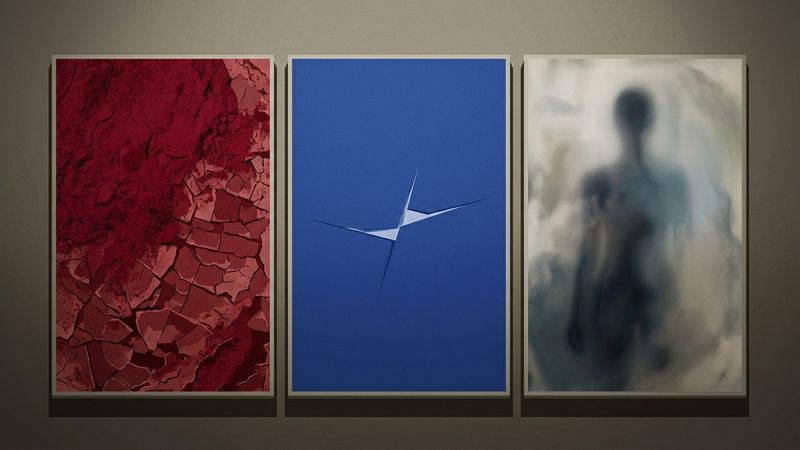
Karen Ohanyan: Delicate Matter at the National Gallery of Armenia
Exploring concealment, materiality, and memory in new triptychs
A review of the artist's latest survey, examining how layered wax and pigment transform painting into a site of quiet resistance.
Why Doha Is Full of Roundabouts
An old circle at a crossroads, sharpened by British road engineering, became the way an Arabian city found its way and remembered itself — and it took the bulldozers to reveal it.
In a city where a landmark was more useful than an address, Doha's roundabouts became its navigation, its landscaping and its national image all at once. Now they're being torn out for signalled junctions — and the affection for them arrived, as one scholar put it, only posthumously.
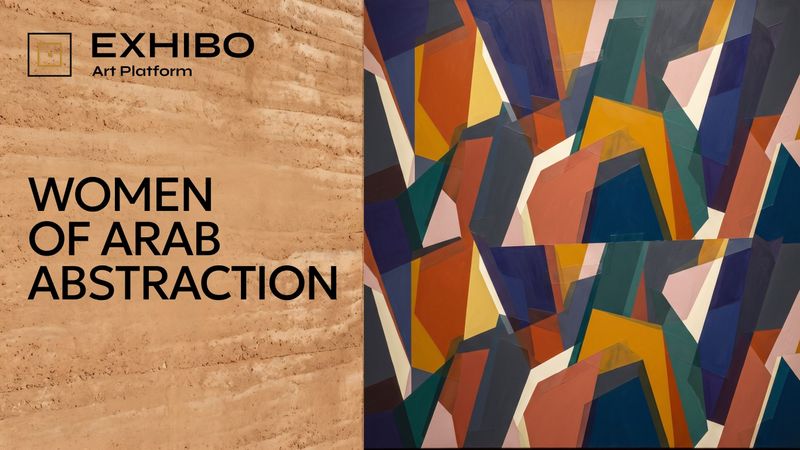
Women of Arab Abstraction
The letter set loose, the line woven, the arabesque the West once threw away — and the women who built modern abstraction out of all three, then got written out of it.
Abstraction is usually told as a Western invention that arrived elsewhere late. Saloua Raouda Choucair, Etel Adnan, Madiha Umar and a room of others tell it differently — often as the only woman in the movement, building modern form from the geometry, craft and calligraphy their own culture already held.