
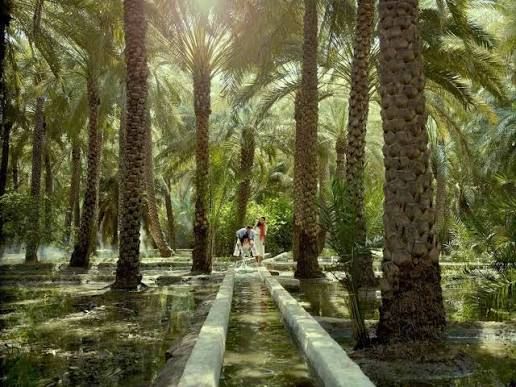
Al Ain Oasis & the Falaj Channels
147,000 date palms watered by channels dug three thousand years ago — and still running.
Al Ain Oasis covers roughly 1,200 hectares in the centre of Al Ain, ninety minutes from Abu Dhabi city, and holds about 147,000 date palms across up to 100 varieties alongside mango, fig, banana, orange and jujube. It became part of the UAE's first UNESCO World Heritage inscription in 2011, and opened as a curated visitor experience in 2016.
The reason for both the oasis and the city is water. Al Ain means the spring, and the settlement here is one of the world's oldest continuously inhabited places, with evidence of habitation going back over 4,000 years. What made that possible is the falaj: a network of gravity-fed irrigation channels carrying groundwater collected from the Hajar Mountains and Jabal Hafeet. Evidence suggests some falaj existed as early as 1000 BC, making them among the oldest irrigation systems anywhere; the two principal systems serving this oasis are named Al Aini and Dawood, each watering a different portion.
The channels are not a reconstruction. They run above ground for much of their length — visible as shallow open conduits alongside the paths, looking almost like concrete gutters — and they are still in daily use, irrigating working farms within the oasis. The sound of moving water is constant under the palm canopy, and is much of what the visit consists of.
Facilities added in 2016 include an eco-friendly Eco-Centre at the entrance with multimedia exhibits on how the oasis functions, plus an Oasis Garden, a Miniature Oasis and a dedicated Falaj Exhibition with a working model. Shaded pathways run throughout; there are eight gates, with the West Gate acting as the main information point and issuing a free map. Bicycles, quadricycles and electric scooters can be hired from around AED 30, and guided walking and buggy tours are available.
Entry is free. Note the water is untreated groundwater and not for drinking.
Exhibo editorial
Three thousand years is an abstraction until you hear it. Then you are on a path under the palms with a shallow channel running alongside your feet, water moving through it at a walking pace, and the abstraction turns into a sound — continuous, unremarkable, the exact sound someone standing here in 1000 BC would also have heard.
That is what separates this from every other heritage site in the emirate. Nothing here has been reconstructed for visitors. The falaj is still irrigating working farms, the palms are still producing dates, and the channels were engineered by people solving a problem rather than commemorating one — bring water from the Hajar Mountains to a place with none, using gravity and nothing else. The Eco-Centre will explain it properly and is worth twenty minutes. But go afterwards and just walk, ideally in the last hour before dark, and listen to the oldest working machine in the country doing its job.
How to find it
In the centre of Al Ain, roughly a 90-minute drive from Abu Dhabi city and five minutes from central Al Ain, near Al Ain Palace Museum and Al Ain National Museum. There are eight gates, but enter through the West Gate just north of Al Ain Palace Museum: it serves as the main information centre and hands out a free map. The Eco-Centre beside the entrance gives the historical and botanical grounding; the Falaj Exhibition holds a working model. Then walk the shaded paths and follow the open channels. Bicycles, quadricycles and scooters hire from around AED 30. Free entry and free parking, wheelchair and pram friendly. Avoid mid-afternoon; go early or after sunset, when there is also a light display.
Similar places
All places
News by Exhibo
Editorial coverage on Exhibo
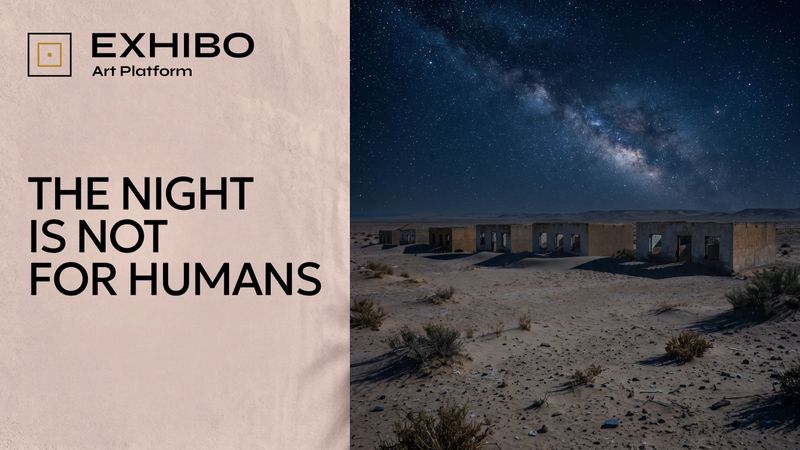
The Night Is Not for Humans: Umm Al Duwais and the Women of Emirati Folklore
A village half-buried in sand an hour from Dubai, a name that means "she of the little sickle," and what Emirati sources actually say.
The houses at Al Madam went up around 1980 and stood empty by the mid-1990s. People will tell you she lives there — not in the old stories, though. That attachment is recent, and it is the interesting part.
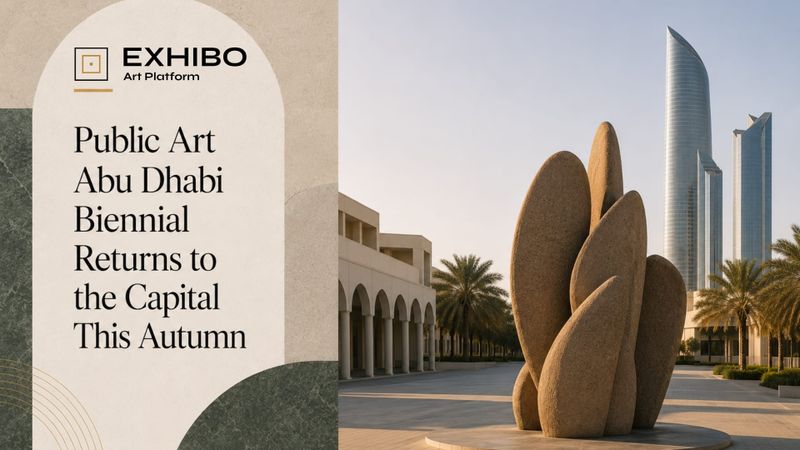
Public Art Abu Dhabi Biennial Returns to the Capital This Autumn
The second edition of the emirate-wide public art event opens in Al Ain in October and Abu Dhabi in November, led by former MACBA director Elvira Dyangani Ose under the theme "Home: A Glossary for a Communal Sense of Place."
The second edition of the Public Art Abu Dhabi Biennial opens in Al Ain on 23 October 2026 and in the capital on 15 November, running into February 2027. Curated by former MACBA director Elvira Dyangani Ose under the theme "Home: A Glossary for a Communal Sense of Place," the free, citywide programme builds on the acclaimed inaugural edition, several of whose works have since become permanent public installations.
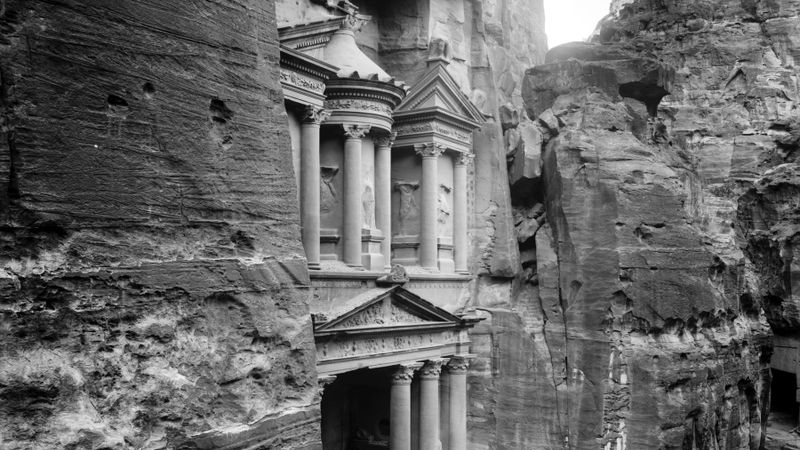
Filmed, but Not Recorded: The Arab World’s Missing Film Locations
Wikidata knows Gladiator was filmed in Morocco. It doesn’t know where.
Ouarzazate is the second most filmed place in the Middle East and North Africa, yet 25 of its 27 productions are recorded only in Wikipedia prose. We compared filming records worldwide and found that in the Arab world, Wikidata usually knows the country but not the place.