Al Bateen & Al KhalidiyaAbu Dhabi
ADNOC Headquarters
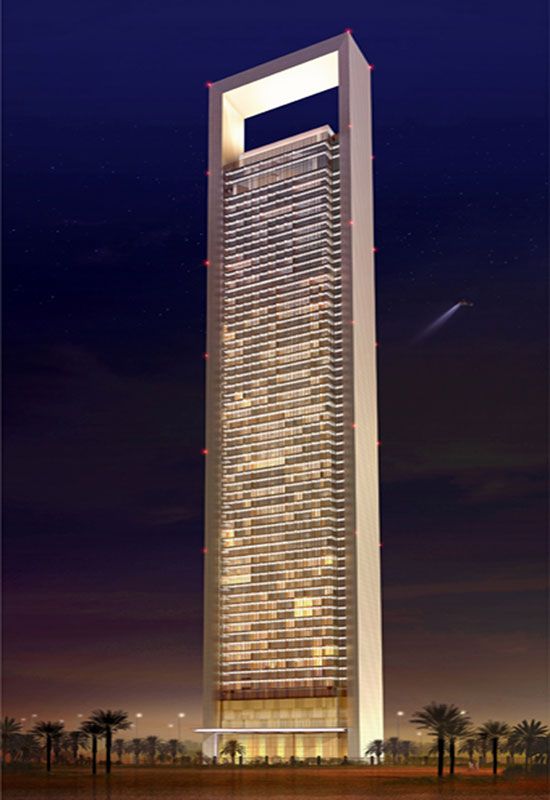
342 metres of granite-framed restraint on the Corniche — a monumental arch standing against the Gulf.
The ADNOC Headquarters is a 342-metre, 75-storey tower on the western Corniche, and one of the tallest buildings in the United Arab Emirates. It is the head office of the Abu Dhabi National Oil Company; staff moved in between April and September 2016, with the building fully operational by 2017.
It was designed by HOK, with Pascall+Watson providing architectural design management and detailed drawings, CH2M as architect of record, and Six Construct of the BESIX Group as main contractor. Construction started in 2009. The tower holds roughly 190,000 square metres of floor space and accommodates around 4,000 employees; the wider complex includes a Corniche club, a crisis management centre and a heritage museum.
The design is deliberately austere. HOK's architects have described a less is more philosophy set consciously against what they call the twisting, turning shape buildings elsewhere in the city. The plan is a parallelogram, chosen for solar orientation: the north side faces the water and is fully glazed, taking advantage of limited direct sun, while the south façade carries a double-skin glazed exterior that filters daylight and blocks heat. Most public functions — conference rooms, reception, service spaces — are zoned towards the south.
The exterior frame is clad in granite for permanence, and rises past the top of the occupied mass to a free-standing architrave, so the tower reads from a distance as a monumental arch beside the Arabian Gulf. The north entrance is sheltered by a large stainless-steel canopy carried on a single column, patterned with aluminium elements repeating the building's triangular and parallelogram geometry. The building carries LEED Gold certification. It is a working corporate headquarters and not open to the public; it is experienced from the Corniche and the surrounding waterfront.
Exhibo editorial
Abu Dhabi spent two decades being told it should be more like its neighbour up the coast — more twist, more crown, more silhouette. This is the building that declines. Straight sides, granite, one clean rectangular hole punched through the top, and nothing else asking for your attention.
What the restraint buys is legibility from three kilometres away. Walk the Corniche at dusk with the Gulf on your left and the tower simply holds its position on the skyline while everything around it fusses — and that opening at the top, which does no structural work and houses nobody, turns out to be the whole idea. It frames sky. On a clear evening you can watch the colour change inside the aperture like it is a window someone left open in an otherwise sealed building. A state oil company built itself a monument and had the discipline to make it quiet. That is rarer than it sounds.
How to find it
On Corniche Road West at the Al Bateen end, between the Corniche waterfront and Sheikh Zayed the First (Electra) Street, close to Emirates Palace and Marina Mall. The best views are from the Corniche promenade and cycle path directly opposite — walk far enough west that the full height and the open architrave at the top read against the sky. Bus routes 11, 34 and 63 stop nearby. The building is a private corporate headquarters with no public interior access.
Similar places
All places
News by Exhibo
Editorial coverage on Exhibo
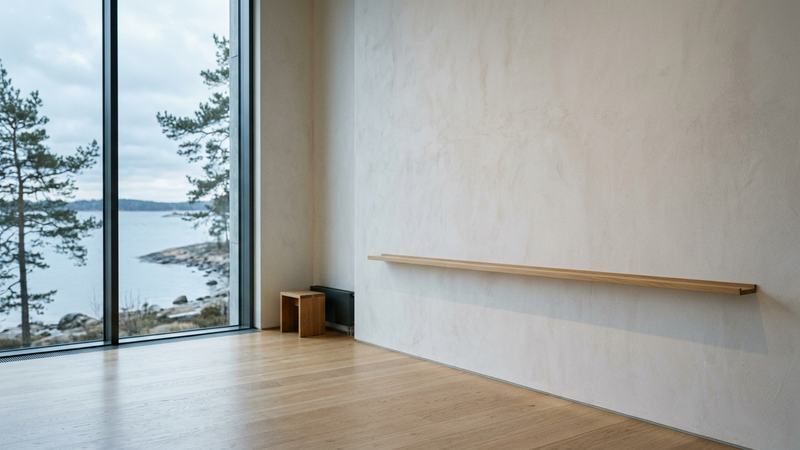
Nordic and Scandinavian Art
Viking carving to Golden Age light, national romantic myth and early modern museums, mapped through named museum holdings
Scandinavian art history runs from Viking animal ornament through Danish Golden Age painting, national romanticism and early modern experiments. This museum map names periods, painters and rooms in Oslo, Copenhagen, Stockholm and Helsinki, and leaves furniture-shop “Scandi style” to a different search intent.
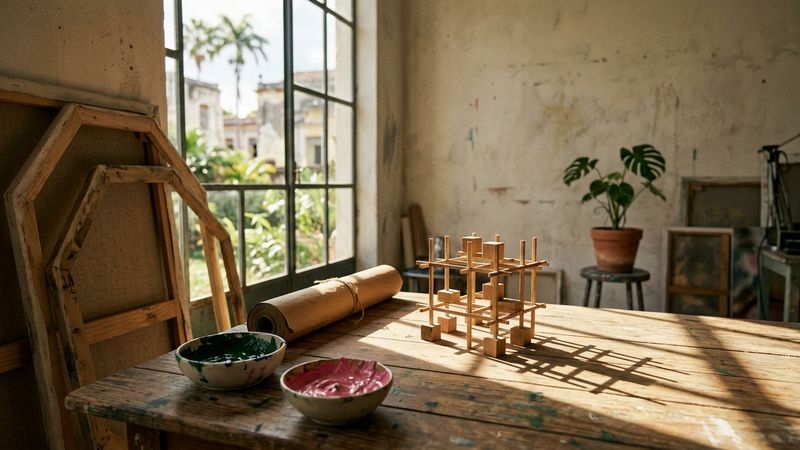
Latin American Modernism
From São Paulo’s 1922 Week and Antropofagia to Torres-García, Madí, Lam and neo-concrete colour: modernisms south of the US border
Latin American modernism is a cluster of twentieth-century programmes, not one school. This guide maps Brazilian Antropofagia, Río de la Plata constructivism, Caribbean Afro-Atlantic painting and later concrete and kinetic work, with named museum holdings and a visit chronology.
Indian Art: A History
Indus seals, Buddhist sculpture, temple towers and court painting on the subcontinent, from Harappa to the Bengal School
Indian art history tracks Indus urban craft, Buddhist stupas and Gupta Buddhas, Hindu temple programmes and court miniatures across the subcontinent. Named works in Delhi, Karachi, Sarnath, Thanjavur, London and New York show how patronage and ritual shaped form without collapsing into one national style.