Saadiyat Cultural DistrictAbu Dhabi
Abrahamic Family House
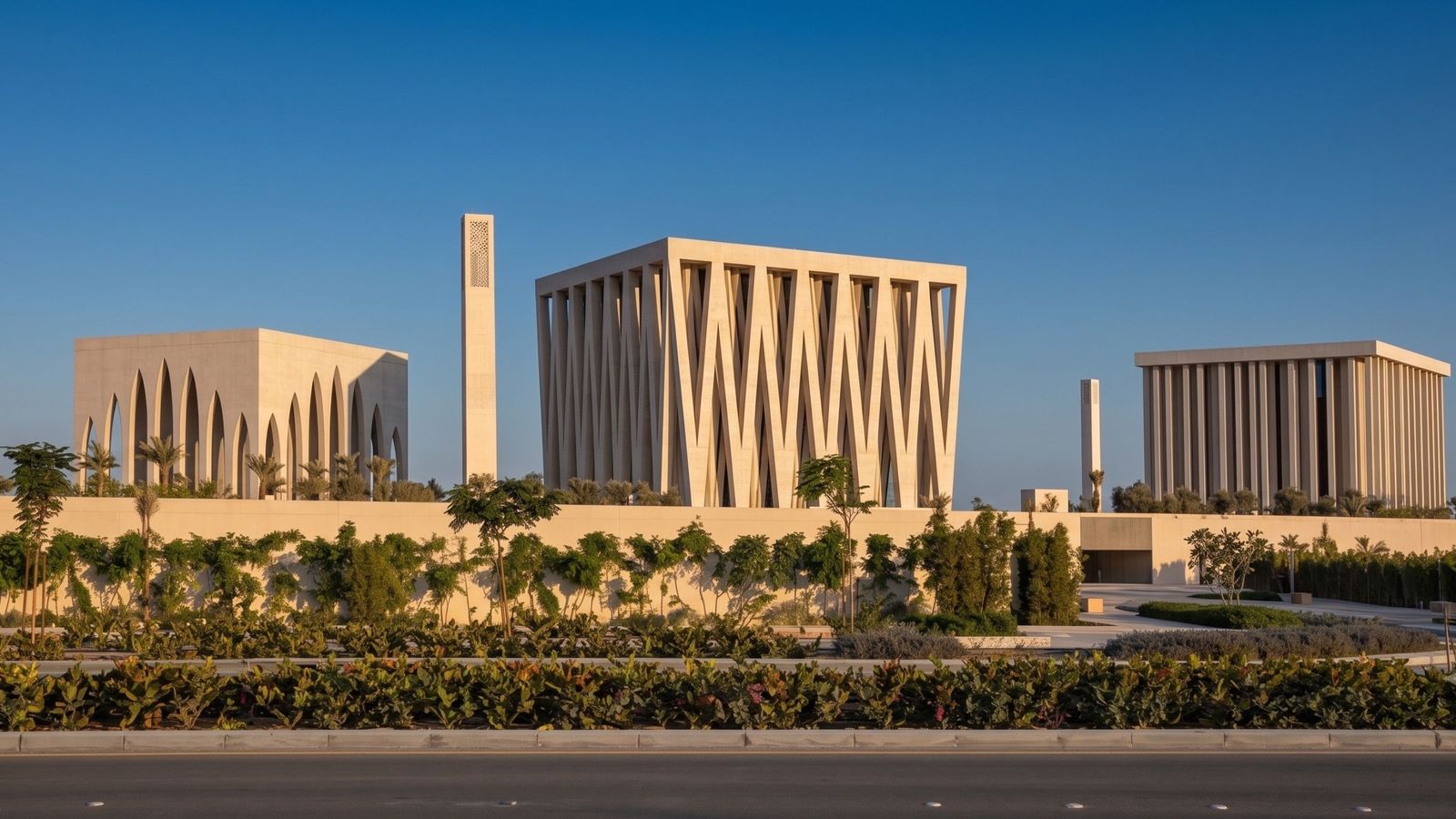
A mosque, a church and a synagogue as three identical 30-metre cubes — equality argued in Omani limestone.
The Abrahamic Family House is an interfaith complex in the Saadiyat Cultural District, comprising three separate houses of worship — the Eminence Ahmed El-Tayeb Mosque, His Holiness Francis Church and the Moses Ben Maimon Synagogue — together with a secular forum, gardens and visitor centre. It was inaugurated on 16 February 2023 and opened to visitors on 1 March 2023.
The complex was designed by Adjaye Associates under Sir David Adjaye, selected through an international competition, with Arup as façade advisor and Arcadis on the project. Its origins lie in the 2019 visit of Pope Francis to Abu Dhabi, when he and the Grand Imam of Al-Azhar, Dr Ahmed Al-Tayeb, signed the Document on Human Fraternity; the UAE government commissioned the complex to commemorate that agreement. Construction began in 2019, with the site covering roughly 6,500 to 7,700 square metres.
The governing architectural idea is equality of form. The three houses of worship sit on a single one-storey plinth arranged around a central welcoming forum, and each takes the shape of a cube measuring exactly thirty metres deep, thirty metres wide and thirty metres tall. All three are built from the same palette — Omani limestone, oak, and an off-white concrete made with aggregate quarried from Saadiyat itself — so that no building is materially privileged over another.
Within that shared frame, each structure is articulated differently and oriented to its own religious requirements: the church presents a façade of towering columns, and each house has its own courtyard with a water feature and fruit trees — lemons for the mosque, oranges for the church, pomegranates for the synagogue. All signage throughout the complex is in Arabic, English and Hebrew.
The central forum functions as a visitor experience centre with an immersive exhibition, and hosts discussions and conferences. Daily guided tours explain the design decisions specific to each faith's practices. Worshippers of each faith use the buildings for services; visitors of any belief are welcome. Entry is free, and booking is recommended; modest dress is required.
Exhibo editorial
Three buildings, one measurement. That is the entire argument, and it is made before you have read a single panel or joined a single tour — thirty metres by thirty by thirty, three times over, in the same stone, on the same plinth. Architecture rarely gets to make a claim this bluntly. Usually it hedges.
What is easy to miss on a quick visit is how much work the differences are doing inside that equality. The cubes match; almost nothing else does. Orientation, light, the way each courtyard handles water, the fruit trees — lemon, orange, pomegranate — that quietly tell you which building you are standing in before you look up. It is a design that refuses the two easy options, which are to blend the three faiths into one bland ecumenical mush or to rank them by scale and position. Neither happens here. Go in the late afternoon when the limestone warms up, take all three, and give yourself time in the gardens between; the space between the cubes is doing as much as the cubes.
How to find it
On Jacques Chirac Street in the Saadiyat Cultural District, a short drive from the Louvre Abu Dhabi and Manarat Al Saadiyat. Enter via the visitor entrance to the central forum, which sits at plinth level between the three cubes and functions as the welcome and exhibition space — from there, all three houses of worship are reached on foot. Bus route 94 serves the site. Book a slot or a guided tour in advance; entry is free. Dress modestly, and check prayer and service times if you want to see a particular building at a quiet hour.
Similar places
All places
News by Exhibo
Editorial coverage on Exhibo
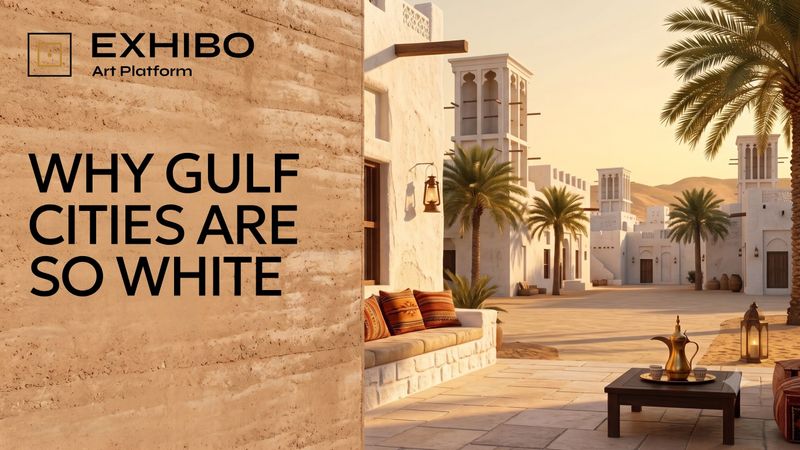
Why Gulf Cities Are So White
The dazzling white of Gulf cities looks like simple physics — sunlight, reflected. The real story runs through coral, lime, faith, oil and the way traditions acquire their reasons after the fact.
Everyone knows why Gulf cities are white: white reflects the sun. It isn't wrong — it's just one strand of a much thicker rope. Follow it back through coral walls and lime skins, a sustainability code that never mentions colour, and a desert that was never really dark and the tidy explanation starts to look like something we tell ourselves afterward.
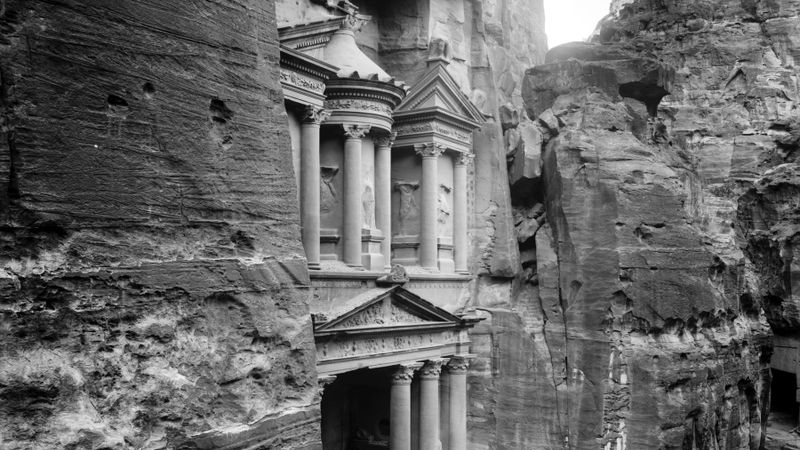
Filmed, but Not Recorded: The Arab World’s Missing Film Locations
Wikidata knows Gladiator was filmed in Morocco. It doesn’t know where.
Ouarzazate is the second most filmed place in the Middle East and North Africa, yet 25 of its 27 productions are recorded only in Wikipedia prose. We compared filming records worldwide and found that in the Arab world, Wikidata usually knows the country but not the place.
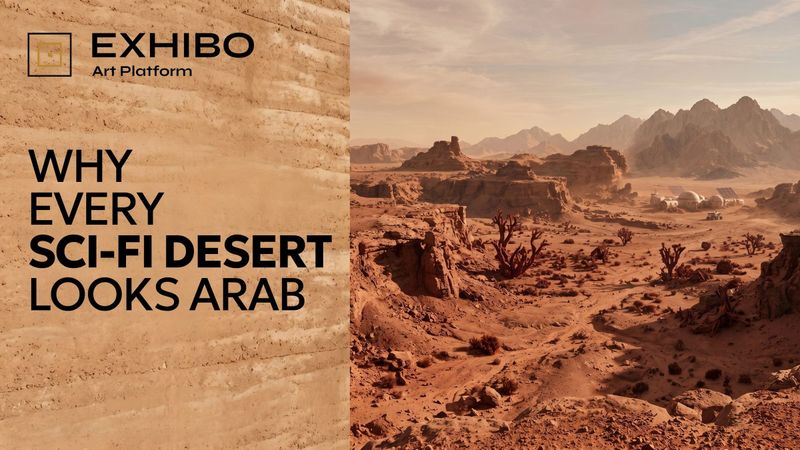
Why Every Sci-Fi Desert Looks Arab
From Arrakis to Tatooine, when a film wants a desert to feel ancient, prophetic and alien, it reaches for an Arab and Berber vocabulary — and reveals more about the West that built it than the region it borrows from.
The wrapped faces, the trilling women, the barely-displaced Arabic: cinema's alien deserts keep sounding Arab. But the vocabulary was assembled in the West — from Orientalist painting to Lawrence to Dune — and it says more about who is looking than about anyone being looked at.