
Tunis · Tunisia
Why Every Sci-Fi Desert Looks Arab
From Arrakis to Tatooine, when a film wants a desert to feel ancient, prophetic and alien, it reaches for an Arab and Berber vocabulary — and reveals more about the West that built it than the region it borrows from.
Paul Atreides lands on the desert planet and a crowd comes out to meet him. They are wrapped head to foot against the sun, faces covered, eyes narrowed. Somewhere in the back, women send up a high trilling ululation — the sound you have heard at weddings in Amman or Cairo, transplanted now to a world that is meant to be twenty thousand years in the future and unimaginably far away. The people speak a constructed language built, in part, from displaced Arabic. They are waiting for a messiah. He has blue eyes and an English name and he was born on a green planet very far from here, and by the end of the story he will lead them.
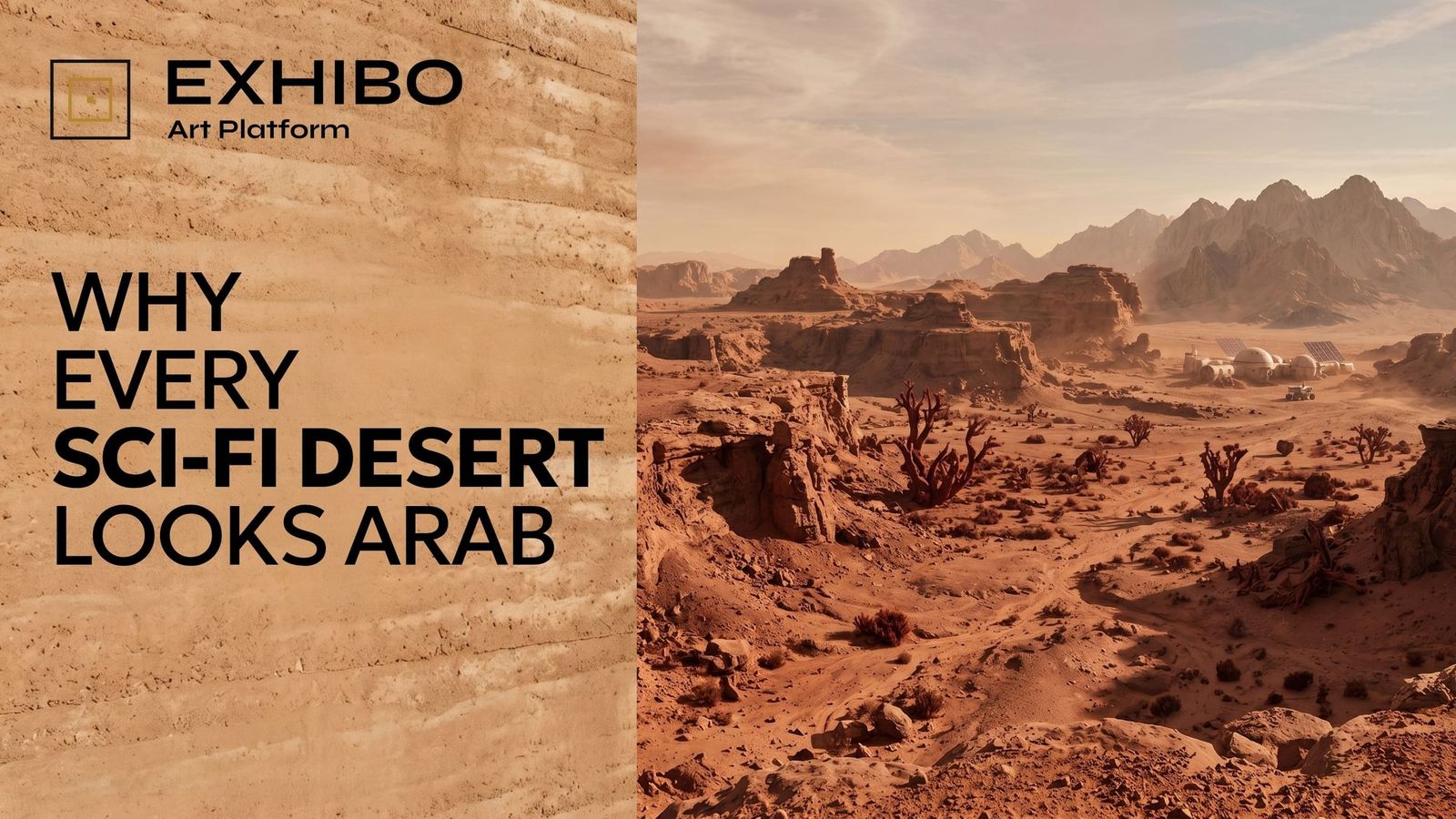
You have seen this before. Not this film — Dune: Part Two, more than $700 million at the global box office, shot across Hungary, Italy, Jordan and Abu Dhabi — but this scene, this grammar, this way of signalling to a Western audience that we have arrived somewhere alien. The wrapped faces. The trilling women. The prophet-hungry natives. The barely-displaced Arabic. Not every sci-fi desert works this way — the wastelands of Mad Max are unmistakably Australian, and plenty of post-apocalyptic Earths are just the American Southwest with the colour drained out. But there is a particular job the desert is asked to do — to read as ancient, prophetic, nomadic, and culturally elsewhere — and when a film reaches for that, it reaches, again and again, for the visual and sonic vocabulary of the Arab and Berber deserts: the robes, the dunes, the call-to-prayer melisma bent slightly out of true. The sci-fi desert-of-otherness is one of the most durable sets in the genre, and it is very often, underneath the prosthetics, North African or Arabian.
The obvious explanation is that deserts look like deserts, and there are a lot of them in the Middle East, and film crews go where the sand is. That is true, and it is not the interesting part. Because the resemblance is not only geographic — it is cultural, linguistic, sonic, and it survives even when no real desert is involved. The costumes stay Bedouin when the film is shot on a soundstage. The language stays Arabic-derived when the planet is invented from scratch. The music stays "Eastern" when there is no East within a thousand light-years of the plot. Something is being borrowed that has nothing to do with where the cameras physically stood.
What is being borrowed is not the Arab world. It is a Western idea of the Arab world, assembled over two centuries and handed down through painting, through the Bible epic, through one British film about one British officer, and finally into a genre that thinks it is imagining the future while it is mostly recycling the past. The sci-fi desert looks Arab for the same reason the nineteenth-century salon painting looked Arab: because "the East" was long ago turned into a stockroom of otherness the West could shop in. The desert planet is the newest room in a very old building.
The language gives it away
Start with the thing hiding in plain hearing: the words.
The Fremen of Dune — the desert-dwelling natives of the planet Arrakis — do not speak a vaguely exotic gibberish. In Frank Herbert's novels they speak a tongue whose vocabulary the linguist Karin Ryding, in her study "The Arabic of Dune," traces overwhelmingly to Arabic — dozens of terms, many of them drawn straight from Islam: ijaz (prophecy), istislah (natural law), ilm (knowledge, theology), karama (miracle), jihad, Mahdi. Paul's messianic title, Lisan al-Gaib, is Arabic for "the tongue of the unseen." Muad'Dib plays on the Arabic for one who teaches manners (Herbert layered it, too, with a desert mouse). The giant sandworm, Shai-Hulud, sits close to the Arabic for "thing of eternity." It is not decoration around the edges; it is the linguistic bedrock of the desert culture, and Herbert built it deliberately.
And in the novel it goes deeper than a vocabulary list, into the specific and the recent. When Herbert's Fremen roar their battle cry — which he glossed as "Long live the fighters!" — the words he gave them are "Ya hya chouhada," his Frenchified spelling of an Arabic phrase that translates, more literally, as "long live the martyrs." It was not invented. It echoes a real chant from the Algerian war of independence against France, which ended in 1962 — three years before Dune was published. As the anthropologist Manvir Singh has noted, that single line, more than any other, ties the Fremen's struggle to real anti-colonial history, turning them from outer-space sand people into portraits of anti-imperialism. The name "Fremen" itself — free men — carries some of the same charge, and the desert culture draws, alongside the Bedouin, on Amazigh and Tuareg traditions of the Sahara.
Which makes what the films did with it so telling — but hold that thought, because it belongs later. For now the point is simply that the source material's borrowing was real, specific, and historically pointed. Herbert's engagement with Arabic was unusually sustained for American science fiction of its period, and the scholar Hoda Zaki — writing in a 1994 collection of Arab-American and Arab-Canadian feminist essays — grants that his Fremen are a long way from the mid-century Hollywood Arab, the figure Edward Said catalogued as "camel-riding, terroristic, hook-nosed, venal". The Fremen are brave, disciplined, spiritually serious, and they win. If you are going to be borrowed, there are worse ways.
But borrowed you still are. The critic Istvan Csicsery-Ronay put the mechanism precisely: Herbert uses Arabic "uncritically," as a supply of "foreign neologisms to create exotic effects," trading on the ignorance of an American readership that would hear ayat and jihad as thrilling alien textures rather than as living words from a living faith. The language is real. The reverence is not transferred with it. Arabic becomes a paint.
The costume gives it away too
If Dune is the literary source code, Star Wars is where the desert planet became a mass-market default — and George Lucas was, to his credit, entirely open about where he shopped.
The Tusken Raiders of Tatooine, the nomadic desert people who nearly kill Luke Skywalker, were designed from photographs of Bedouins — a debt Lucas himself acknowledged, and one his design process makes explicit: take something recognisable, then alter it just enough to read as new. The head-to-toe wrapping that never comes off in public; the nomadic raiding; the harsh honour culture — all of it lifted from a Western image of desert Arabs and given tusks.
And then the planet's very name. Tatooine was filmed in southern Tunisia, and it is named after a real Tunisian town, Tataouine — a name widely traced to the Amazigh (Tamazight) word Tiṭṭawin, "eyes" or "springs." The nearby canyon where Lucas shot his chase scenes is now marked on maps as Star Wars Canyon. The layering is total: the landscape is Tunisian, the name is Berber, the raiders' aesthetic is Bedouin, and the whole thing is presented as a galaxy far, far away. (I've written elsewhere in this series about what that did to the Tunisian towns left holding the sets; here I want to stay with the pattern rather than the place.)
There is a detail from the Star Wars story I keep returning to, because it compresses the whole argument. In 1995 the archaeologist David West Reynolds — who would later go to work for Lucasfilm — travelled to Tunisia to rediscover the original film sites, nearly two decades after the shoot. Watching local Berber men move through the same landscape, he reached for the only frame he had: "these Berbers might as well have been Jawas," he told an interviewer years later — the real inhabitants of the place read, to him, as the aliens the film had invented there. And the invention had been literal: on the original shoot the production dressed local Tunisians, including children, in Jawa costumes and filmed them as the scavenging desert creatures. So the sequence runs like this: come to the real place, dress its real people as extraterrestrials, film them, take the footage home — and the alien image travels back so completely that, decades on, the actual inhabitants can look like a visiting fan's idea of the creatures. The costume swallowed the person wearing it. That is not a metaphor. It happened, on location, with a wardrobe department.
And the film did to the Tuskens what the crew did to the extras. The Tusken Raiders are called, in the film and by fans, "Sand People" — a name that reduces an entire people to the terrain they live on. They were given no language of their own; their distinctive howl was built, as the production histories record, from the brays of a donkey worked over by the sound designer. In the original film they attack the hero with little motive or interiority and vanish. A people modelled on the Bedouin were put on screen without speech, without much reason, without faces — the desert's inhabitants reduced to a hazard of the landscape, like heat or thirst. (Later Star Wars would go back and give the Tuskens culture, language and grievance; the first film did not.) You can love Star Wars — I do — and still notice that its first desert planet learned the oldest lesson of the Orientalist stage a little too well: the natives are scenery that occasionally turns dangerous.
Where the idea actually comes from
None of this began with a camera. To understand why the desert reads as other world rather than simply as other place, you have to go back before film — to the point where "the East" was first built as an imaginative territory, and to the critic who gave that process its most influential name.
In 1978 the literary critic Edward Said published Orientalism, and its opening pages still describe the machine better than anything since. "The Orient was almost a European invention," he wrote, "and had been since antiquity a place of romance, exotic beings, haunting memories and landscapes, remarkable experiences." Not a real place that Europe described — a construction Europe needed, a screen onto which the West could project everything it was not, and thereby work out what it was. Said called it "one of its deepest and most recurring images of the Other." And he reached, tellingly, for the language of theatre: in the Orientalist imagination, he wrote, the Orient becomes "the stage on which the whole East is confined." A stage. A set. The vocabulary was cinematic decades before it was applied to cinema.
The desert had a special place on that stage, and it was set-dressed long before Hollywood. Orientalist painters worked every subject — cities, markets, interiors, battle scenes, crowded caravans — but one of the recurring images they left the West was the desert as a vast, timeless, sparsely peopled space: dangerous, magnificently barren, a land imagined as outside modernity and therefore available for projection. Never mind that the actual desert held Bedouin tribes with intricate social systems and trade networks running across it. The empty desert was more useful than the inhabited one. Emptiness is projectable. You cannot make a fresh world out of a place that visibly already belongs to someone.
Then the Bible epic took that painted desert and made it move. Cecil B. DeMille's The Ten Commandments, the wide-screen historical spectacles of the 1950s, helped consolidate a mass audience's habit of reading sand-and-robes as the deep past, the sacred, the site of prophecy and law — the Holy Land as a kind of permanent film set, standing in for the whole ancient Middle East. The desert became the place where God speaks and civilisations rise and fall, ancient and grand and not-quite-real. Which is precisely the emotional register a science-fiction desert planet wants: somewhere old and vast and portentous, where a prophecy might land.
That same period taught the audience the people, too, and less kindly. The film scholar Jack Shaheen spent a career cataloguing how Hollywood drew Arabs across the twentieth century, screening on the order of a thousand films for Reel Bad Arabs, and found the same handful of figures repeating almost without exception: the bandit, the fanatic, the lecherous sheikh, the veiled and voiceless woman, the mob. The desert epic and the sword-and-sandal spectacle ran the reel; by the time science fiction arrived, its audience already knew, in its bones, what a desert full of robed strangers was supposed to mean. The genre did not have to build the association. It inherited it, fully formed, and only had to add spaceships.
And between the Bible epic and the space opera sits one film, doing more connective work than any other. David Lean's Lawrence of Arabia (1962) took the Orientalist desert, shot it in 70mm with a genius's eye, and made it the definitive cinematic image of the sublime, dangerous, transfiguring wasteland — the place where a European goes to lose and remake himself among noble, volatile desert tribesmen. Some of the links from here forward are documented influence: Frank Herbert, writing Dune across the same years, drew on Lawrence directly, and the parallels between Paul Atreides and T. E. Lawrence — the outsider who goes native, masters the desert, and leads its people to a victory that is also a kind of appropriation — are close enough that critics treat Lawrence as one of the book's primary sources. Lucas, in turn, cited Lawrence as a visual model for Star Wars. Other links are looser — a shared inheritance rather than a documented borrowing: the painters did not "cause" DeMille, and DeMille did not hand Herbert his desert. But each generation inherited roughly the same desert — old, empty, chargeable with meaning, populated by people who exist mostly to be led — and passed it on a little further from any real place, until what remained was close to pure grammar. A way of shooting sand that means elsewhere.
I've traced that as a genealogy, which is an argument, not a proof — no single film mechanically produced the next. The strongest links (Lawrence into Dune, Lawrence into Star Wars) are stated by the makers themselves; the larger inheritance is my reading of a family resemblance that becomes hard to miss once you are looking for it.
The sound is stranger than the sight
The most revealing part of the pattern is the one you notice last, because it works on you below the level of attention: the music.
When a film wants a scene to feel like the arid, mysterious East — desert, ancient ruins, a bazaar, an alien planet of sand — it reaches for a small kit of instruments and gestures. A wailing, wordless female vocal. A low double-reed pipe with a mournful, breathy tone. Percussion that sounds hand-struck. Melodies that slide between the notes of the Western scale, bending pitch in a way that reads, instantly, as not here. This is so established that composers treat it as a preset. Through the 2000s many a historical epic set anywhere near the Mediterranean — Gladiator, Troy, The Passion of the Christ — opened the same envelope: the wailing woman, the pipe, the bent note.
Here is the joke, and it is a sharp one. That mournful double-reed pipe, one of the instruments Hollywood reaches for most reliably to signify Arabian desert, is frequently the duduk — which is Armenian. Armenia has no desert. The point is not that the instrument is somehow disqualified from the region — it is that an instrument with a specific Armenian history keeps getting detached from that history and made to stand for a generic, placeless "East," its misuse in sand scenes genuinely confusing to Armenians and Arabs alike. The Iranian composer Farya Faraji, who makes a study of this, calls screen "Middle Eastern" music what it usually is: a hodgepodge of instruments and styles from unrelated cultures, assembled to satisfy a Western expectation rather than to represent any real tradition. Scholars of film sound have a phrase for the effect being chased — the "sonic construction of foreignness" — a timbre exotic enough to signal difference and recognisable enough not to lose the ticket-buyer.
Sit with what that means. The "Arab" desert of the sci-fi film is often not even musically Arab. It is a composite of borrowed sounds — an Armenian pipe, a generic ululation, a vaguely Eastern-sounding melodic inflection detached from any particular maqam tradition — glued together to trigger a single association in an audience that will never check. A note bent between the semitones of the Western scale reads as other to a Western ear not because it is alien but because it is unfamiliar — and the two get quietly confused, so that the sound of a living musical civilisation becomes shorthand for the inhuman. Which is the clearest possible evidence for the thing this whole essay is circling: the point was never accuracy about the Arab world. The point was a feeling of the Arab world, and the feeling can be manufactured from parts that have nothing to do with it. As the scholar Hamid Dabashi put it, cutting to the bone: Hollywood Orientalism "is not about the Arab world. It is about the American world." The desert is a mirror the West holds up to itself and mistakes for a window.
Follow the money, but not too far
There is a materialist objection to all of this, and it deserves an honest hearing, because it is partly correct.
Films get shot in MENA deserts, the objection runs, not because of some deep Orientalist current but because of spreadsheets. And the spreadsheets are real, and by 2026 they are enormous. Jordan runs a scalable cash rebate of 25 to 45%. Abu Dhabi — effectively the UAE's film rebate — pays 35% and climbs, on a points system, to 50%. Morocco offers 30%, Egypt 30%, Tunisia a VAT exemption; and in May 2026 Saudi Arabia's Film Commission raised its national rebate to as much as 60% of eligible spend, the highest headline rate in the region, with Film AlUla and NEOM running their own schemes alongside it. Ouarzazate in Morocco — "the Hollywood of the desert" — keeps standing sets that can dress, on demand, as Egyptian temples, biblical streets or Roman amphitheatres. The head of production services at Jordan's film commission makes the pitch with disarming clarity: "We don't ask for a script," he told Variety — no red lines, permits issued fast. The region is not a passive victim of the Western lens. It is actively, competitively selling itself as the world's most convenient elsewhere.
All true. And it explains something real — where the cameras go. It explains why a given production lands in Wadi Rum rather than Death Valley, why "Mars" is so often Jordan and "Arrakis" so often the Empty Quarter of Abu Dhabi. What it does not explain is the thing this essay is actually about: why the invented world, once you get there, is dressed and scored and languaged as Arab even when the plot has no Arabs in it and the rebate would have paid out just the same for a neutral set of robes and a made-up tongue with no Arabic in it at all. The economics answer where you shoot. They are silent on why it sounds like a call to prayer. Those are two different questions, and collapsing them lets the more interesting one off the hook. The money brings the crew to the sand. It does not tell them to make the aliens Muslim.
That standing set at Ouarzazate, though — the one that plays Egyptian temple on Monday and biblical street on Tuesday and Roman ruin on Wednesday — is worth holding onto as an image. It is Said's stage, built in plywood and staff, in the actual desert, earning an actual rebate. The whole East, confined to one back lot, dressed each morning for whichever past or future has booked the day.
The people, and the paint
The sharpest version of the problem is not that the desert is borrowed. It is what happens to the people who live in it, and the pattern there is consistent enough to state as a rule: the culture is good enough to wear; the people are not good enough to cast.
Villeneuve's Dune is the case that brought this into the open, precisely because the films are so good and so evidently sincere. They were widely praised — including by many Muslim and Arab viewers, and it would be dishonest to pretend otherwise. But the criticism that gathered around them is not easily waved off, and it starts with the two excisions I set aside earlier. In adapting the book, the films quietly sanded away its most explicitly Islamic and anti-colonial edges: Herbert's jihad became the blander "holy war," and the Fremen battle cry Ya hya chouhada — that real echo of Algerian independence — was replaced with a newly invented phrase with no Arabic in it, reportedly for "believability". Enough Islamic texture stayed to flavour the aesthetic; the specific line connecting the desert people to a real anti-imperial struggle did not. Even the borrowed Arabic, in other words, got abstracted one more step into sci-fi texture.
And the casting told its own story. The principal Fremen — the film's Arab-and-Amazigh-coded desert people — were played overwhelmingly by non-MENA actors: Javier Bardem as Stilgar, Zendaya and Rebecca Ferguson among the leads on the sand. The wider cast is strikingly diverse — Latino, African, Asian, European faces throughout — and the production noted a number of MENA performers among the Fremen (the Swiss-Tunisian actress Souheila Yacoub among them). But representation among the speaking, central Fremen roles stayed thin, in a story whose language, dress, faith and music are built on the region.
The casting director Serena Rasoul, who founded a Muslim American casting agency, named the sting of it exactly: "You don't cast MENA or Muslim actors, yet you profit off their culture," she said. "That's where it's painful for us as creatives… It means that we are not good enough to be part of the film." Ali Karjoo-Ravary, a scholar of Islamic studies, set the recurring image — the veiled, wailing crowd, especially when the camera pairs it with violence — in its longer lineage: it has, he wrote, "a history that is steeped in the dehumanization of entire peoples." The garb, the tongue, the ululation, the architecture — all welcome on screen. The human beings those things belong to — extras, at most, in someone else's story. It is the Tunisians-in-Jawa-costumes problem, promoted to a $400 million franchise. Said saw it coming half a century ago, in a line that reads now like a review of a film not yet made: "Orientals were rarely seen or looked at; they were seen through."
I want to be careful here, because the honest picture has more than one colour in it, and the flattening cuts both ways. Dune is not a simple act of theft. It is also, as the writer Haris Durrani — a Muslim scholar who loves the book — argues, a work through which many people from the region and the faith have felt genuinely seen; its Arabic-influenced text was deep enough that some native Arabic speakers, reading the translation, did not clock how much of the original was built from their own language until they checked. Herbert drew on more than the Arab world, too — on Indigenous North American cultures, among others — and the story is, at its core, an anti-colonial one, suspicious of the very white saviour it hands us. Even Dabashi, no soft touch, lands somewhere bracing and unexpected: the white saviour who looks like Timothée Chalamet is ultimately a Western fantasy about the West itself, and it tells you more about the people who made it than about the people it borrows from. The desert is a story the West keeps telling itself. The people who actually live there were never really the audience.
The desert answers back
Which is the turn worth ending on, because it is happening now, and it changes what the pattern means going forward.
For a century the Arab and Berber desert has been, in Western cinema, a place things are done to — surveyed, dressed, scored, emptied of its people so it can be filled with someone else's meaning. But a desert is only a blank slate to someone who does not live on it. To the people who do, it is home, with its own language and music and — increasingly — its own cameras. And the genre that borrowed the desert most heavily is precisely the one the region is now taking up for itself.
There is a growing body of Arab science fiction that reaches for the tools of the genre and turns them back around. The Iraqi novelist Ahmed Saadawi's Frankenstein in Baghdad rebuilds a horror-SF archetype out of the debris of occupation. The Palestinian artist Larissa Sansour's film Nation Estate imagines all of Palestine compressed into a single skyscraper, each city its own floor — science fiction's clean futurist surfaces enlisted, deliberately, to speak about dispossession from the inside. Scholars have started calling this what it is: science fiction by, about, and for Arabs, a deliberate reclaiming of the imaginative territory that Orientalism fenced off.
And the industry underneath it is no longer notional. The Saudi director Meshal Aljaser made Naga, a desert thriller with a creature-feature spine, and an earlier short pointedly titled Arabian Alien. The Saudi filmmaker Shahad Ameen makes mythic, water-and-sand parables with young women at their centre — the desert not as a blank stage for a foreign prophet but as a home with its own gods and grievances. The Red Sea International Film Festival and Film AlUla now run their talent showcases with photoshoots staged among the Nabataean tombs of Hegra — the same monumental desert that, elsewhere in this series, I watched get carved into a film set for outsiders. The Jordanian writer-director Zain Duraie, named among Screen International's Arab Stars of Tomorrow, is one of a cohort of new regional filmmakers working the same desert their country long rented out to others. And the money is following the talent, not only the scenery: the Arab Cinema Center's 2025 industry list runs to more than a hundred names, with Egypt alone fielding over forty — a working ecosystem, not a location register. The desert that Hollywood shot as an empty elsewhere is filling, on screen, with the people who were always standing just outside the frame.
So go back to Paul Atreides landing among the wrapped, trilling crowd. For most of a century that shot has run one way: the outsider arrives, and the desert and its people arrange themselves around his story, speaking a borrowed version of a real language, wearing a borrowed version of real clothes, waiting to be led. The camera looked at them and saw a set. What is changing — slowly, unevenly, one Saudi thriller and one Palestinian art film at a time — is who is holding the camera. And when the people in the robes are the ones who wrote the scene, the desert stops being a mirror the West holds up to itself. It goes back to being a place. Which is what it was the whole time, under the paint, while everyone was busy seeing through it.
Related reading
The Real Aladdin: The Story That Belonged to No Country
Aladdin has no Arabic manuscript older than its French translation. Behind the gap stands a young man from Aleppo, catalogued for a century as anonymous.
The most famous "Arabian" tale in the world is missing from the oldest Arabic manuscript of the Thousand and One Nights — because before a French translator wrote it down in Paris, there was no manuscript of it to be missing from.
The Fruit We Are Sure We Recognize
How the pomegranate became one of the most confidently named motifs in Islamic ornament — and one of the least confidently identified — across a thousand years of tile, silk and stucco, with meanings we mostly attached later.
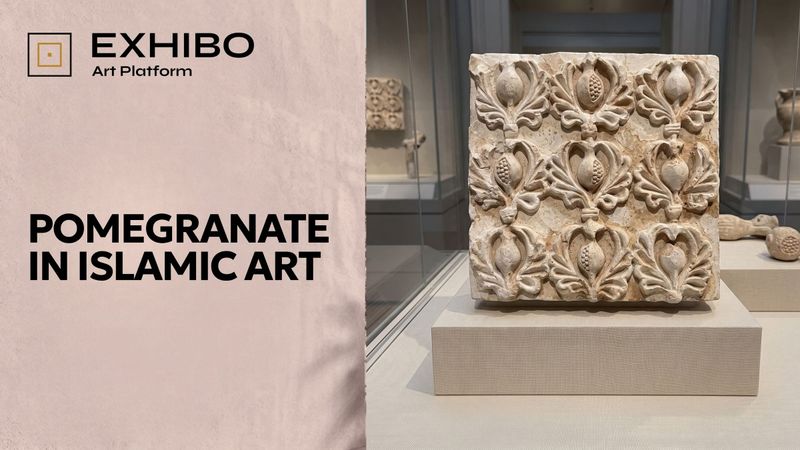
A slab of sixth-century plaster in the Met shows a fruit you recognise at a glance: a pomegranate, and surely it means paradise. Hold that certainty up to the light and it dissolves. Across a thousand years of tile, silk and stucco, the pomegranate is the shape we name most confidently and identify least — blurring into the artichoke and the palmette, its meanings attached by later viewers, its very name partly a nineteenth-century invention
The Visual Language Older Than Arabic
How one of North Africa's oldest writing traditions survived conquest, colonial classification and the loss of its readers — and why, for much of it, we still cannot say what the marks mean.
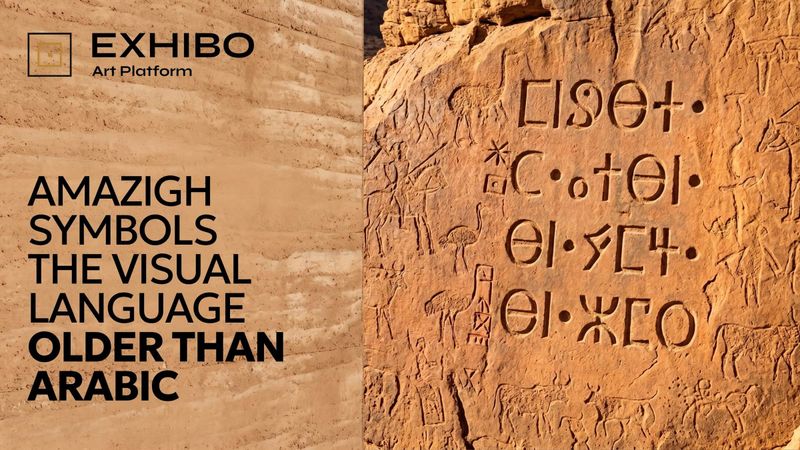
A flat rock in southern Morocco is covered in a script you can see is writing and still cannot read a word of. It belongs to the Amazigh — a visual language older in North Africa than the Arabic alphabet, carried onto skin and wool and silver, nearly erased, and now reassembled into an alphabet on ministry walls. This is the story of what survived, what didn't, and why almost everything we "know" these signs mean was added later.