
Tehran · Iran
The Fruit We Are Sure We Recognize
How the pomegranate became one of the most confidently named motifs in Islamic ornament — and one of the least confidently identified — across a thousand years of tile, silk and stucco, with meanings we mostly attached later.
How the pomegranate became one of the most confidently named motifs in Islamic ornament — and one of the least confidently identified — across a thousand years of tile, silk and stucco, with meanings we mostly attached later, sometimes as late as a Victorian catalogue.
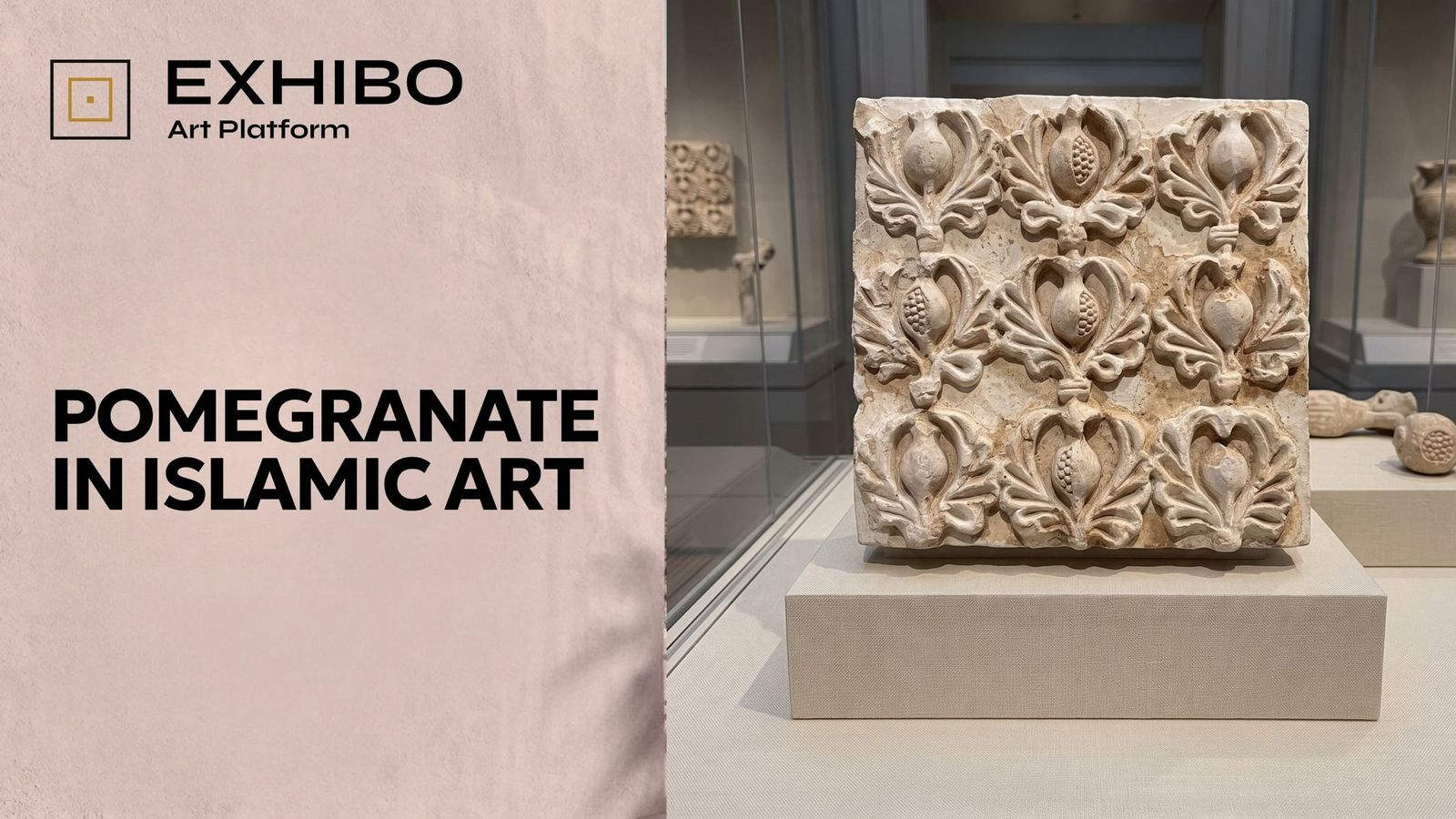
There is a slab of moulded plaster in the Metropolitan Museum, about a foot square, that was excavated near Ctesiphon in Iraq during the Metropolitan's 1931–32 expedition. It is grey-brown, undramatic, the kind of object that hardly stops a visitor at all. Look closely and you see a shape repeating across it, held inside a frame of curling leaves: a round body, a little crown of points at the top, a swelling that reads instantly, unmistakably, as a pomegranate. The label agrees. Wall decoration with pomegranates in palmettes, it says — Sasanian, sixth century, a couple of generations before Islam arrived in the region at all.
Stand in front of it and three things feel certain, in the space of about two seconds. That it is a fruit. That the fruit is a pomegranate. That the pomegranate means something — fertility, paradise, eternal life, one of the warm abstractions the guidebooks reach for. Three certainties, arriving faster than thought — and on this particular object the first two are fairly safe; it is the third, and the habit of stretching that confidence across every similar shape, that this piece is about. This piece is about how each one is shakier than it looks, and about how much of what we are sure we see in a thousand years of Islamic ornament turns out to have been supplied by us, standing in the gallery, rather than by the person who pressed the mould into the wet plaster.
The pomegranate is a good place to test this, because it is everywhere and because we are so confident about it. It runs across tile, textile and manuscript from Spain to India. It is named three times in the Qur'an. It gave a Spanish city its coat of arms and, arguably, its name. It is sold today, in ten thousand gift shops from Granada to Istanbul, with a fixed and glowing meaning printed on a little card. And yet the closer you get to any single object — this stucco, that plate, this length of silk — the more the certainties dissolve into something more interesting: a shape we call a pomegranate more often than any maker ever did, carrying a long history of meanings that we too easily collapse into a single settled meaning for the object in front of us. The fruit is old. A great deal of the story around it is young, and some of it is younger than the museum it sits in.
The fruit before the faith
Start before Islam, because the pomegranate does.
By the time the Sasanian plasterer near Ctesiphon was stamping fruit into his wall, the pomegranate had already been a loaded object across the Near East for several thousand years. It grows wild across the Iranian plateau and the Caucasus, was domesticated there roughly five thousand years ago, and travelled everywhere trade went. Everywhere it went, it picked up meaning — and the meanings rarely agreed. In Mesopotamia it belonged to the imagery of abundance and to religious and healing traditions. In Egypt they appear in funerary contexts. In Greece the fruit belonged to the story of Persephone and the cycle of the seasons, the seed that binds you to the underworld. In Iranian traditions, including Zoroastrian practice, it acquired associations with fertility, blessing and ritual life. The seeds — too many to count, packed in their jewelled chambers — made it an obvious emblem for anyone who wanted to talk about abundance, multiplicity, or the future. It is almost too useful a symbol. Anything with that many seeds is going to get recruited.
The Sasanian world folded it into a particular visual habit. In the reception halls and iwans of elite houses around Ctesiphon — the twin-city capital on the Tigris, twenty miles south of modern Baghdad — walls were covered in moulded stucco: geometric bands, animals, royal busts, and endless vegetal panels. The pomegranate turns up nested inside the palmette, a paired fan of leaves cupping the round fruit, a composition specific enough that scholars treat it as a Sasanian signature. One association often proposed is with Anahita, the Iranian goddess of water, fertility and prosperity, protectress of righteous kings. It is a tempting association, and worth noticing how it is built — because identifying Anahita in ancient Iranian art is itself one of the thornier problems in the field, where many attributions stay frankly speculative. We have a fruit that means fertility in many cultures; we have a goddess of fertility; we have no caption on the wall telling us this particular plasterer was thinking of her. The link is inference, drawn backward from what we know the fruit meant elsewhere. It may well be right. It is not the same kind of fact as the date of the plaster.
Here is the detail that should slow us down, though, and it comes straight from the Met's own account of its Ctesiphon digs. In one excavated house, the archaeologists found reliefs decorated with a pomegranate and a cross — and read that pairing as a sign the house may have been occupied by Christians. Same fruit, same city, roughly the same period, same decorative habit — and now the identical motif turns up in a Christian context, or at least in a house the excavators thought might be Christian. Notice it was the cross that carried the reading; the pomegranate simply came along, as at home beside one faith's sign as another's. The pomegranate did not change. The wall around it did. This is the thing to hold onto as we go forward: the fruit is a constant, and the meanings are variable, and context does much to determine which of them becomes legible. A pomegranate beside a fire altar may invite one reading; the identical pomegranate beside a cross, another; and in a few centuries the identical pomegranate beside a line of Qur'anic script, a third. The shape is a vessel. Everyone who picks it up fills it with their own water.
And then Islam arrives, and does not throw the vessel away. This is the part the tidy story of a clean Islamic beginning tends to skip. When the Umayyads began building a visual culture for the new empire, they drew, among many other sources, on Sasanian visual traditions — the winged vegetal forms in the mosaics of the Dome of the Rock, commissioned around 691, are, in the Met's words, "reminiscent of Sasanian imagery." The plaster vine kept growing straight through the conquest. What changed was not the ornament but the frame around it, and the meanings that frame invited. Continuity of form; reset of meaning. It is the oldest move in this whole story, and we are about to watch it happen again and again.
What the book actually says
Because the pomegranate has one thing most ornamental motifs don't: it is named, by name, in scripture. And this is where the confident modern reading — pomegranate on a tile equals a promise of paradise — likes to plant its flag. So it is worth going to the text and seeing exactly what it does and does not give us.
The fruit, ar-rummān, appears three times in the Qur'an. Twice in Surat al-An'am, where it sits among the signs of creation: God sends down water, and there grow gardens of grapes and olives and pomegranates, "similar yet different" — look, the verse says, at the fruit as it ripens; in this there are signs for people who believe. And once in Surat ar-Rahman, in the garden of the afterlife, where the two gardens hold "fruit, palm trees, and pomegranates." That is the scriptural pomegranate: a sign of God's generosity in the world, and one of the named fruits of paradise in the next. It is a genuine and specific presence. The classical commentators noticed the unusual singling-out of dates and pomegranates after the general word for fruit, and offered several explanations for it — al-Qurtubi among those reading it as a mark of the two fruits' special standing.
Now notice the gap. The text gives the fruit a place. It does not give the ornament a meaning. There is nothing in the Qur'an, or in the sound hadith, that says a pomegranate carved on a wall or fired onto a plate stands for paradise, or should be read as a prayer, or does anything at all. The leap from "the fruit is named in scripture" to "the image promises the garden" is an interpretation — a very natural one, an old one, possibly a correct one — but it is ours, or at least it belongs to a chain of readers between the potter and us, and it is not licensed by the book. When the Cleveland Museum notes, entirely reasonably, that a pomegranate on a lustre dish evokes the fruit "mentioned in the Qur'an as one of the fruits of paradise," it is performing exactly this move, smoothly and invisibly: connecting the image to the text across a bridge the maker may never have walked.
The hadith deepen the fruit's prestige without closing that gap. A number of later reports and sayings connect earthly pomegranates with the pomegranates of paradise, and praise the fruit; but their evidentiary status varies considerably, and some of the most quoted are not among the soundest — a distinction the gift-shop card flattens entirely, and one worth keeping, because the difference between a Qur'anic verse and a weak hadith and a Victorian design theory is exactly the difference this piece is about. The pomegranate's place in Islam is real and layered: scripture, commentary, medicine, the tenth-century Abbasid cooks who soured their stews with it and called the dish rummaniyya, the Sufi poets who reached for it — Rumi opening a poem with a pomegranate "cleft open with a seed-revealing smile." All of that is true, and none of it tells you what the fruit on a particular sixteenth-century plate was for. It might have been a wish. It might have been a fruit. It might have been the shape the workshop always put in that spot. The scripture raises the odds of meaning; it does not prove it in any single object.
One repertoire, three surfaces
Now to the objects themselves, and to the second certainty — that when we see the fruit, we are seeing a pomegranate at all.
Walk through the Islamic galleries of any large museum and you will meet the pomegranate on three very different materials that turn out to speak one language. There is the ceramic: Iznik plates and tile panels, Kashan lustreware, the great glazed façades of Iran. There is the textile: Ottoman silks and velvets, the woven and embroidered fruit that travelled west and conquered European looms. And there is the manuscript and its border, the illuminated vegetal scrollwork that frames a page of poetry. These are not three separate traditions that happen to share a fruit. In the Ottoman world especially, they belonged to a connected design system. The royal design atelier, the nakkaşhane, developed motifs whose iconography was then shared across media — adapted to the loom in one workshop, to the tile at Iznik, to the manuscript page in the palace. A motif is a motif before it is a plate or a robe.
And within that shared repertoire, the pomegranate is rarely a portrait of a pomegranate. It entered an Ottoman floral repertoire that also included the hatâyî vocabulary — a highly stylised floral mode, the fully stylised composite blossom, that the Ottomans took over and recombined endlessly. The name itself is a small lesson in how these things travel: hatâyî means, roughly, "Cathay" — China — because the style was understood to have come, via Timurid Iran, from Chinese floral ornament (the peony and the lotus above all). A motif at the heart of what we now call classical Ottoman, and therefore quintessentially Islamic, art carried a name that pointed at China and a lineage that ran through the lotus and the peony. The pomegranate sits inside that borrowed, mobile system as one blossom among several, and the crucial fact is that the system does not keep them cleanly apart.
You can watch curators themselves negotiate this. The Met, describing Ottoman silks, lists the standard layouts as "wavy vertical stems with blooming palmettes, carnations, or pomegranate fruit" — the or doing quiet, enormous work, because it tells you these are alternatives filling the same slot in the same grammar, not a botanist's distinctions. When the David Collection in Copenhagen mounted its great survey of plant motifs in Islamic art, the catalogue described one design as holding "something that resembles pomegranates," and noted of a lustre bowl that it is "difficult to differentiate between background and pattern." Resembles. Difficult to differentiate. This is not vagueness; it is honesty. Some of the most careful museum catalogues are correspondingly unwilling to say, flatly, that is a pomegranate. The round crowned form you would confidently label a pomegranate turns up, across this repertoire, catalogued by different institutions as different things: the V&A files one Iznik dish under a "artichoke-like" central motif; the Fitzwilliam calls a closely related form on an Iznik jug a pomegranate; and the same broad form is elsewhere described as resembling a pomegranate, a thistle, or an artichoke depending on the cataloguer. Closely related forms, in other words, get catalogued under different names — the identification arriving with the cataloguer as much as with the artist.
This is the sharpest edge of the whole subject, and it is worth sitting with because it inverts what we expect. We think the hard question about a symbol is what does it mean? With the pomegranate in Islamic ornament, there is a harder question underneath: is it even the thing we think it is? The palmette, the rosette, the lotus, the artichoke, the pine cone, the thistle, the pomegranate — as stylised ornament these categories can overlap visually, flowing into one another across centuries and workshops, and "pomegranate" is often a spot we mark on that spectrum for our own convenience. The fruit is real. Its edges are not.
The tile you think you can read
Hold a familiar kind of Iznik dish in your head for a moment — sixteenth-century, white ground, that astonishing tomato-red the Iznik potters achieved for only a few decades and then lost. Around the rim, a wreath of round fruit alternating with serrated leaves; in the centre, a spray of blossom on a curving stem. You have seen it on a museum wall and on a tea towel. It is one of the most reproduced patterns in the world.
Ask what the fruit means and the confident answers arrive at once: abundance, fertility, paradise, the seeds as the multiplicity of the faithful. Ask the prior question — how do we know it is a pomegranate — and the ground softens. Much of the floral repertoire the Iznik potters used drew on hatâyî and related stylised traditions, flattening flowers and fruit into schematic forms that prize rhythm and symmetry over botany. The round crowned shape reads as a pomegranate to us partly because the pomegranate is the fruit we have been taught to look for. A sixteenth-century painter in the Iznik workshops was not illustrating a pomegranate the way a botanical draughtsman would; he was deploying a form from a pattern book, one that had drifted a long way from any orchard, and that shaded by imperceptible degrees into the artichoke beside it and the palmette above it. The dish is gorgeous and the fruit is legible and both of those things can be true while the confident single name we give it is doing more work than the object can bear.
None of which makes the ornament empty. This is the trap to avoid — the lazy debunk that says it's just decoration, it means nothing. That is as wrong as the gift-shop certainty. The truth is more demanding and more interesting: the pomegranate in Iznik is a real form with a real history and a genuine field of associations, deployed by artists who knew that field — and also a repeating decorative unit, chosen partly because it sat well in a rhythm, and often indistinguishable from its neighbours in the same family. Both at once. The mistake is not believing it means something; the mistake is believing it means one thing, cleanly, that we can read off the surface like a word.
A fruit stamped forty times
There is a second way ornament resists being read as a message, and the Sasanian plaster we started with shows it plainly. That wall of pomegranates was made with a mould. The plasterer carved or obtained a single die and pressed it into wet stucco again and again, running the fruit across the wall in mechanical repetition. The Met is explicit that the point of the technique was exactly this: moulds "allowed for the creation of large scale repetitive patterns." The pomegranate here is not a word in a sentence. It is a tile in a field, a unit of surface, closer to wallpaper than to writing.
This matters because our instinct with a symbol is to read it — to treat each instance as a deliberate utterance, a little act of meaning. But a form stamped forty times down a reception hall is doing something different from a form painted once at the centre of a page. It is generating texture, richness, the sense of a surface too alive to be blank — the dense, all-covering fields characteristic of so much Islamic ornament. In that mode the individual pomegranate is not saying paradise forty times over any more than a repeated floral on your wallpaper is making forty separate botanical claims. It is making a pattern. The meaning, if it is anywhere, is in the overall effect of abundance and order, not in the semantic content of each stamped fruit.
You can see the museums quietly registering this too. Right next to the labelled pomegranate panels from Ctesiphon sit fragments the Met catalogues simply as vegetal design — a wavy vine with half-palmettes, "probably formed the border around the edge of a larger pattern," found in the same houses as the pomegranate reliefs. One fragment gets the fruit's name; the adjacent fragment, from the same wall system, gets "vegetal." The difference is often not in the makers' intentions, which are lost, but in how legible a given stylisation is to us now. Where we can read a pomegranate, we write "pomegranate." Where the stylisation has drifted too far, we write "vegetal." The label is a record of our recognition, not necessarily of their meaning. We are, in the most literal way, naming these walls ourselves.
The name that the nineteenth century gave it
And then there is the beat that should make anyone who loves this material sit up, because it locates a big piece of the "ancient Eastern symbol" firmly in nineteenth-century Europe.
If you read widely about historic textiles, you will keep meeting a phrase: the pomegranate pattern or the pomegranate motif, used for a whole family of designs — the ogival lattices, the great crowned forms with their radiating fronds, the patterns that dominated Italian Renaissance velvets and travelled across Europe as the height of luxury. It sounds like an old name for an old thing. It is not. As the textile historian Rosalia Bonito Fanelli laid out in a study for the Textile Society of America, the term, as used for this broad family of Renaissance and later textile patterns, is a modern coinage — it "came into use during the period of historic revivalism in the latter half of the nineteenth century," among the design theorists and reformers who were then busy codifying the world's ornament into catalogues and principles, especially in Britain: Owen Jones, William Morris, Walter Crane. And what the term covers, Fanelli notes, is a "series of vegetal patterns" that includes "the pine cone, the artichoke, the thistle, variants of the tree-of-life motif, and, in particular, the lotus and the palmette."
Read that list again. The category nineteenth-century design culture called "the pomegranate" could encompass pine cones, artichokes, thistles, tree-of-life variants, lotus and palmette forms. The fruit gave its name to a category it does not actually rule — a category assembled by nineteenth-century Europeans looking at centuries of Islamic and Italian ornament and reaching for a single, evocative, orchard-scented label. The pomegranate was a good name. It was memorable, it was biblical, it carried its warm freight of fertility and paradise. So it got stamped onto the whole drawer of related shapes, and the label stuck so well that we now read it backward onto the objects as if the makers had used it.
This is the same mechanism, exactly, as the Hand of Fatima — the khamsa's most familiar name turning out to be, in large part, a French colonial coinage laid over a shape far older than the woman it honours. In both cases a later culture, confident and cataloguing, gave an ancient and ambiguous set of forms a clean, appealing, portable name — and the name then travelled back through time in our imagination and attached itself to makers who never used it. The pomegranate pattern is, in a real and documented sense, younger than a great many of the pomegranates it names. The label is nineteenth-century — codified especially in Britain. The tiles are medieval. We put the two together and called it tradition.
Granada, or a fruit that won an argument
There is one more place where the pomegranate's meaning turns out to have been manufactured rather than inherited, and it is a whole country's emblem.
The Spanish for pomegranate is granada. It is also the name of the last city of Muslim Spain, the seat of the Nasrid emirs, the city of the Alhambra. The fruit is everywhere in Granada — in the pavements, on the bollards, carved over the Puerta de las Granadas that leads up to the palace, and, since the conquest of 1492, quartered onto the coat of arms of Spain itself. It is one of the great coincidences of European place-names: Granada sounds like granada, the Spanish word for pomegranate, and the fruit duly became the city's emblem. Whether the resemblance actually explains the name is a separate question — and the obvious story, that the city was named for the fruit and the emblem grew naturally from the name, is the one to be most careful with.
Except the link between the name and the fruit is far shakier than the emblem suggests. The city's Arabic name was Gharnāṭa, and the honest scholarly position is that its origin is genuinely disputed — the standard reference works call the meaning uncertain and debated, offering a Berber reading as a "hill of strangers," a Latin granum ("seed"), an early Gharnāṭa al-Yahud ("pomegranates of the Jews"), and the Romance granata ("pomegranate"), with none commanding assent. And Gharnāṭa and rummān, the Arabic word for the fruit, are not even related; the Arabic-speaking city was not called "pomegranate." What is clear is what happened next: whatever Gharnāṭa first meant, Romance speakers eventually heard a resemblance to their own word for the fruit, and the resemblance helped turn the pomegranate into Granada's emblem — folk etymology, in the phrase of one account, "made true by heraldry and habit." A coincidence of sound helped turn the fruit into a heraldic emblem: after the conquest of 1492 the Catholic Monarchs added the pomegranate — the device of the conquered Kingdom of Granada — to the royal arms, where it has remained, in the arms of Spain, ever since.
It is the purest example in the whole subject of meaning arriving after the fact and then hardening into apparent antiquity. And it comes wrapped, as these things do, in the same generous confusion of faiths the fruit attracts everywhere: the pomegranate adorned the capitals of Solomon's temple and the hem of the high priest's robe in the Jewish tradition; it carried Christian associations with resurrection and eternal life in European art; it was one of the fruits named in the Qur'an's gardens of paradise, in the Nasrid city whose palace crowns the hill. Three faiths, one fruit, one hill — and a national emblem that grew, in the end, from a resemblance of sound. Whether the pomegranate ever gave Granada its name is unresolved and may stay that way. What is certain is that a coincidence hardened, over centuries, into heraldry, and then into something indistinguishable from ancient truth.
I will not push further into Spain than that, because the centre of gravity of this story is the Islamic east — the stucco of Ctesiphon, the kilns of Iznik and Kashan, the looms of Bursa — and Granada is the western echo, not the source. But the echo is clarifying. If a fruit can become a country's arms by accident of sound, the smaller daily miracle of a tile "meaning paradise" because we have decided it does should feel entirely familiar.
What the market knows for certain
Here is a contrast worth holding up to the light. Everything above — the hedging curators, the disputed etymology, the Victorian label, the scripture that names the fruit but not the ornament — describes a subject where the people who know the most claim the least. Now walk into an Iznik workshop's online shop, or scroll a page of Ottoman-style cushions, or stop at a souvenir stall below the Alhambra, and you will find the opposite: total confidence.
The pomegranate, these sellers will tell you, is a symbol of life, health, and renewal; of abundance and fertility; of prosperity and posterity. The meaning is fixed, ancient, and printed on the card. There is no resembles, no difficult to differentiate, no disputed etymology, no Victorian coinage — just the warm certainty that this fruit has always meant this thing and that owning the object connects you to it. And this is not a criticism of the sellers, exactly; it is an observation about where certainty lives. The museum, holding the actual sixth-century object, says "something that resembles pomegranates." The market, selling a modern reproduction, says "the ancient symbol of eternal life." In these examples, at least, the confidence seems to grow as the distance from the surviving evidence grows.
This is the gap the whole piece has been circling, and it is the most Exhibo thing about the pomegranate: the popular story and the historical one are not just different in detail, they are different in temperature. The popular story runs hot and sure. The historical one runs cool and careful. Neither is worthless — the market's story is itself a real cultural fact, a live meaning the fruit genuinely carries for millions of people right now, and dismissing it would be its own kind of error. But they are not the same kind of claim, and the pleasure of looking properly is in feeling the difference: in standing before the tile and holding, at the same time, this is beautiful, this is a pomegranate, this may mean paradise and I am the one supplying most of that, and the maker might have simply been filling the rim.
Where the old fruit becomes new work
None of this is settled history, sealed behind glass. The pomegranate and its whole ambiguous family — the palmette, the arabesque, the stylised blossom that may or may not be a fruit — are live material in the hands of artists working right now, and several of them are working precisely on the seam this piece has been prying at: the gap between an ornament and the meaning we assign it.
The clearest is Kamrooz Aram, born in Shiraz, based in Brooklyn, whose paintings and installations set Persian ornament against the grid of Western modernism and refuse to let either win. His work treats the decorative motif — the very thing European modernism dismissed as mere pattern, mere craft, the feminine and the Eastern and the un-serious — as a site for what he has called a renegotiation of history, asking why we decided ornament was empty in the first place, and who benefited from that decision. That is this article's question, made in paint: the pomegranate on the tile was never just decoration, but it was never a fixed message either, and the space between those two errors is where the interesting art lives.
Around him, contemporary artists are reworking different parts of the Islamic decorative vocabulary — moving the argument from botany toward geometry. Timo Nasseri builds glittering muqarnas and star-patterns into sculpture; Sahand Hesamiyan turns the forms of Persian architecture into swelling steel volumes that open like — well, like a fruit splitting along its seams; Shirazeh Houshiary, Shiraz-born and London-based, has spent a career dissolving Islamic geometry into breath and veil and near-invisible abstraction. You can find these artists through the same galleries that anchor the region's scene — Lawrie Shabibi, The Third Line — the galleries a platform like this one maps, which is the point: the fruit you thought you understood on a museum plate opens, if you follow it forward, onto a living room full of people still arguing with it.
So go back, one last time, to that grey slab of Sasanian plaster in the Met, with its fruit stamped patiently across the wall. You can still see it's a pomegranate. That much is real, and it is enough. But loosen your grip on the rest — on the certainty that you know what it meant, on the assumption that the name you'd give it is the name its maker used, on the warm printed story that the gift shop will sell you downstairs — and the object gets richer, not poorer. What you are looking at is not a coded message you can decrypt but something stranger and more human: a shape that a hundred generations kept finding useful, and kept reading through whatever they most needed it to mean. The meanings are real and old; what we add is the false certainty that one of them is the answer. The pomegranate is one of the most persistent plant forms across Islamic decorative traditions. You do not need to be sure what it means to look at it properly. You only need to notice how much of the meaning is yours.
Related reading
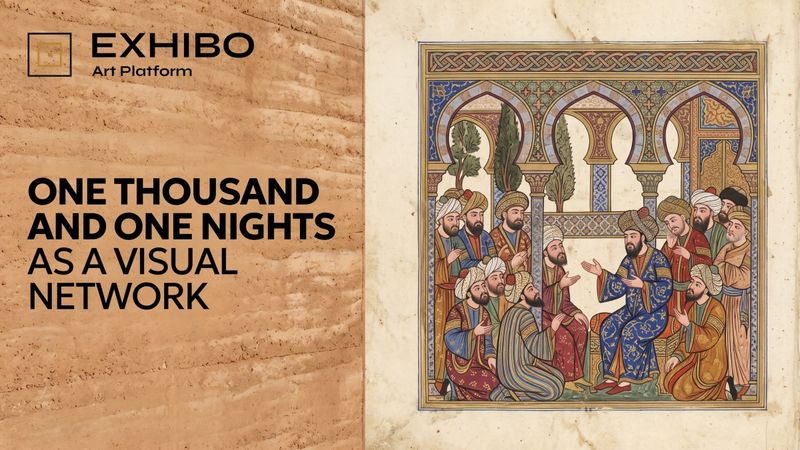
One Thousand and One Nights as a Visual Network
The book that taught Europe to picture the East arrived with no pictures at all. Three centuries of illustrators — Dutch, Egyptian, Persian, French, German, Iraqi — each gave it a face, and every face was a self-portrait.
Open Galland's Thousand and One Nights, the edition that conquered Europe, and there is nothing to look at: no genie, no lamp, not one illustration. The most visually imagined book in the world began blind — and because its text was never fixed either, no picture of it could ever be a copy.
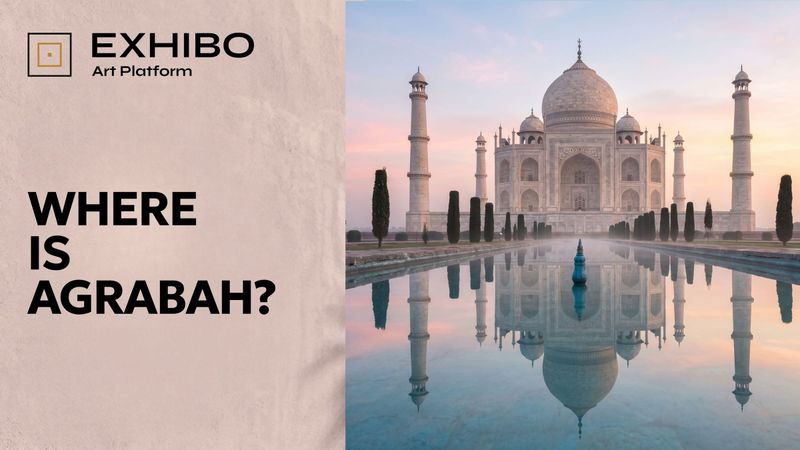
Where Is Agrabah? The City Disney Assembled From Real Places
Agrabah was going to be Baghdad. A war made it fictional — and then Disney built it back out of real places, from a tomb in Agra to a valley in Jordan that usually plays Mars.
The Sultan's palace where Princess Jasmine feels trapped has the silhouette of the Taj Mahal — which is not a palace at all, but a tomb. That is how Agrabah works. Disney's fairy-tale city was going to be Baghdad, until the Gulf War made the name impossible; the studio invented a place that could not be found on a map, then quietly rebuilt it out of real ones — Isfahan and Agra, Marrakesh and Mandalay, a Jordanian desert that has played both Arabia and Mars.
Why Disney Made the Genie Blue
The long material and colonial history behind the most recognizable blue body in popular culture.
Almost everyone remembers that Disney's genie is blue. Fewer ask why. The answer runs backward through five thousand years — Egyptian blue standing in for lapis, cobalt on a Mongol palace, the eye that guards against envy, the last color most languages learned to name, and a layout artist photographing Isfahan just before a war — to a color that was rarely, in this part of the world, quite what it claimed to be.