
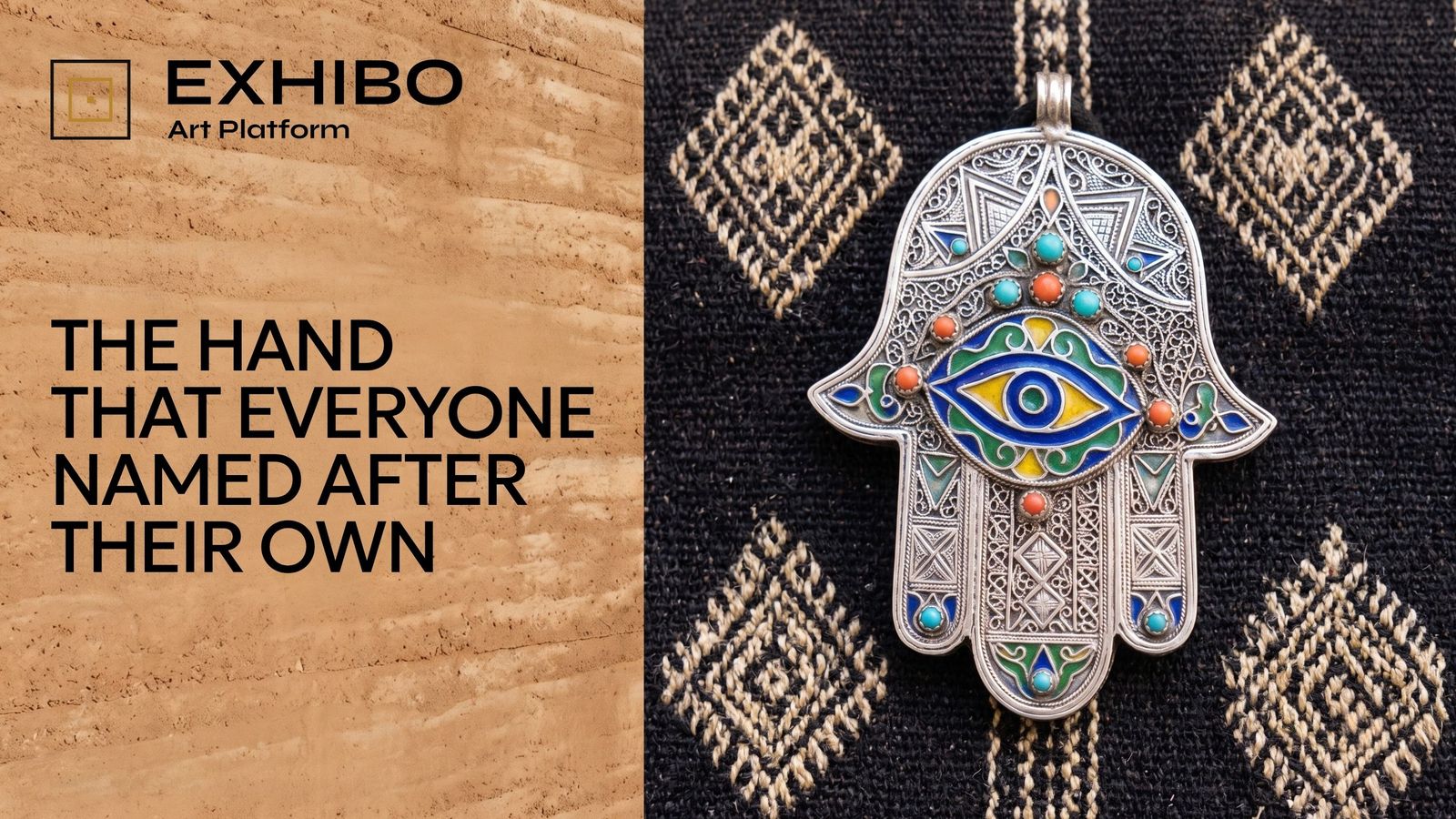
Marrakech · Morocco
The Hand That Everyone Named After Their Own
The Khamsa across North Africa — Marrakech, Tunis, Algiers — and why the oldest thing about it is the shape, not the story.
Stand at the Puerta de la Justicia, the great southern gate of the Alhambra in Granada, and look up at the keystone. There is a hand carved into the marble — palm out, fingers spread — set into the outer arch. Walk through the bent passage, and on the inner arch there is a key. Sultan Yusuf I finished the gate in 1348. For nearly seven hundred years people have passed under that hand on their way in, and most of them have been told the same thing: five fingers, five pillars of Islam, a hand of protection over the threshold of a kingdom.
Here is the first small surprise. The gate's own name is a mistranslation. For a long time it was read as the Gate of Justice, from an Arabic name people assumed pointed to law — but the reading now thought closer to the original makes it the Gate of the Esplanade, after the open ground that once stretched in front of it. The Gate of the Esplanade, renamed the Gate of Justice by later hands reaching for a grander meaning. And the hand above it has gathered meanings the same way — layer on layer, each era reading its own faith into five fingers of stone.
That is the khamsa in a single gate. A shape that is genuinely ancient, and a set of names and stories that are mostly younger than they feel. This is a piece about the distance between the two — walked gently, because the walking turns out to be the whole pleasure of it.
Part I — Origins
When the hand found its names
Ask almost anyone what the symbol is called and you will hear the Hand of Fatima — named for Fatima al-Zahra, the daughter of the Prophet Muhammad, honoured across the Islamic world for her patience and her grace. The five fingers, the account continues, stand for the five pillars of the faith: the declaration of faith, prayer, almsgiving, fasting, and pilgrimage.
It is a beautiful association, and it is worth saying clearly what kind of thing it is: a cultural attachment that grew over time, deeply cherished by many Muslim communities, rather than a rule handed down in scripture. The khamsa itself is not prescribed in the Qur'an or the canonical hadith collections, although many Muslim communities have long associated it with Fatima and with protection. It developed, as one Shia source puts it plainly, out of cultural practices that formed over generations, in conversation with the religious ideals of the region — not out of a verse. Across North Africa the hand had long been used to protect mothers in childbirth and children from the harmful glance. Attaching it to a beloved maternal figure fit a role the object was already playing. The association settled onto an already older symbol rather than creating it.
The origin legends confirm how late the naming really is, because they tend to undo themselves as you read them. One popular story has Fatima pressing a bloodied hand to a banner in battle — a tale for which there is no historical support. There is a gentler domestic version: Fatima stirring a pot, so lost in a private grief that she does not feel the heat, the hand becoming an emblem of endurance and sabr, patience. Lovely. Also a story wrapped around a shape after the shape was already old.
And the name splits depending on whose hand is holding the pendant. In much of Sunni tradition the five fingers are often interpreted as the five pillars. In Shia tradition they are often the five of the Ahl al-Bayt — the Prophet, Ali, Fatima, Hasan and Husayn — the panjtan pak, the five pure ones; the hand itself is sometimes called the panja, and in some communities the Hand of Abbas, tied to the remembrance of Karbala, rather than the Hand of Fatima at all. Cross into a Jewish home in Fez or on the island of Djerba and the same object is the Hand of Miriam, sister of Moses, or the hand of Shaddai, one of the names of God. Among some Levantine Christians it is the Hand of Mary. One shape. Several holy names, each held with real devotion by the people who chose it.
That is the pattern to keep in view. Not a single symbol with one true owner and a crowd of borrowers — a shape old enough, and open enough, that everyone who met it found room to understand it through their own tradition.
How old is the shape, really
Here the honest answer is: older than any of the stories, and harder to pin down than the confident version admits.
The open hand is one of the oldest marks humans make anywhere. Hand stencils appear in painted shelters across Europe, Africa, Asia and the Americas, some of them tens of thousands of years old — pressed onto rock long before any of the religions that now claim the hand existed. That is the deep background. Not the khamsa specifically. The human reflex underneath it: an open palm, raised, meaning stop, I am here, be well.
Then there is the layer everyone reaches for first — Carthage, and the goddess Tanit. Tanit was among the chief deities of the Punic Mediterranean, a great mother figure whose worship centred on Carthage, in what is now Tunisia, and radiated out to Phoenician settlements from Iberia to Malta. The sanctuary known as the tophet has yielded thousands of votive stelae dedicated to Tanit and her consort Baal Hammon, and among the carved signs — the famous triangle topped with a disc, the "sign of Tanit" — an open palm does appear, sometimes raised over a worshipper like a blessing. Such stelae, some carrying that palm motif, sit today in the British Museum, the Louvre and the Bardo. The stones are real. The gesture is there. You can stand in front of it.
What is not quite real is the clean, unbroken line people love to draw from Tanit's palm straight to the pendant on a market stall. As several Tunisian historians have argued, the khomsa known today is not a single continuous thread running back to Tanit. It was reshaped at every stage — through Roman visual culture, through the Amazigh tafust, through the Jewish Hand of Miriam, through Islamic thought, through French colonial taste. The impulse to make a five-fingered hand that defends is genuinely older than the later religious interpretations attached to the khamsa. The specific object — the one you can buy this afternoon — is young, assembled from all those layers rather than passed down intact from a single ancient source.
This distinction matters, and not to spoil anyone's story. The tidy version — Mesopotamia four thousand years ago, then Tanit, then Fatima, one straight thread — is largely a shape the modern era gave the past. Antique dealers, nation-builders, ethnographers and the tourist trade all had reasons to prefer one deep origin to a messy, many-handed inheritance. The messier truth is the more human one. The hand was not run down a relay of couriers, each handing the baton cleanly to the next. It was picked up, set down, renamed and reworked by generations of people who lived along that sea. That is not a lesser history. It is a richer one.
Spain, and the hand that crossed the water twice
If you want a route you can actually follow rather than a legend, follow the object through medieval Iberia.
The account historians can work with runs roughly like this. Amazigh — Berber — communities carried the khamsa into al-Andalus. Centuries later, when Muslims and Jews left Spain, they carried it back into North Africa — this time enriched with new motifs and metalworking techniques absorbed on the peninsula. The hand was never a static, single-owner emblem sitting still in one country. It was a shuttle, crossing the Mediterranean and crossing back, gathering detail on each passage. Hold that image; it will explain something specific about Algerian silver later on.
You can watch the anxiety around the symbol surface in the written record. During the years of the Inquisition, the Granadan writer Francisco Bermúdez de Pedraza recorded that the hand carved on the Alhambra gate was understood to stand for the pillars of Islam — and that, for exactly this reason, an order went out that the Moriscos of the kingdom should not wear "those amulets they used to wear with a hand and certain Arabic letters." A symbol has to be a powerful marker of belonging before authorities trouble to forbid it. The hand was that marker, worn close to the body, legible enough to be feared.
And it was already art before it was ever a mass-market charm. On the finest Nasrid vases the hand extends past the wrist to show a forearm wrapped in a wide sleeve; on some the palm carries eyes, or holds Qur'anic inscriptions in fine script. It appears on an Iberian Jewish ketubba, a marriage contract, as a protective sign over the union. This was not folk kitsch. It was a shared visual language spoken across the courts and communities of the medieval western Mediterranean — Muslim, Jewish, and the mixed world in between.
Part II — A shared symbol
The shared well
Now the part that quietly rearranges everything around it.
For a long time the standard scholarly frame for the khamsa among the Jews of North Africa was borrowing. Jews, the argument went, adopted a symbol from the surrounding Muslim world and put it through a process of "Judaization" — adding Hebrew letters, divine names, scriptural echoes — that made it acceptable within Jewish life. The careful, foundational version of this reading belongs to the art historian Shalom Sabar, whose essay on the Judaization of the hamsa is still where the subject begins.
The scholar Noam Sienna, in an essay titled Five in Your Eye, takes that frame and gently turns it over. The trouble with borrowing, he argues, is that it quietly assumes the surrounding culture was foreign to Jews to begin with — something outside them that they could only reject, or adopt-and-adapt. But in North Africa the Jewish presence predates the arrival of Islam by centuries, in places by close to a thousand years. These were not guests in someone else's house who redecorated a borrowed ornament. They were among the people who built the house. The material and the meaning grew up together.
So Sienna offers a better picture than borrowing: a shared well. Two communities drawing water from one source, each with a bucket shaped by their own hands. It is more useful, he argues, to think of the khamsa not as something one group lent the other but as a thing both made, at the same time, in a long conversation — what you might call co-creation rather than influence. The scholar of Amazigh Jewish jewellery David Rouach had reached a similar conclusion earlier:
A phenomenon of convergence and parallelism, rather than a direct influence of one on the other.
Not a lender and a debtor. Two neighbours at one source.
The material record backs this up in a way that is almost too neat to be true. Until the middle of the twentieth century, a large proportion of Morocco's master jewellers and silversmiths were Jewish — and they made khamsas for Muslim and Jewish clients alike, with often no easy way to tell one from the other by sight. A khamsa carrying the basmala, the Islamic invocation, might have been made by a Jewish craftsman for a Muslim patron. A khamsa carrying the Hebrew name Shaddai might hang three doors down in a Jewish home. There is a recorded case of a Jewish artisan copying an Islamic basmala onto an amulet — whether by accident, because the calligraphy had grown so ornamental it was hard to read, or as a deliberate reach for the power of the other tradition's script, no one can now say. Either way, the hand moved between hands.
And there is a silence in the record that tells its own story. In the vast body of North African rabbinic writing — pages and pages on law, on ritual, on communal argument — the khamsa is almost entirely absent. The single most common visual symbol in the whole culture barely appears in that culture's own written sources. Not because it wasn't there — it was everywhere — but because the writing tradition tended not to record the things that lived in women's hands, in silver, in the space over a doorway. The object outran the text.
That is the sentence to carry out of the archive and into the street. Walk through the old mellah of Fez or the medina of Essaouira and you begin to see what the scholars are reaching for: the hand is on the door knocker, painted above the lintel, hung at the throat of a woman buying bread — present in exactly the places the written record was least likely to look. To find the khamsa's real history you have to read the walls and the wrists, not only the books.
There was one place, though, where the two communities' hands quietly parted. In Jewish life the khamsa climbed all the way into the sacred: onto synagogue lamps in the north of Morocco, onto the pointers — the yad — used to read the Torah scroll in the south, onto the embroidered curtains of the ark. In Muslim practice, so far as the surviving material record suggests, the hand stayed on the threshold — on doors, on walls, on cradles — rather than entering the mosque or resting on the Qur'an itself. Same object, shared for centuries across the domestic and the everyday, diverging only at the innermost sacred edge. It is a small divergence, and it says a great deal: two traditions can hold one symbol fully in common and still each keep a private room the other's version does not enter.
The word you were not supposed to say
There is a whole layer of the khamsa that has nothing to do with metal, and it survives because ethnographers wrote it down before it faded.
The amulet is the frozen form of a living gesture. To ward off the harmful glance you raise your open hand, palm out, and say khamsa fi ʿainek — five in your eye. The silver hand on the chain is that raised palm made permanent, a defence that never tires and never has to put itself down to do the day's work. Edvard Westermarck, whose Ritual and Belief in Morocco (1926) remains the great sourcebook, recorded the phrases that went with the motion: five in your eye, five on your eye, five and little five.
The word itself became so charged that in parts of Morocco people grew wary of saying it plainly. Because khamsa — five — had soaked up so much protective force, it could feel unlucky, almost dangerous, to use it for ordinary counting. The Moroccan Jewish ethnographer Elie Malka recorded in the 1930s that people would reach for a euphemism instead — "four and one," or "six less one" — rather than let the loaded word out for something as mundane as arithmetic. Compliment a woman on her child and she might answer bel khamsa aliya, may the five be over me, turning aside the very praise that could attract envy. The number had become a small act of devotion, too potent to spend on change at the market.
That is the texture the pendant carries and the tourist version loses. The khamsa was never only an object. It was a word, a gesture, a reflex built into the grammar of a compliment — a way of moving through a world where a kind glance and a covetous one could look identical, and where you wanted, quietly, to be safe from both.
What the hand looks like, and why
Look closely and the khamsa is rarely just a hand. It is a hand carrying passengers.
The form has two families. One is nearly realistic — four fingers and a thumb, sometimes clearly a right hand, though, despite the common claim that it is always the right, plenty of surviving pieces are unmistakably left. The other is symmetrical to the point of abstraction: three fingers upright between two outward-curving thumbs, one on each side, so the whole thing reads the same in a mirror. Push the abstraction further and the hand dissolves into pure geometry — the rectangular luha or lawh, a "board," sometimes hinged, sometimes hung on a door as a knocker; the khmissa, the "little five"; the five soft mounds of the Mauritanian schiemassa arranged in a loose triangle. At its most stylised the hand stops looking like a hand at all and becomes simply five, which was always the point.
Then there is what sits inside the palm. Often an eye — the watching eye that turns the harmful glance back on itself — though the eye is common rather than compulsory; some regional versions carry none. Around and within the hand come the other guardians: a fish for fertility and plenty, a salamander, birds, a crescent. And the materials are chosen, not incidental. Silver, valued in Amazigh tradition for its likeness to white and to purity. Iron, with its own old association with warding. Coral, red and living, set at the centre to draw off illness and the evil eye. Blue — in stone or enamel — because blue has its own long history against the harmful gaze. In this world the material was never neutral. A khamsa's power came partly from its shape, partly from what it was made of, partly from who made it, and partly from the words said as it was hung. All of it worked together, or was meant to.
Part III — Three cities
The khamsa does not live in the abstract. It lives in particular streets, particular workshops, particular vitrines. Three cities hold three different versions of the same hand.
Marrakech: the hand between two palaces
In the southern medina of Marrakech, on the Rue de la Bahia, between the Bahia Palace and the Dar Si Said, there is a restored riad most tourists walk straight past. It is the Maison Tiskiwin, the museum built around the lifetime collection of the Dutch anthropologist Bert Flint, who settled in Marrakech in the 1950s and never really left. Flint arranged his objects not by type but as a journey — the round trip of a caravan, Marrakech to the High Atlas to the Sahara and on toward Timbuktu, and back again, laden with what the routes carried. Jewellery, textiles, baskets, the everyday material of a world that moved.
What makes Tiskiwin the right door into the Marrakech khamsa is that Flint refused to sort the material by religion. His displays document the fine silverwork of Morocco's Jews and how it lived alongside — and inside — Berber craft, to the point where the two are often inseparable and the makers sometimes identified as Berbers themselves. This is the co-creation Sienna describes, made visible in a courtyard between two palaces: the hand as a thing jointly made, its "Jewishness" and its "Muslimness" and its "Berberness" braided so tightly you cannot pull one thread without the others.
The living craft is a short walk and a few centuries away, unbroken. The silver traditions of Tiznit and Essaouira still turn out khamsas whose filigree and engraving take years to learn; the zellige mosaic masters set the hand into panels of cut tile, joining two of Morocco's great craft languages in a single object for a wall. And the hand has kept climbing into new media — over the past two decades the Moroccan khamsa has migrated out of purely devotional use into the full range of contemporary design, interior, graphic, wearable. In Marrakech the hand has never been a museum piece. It is a working motif that happens to also sit in a vitrine.
Tunis: the hand in the field of stones
Tunis lets you stand at both ends of the story in a single day, which almost no other city offers.
Four kilometres west of the centre sits the Bardo National Museum, housed in a former palace, holder of the largest collection of Roman mosaics in the world and — in its Punic and Libyco-Punic rooms — of the votive stelae of Carthage, the spare strange visual world of the civilisation Rome tried to erase. The Carthage Room was rehung when the museum reopened in September 2023, and on those stones you can find the sign of Tanit and, near it, the raised open palm: the gesture at what is, arguably, close to its source, cut into stone centuries before the hand acquired its later Islamic names. It is worth noting, plainly and without dwelling, that the Bardo was the site of a terrorist attack in 2015 that killed and injured visitors; the museum reopened and welcomes the world again, and a visit today feels entirely ordinary — school groups in the courtyards, families photographing the mosaics. It is included here as what it is: one of the great museums of the Mediterranean.
Out at the coast, the Tophet of Salambô keeps its votive stelae standing in their original field, under the open sky, a disquieting and moving place where the raised palms to Tanit and Baal Hammon are exactly where they were left. (The old reading of the tophet as a site of child sacrifice, it should be said, is genuinely debated among archaeologists rather than settled — one more place where the confident story is thinner than it sounds.)
And then the medina, where the hand comes fully back to life as commerce and craft. In the Souk el Berka — once, under Ottoman rule, a slave market, now the gold and jewellery souk — most of the khomsa pendants sold across the whole country change hands. It is a heavy thing to hold together: the same few lanes that trafficked human beings now sell, by the thousand, a hand that means protection. Tunis does not tidy that away, and neither should a piece about it. The symbol is not innocent of the history around it; it is threaded through it.
The Tunisian khomsa also carries a live political charge that is worth handling with care and respect. Since 2011 the five-fingered hand, and Tanit behind it, has been picked up by feminist movements such as Aswat Nissa as an emblem of women's dignity, drawing, in their own interpretation, on the deep pre-Islamic past as a source of national pride — while others, holding a stricter view, see the veneration of any such object as at odds with a purer practice of the faith. Both positions are held sincerely, by people with real stakes in what their country has been and will be. The hand sits in the middle of that conversation, as symbols with this much history tend to. It has always meant more than one thing to more than one person; that is not a flaw in it.
Algiers: the geometric hand, and the enamel that came home
Algeria gives the hand its most abstract and, arguably, its most political life.
Go up into Kabylia, to the villages around Beni Yenni — Ath Yenni in Amazigh — and you reach one of the great silver traditions of North Africa. Kabyle jewellery is unmistakable: heavy silver, red Mediterranean coral set in cabochons, and above all polychrome cloisonné enamel in a tight vocabulary of green, yellow and blue. The pieces are talismanic armour as much as adornment — layered collars, the great fibulae that pin a woman's cloak, earrings so large they must be carried on a chain from a diadem — and given, traditionally, to a Kabyle bride at her marriage, worn afterward at every major occasion. The khamsa is in there too, but rendered in the Kabyle manner: distinctly geometric, angular, closer to a diagram of a hand than a drawing of one.
And here the Spanish thread from earlier ties itself off. That brilliant Kabyle enamel — the technique itself — is believed to have been brought to North Africa by jewellers exiled from Muslim Spain after the fall of al-Andalus. The hand crossed to Spain with the Berbers, gathered new craft there over centuries, and came back across the water in the luggage of the expelled — and one of the things it came back carrying was the enamel that now defines Kabyle silver. The shuttle image was not a metaphor. You can see the return journey in the green and blue on a bracelet from Ath Yenni. The Met holds such pieces; so does the Quai Branly in Paris; so do the collectors who trade them still.
Coral does the same double duty here it did everywhere — a red bead set into nearly every pendant, esteemed and expensive, valued for beauty and worn to ward off the evil eye and illness. And the wider point about Algeria is the one that closes the circle on the whole "whose symbol is it" question: given its importance to Amazigh and Arab Algerians alike, the khamsa has become one of the country's shared cultural symbols. A protective hand that belonged, first, to no one in particular has become, in Algeria, a hand held in common across communities.
Part IV — The hand's modern life
From the doorway to the keyring
The khamsa's modern life has a twist, and Sabar is the one who traced it.
Through the late nineteenth and early twentieth centuries, communities across North Africa and the Middle East held to the hand's protective power as a matter of course — painted in henna on the wall of a wedding house, drawn in kohl on a newborn's brow, hung at a bride's neck under the weight of silver. Then, around the middle of the twentieth century, as populations moved and modernised, the old certainty thinned in places. In the new society taking shape in Israel, the hamsa was for a while set aside by many as a superstition belonging to an older, Eastern world.
And then it returned — changed. Sabar's title says it in five words:
From Sacred Symbol to Key Ring.
The hand came back less as an amulet you feared to be without and more as an emblem you chose — heritage, a design motif, a keyring, sometimes layered with a Star of David or a line of Torah, worn especially as a marker of Sephardic and Mizrahi identity in a place that had once filed that identity under folklore. Not the loss of meaning, exactly. The migration of it — from the doorway to the collarbone to the gift-shop shelf, from a defence against the unseen to a statement about who you are.
That migration is now global, and it is where the story turns genuinely contemporary — and slightly uncomfortable, which is the honest place to leave it. In the worldwide wellness market the hamsa has become a generic pendant, sold beside crystals and mandalas, detached from every history in this piece. That drift has drawn criticism, and the criticism, when it comes from within the communities that carried the symbol, is not really about who is permitted to wear a hand. It is about the difference between a symbol worn with knowledge of what it holds and a shape lifted flat as decoration. A hand that meant protection, blessing, presence to people who were often not free to display their own emblems openly, now trending, worn lightly, its weight filed off. You do not have to settle that argument to feel why it is a live one — and the most generous reading is that the hand's openness, the very quality that let four faiths name it, is also what makes it so easy to pick up and so easy to empty.
Cinema, tellingly, has pulled in the opposite direction — putting the weight back on. The clearest case shares its name with the object: a 2008 French-Tunisian film simply called Khamsa, directed by Karim Dridi. Its hero is an eleven-year-old boy nicknamed Khamsa, son of a Roma father and an Algerian mother, who wears a small Hand of Fatima inherited from his dead mother and kisses it for a protection that never comes as he slides into petty crime. Dridi uses the amulet exactly as North African life always has, then lets the hard world refuse it — the hand as belonging, and as the ache of not quite belonging, both at once, on a chain a child will not take off.
Where the hand is now
Walk through Marrakech, Tunis or Algiers today and the khamsa is everywhere and nowhere in particular — on a door knocker, a car mirror, a henna design, a hotel logo, a tattooed forearm. Which is exactly what makes it easy to stop seeing. Part of the work of looking again is finding where it lives as art rather than as wallpaper.
Some of it lives in the crafts that never stopped — the Tiznit and Essaouira filigree, the Kabyle enamel of Ath Yenni, the zellige hand set in cut tile. Some of it lives in the museums and the market: the Amazigh Collier Khamsat of the Aurès in Algeria, the chiselled Moroccan hands catalogued by writers on North African jewellery, each carrying the fish and the crescent and the coral that once did their own quiet work.
And some of it lives in contemporary art that treats the whole visual world of the Maghreb — the khamsa among it — as living material rather than heritage under glass. The Moroccan artist Hassan Hajjaj, sometimes called the Warhol of Marrakech, frames his exuberant portraits in borders built from harissa tins and motor-oil cans, folding market goods, pop culture and North African tradition into one exhilarating surface — proof that the region's everyday iconography can be picked up and made new without being emptied out. In 2014 a small, sharp exhibition, KHAMSA: Amulets of North Africa, was deliberately staged alongside a show of contemporary Maghrebi art, so the old protective hand and the new work could sit in one building and speak to each other. That is exactly the right instinct. The khamsa was never only heritage, and never only design. It has always been a shape each generation picks up and remakes in its own hand.
Which brings us back to the gate in Granada — the hand on the keystone, the seven hundred years of people passing under it, each reading their own meaning into five fingers of stone. The mistake would be to stand there and ask which reading is the true one: the pillars, the goddess, Fatima, Miriam, Mary, the boy on the motorway with his mother's pendant. They are all true to the communities that gave them meaning — all historically attested layers of the symbol's meaning. The hand is old enough, and open enough, to hold every one of them. What it has never been is one thing belonging to one people. It is a shared well. Generation after generation of those who lived along that sea have drawn from it — each with a bucket shaped by their own hands.
Related reading
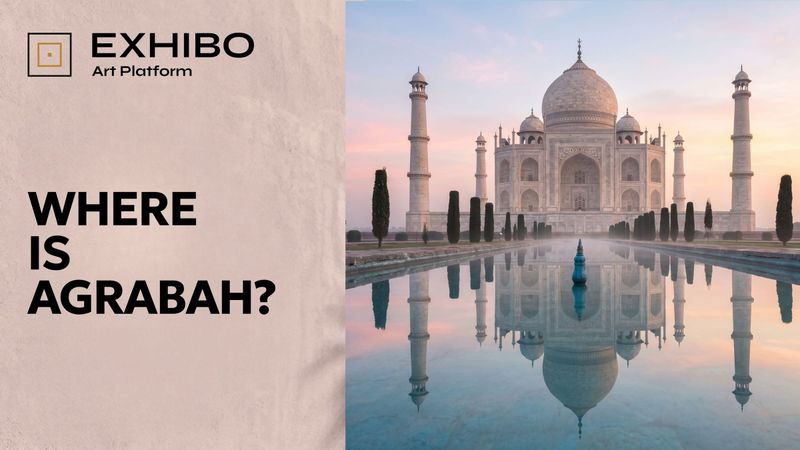
Where Is Agrabah? The City Disney Assembled From Real Places
Agrabah was going to be Baghdad. A war made it fictional — and then Disney built it back out of real places, from a tomb in Agra to a valley in Jordan that usually plays Mars.
The Sultan's palace where Princess Jasmine feels trapped has the silhouette of the Taj Mahal — which is not a palace at all, but a tomb. That is how Agrabah works. Disney's fairy-tale city was going to be Baghdad, until the Gulf War made the name impossible; the studio invented a place that could not be found on a map, then quietly rebuilt it out of real ones — Isfahan and Agra, Marrakesh and Mandalay, a Jordanian desert that has played both Arabia and Mars.
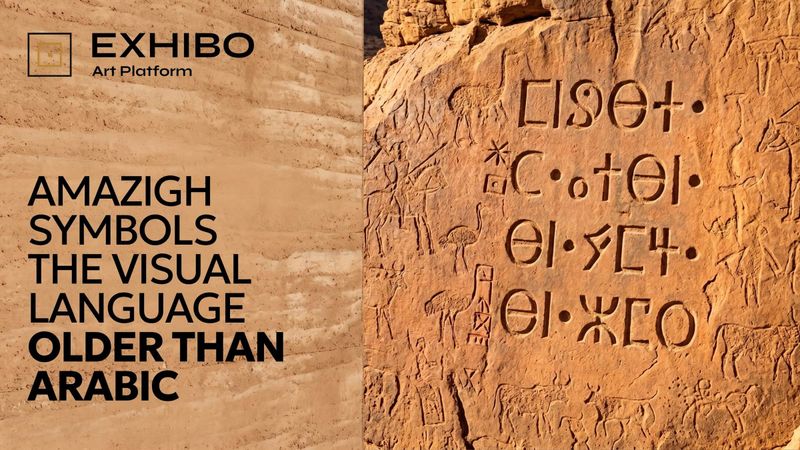
The Visual Language Older Than Arabic
How one of North Africa's oldest writing traditions survived conquest, colonial classification and the loss of its readers — and why, for much of it, we still cannot say what the marks mean.
A flat rock in southern Morocco is covered in a script you can see is writing and still cannot read a word of. It belongs to the Amazigh — a visual language older in North Africa than the Arabic alphabet, carried onto skin and wool and silver, nearly erased, and now reassembled into an alphabet on ministry walls. This is the story of what survived, what didn't, and why almost everything we "know" these signs mean was added later.
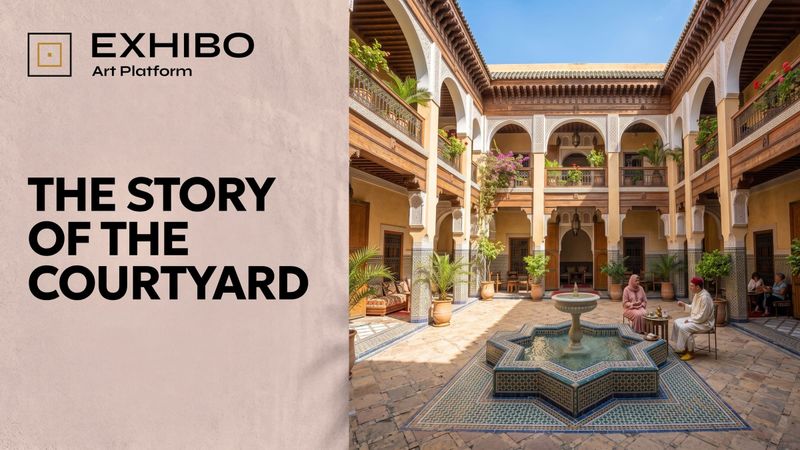
Why North African Cities Turn Inward: The Story of the Courtyard
A courtyard plan far older than Islam turned North African houses — and the medinas built from them — to face inward. Climate and religion only half-explain why, and what finally displaced the courtyard says the rest.
The blank walls and inward courtyards of Fez, Tunis, Algiers and Cairo are usually explained by heat or religion. Both are true; neither is the whole story. The clue is in what eventually pushed the courtyard out of the modern city.