
Marrakech · Morocco
Gladiator and Game of Thrones: Inside Aït Benhaddou
The earthen ksar that has played Rome, Jerusalem and Yunkai survives only because people keep rebuilding it. What cinema films as eternity is, wall by wall, a work of constant repair.
Again and again, as the rains and the heat take their turn on the walls, someone has to climb the lanes of Aït Benhaddou with a bucket of wet earth and begin, once more, to repair the past.
The walls that millions of viewers have seen — Maximus dragged in chains across the sand below them, Daenerys Targaryen breaking the slavers at their gate — are made of earth. Not stone dressed to look humble, not concrete stained ochre: earth rammed into timber moulds, earth laid as sun-dried brick, bound with timber, then smeared with a fine earthen render that is the same material as the wall beneath it. It is beautiful, and it is dissolving. Rain undoes it. A hard winter takes the render; a flood takes more. Left alone for a few decades, a pisé village does not become a romantic ruin the way a Roman theatre does — it slumps, rounds off, and returns to the ground it came from. So the people who keep Aït Benhaddou standing do not preserve it in the way we usually mean the word. They patch and re-render the walls, repair what the weather has opened, replace what has rotted or fallen. They make it again. What the tour buses photograph as centuries of unbroken antiquity is, in large part, a surface younger than the form it keeps alive.
This is the strange thing about one of Morocco's most filmed places, and it is worth holding onto before we get to the films. The ksar of Aït Benhaddou and the country around it have played ancient Rome's African province, pharaonic Egypt, Persia, Tibet, biblical Jerusalem and the Mecca of early Islam — and, in a made-up world of dragons, a slaver city. It is cinema's default setting for the deep past — the place a production goes when it needs somewhere that looks like it has stood, unchanged, since the beginning. And it is one of the least permanent kinds of structure human beings have ever built, a village that survives only because it is continuously, laboriously remade. The set for eternity is the freshest mud in Morocco.
What it actually is
Before it was a backdrop it was a machine, and the machine had a purpose you can still read in its shape.
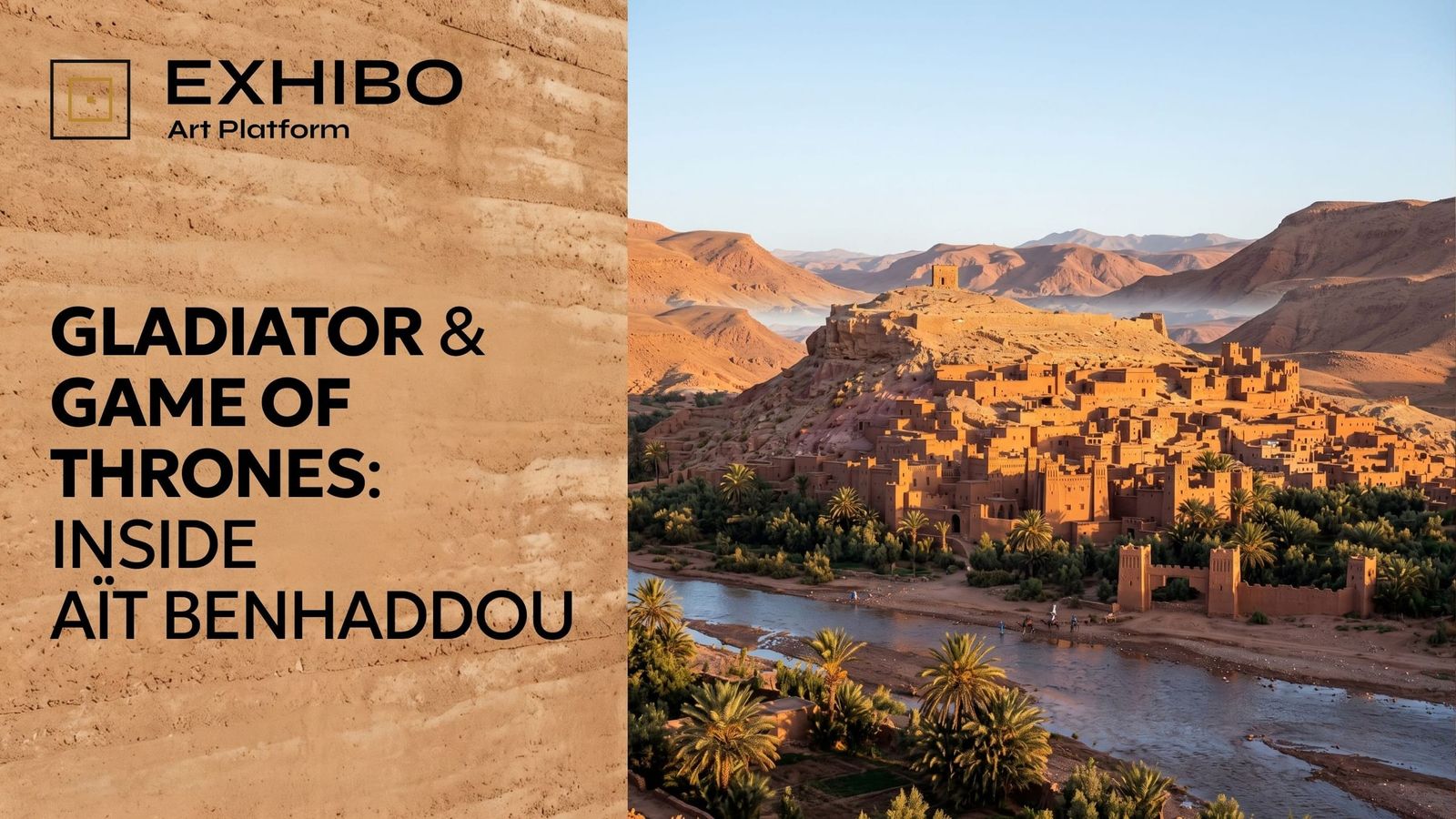
Aït Benhaddou is a ksar — a fortified collective settlement, rather than the single fortified residence a kasbah usually denotes. It sits on a hill above the Oued El Maleh, in the Ounila Valley on the southern slope of the High Atlas, and for centuries it sat on something more important than a river: the caravan route that carried goods across the mountains between Marrakech and the Sahara, and on toward the trading cities of the sub-Saharan south. Gold came north. Manufactured goods and textiles went south. Salt, spices and much else moved with the caravans in both directions, depending on the market. So did enslaved people — the trans-Saharan trade moved human beings along the wider network of routes this caravan corridor belonged to. The fortified walls were not decoration. They guarded a community, its stores and its goods.
Look at how the village is built and the whole social order is legible in the mud. The houses climb the hill in tiers, packed so tightly that the wall of one becomes the wall of the next, the entire settlement reading from across the river as a single continuous mass of red earth. The larger houses toward the bottom, tower-cornered and carved at the top like small urban castles, are the ones that most suggest prosperity; these are also the ones, UNESCO notes drily, that are "regularly maintained." At the very top sits the agadir, the communal granary and fortress, where the village stored its grain and could retreat under siege. Inside the walls: a mosque, a caravanserai where the trading caravans lodged, public squares, and — a detail cinema always sands away — two cemeteries, one Muslim and one Jewish. Whatever the size or span of the community it served, the Jewish cemetery is quiet evidence that the settlement was more socially complex than the monolithic, monofaith "ancient East" the movies project onto it. The real place was more plural than any of its screen roles.
The name itself carries the older layer. "Aït," in the Amazigh naming tradition, means "people of" or "descendants of"; tradition connects Ben Haddou to a founding figure, though the settlement's actual origins are far hazier than the name's neat legend. The whole thing sits in the Ounila Valley below Telouet, the stronghold of the Glaoui — the family whose control of the mountain routes helped them build an extraordinary political and economic power across southern Morocco, increasingly entangled with the French Protectorate right up to its end in 1956. This is a landscape whose real history is dense, specific, Amazigh, mercantile, multi-confessional and politically sharp. On screen, almost none of it survives. What the cameras kept was the walls.
The material is the whole story
To understand why Aït Benhaddou is both so photogenic and so precarious, you have to understand what it is made of, because the material explains almost everything else — the look, the fragility, the recurring labour, even the roles it gets cast in.
The load-bearing structure is pisé, rammed earth, known locally as tabya — combined, as the walls rise, with adobe (sun-dried mud brick) and timber. Local earth — its mix varying with the element being built, sometimes with fibre or aggregate worked in — is dampened and tipped in layers into a box of removable timber formwork and compacted with a wooden rammer until it is dense and hard. The mould is struck, moved along, and the process repeats, so a wall grows as a sequence of horizontal lifts whose faint seams stay visible in the surface if you look. Because rammed earth has very little tensile strength, the architecture relies heavily on compression, mass and geometry: the walls are thick and battered — widest at the base, tapering as they rise — which is what gives the towers their characteristic sloping profile, the silhouette that reads instantly as desert fortress. Above the rammed-earth base, lighter adobe brick is typically used for upper portions, partitions and decorative façades, with timber for lintels, floors and roofs. The same earth is structure, insulation and finish at once. Building material, wall, and the red-ochre colour of the whole place are a single substance: the ground of the valley, stood upright.
There is genuine genius in it. The thick walls hold the night's cool through the furnace of the day and the day's warmth through the cold desert night; the material is local, cheap and endlessly reworkable by anyone with the knowledge — though building with it still takes water, timber for the formwork and a great deal of labour; the technique belongs to a much older Amazigh building tradition of southern Morocco. Its low embodied energy, local sourcing, thermal mass and repairability are exactly why rammed earth is being studied seriously again by architects looking for lower-carbon ways to build. But the same properties that make earth humane make it mortal. It is permeable. Water is what it must constantly be protected from. And so, as UNESCO's own description of the ksar makes plain, the great threat is not age but the lack of maintenance and regular repair: moisture erodes earthen structures, so they have to be patched or rebuilt frequently, and once abandoned they disintegrate — not over millennia, but in a matter of decades.
The repair is not a modern rescue operation bolted onto an ancient object; it is part of the original logic of the material, the maintenance built in from the start. Where straw or other fibres are worked into an earthen mix, they help control cracking as the material dries and moves; the surface render is, in effect, sacrificial — meant to take the weather so the load-bearing wall beneath it does not, and therefore meant to be renewed. A pisé village assumes its own upkeep the way a garden assumes weeding. What has changed is not so much the technique as the number of hands: a village of nearly a hundred households had far more hands to share that upkeep than a handful of residents do, and much of it now falls to a conservation apparatus. CRAterre and CERKAS published a manual — in Arabic, French and English — to gather and spread conservation knowledge among owners, which is a quietly poignant thing in itself: a craft long passed on in practice now also has a book to help keep that knowledge in circulation.
The proof sits an hour up the same valley. Kasbah Telouet, the Glaoui seat — a palace so lavish that its ruined state rooms, with their cedar ceilings and zellij tilework, still stop visitors cold — has been deteriorating in the decades since 1956, when the death of Thami El Glaoui and the end of the Protectorate brought the family's power crashing down. Large parts of it are now severely decayed. Seventy years — less than a single human lifetime — and one of the most powerful houses in Moroccan history is slumping back into the hillside, its rammed-earth walls rounding and softening like sandcastles at the edge of the tide. That is the fate Aït Benhaddou is spared not by its solidity but by its hands: by the fact that, unlike Telouet, someone is still there with the wet earth and the wooden float. Earthen heritage is kept alive by maintenance, not preserved by being frozen. The building is a verb. A stone cathedral, neglected, can stand for centuries as a ruin; an earthen ksar, neglected, can lose its form within decades. Permanence, in mud, is not a property of the material. It is a decision someone keeps renewing, or one day stops renewing.
The village that stopped being a village
Here is the contrast the postcards leave out. The place cinema treats as timeless is a place its own people have been leaving for most of a century.
Around 1940, some ninety-eight families lived inside the walls of Aït Benhaddou. Today, depending on who is counting and how, perhaps half a dozen families do. Everyone else moved — not far, just across the Oued El Maleh, to a newer village with the running water, electricity and roads the old one lacked — a place to live a modern life without the daily burden of maintaining a monument made of mud. As the old caravan economy declined and modern infrastructure settled on the other bank, the reasons to endure the ksar's inconveniences went with them. The watercourse now marks a boundary that is also a choice: the old earthen village on one bank, the modern one on the other, a few hundred metres and several centuries apart, joined by stepping stones and, by the early 2010s, a footbridge.
So who keeps the old side standing? Not, mostly, the residents any more — there are too few of them. The answer is an unusually crowded committee, and it is the least glamorous and most interesting part of the story. Aït Benhaddou has been a UNESCO World Heritage Site since 1987, inscribed as a "perfect synthesis of earthen architecture of the pre-Saharan regions of Morocco." Its conservation is led by CERKAS — the Moroccan state centre for the rehabilitation of Atlas and pre-Atlas architectural heritage — which has worked with CRAterre, the international earthen-construction institute in Grenoble, with support over the years from UNESCO, the Moroccan Ministry of Culture, Japan's development agency JICA and other international partners, alongside local and national management committees. In 2004 CRAterre and CERKAS published a conservation manual — seventy-two pages, in Arabic, French and English — codifying which repair techniques worked best, so the knowledge could be handed to the owners themselves. A management plan was built in 2006–07 through a process that pulled in over seventy people.
And there is a small, telling war being fought inside those walls, between two materials. Modern concrete is harder for the conservation authorities to reconcile with the ksar's traditional construction, and residents have introduced it in places — a reinforced lintel here, a cement patch there. A body with the plain-spoken name of Comité de contrôle des infractions polices this, and mostly wins. But not always: a few concrete lintels, UNESCO's statement of authenticity records, "escaped its vigilance" — and were then "hidden by earthen rendering." Read that again, because it is the whole essay in a sentence. Where the twenty-first century breaks through, it is smeared over with mud to look old. The authenticity that the entire global machine of tourism and cinema comes here to consume is, at the seams, a performance of age laid over whatever modern material got through. The village is not lying, exactly. Renewing an earthen surface is not a forgery of age; it is how this architecture has always lived. What is new is the modern material underneath, and the fact that the surface now has a second job. It has to keep looking like the past.
The fragility is not theoretical. Floods on the Oued El Maleh damaged parts of the property in 2014, slowing an ongoing programme to restore the ksar's houses. And on 8 September 2023, the earthquake that struck the High Atlas reached Aït Benhaddou too. The traditional earthen buildings generally held up better than might have been feared, but the site was damaged: UNESCO's 2024 state-of-conservation report records cracked walls and façades, partial collapses, falling sections of pisé, detached render and rockfall risk on the edge of the hill — and the collapse of the so-called granary of the Potters, a rare surviving trace of a collective granary. UNESCO's committee has since tracked stabilisation measures and the launch of restoration works, alongside house-restoration projects already begun in the preceding decade, and UNESCO has since asked for the site's 2020–2030 management plan to be strengthened on risk. That is how close the margin runs on a monument made of mud. The threat to an earthen building is not only that rain wears it slowly away; it is that flood, quake and simple neglect each add another reason to rebuild, and the rebuilding never reaches a state you could call finished. And filming here does not happen on an empty set: productions operate within Morocco's heritage and film-authorisation framework, alongside the local and national management structures responsible for a site that is, unusually, both a World Heritage monument and a place where people still live.
One of Morocco's most filmed places
Cinema found Aït Benhaddou before UNESCO did, which is a fact worth sitting with. David Lean's unit came through in the early 1960s for Lawrence of Arabia, a quarter of a century before the site made the World Heritage list. The place was recognised as a usable image of the past by a film crew a full generation before it was recognised as heritage by the institution whose job that is. The camera got there first.
And once it arrived it never really left. The productions that have used the ksar, the valley around it and the studios down the road add up to something close to a complete inventory of the Western idea of antiquity: biblical epics from Sodom and Gomorrah to Jesus of Nazareth and The Last Temptation of Christ; The Message, the 1976 film about the birth of Islam; Egypt for The Mummy, the Hellenistic world for Alexander, Crusader-era Jerusalem for Kingdom of Heaven, even Tibet for Kundun. Not all of these were shot inside the walls — many used the surrounding landscape or purpose-built sets nearby — but together they made this corner of Morocco the place a production goes when it needs the past. And, most famously, Gladiator: the ksar became "Zucchabar," a market town in Rome's North African province, and an arena was purpose-built at its foot for Maximus's first fights — raised, the production designer Arthur Max recalled, from some 40,000 mud bricks over a steel frame, and demolished when the shoot was done. The slave market that sold him was built on the studio lot in Ouarzazate. (Rome's Colosseum, worth being precise, was a mixture of partial set, visual effects and location work at Fort Ricasoli on Malta — Aït Benhaddou played Rome's African edge, its province, its slave-frontier, never the capital.)
Then, in 2013, Game of Thrones recast the same walls as Yunkai, one of the slaver cities of Slaver's Bay, whose gates Daenerys Targaryen throws open to free the enslaved. And here the roles start to rhyme in a way no one seems to have designed and which is hard to unsee once noticed. A village that sat, in fact, on a trans-Saharan route that also carried enslaved people has become a recurring set for stories about slavery and its overthrow — the slave who becomes a gladiator, the queen who frees the slave cities, the desert frontier of bondage. Nothing suggests the productions came for that history; the documented draw was the architecture, the landscape and the light. The rhyme is an accident. But it is a loud one.
The pattern underneath all of it is simple to state. On screen, one place is drained of its own specific past — Amazigh, mercantile, Muslim and Jewish, Glaoui — and refilled, production after production, with someone else's. The same landscape is Rome and Jerusalem and Tibet and a fantasy slave-city, whichever antiquity has booked the week. It is the Wadi Rum problem — a real place hired to be an imagined one — but with a twist that belongs to Aït Benhaddou alone: here the surface being filmed is not even old. It is renewed patch by patch, wall by wall. The production designer's dream of deep permanence is painted onto a substrate of fresh mud.
And the layers pile up on each other in ways that would be funny if they were not so on-the-nose. When Ridley Scott came back for Gladiator II in 2024, he staged the film's "Numidia" — Rome's African frontier again — in the same Ouarzazate area where he had built his "Jerusalem" for Kingdom of Heaven two decades earlier, among standing sets that have also served productions from Game of Thrones onward. Crusader Jerusalem, Westeros, Roman Africa — one stretch of Moroccan desert, called on to be one antiquity after another, each production rendering over and reusing what earlier ones left rather than starting clean. The ksar and the studio sets are separate places, some thirty kilometres apart, and many sets were struck as soon as filming ended. But in the region's economy and in the images the world carries away, they have grown into each other; in the mind's eye, it is hard to separate the village from the things built to stand in for it.
Ouarzawood, and who pays for the past
None of this happens in isolation, and the reason so many productions land at this particular ksar rather than some equally photogenic ruin elsewhere is partly a spreadsheet.
Thirty kilometres away sits Ouarzazate, a town that has turned the desert's light into an industry and earned itself the nickname "Ouarzawood." Its clear skies, its long filming season and its dramatic meeting of Atlas snow and pre-Saharan rust make it, in one location manager's phrase, a place where geography did the casting. Atlas Studios, founded in 1983, became one of the region's major production complexes, its standing sets able to dress on demand as an Egyptian temple, a biblical street, a Roman forum. And Morocco has made the economics irresistible: since a 2022 reform, the state offers foreign productions a cash rebate of 30% of eligible local spend. When Ridley Scott returned for Gladiator II in 2024, the Moroccan Cinematographic Centre recorded a declared local production budget of more than 301 million dirhams — with some 72 million dirhams in production support. One earthen region, one antiquity rendered over another, and a river of foreign money flowing into it.
Because that is the quiet transaction underneath the glamour: cinema has become part of the economy that surrounds the past it consumes. The film industry helped make the ksar internationally famous and economically valuable, and tourism and filming are now woven into the site's complicated conservation economy — though the heritage specialists who work here note, pointedly, that the benefits of that economy are unevenly shared, and that local tourism revenue remains underexploited by the community itself. Local people have found work around the productions over the decades, and some of the crafts the studios rely on — building large things by hand, in earth and timber — overlap with the skills the ksar itself needs to survive. In a region with few economic alternatives, UNESCO's creative-cities network now describes film as a driver of local employment and development in Ouarzazate.
It is worth being honest about the terms of that dependence, though. Ouarzazate's own studios sell the region partly on affordable crews and competitive costs, and reporting over the years — from a 2017 US News piece to Le Monde diplomatique during the Gladiator II shoot — has recorded concerns about contracts, extras' pay and how unevenly the benefits of big productions are spread. Both things can be true at once — the industry sustains the region, and it sustains it cheaply — and the honest version of the story holds them together rather than choosing the flattering half. The money is real, and so are the questions about who it reaches.
But the dependency is starting, slowly, to run the other way too. Decades of serving other people's epics have built something in Ouarzazate that outlasts any single shoot: a deep local workforce fluent in large-scale set construction, historical costume, horses, crowds, stunts and the logistics of shooting in hard country — skills available to Moroccan and regional productions, not only Hollywood's. The town has a Musée du Cinéma. Moroccan filmmakers are telling their own stories on the same ground that has spent sixty years pretending to be everywhere else, and Moroccan films are winning their own audiences: in 2024, according to the Moroccan Cinematographic Centre, the top seven places at the national box office all went to Moroccan features, with Gladiator II arriving at ninth. The desert that learned to play other people's pasts is, gradually, learning to film its own present. It is the same arc this series keeps finding: the borrowed backdrop, over time, quietly reclaimed by the people who live in front of it.
The performance of permanence
Stand across the river at the end of the day — the hour when the coaches have gone and the low sun turns the whole east-facing mass of the ksar to burning ochre — and you are looking at one of the most convincing images of the ancient world that exists anywhere on earth. It is genuinely old: a settlement whose history is traditionally traced back centuries, its surviving architecture largely of the seventeenth century, its form evolved over a very long time to fit this exact valley and society. And it is genuinely new: re-rendered surfaces, replaced lintels, concealed concrete, restored walls, all of it, to most visitors, hard to tell apart from the "original" thing. Both truths sit in the same photograph. The place is ancient and the place is freshly made, and there is no seam where one stops and the other starts — which is, when you think about it, exactly what a rammed-earth village is: a thing that is always simultaneously very old and only as old as its last repair.
Outsiders have long looked at this place through pictures of somewhere else. The film industry did it at industrial scale, and the render itself now does it at the level of the wall — presenting this specific, local, living place as a stand-in for a more famous, more permanent, more legible idea. Rome, Jerusalem, a place that has always simply been there — rather than a place that people make and remake with their hands.
But the people are the point, and they are still there, on both banks. The few families inside the walls, and those across the river whose families built it — with jobs, homes and interests of their own as real as any inherited craft — are not curators of a ruin. They are practitioners of a living craft — the same craft that raised the ksar, applied now to keeping it up, alongside the conservators and often through them — and the knowledge in their hands is Amazigh, specific, and older than any film that has ever used their home as a backdrop. The conservation manual was meant to keep that knowledge in circulation among the people responsible for the buildings. The management committees consult them. When new render goes on, it follows techniques with deep roots in the region, applied by people whose forebears built in the same way. The past that Aït Benhaddou performs for the cameras is fictional, borrowed, endlessly recast. The past in the technique — in the wet clay, the timber float, the rhythm of undoing and remaking — is real, and it is theirs, and it is one of the deepest continuities the place has.
So go back to the figure on the lane, with the bucket of earth. The tourists below are photographing centuries of history. The film crews book the walls as the unchanging deep past. And the person doing the actual work of keeping it all upright knows the truest thing about this monument to permanence: that it survives only because, again and again, someone agrees to build it once more. The eternity is the performance. The maintenance is the reality. And the freshest mud in Morocco is the part everyone has travelled across the world to see, mistaking, in the golden hour, the newest surface on the hill for the oldest thing they have ever laid eyes on.
Related reading
Where Is Agrabah? The City Disney Assembled From Real Places
Agrabah was going to be Baghdad. A war made it fictional — and then Disney built it back out of real places, from a tomb in Agra to a valley in Jordan that usually plays Mars.
The Visual Language Older Than Arabic
How one of North Africa's oldest writing traditions survived conquest, colonial classification and the loss of its readers — and why, for much of it, we still cannot say what the marks mean.
Why North African Cities Turn Inward: The Story of the Courtyard
A courtyard plan far older than Islam turned North African houses — and the medinas built from them — to face inward. Climate and religion only half-explain why, and what finally displaced the courtyard says the rest.