
Marrakech · Morocco
The Visual Language Older Than Arabic
How one of North Africa's oldest writing traditions survived conquest, colonial classification and the loss of its readers — and why, for much of it, we still cannot say what the marks mean.
How one of North Africa's oldest scripts — and a visual repertoire that may be older still — survived conquest, colonial classification and the loss of its readers — and why the truthful thing to say about most of it is that we still cannot read it at all.
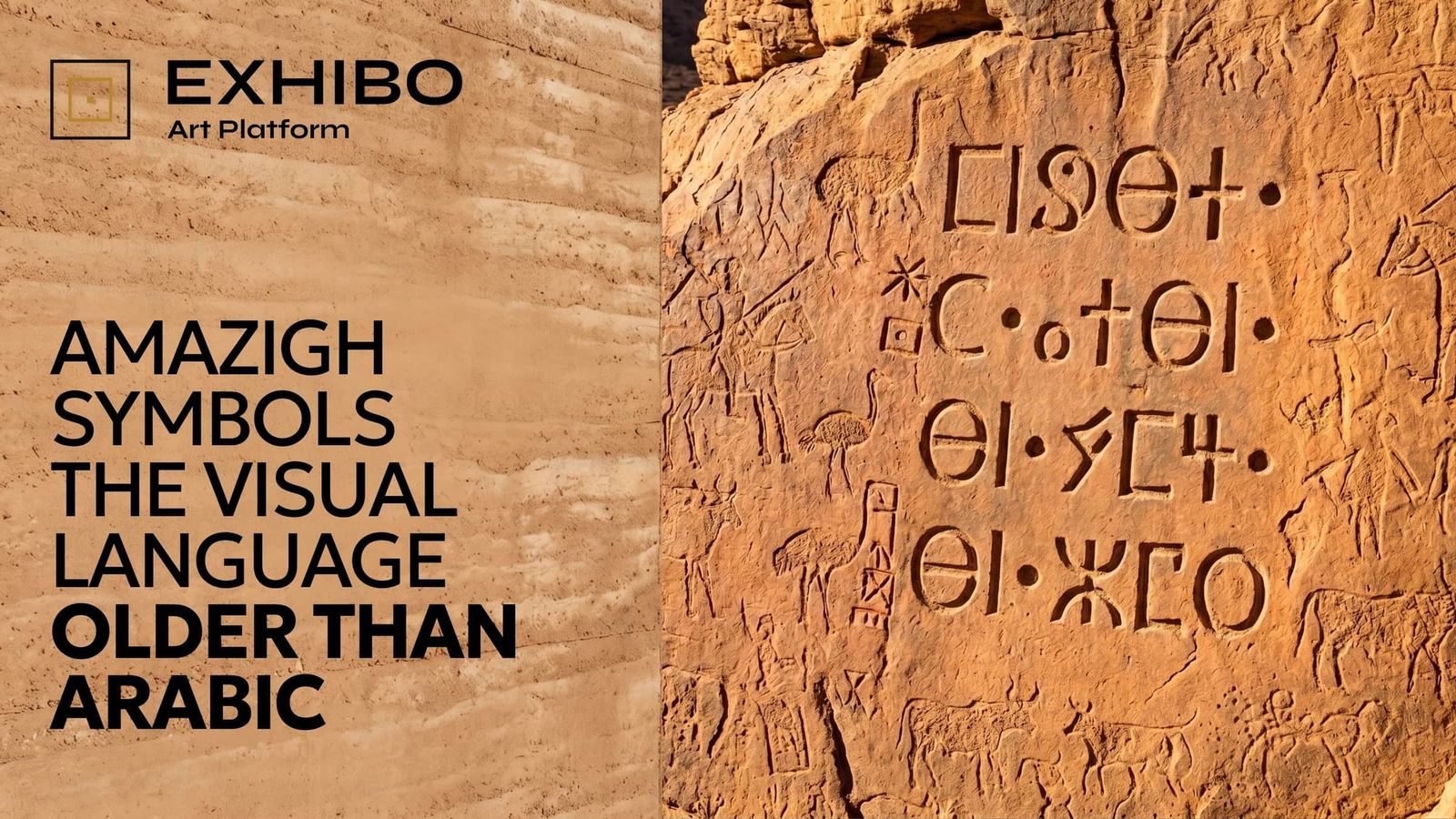
There is a stretch of rock in the Draa valley, near Foum Chenna in southern Morocco, where ancient inscriptions sit among the rock art of a large engraved site — a script scattered across the stone. Vertical strokes. Dots in a row. Circles, crosses, three-pronged forks, little ladders. It looks, at first glance, like a language you could learn on a slow afternoon — the alphabet is small, the shapes are clean, nothing curls or connects. Stand in front of it and the honest response is not awe. It is a specific, uncomfortable feeling: you are looking at writing, you can see that it is writing, and you cannot read a word of it.
That feeling is the subject of this piece. The marks are Libyco-Berber, the ancient script that stands, distantly, behind the modern Tifinagh of the Amazigh — the people long called Berber. "Behind" is doing careful work in that sentence: the line from these ancient signs to the letters written today is real but not a clean relay, and untangling it is half of what follows. What can be said plainly is that this is one of the oldest indigenous writing systems of North Africa, attested on the ground centuries before the Arabic script reached the region with the conquest of the seventh century. (Older than the Arabic script in North Africa, that is — not a claim about the age of the Arabic language, which is its own long story.) And most of what has been said about what it means was added later, by someone else, often to serve a purpose that had nothing to do with the person who first cut the strokes into the stone. The script is old. A great deal of the story around it is young. The gap between the two is where the interesting things live.
The rock we cannot read
Start with the scale of the thing, because it is the part nobody expects. Libyco-Berber inscriptions are not a handful of curiosities. There are thousands of them, scattered across a region that runs from Morocco through northern Algeria and Tunisia into Libya — carved on funerary stones, pecked into rock shelters, scratched as graffiti beside herds of engraved cattle. The bulk of the North African corpus is generally placed between roughly the third century BCE and the third century CE, the world of the Amazigh kingdoms of Numidia and Mauretania, contemporaries and rivals of Carthage and Rome — though a handful of engravings, on the strength of the rock art around them, have been argued to run much older. Related inscriptions reach out to the Canary Islands as well, but those are a distinct corpus with their own contested chronology, and are best not folded into the mainland pile — we'll come to them. Whatever else is uncertain, this much is not: people here wrote, and they wrote a great deal.
And here is what the confident summaries skip: for much of that territory — the coast from Kabylia across Morocco, and the desert engravings of the Sahara — we largely cannot read them. Not "we're still working out the nuances." In some regions we can recover many of the signs but only fragments of the language — an ancient variety of Berber sometimes called Numidian or Old Libyan, known only in pieces. In others, especially some western and Saharan variants, the sound values of certain signs remain unreliable, and specialists warn that readings there should be treated with caution — even the reconstructed "Berber" behind them is, as one puts it, questionable.
This is not a failure of effort. It is a failure of evidence, and the difference matters. The distance is wide enough that even among communities who still use a living descendant of the script, the ancient inscriptions are often unreadable — modern Tuareg may recognise some signs and no more. Decipherment needs a crack — a bilingual, a text that says the same thing twice in two scripts, one of which you already know. Secure bilinguals of that kind are very few, and one site does most of the work. What survives is overwhelmingly short: gravestones, a name and a lineage, X son of Y, and then nothing. You can crack the code of a padlock and still find the diary inside written in a language you don't speak. That is closer to the situation — and in the hardest cases we cannot even be sure we have the code.
It is worth adding one caution the specialists insist on, precisely because the popular telling skips it: "Libyan," "Numidian" and "Libyco-Berber" are scholarly labels of convenience, not proof that every inscription records one language, nor that there is a seamless line from these ancient marks to the modern Amazigh communities who now, understandably, claim them. The kinship is real; the clean, unbroken pedigree is an assumption. Which means that when you read — on a museum placard, in a guidebook, on the little card beside a silver pendant — that a particular ancient mark "symbolises fertility" or "represents the sun" or "wards off the evil eye," you are often not reading a translation at all. You are reading an interpretation, supplied centuries or millennia after the fact, by someone who could see the shape and could not hear the voice. Sometimes the interpretation is careful and probably right. Often it is a guess wearing the costume of a fact. Learning to feel the difference is the whole art of looking at this material honestly.
The key that was carried away
There is one place where the code did crack, and the story of how is worth telling slowly, because it contains almost everything — the real scholarship, the real breakthrough, and a small uncomfortable fact usually left out.
The place is Dougga, ancient Thugga, a hill town in northern Tunisia that happens to be the best-preserved Roman small town in North Africa. Long before Rome, the Amazigh built a tall funerary monument there — the Libyco-Punic mausoleum whose surviving inscription names Ateban, son of Iepmatah, son of Palu. For generations that name was read as the prince the tomb was built for. More recent epigraphy suggests something more prosaic and, in its own way, more telling: the surviving text seems to list the builders — the architect and the head craftsmen — while a second inscription, now destroyed, may have carried the actual dedication. Either way, the monument did the one thing almost no other Libyco-Berber text does. It placed two scripts side by side: Punic, the language of Carthage, which scholars could already read, and the Amazigh script, which they could not. Two languages, one monument — the nearest thing the Berber script has to a Rosetta Stone, with the caveat that it unlocked far less than the real one did.
In 1843 the French scholar Ferdinand de Saulcy used it, matching the personal names across the two texts to pull out sound values one letter at a time. It worked, mostly — a few characters still remain uncertain. It was a genuine and brilliant piece of work, and it is why the inscriptions of Tunisia and eastern Algeria can be read better than any others. But notice the size of the win. What cracked was one regional form of the script, in one corner of a vast territory. The old textbook split into a neat "eastern" and "western" Libyco-Berber is itself contested; look closely and the single script fractures into numerous local varieties, some so unlike each other that even the old eastern/western division becomes hard to sustain. De Saulcy found a key. He did not find the key, because there was never only one lock.
And notice, too, what the key opened even where it turned. It gave scholars the letters. It did not hand over the language, which — an ancient variety of Berber sometimes called Numidian or Old Libyan — is still only partly understood. Take the recovered letters back to the mausoleum inscription and the grand text you get is not a royal proclamation but a working record: the name of Ateban, then the people who did the job — the stoneworkers were these men, the carpenters these, the metalworkers these. A monumental inscription on a royal tomb, and it reads like a contractor's credit roll. That is not a fluke of one stone; the surviving corpus is overwhelmingly this plain — a name, a lineage, X son of Y, or the bare it is me, X, and little more. And then, every so often, the plainness breaks and something human comes through: among the translated inscriptions are, the British Museum notes, a few with an amorous meaning — I, so-and-so, love so-and-so. Two thousand years of silence, and what surfaces is a builder's invoice and a love note. It is a useful corrective to the assumption that these marks were mainly about gods and cosmic forces; mostly, on the evidence we can read, they were about people.
Now the uncomfortable part, told plainly because the brief of this series is to tell it plainly. The bilingual inscription that unlocked the script is not in Tunisia. In 1842 Sir Thomas Reade, the British consul at Tunis, had the inscription removed — an operation that damaged and effectively ruined the monument. The two blocks of the frieze, the Libyco-Berber and the Punic, were shipped to London and entered the British Museum in 1852. The tomb itself stood ruined until the French archaeologist Louis Poinssot rebuilt it, with Tunisian labour and support, between 1908 and 1910. The single object that let the world begin to read one of North Africa's oldest indigenous writing traditions was physically taken out of North Africa to do it. De Saulcy's scholarship was real, and the removal followed the ordinary extractive logic of its century — the same logic that filled every great European museum. It is worth saying plainly what happened, without heat: the key to the script was turned in a lock in Tunisia and then carried across the sea. To stand before the stone that first unlocked the script, you now travel to London.
What the marks actually say — and what we say for them
So if we mostly cannot read the ancient script, where did all the confident meanings come from — the fertility triangles, the sun-wheels, the protective eyes that fill every article on Amazigh symbols, including the ones that will sit next to this one in a search result?
Some came from living traditions and were then projected backwards onto the ancient material; others come from colonial-era ethnography, from the modern revival, or simply from one writer copying the last. The projecting-backwards is where the caution has to live.
Here is the mechanism. A family of geometric marks — the lozenge, the chevron, the cross, the comb, the row of dots, the three-pronged fork — recurs across Amazigh material culture over a very long span, on skin, in wool, on the clay of a water jug, in the silver of a bride's pendant. Those marks carried meanings in the communities that made them, meanings ethnographers wrote down in the nineteenth and twentieth centuries: this one for the eye, that one for the partridge, this one for the free-standing man. Real meanings, held by real people — though even here the names and readings shift from place to place and change over time, which is the first clue that the meaning is not a fixed property of the shape. What none of that establishes is that a given mark meant the same thing, or descends by an unbroken line, from its lookalike on an ancient stone.
The temptation — and it is nearly irresistible — is to run the film in reverse. If a lozenge means fertility on a rug woven in 1950, then surely a lozenge cut into rock in 300 BCE meant fertility too. Surely the thread is unbroken. Surely the woman at the loom is transmitting, hand to hand across a hundred generations, a code the ancients set down.
Maybe. But that is precisely the move that the honest scholarship refuses to make cleanly, and for a reason worth sitting with. It is the same reason the khamsa — the subject of another piece in this series — turns out to be a shape far older than any of the holy names later written onto it. A symbol's shape can survive for millennia while its meaning is renewed, overwritten and reinvented at every stage. The mark persists; the story attached to it does not have to. When a colonial scholar looked at a triangle tattooed near a woman's mouth and declared it evidence of an ancient "Berber sun-worshipping cult," he was not translating. He was, as the writer Samira Larouci puts it in her account of how these motifs were lifted out of context, inventing — taking a living mark whose meaning the wearer knew perfectly well, and swapping it for a meaning that flattered his own theory.
So the rule for the rest of this piece, and the rule I would offer for looking at any Amazigh symbol: hold the shape and the story a little apart. Trust the material fact before the story attached to it: the shape is real, and its presence in Amazigh culture is real; its exact journey across time is the part we often cannot reconstruct. Treat the story with tenderness and suspicion in equal measure, and always ask the quiet question — who is this meaning serving, and when did they start telling it? The gap is not a disappointment. It is the most honest thing in the room.
The "alphabet" written on skin
Which brings us to the body — and to a distinction the rest of this piece depends on. What lived on the skin was not a script in the strict sense: it did not spell out the Berber language sound by sound the way Libyco-Berber did. It was something else, and arguably wider — a visual language, a graphic vocabulary of marks that carried meaning without encoding speech. Calling it a "second alphabet" is a metaphor, and it is worth keeping the quotation marks on. And yet the two may not be as separate as they look: one of the three main theories for where the Libyco-Berber alphabet even came from holds that its signs grew out of an older indigenous stock of marks — tribal tattoos, marks of ownership, the geometry of rock art — rather than being borrowed wholesale from Phoenician. On that reading, some of the signs may have roots in an indigenous graphic repertoire that predates their use as writing — the marks on the skin and the marks on the stone drawing on a common older well, rather than one copying the other.
Until well within living memory, Amazigh women in many regions of North Africa — the practice varied sharply from group to group, and no single code covered all of them — wore a visual language on their faces and hands and ankles — tattooed in a soot-and-herb ink pricked under the skin with a needle, a vertical line from lip to chin, a diamond on the forehead, a scatter of points across a cheek, a motif at the wrist. The marks were not decoration in the way a modern tattoo is decoration. They were readable. To someone who knew the local conventions, a woman's face could signal belonging, a life stage, beauty, protection against the harmful glance — things that varied from one community to another. The body could be read, at least by those who shared its code.
And in the communities the art historian Cynthia Becker studied — she spent years living among the Ait Khabbash of southeastern Morocco — it was overwhelmingly a document written and read by women, who made the marks and wore them, controlling the symbols of the group's identity and displaying them on their own skin. Similar female-centred traditions are documented elsewhere, but Amazigh tattooing was never one uniform system, and what held among the Ait Khabbash need not hold in the Rif or the Aurès or the Sahara. Becker's sharp formulation, drawn from the communities she worked in, is that women there both created the visual language of Amazigh identity and were its public surface — the decorated female body as the group's billboard. Museum scholarship finds women as the makers of everyday decorated objects across other Berber areas too, each drawing on a shared vocabulary while working within her own tribe's design tradition — though how far the billboard role generalises is Becker's reading of her own fieldwork, not a settled fact for every Amazigh society. That gave women a real and unusual kind of authority. It also, Becker is careful to note, boxed them in: to be the living emblem of your people's purity is a form of power that is also a cage. Both things are true. The tradition handed women a voice and a set of walls in the same gesture.
The most common single mark is a vertical line running down from the lower lip to the chin — often given a name, though the naming varies from telling to telling. You will read, in a great many places, that this line and the palm-frond motif on the chin descend directly from Tanit, the great goddess of Carthage, so that the woman wearing it carries a Punic deity on her face across two and a half thousand years. Tanit was real, and the sign of Tanit is real. What is not established is an unbroken line connecting the Punic goddess to a particular Amazigh tattoo across two thousand years — and possible and attested are very different statements, and the market — the tour guide, the tattoo-revival brand — has every incentive to blur them. The shape is old. The goddess-story is a story.
There is one more legend to handle with care, because it recurs everywhere: the claim that Amazigh women covered themselves in tattoos to make themselves ugly to French soldiers, or to Sultans' men, and so escape being taken. It is repeated as established fact. Treat it as what it is — a piece of oral tradition whose age and historical basis are difficult to establish, plausible in spirit and unproven in detail. The better-documented account of why the tattoos existed is the one the women themselves gave: beauty, protection, fertility, belonging, and the marking of a life's stages. Not a single dramatic origin. A thousand ordinary reasons, which is how real traditions actually work.
And then, within two or three generations, it nearly vanished. In many communities where facial tattooing survived into the twentieth century, the women who still bear it are now elderly — the last generation to have received the marks. The disappearance had no single cause, and it would be dishonest to assign one. Religious condemnation, in which many came to regard permanent marking of the God-given body as forbidden, was one factor. So was urbanisation, which pulled young women into cities where the marks read as rural and backward rather than beautiful. So was the long colonial-era stigma that had already taught North Africans to see the tattoos as primitive. Several currents, pulling the same direction, and a mark that had been read fluently for generations thinned toward silence within a single lifetime — its last bearers and readers growing old.
The same signs, woven
Take the marks off the skin and you find many of the same forms recurring in the wool.
Walk the length of an Amazigh carpet from the Middle or High Atlas and you meet a recurring geometric repertoire that echoes what lives on the ancient rock and the vanishing face: lozenges, chevrons, combs, crosses, zigzags, the eye, the fork. It helps to name what is actually being looked at, because three different things travel under the one phrase visual language. There is a script — Libyco-Berber, later Tifinagh — that encodes speech. There is this graphic repertoire — the marks on wool and skin and clay — that carries meaning without spelling out words. And, further on, there is a political symbol — a single letter made to stand for a people. They overlap and feed each other, but they are not one system, and a shared stock of forms is not a single coded language transmitted intact across three thousand years. Same shape need not mean same sign, same meaning, or same lineage. Recurring forms, not proven continuity. In many documented Moroccan traditions the pieces are woven by women, and the good scholarship — Becker's again — treats the loom the way it treats the tattoo needle, as a technology of setting down identity in a medium the group controls. A carpet made for a wedding, a striped blanket, an indigo head-covering embroidered at the edge, a clay jar painted before firing, the silver of a marriage necklace: a recurring repertoire of forms, distributed across every surface a life touches.
But — and by now you know where this is going — the meanings assigned to the woven signs come with the same asterisk as the meanings assigned to the tattoos. There is a whole genre of writing that hands you a tidy dictionary: this diamond is protection, this line is a river, this chevron is a bird's wing, this X is the four directions. Some of it rests on real ethnographic testimony, women explaining their own work to a careful listener. A lot of it is later systematisation — the impulse to turn a living, regionally variable, family-specific visual habit into a clean codex with one meaning per shape, the way a European reader expects a symbol-system to behave. The reality on the loom is messier and more human: the same shape can mean different things three valleys apart, or nothing in particular beyond this is how my mother made it, or something the weaver knows and does not say to the person buying the rug. The signs are real and old and structured. The single-meaning dictionary is frequently a convenience invented for outsiders. When a rug is sold to a tourist with a laminated card explaining that each motif is an ancient coded message, the card is often doing to the wool exactly what the colonial doctor did to the skin — supplying a meaning, and calling it a translation.
None of which makes the weaving less extraordinary. It makes it more so — because what you are actually looking at is not a fixed code to be decrypted but a living improvisation on a repertoire of inherited forms, transmitted within families and communities, still being made this year. The thing to admire is not a secret you can crack. It is a continuity you can watch.
Who kept the writing
If the monumental Libyco-Berber inscription tradition of the northern Maghreb vanishes from the surviving record during the Islamic period — and it does, with no Libyco-Berber inscriptions securely identified from that period there — then how does anyone still call Tifinagh a living script? The answer is: the desert kept it. Or, more precisely, the Tuareg did.
Out in the central Sahara — across what is now southern Algeria, Libya, Mali, Niger — the Tuareg, the Amazigh people of the deep desert, held onto a form of the script the whole time, right through the centuries it lay abandoned on the coast. They call it Tifinagh, and they used it in the way the tidy story of "an ancient literary tradition" would never predict: not for epics, not for scripture, not for the great recited poetry that is the real treasure of Tuareg culture — that stayed oral — but for short things. Love notes. Messages. Graffiti on a rock at a rest stop. A name scratched on the wooden neck of a lute. Games of writing between people who could otherwise recite for hours and never reach for a pen. Writing, among the Tuareg, was the small tool; the memory was the monument.
There is a popular version of this that says: and it was the Tuareg women who guarded the alphabet, teaching it to their children, keeping the flame. It is a lovely image and it is sometimes true — the anthropologist Susan Rasmussen found Iwellemmedan women in Mali who taught her the script with enthusiasm. But she also found, among the Kel Ewey of northern Niger, women who did the opposite — who ranked Arabic above Tifinagh precisely because Arabic was the alphabet of the Qur'an, one telling her flatly that she did not know Tifinagh and did not need to, because Islamic learning was worth more. Both women are Tuareg; both are telling the truth about their own lives. The clean claim — the women kept the script — is half a fact. The fuller fact is that the script meant different things to different people in the same tent-range, and that the story of a single devoted guardian is itself a little too tidy to trust. Even the counter-narrative needs a counter-narrative.
The desert also holds the script's most evocative site, though it has to be handled with care, because three different things get folded into one name. There is a real monument: a tomb at Abalessa generally dated to Late Antiquity in the Ahaggar, excavated in 1925 — by a colonial adventurer whom even his contemporaries regarded as more showman than scientist — and found to hold the skeleton of a Berber woman amid gold, silver and Roman coins, with Tifinagh marks reported on its stones. There is a legend: Tin Hinan, the ancestress the Tuareg remember as the mother of their line. And there is the leap of faith that fuses the two — the identification of the woman in the tomb as Tin Hinan, which the archaeology does not confirm. Keep them separate and the site is still remarkable: a woman's monumental grave, in a society whose major literary traditions remained oral, with Tifinagh marks associated with the monument. The cliché said writing and a memory-culture could not sit together. In the Sahara they do — even if we cannot say for certain whose grave it is.
And the desert holds the losses, too. The French suppression of the Tuareg revolt of 1916–17 was ferocious — mass reprisals and public executions fell on the towns of the Aïr, including the killing of religious scholars who were the region's keepers of manuscript learning. When the people who carry a written culture are killed, the writing thins with them. The pattern by now is familiar. The script does not mostly die of natural causes. It is, again and again, taken — the stone shipped north, the manuscripts burned, the key carried away.
Yet the most important fact about the Saharan inscriptions is that they never fully stopped. When researchers digitised the Tifinagh sites of the Tadrart Acacus in the Libyan desert, they found that at some locations the inscriptions span pre-Islamic, Islamic and modern periods — some cut by Tuareg who still camp there now. Not a dead script from a sealed past. A rock that people have been marking in Tifinagh across pre-Islamic, Islamic and modern periods, and were still marking this century. The wall is not an archive. It is a guestbook, and it is not closed.
The island where the sign outlived its readers
Follow the script to its strangest edge and you leave Africa entirely, for the Atlantic.
The Canary Islands, off the coast of Morocco, were inhabited long before the Spanish came — by the Guanche and their island cousins, peoples whom archaeological, genetic and linguistic evidence connects to the Amazigh of the mainland, settled across the water during the first centuries CE. And the islands preserve inscriptions in scripts related to the Libyco-Berber tradition, on rock faces across El Hierro, Tenerife, Gran Canaria and Lanzarote — some of them, perhaps, still in use in the centuries just before the Spanish conquest, made by the descendants of people who had crossed from the continent long before.
We cannot read these either. And here the reason is the darkest in the whole piece, stated in a single devastating clause by the scholars who study the islands' colonisation: the connection to the mainland Amazigh is clear in the broad evidence, but the detail stays uncertain because the islands' societies were conquered, enslaved and absorbed across the fifteenth and sixteenth centuries, their languages fading before they were systematically recorded. The Indigenous islanders did not fade. Their societies were conquered, disrupted, enslaved and progressively absorbed into the colonial population across the fifteenth century — their descendants survive today in ancestry and mixture, but those societies as distinct worlds did not — and their languages disappeared before they could be adequately documented. A scatter of place names, loanwords and lexical fragments survives, but not enough to read the inscriptions back into speech.
So the inscriptions on El Hierro are a script we cannot fully read, left by societies whose languages and social worlds were dismantled by conquest. The people did not disappear; their pre-conquest societies did. Everywhere else in this story, "we can't read it" is a problem of missing keys — the bilingual carried away, the words too short. On the Canaries it is something else. Sometimes we cannot read the writing not because the code is lost but because the readers are gone. The sign outlived the people who understood it. That is the coldest thing a symbol can do, and it is worth remembering the next time the marks look merely decorative.
The ancient script rebuilt in the twentieth century
Now turn the whole thing around, because the modern chapter contains the sharpest twist of all — and it is the one the celebratory version never mentions.
Walk through Rabat or Tizi Ouzou today and you will see Tifinagh everywhere: on the ministry signage, on the university nameplate, on schoolbooks, on the ID of a cultural revival that has, against long odds, put an ancient indigenous script back into official public life. Morocco recognised Tamazight as an official language in its 2011 constitution; Algeria followed in 2016. The script that fell silent on the northern coast twelve hundred years ago is back on the coast, cut into the granite of the state. It is a genuine and moving reversal, and nothing that follows is meant to diminish it.
But the version most people carry — that the modern Amazigh movement simply revived the ancient alphabet, dusting off the letters of Dougga and putting them back to work — flattens three quite different historical moments into one, and blurs the line of descent in the bargain. The living Tuareg tradition is generally traced through the Saharan branch rather than through the eastern form deciphered at Dougga — though the eastern/western taxonomy is itself contested, so this is a line of descent reconstructed, not a settled family tree. So the three moments are: the traditional Tuareg Tifinagh of the Sahara, a living, mainly consonantal script that never stopped. There is the Neo-Tifinagh developed from the 1960s onward by Amazigh activists — the Berber Academy, Agraw Imazighen, working largely from Paris — who reworked those Tuareg forms and, crucially, adapted a tradition that had marked vowels only sparingly — mostly word-finally — into a full orthography that writes vowels throughout the word. And there is the later standardisation by Morocco's Royal Institute of Amazigh Culture (IRCAM), which in 2003 standardised a 33-character Tifinagh orthography and adopted it as the official script for teaching Tamazight in Moroccan schools. Three moments, not one line: a desert script, an activist reconstruction, a state standard.
The result is a script whose deepest forms are genuinely ancient while its working shape — its vowels, its standardisation, its very presence in a classroom — is a twentieth-century construction. The choice was contested. Some Amazigh linguists and activists argued that the Latin alphabet would be more practical and easier to deploy; others saw Tifinagh's distinctiveness as precisely its point — a symbol of visible, unmistakable, unarguably-indigenous difference. On that reading the decision was driven as much by the symbolic stakes as by convenience. And outside the formal Moroccan school system the Latin alphabet remains widely used — and in many contexts predominates — for everyday Amazigh writing, in print and online, while Tifinagh's most conspicuous public presence is often on signage and other culturally visible surfaces — the places where the script is most legible as a marker of Amazigh identity. The choice was sharply contested among Amazigh linguists and activists at the time, some of whom argued that a harder-to-learn script would slow the language down at the very moment it needed to spread. None of which settles whether it was wrong — only that it was a choice, and a close one.
Which is not a scandal. It is simply the truth about how living symbols work, and it rhymes exactly with everything else in this piece. The khamsa's holy names were written onto an older shape. The tattoo's Tanit was read onto an older mark. And now the "ancient alphabet" of the Amazigh revival is, in its everyday form, a modern instrument reaching back through an ancient one — the past reconstructed to do a job in the present. The move is honest as long as you name it. The dishonest version is the one that pretends the letters on the ministry wall were handed down unbroken from the man who carved the rock at Foum Chenna. They were not. They were reassembled, with love and intent, by people who needed the past to say something now. That is not a lesser act. Building a usable present out of a half-legible past may be the most Amazigh act in the entire history.
The sign is stronger than bombs
There is a single letter you have been seeing this whole time without knowing its name. Three strokes — a vertical line crossed by two diagonals, a small figure that reads like a person standing with arms flung up to the sky. In the script it is the letter yaz, sometimes ezza, the sound z — the middle consonant of the word Amazigh itself. In red, on a banner of blue, green and yellow, it is the centre of the Amazigh flag, created in the milieu of the Berber Academy around 1970 — the design is usually credited to the activist Mohand Arav Bessaoud, while the flag's first public raising is associated with the Kabyle veteran Youcef Medkour, one of several competing origin stories even for so recent a symbol — and adopted in 1997 by the World Amazigh Congress, meeting, as it happens, in the Canary Islands, the far Atlantic edge of this whole story. A single letter of a barely-readable script, standing for a whole people's claim to exist. The most-seen Amazigh symbol on earth is not an ancient meaning recovered. It is one old sign, chosen recently, made to carry everything — and states have treated it as if it carried a charge. During Algeria's Hirak protests in 2019, the army chief Ahmed Gaïd Salah ordered that no flag but the national one be raised at demonstrations; at least forty-one people were arrested in the first wave for carrying the Amazigh flag, and courts later imposed prison terms on flag-bearers under laws concerning national unity. A letter can be treated as contraband.
And that is the note the whole story has been building toward, because it is where the ancient marks stop being heritage and become art again — living material in the hands of people making new things. In the mid-twentieth century, Moroccan modernists drew on this material in distinct ways: Ahmed Cherkaoui explicitly took up Amazigh tattoo-marks and signs — his own mother's among them — while Mohammed Melehi, later shown at Tate, built a modernist vocabulary partly from Amazigh textile forms — turning the bands and rhythms of Glaoua rugs into his signature waves — both answering European abstraction on their own terms. In Algiers in 1967, the artists Denis Martinez and Choukri Mesli, with others, founded a movement and named it Aouchem — the word means tattoo — dedicated to drawing exactly these ancient North African signs, from the rock art of the Tassili to popular talismans, into a decolonial modern art. Their manifesto, signed in Algiers on 1 April 1967, put it in a line that could serve as the epitaph for this entire piece: the sign is stronger than bombs.
You can watch the same current running now, in the hands of a younger generation — the Amazigh-inspired tattoo artists reopening the practice their great-grandmothers were shamed out of, from Casablanca to Tunis; the designers and weavers pulling the old repertoire into contemporary work; the whole quiet reversal by which a mark that meant primitive for a century now means free. It carries a real tension, and the honest thing is to leave it standing rather than resolve it: the same revival that rescues a symbol can also empty it, and a yaz printed on a tote bag is not automatically the yaz raised at a protest where it once meant prison. Reclaiming and diluting can look identical from across a market stall. The difference is whether the person carrying the sign knows what it holds.
Which is where a piece like this ends, and where looking begins. The marks are still here — on the rock in the Draa valley we still cannot fully read, on the last tattooed faces, in the wool of a carpet being finished this week, in the red letter on a flag at a football match, in the hands of artists turning three ancient strokes into something new. The shape is old, and it remains part of a visual culture that people are still making. The story is younger, and more contested, and more human than the confident version admits. Hold them apart, and neither one shrinks: the antiquity stays real, and so does the long, unfinished work of deciding what it means. You do not need to translate these marks to look at them properly. You only need to keep looking.
Related reading
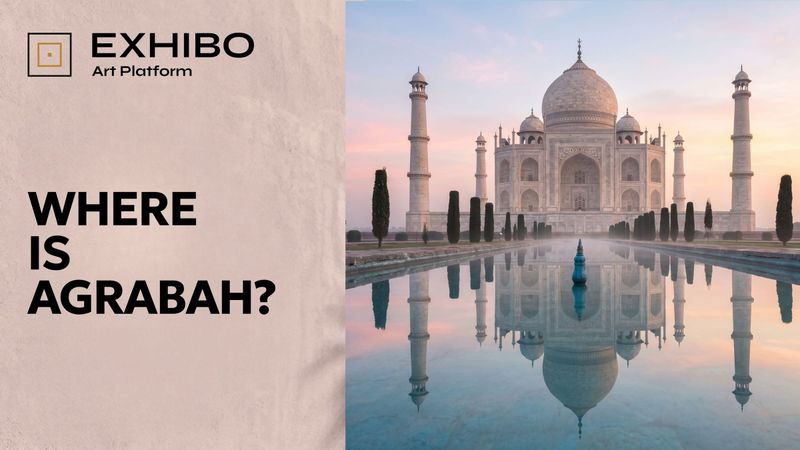
Where Is Agrabah? The City Disney Assembled From Real Places
Agrabah was going to be Baghdad. A war made it fictional — and then Disney built it back out of real places, from a tomb in Agra to a valley in Jordan that usually plays Mars.
The Sultan's palace where Princess Jasmine feels trapped has the silhouette of the Taj Mahal — which is not a palace at all, but a tomb. That is how Agrabah works. Disney's fairy-tale city was going to be Baghdad, until the Gulf War made the name impossible; the studio invented a place that could not be found on a map, then quietly rebuilt it out of real ones — Isfahan and Agra, Marrakesh and Mandalay, a Jordanian desert that has played both Arabia and Mars.
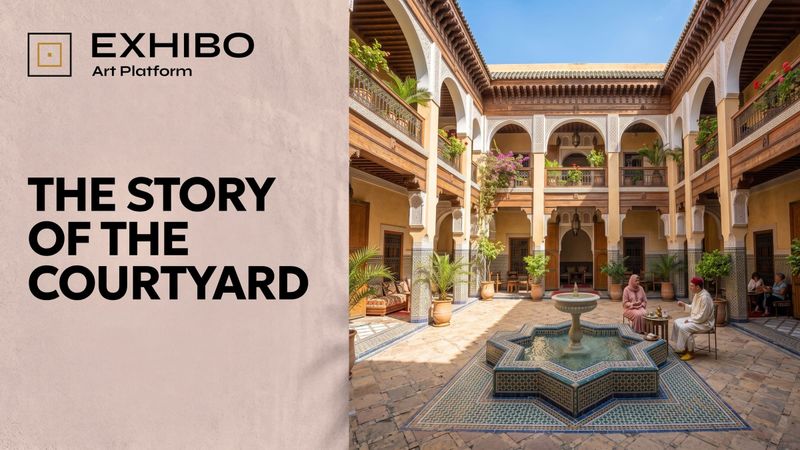
Why North African Cities Turn Inward: The Story of the Courtyard
A courtyard plan far older than Islam turned North African houses — and the medinas built from them — to face inward. Climate and religion only half-explain why, and what finally displaced the courtyard says the rest.
The blank walls and inward courtyards of Fez, Tunis, Algiers and Cairo are usually explained by heat or religion. Both are true; neither is the whole story. The clue is in what eventually pushed the courtyard out of the modern city.
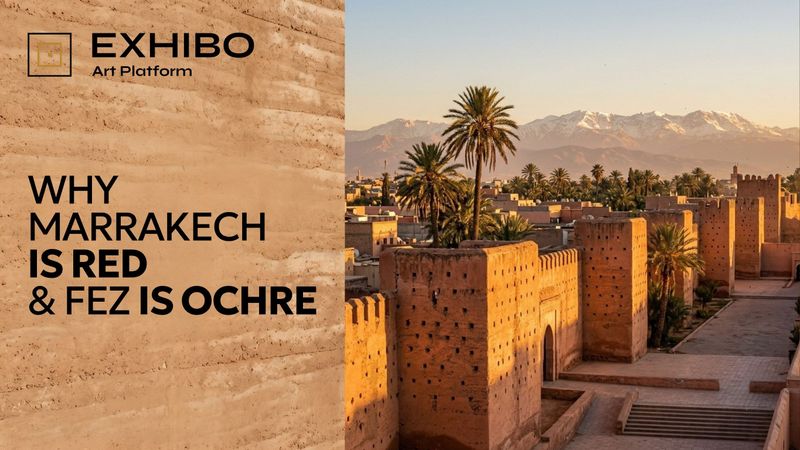
Why Marrakech Is Red and Fez Is Ochre
Two imperial cities, one element in the ground — and the difference between a red city and an ochre one turns out to be half geology, half planning law.
Marrakech shows you the iron in its earth; Fez veils the same iron under lime. What makes each city relentlessly one colour, though, isn't the ground — it's what the twentieth century did to it.