
Whilst We Are Savages: Colonial Constructs and Atlantic Dialogues
A critical survey at TEA Tenerife exploring how colonial frameworks shaped identity, territory, and knowledge across Europe, Africa, and Latin America.
Directory listing — not yet managed by the museum. Spotted something wrong? Suggest an edit →
Traditional life in Dakhla Oasis: costume, jewellery, household objects, crafts and village customs
A small museum of oasis life in an old mudbrick house in Mut, the main town of Dakhla Oasis, opened for visitors on request.
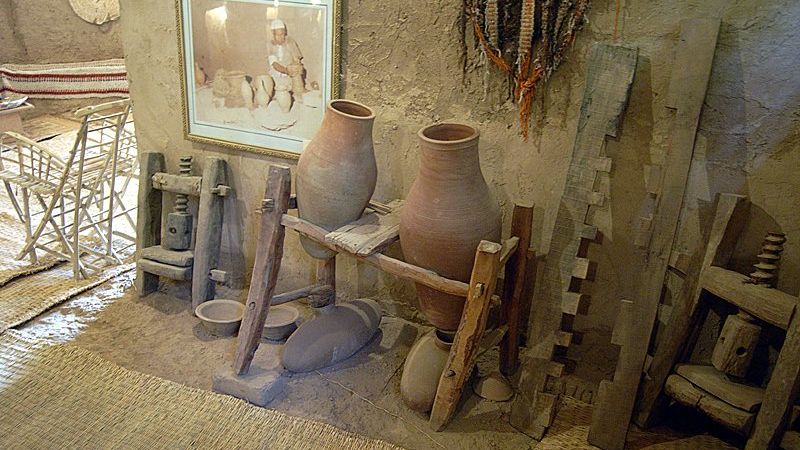
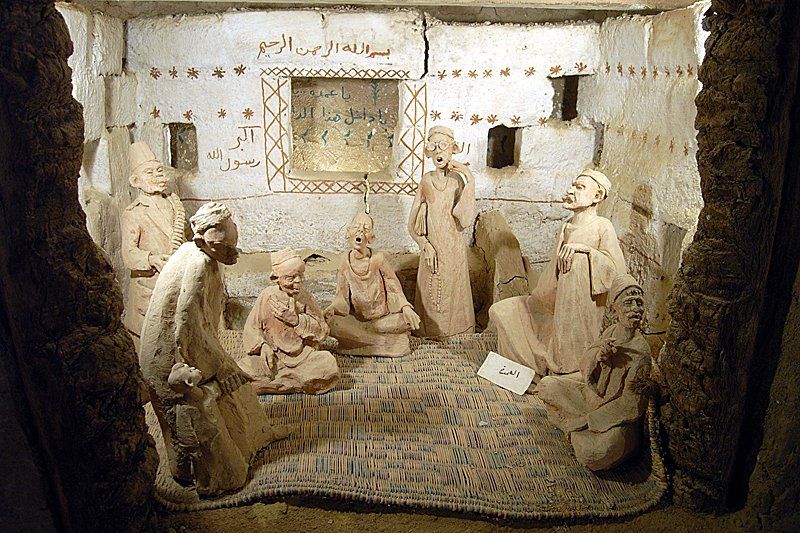
The Ethnographic Museum in Mut shows how people lived in Dakhla Oasis before electricity, asphalt and concrete reached the Western Desert. Mut is the main town of the oasis, in the New Valley governorate. The museum fills an old mudbrick house in the town. Travel guides date the house to 1785 and name its owner as Sherif Ahmed. Inside, the rooms are furnished as they would have been in an oasis home. Palm-rib mats cover the floors. Oil lanterns hang from the beams. Frame drums, woven hangings and baskets sit on the walls and in the niches. The collection is about daily life. There are embroidered dresses in black with red, green and yellow bands, the festive clothes of oasis women. There are metal bangles, anklets and necklaces of glass and metal beads, each with a small handwritten label in Arabic. Pottery water jars, grinding stones, wooden tools and a loom show the work of the house and the fields. In one room clay figures sit on a mat in a circle, a model of the men's gatherings where village matters were settled. The museum keeps no regular hours. Visits are arranged through the tourist office in Mut, on Sharia al-Salam. Expect a modest entry fee and a short guided walk through the rooms.
Most museums in the oases are about the dead: coffins, masks, offering tables. This one is about the living. Everything here was used by someone, worn by someone, carried to a well or a field. Look at the dresses first. The embroidery on the chest panels is dense and bright, done by hand. It was meant to be seen at weddings and feasts. It still pulls the eye in a dim mudbrick room. Then find the room with the clay figures. The men sit in a ring on a mat, the way village councils met for generations. It is a simple model. It explains more about oasis society than a panel of text would. After the visit, drive north-west to al-Qasr, where the mudbrick old town shows the same way of life at the scale of streets and houses. Ask at the tourist office a day ahead. The museum opens for you, not on a timetable.
Current and upcoming shows at Ethnographic Museum, Mut.
Hours, tickets, and directions for Ethnographic Museum, Mut.
Sharia al-Salam, Mut, Dakhla Oasis, New Valley
No fixed opening hours. Visits are arranged on request through the tourist office in Mut (Sharia al-Salam), usually a day ahead. Please check before visiting.
Editorial coverage on Exhibo
A critical survey at TEA Tenerife exploring how colonial frameworks shaped identity, territory, and knowledge across Europe, Africa, and Latin America.

How a 1970s feminist archive inspires contemporary photographers to rethink spatial inequality
A new exhibition at MoMA pairs Marianne Wex's pioneering street photography with seven modern creators exploring gender, race, and Indigenous sovereignty through the lens.

Kumu Art Museum pairs Sámi activist practice with Finno-Ugric ethnography in a dual autumn programme
Two concurrent exhibitions at Tallinn's Kumu Art Museum examine how visual culture, institutional authority, and academic frameworks have historically shaped minority identities across Northern Europe.