
Exhibo Editorial
The Real Tatooine: Star Wars, Southern Tunisia and the Living Art Beneath the Myth
The Tunisian desert that became Tatooine — its Berber architecture, its vanishing film sets and the living street-art scene painting over the myth.
There is a town in southern Tunisia called Tataouine. It sits at the edge of the Sahara, a governorate capital of low ochre buildings and fortified granaries, and if the name makes your ear twitch, that's because George Lucas almost certainly heard it too. The planet Tatooine is widely understood to take its name from here; Lucas softened one vowel and hung it on a desert world with two suns. Half a century later, most of the people who can spell Tatooine have never heard of the place behind it — which is a small, precise illustration of what this whole story is about.
Lucas shot Star Wars in Tunisia across four films — A New Hope in 1977, then the prequels from 1999 to 2005 — and he did it because the country handed him a ready-made alien world. Many of the recognisable Tatooine exteriors were filmed around Tozeur, using the sand dunes, the rock formations, and the vast Chott el-Djerid salt flats; the interiors and the strange stacked cities came from the Berber ksour and the underground homes of Matmata and Tataouine. None of it was built for him. It was already there, and it had been for centuries.
That's the thread worth pulling, and it isn't really about the films at all. It's about what a place like this holds onto — and who is still making culture here now, long after the crews packed up. The movies are the door. What's on the other side of it is a living region, not a set.
Matmata: the house where Luke grew up is a real one
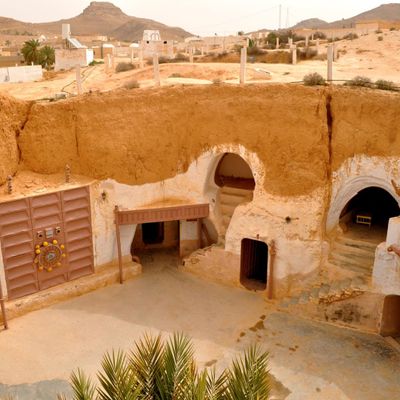
Drive about four hundred kilometres south of Tunis and the ground starts to behave oddly. The landscape around Matmata is cratered, pitted, dotted with palm and olive — and the craters are houses. The dwellings are built by first digging a deep circular pit into the soft sandstone, then hollowing caves out around the edges, leaving the central pit as an open courtyard. People have lived like this here for centuries; the caves stay cool through the blistering days and hold warmth through the cold desert nights, and they doubled, when they had to, as fortresses.
The interior of the Lars homestead — Luke Skywalker's childhood home — is one of these pits. It's the Hotel Sidi Driss, a troglodyte dwelling converted into a hotel, still operating today, where you can sleep in what the films made into Luke's kitchen. The blue-painted frescoes and alcove doors from the set are still on the walls; the production repainted parts of the interior for Attack of the Clones in 2002, and some of that decoration survives too. But the thing to hold onto is that Lucas didn't design that space. He found a form of architecture that Amazigh communities had refined over generations and simply pointed a camera at it, and it read, instantly, as another planet.
There's a harder history under the picturesque one. Matmata was largely unknown to the outside world until the 1960s, when severe flooding brought it to the attention of the Tunisian government — the same kind of rains that can, occasionally, collapse the pit houses they revealed. Around then, many families were moved into new surface towns as part of President Habib Bourguiba's modernisation drive — a push some scholars and Amazigh activists have interpreted as an effort to dilute Berber communities and fold them into a single Arab national identity after independence from France, though it is not a settled reading. During the French colonial period, the same underground homes were reportedly used to shelter resistance fighters.
So the caves that a global audience knows as the backdrop for a farm boy's restlessness are, on the ground, a record of adaptation, coercion, and endurance — Amazigh heritage that outlasted the desert and nearly didn't outlast the twentieth century. Roughly 1,200 of the homes have been preserved, and some are still lived in; others became guesthouses, or were kept on as stables and workshops by families who built modern houses on the plot next door. Half a century ago, a visitor to Matmata would have seen almost nothing on the surface at all. Everything was below.
Tataouine and the granaries that looked like the future
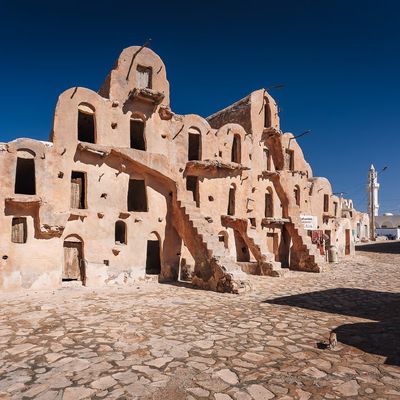
South of Matmata, near the town that gave the planet its name, stands Ksar Ouled Soltane — and this is where the "found alien architecture" idea reaches its sharpest point. It's a ksar: a fortified Berber granary, built on a hilltop to keep raiders off the food supply. The storage cells are called ghorfas — barrel-vaulted rooms stacked up to four storeys high around two courtyards, each ghorfa once assigned to a single family, the older courtyard dating to around 1699. From the courtyard floor they climb in honeycomb tiers, connected by steep external stairs, the whole thing built of mud and lime the colour of the hills behind it. By the nineteenth century the complex had grown to around 400 cells.
There is a deliberate economy to it that's easy to miss under the film-set glamour. Each family got its own vaulted room; grain and olive oil went up and down on ropes through wooden hooks still mounted in the walls; and the fortress form — hilltop, blank outer walls, a single controlled way in — existed because in a lean year, stored food was the thing most worth stealing. A ksar is a bank made of mud. It is architecture as insurance policy.
In The Phantom Menace, this granary became the slave quarters of Mos Espa, where Anakin Skywalker lived as a boy. Ksar Ouled Soltane is one of the ksour around Tataouine used to represent that Slave Quarters Row. What draws me here isn't the film trivia — it's the inversion. A structure designed five hundred years ago to hoard grain against famine reads, to a modern audience, as futuristic. The ghorfas look like a rendering of a colony on some distant world. It's the same visual logic that would later send Denis Villeneuve to the Liwa dunes to build Dune: the desert of the Arab world keeps getting cast as the future precisely because Western audiences don't recognise it as the past.
Mos Espa, and the dune that ate a planet
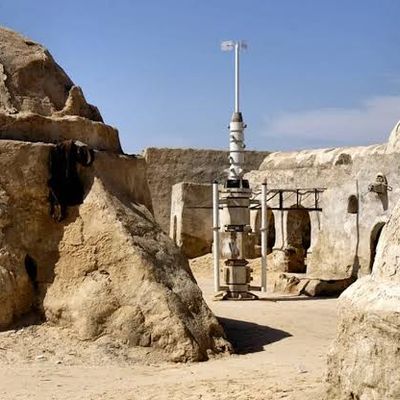
Not everything in this story was borrowed. One place was built for the films — the town of Mos Espa, constructed from scratch in the late 1990s on the sand flats at Ong Jmal, near Tozeur, for The Phantom Menace. Its main street of vaporators and domed façades still stands, more or less. It has become a pilgrimage site. And it is losing a slow war with the desert.
This is where the story turns genuinely strange, because the fate of a fake Star Wars town became a piece of real planetary science. A dune was bearing down on Mos Espa — a barchan, the crescent-shaped, free-marching kind — and a group of planetary scientists led by Johns Hopkins geomorphologist Ralph Lorenz realised the set was perfect for their work. The buildings gave them a fixed, dated, surveyable reference point against which to measure how fast the sand actually moves. Using Google Earth images going back to 2002, they clocked the barchan advancing on the town at roughly fifteen metres a year — in geological terms, one of the fastest surface processes there is, short of lava and landslides. They published it in the journal Geomorphology. The paper's title, with a straight face, is Dunes on Planet Tatooine.
The reach of that little study is the best part. These are scientists who ordinarily study barchans on Mars — the Mars Reconnaissance Orbiter has tracked them marching across the Martian surface at Nili Patera — and on the dune-covered moons of Saturn. A film set built to fake an alien desert became a calibration tool for measuring real ones, on real other planets. The fiction pointed back at the science that inspired it.
The set itself may not survive the attention. Bulldozing the dune isn't a fix, because a second, larger barchan is already queued up behind the first; the only durable rescue would be to physically relocate the whole town about two hundred metres south. In 2014, the Tunisian tourism ministry launched a "Save Mos Espa" campaign, allocating state money and appealing for crowdfunding to clear the sand — a stopgap its own officials admitted would buy the set perhaps eight to ten more years before the dunes came again. The older 1970s sets from the original trilogy were already gone, long since overrun. Mos Espa is a monument to a fictional desert being swallowed by a real one, on a schedule scientists can predict to the metre.
Djerba: an island of coexistence, and an open-air museum
Off the southern coast sits the island of Djerba — where Lucas filmed the streets of Mos Eisley, the spaceport where Obi-Wan first appears. The Mos Eisley cantina exterior was the town of Ajim; Obi-Wan's house sits out on the island's coast. But Djerba is where this story stops being about a film at all, because Djerba is one of the most quietly remarkable places in the Mediterranean, and the movies are the least of it.
In September 2023, UNESCO inscribed the whole island on the World Heritage List — not for a single monument, but for a settlement pattern: the way its villages, fortified mosques, and olive groves adapt across the centuries to a land short of water. It was Tunisia's first new World Heritage site since 1997. The island is defined by coexistence: it holds the El Ghriba synagogue — traditionally held to be the oldest in Africa, and believed by local tradition to date back some 2,500 years — alongside hundreds of Ibadi mosques, some of them underground, and a Catholic church. Muslims, Christians and Jews have lived here together, more or less continuously, for a very long time.
That coexistence is not an abstraction. Every spring, on the festival of Lag BaOmer, Jewish pilgrims from France, Israel and across the diaspora converge on El Ghriba, light candles, and write their wishes on hard-boiled eggs that they tuck into a cave beneath the synagogue, beside a stone said to have been carried from the ruins of Solomon's Temple. It is one of the most distinctive living pilgrimages in the world. It is also fragile: Tunisia's Jewish community, once around 100,000 before independence in 1956, has dwindled to roughly 1,500, most of them clustered on Djerba, and the synagogue has been the target of deadly attacks in 1985, 2002 and 2023. The pilgrimage continues anyway, under heavy security, a few hundred where there were once thousands. Continuity here is a choice, renewed every year against the odds.
And it was this — the long layering, the coexistence — that made the village of Erriadh, which holds El Ghriba, the chosen ground for one of the most ambitious street-art projects on Earth. Cinema gave this island a fictional identity, borrowed for a weekend and left behind. What happened in Erriadh was the opposite: contemporary artists came to give an old village a living one.
Djerbahood: writing contemporary art onto a two-thousand-year-old wall
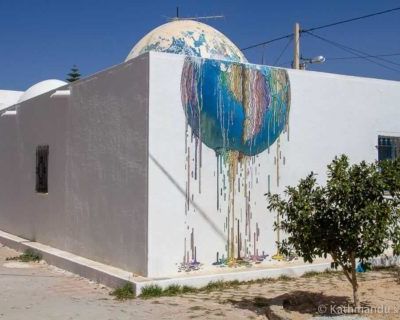
In the summer of 2014, the Paris-based Galerie Itinerrance, led by the French-Tunisian gallerist Mehdi Ben Cheikh, brought around 150 artists from more than 30 countries to Erriadh and turned its whitewashed medina into an open-air museum: some 250 murals painted on doors, arches, walls and rooftops. They called it Djerbahood. Ben Cheikh chose the village deliberately, and said so plainly: he wanted a project in Tunisia, but the location carried meaning — this was a place where Muslims, Christians and Jews had lived in peace for some two thousand years. His stated ambition was to build a real museum in the open air, with labels, lighting and staging, on walls that residents had to be persuaded, at first, to lend. Some who refused at the start later asked the artists to come paint theirs too.
The roster was not minor. Djerbahood drew some of the biggest names in the international street-art world — the American Shepard Fairey (Obey), the French tile-mosaic artist Invader, the Argentine muralist Inti, alongside Tunisian and Arab artists working in a register the region had made its own. Chief among them was eL Seed, the most internationally famous Tunisian artist alive, whose signature style is calligraffiti — a fusion of graffiti technique with classical Arabic calligraphy. Born in Paris to a Tunisian family, eL Seed grew up speaking only Tunisian dialect and didn't learn to read or write Arabic until his teens, when a return to his roots led him to calligraphy; he has since painted an anamorphic work spanning fifty buildings in Cairo's Manshiyat Naser, the district of the city's Coptic garbage collectors, and murals from Sharjah to the Institut du Monde Arabe in Paris. His pieces work first as abstraction — you feel the rhythm of the script before you can read it — and only then, if you can, as text.
Djerbahood didn't come from nowhere. It landed at a very particular moment: after the 2011 Tunisian revolution, the walls of Tunis filled with words and images almost overnight — student collectives like Ahl El Kahf painting portraits of Mohamed Bouazizi, the street vendor whose self-immolation sparked the Arab Spring. A country that had been silent under decades of dictatorship discovered public walls as a place to speak. Djerbahood, two years later, took that energy and made it international — and planted it, pointedly, in the one village on the island most associated with living together across difference.
And it didn't stop in 2014. Djerbahood came back for a second edition in 2021–22 — Shepard Fairey arrived in April 2022 with three monumental works, and the collection now runs to more than 300 pieces woven into the village architecture. Crucially, it has hardened from an event into infrastructure: the later editions run as part of Tounes Wijhetouna, a programme funded by the European Union with the Tunisian ministries of tourism and culture, explicitly framing the murals as a way to preserve and revive the island's heritage — and to bring tourism, and income, into a village that now lives partly off the art on its walls. Ben Cheikh talks about it not as a festival but as an attempt to build the ideal street-art museum in the open air, with a curated path, lighting and scenography. Whether it fully is one is a fair debate. That it is a working piece of contemporary cultural life in southern Tunisia, run with local institutions and sustaining local livelihoods, is not.
What lasts, and who is still here
Here is the thread that ties Matmata, Ong Jmal, Tataouine and Djerba into one story, and it isn't George Lucas.
The Mos Espa set is being buried on a timetable you can graph. The two most photographed, most contemporary things in this landscape — a movie town and, in its earliest murals, a mural village — are also among the most fragile; the older things built by the people who actually live here are the ones that endure. The pit houses of Matmata, the ghorfas of Ksar Ouled Soltane, the settlement pattern of Djerba, the synagogue at Erriadh have lasted centuries, some of them millennia — not because they were made to be looked at, but because they were made to be used: to store grain, to hold heat, to shelter a family, to keep a faith, to make a life possible in a place that resists one. The film set is the spectacular top layer. The vernacular architecture is the durable one underneath, and it endures precisely because it was never trying to be spectacular in the first place.
But durability isn't the same as being finished, and that's the part a visitor arriving through Star Wars is most likely to miss. Southern Tunisia is not a museum of what lasted. It's a place where people are still making things: where a granary is still a landmark a Tataouine family points to, where the El Ghriba pilgrimage still fills a cave with candles every spring against real risk, where a village co-produces a growing museum of world street art with its own ministries and lives partly off it. eL Seed is a global artist who learned his language here; Djerbahood is on its second edition and still expanding; the walls of Erriadh are being repainted, not just weathered.
That's the inversion worth keeping. We arrive at southern Tunisia through a science-fiction film — through Tatooine, through a childhood memory of two suns — and what we find is neither an alien planet nor an exotic ruin, but a working region with a deep past and a busy present: a living tradition of desert building, some of the oldest coexistence on the Mediterranean, and a contemporary art scene doing something genuinely new on very old walls. The desert lent the movies a face for a few weeks. The people who live in front of that face never stopped using it.
Sources and further reading
Filming locations
- ASocialNomad, complete guide to Tunisia's Star Wars locations
- Sahara Days, Star Wars Tunisia guide, including Hotel Sidi Driss
- Wookieepedia, Ksar Ouled Soltane as the Mos Espa Slave Quarters
Architecture and history
- Atlas Obscura, how the Matmata pit houses are built
- The Arab Weekly, Matmata's architecture and Berber heritage
- Something Curated, the subterranean architecture of Tunisia and its politics
- Abandoned Spaces, Ksar Ouled Soltane, the 15th-century granary
The dunes and the science
- Smithsonian Magazine, Tatooine is about to be reclaimed by the desert
- Space.com, the barchan advancing on Mos Espa, and barchans on Mars
- Phys.org, the "Save Mos Espa" campaign
Djerba, heritage and art
- Philstar / AFP, UNESCO inscribes Djerba on the World Heritage List (2023)
- Carthage Magazine, the El Ghriba synagogue and the Lag BaOmer pilgrimage
- Times of Israel, the pilgrimage, egg-wishes and the Temple stone
- DeMilked, Djerbahood: 150 artists, 250 murals
- The New Arab, Tunisia as a hotbed of Arab street art, from Bouazizi to Djerbahood
- Middle East Eye, eL Seed and calligraffiti
- Galerie Itinerrance, Djerbahood: the 2014 and 2021 editions and 300+ works
- Circular Museum, Djerbahood within the EU-funded Tounes Wijhetouna heritage programme
Getting there: The southern locations cluster around three bases — Tozeur (for the Mos Espa set at Ong Jmal, the salt flats and the canyons), Matmata or Tataouine (for the pit houses and the ksour), and Djerba (for Erriadh, Djerbahood and the El Ghriba synagogue). Most sites are free to enter; reaching the desert sets often needs a 4×4. Allow five to seven days for the full circuit, best attempted November through March.
Places mentioned
Related reading
Gladiator and Game of Thrones: Inside Aït Benhaddou
The earthen ksar that has played Rome, Jerusalem and Yunkai survives only because people keep rebuilding it. What cinema films as eternity is, wall by wall, a work of constant repair.
Nasreddin: The Trickster Everyone Claims
A padlocked gate with no walls, two rival graves, and stories told among two dozen peoples: how the wise fool of the Islamic world became a shape every culture fills with itself.
Sharjah Biennial 17 Unveils Curatorial Vision and Opening Schedule
Angela Harutyunyan and Paula Nascimento frame the 2027 edition around archival residue and spatial memory