
Exhibo Editorial
Latin American Modernism
From São Paulo’s 1922 Week and Antropofagia to Torres-García, Madí, Lam and neo-concrete colour: modernisms south of the US border
Latin American modernism names a set of twentieth-century visual programmes across Spanish- and Portuguese-speaking Americas and the Caribbean, not a single style with one manifesto. Painters, sculptors and theorists borrowed Cubism, Surrealism, Constructivism and Concrete Art from Europe, then remade those tools for local histories of colonialism, race, labour and nation. Search engines often collapse the field into Mexican celebrity names. Museum scholarship treats plural modernisms: São Paulo’s 1922 Semana de Arte Moderna and Oswald de Andrade’s Antropofagia; Joaquín Torres-García’s Constructive Universalism in Montevideo; Buenos Aires Madí and Arte Concreto-Invención; Afro-Cuban Surrealism in Wifredo Lam; Brazilian neo-concrete and Venezuelan kinetic colour.
This article stays with those broader modernisms. Government-backed Mexican muralism after 1920 has its own guide in Mexican muralism; this page does not retell Rivera, Orozco and Siqueiros. Dates and locations follow MoMA, Tate, MALBA, Museo Torres García and related institutional accounts. The series hub is World Art Traditions. Collection routes for museums named below sit in the museums directory.
What Latin American modernism names
“Latin American art” is a museum and market label that covers Indigenous, colonial, modern and contemporary production from Mexico to Tierra del Fuego and the Spanish- and French-speaking Caribbean. Modernism, in the narrower sense this article uses, marks the decades when artists claimed parity with European avant-gardes while arguing that local materials, myths and bodies should set the terms. Rough bookends run from Anita Malfatti’s São Paulo exhibition of 1917–18 and the Semana de Arte Moderna of February 1922 through the kinetic and participatory experiments of the 1950s and 1960s. Later contemporary biennials sit outside that frame.
The label “Latin American” itself is contested. It flattens linguistic and racial differences. It also did useful work for collectors and museums that needed a shelf. Smarthistory’s teaching cluster on Latin American modernisms stresses plurality: different cities produced different programmes in the same decade. You meet coffee-elite modernists in São Paulo, geometric inventors in Buenos Aires, a pedagogue-constructor in Montevideo, and painters who put Afro-Caribbean religion and sugarcane labour on the same canvas in Havana. Shared traits include travel to Paris or Madrid, magazines and manifestos, and a refusal to treat the academy’s European hierarchy as final.
Modernism here is therefore a family of arguments, not a look. Antropofagia digests Europe into Brazil. Constructive Universalism stacks Inca masonry logic with pictograms. Madí cuts the rectangle and invites play. Lam turns Cubist dissection toward sugarcane and orisha. Neo-concrete artists ask your body to complete the work. Those programmes disagree with each other. That disagreement is the field.
Conditions that produced modernisms across the region
Independence-era academies in the nineteenth century taught European history painting and portraiture as the measure of civilisation. Coffee, sugar, oil and cattle money later paid for study abroad. Young artists returned with Cubist volumes and Surrealist dream logic, then faced critics who still wanted soft Impressionism or academic finish. Nationalist politicians wanted images that could bind republics after oligarchic and civil wars. Modern painters answered with Indigenous motifs, tropical colour, industrial workers and geometric order, often in the same decade and city.
Paris mattered as a school and as a marketplace. Tarsila do Amaral studied with André Lhote, Albert Gleizes and Fernand Léger in the early 1920s and called that training her “military service in Cubism,” a phrase MoMA’s 2018 retrospective kept in circulation. Torres-García worked in Barcelona, New York and Paris before he returned to Montevideo in 1934. Wifredo Lam fought in the Spanish Civil War, joined Surrealist circles in Paris and Marseille, then came back to Cuba in 1941 via Martinique, where he met Aimé Césaire. The pattern is consistent: European studios supplied technique; local politics and memory supplied the subject that made the technique matter.
Print culture and exhibitions accelerated the shift. Magazines such as Klaxon in São Paulo, Arturo (one issue, 1944) in Buenos Aires, and Arte Madí Universal carried arguments across borders faster than museum retrospectives. The São Paulo Bienal (from 1951) and new museums of modern art in Brazilian and Argentine capitals gave geometric abstraction institutional homes. Dictatorships and coups later forced exile or silence for some of the same artists. Modernism’s timeline in the region is therefore tied to state patronage and state violence as much as to Paris ateliers.
Mexican muralism after the Revolution is the best-known state programme in English search results. It belongs to the sibling essay on Mexican muralism. Elsewhere the state still shaped taste: Getúlio Vargas’s Brazil pushed nationalist imagery that nudged Tarsila toward workers’ canvases in the 1930s; Venezuelan governments of the 1960s and 1970s sponsored kinetic public art as a vision of oil modernity. Private coffee fortunes, émigré networks and university posts filled the gaps when ministries stayed conservative.
Brazilian modernism: Semana, Antropofagia and after
Brazilian modernism crystallised in São Paulo around writers and painters who wanted a national culture that could swallow Europe without copying it. Coffee plantation wealth funded European study. The city’s industrial boom made a public hungry for novelty and scandal. Anita Malfatti’s Exposição de Pintura Moderna (December 1917–January 1918) showed Expressionist and Cubist-inflected figures to a São Paulo audience that still expected polite finish. Monteiro Lobato’s hostile review made her a rallying point. Mário de Andrade later said he owed his sense of revolt to her pictures.
The Semana de Arte Moderna at the Theatro Municipal in February 1922 staged painting, poetry, music and architecture as a week-long provocation. Malfatti showed among the painters. Tarsila was still in Paris and missed the Week itself; she joined the circle on her return and, with Malfatti, Oswald de Andrade, Mário de Andrade and Menotti del Picchia, formed what Brazilian histories call the Grupo dos Cinco. The Week’s noise mattered more than any single canvas. It told Brazilian elites that modern art had a local address.
Semana de Arte Moderna and the Grupo dos Cinco
The Week did not invent Brazilian painting from nothing. Lasar Segall had already shown modern work in São Paulo. What 1922 did was bind painting to a literary and musical programme and to a city that saw itself as Brazil’s modern capital. Manifestos and magazines followed. Pau-Brasil poetry (Oswald, 1924) treated Brazilian speech and landscape as raw export that Europe should receive back as art. Tarsila’s A Negra (1923) and Anthropophagy-period landscapes of the late 1920s give that literary programme a body: simplified volumes, tropical greens and pinks, and figures that refuse academic proportion.
MoMA’s catalogue for Tarsila do Amaral: Inventing Modern Art in Brazil (2018) stresses her dual address to São Paulo and Paris. She wanted to be “the painter of my country” while remaining legible to Léger’s circle. That double audience is typical of Latin American modernism: success meant recognition abroad and authority at home. Failure meant looking like a provincial copy or like an exotic product for foreign collectors. Brazilian modernists solved the bind by theorising digestion.
Antropofagia as programme
In 1928 Tarsila painted Abaporu as a birthday gift for Oswald. The oil shows an elongated seated figure with a tiny head, a massive foot, a cactus and a sun. The title, assembled from Tupi-Guarani roots, names a man-eater. Oswald answered with the Manifesto Antropófago, published in the Revista de Antropofagia. The manifesto treats cultural cannibalism as method: swallow foreign forms, absorb Indigenous and African inheritances, produce something that is neither colonial copy nor folkloric souvenir. MoMA’s wall texts and audio for the 2018 show still present Abaporu as the banner image of that argument. The canvas now hangs at MALBA in Buenos Aires, a reminder that Brazilian icons travel through Argentine collecting.
Tarsila’s Antropofagia (1929) pairs two simplified bodies in a lemon-slice sun landscape and pushes the metaphor toward sex and politics. After her divorce from Oswald and under Vargas-era pressure, she turned to sombre multi-figure scenes such as Operários (Workers, 1933). The anthropophagic decade remains the peak that English exhibitions prefer. Brazilian art history keeps the later social canvases in view as proof that modernism answered dictatorship and industrial labour as well as Paris.
Río de la Plata: Constructive Universalism to Madí
While São Paulo digested Cubism into tropical myth, Montevideo and Buenos Aires built geometric programmes that claimed universal structure. Joaquín Torres-García (1874–1949), born in Uruguay, spent decades in Europe and New York before returning to Montevideo in 1934. He co-founded the Paris group Cercle et Carré with Michel Seuphor, then transplanted that constructive ethic into a Southern Cone pedagogy. Younger Argentine artists of the mid-1940s split into rival concrete factions that Tate still treats as twin poles of porteño abstraction.
The Río de la Plata story matters for searchers who know only muralism. Here the wall is often a wooden grid or an irregular Madí support, not a ministry fresco. Theory arrives as lecture, magazine and school. Torres-García delivered hundreds of talks and published Universalismo Constructivo (1944), a vast compilation he subtitled as a contribution to unifying the art and culture of America. The Museo Torres García on Sarandí in Montevideo keeps that archive public.
Torres-García in Montevideo
Torres-García’s Constructive Universalism rejects a hard split between figuration and abstraction. He organised pictograms (sun, fish, man, clock) inside golden-section grids and linked those structures to Andean stonework and to a “universal” symbolic language. MoMA’s Construction in White and Black (1938) shows a syncopated black-and-white masonry grid inscribed AAC for the Asociación de Arte Constructivo he founded in 1935. The museum notes his interest in Inca masonry’s irregular fit: volume without Renaissance perspective.
His inverted map of South America, with the south at the top, argued that the Southern Cone should lead modern art rather than wait for Europe’s permission. Students and admirers including Julio Alpuy, Francisco Matto, and, at a distance, Argentine concrete painters took that claim seriously. When Torres-García died in 1949, Montevideo already held a constructive school with its own journal Círculo y Cuadrado. The Met’s Modern Art Index Project entry on Torres-García frames him as the figure who made the Southern Cone a global hub for geometric abstraction.
Arte Concreto-Invención and Madí in Buenos Aires
A single magazine issue, Arturo (1944), gathered Carmelo Arden Quin, Gyula Kosice, Rhod Rothfuss, Tomás Maldonado, Lidy Prati and others against representational painting. From that nucleus two groups formed in 1946. Maldonado led the Asociación Arte Concreto-Invención, which showed at Salón Peuser in March with a manifesto for invention rather than imitation. Tate’s glossary stresses Mondrian-like grids, primary colour and straight edges as the association’s public face. Kosice, Arden Quin and Rothfuss launched Grupo Madí that August at the Instituto Francés de Estudios Superiores. Tate describes Madí as more playful: irregular canvases, movable parts, three-dimensional objects, and a journal (Arte Madí Universal) that sought international exchange.
The name “Madí” has competing etymologies (acronyms, Civil War chants, nonsense). What museums agree on is the break with the rectangle and the invitation to spectators to treat art as invention in real space. Pérez Art Museum Miami’s Kosice materials underline interactive sculpture and industrial materials. Those experiments fed later Brazilian neo-concrete interest in the viewer’s body. Argentine concrete art also trained Tomás Maldonado for his later Ulm School career in Europe, a reverse Atlantic crossing that complicates any story of one-way influence from Paris.
Caribbean modernisms and Afro-Atlantic form
Caribbean modernism arrives through painters who treated African diaspora religion, plantation economy and colonial language as modern subjects, not as ethnographic décor. Cuba’s Amelia Peláez modernised still life and architectural ornament with hard colour and stained-glass structure. Wifredo Lam remains the figure English museums use to teach the Caribbean’s claim on Surrealism and Cubism. Haitian painting schools and Martinican Négritude networks sit beside that Cuban story; this section stays with Lam and the Havana–Paris–New York circuit that MoMA’s collection makes easiest to verify.
Lam (1902–1982) trained as an academic painter in Spain, fought for the Republic, then worked with Surrealists in Paris. Picasso’s circle noticed him; he kept a critical distance from European primitivism even while using mask-like faces. The wartime voyage that returned him to Cuba via Martinique put him in conversation with Aimé Césaire. Back in Havana he painted hybrid plant-animal-human figures in sugarcane fields. The result refuses both tourist tropicalism and pure Paris abstraction.
Wifredo Lam after Europe
La jungla (The Jungle) (1942–43), oil and charcoal on kraft paper mounted on canvas, is Lam’s best-known work and has been in MoMA’s collection since 1945 (acc. 140.1945). MoMA’s object page describes life-size hybrid figures among sugarcane and tropical foliage, faces that recall African masks, and a support made from two sheets of kraft paper sketched in charcoal then painted with thinned oil. Lam wrote that he wanted to paint the drama of his country and to disturb the dreams of exploiters. Sugarcane names Cuba’s plantation economy and the Atlantic slave trade; the hybrids insist that Afro-Cuban spiritual presence survives that history.
Conservation and curatorial work around MoMA’s recent Lam retrospective treat The Jungle as both Surrealist masterpiece and anticolonial document. The painting’s scale forces museum visitors to stand inside the cane rather than look down on a postcard landscape. That address to the body links Lam to later participatory modernisms even though his medium remains two-dimensional pigment on paper.
Cuban and Antillean networks
Lam’s Havana years also produced works titled with Yoruba and Lucumí references (Omi Obini, Ogue Orisa, 1943), which MoMA’s retrospective materials group with his interest in Afro-Caribbean spiritualities. Amelia Peláez’s modernist still lifes and stained-glass colour, held in Cuban museums and international collections, give another Havana modernism less tied to Surrealist myth. Across the Antilles, Césaire’s poetry and later Caribbean artists treated Lam as proof that modern form could carry Black Atlantic knowledge without apology. English survey courses that stop at Mexican muralism miss this circuit entirely.
Four works to study closely
Named works beat abstract definitions. Survey pages list dozens of painters; close looking at four objects teaches the arguments faster. The works below sit in public collections with stable documentation from MoMA, MALBA and related catalogues. Dates follow museum consensus. Titles sometimes shift in English translation; use the local title on the label when you visit.
Choose the set as a comparative route rather than a greatest-hits poster. Abaporu shows Antropofagia’s body. Torres-García’s grid shows Constructive Universalism’s claim on Andean structure. Lam’s cane field shows Afro-Caribbean modernism under Surrealist pressure. Clark’s Bichos show neo-concrete participation after concrete rationalism. Together they span 1928 to the early 1960s without collapsing into one national school. Photographs help for study; scale, support and handling rules only become clear in the room.
Tarsila do Amaral, Abaporu (1928), MALBA
Oil on canvas, about 85 × 73 cm. A solitary figure sits beside a cactus under a disk sun. The foot dominates the foreground; the head shrinks. Oswald took the shock of that disproportion as a licence to theorise cultural cannibalism.
MALBA’s holding places a Brazilian modernist icon in Buenos Aires, which is historically apt: Argentine collectors and museums have long anchored Latin American modernism as a regional, not only national, field. MoMA’s 2018 retrospective treated the painting as the banner of Antropofagia even while the object itself lives in Argentina. Loans return it to Brazilian audiences for major shows; check current display before you plan a trip around a single canvas.
Stand in front of the work and the “cannibal” metaphor becomes physical: the body has already been rearranged. Academic proportion dies. Tropical nature stays, but as cactus and sun rather than as tourist palm. That mix of shock and clarity is why English exhibitions still start Brazilian modernism here.
Joaquín Torres-García, Construction in White and Black (1938), MoMA
A black-and-white grid that seems to advance and recede at once. MoMA links the irregular masonry rhythm to Inca stonework and notes the AAC inscription for Torres-García’s Montevideo association. The painting teaches Constructive Universalism without a lecture: order without classical perspective, structure without pure Mondrian flatness.
Torres-García built many related grids with pictograms (fish, sun, man) that read as a portable alphabet. This 1938 canvas strips the signs back to tonal architecture. You can still feel the golden-section planning he preached in Montevideo lectures. Compare it mentally with a Madí irregular frame from a few years later and you see how quickly Río de la Plata abstraction diversified once the constructive school had trained a generation.
The work also records institutional ambition. AAC claimed modern art for Uruguay on local terms. MoMA’s later collecting of Torres-García, amplified by Cisneros gifts of related geometric work, moved that claim into the New York canon. The painting is small enough to miss if you rush; give it the time a masonry wall demands.
Wifredo Lam, La jungla (1942–43), MoMA
Figures and cane share one shallow space. Mask-faces, hand-feet and fruit punctuate vertical stalks. MoMA acquired the work soon after Pierre Matisse showed it in New York. The museum’s Spanish/English object text stresses slavery, indenture and Afro-Caribbean resilience in the same sentence.
Lam glued kraft sheets, sketched in charcoal, then floated thinned paint so drips and unexpected hues stay visible. The support is modern scrap as much as fine linen. That material choice matches the subject: plantation labour, not salon flora. Later conservation studies published around MoMA’s Lam retrospective treat the surface as evidence of haste and intensity after his return from Europe.
Use this painting when a syllabus asks for “Latin American Surrealism.” Lam is Surrealist and Cuban and Atlantic at once. He refuses the role of exotic supplier to Paris. The cane field stares back.
Lygia Clark, Bicho series (from 1960), various museums
Clark’s hinged aluminium “critters” fold and unfold in the spectator’s hands. Neo-concrete theory (Ferreira Gullar’s 1959 manifesto) had already asked for art as living organism rather than machine diagram. The Bichos make that claim tactile.
Tate, MoMA and Brazilian museums hold related Clark and Hélio Oiticica works from the same turn: colour leaving the plane, viewer completing the form. Oiticica’s spatial reliefs hang in space; Clark’s animals ask for touch. Handling policies differ by loan. When a museum allows supervised interaction, you feel the argument. When the object sits behind glass, read the hinge geometry as a score for movement you must imagine.
Clark’s later sensorial suits and therapeutic propositions push past the modernist frame of this article. The early Bichos remain the clearest bridge from Río de la Plata and São Paulo concrete invention to participatory practice.
From concrete to neo-concrete and kinetic colour
By the early 1950s São Paulo’s Grupo Ruptura and Rio’s Grupo Frente had planted Max Bill-inflected concrete art in Brazil. Bill’s 1951 São Paulo Bienal prize and the new capital at Brasília supplied a public rhetoric of rational modernity: clear geometry for a country that wanted to look engineered. Waldemar Cordeiro and other Ruptura painters defended serial order and industrial clarity. Rio artists including Lygia Clark, Lygia Pape and (from 1960) Hélio Oiticica found that rationalism too rigid for the body’s experience of colour and space.
Ferreira Gullar’s Neo-Concrete Manifesto, published in the Jornal do Brasil in March 1959 and signed by Clark, Pape, Amilcar de Castro, Franz Weissmann and others, called for sensuality, colour and phenomenological experience inside geometric art. Gullar’s related “Theory of the Non-Object” argued that the work should behave like a living organism in time. Tate’s neo-concrete glossary highlights Oiticica’s hanging spatial reliefs that liberate colour into three dimensions. Those reliefs prepare the later Penetráveis and Parangolés, which ask viewers to enter or wear the work.
Venezuelan artists Jesús Rafael Soto, Carlos Cruz-Diez and others pursued related problems through vibration, light and spectator movement. Exhibition catalogues such as Vibration / Vibração / Vibración treat kinetic Latin American art of the 1960s and 1970s as a regional research programme with Paris studios and Caracas patronage in dialogue. Cruz-Diez’s physichromies make colour an event in time; Soto’s penetrables put your body inside hanging tubes of colour. Gego’s wire environments in Caracas add a more fragile, drawing-in-space variant of the same mid-century research. These practices inherit Madí’s play and neo-concrete’s participation more than they inherit mural narrative.
Concrete poetry in São Paulo’s Noigandres group and Clark’s later therapeutic objects show how far “modernism” stretched beyond easel painting. Keep the fence clear: this page stops before contemporary biennial careers as a primary subject. The mid-century turn from manifesto painting to participatory structure is the afterlife that still shapes museum rooms labelled Latin American modernism.
Critics, museums and the problem of the label
English-language criticism long treated Latin American modernism as derivative: Cubism with palm trees, Surrealism with folklore. Textbooks sorted the hemisphere under European style names and graded local painters by fidelity to Paris. Revisionist curators since the 1990s, often backed by gifts such as the Patricia Phelps de Cisneros collection at MoMA, have shown geometric abstraction in Buenos Aires and São Paulo as generative rather than late. Major shows on Tarsila, Torres-García and Lam rewrote wall labels for visitors who arrived expecting only a Mexican mural poster.
The risk now runs the other way: a market category called “Latin American art” that flattens differences for auction evenings. Students need city names, dates and works, not a mood board. Ask which magazine published the manifesto, which museum first bought the canvas, and which dictatorship closed the school. Those questions restore agency to painters and poets who organised under pressure.
Scholars also debate whether “Latin American” should include Chicano and Latinx production in the United States. Smithsonian and other US institutions maintain separate Latino/Latinx collecting briefs. This article stays with modernisms produced in Latin American and Caribbean cities and with works those cities’ artists made in exile. Diaspora murals in California that cite Mexican walls belong to the muralism sibling’s afterlife note, not here.
Museum display choices shape what searchers think the field is. MOLAA in Long Beach brands itself around modern and contemporary Latin American and Latino art and often owns the US Google result for the head term. MoMA, Tate, MALBA, MASP, Museo de Bellas Artes de Caracas and Museo Torres García hold the specific modernisms this essay names. Walk those rooms by movement rather than by passport and the plurality becomes obvious.
Chronology: programmes, works and where to see them
Use the table as a study and visit checklist. Confirm loans and hours before travel; major canvases tour.
| Year | Programme / event | Key work or text | Artist / author | Where to see / read |
|---|---|---|---|---|
| 1917–18 | Malfatti modern exhibition, São Paulo | Tropical; O Homem Amarelo | Anita Malfatti | Brazilian public collections; MAM SP exhibition histories |
| 1922 | Semana de Arte Moderna | Week of painting, poetry, music | Grupo dos Cinco circle | Theatro Municipal, São Paulo (historic site) |
| 1928 | Antropofagia | Abaporu; Manifesto Antropófago | Tarsila; Oswald de Andrade | MALBA, Buenos Aires; manifesto in print archives |
| 1934–35 | Torres-García returns; AAC founded | Lectures; constructive grids | Joaquín Torres-García | Museo Torres García, Montevideo |
| 1938 | Constructive Universalism in paint | Construction in White and Black | Torres-García | MoMA, New York |
| 1942–43 | Afro-Cuban modernism | La jungla (The Jungle) | Wifredo Lam | MoMA, New York |
| 1944 | Arturo magazine (single issue) | Abstract programme texts | Arden Quin, Kosice, Maldonado et al. | Facsimile / library holdings |
| 1946 | Arte Concreto-Invención; Madí | Manifestos; irregular supports | Maldonado; Kosice, Arden Quin, Rothfuss | Tate glossary; PAMM / MoMA Cisneros works |
| 1959 | Neo-Concrete Manifesto | Manifesto in Jornal do Brasil | Ferreira Gullar et al. | Tate term; Brazilian museum rooms |
| 1960s | Kinetic and participatory colour | Physichromies; Bichos; penetrables | Cruz-Diez; Clark; Soto | Tate, MoMA, Caracas and European collections |
What Latin American modernism left behind
Antropofagia still supplies a method for cultural studies far beyond painting: absorb the foreign, refuse purity myths. Designers, filmmakers and writers in Brazil still cite Oswald’s manifesto when they argue for hybrid form. Torres-García’s inverted map remains a teaching image for decentring Europe in classrooms from Montevideo to New York. Madí and neo-concrete normalised irregular supports and spectator participation decades before “interactive” became a marketing word.
Lam forced Surrealism to answer the plantation. Later Caribbean and diaspora artists treat The Jungle as proof that modern form can carry Black Atlantic knowledge without apology. Kinetic artists made colour a public event for moving spectators in cities funded by oil and industry; Soto and Cruz-Diez environments still tour as arguments about perception rather than as period décor.
For a reader planning museum time, pick one city thread and follow it. São Paulo and Rio for Semana to neo-concrete. Montevideo for Torres-García’s school. Buenos Aires for Madí and concrete invention. Havana and New York for Lam. Caracas and Paris for kinetic vibration. Use the World Art Traditions hub for parallel regional surveys, the Mexican muralism sibling for the post-revolutionary wall programme, and the museums directory for institutions that hold the works above.
FAQ
What is Latin American modernism?
Latin American modernism is a group of twentieth-century art programmes in Latin America and the Caribbean that adapted European avant-garde methods to local histories of colonialism, race and nation. It includes Brazilian Antropofagia, Río de la Plata constructivism and concrete invention, Caribbean painters such as Wifredo Lam, and later neo-concrete and kinetic practices. Museum labels sometimes stretch the phrase to cover all post-1900 production; this guide keeps the focus on the manifesto decades from about 1917 to the 1960s.
How is Latin American art different from Mexican muralism?
“Latin American art” is the broad field label. Mexican muralism is one major modern programme inside that field: state-backed public fresco and related walls after the Mexican Revolution, led in English textbooks by Rivera, Orozco and Siqueiros. Latin American modernism, as mapped here, also covers Brazilian, Argentine, Uruguayan, Caribbean and related modernisms that do not depend on those walls. For the mural story, see Mexican muralism.
Who are important Latin American modernist artists outside Mexico?
Core names for this map include Anita Malfatti, Tarsila do Amaral, Oswald and Mário de Andrade (as theorists of the Brazilian scene), Joaquín Torres-García, Gyula Kosice, Carmelo Arden Quin, Tomás Maldonado, Wifredo Lam, Amelia Peláez, Lygia Clark, Hélio Oiticica, Lygia Pape, Jesús Rafael Soto and Carlos Cruz-Diez. Lists vary by city and decade; geometric Buenos Aires and anthropophagic São Paulo alone already fill a syllabus.
What was Antropofagia?
Antropofagia (cultural cannibalism) is the Brazilian modernist programme launched around Tarsila’s Abaporu (1928) and Oswald de Andrade’s Manifesto Antropófago. It argues that Brazilian culture should devour foreign and local sources and remake them as something new, rather than imitate Paris or freeze folklore. The metaphor draws on recorded Tupi practices and on 1920s European fascination with cannibalism, then redirects both toward a national modern style.
Where can I see Latin American modernist works in museums?
Start with MoMA (Torres-García, Lam, Cisneros geometric holdings), MALBA (Abaporu), Museo Torres García in Montevideo, Tate (Madí and neo-concrete terms plus related works), MASP and other São Paulo museums for Brazilian modernism, and kinetic holdings in Caracas and European collections for Soto and Cruz-Diez. Confirm loans before travel. Check the museums directory for institution pages.
Did Latin American modernists only copy European movements?
They studied in European academies and studios, then rewrote those tools. Antropofagia theorises digestion rather than copy. Torres-García fused constructive grids with Andean structure. Lam turned Cubism and Surrealism toward sugarcane and Afro-Cuban presence. Madí and neo-concrete invented formats Europe had not standardised. Influence also ran back toward Europe once teachers such as Maldonado and kinetic artists worked in Ulm and Paris.
What came after modernist painting in the region?
Neo-concrete and kinetic art pushed modernism into participation, vibration and public colour. Later contemporary art, conceptual practices and biennial cultures continue from those experiments. They fall outside this article’s period focus once careers become primarily post-1970 contemporary. Treat the 1959 manifesto and 1960s penetrables as the hinge, not as the whole later story.
Is “Latin American art” the same as Latino or Hispanic art in the United States?
Not automatically. “Latin American art” usually means work produced in Latin America and the Caribbean (and by artists from those places abroad). Latino/Latinx art in US museums often centres US-based communities and citizenship histories. Overlap exists in biographies and collecting; institutional briefs differ. This guide stays with modernisms rooted in Latin American and Caribbean cities.
Related reading
Sharjah Biennial 17 Unveils Curatorial Vision and Opening Schedule
Angela Harutyunyan and Paula Nascimento frame the 2027 edition around archival residue and spatial memory
The seventeenth iteration of the Sharjah Biennial runs from January to June 2027, presenting a dual curatorial methodology that examines historical legacies and infrastructural critique across multiple emirate locations.
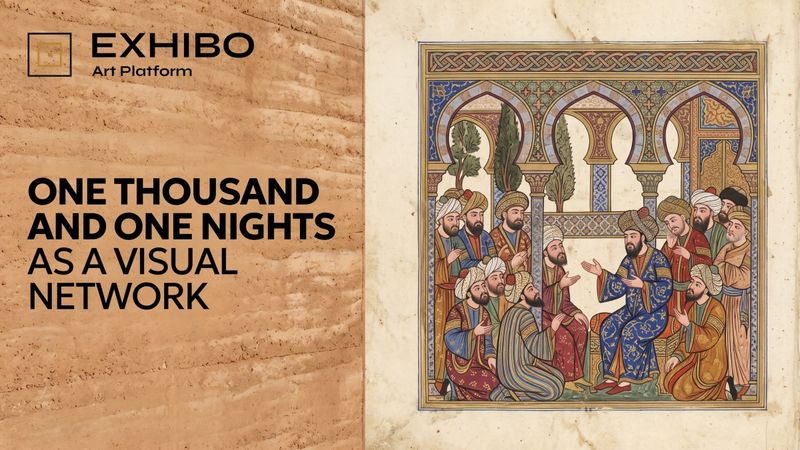
One Thousand and One Nights as a Visual Network
The book that taught Europe to picture the East arrived with no pictures at all. Three centuries of illustrators — Dutch, Egyptian, Persian, French, German, Iraqi — each gave it a face, and every face was a self-portrait.
Open Galland's Thousand and One Nights, the edition that conquered Europe, and there is nothing to look at: no genie, no lamp, not one illustration. The most visually imagined book in the world began blind — and because its text was never fixed either, no picture of it could ever be a copy.
Curating Tomorrow's Archive: Hamburger Kunsthalle Seeks Contemporary Collections Lead
A new permanent appointment will steer the museum's post-1960 holdings across paper, photography, and media formats.
The Hamburger Kunsthalle is inviting applications for a senior curatorial position focused on contemporary acquisitions, exhibition strategy, and digital collection management. Applications close October 2026 for a January 2027 start.