
Doha · Qatar
Why Doha Is Full of Roundabouts
An old circle at a crossroads, sharpened by British road engineering, became the way an Arabian city found its way and remembered itself — and it took the bulldozers to reveal it.
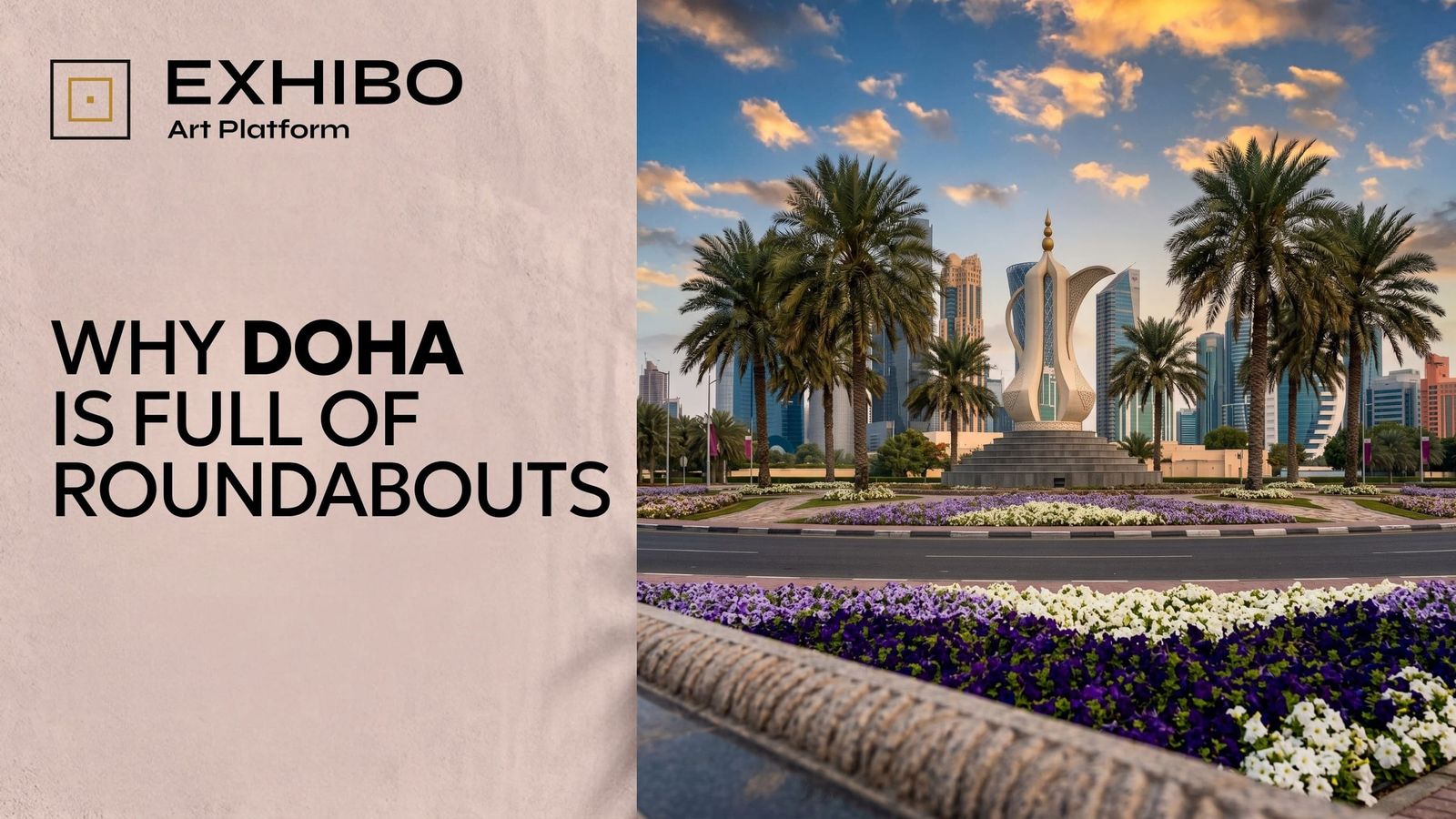
Ask someone in Doha how to get somewhere and the answer may begin with a roundabout before it reaches a street number. Turn at the Clock, they say, or head for the one with the oryx, or it's just past where the Rainbow used to be. The city is navigated by its circles — by the sculptures sitting in the middle of them, by the names those sculptures earned, by the memory of the ones already gone. There is a whole grammar of direction here that leans less on street numbers than on a concrete oryx on a twisted column, and for decades it worked, because in a city like this the roundabout was doing a job that in most cities is done by the address itself.
And now they are disappearing. All over Doha the circles are being cut out and replaced with signalled junctions — four lanes, an underpass, a bank of traffic lights — because the traffic long ago outgrew them. The oryx roundabout is gone. The Clock roundabout has been re-landscaped and renamed. The Sports roundabout, with its 1980s concrete sculpture of figures mid-throw, went under the bulldozers on an ordinary morning in June 2017 while a few people stopped to photograph the mangled steel and mound of rubble that had, the day before, been a landmark. What is being removed is not really a piece of road engineering. It is the thing people used to find their way, and to know where they were.
This is a piece about how a circle at a crossroads — an old European form, sharpened into a modern device by British engineering — became the way an Arabian city found its way and remembered itself, and then discovered that it had become that only at the moment it was being erased. Doha did not simply import a finished British invention. It was already building its own modern city when British road standards arrived, and it made the roundabout its own almost immediately — first as infrastructure, then as landscape, then as landmark, then as memory. The distance between a traffic island and a piece of civic memory is the whole story.
A device from a particular place, at a particular time
The circle at a crossroads is old. The Circus at Bath was finished in 1768; the Place de l'Étoile wrapped itself around the Arc de Triomphe in the 1780s; New York had a traffic circle at Columbus Circle in 1905. But those were architectural gestures or early, unruly experiments — big circles where traffic milled around with no agreed rule about who went first, and which had a persistent habit of seizing up. By the 1950s the traffic circle was falling out of favour on both sides of the Atlantic, jammed and accident-prone, and many were being torn out and replaced with signals.
What saved the idea, and turned it into the thing Doha would later fill itself with, was not the circle itself but a new rule of priority. In 1966 the United Kingdom made giving way to circulating traffic the standard at circular junctions: traffic entering must yield to traffic already on the circle. It sounds trivial. It was transformative. As the UK's Transport Research Laboratory later put it, before 1966 there were no rules defining priority between traffic streams at roundabouts, and early designs tended to "lock" under heavy load — entering cars forced their way in and the whole thing gridlocked. The new rule meant nobody could block the path of a car already going round, so the junction kept clearing itself — the traffic equivalent, as one legal history nicely puts it, of letting people off the bus before others get on. British road researchers — Frank Blackmore and the Transport Research Laboratory prominent among them — developed the compact, deflected-entry form, with raised entry islands that forced drivers to slow on the way in, that made the modern roundabout much more effective. Crashes at converted junctions fell by around 40%. From the late 1960s the roundabout was, in effect, a solved problem, refined and standardised through British road research.
Now look at where Doha was in exactly those years. Qatar was still a British protectorate; it would not become independent until 1971. Oil money had begun to arrive and the country was building its first real infrastructure more or less from nothing — the population of the peninsula had fallen to around 25,000 by the end of the Second World War and stood at roughly 120,000 by 1971, and the roads, the water, the electricity all had to be conjured at once. British engineers and British road conventions were foundational to that effort — a state engineer had arrived from Britain in the early 1950s, and later master-planning ran through a string of mostly British and American consultancies — though Doha's road system was never a purely British creation. The standards those engineers knew were the ones they brought. Roads were laid to British specifications; for a while cars even drove on the left, as in Britain, before Qatar switched to the right in 1965, ahead of several of its neighbours. When it came to junctions, the roundabout was simply what was reached for. It was, in the words of John Lockerbie — a British architect-planner who worked in Qatar's government through those years and kept a meticulous record of it — a standard solution on British road systems where the engineers came from, and it made, he adds, considerable engineering sense on the calculated traffic flows of the new road network outside the crowded centre. And crucially, Doha had not waited for the 1966 rule to start building circles: one of its earliest major roundabouts was already in place in the early 1950s, more than a decade before Britain standardised the modern form. The circle was older than the device it became; Doha was making its own version before the textbook was written.
There is a detail in Lockerbie's account that is easy to skate past and worth stopping on. He recalls being told that traffic lights were considered offensive — that a roundabout was, in his recollection, a more polite way of guiding you at a junction than a machine barking red and green at you. Whether that reasoning was official policy or the sort of thing engineers told each other, it points at something real: the choice of the circle over the signal was, in this telling, never purely about throughput. It carried a sense of how a road ought to treat the person on it. In Lockerbie's recollection the roundabout was the courteous option. That idea — that a junction could have manners — will matter later.
Why the circle became more than a circle
A roundabout is a piece of tarmac with a hole in the middle. What went into that hole, in Doha, is the reason the form stopped being infrastructure and started being memory.
Begin with the most basic fact of everyday navigation in the Qatari city: Doha had streets and street names, but for finding your way around a number was rarely as useful as a landmark. The formal system of zones, streets and building numbers existed, and digital tools like the Qatar National Address and the Metrash app later made it far easier to pin a point on a map — but for most of Doha's formative modern life the reliable way to say here was not to name a coordinate; it was to name a thing everyone could see. And the most visible things the new city produced, sitting at the junctions where everyone had to pass, were the roundabouts.
So the circles became the shared reference grid the city leaned on. This is the point the guidebooks miss when they treat Doha's roundabouts as decoration: they were load-bearing. When you told someone to turn at the oryx, you were not being charming, you were being precise — the Al-Maha roundabout, named for the Arabian oryx sculpture on its central island near the approach to the West Bay, was a coordinate that drivers across the city shared. Lockerbie, who was in the room for some of these decisions, notes plainly that putting a sculpture on a roundabout had a way-finding benefit, whatever else it did. The art was navigation. The navigation was art. When a landmark did the work an address would do elsewhere, the two collapsed into the same object.
Two other things fed the form. One was water. As desalination and urban water infrastructure expanded through the early 1970s, the circles — bigger than the thin planted medians, sitting in the middle of an otherwise unrelentingly hard, hot, hard-surfaced city — offered unusually large islands on which to introduce soft landscaping into the urban scene: grass, flowers, small ficus trees, a fountain in a pool. The roundabout was, briefly, the greenest thing around. The other was the pedestal. A circle at a junction is a plinth that thousands of people see every day from every direction, and a young country assembling a national image found that irresistible. Onto the circles went the oryx, the falcon, the coffee pot, the clock — objects that said this is who we are to a captive, circling audience.
And here the tidy version of this essay — import arrives as function, slowly accretes meaning — needs correcting, because in Doha the meaning was there almost from the start. One of the city's earliest monumental roundabouts, the Clock Tower roundabout by the Diwan al-Amiri — a different landmark from the later Clock (Al Mirqab) roundabout with its talking clock — was developed early in the 1950s and conceived as a piece of design in concert with the Sheikhs' mosque and the Diwan al-Amiri, the seat of the ruler. Before the offside rule, before the oil-funded ring roads, before any of the engineering logic that would later justify hundreds of these things, one of Doha's earliest roundabouts was already a monument — a considered civic composition next to the mosque and the palace. The function and the symbol did not arrive in sequence. They arrived together, and stayed tangled.
It is worth holding the counter-fact too, because it keeps the circle from explaining more than it should. The roundabout was a device for the new Doha, not the old one. Where the new radial ring roads — the Corniche and the A, B, C and D rings that fan out from the old port — ran through open ground, the circles could be set out theoretically correct, with the space they needed; but inside the old inner ring, in the dense fabric of the historic town, they were, in Lockerbie's phrase, constrained by ownership problems, jammed awkwardly into a street pattern that predated them. The circle belonged to the parts of the city the oil age was building from scratch. Where the old city resisted, it resisted the roundabout too.
One form, a whole coast
Doha did not do any of this alone, and the roundabout is not a Qatari story so much as a Gulf one — the same device, arriving by the same route, doing the same double job of moving traffic and holding meaning, all the way down the coast. Drive the Gulf and you are driving a single inherited idea in a dozen local accents.
The through-line is stated most plainly by the people who lived inside it. Roundabouts, one long-time UAE resident writes, were introduced by the British — but we are talking about more than a road system here; we are talking about well-known landmarks that provide anchor points to lost travellers when the lack of road names offers few clues. That is the Doha situation exactly, repeated across seven emirates and several capitals: cities growing too fast for their own street signs, leaning on circles to tell people where they were. Most roundabouts in the UAE, one survey notes, were introduced from the 1950s and were based on Britain's traffic system. Al Ain, on the border with Oman, built so many that people simply call it Roundabout City.
One of Dubai's earliest modern landmarks is one of these circles. The Deira Clock Tower, built in the mid-1960s, sat on a roundabout at the gateway of the newly opened Maktoum Bridge — for a while the only entry point for anyone arriving in Dubai from Sharjah — and its clock, in a detail that quietly maps the region's web of favours, was a gift from the ruler of Qatar, Sheikh Ahmad Al Thani, to his father-in-law, the ruler of Dubai. Decades later the same city began pulling its circles down for exactly Doha's reason: Dubai's Defence Roundabout, the first interchange on what became Sheikh Zayed Road, was rebuilt in the 2000s as a multi-level, signal-free interchange. The circle became a stack of flyovers. As the traffic thickened, Gulf roundabouts gave way to signals and interchanges, and the sculptures on them went into storage or into rubble.
Abu Dhabi tells the same story with a sharper edge, because there the roundabout had become something close to a diplomatic instrument. The city's Volcano Fountain — a conical, staged fountain lit orange at night so the water seemed to erupt — was built during the capital's 1980s beautification drive and demolished around 2004 in the redevelopment of the Corniche. Sharjah's Kuwait Roundabout was raised in the mid-1980s in recognition of Kuwait's help in building the emirate's early schools and hospitals — a monument, sitting in a traffic junction, to a debt between two states. These were not decorations that happened to be circular. They were the Gulf's civic memorials — and the reason they were circular is that the roundabout was, more than almost any other piece of public infrastructure, the thing a citizen would meet at eye level, over and over, in the ordinary course of a day.
There is a linguistic fossil in all this worth noticing. In several Gulf cities the roundabout is signed, and spoken of, as a square — Sharjah's Kuwaiti roundabout is also Kuwait Square — a holdover from the maidan, the open public square of the older city that the circle quietly replaced. The word for a place where a public gathers got carried over onto a place where traffic circulates. Most of the time that fossil is inert. In one Gulf city it detonated.
When the circle carried too much
On 18 March 2011, Bahrain's authorities demolished a roundabout.
The Pearl Roundabout in Manama had been built in 1982 to mark the third Gulf Cooperation Council summit: six stylised dhow sails rising around a giant white pearl, evoking the six Gulf states and Bahrain's pearl-diving heritage. For nearly thirty years it was, like its cousins up and down the coast, an ordinary traffic circle that doubled as a national symbol, the kind of thing that appeared on promotional literature and that everyone used to give directions. Then, in February 2011, it became the gathering point for mass anti-government protests, and its meaning changed under it. When the state cleared and then razed the monument, the demolition was officially framed in infrastructural terms — the works were described as intended to improve traffic flow and the junction — even as the monument had become the most visible symbol of the uprising; the site was rebuilt as the Al Farooq Junction, and, as a peer-reviewed study of the episode pointedly titled "Squaring the Circle" records, the monument's imagery was afterward suppressed from public life.
I raise Bahrain not to collapse it into the others — the circumstances there were singular, and belong to a political history well beyond the scope of a piece about traffic engineering — but because it is the limit case of the thing every Gulf roundabout quietly was. A circle at the centre of a city, with a monument in the middle that a whole population uses to locate itself, is not neutral ground. Most of the time that latent charge stays latent; the oryx and the clock and the coffee pot sit there harmlessly being landmarks. Manama is what it looks like when the maidan buried inside the roundabout wakes up. The same form that made these objects useful as shared reference points — central, visible, held in common — is what made one of them, once, impossible for a government to leave standing.
What is taking the circle away
Set the exceptional case aside and the ordinary reason the Gulf's roundabouts are vanishing is almost boring, which is the point. They are being removed because they stopped working.
A roundabout can be remarkably efficient at moderate traffic volumes and a poor fit at high ones. Below a certain flow it keeps itself clear, self-regulating, no signal required; as demand rises the gaps a car needs to enter the circulating stream become harder to find, queues grow in every direction at once, and a set of traffic lights — metering the flows, holding one stream while another moves — can offer greater capacity and more predictable control at very high demand. By the 2010s several of Doha's major roundabouts were carrying traffic volumes for which they were no longer well suited. Its roads had been built for densities far lower than the ones that actually arrived; the pressure on the system, as Lockerbie noted from inside it, became intense, and the calculated flows the roundabouts had been so elegantly sized for were overwhelmed. The public-works authority, Ashghal, has spent the last decade methodically converting the city's circles into signalled junctions and grade-separated interchanges — part of a wider push by the Ministry of Municipality and Urban Planning described as "Keep Doha Moving", which included widening the Corniche, signalising its junctions and removing the roundabouts along one of the city's most scenic stretches. The engineering logic that installed the circle is the same logic, run forward forty years on bigger numbers, that removes it.
Two deeper shifts finished the job. The first was that the way people found their way changed entirely. By the late 2010s GPS and smartphones had weakened the roundabout's second function: you no longer need a shared concrete landmark to tell a stranger where you are when the stranger has a map in their pocket that updates in real time. The second shift was that the city began rebuilding its own centre. Msheireb Downtown Doha, a large-scale redevelopment of the old commercial heart around the well the district is named for, was begun in 2010 and opened through 2022; at the same time parts of central Doha, served from 2019 by a new metro, were beginning to embody a different model of urban movement — on foot and underground rather than in a car going round in circles.
Notice what displaced the roundabout, because it tells you what the roundabout had been. It was not a better circle. It was a different model of the city entirely — signals and interchanges for the traffic, a metro and a smartphone for the wayfinding, a rebuilt walkable centre for the civic life. The circle had been quietly holding all three of those jobs at once: it moved the cars, it located the citizen, and it carried the national image. The modern city simply unbundled them, handed each to a specialist, and had no remaining use for the object that used to do all three. That is usually how a form dies — not because it fails at its one job, but because the city stops asking any single object to do so many at once.
The nostalgia arrives after the object
Here is the strange part, the part that makes this more than a story about traffic. The affection for Doha's roundabouts became articulate only once they were being destroyed.
In 2014, while the bulldozers were busy, an exhibition opened at Hamad Bin Khalifa University asking whether pulling the circles down was destroying part of Qatar's heritage — using the roundabouts, of all things, as a way into the larger question of what a young country decides is worth keeping. The heritage scholar Trinidad Rico, then at UCL Qatar, put the paradox precisely: the roundabouts were widely understood as a Western import, not originally part of Qatari culture, and yet, she observed, in the aftermath of their disappearance there was a growing conversation that aimed to value them — an emerging nostalgia and appreciation that may only have emerged posthumously. Posthumously. The thing became precious at the moment of its death, and possibly because of it. Artists began treating the circles as subjects worth mourning; the Doha-based duo Christto & Andrew built an installation, Permanent Temporalities, around exactly this — the country's face changing so fast that its own recent past becomes an object of loss almost as it happens.
You can read this as sentiment, and some of it is. But there is a harder observation underneath. A form imported as pure function is not supposed to accumulate a soul; it is supposed to do its job and be replaced when a better job comes along, and no one is meant to grieve a junction. What happened in Doha is that the roundabout, doing its unglamorous work for fifty years in a city where a landmark beat an address, quietly became the repository of an enormous amount of ordinary life — every direction ever given, every landmark ever used to explain where a home or a shop or a childhood was. The oryx was where you turned for your uncle's house. The Clock was where the city began for anyone arriving. You do not notice that a thing has been holding all of that until it is gone and the holding stops. The nostalgia arrived posthumously because the meaning was invisible right up until the object carrying it was removed — which is, when you think about it, the definition of infrastructure. You only see it when it breaks, or when it leaves.
Back at the junction
Go back to the way this started — someone in Doha telling you to turn at the roundabout that isn't there any more, past where the Rainbow used to be. It is a small linguistic ghost, that construction, and the city is full of them now: directions that route you past absences, landmarks preserved only in the sentence that points at the space they left. The concrete oryx has been safely removed and handed over; the junction where it grazed is four lanes and a set of lights; the way-finding has moved into the phone. Everything the circle did is still being done, better and faster, by other things.
And still the sentence keeps the roundabout in it. People go on giving directions by circles that were bulldozed years ago, because the alternative — a zone number, a street number, a blue dot on a screen — locates the building but not the memory, and the memory is the part that was doing the real work all along. The roundabout came to Doha as an old European circle sharpened into the most rational way to guide a car politely through a junction, and the city made it its own before the textbook was even finished. It leaves as the thing a whole city used to know where it was. Somewhere in the fifty years between those two facts, a piece of imported traffic engineering quietly turned into the closest thing a fast-built city had to a shared past — and, in the usual order of these things, nobody could quite see that until the moment the circle was gone and the light turned green.
Related reading
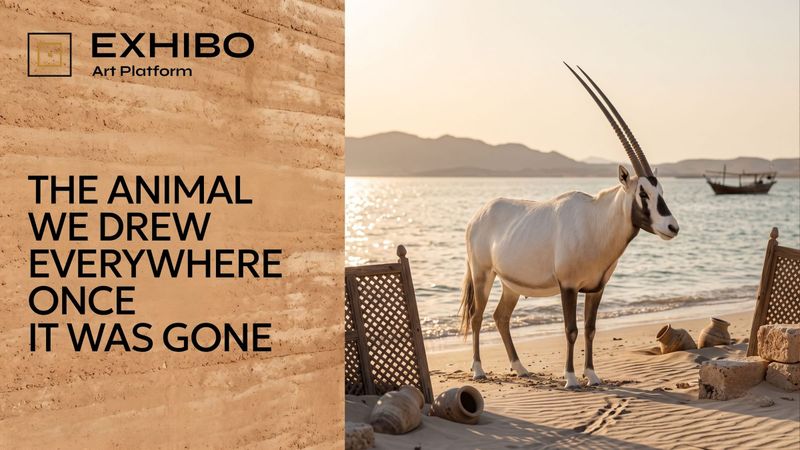
The Animal We Drew Everywhere Once It Was Gone
From Neolithic rock to airline tailfin — how the Arabian oryx vanished from the desert, came back from nine animals, and multiplied everywhere as a symbol in the very decades it was gone.
The last wild Arabian oryx was shot in 1972. By then it was already a picture — carved on Bronze Age tombs, mistaken by the ancients for a unicorn, praised by poets as the eyes of the beloved. This is the story of an animal that went extinct in the wild and was brought back from nine survivors, and of the strange gap between the creature and the emblem it became: fast, sharp and ascendant on a nation's tailfin, while the animal itself survives by standing still in the shade.
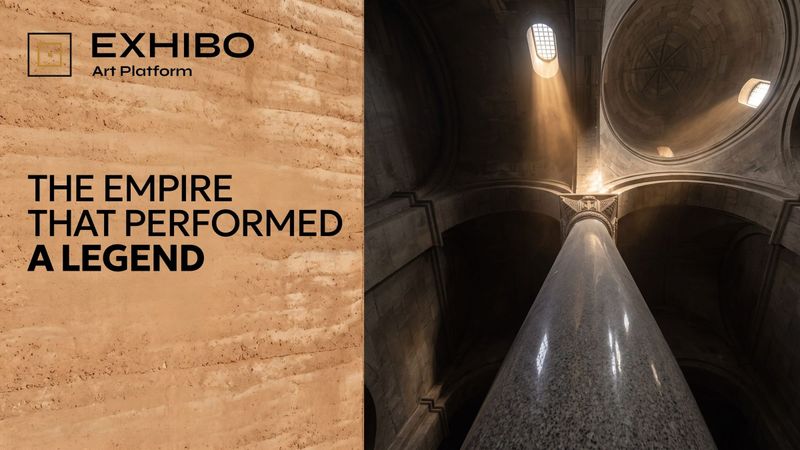
Seventy Thousand Solomons: The Empire That Performed a Legend
A demon catalogue in the conqueror's library, a sixteenth-century text where kingship is an office held seventy thousand times, and the columns a sultan dragged across three provinces to prove he held it.
Mehmed II kept a Greek catalogue of demons in his library at Topkapı. Seventy years later a sultan named for a prophet was rebuilding the walls of Jerusalem and hauling Roman columns out of Egypt and the Lebanon into a mosque above the Golden Horn. In between, Ottoman writers turned Solomon from a warning into a job — and the empire applied for it in stone.
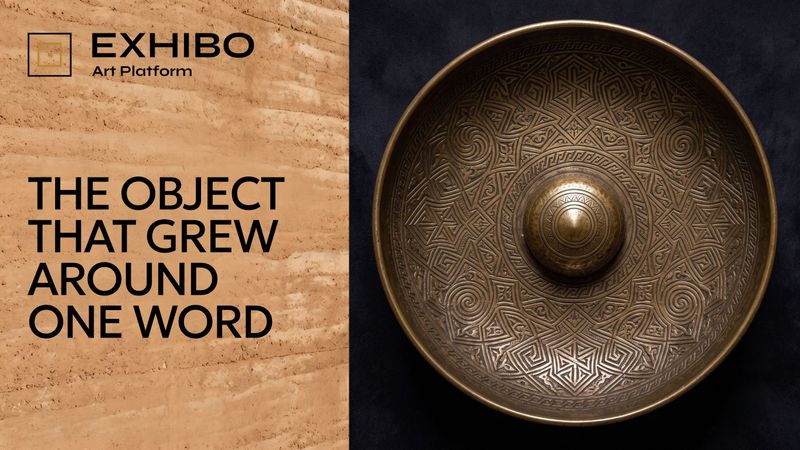
The Seal of Solomon: The Object That Grew Around One Word
The Qur'an never mentions a ring. What grew in that gap instead: a demon, a seal, seven signs nobody can trace, a thousand years of amulets, and a star that ended up on a flag.
A fisherman pulls up a copper jar stopped with lead, and the mark of a signet ring is pressed into the lead. Everyone hearing this in ninth-century Baghdad knew what came next — they knew it from the lid. The strange part is that the ring they all knew about is not in the Qur'an.