
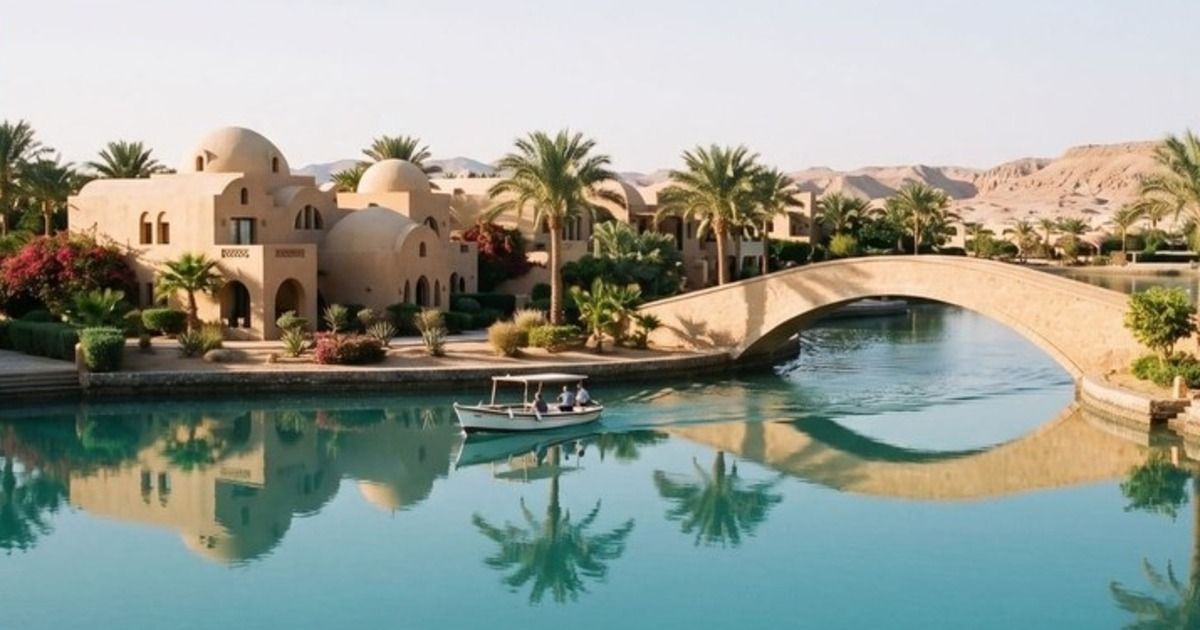
El Gouna · Egypt
Why the Middle East Keeps Building Venice
From the Red Sea to the Gulf, canal towns keep getting called Venice. The water was usually about something else — and Venice was never quite Venice either.
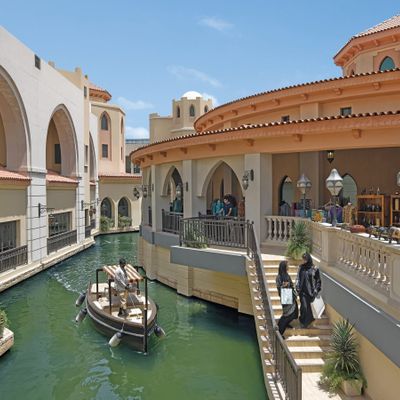
In the third week of October the lagoons of El Gouna fill with small boats carrying people in evening clothes. The El Gouna Film Festival runs this year from the 15th to the 23rd, its galas and open-air screenings spread between Abu Tig Marina and Downtown, and a fair share of any festival evening here is spent on the water — under low arched bridges, past sand-coloured domes, between islands that did not exist forty years ago. The Red Sea is somewhere off to the east. What you are actually crossing is a canal.
And someone on the boat will tell you, as someone always does, that you are in the Venice of the Red Sea.
There is a story that comes with the nickname. The story goes that in 1989 the Egyptian engineer Samih Sawiris visited Venice, fell in love with it, came home and decided to build his own — and because the Egyptian coast had no lagoons, he simply dug them out of the desert. It is a lovely story. It has the shape of a founding myth: one man, one city, one moment of desire. It turns up in travel blogs and on lagoon-tour brochures, and it explains everything you can see from the boat.
None of the contemporary accounts we could find gives Venice that role.
It matters less as a correction than as a clue. Because the comparison turns up all over the region, in different guises: as a developer's tagline for a resort in Dubai, as the architectural programme of an island quarter in Doha, as the borrowed name of a creek-side hotel in Abu Dhabi, as an aside at a ribbon-cutting in Sharjah, as an estate agent's label for a desert city in southern Kuwait. Not quite the same thing each time — and the differences turn out to matter. Strip out the myth, and a more interesting question is left standing in its place. Why does a region with some of the oldest waterside cities on earth keep reaching for the name of a city in the northern Adriatic?
A few villas and a marina
Sawiris tells the story differently, and he has told it more than once. In an interview given years later, he described his first project as a plan for "a few villas and a marina for sailors and fishermen". The company's own thirtieth-anniversary account puts it more domestically still: in 1989 he decided to build some beach houses with a private marina for himself and a few close friends. The nearest shops, petrol station and hospital were twenty-five kilometres away in Hurghada. So he added a small town.
Then the honest part. By his own account the project turned out to be a failure — the infrastructure those few villas needed cost far more than the villas could justify — and the only way out was forward. More villas, to reach critical mass. Then, because there were now people staying, a clinic. Then a school for the staff's children, houses for the teachers, a decompression chamber for injured divers, more and more generators to light the place. A 500,000-square-metre idea that ended up, in his words, covering close to forty million.
Nobody falls in love with Venice and builds a decompression chamber. This is not a romance. It is a balance sheet that kept demanding to be fed.
Look at who designed some of El Gouna's defining early buildings and the Venice recedes further. Rami El Dahan and Soheir Farid are a husband-and-wife practice who spent the decade from 1979 to 1989 working alongside Hassan Fathy, the Egyptian architect who made a modern argument out of mud brick and Nubian vaults; their Archnet profile, drawn from the practice's own record, credits them with work on the town centre, its mosque and several hotels between 1993 and 2002. Kafr El Gouna, begun in the early 1990s as plain staff housing, grew a museum, restaurants and a small hotel when the client liked it. The Sheraton Miramar they did with Michael Graves, the American postmodernist best known for his Disney hotels in Florida. "Since Fathy, working with the vernacular became fashionable," El Dahan said in a later interview, and that is precisely what El Gouna looks like: Upper Egypt's domes and arches, reworked for holidaymakers. If you have read our piece on why desert architecture loves earth tones, you have met this lineage before. It is not Venetian. Nothing here is, except the water.
So where did the name come from? By 2010 Newsweek was already reporting that the town was "often pitched by travel agents" as the Venice of Egypt — on the strength of its villas clustered round man-made canals and stone footbridges. Travel agents. Not the founder, not the architects. The people whose job was to sell it to someone who had never been. That is evidence of how the town was being sold by 2010, not proof of who first reached for the comparison; somebody may have said it on a boat in 1995. But every trace of it we could find sits in the selling, not in the planning.
The canals came first. Venice is what the brochure called them afterwards.
Making shore
If not love, then what? Follow the money for a moment, because it leads somewhere very physical.
A villa on the water can command more than a villa behind it. Everyone who has ever bought a house by the sea knows this, and every developer on a desert coast knows something sharper: there is only so much sea to go round. A natural coastline is a line. It has one front row. Everything behind it is second-rate by definition, and on a long flat plot that is almost all of it.
Unless you move the sea.
You can watch the distinction being drawn in El Gouna's own paperwork. In a 2023 presentation to investors, Orascom Development reported selling 45,350 square metres for around CHF 11.3 million and described the plot in one telling phrase: in the middle of El Gouna, with no beach access. Of all the things a buyer might want to know about a piece of land, the company led with whether it touches water. Earlier that year it had signed a master agreement with the Egyptian authorities for the 17.4 million square metres of the town still undeveloped. The new master plan adds some 1.2 million square metres of connected lagoons; the coastal setback was cut from 200 metres to 105, which, in the company's words, lets it make commercial use of its most prime land; and two new channels to the sea were approved. In this model, a good part of what land is worth is, quite literally, where the next canal gets cut.
The clearest statement of the logic comes from a supplier. The Chilean firm Crystal Lagoons, which builds vast swimming lagoons fed by brackish groundwater, reported 45 projects at various stages in Egypt in 2024, its largest market in the region. Its lagoons, it explains, let developers build "second-line" beach projects and let homes on the second or third row face the water. The first, it has said, were built on the North Coast to add value to low-priced land; its showpiece at Citystars Sharm El Sheikh is filled, by the company's account, from desert wells whose salty water was otherwise useless. Next, it says, come ticketed Public Access Lagoons in cities such as Cairo, hundreds of kilometres from the nearest real beach. The sea is becoming something you can install almost anywhere the land is cheap enough and the buyers are close enough.
The lagoon is not a view. It is a machine for turning the back of a plot into the front.
Egypt had been running that machine since before El Gouna. Marina El Alamein, west of Alexandria, was laid out from the mid-1980s as a state project, now run by the New Urban Communities Authority, with canals and inner lagoons behind its front row of chalets; at Porto Marina, the Amer Group's development there, gondola rides are still on offer. Archaeologists have been excavating since 1986 a prosperous Roman-era town on the same coast, its wealthier houses also ranged along the shore. The analogy proves nothing about prices, but the front row, it seems, was prized two thousand years ago too.
Dubai ran the same sum offshore. The museum at The View at The Palm tells the origin story plainly: the first suggestion put to Sheikh Mohammed was a circular island that would add seven kilometres to the coast, and he asked for one that would add ten times as much. The palm shape — a trunk, seventeen fronds and an eleven-kilometre crescent of breakwater — added some seventy-eight. Same patch of sea. Ten times the edge. The silhouette is beautiful, but the reason it is a palm and not a disc is arithmetic: fronds are mostly perimeter. The manufactured shore has since learned to act. In Mission: Impossible – Ghost Protocol (2011), the Jumeirah Zabeel Saray, an Ottoman-styled hotel on the Palm's western crescent, stood in for a palace in Mumbai: a copy on a copy, cast as somewhere else entirely.

Palm Jumeirah photographed from the International Space Station. NASA, Public domain, via Wikimedia Commons
There are two ways to manufacture shore, and the region has tried both. You can pile it outward, dredging the seabed into islands, as Dubai, Doha and Bahrain have done; Bahrain, according to studies of its reclamation, grew from about 668 square kilometres in 1963 to nearly 780 by 2018, roughly a sixth more country. Or you can dig it inward, cutting the sea into the land, as Sawiris did at El Gouna and as Kuwait did on a scale that makes El Gouna look like a garden pond.
Sabah Al Ahmad Sea City, near the Saudi border at Al Khiran, began as an idea in the mid-1980s of the businessman Khalid Yousef Al-Marzouq and was carried through by his son Fawaz. Originally called Al-Khiran Pearl City, it was delayed for years by the Iraqi invasion of 1990 and its aftermath, by politics and by bureaucracy. Kuwaiti coverage describes it as the first and largest project in the country built entirely by the private sector, its infrastructure completed at no cost to the state and its ground raised as a hedge against a warming, rising sea.
What makes it unusual is the method. The northwestern Gulf coast here is low tidal flat backed by sabkha — hypersaline salt marsh — and desert. Rather than infill the shallow marine habitats offshore, as most Gulf waterfront schemes do, the developers excavated the saline desert and flooded it, first opening it to the sea in 2004. The system was modelled before a spade went in and relies on nothing but tides and wind to move its water. Its channels follow the paths of two hypersaline khors, tidal creeks that the scientists who later studied the project describe as of little ecological value before the digging began; that is their judgement, not a property of every sabkha. By their 2012 survey, three phases had produced 84 kilometres of shoreline, out of a planned total of roughly 180, and more than a thousand species had been recorded in the channels, a hundred of them fish and shellfish; within five years of opening, they report, the new habitats had come close to, or exceeded, the species richness of comparable natural ones nearby. Kuwait's birdwatchers now list its muddy islets and mangroves as a stop for migrating waders. The villas and chalets have been marketed chiefly to Kuwaiti buyers, with designs pitched at the requirements of Kuwaiti family life — a domestic market, not a foreign one.
The scientists framed all this, quite explicitly, as an alternative to the rest of the Gulf's waterfront. Much of this coast, their paper notes, has been infilled for housing, recreation and industry, degrading the shallow nursery waters that fisheries depend on. Rather than building out into the sea, they propose building cities on land, safely above future high water, by excavating what they call unproductive saline desert into marine waterways. Leave the sea alone, in other words, and bring it inland. It is worth knowing that two of the paper's three authors worked for La'ala Al-Kuwait, the company developing Sea City. The survey is detailed and peer-reviewed, but the advocacy is not disinterested — and a habitat that fills quickly with life does not prove that what it replaced was worthless.
A city that adds coastline to a country by subtracting desert. That is the real invention, and it has nothing to do with gondolas.
None of this means every canal in the region was dug for the same reason. El Gouna grew because its infrastructure needed buyers; the Palm because a coast needed length; Sea City because a family looked at a salt flat and saw a shore. Property economics explains a great deal of what follows. It does not explain all of it, and the places where it falls short are where the story gets interesting.
Which leaves the name. Here, flagged plainly as interpretation: when a developer has manufactured shore and needs one word for a city where every front door opens onto water, there is really only one word the world already knows. Amsterdam is canals and merchants. Bruges is a postcard. Venice is the only city on earth whose entire identity is that the water is the street. The name is less a homage than a unit of meaning — the shortest available way to say "everyone here lives on the edge".
The name painted over the creek
Now look at what the name lands on, because in the Gulf it keeps landing on things that already had names of their own.
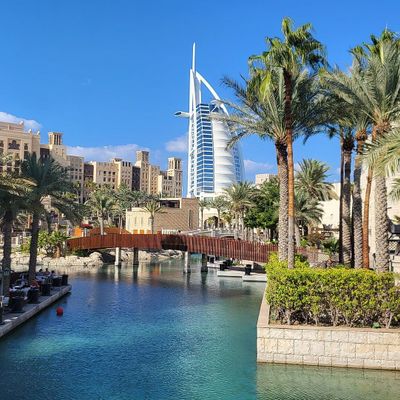
Madinat Jumeirah, the resort beside the Burj Al Arab, opened in the early 2000s around a network of seawater canals ridden by abras, the flat wooden ferry-boats of Dubai Creek. Its landscape architects describe the brief in so many words: to recreate the feel of Old Dubai along the Creek, complete with waterways, abras, wind towers and a souk. Its developer, Mirage, describes the same project as built around internal waterways and "inspired by an Arabian citadel" — and then, in the same sentence, calls it "the Venice of the Middle East".
Read that twice. A place designed to remember the Creek, sold under the name of the lagoon. Its canals have since acquired a life no brochure planned: since 2004, according to Gulf News, more than 560 injured sea turtles have been nursed back to health in the resort's waters and released into the open Gulf. The Venice of the Middle East, it turns out, is also a turtle hospital.
In Abu Dhabi, the Ritz-Carlton describes itself as inspired by Renaissance architecture and the urban planning of Venice, and calls itself the Grand Canal. The water it sits on is the Khor Al Maqta — a natural tidal channel between Abu Dhabi island and the mainland which, until the emirate's first bridge opened across it in 1968, could be crossed only at low tide or over a narrow causeway. The emirate's own tourism board now lists it as Khor Al Maqta, also known as the Grand Canal. Across that channel sits Qaryat Al Beri, a new souk you reach by abra. The khor did not change. It acquired a second name in a second language.
Dubai's own most recent canal makes the point from the other direction. Opened in November 2016, the 3.2-kilometre Dubai Water Canal carries the Creek through Business Bay to the Gulf at Jumeirah. Its contractor, BESIX, frames it not as a European import but as the culmination of a dream of Sheikh Rashid bin Saeed Al Maktoum, who had the Creek deepened in 1959 to make it navigable for trade. The canal also did something no brochure mentions: by linking the Creek to the open sea, it turned a major portion of old Dubai — Bur Dubai, Karama, Oud Metha, Satwa, Zabeel — into an island. Sheikh Mohammed put it more simply at the opening: the heart of Dubai, he said, is now an island. Dubai did not need Venice to become a water city. It needed one more cut.
Sharjah gave the trope its most candid moment. When the ruler opened the Al Qasba Canal in 2000 — a kilometre of water linking the Khalid and Al Khan lagoons, five metres deep and thirty wide, its banks lined with cultural buildings — an official at the ceremony called the project "Venice-like", in the hope it would raise the emirate's profile for cultural tourism. Fair enough. But the two bodies of water it joins are lagoons that were there long before anyone in Sharjah had heard of a vaporetto.
And then there is Kuwait, where the trope barely exists at all in the local press. English-language property sites call Sea City the Venice of the East. In some Kuwaiti Arabic-language coverage it is called something else — the Pearl of Khiran — and when Al-Marzouq's project is described in his own terms, the point is that it would return Kuwaitis to the marine environment that was once theirs. Not an Italian fantasy. A homecoming to the sea. Sit with that difference for a moment. The same canals, described in two languages, mean two entirely different things: in English, a copy of somewhere else; in Arabic, a memory of here.
That memory has its artists, too. The Kuwaiti artist Monira Al Qadiri, whose grandfather was a singer on a pearling boat, made DIVER in 2018: synchronised swimmers in bodysuits with the sheen of both pearl and oil, moving to a traditional pearl-diving song. Her wider work keeps returning to the hinge between the two industries — the sea that fed the Gulf before oil, and the wealth that came after it. Watch it with Sea City in mind and the canal city looks less like an import than a reply.
Venice is the word English reaches for. The Gulf had its own words all along — khor, creek, lagoon, sea.
When Venice is meant
Not every Gulf Venice is a mislabelled creek. Some are Venice on purpose, and they are worth looking at closely, because they show exactly when the literal copy appears.
The Pearl, the reclaimed island north of Doha, is named, as NASA's Earth Observatory noted while it was still being built, because it stands on one of Qatar's historical pearl-diving sites, and it adds 32 kilometres of coastline to Doha. Urban researchers point out that the economic premium placed on waterfront access and views is why the whole island hangs off a single spine road, leaving every possible edge to the water. Its precincts wear different Mediterranean costumes — Porto Arabia, Medina Centrale, Viva Bahriya — and then there is Qanat Quartier. Qanat is Arabic for canal. A marketing manager for the developer, United Development Company, told a trade magazine the aim was a precinct akin to the finest European cities and to "the city of Venice with its water canals and Italian architecture"; the master planners, SBD International, divided it into nine Venetian-inspired islands, built, by UDC's dating, between 2006 and 2012.
An island named after the pearl beds beneath it, with a Venice inside: the local water underneath, the borrowed name on top.
The date is the tell. In 2004 Qatar's Law No. 17 for the first time allowed non-Qataris to own freehold property in designated areas, The Pearl among them. Dubai had opened its first freehold zones to foreigners in May 2002; Bahrain's canal-laced Amwaj Islands were planned around 2000 as its first full-freehold project for expatriates. Oman, by royal decree in 2006, confined foreign freehold to designated tourism complexes — and the two largest outside Muscat, Jebel Sifah and the lagoon town of Hawana Salalah, are built by Muriya, a joint venture between the Omani state developer OMRAN and Orascom Development, the company Sawiris built on the back of El Gouna. The lagoon town, in short, is an export.
There is an uncanny parallel on the other side of Asia. In Original Copies, the writer Bianca Bosker documented China's themed towns — a Hangzhou suburb with its own Doge's Palace and canals, a Paris with an Eiffel Tower — and traced their boom to the late 1990s, when housing was being rapidly commercialised, a private urban property market was taking shape and a new upper class needed somewhere to live that looked like having arrived.
Here is the interpretation, and it should be held carefully. When a property market opens to buyers who are new to it, developers tend to speak a visual language those buyers already read. Venice, the Riviera, a Mediterranean marina are less styles than reassurances: you know what this is, you know what it is worth. That is our reading of a pattern, not a motive any developer has stated; UDC's own words describe a design ambition, not a sales strategy. The pattern is strong enough to notice and not strong enough to explain everything. El Gouna began more than a decade before any of these laws. Sea City sells to Kuwaitis. Madinat Jumeirah is a hotel. Freehold may explain why the literal Venice appears where and when it does. It does not explain the canals.
Bosker offers a second reading worth keeping in the room. The usual verdict on themed towns, from Baudrillard onward, is loss — the copy as a confession of emptiness. Bosker turned that around: in her argument, "in the way it copies the West, contemporary China manifests its tremendous originality" — copying as mastery, a way of owning what you once envied. Nobody has made that case systematically for the Gulf, and it would be wrong to transplant it whole. But it corrects the reflex that a Venice in Doha must signal insecurity. It may just as easily signal a country that can afford to build anything it likes, including other people's cities.
Either way, the copy has to be kept alive. In January 2026 UDC ran a month of "Qanat Quartier Evenings – An Italian Experience" on the quarter's boardwalk, as part of a strategy to activate public spaces. A morphological study by Qatar University researchers found that Qanat Quartier accounts for about six per cent of the island's housing: the most photographed quarter of The Pearl is one of its smallest, occasionally staged as Italy to draw people in. There is a quieter luxury, too. Its streets, like those of the island's other main districts, promote walking across compact, connected areas, and in a city as car-bound as Doha a place you can cross on foot is a status symbol of its own. Part of what the costume sells, perhaps, is not Italy at all but the pavement.
Venice, here, is less the city than its portrait.
Then there is the Venice that never sees daylight. Villaggio Mall in Doha opened in 2006 beside the Aspire Zone venues built for that year's Asian Games, with a 150-metre indoor canal, gondolas and a painted sky. One famous version of the format had appeared seven years earlier in Las Vegas, where the Venetian's Grand Canal Shoppes opened in 1999 with the same three ingredients. Nobody has shown a direct line between the two, and it would be wrong to invent one. But the format had become portable — a Venice you could install indoors, at any latitude, in a building whose only real water feature is the air conditioning.
The Venices nobody bothered to name
If the name were inevitable, every canal town in the region would carry it. Many don't, and they are the best evidence of all.
North of Jeddah, Durrat Al Arous began in 1991 — almost exactly El Gouna's contemporary. It spreads over some eight million square metres of Red Sea shore, built by the Dallah Al Baraka group around ten lagoons, with villas, chalets and a marina. Same coast, same decade, same physical idea. It is not commonly marketed as Venice. It grew as a place of weekend chalets within reach of Jeddah, not for package tourists who needed a word to imagine it.
In North Africa the pattern breaks differently, because the coast was generous. Morocco's Marchica, beside Nador, is a natural lagoon of around 120 square kilometres, protected as a Ramsar wetland under its older name, Sebkha Bou Areg. A state agency has spent the past fifteen years planning seven themed districts around it. It was not renamed after a European city. Tunisia got there first and went the other way: Port El Kantaoui, near Sousse, was opened to yachts in 1979 as a purpose-built marina resort, an idea that goes back to President Bourguiba, and was dressed not as Italy but as a white-and-blue Tunisian village with a reproduced medina. One can argue about whether a reproduced medina beside a yacht basin is charming or contrived. The interesting point is that when Tunisia themed its first purpose-built marina resort, it themed it as itself.
Where a lagoon already existed, nobody imported one. Where a country had a tourist image of its own to sell, it sold that.
And in Saudi Arabia the newest canal has quietly dropped Italy from the comparison. Marafy, by Roshn, the housing developer of the Public Investment Fund, is cutting a canal more than eleven kilometres long and over 100 metres wide inland from the Red Sea, extending the natural Obhur Creek through north Jeddah for some 130,000 planned residents, with water taxis and a canal link to the airport promised. "We are actively digging a very big hole as we speak," one of its project chiefs said cheerfully in a webinar. When Roshn conveys scale, it compares the waterfront with Chicago, Stockholm, Hamburg and central London, and promises architecture drawn from Jeddah's own historic houses — the city that, as we wrote in Why Jeddah Was Built From Coral, spent the oil decades walking away from the sea that built it. Now it is digging the sea back in. Venice is not on the list.
Abu Dhabi has gone one step further. The Ritz-Carlton's Venetian Village — twenty thousand square metres of Renaissance-style piazza, cobbled lanes and waterfront restaurants beside the khor — had its official launch in early 2016 with a festival attended by the Italian ambassador. On 29 May 2025 the hotel began a redevelopment that includes taking the village apart, to make way for a collection of ultra-luxurious standalone villas. Less than a decade from ambassador to bulldozer. Set against everything above, it is almost too neat: the shared piazza was the theme, the private edge of the water was the asset, and when it came to a choice, the asset stayed.
The Venice the region already had
There was a real Venice of the East — though, having spent several thousand words suspicious of the comparison, we should say at once that Basra never needed it either.
Basra stands on the Shatt al-Arab, the joint channel of the Tigris and Euphrates, upstream of the Gulf. Each day the Gulf's tide pushes up the river and holds back its fresh water, and the level in the canal network along it rises and falls with it. From the first Islamic centuries, the people of Basra used that rhythm to irrigate a vast landscape around the city through a network of canals — the first, by the textual sources, the Nahr al-Ubulla, linking Basra to the older port of al-Ubulla and the sea. Archaeologists working on the hinterland of medieval Basra describe the whole network as, at heart, a system of tidal irrigation. The sources remember the canals by the people who dug them: one, the Nahr al-Asawira, was named after a unit of Persian cavalry who settled in early Basra and cut their own channel. Out in the floodplain, the old ridges and canals can still be traced in satellite images, running until they vanish beneath the channels of a tidal inlet, the Khur al-Zubayr — which is how archaeologists know they are not modern. Centuries later, under the Ottomans, the canals running through Al-Ashar were lined with merchant houses whose carved wooden balconies, the shanasheel, hung over the water.

Ashar Creek and its bazaar in Basra, 1914–1918. Nationaal Archief, CC0, via Wikimedia Commons
That was the city that came to be called the Venice of the East. Nobody we could find can say who first used the phrase, or when; it has been repeated for so long, by foreign visitors and Basrawis alike, that it has worn smooth. What it describes is real enough, but it describes it backwards. The canals of Basra were not an imitation of anything. They were a city working with the tide — a Venice, if you insist on the word, made by the moon.
What happened next is the shadow that falls across every rule this article has found. Decades of war, urban growth and water scarcity left the canals silted, polluted and partly built over. A UNESCO programme funded by the European Union has restored eleven shanasheel houses along the Al-Ashar Canal, a section of the canal itself and eight of its bridges. Sadiq Al Hassoun, a Basra man in his sixties, leafed through old photographs of swimmers and boats and merchant ships for a reporter last year and said simply: "It was a paradise." Elsewhere in the region, a dozen new Venices went up in the decades in which Basra was losing the one it had.
The tide is the thread that ties them together, because every new lagoon in the Gulf depends on it as much as Basra did. A canal that does not flush goes green, then salty, then starts to smell. The Palm's engineers learned this when its enclosed fronds first held stagnant water and the design had to be reopened to the sea. When Dubai cut its Water Canal, trapped hypersaline water in Business Bay's lagoons first had to be diluted and pumped out to sea. In February 2025 Sharjah opened a 600-metre canal between the Khalid Lagoon and the Gulf for one stated reason: better circulation, less pollution. El Gouna is no exception. Engineers who modelled its lagoons at TU Berlin found that the tide moves oxygen levels but does little for nutrients; on hot, still days water quality drops, and brine from a nearby desalination plant can spread through the channels. The two new channels in the 2023 agreement are meant, the company says, to improve water quality, and the same deal included a payment that settled a dispute with the environment ministry, which had fined the company in 2021 over alleged environmental damage during construction. Whatever these places are called, they live or die by their own version of the tidal pulse that once watered Basra's palm groves.
One claim often made for them holds up less well: that canals cool the city. When the Dubai Water Canal opened, the official briefing promised it would moderate the temperature, much like the artificial canal in Korea — Seoul's Cheonggyecheon, as the Avery Review spelled out, a model borrowed from a far cooler, wetter climate. Satellite studies of Doha do find lower surface temperatures near water, but the Gulf averages around 33°C in summer, and one study found proximity to water had both a cooling and a heating effect depending on the day. Water cools a surface in a satellite image. Whether it makes a July afternoon more bearable for a person standing beside it is, so far, unproven — a little like the old certainty that Gulf cities are white because white reflects the sun: not wrong, exactly, but a reason found after the fact.
Venice was never Venice either
So far this has been a story about copies. It is worth asking, before the end, what exactly was being copied.
Venice is not a natural city that happens to have canals. It is an engineered lagoon that has been kept alive by force for half a millennium. Left alone, the rivers draining into the Venetian lagoon would have silted it into marsh and then into dry land; the city's whole reason for existing — water around it, navigable channels through it — would have filled in. So, over two centuries, the Republic moved the rivers. A new cut completed in 1507 pushed the Brenta south, away from the city, and later works pushed it further still; the Piave was turned eastwards through the Taglio del Re in 1579 and again in 1664; and in 1683–84 a new channel carried the Sile out of the northern lagoon to the sea. The sequence is laid out, stage by stage, in a hydraulic history compiled for the Italian environment ministry. In 1501 Venice concentrated all responsibility for the protection of its fresh and salt water in a single body, the forerunner of its water magistracy, because the Republic understood that a dying lagoon meant a dying state. In September 1604 its engineers went further still, opening the Porto Viro cut to push the mouth of the Po itself southwards — the work that shaped the modern Po delta. The official reason was the lagoon. Historians in Ferrara have long pointed out a second one: the new river mouth was aimed at the bay of Goro, and silting up a rival's port was, from Venice's side, no great loss. Water engineering has never been only about water. A city that moves Italy's longest river to keep its lagoon alive is not, by any reasonable definition, a natural place.

Venice and Murano in their lagoon, photographed from the International Space Station. NASA, Public domain, via Wikimedia Commons
Hold that list up against Sea City or the Palm. Dredging, diverting, modelling the flow, cutting new channels to keep the water moving. No line of descent runs from one to the other. But the thing the Gulf is supposedly imitating is itself the oldest large-scale precedent for the same habit of mind: water as something a state builds, not something it is given.
And the stones are not as European as they look. In Venice and the East, the architectural historian Deborah Howard showed how deeply Venetian architecture between 1100 and 1500 was shaped by what Venetian merchants saw on their travels in the Islamic world — above all in the great Mamluk trading cities of Cairo, Aleppo and Damascus, and in Alexandria, which she reads as a recurring reference in the mosaics of San Marco. Howard reads features such as certain window forms and the crenellations along the Doge's Palace against Mamluk and Levantine models. Not every one of her proposed connections has convinced every reviewer — some motifs have wider Mediterranean family trees — but the broad case for Islamic influence on medieval Venetian building has held. And it is tempting, as an interpretation rather than her claim, to see something familiar in the city as a whole: merchants' palaces packed along a commercial waterway, the urban shape of a trading emporium.
Which turns the whole question inside out. When an Egyptian engineer builds a lagoon town on the Red Sea and a travel agent calls it Venice, the word is making a round trip. Parts of Venice were shaped by merchants' memories of the Islamic world, Mamluk Egypt among them. Now an Egyptian lagoon town is wearing its name.
A festival on the lagoon
The Lido is the long sandbar that closes the Venetian lagoon off from the Adriatic, and in the early twentieth century it was being turned into a resort. In 1908 the Hotel Excelsior opened there; its owner was CIGA, the luxury hotel company in which the industrialist Giuseppe Volpi became, from around 1907, the largest shareholder.
On 6 August 1932 the first Venice film festival opened on the Excelsior's terrace with Dr Jekyll and Mr Hyde, followed by a grand ball. It was organised under the auspices of three men: the sculptor Antonio Maraini, general secretary of the Biennale; Luciano De Feo, who became its first director; and the Biennale's president — Volpi himself, former finance minister under Mussolini and still the man behind the hotel. The motives were many: prestige, cultural diplomacy, the regime's appetite for cinema, cinema itself. But it is hard not to notice, and here we are reading rather than reporting, that the world's oldest film festival opened on the terrace of a seaside hotel whose principal shareholder presided over it, in a resort that very much wanted its summer to last.

The Hotel Excelsior on the Lido, Venice, 2009. Photo: Florian Fuchs, CC BY 3.0 via Wikimedia Commons
The story has a North African thread. Volpi's title, di Misurata, came from Misrata in Libya, granted in 1925 after four years as governor of the Italian colony of Tripolitania; his Treccani biography records that he personally led the seaborne attack that took the city, and the ballroom ceiling of his palazzo on the Grand Canal carries in its frieze the names of Italian victories in Tripolitania. It is context, not cause. But one of the men who gave Venice its film festival carried the name of a North African city.
Eighty-five years later, in September 2017, the El Gouna Film Festival opened on the Red Sea, founded by Naguib Sawiris with the actress and producer Bushra Rozza, the producer Kamal Zadeh and the events entrepreneur Amr Mansi, who, by the festival's own account, then brought in Samih Sawiris, whose town it is. Mansi, a former professional squash player, had already given the town an international squash tournament. A private town has to manufacture its calendar as deliberately as its coastline. "Cinema is the only thing that raises Egypt's name internationally," Naguib Sawiris said at the opening, and the festival has since become an important meeting point for Arab and African film. It also does something the Lido did: it gives a lagoon resort a reason to fill its hotels in October, and a property development a cultural identity that has outgrown the logic that started it.
Where the water meets the art
Every article in this series goes looking for the point where the reason opens onto art, and this one has an unusually direct route.
In Sharjah, the "Venice-like" Al Qasba Canal of 2000 became home to Maraya Art Centre, a non-profit space for young Arab and international artists, and it was on Maraya's second floor that the Barjeel Art Foundation first opened its collection of modern and contemporary Arab art to the public in 2010; Barjeel has since broken ground on a museum of its own, due in 2028. A canal built for cultural tourism ended up, a quarter of a century later, actually delivering it. It was, in fact, born that way. On the day the ruler opened the canal, he arrived by tourist boat from the Khalid Lagoon, sailed its kilometre to Al Khan, and among his first acts on the bank was opening an exhibition of art by children from across the Islamic world. Most of the region's Venices began with a sales brochure. This one began with a children's art show.
In Dubai, Madinat Jumeirah — the creek-memory resort its developer still calls the Venice of the Middle East — is the longtime home of Art Dubai, the fair founded in 2007 that marked its twentieth anniversary this year, its booths ranged among the same abra canals that were drawn to recall the old Creek. A Venice of the Gulf, hosting one of the Gulf's major international art gatherings. Count Volpi, president of the original Biennale, would have recognised the arrangement immediately: art on the water, and the hotels full.
And in El Gouna, for nine days this October, the art is on the screen, and the best seats in town are reached by water.
Which brings you back to the boat. The water under it is a few decades old, cut from a coast that offered reef rather than lagoon, and kept circulating by the tide. The domes on the banks were drawn by architects who had worked alongside Hassan Fathy. The town exists because a few beach houses for friends could not pay for their own road. Somebody on board is still saying Venice — and for once, without knowing it, they are right in a way they did not intend. Venice was also a lagoon somebody refused to let fill in. It also borrowed architectural forms from the Islamic world, Mamluk Egypt among it. It also put a film festival on a hotel terrace by the water.
The copy, it turns out, has very good taste in originals.
Galleries mentioned



Places mentioned
Artists & people mentioned
Exhibitions mentioned

Related reading
Agatha Christie's Egypt: Three Abu Simbels, a Pharaoh and a Murder on the Nile
Christie set one famous murder on the Nile and two lesser-known stories in ancient Egypt. The temples, letters and film sets behind all three.
The Real Oasis of The Alchemist: Al-Fayoum and the Dream Coelho Borrowed
Paulo Coelho sent his shepherd to a real place in Egypt. What Santiago would have found there and where the story of the treasure at home came from.
Sinbad and the Real Trade Routes of Oman and Basra
A ninth-century ship sewn together without nails, a hold of Chinese porcelain, and the sailors’ yarns of Basra, Siraf and Sohar: the real sea behind the fantasy.