
Marrakech · Morocco
Why Desert Architecture Loves Earth Tones
In the deserts of North Africa and Arabia, ochre and terracotta were never a palette choice — they were what the wall was made of.
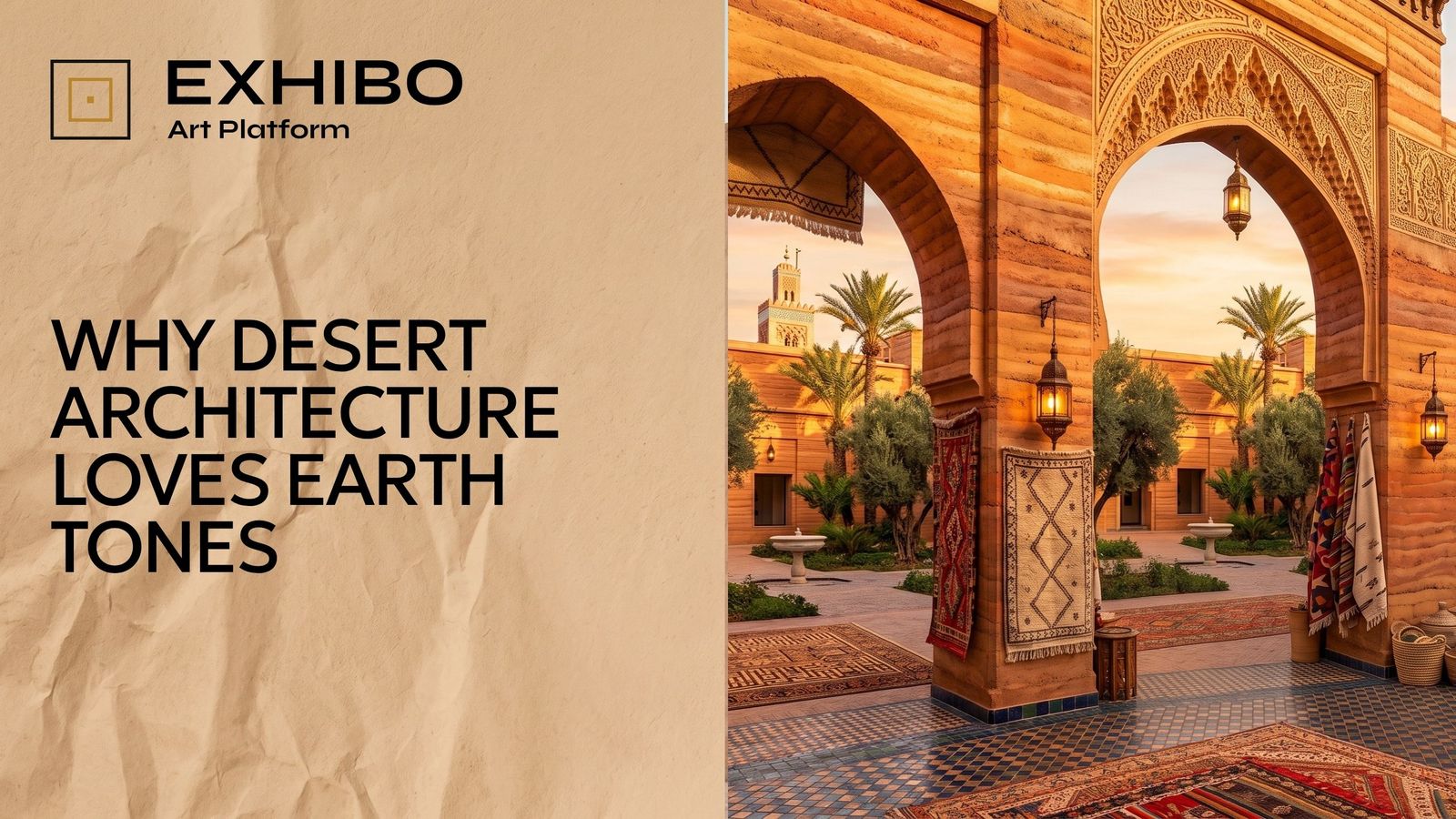
March, on the Haouz plain outside Marrakech, and the ground you are standing on is the same colour as the city you just left. Not a similar colour. The same one. The medina walls, the ramparts around the old town, the new villas going up along the road to the Atlas foothills — all of them carry the exact reddish-brown of the dirt under your feet, because for most of Marrakech's history that dirt was not a metaphor for the buildings. It was the buildings, dug up, dampened, packed into wooden forms and left to dry.
That is the thing worth noticing before anything else. In most cities, colour is something you apply. Here it was something you excavated.
The story you have probably heard about desert architecture and its warm palette is a story about taste — that architects reach for ochre and terracotta and sand because those tones feel right in the desert, because they harmonize, because a glass tower would be an insult to the dunes and a burnt-sienna wall is a kind of good manners. There is something to that. But it puts the cart a long way in front of the horse. The earth tones came first, for reasons that had nothing to do with taste, and the taste grew up around them afterward — which is the more interesting story, and the one that turns out to explain what is happening right now across the deserts of the world, as architects try to reproduce a colour their new materials no longer contain by default.
Let's start with why the earth is coloured at all.
The colour is iron, and the iron is everywhere
Dig into soil almost anywhere and the colour you turn up is, chemically, rust. The pigment in ochre, in terracotta, in the red clay of the Haouz is iron-bearing minerals — chiefly goethite and hematite, the same family of compounds that forms on a neglected bicycle, painted instead across whole landscapes. And the specific shade is a matter of chemistry you can almost read off the wall. Yellow ochre gets its colour from goethite, a hydrated iron oxide — iron bound up with water. Red ochre gets its deeper tone from hematite, the same iron without the water. Heat the yellow in a fire and you drive the water off; the goethite dehydrates into hematite and the pigment shifts from gold to red in front of you. That is the whole trick behind "burnt" sienna and "burnt" umber. The fire does the chemistry.
Which means a desert builder was never really choosing a colour. They were choosing a place to dig, and the colour came with the ground — a particular ratio of iron and water and clay and whatever else the local geology had folded in over a few million years.
And here is the detail that matters most, the one that separates earth colour from every other kind. A red ochre from Morocco is not the same red as a red ochre from France, which is not the same as a red ochre from America — they differ in their trace minerals and clay composition — and even two seams in the same quarry differ. The colour is a signature of a specific hill. When people say a building is "rooted in place," they usually mean it as a compliment about style. In earthen architecture it is closer to a geological fact. The wall is the place, relocated a few metres and stood upright — and holding onto that image is worth it, because everything that follows is a slow drift away from it.
So before this becomes a story about aesthetics, it is a story about three deserts that each solved the same problem with the ground they happened to be standing on.
Three deserts, three techniques, one colour source
Go to Marrakech and the technique is rammed earth — pisé, or tabia in Arabic — damp iron-rich clay from the Haouz plains and the Tensift valley, compacted layer by layer inside timber formwork until the frames come off and leave a wall. The red is not a finish. It is the material all the way through. The Almohads built the ramparts this way in the twelfth century, and the reason the whole medina reads as one warm mass is that much of the building earth came from the Haouz plain immediately around the city — one source, one colour.
Go to Shibam, in Yemen's Wadi Hadramaut, and the technique is different and the colour source is the same. The town people call the "Manhattan of the desert" stacks mud-brick tower houses five to eleven storeys high, walls thinning as they rise so the upper floors don't crush the lower ones. But look closely and Shibam quietly complicates the postcard of the monochrome earthen town. The tower walls are plastered in brown earth, with a lighter lime on the upper storeys, and a whiter plaster used for decoration — the roof parapets are often whitewashed. The body of the town is the colour of its ground; the crown is something paler. Even here, where the material is humble and local, the palette is a composition, not an accident.
And go to Diriyah, on the edge of Riyadh, and the technique is adobe — air-dried mud brick in the Najdi style, the tradition that built At-Turaif, the mud-brick citadel where the Saudi state began and now a UNESCO World Heritage site. The colour there is described, again and again, as golden — the tone of the surrounding desert, echoed back. Three regions, three construction methods, one common fact underneath: the buildings are the colour of the dirt because they are made of the dirt.
None of this required a decision about colour. Which raises a question that turns out to have a surprisingly loaded answer: what happens when a city decides it wants to keep the colour, on purpose?
The one place with a colour rule — and where it came from
In the first of these pieces, about the white cities of the Gulf, the surprise was that there was no law — no code anywhere requiring the whitewash, only habit and symbolism doing the work that people assumed a rule was doing. Marrakech is the mirror image. Here there really is a colour rule, and its origins are more tangled than the tourist version admits.
The tourist version says simply that "a decree" fixed the red. The fuller version runs through the French Protectorate of 1912 to 1956 and its chief planner, Henri Prost, working under Resident-General Hubert Lyautey. Prost's planning system — zoning, medina preservation, façade control, architectural review — institutionalised rather than invented the city's colour identity: the red already existed, produced honestly by pisé, and the Protectorate apparatus made its continuation a rule, deciding how a Moroccan city ought to appear and then requiring it. Later Moroccan planning law kept the palette uniform as concrete replaced pisé, which is why new villas still arrive in the same reddish plaster today.
I want to be careful here, because it would be easy to make this sound cynical, and it isn't quite. The clay under Marrakech really is red; the pisé tradition really did produce the colour honestly for centuries before any planner wrote it down. What the Protectorate added — and what Moroccan authorities later maintained — was the insistence that the colour continue even after the material that produced it began to disappear. That is the pivot the whole subject turns on. The moment the wall stops being made of the local earth, the earth tone becomes a thing you have to choose to reproduce. And reproduction is a different act from excavation, with its own trade-offs.
Which is exactly the problem the best architects working in these deserts right now have decided to take seriously.
Reproducing a colour that used to come free
Modern architecture reverses the relationship the old wall depended on. Instead of moving the place into the building, it moves the appearance of the place onto the building — and the interesting question is how honestly it does so.
Start with the awkward bit the earth-tone camp rarely mentions: judged by reflectance alone, earth tones are the wrong choice, since a dark earthen surface absorbs far more sunlight than a whitewashed one. And yet the earthen wall works — because what cools it was never the colour but the mass. A thick rammed-earth or adobe wall has such thermal inertia that the day's heat arrives inside long after sunset, once the desert night has turned cold. The colour and the cooling are the same fact seen twice: both come from a deep wall of local soil. You cannot have the tone, in the honest version, without the mass that makes the tone worth having — which is precisely what a thin modern skin cannot supply.
So contemporary building reproduces the tone by other means, and those means run from the frankly cosmetic to the genuinely tectonic. At the cosmetic end, a reinforced-concrete frame does the structure, insulation does the thermal work, and a thin rain-screen of local limestone is hung on the outside for colour and texture. The stone is real; that isn't the point. It reproduces the appearance of a Najdi wall without reproducing the construction that once produced it.
At the tectonic end, architects from Hassan Fathy onward have insisted the colour stay bound to the wall rather than coating it — rammed earth whose tone runs through the full thickness, sometimes pigmented, but pigmented all the way through. A good deal of ambitious work is now built this way. Snøhetta folded two thousand square metres of rammed earth into the Ithra cultural centre in the Eastern Province; Adjaye Associates used it for a pavilion at King Salman Park in Riyadh; the Rome studio Schiattarella Associati built the walls of Diriyah Art Futures in rich rammed earth, its director explicit about wanting a contemporary Saudi idiom that avoided pastiche.
There's an honest wrinkle in even this good-faith revival, and the same RIBA reporting names it: rammed earth, with its distinctive striations, is not actually traditional to Saudi Arabia — adobe is. The technique is being imported partly because it reads as earthen and sustainable; the Saudi building code had no reference for it, so early plans for tall load-bearing walls had to be revised. The past being returned to is a slightly invented one — the right spirit, a different method. Which doesn't make it dishonest. It makes it a choice, worth seeing clearly rather than dissolving into a story about timeless desert wisdom.
The most literal version is happening at the old capital itself, where Zaha Hadid Architects have Asaan Museum under construction in adobe made predominantly of the site's own clay, the studio's first adobe building anywhere. The wall will be close to the colour of Diriyah because it is made, in large part, of Diriyah. Twelve hundred years after At-Turaif, the oldest technique in the region turns out to be the one with the least distance between the ground and the colour.
The colour you dig, versus the colour you order
To see how far the colour has travelled from the ground, follow the pigment itself.
For most of history, an earth colour was quarried. In central Morocco, ochre is still dug from seams in the High Atlas near Midelt, calcined on site in a wood-fired oven and ground into the pigment that tints tadelakt, the polished lime plaster of Moroccan interiors. That is the unbroken version of the chain: a specific hill, a specific red, brushed onto a specific wall a few valleys away.
Then, in the 1780s, a man named Jean-Étienne Astier stood in front of the ochre cliffs of Roussillon, in Provence, and worked out how to industrialize them — washing the clay, settling out the sand, drying and cutting and grinding the pure pigment into a product. Provençal ochre went global; by 1929 the region was pulling forty thousand tonnes a year out of the ground and shipping it across the world. And then, through the mid-twentieth century, it collapsed — undercut by synthetic iron oxides made in a factory, cleaner and stronger and cheaper than any hillside. The quarries closed one by one.
That synthetic pigment is what tints most "earth-toned" buildings now. It is, chemically, the same iron oxide — often more vivid than the natural version, precisely because it lacks the impurities that a real hillside folds in. And that is the quiet loss hiding inside the gain: the synthetic red is arguably a better red. It is just a red from nowhere — no seam, no valley, no signature of place.
The colour survived. The place it came from did not.
What the earth tone was really saying
There's a temptation, at this point, to make the earthen wall into a moral — to say the old way was honest and the new way is fake, and leave it there. The architects who have thought about this longest don't, and it's worth ending where they do.
Hassan Fathy, glimpsed a few paragraphs ago, made the argument most fully. The Egyptian architect spent the mid-twentieth century insisting that mud brick was not poverty but intelligence. In Architecture for the Poor, his account of building the village of New Gourna near Luxor, Fathy argued that we should "subject technology and science to the economy" of ordinary people rather than the reverse — and he taught the villagers to make the bricks themselves, so that the colour of their houses was the colour of earth their own hands had mixed. It is the shortest possible distance between a place and its buildings. It is also worth saying that New Gourna was, by Fathy's own assessment, a partial failure — the residents resisted the move, much of the plan went unbuilt, and critics have argued ever since about how far his vision ever reached the people it was for. The honest earthen wall is an ideal. Ideals are hard to inhabit.
What survives, and what the current desert architects are chasing, is the idea underneath. When Lina Ghotmeh describes her rammed-earth dwelling for AlUla as a "living landscape," meant "not to dominate but to host," with a colour palette drawn to blend into its setting, she is reaching for Fathy's continuity in a contemporary register. And when the architects of the Banyan Tree resort at AlUla describe their own earthen palette as a way to camouflage the development into the desert, they say the quiet part out loud: at the luxury end, the earth tone is partly a way of making a large intervention disappear into a landscape it is also, unavoidably, changing.
So why does desert architecture love earth tones? Because for most of its history it had no choice — the colour was a free by-product of building with the only material to hand, the local iron-rich ground, which happened also to be the material that held the heat at bay. The love came later, once the tone had come loose from the wall and someone had to decide whether to keep it.
And that decision is the whole of contemporary desert architecture in miniature. You can hang the colour on a concrete frame and call it heritage. You can ram it through the full thickness of a wall and mean it. You can dig it, still, out of the ground it belongs to. In a photograph the three are indistinguishable.
Stand again on the Haouz plain, though, with the red dirt on your hands and the red city on the horizon, and the difference is the only thing that matters. One wall is made of a place. The other only remembers one.
Galleries mentioned
Museums mentioned
Exhibitions mentioned
Related reading
Where Is Agrabah? The City Disney Assembled From Real Places
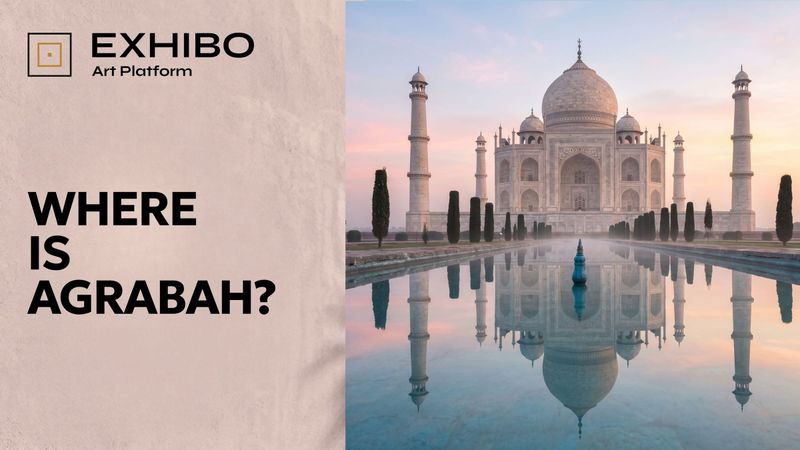
Agrabah was going to be Baghdad. A war made it fictional — and then Disney built it back out of real places, from a tomb in Agra to a valley in Jordan that usually plays Mars.
The Sultan's palace where Princess Jasmine feels trapped has the silhouette of the Taj Mahal — which is not a palace at all, but a tomb. That is how Agrabah works. Disney's fairy-tale city was going to be Baghdad, until the Gulf War made the name impossible; the studio invented a place that could not be found on a map, then quietly rebuilt it out of real ones — Isfahan and Agra, Marrakesh and Mandalay, a Jordanian desert that has played both Arabia and Mars.
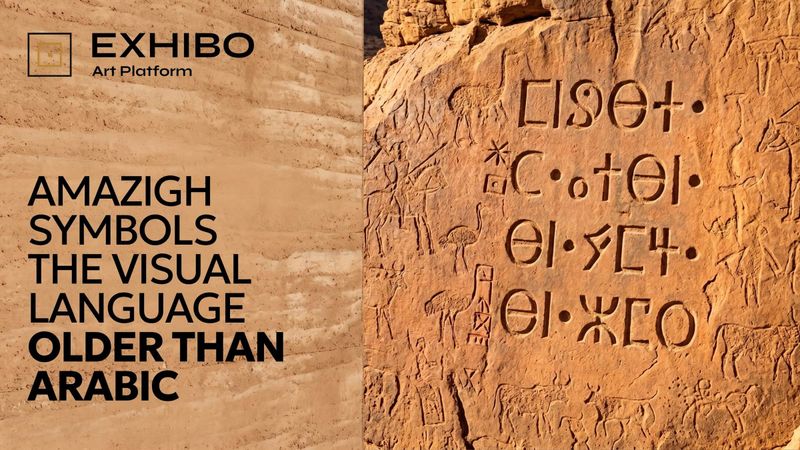
The Visual Language Older Than Arabic
How one of North Africa's oldest writing traditions survived conquest, colonial classification and the loss of its readers — and why, for much of it, we still cannot say what the marks mean.
A flat rock in southern Morocco is covered in a script you can see is writing and still cannot read a word of. It belongs to the Amazigh — a visual language older in North Africa than the Arabic alphabet, carried onto skin and wool and silver, nearly erased, and now reassembled into an alphabet on ministry walls. This is the story of what survived, what didn't, and why almost everything we "know" these signs mean was added later.
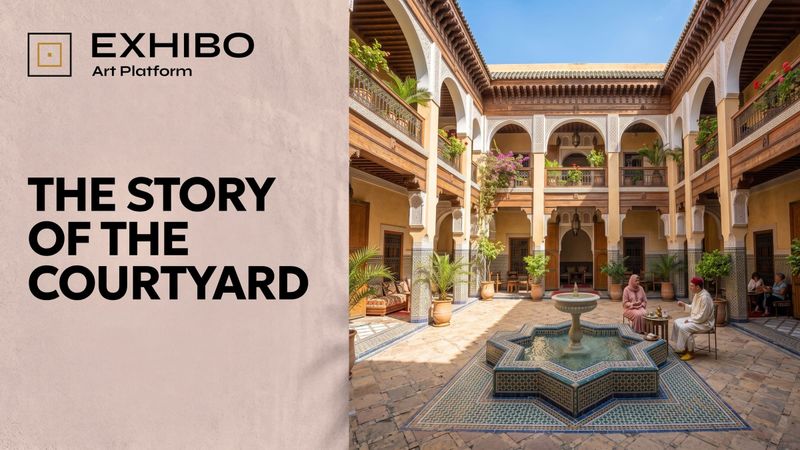
Why North African Cities Turn Inward: The Story of the Courtyard
A courtyard plan far older than Islam turned North African houses — and the medinas built from them — to face inward. Climate and religion only half-explain why, and what finally displaced the courtyard says the rest.
The blank walls and inward courtyards of Fez, Tunis, Algiers and Cairo are usually explained by heat or religion. Both are true; neither is the whole story. The clue is in what eventually pushed the courtyard out of the modern city.