
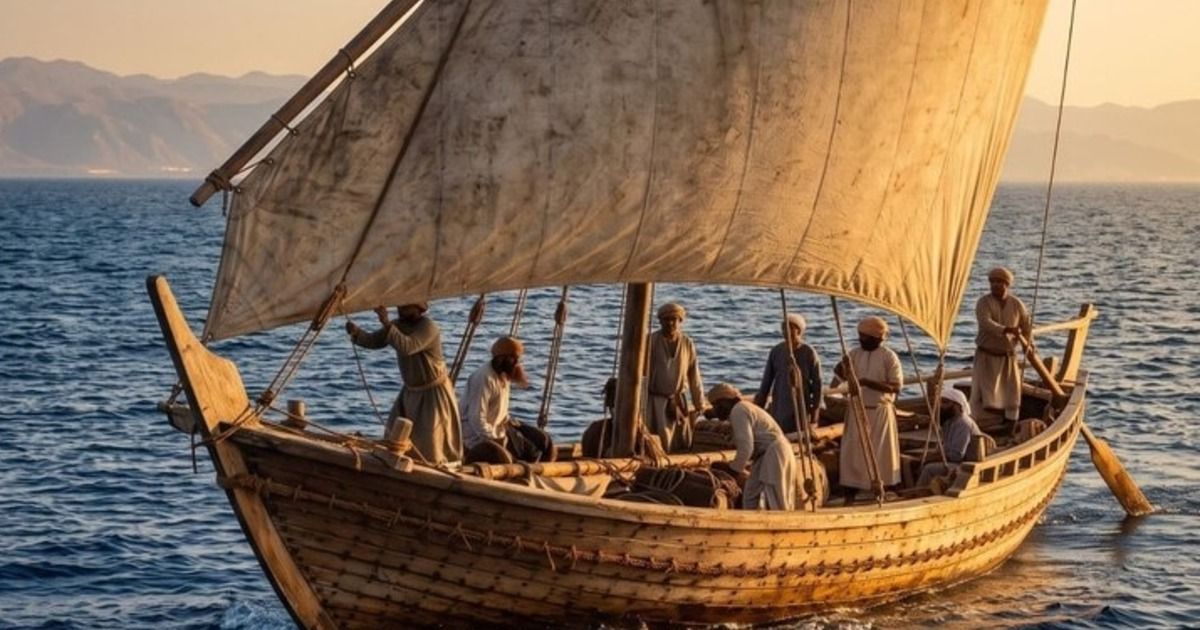
Muscat · Oman
Sinbad and the Real Trade Routes of Oman and Basra
A ninth-century ship sewn together without nails, a hold of Chinese porcelain, and the sailors’ yarns of Basra, Siraf and Sohar: the real sea behind the fantasy.
In 1998, off Belitung, a small island in the Java Sea between Sumatra and Borneo, a group of Indonesian fishermen were diving for sea cucumbers when they found a mound on the seabed about three feet high. It was made of bowls. Hundreds of them, crusted with coral, many still whole, stacked the way someone had packed them more than a thousand years earlier. Beneath the bowls lay the outline of a ship — and when the archaeologists who followed looked closely at its timbers, they found something no local boat had: the planks were not nailed, not pegged, not dowelled. They were sewn together with rope.

A Changsha bowl from the Belitung wreck, China, Tang dynasty, 9th century. Cincinnati Art Museum. Photo: Daderot, CC0, via Wikimedia Commons
The cargo, once it came up, ran to roughly sixty thousand objects. Some fifty-five thousand of them were bowls from the kilns of Changsha in southern China, packed in big Guangdong storage jars — as many as 130 bowls to a jar, coiled in a spiral and padded with straw. There were more than thirty pieces of Tang gold and silver. One of the plain Changsha bowls carried a date scratched into its clay near the foot, partly illegible, ending in a phrase that corresponds on the Chinese calendar to a single summer day in 826: the sixteenth day of the seventh month of the second year of the Baoli reign. The ship itself, the Smithsonian would later note, was the only vessel of Arab origin then known from Southeast Asian waters — a western Indian Ocean hull, probably built on the Arabian Peninsula, carrying a hold full of Chinese porcelain when it went down. Where exactly it was going, and where it had stopped on the way, the wreck itself cannot say. One curator who has studied the cargo suggests it may have put in at Java, to trade some of its ceramics for the nutmeg and cloves of the Moluccas, which weighed little and sold for a fortune further west — a reasonable hypothesis, not a finding.
Now open a children's book of The Arabian Nights, turn to the sailor who leaves Basra seven times and comes home rich seven times, and look at the ship in the picture. It has the wrong rigging and the wrong century and, usually, nails. But the world around it is the same world. The sea it crosses is the same sea, the kind of cargo is the same kind of cargo, and so is the danger.
Sinbad is the one great hero of the Nights whose fantasy sits on top of a world we can actually dig up. Archaeology does not prove his voyages. It makes them legible.
Some of the most famous tales in the Nights turn out, when you pull at them, to have been finished in Paris. Sinbad turns out to have a shipwreck.
The porter at the gate
The story begins not at sea but in a Baghdad street, on a hot day, with a man who has nothing to do with ships.
He is a porter, carrying a heavy load through the city, and he stops to rest on a bench outside a rich merchant's house. The air coming through the gate is cool and smells of food and perfume; there is music inside. The porter, tired and resentful, says out loud what anyone in his position might think — that God gives some men everything and others nothing, that this rich man has never carried a load in his life. A servant appears and invites him in. The master of the house wants to meet him. And the master, it turns out, has the same name: he is Sindbad too. Sindbad of the sea, al-Baḥrī, has overheard Sindbad the porter, al-Ḥammāl, and instead of throwing him out he sits him down, feeds him, and says, in effect: you think this was given to me. Let me tell you what it cost.
Then come the seven voyages, one each evening, and at the end of each the sailor gives the porter a hundred pieces of gold and tells him to come back tomorrow.
It is worth pausing on that frame, because it is easy to skip on the way to the giant bird. The voyages are not presented as adventures for their own sake. They are an answer to a complaint about inequality. Every shipwreck, every island that turns out to be a whale, every valley full of serpents, is entered into the accounts: this is what the house cost, this is what the music cost. The rich man is rich because he kept going back to sea after the sea had tried, six times, to kill him. Whether that answers the porter's complaint is another matter. The story lets him keep the gold and does not ask.
The tale also has a history unlike its famous neighbours. Aladdin and Ali Baba, as this series has shown, have no Arabic text older than their French one. Sinbad has an Arabic life of his own, and it predates his membership in the Nights entirely. Antoine Galland had already finished translating The Adventures of Sindbad the Sailor from an Arabic manuscript by the spring of 1701 — three years before the first volumes of his Mille et une nuits — and only then did Syrian friends in Paris tell him that these voyages belonged to a much larger collection called The Thousand and One Nights. He never found a manuscript of the Nights that contained Sinbad. He slotted his earlier translation in anyway. The oldest known independent Arabic version of the voyages was copied in Aleppo in 1672, with a Latin translation written between the lines, and it carries no trace of Scheherazade at all. That is the date of a copy, not of the story, which was certainly older. Later Arabic editions of the Nights, in the Egyptian branch of the tradition, took the voyages in. But for most of his life Sinbad sailed alone.
That independence matters for what follows. Sinbad was not invented to fill a gap in a French book. He was a story people were already telling in Arabic, about a kind of man they already knew.
What the captains told each other
You can hear that man talking in two books written in the ninth and tenth centuries by people who actually sailed.
The first is a slim compilation known as Akhbār al-Ṣīn wa-l-Hind — Accounts of China and India. Its first part was put together around 851 by an unknown merchant-mariner; its second was added some fifty years later by Abū Zayd al-Sīrāfī, a seafarer from the Persian port of Siraf who moved to Basra in 915–16. It is not a story collection. It is closer to a briefing: how the sea route runs, which islands have water, what the kings of India are like, how the Chinese run their ports. It contains, as its modern translator's publisher puts it, the first foreign descriptions of tea and porcelain — two things that would go on to remake the world's tables — set down in Arabic, in passing, among notes on monsoons and cannibal islands. The same publisher describes the whole world it records as the real-life background to the Sinbad tales.
The engine of that world was the wind. The Arabic word for a season, mawsim, travelled through Portuguese into English as "monsoon": the great system of seasonal winds that pushed ships east across the Indian Ocean for half the year and back west for the other half. You did not sail when you liked. You sailed when the wind said you could, and if you missed it you waited months. At one end of the system lay Siraf, in the Gulf. At the other lay Khānfū, the Arabic name for Guangzhou, home to a large community of foreign merchants. Between the two lay months of open water, a string of islands and anchorages, and — as George Hourani's history of the trade lays out — a whole working culture of lighthouses, piracy, pilots and port directories that the stories mostly leave offstage.
Read the Accounts for the goods alone and the hold of a ninth-century ship assembles itself on the page. Porcelain and silk from China, and the leaves of a drink nobody west of it had yet tasted. Musk from the deer of Tibet, carried down to the coast. Gems from Sri Lanka. Aromatic woods and spices from India and the islands beyond it. Ivory, skins and gold coming up the other way, from East Africa, to be sold on in the Gulf. Bowls by the tens of thousands, a few objects of gold for someone very rich. And around all of it the ordinary marvels of the route, noted with the same flat attention as the prices: flying fish, holy men, islands where the people were said to eat strangers. It is the same inventory Sinbad brings home in the stories — diamonds, sandalwood, spices, bales with his own name on them — except that here nobody had to tie himself to a giant bird to get it. They paid in years at sea instead.
The second book is louder, stranger and much more fun. Kitāb ʿAjāʾib al-Hind — The Book of the Wonders of India — was compiled around 953 and is attributed to a ship's captain, Buzurg ibn Shahriyār, from the town of Rāmhurmuz in what is now southwestern Iran. It holds 136 tales, twenty-nine of them dated to particular years between 900 and 953, gathered from captains, shipowners and sailors in Siraf, in Oman and elsewhere. It is not a transcript of harbour talk but a literary collection, shaped and arranged, in which observation, rumour and invention sit side by side. Here are cannibal islands in the Bay of Bengal, a giant bird called the rukh, diamonds in a Kashmiri valley, sea creatures no one ashore would believe in, tragedies at sea and voyages of fantastic profit, set down among the names of real captains and real ports, from the Gulf to China and the coast of East Africa. One of the scholars who has studied it quotes a line that could stand over the whole collection: All us captains, when we board a ship, stake our lives and destiny on it.
It is the genre the Arabic tradition called ʿajāʾib — marvels — and it is meant to entertain. One modern introduction to it calls it, fondly, good ward-room talk. But the marvels sit among place names, sailing times, prices and the names of real ports, and the captains tell them the way sailors have always told things: as true, more or less, and better with each telling. Read Buzurg next to Sinbad and the family resemblance is impossible to miss. The scholars who compare them still argue about who borrowed from whom, and whether the debt runs through books, through spoken stories, or both. My own guess, and it is only a guess, is that both grew from the same harbour talk.
There is even a twist worthy of this series. Nothing outside the book confirms that Captain Buzurg ever existed, and some scholars suspect he is a literary persona — a convenient captain to hang the yarns on. One researcher, Jean-Charles Ducène, has gone further and proposed a different compiler altogether: a scholar from Siraf named Abū ʿImrān Mūsā ibn Rabāḥ, working in Cairo later in the tenth century. The question of who made the book is still open. But if the captain was a mask, the most "real" source behind Sinbad has its own fictional narrator. It does not change what the book records. It only proves, again, that in this world the line between a logbook and a tale was never sharp.
In the captains' books the marvellous and the merely true share a page. They sailed, they traded, they came home and talked — and it is in talk like that, I suspect, that Sinbad was born.
Three ports
Sinbad leaves from Basra, voyage after voyage. He buys goods in Baghdad, goes down the river to Basra, and takes ship. That detail is not decoration. For most of the Abbasid centuries Basra really was the caliphate's door to the sea.
Basra
The city began in the 630s as an army camp on reedy salt marsh in southern Iraq, and grew into one of the great cities of the early Islamic world. Its outport, al-Ubulla, sat on the waterway that the Tigris and Euphrates form before they reach the Gulf, and it was a hub for trade with India, East Africa and the Gulf ports. Basra was a city of grammarians and merchants, of the satirist al-Jāḥiẓ and of shipowners — and, a little later, of al-Ḥarīrī (1054–1122), a Basran whose name probably means "silk merchant" and whose Maqāmāt, a book of fifty witty, virtuosic tales about a silver-tongued rogue, became one of the most admired works of Arabic prose. Hold on to al-Ḥarīrī. He comes back, with a ship.
Siraf
If Basra was the door, Siraf was the dock. On the Iranian shore of the Gulf, south of Shiraz, Siraf was in the ninth and tenth centuries the terminus of the China trade on the western side — the place where ships from Khānfū unloaded and where the great shipowners lived. Between 1966 and 1973, the British archaeologist David Whitehouse excavated it for the British Institute of Persian Studies and found a Sasanian port beneath the Islamic one, with mosques, bazaars, merchants' houses and a vast haul of Chinese and Islamic pottery, glass and inscriptions. Through Siraf, as one archaeologist summed it up, passed the silks and porcelains of China, the spices and aromatic woods of India and Indonesia, and the ivory, skins and gold of East Africa.

Ruins at Siraf, on the Iranian shore of the Gulf, 2007. Photo: saeed dehghani, CC BY-SA 4.0 via Wikimedia Commons

Then, in 977, an earthquake struck. The tenth-century geographer al-Muqaddasī reports that afterwards many of Siraf's merchants moved their business elsewhere, some to Sohar on the Omani coast. The earthquake was a blow rather than a full stop — the port's decline was a longer process than any single disaster — but Siraf never recovered its old place. Today a modern village has grown over the site, and the houses Whitehouse dug out stand surrounded by new ones. If you want an image of how a trading world disappears, it is that: not a ruin in the desert but a town built on top of a town, people hanging washing over the merchants' floors.
Sohar
Sohar, on Oman's Batinah coast, was called in ninth-century Arabic sources — by al-Ṭabarī, al-Balādhurī, al-Muqaddasī — the "gateway to China." It sat exactly where it needed to: between the ocean routes to India and China and the markets of Iraq, Iran and Egypt, the three heartlands of the early Islamic world. Buzurg's captains told their stories there.

Sohar Fort, 2019. Photo: Vilphy Pulickan, CC BY 2.0 via Wikimedia Commons

In Oman, Sohar also has a claim the archaeology cannot settle and does not need to. Many Omanis hold that Sinbad himself was born there. When a British expedition built a replica of a medieval ship in Oman in 1980, it was named Sohar for exactly that reason — after the town where, as its builders put it, Sinbad was born. It is the kind of belief that is less a historical statement than a civic one: this coast sent ships to China; of course the greatest sailor in the stories was one of ours. Nothing in the record contradicts the spirit of it.
Ships without nails
Go back to the Belitung wreck and its sewn planks, because they explain more than one mystery.
For more than a thousand years — and in some places much longer — the ships of the western Indian Ocean were built by sewing. Shipwrights shaped the planks, bored rows of holes along their edges, and stitched them together with cord made from coir, the fibre of coconut husks. The hull was built first, as a shell, and the frames were fitted afterwards, because you cannot sew a plank where a frame is in the way. Every hole was then plugged with coconut fibre, primed with fish oil and sealed with a putty of lime and rendered goat fat. The technique is described in Greek texts of antiquity — the first-century Periplus of the Erythraean Sea mentions sewn boats in these waters — and it survives in Oman to this day, as the maritime archaeologists who have rebuilt such ships there have documented.
Why sew a ship when you could nail it? Outsiders spent a long time trying to answer that, and the attempts are a small comedy of confident wrongness.
The oldest answer was a myth. Somewhere in the eastern seas, sailors said, there were rocks — or a whole mountain — of lodestone, and any ship fastened with iron that came too close would have its nails torn out and fall to pieces. The Nights uses this mountain in another tale, where a ship disintegrates beneath its passengers; the motif ran through Indian, Greek and Arabic writing for centuries. It was a story that explained a ship.
The Byzantine historian Procopius, writing in the sixth century, was having none of it. In his History of the Wars he notes that the boats of India and that sea are not built like other ships, and dismisses the popular explanation: Roman vessels sailing from Aila into that sea are full of iron, he points out, and nothing of the sort has ever happened to them. Then he offers his own reason — that the Indians and Ethiopians simply had no iron — which was also wrong. The tenth-century geographer al-Masʿūdī tried a scientific explanation: seawater in the Indian Ocean, he thought, corroded iron nails and made them soft. Other travellers — Ibn Jubayr, al-Idrīsī, Ibn Baṭṭūṭa — noticed something closer to the truth: that sewn hulls were pliant, and less likely than rigid nailed ones to break apart when a ship ran onto a reef or a sandbar in the shallow, treacherous waters of the Gulf and the Red Sea.
The historian George Hourani, whose Arab Seafaring in the Indian Ocean remains, in its publisher's words, an account that has never been superseded, summed up the whole long argument in a sentence: it is not that iron was not available. The sewing was a choice, not a deficiency. A pliant hull had its advantages on a coast of reefs and sandbars, but the choice rested just as much on materials that were everywhere, on skills passed from one generation of shipwrights to the next, and on a tradition that worked. Hourani connects their long decline with the way European commerce reshaped the Indian Ocean in later centuries; it was a slow and uneven change, and the craft never vanished entirely.
So one of the most famous marvels of the eastern seas — the mountain that pulls ships apart — turns out to be a story invented to explain an engineering decision by people who did not understand it. Sinbad's sea is full of things like that. The fantastic is often just the practical, seen from outside.
A mountain of magnets, a lack of iron, corrosive seawater: three confident explanations, none of them right. The shipwrights had reasons of their own, and in Oman they are still sewing.
The marvels, one by one
Once you know the world Sinbad sails in, his wonders stop looking like pure invention and start looking like what they probably were — the real dangers, goods and rumours of a trade, carried home in a form people would want to repeat.
The island that is a whale. On the first voyage, the crew land on a small green island, light a fire to cook, and the island wakes up and dives. The story is very old and very widely shared: Britannica points to the giant whales of the Indian Ocean described by the Roman writers Pliny and Solinus, and the same island-that-is-a-whale turns up in the medieval Irish voyage of St Brendan. Every ocean seems to have produced it.
The rukh. On the second voyage Sinbad, marooned, finds a gleaming white dome on an island and walks all the way round it without finding a door. It is an egg. When the parent bird comes back, it blots out the sun; Sinbad ties himself to its leg with his turban and is carried off. On the fifth voyage, sailors smash a rukh's egg and the parents return with boulders in their claws and sink the ship. The bird appears in Buzurg's tales of the tenth century, and it is often compared with the great mythical birds of Persian and Arabic tradition, the Simurgh and the ʿAnqāʾ. Marco Polo, at the end of the thirteenth century, placed it near Madagascar. In the nineteenth century, when European naturalists began receiving the enormous eggs of Madagascar's extinct elephant bird, Aepyornis — eggs that held, by different estimates, between eight and thirteen litres — writers decided they had found the rukh. It is a lovely idea and a disputed one: the legend is older than Europeans' knowledge of the bones, and Polo never went to Madagascar. But one detail makes it hard to let go of. A 2021 radiocarbon study suggested the last elephant birds died out between about 800 and 1050 — a window that overlaps the centuries when Buzurg's captains were telling their stories. It is a coincidence of dates, not evidence that any sailor ever saw one.
The valley of diamonds. Also on the second voyage, Sinbad finds himself in a valley carpeted with diamonds and crawling with serpents. Merchants throw raw meat down from the cliffs; the diamonds stick to it; eagles carry it up to their nests, where the merchants collect the stones — and Sinbad escapes strapped under a joint of meat. It is one of the oldest stories in the collection. Versions of it appear, Britannica notes, in St Epiphanius, the fourth-century bishop of Salamis in Cyprus, in the thirteenth-century Persian geographer al-Qazwīnī, and in Marco Polo; Buzurg has his own diamonds in a Kashmiri valley. It reads like a trader's explanation for why diamonds were scarce, costly and always came from somewhere you could not go — which, in a sense, it was.
The cannibal islands. On the fourth voyage Sinbad's companions are fed by islanders on a herb that dulls their minds and fattens them for eating; he alone refuses and escapes. Buzurg describes islands in the Bay of Bengal — he names one Andaman al-Kabīr, "Great Andaman" — whose people were said to eat strangers. The Accounts of China and India mentions them too. The fear was real and the shore was dangerous; the story built on them says more about the sailors than about the islanders.
The giant who eats men. The one-eyed man-eater of the third voyage, blinded with heated spits, is Homer's Polyphemus — a marvel that came not from the sea but from books, a Greek story that had found a new ship to ride.
Serendib. On the sixth voyage Sinbad reaches Sri Lanka, whose king sends him home with gifts and a letter for the caliph Hārūn al-Rashīd. The Accounts of China and India already knows the island for its gems: the soberest of the marvels, and the most accurate.
None of this means the marvels can be "solved" one by one into facts. That would miss the point as badly as reading them as pure fantasy. They are what a trade sounds like when it is turned into stories — the dangers enlarged, the profits gilded, the unknown filled in with things that might be true. Sinbad's genius is that he keeps all of it: the whale and the price of pepper, the rukh and the letter to the caliph, in the same breath.
What else the ships carried
There is a reason the sailor gives the porter gold at the end of each evening and does not dwell on what happened to the rest of the crew. Sinbad survives every voyage. Almost no one else does. The book is honest about that in its own way — whole crews drown, are eaten, are crushed by boulders — and it is worth being honest about the real trade too, because it was not a postcard.
The ships could disappear entirely. The men who loaded fifty-five thousand Changsha bowls into the Belitung ship never came home; the wreck is a cargo manifest and a grave at once. Piracy was a constant threat on the route east. And the ports at both ends of the trade were exposed to catastrophes no amount of seamanship could prevent.
At the eastern end, Abū Zayd tells of what happened to Khānfū in 878–79, when the rebel Huang Chao took the city during the uprising that was tearing Tang China apart. He reports that the rebels killed the foreign merchants there — Muslims, Christians and Jews among them — and gives a figure of 120,000 dead. Chinese records do not confirm his number, and his dating does not match theirs, so it is best read as what it was: the account that reached the Gulf, filtered through grief and distance, of a disaster that, by his account, disrupted the direct voyages to China. His own translator notes that publicity for the China route could hardly have been worse.
At the western end, the trouble was closer to home, and it was built into the trade itself. The ships that carried porcelain and pepper also carried people. The medieval chroniclers describe how, in the marshlands around Basra, wealthy landowners set great numbers of labourers to the brutal work of scraping away the salt-crusted topsoil to make the land farmable. Many were enslaved, and many were of African origin, brought through the Indian Ocean and by other routes. The sources call them the Zanj — though who exactly that word covered, and where the people it named came from, historians still debate. In September 869 a revolt broke out, led by a man called ʿAlī ibn Muḥammad, who was not himself enslaved and who promised the workers freedom and wealth; as it spread, local peasants and Bedouin joined it too. For fourteen years they fought the caliphate in the marshes, where its armies could not easily follow. They took al-Ubulla in 870. In September 871 they took Basra, and the city was sacked and burned. The revolt was finally crushed in 883.
For centuries the chroniclers' version stood: the rebellion ruined Basra's economy and left its farmland abandoned. Archaeology is now complicating that. In 2025 a team from Durham, Newcastle, Radboud, Al-Qadisiyah and Basra universities published in Antiquity the first dates for the thousands of earthen ridges and canals that still scar the floodplain of the Shatt al-Arab — the landscape traditionally linked to Zanj labour. Using a technique that measures when buried sediment last saw sunlight, they found the system was in use from the late ninth century to the middle of the thirteenth. The dates, taken from a sample of the features, do not fit the old picture of farmland abandoned for good: the rebellion did not end the system, and labour-intensive farming went on for centuries afterwards. They do not show that the revolt did little damage, and they cannot say who did that work in later centuries, or under what conditions. The written sources describe the labourers of the ninth century; the soil dates the fields; the people in between remain unnamed.
None of this is a reason to read Sinbad differently in some crude, accusatory way. Basra's history is far larger than its worst decade. But it is a reason not to treat the trade behind the tales as a sunlit adventure. The door Sinbad sails out of was also a door through which people were brought in bondage. The gold he hands the porter came from the same sea.
There is a modern postscript, too, and it concerns the Belitung wreck itself. The cargo was recovered not by a scientific excavation but by a commercial salvage company, legally under the Indonesian law then in force — which is not the same as meeting the professional standards of archaeology — and bought by Singapore in 2005; it is now on display there. When the Smithsonian prepared to show it in Washington, archaeologists and scientists protested that commercial salvage had stripped the wreck of most of its scientific value, and in December 2011 the institution cancelled the exhibition. A 2001 UNESCO convention says that underwater cultural heritage should not be traded as commercial goods. The ship that proves Sinbad's world was real became, in our own century, an argument about who gets to own the sea's memory — and how much of it is lost in the getting.
Sewing the stories back together
In the late 1970s a British writer and explorer named Tim Severin, who had already crossed the Atlantic in a leather boat to test the medieval legend of St Brendan — a story that has its own island that turns out to be a whale — decided to find out whether Sinbad's voyages were possible. "Once the figure of Sinbad appeared in my mind," he told a reporter, "that has totally dominated me." He spent three years in research and then brought the project to Oman, where the government, with the approval of Sultan Qaboos bin Said, offered to sponsor it.
The ship was built at Sur, on Oman's eastern coast, by Omani shipwrights working in the old way: hand-sawn planks, sewn together with several hundred miles of hand-rolled coconut cord, without a single nail. She was a replica of a medieval Arab trading ship, and she was named Sohar, for the town said to be Sinbad's birthplace. The departure was timed by the wind, as it would have been a thousand years earlier; there was, the reporters covering it were told, an old saying on that coast that only a madman or a Christian sails against the monsoon. She left Sur on 21 November 1980 with a crew of about two dozen, Omani sailors among them, and some eight months and six thousand miles later reached Canton — Guangzhou, Khānfū, the far end of the old route.
She is back in Oman now. If you drive past the Al Bustan roundabout in Muscat, opposite the parliament buildings, you will see her: a wooden dhow beached in the middle of the roundabout, a ship that crossed the Indian Ocean now steered around by traffic. She has also become something more than a monument. The Sohar is regularly invoked in diplomacy between Oman and China as a symbol of a connection more than a thousand years old.

Tim Severin's sewn ship Sohar at the Al Bustan roundabout, Muscat, 2012. Photo: Joe Castleman, CC BY-SA 3.0 via Wikimedia Commons

Thirty years later Oman did it again, this time with an archaeological blueprint. The Belitung wreck, for all the damage done in its recovery, preserved enough of its hull for specialists to work out its shape and how it was sewn. In 2008, in Oman, shipwrights began building a full reconstruction of it, a hull of about the original's size, roughly 58 feet long, stitched plank by plank with coir. They called her Jewel of Muscat. She sailed from Muscat on 16 February 2010 and docked in Singapore on 3 July, retracing the sea road in stages, and the Sultanate presented her to the government and people of Singapore — a ship returned, in a sense, to the part of the world where her original went down.

The Jewel of Muscat, built at Qantab on the model of the Belitung wreck, in the Maritime Experiential Museum, Singapore. Photo: Jacklee, CC BY-SA 3.0 via Wikimedia Commons

And then Oman built a ship out of a painting.
In 1237, probably in Baghdad, a calligrapher and painter named Yaḥyā al-Wāsiṭī copied and illustrated a manuscript of al-Ḥarīrī's Maqāmāt — the book by the Basran silk merchant. It is now in the Bibliothèque nationale in Paris, it holds 99 miniatures — more than any other known copy of the work — and it is one of the treasures of Arab painting; this series has visited it before. Among its fifty tales is one known as the Omani maqāma, in which the rogue Abū Zayd and the narrator al-Ḥārith take ship for Oman, and al-Wāsiṭī illustrated it with four paintings. One of them shows a seagoing ship in remarkable detail: the stitching that joins the planks, a rudder at the stern, sailors at work, passengers looking out from below.

Abu Zayd and al-Harith at sea. Al-Wasiti, Maqamat of al-Hariri, Baghdad, 1237. Bibliothèque nationale de France, Arabe 5847. Public domain, via Wikimedia Commons
At Qantab, Omani shipwrights used that picture as a plan. The result, documented in the International Journal of Nautical Archaeology, is called the al-Hariri Boat. The archaeologists who recorded its construction even timed the sewing: about seven and a half minutes per stitching hole, using a single-wadding technique, against nearly thirteen minutes per hole for the more elaborate double-wadding of the Jewel of Muscat. A Basran wrote a voyage to Oman. A Baghdad painter drew the ship. Eight centuries later, in Oman, men timed themselves sewing it into existence.
Set the three Omani ships side by side and you can see the whole problem of rebuilding a vanished world. The Sohar of 1980 was built, as the archaeologists who later documented all three put it, on limited pictorial evidence — old drawings, informed guesses, the memory of living shipwrights. The Jewel of Muscat was built from the bones of a real wreck. The al-Hariri Boat was built from a painting. A guess, a body and a picture: between them, three different answers to the question of what Sinbad's ship actually looked like, and all three of them float.
The sea also left a manual. In the fifteenth century, long after Sinbad's world, the knowledge those sewn ships sailed by was written down by Aḥmad ibn Mājid, remembered as "the Lion of the Sea," born around 1432 in Julfar, a historic port on the coast of southeastern Arabia near present-day Ras al-Khaimah — long before the modern borders of Oman and the United Arab Emirates existed, which is why both countries claim him with pride. He came from a family of navigators and learned the sea first from his father's verses on it; "my father's poem," he wrote, "was more valuable to me than all the inheritance he left me." His Kitāb al-Fawāʾid, written around 1490, gathers the whole craft of Indian Ocean navigation: ports from East Africa to Indonesia, the stars and their risings, the monsoon calendar, the difference between hugging a coast and crossing open sea. Latitude was read from the height of the Pole Star, measured with a small wooden tablet on a knotted cord, the kamal. Popular legend says Ibn Mājid piloted Vasco da Gama from East Africa to India in 1498. Historians doubt it; the scholar G. R. Tibbetts thought the pilot was more likely a Gujarati. The legend persists because it is the right shape: the moment the old ocean's knowledge passed to the people who would end its world.
A painted ship from 1237, sailing to Oman in a story, was sewn into wood in Oman eight centuries later. The tales did not just remember the ships. They kept the instructions.
The next voyage
At Sohar, the archaeologists are back.
The University of Chicago's Institute for the Study of Ancient Cultures is running an excavation there planned for at least seven seasons, and its first job is to correct the record. Earlier digs in the 1980s showed that the town has a long and well-preserved archaeological history of trade. But their dating, it is now known, was off by more than two hundred years, and the trenches were tiny keyholes. The basic questions are open again: when Sohar was founded, when it began to grow as a port, when the trade that made it the gateway to China began to fade. The answers are in the ground, a layer at a time.
It is a strange, fitting place for this story to end — or not to end. In Basra, an island in the Shatt al-Arab still carries Sinbad's name, a riverside park that has had its good decades and its neglected ones. In Siraf, a village sits on top of the merchants' houses. In Singapore, sixty thousand pieces of a ninth-century cargo sit in a museum, the subject of an argument about who should have raised them. In Muscat, a sewn ship rests in a pond at a roundabout. And off the coast of Oman, the old tradition of stitching planks with coconut cord has been taught again to people who can now build from a shipwreck, or from a page painted in Baghdad.
Sinbad never quite ends his story either. Every evening he sends the porter home with a hundred pieces of gold and the same instruction: come back tomorrow, and I will tell you the next voyage. The porter comes back. The sea, it turns out, works the same way. Each season the diggers at Sohar return, and the ground gives them another layer, another date, another piece of a route that was real all along.
Come back tomorrow. There is another voyage.
Related reading
The Animal We Drew Everywhere Once It Was Gone
From Neolithic rock to airline tailfin — how the Arabian oryx vanished from the desert, came back from nine animals, and multiplied everywhere as a symbol in the very decades it was gone.

Hatta: The Valley That Changed Hands
Ninety minutes from Dubai, a mountain town where the same water has shaped human settlement for four thousand years.
Agatha Christie's Egypt: Three Abu Simbels, a Pharaoh and a Murder on the Nile
Christie set one famous murder on the Nile and two lesser-known stories in ancient Egypt. The temples, letters and film sets behind all three.