
Dubai · United Arab Emirates
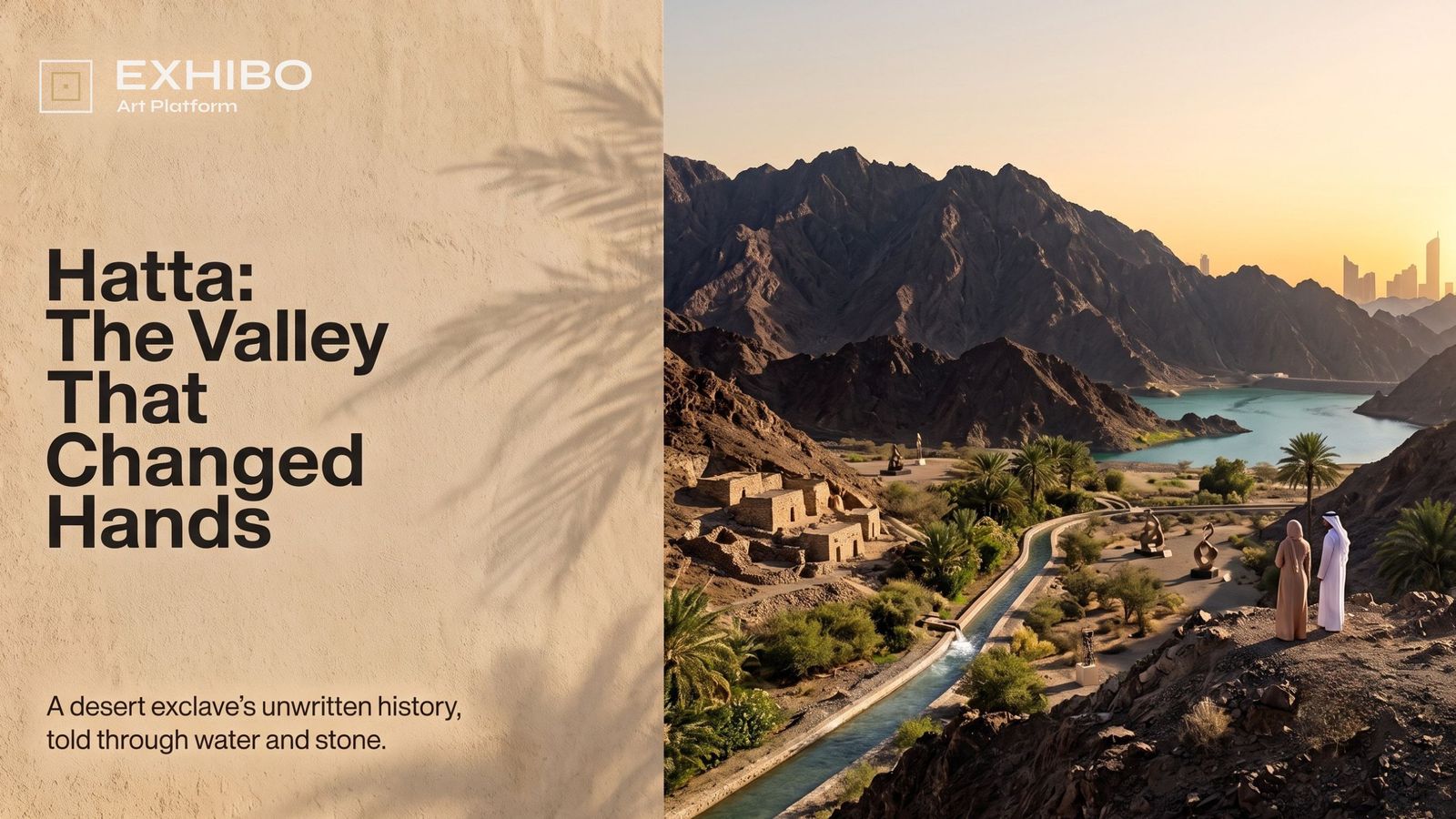
Hatta: The Valley That Changed Hands
Ninety minutes from Dubai, a mountain town where the same water has shaped human settlement for four thousand years.
Start with the rock, because the rock is the strangest thing here and few visitors ever realise it.
The mountains around Hatta are not ordinary mountains. They are the floor of a vanished ocean, lifted and turned on its side. Around 96 million years ago a slab of oceanic crust — and rock from the upper mantle beneath it, the layer that normally sits kilometres below the seabed, permanently out of reach — was shoved sideways and upward onto the edge of the Arabian continent. Geologists call the process obduction. They call the result the Semail ophiolite: the world's largest and best-preserved thrust sheet of oceanic crust and upper mantle, more than 10,000 square kilometres, roughly 550 km long and 150 km wide, emplaced onto the Arabian margin in the Late Cretaceous.
What this means, standing in a wadi outside Hatta with your hand on a warm boulder: you are touching rock that originated in the Earth's upper mantle. Ordinarily you would have to drill through the entire crust to reach material like this. Here it forms the skyline. The range runs 700 kilometres from the Dibba zone in the northern UAE down to the east coast of Oman, and the reason it exists is that a piece of seafloor got caught between two converging plates and had nowhere to go but up.
The rock is dark, iron-heavy and mostly barren, because mantle peridotite makes poor soil. Rain runs off it fast and hard. Which is the whole story of Hatta, in the end — everything that has happened here since is people working out what to do with water that arrives suddenly and then vanishes.
The Town That Was Given Away Because It Could Not Be Held
Most border stories are stories of taking. This one isn't.
Hatta was not conquered by Dubai and it was not bought. The long-standing explanation is that it was handed over by a ruler who had worked out that defending it cost more than holding it was worth — though, as we'll see, the record is thinner than that tidy sentence suggests. The old name of the settlement was Hajarain — "the two rocks," after the peaks that frame the valley, each one eventually crowned with a defensive tower built to protect the area. The name outlived the change of sovereignty by decades.
The primary evidence is worth quoting, because most of what circulates about Hatta is third-hand. John Gordon Lorimer compiled his Gazetteer of the Persian Gulf, Oman and Central Arabia for the British government in India, published in secret in 1908 and 1915 and declassified only in 1955. It remains, in the assessment of the archive that now holds it, the most important single source of historical material on the Gulf states. Writing on the principality of Dubai, Lorimer records that Hatta recognises him as overlord; but the origin of the connection is exceptional, and the place must be regarded as an isolated dependency, for there are villages nearer to Dibai Town which do not acknowledge the Shaikh's authority.
In 1908 a British officer surveying the coast found it noteworthy that Dubai controlled a village fifty miles inland across a mountain range while failing to control villages on its own doorstep. He called the arrangement exceptional, and the exception is the entire point.
In the same passage he lists the sheikh's only recognised subjects: the inhabitants of Dubai town, of Jumairah, and of Hajarain — the latter being merely a distant protectorate. Three places, one of them over the mountains.
The pressure came from the west. The Na'im, the dominant tribal confederation of the interior — the Gazetteer put them at roughly 13,000 — had settled Masfout, and Lorimer records repeated conflict between them and the people of Hajarain. The commonly repeated explanation is that a distant Omani sultan, weighing that threat across a roadless mountain range, judged a friendly neighbour holding the valley preferable to an enemy taking it. Nobody wrote the sultan's reasoning down; the motive is tradition rather than record. But the logic is legible.
The date is genuinely unsettled, and I would rather say so than pick one. Accounts variously place the transfer around 1850 and in the later nineteenth century — yet the sultan usually named in the story, Turki bin Said, ruled from 1871 to 1888, which cannot be reconciled with the earlier date. (For the fuller picture, Frauke Heard-Bey's From Trucial States to United Arab Emirates is the standard history.) What is certain is the situation Lorimer found by 1908: an isolated inland dependency, exceptional in origin, still going by its old name.
The tidy borders came much later, and British officials drew them. Before Britain withdrew in 1971 it delineated internal boundaries among the seven emirates to pre-empt disputes that might have stopped the federation forming at all, and the most complicated of these ran through the western Hajar Mountains, where five emirates contested jurisdiction over more than a dozen enclaves. Hatta is not a quirk but one entry in that catalogue: drive an hour in any direction and you cross into Ajman's mountain exclave, into Oman, into Ras Al Khaimah — a map that reads like spilled paint because it was drawn by tribal allegiance and then frozen by a departing empire in a hurry. Dubai's own administrative geography still registers the oddity: the exclave of Hatta is a community in Sector 8, an hour and a half from every other community in it.
Four Thousand Years of Burying People in the Same Places
This is the part almost nobody writes about, and it is the most remarkable thing in the valley.
On the slopes of Jabal al Yamh, above the wadi, there is a necropolis. In 2022 a team from the Sanisera Archaeological Institute, working with the Architectural Heritage and Antiquities Department of Dubai Municipality, published their findings in the Proceedings of the Seminar for Arabian Studies — peer-reviewed, not a press release. The site holds more than seventy tombs, telling of occupation of the Hatta valley since prehistoric times, with architecture representing styles associated with the Hafit, Umm an-Nar, Wadi Suq and Iron Age periods. Dubai Culture's own survey count runs higher: 84 tombs scattered beneath the mountain slopes, of which around 29 have so far been restored, with a conservation plan in progress for the remainder. The finds include pottery and soft stone vessels, decorated shells, copper rings, carnelian, faience, stone and glass beads.
Four named cultures, spanning roughly 2500 to 1300 BC in the official dating. And underneath the chronology, the excavation found two things.
First: the dead were placed by water. Interpretation through GIS allowed the team to establish parameters showing a preference for certain features of the landscape that were always associated with water, and the tombs share a common orientation with the hydrological network of the wadi. They are not scattered where digging was easiest. They track where the water runs. Across two millennia and four distinct cultures — different pottery, different burial architecture, different everything — the same rule about where a grave goes.
Second, and this is the remarkable part: from human remains dated by their biological apatite, the team confirmed that these tombs were reused over millennia until the twelfth century AD, perhaps indicating the importance of such monuments for the inhabitants of the region even in such relatively recent times.
The twelfth century AD. Someone in the medieval Islamic period carried their dead up that slope and, rather than begin again, returned to a chamber already thousands of years old.
You could read that as pragmatism — old ground, less digging. But a tomb that ancient is not convenient; it is chosen. The archaeologists describe it cautiously, as evidence of the continuing importance of the site, and stop there, because that is what the evidence will bear. Whether the continuity was practical, symbolic, ancestral, or all three at once is something the archaeology alone cannot settle. What it can show is the fact of return: that people kept coming back to the same slope, for the same purpose, across a span longer than most countries have existed.
The record doesn't stop in prehistory. Dubai's heritage register also lists sites dating to the late Islamic era, from the seventeenth to the early nineteenth century: the Suhaila archaeological sites, several villages sharing similar architectural elements and building methods, and Hatta's "Islamic Village," a group of houses and a mosque on a high hill, characterised by support walls and retaining walls.
Villages on hills, held up by retaining walls, because the flat ground was for growing things. The same logic as the tombs, inverted: the living took the slopes the water didn't want.
The Falaj: An Engineering System That Is Really a Social Contract
Now the thing that made settlement possible.
A falaj (plural aflaj) is a gravity-fed water tunnel. You find the water table in higher ground, sink a mother well to it, then drive a tunnel back toward the settlement at a gradient shallow enough that water flows but does not scour the channel. No pumps. No power. An extremely well-judged slope and a great deal of digging in the dark.
Hatta has seven of them. The town's tourism campaign counts seven massive underground aflaj built to streamline the flow of underground water, alongside three old mosques — Al Hail, Al Wali, and Al Sharia, the last built more than two centuries ago.
One falaj you can walk into. It draws fresh water from the mountains into the heart of the village, supplying homes and date farms; the accessible section drops about fourteen metres underground and runs for something over a kilometre, water ankle-deep, bats overhead. It sits in a shaded palm grove behind the heritage village. The channel in its present form dates to the 1800s, though the technology is far older in the region — archaeological evidence suggests irrigation systems existed in this extremely arid area as early as 2500 BC.
Here is where plumbing becomes culture.
The Arabic root of falaj means "to split." The term refers to the system of splitting and distributing water flow. The word is not about the tunnel. It is about the division.
Because water in a falaj runs continuously under gravity, it never stops — so it must be allocated by time rather than volume. Households own shares measured in minutes. Water-time shares owned by many people are less than thirty minutes, so there is usually a need to time the distribution. Shares are inherited, sold, subdivided, disputed. In some systems the units become almost absurdly fine — one study records share units of 9.36 seconds and 0.26 seconds, the smallest relevant only to inheritance law.
Fractions of a second, written into a will.
And before wristwatches, how do you time a thirty-minute share at three in the morning? You use the sky. In Oman, stars by night and the sun by day were once widely used to time the distribution of irrigation water within the falaj system; when wristwatches became widely available in the late 1960s, many communities abandoned the traditional methods. By day the instrument was public: an iron rod set at an exposed location, its shadow falling across stone markers laid in rows on the ground, each marker indicating an individual share.
A shadow crossing a stone, and that is your family's water.
The practice is nearly gone — today many settlements still use sundials, but stars are used in only about eight places, and the fieldwork that documented them was, in its author's own framing, recording a rapidly dying art. But the system survives because it works, and because it does something no pump can: it makes a village mutually dependent. Nobody can hoard a falaj. The water passes through everyone's land in sequence. Maintenance is collective or the tunnel collapses on all of you. UNESCO's citation for the Omani aflaj — Hatta's are not on that list, but the engineering and the customs belong to the same tradition — puts it in terms worth borrowing: such systems reflect the former total dependence of communities on this irrigation and a time-honoured, fair and effective management and sharing of water resources, underpinned by mutual dependence and communal values.
Walk the tunnel, then think about the tombs. Bronze Age burials sited by hydrology; a nineteenth-century tunnel chasing the same water; the same valley, the same aquifer, the same problem solved again. Every era in Hatta is another answer to one question, and the question is always: where does the water go, and whose turn is it?
What Was Actually Restored, and How Carefully
Hatta's built heritage is small, old, and — unusually — documented with real conservation discipline.
The dates are firm. The Juma Mosque was built in 1780. Two watchtowers date from the 1880s, one on each of the two rocks that named the place. Hatta Fort went up in 1896, constructed on the order of Sheikh Maktoum bin Hasher Al Maktoum, with a watchtower approximately eleven metres high.
The heritage village opened on 6 February 2001. Contemporary reporting from the opening gives founding figures that have drifted in later retellings: more than two square kilometres, twenty restored structures around 150 years old, at a cost of fifteen million dirhams, with the governor's fort, old houses, a traditional restaurant, date palm products and the grand mosque among the things visitors could see. The national cultural register now counts around 38 structures built using traditional materials — clay, palm fronds and stone, so the site has grown since.
The mosque restoration was carried out to a stated professional standard, and the language in the project record is the language of conservation rather than tourism. Dubai Municipality, helped by the local community, carried out the project to conserve Hatta's traditional architecture and urban setup; the aim was to conserve its traditional character and ensure authenticity through respecting the international standards of restoration, using traditional building materials and adopting local techniques, with minimum interventions applied.
Helped by the local community. Minimum interventions. Not marketing phrases — the terms conservators use when they mean it.
There is more of this than the village. A separate municipal project has been developing the Al Sheraa heritage area in the centre of town, home to a 200-year-old mosque and one of the most important archaeological sites in Dubai and the UAE, phased so that fencing, lighting and pedestrian paving come first and access follows.
A Hydroelectric Plant in a Desert With No River
Then the thing that should not exist.
Hatta hosts a 250 MW pumped-storage hydroelectric plant, the first of its kind on the Arabian Peninsula. The physics are elegant and faintly absurd: solar power from Dubai's desert array is used, during off-peak hours, to pump water uphill from the existing Hatta Dam into a purpose-built upper reservoir. When the city needs power, the water comes back down.
The figures: a production capacity of 250 megawatts, storage of up to 1,500 megawatt-hours, an operational lifespan of up to 80 years, and total investment of approximately AED 1.42 billion, with the upper reservoir holding around 5.3 million cubic metres. Water falls through a 1.2-kilometre subterranean tunnel to spin the turbines, and electricity can reach the grid within 90 seconds of being called for. Round-trip efficiency is 78.9 per cent, and the upper dam required a 72-metre main wall and a 37-metre side dam. Engineering studies ran with France's EDF Group under a AED 58 million consultancy contract awarded in 2017; construction went to ANDRITZ Hydro in consortium with civil works partners STRABAG and ÖZKAR. By late 2024 the plant was 94.15 per cent complete; trial operations have since generated more than 17,900 megawatt-hours.
Ninety seconds. A valley where households once owned water by the half-hour now holds a reservoir that answers a city's demand faster than you can read this paragraph.
I don't want to over-tidy the parallel, but it is hard to miss. The falaj moved water by gravity because no other force was available. The plant moves water by gravity because gravity turns out to be the cheapest battery anyone has invented. Same valley, same rainfall, same trick, four orders of magnitude apart.
Water explains the bees, too.
The same rainfall that the tombs were sited by and the falaj was dug to catch also makes the higher wadis around Hatta greener than the coast — and green enough, in a country that is mostly not, to support the valley's most unexpected industry. Manea Al Kaabi runs a honey company based in Hatta and represented the UAE at the 2022 Smithsonian Folklife Festival. His account of how he started catches the whole thing:
He supplies the ecological reason it works here. Visitors are usually surprised, he notes, that this region has areas abundant in plants and herbs and valleys rich with rain, which make it suitable for bees and honey production. And the historical one: in the early days, Emiratis had to adapt to their arid environment with minimal resources and eventually learned to keep bees in harsh conditions.
The scale is not trivial. A dedicated bee garden in the valley runs more than 300 active hives among hundreds of indigenous Samar, Ghaf and Sidr trees across 16,000 square metres, and a separate conservation project has established a reserve near Hatta with more than 8,000 sidr trees.
There is a real sustainability argument under the charm, and it involves an uncomfortable practice. As one operator working on the problem describes it: a lot of bees are brought in. They are purchased outside of the UAE, in Egypt, for instance. It becomes a really commercial practice, where they bring the bees in for the season for maybe one month and then they let the bees die.
The economics driving that are brutal and worth stating plainly: imported bee species produce 10 to 20 kg of honey per hive annually, while the local species produces only one to two kg. A tenfold yield gap. Everything admirable about keeping native bees in Hatta is admirable against that number, which is also why local honey costs what it costs.
Households across the UAE can now sponsor a hive here, visiting a few times a year and receiving the honey; the scheme reported 113 families participating and 25 per cent growth in adoptions in one recent season. Each winter the town holds a honey festival with more than 50 indoor stalls for producers and beekeepers plus ten outdoor stalls for family-run businesses, free to enter. The first one was organised back in the first quarter of 2017, alongside an Emiratisation programme and scholarship.
A valley whose entire premise is scarce water turns out to be, by regional standards, lush. The bees worked that out before the tourism board did.
The Town Writing Itself Down
There is something happening in Hatta that turns out to be the most quietly significant thing in the valley, and it is not made of stone.
The place is documenting its own history, in the words of the people who lived it, before they are gone.
In 2021 Dubai Culture launched Faces of Hatta, a project to record the oral history and cultural heritage of Hatta, drawing from the oral narratives of people who have witnessed its evolution. The framing came from the head of the museums department: the documentation that will be done in Hatta is an important initiative to demonstrate how stories help create, foster and sustain communities. The stated scope is the history of Hatta, its lifestyle and stages of development before and after the establishment of the federation, captured on audio and video, rolled out in phases.
Before and after the federation. That is a specific and rather brave thing to set out to record — living memory of what a mountain village was like when it was a mountain village, held by people who then watched a country form around them.
There is a book, too, and its authorship matters. Hatta, a 286-page volume in eight chapters, was written by the Emirati writer and researcher Juma Khalifa bin Thalith and launched at the heritage village in the presence of the people of Hatta. Its contents are gloriously granular: historical, economic and social aspects of the region, its landmarks, the names of the villages within Hatta, the story of the first shop in Hatta, agricultural life.
The story of the first shop in Hatta. A whole chapter — precisely the kind of detail that vanishes first, and that no outside historian ever recovers.
The cultural programming follows the same instinct. The annual Hatta Cultural Nights at the heritage village are run, in the words of the acting director of Dubai Culture's heritage sites department, in close collaboration with the residents of Hatta, in a step aimed at supporting and attracting families and creative talent in the area, with a stated aim of spotlighting the culture of the mountainous environment in Hatta and the local expressions — folklore, Al Harbiya and Al Rababa performances, evenings of Nabati poetry.
An earlier heritage festival ran over 48 activities including exhibitions of traditional arts and crafts, dresses and wedding garments, and a poetry recitation event with well-known local Nabati poets.
Mountain-environment culture, local expressions, wedding garments, the first shop. This is a place taking its own particularity seriously rather than accepting a generic Emirati-heritage template. Given how much money is arriving, that instinct may prove more protective than any planning regulation.
What a Mountain Town Does When the Country Gets Rich
Hatta is being invested in heavily, and the shape of the investment is more interesting than the headline figures.
The first big announcement came in 2016: AED 1.3 billion. Read the order of its priorities, because it is not the order you would expect from a tourism scheme. Over the following two years, 400 homes for Emiratis were to be built, along with landscaping using local trees to improve air quality. Young people were encouraged to start businesses. Officials would work with archaeologists and restorers to preserve Hatta's heritage, restore its ruins and renovate farm homes to provide accommodation for visitors. Scholarships were part of the package.
Housing, education, entrepreneurship, archaeology — then tourism.
The Hatta Master Development Plan followed in October 2021, as part of the Dubai 2040 Urban Master Plan. Its aims include supporting projects initiated by Hatta residents and creating opportunities for locals in a way that stimulates tourism and encourages entrepreneurial activity, while also preserving the unique identity of the area, and addressing the housing needs of Emiratis over the next 20 years.
That clause about preserving identity is the interesting one. It only appears when somebody has identified a risk. Development plans do not usually promise to protect a place from themselves unless the authors know what could be lost.
The current programme — valued at AED 3.6 billion as of late 2025, and likely to keep growing — reads the same way. Alongside the tourist-facing pieces (a 610-metre amphitheatre at the dam, 120 km of planned cycling and scooter tracks, mountain-bike and hiking trails) sit the things a place builds for the people who live in it: a 44-classroom school with a 416-seat theatre, a 213-home Emirati neighbourhood, a majlis, and a 1,000-capacity wedding hall. A farming programme backs growers toward food and economic self-sufficiency, with hydroponic greenhouses and training space.
A 44-classroom school and a wedding hall for a thousand are not visitor infrastructure. They are what a town needs if the people who live there are meant to stay and raise families.
The clearest evidence that some of this lands: two brothers from Hatta, Khalifa and Ahmed Al Bedwawi, founded a company in 2018 manufacturing electric bikes for mountainous areas and rugged terrain, a project that has since expanded to international exports.
Two engineers from a mountain valley, building mountain bikes, shipping them abroad. If the 2016 scholarships-and-entrepreneurship plan was ever going to produce one emblematic result, that is what it would look like.
One gap worth naming. There is no published visitor data specific to Hatta — Dubai's tourism department reports emirate-wide figures only — and no independent research on how residents experience change at this scale. For a valley with a peer-reviewed archaeological literature, the silence on its living present is conspicuous. The Faces of Hatta recordings may eventually fill part of it, from the inside, which is arguably the better place to fill it from.
What It's Actually Like
The drive is about 134 km east of Dubai city, roughly 70 to 90 minutes from the airport. You leave the coast, cross a stretch of desert, and then the Hajar rises in front of you like a wall — dark, dry, unfriendly-looking rock, which you now know is the bottom of an ocean.
Worth correcting a figure that gets repeated everywhere: Hatta is often described as sitting at 1,100 metres. That refers to the peaks. The valley floor is far lower — the drainage system feeding it rises on the slopes of Um Alnosoor, at 1,280 metres, and falls a long way before it reaches the town. The altitude is real but modest, enough for a noticeable temperature drop, which is exactly why the place has long served as an escape from coastal heat.
What's here, in rough order of how much I think it repays attention:
The falaj tunnel. Fourteen metres down, a kilometre of passage, water at your ankles, bats. The only place in the valley where you experience the thing rather than look at it. Go here first.
The heritage village. Around 38 restored structures, the fort of 1896, the two towers, the mosque of 1780. Small enough to do properly in an hour.
Jabal al Yamh. The tombs. Underwhelming to look at, staggering to think about. Bring the chronology with you or it is just stones on a hillside.
The dam and the wadis. The reservoir is the postcard — turquoise against dark rock, kayaks on the water. It sits amid valleys, most notably Wadi Al Qahfi, and the rock pools further up the side wadis are quieter than the lake. Other named valleys worth the detour include Wadi Al Hattawi, Wadi Al Majarra and Wadi Jema.
The mountains. Trails, bike routes, and Jebel Umm Al Nusour, the highest natural point in Dubai. A cable car is planned to run 5.4 km from the dam to the summit, passing over the lake and the power station.
The bee garden. Open daily, tours through the afternoon, no booking needed, minimum age three.
One practical note that surprises people: Hatta sits inside UAE territory and no passport is needed if you stay within UAE boundaries — passports are only required if you cross into Oman. Given how tangled the borders are here, and that older routes did cross Omani land, check your route before setting off rather than assuming.
Coda: One Valley, One Question
Four moments, all within the same few square kilometres.
Around 2500 BC, someone carried a body up the slope of Jabal al Yamh and built a stone chamber for it, sited — as GIS analysis now shows — with reference to where the water ran.
Around AD 1150, someone carried another body up the same slope and placed it in that same chamber, by then three thousand years old, because it was still the right place.
In the 1800s, someone dug fourteen metres down and drove a tunnel a kilometre through rock at a gradient fine enough to keep water moving without tearing the channel apart. The village then split the flow into shares timed by the shadow of an iron rod falling across stones.
And in 2025, turbines beneath that valley began sending power to a city 134 kilometres away, ninety seconds after being asked, using sunlight to push the same rainwater back up the same mountain.
Mantle rock, tombs, tunnel, turbines. Nobody planned that sequence. It reads, in hindsight, as if a valley in dry mountains poses one problem above all others, and every generation that has lived here has answered it with whatever it had — stone, patience, a shadow on a marker, a solar farm ninety minutes away.
We can reconstruct that sequence only because enough of the record survived to read: a tomb dated by the apatite in its bones, a gradient still holding water, a British officer's note that an inland dependency was exceptional, a sundial's stone markers, a beekeeper's memory of his grandmother's sheep. Take any one of those away and a piece of the valley goes dark.
Which is the quiet argument underneath all of this, and it isn't really about Hatta. Places rarely disappear all at once. What disappears first is the account of them — the relationships, the routines, the stories that once made a place legible to everyone who lived there. The names of the villages. The story of the first shop. Hatta is unusual not because it has escaped that erosion, but because so much of its record has survived it — and because, lately, the town has begun writing the rest of it down itself.
Related reading
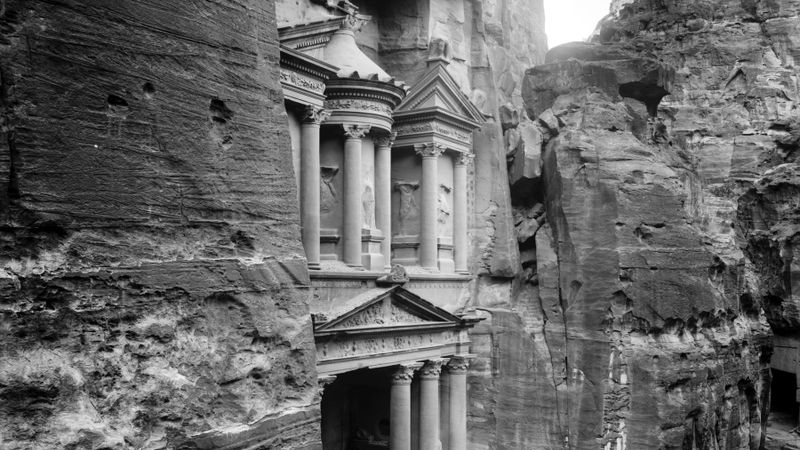
Filmed, but Not Recorded: The Arab World’s Missing Film Locations
Wikidata knows Gladiator was filmed in Morocco. It doesn’t know where.
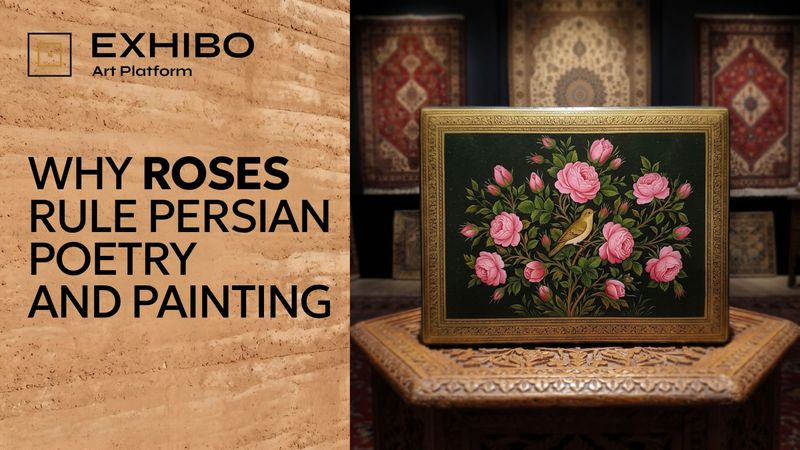
The Flower That Was Never Only Beautiful
The rose rules Persian poetry and painting — but under the sweetness sits a thorn, a bleeding bird, and a national emblem quietly assembled out of Chinese, European and Persian parts. A history of gol o bolbol, from a medieval still to a Dubai gallery.
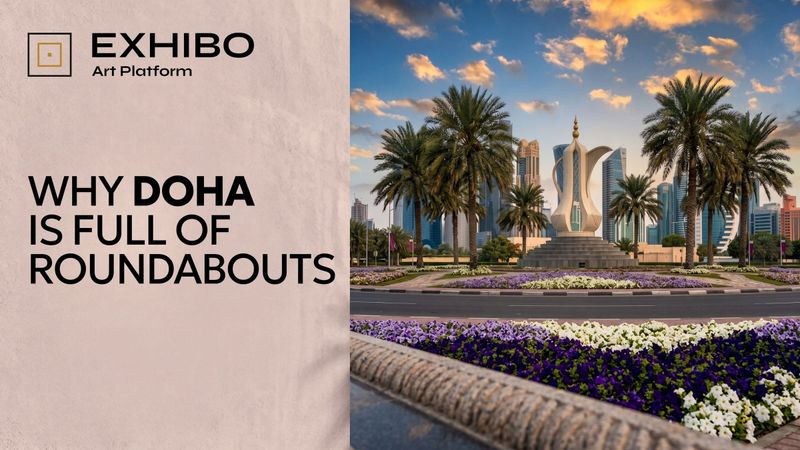
Why Doha Is Full of Roundabouts
An old circle at a crossroads, sharpened by British road engineering, became the way an Arabian city found its way and remembered itself — and it took the bulldozers to reveal it.