
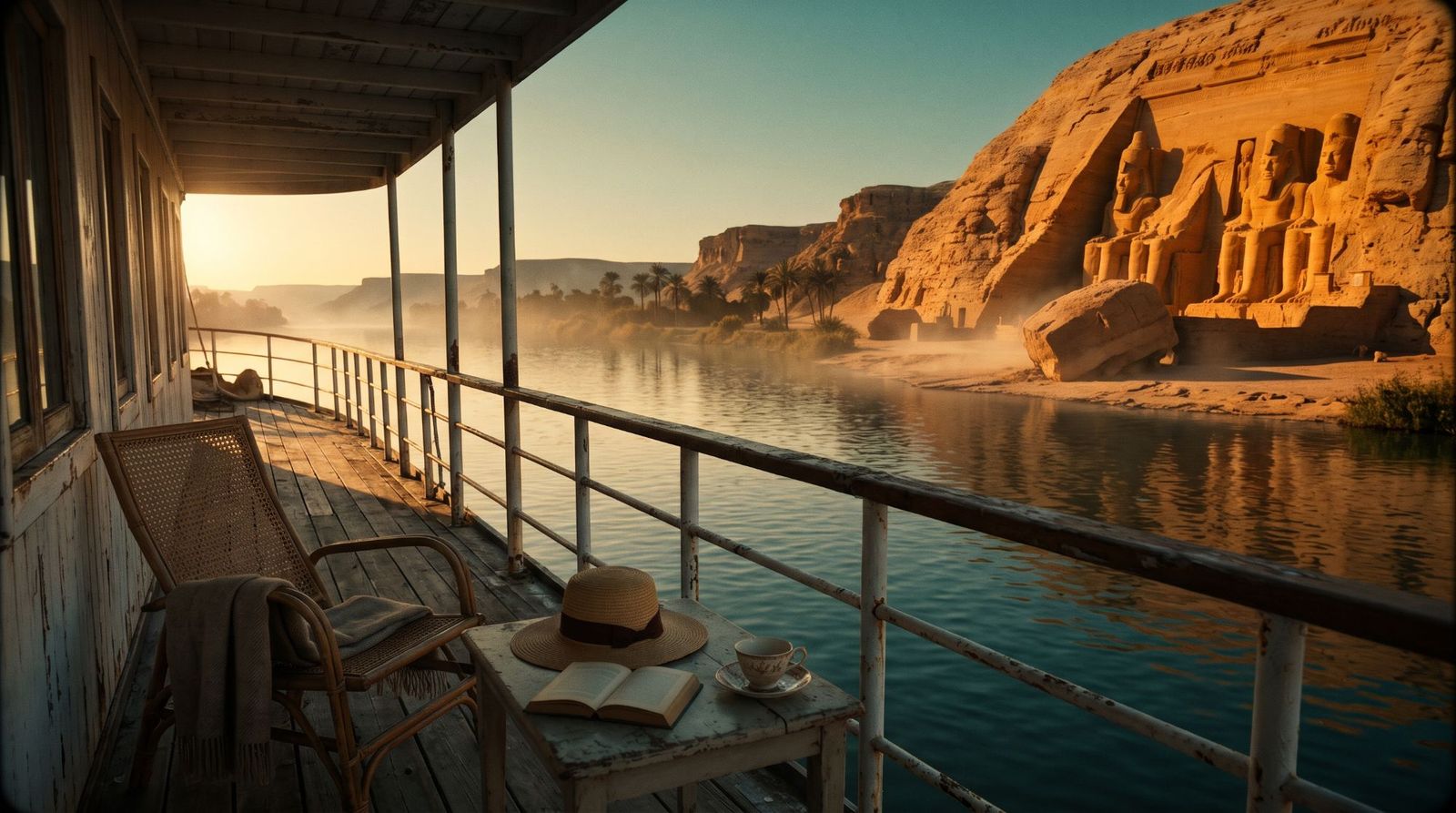
Aswan · Egypt
Agatha Christie's Egypt: Three Abu Simbels, a Pharaoh and a Murder on the Nile
Christie set one famous murder on the Nile and two lesser-known stories in ancient Egypt. The temples, letters and film sets behind all three.
Halfway through Death on the Nile, a boulder comes down the cliff at Abu Simbel. It misses Linnet Doyle by a few feet and smashes on the sand in front of the four giant statues of Ramesses II. Hercule Poirot, who has been watching the cliff, is not surprised. Someone on the steamer wants the richest girl in England dead.
Christie published the novel in 1937. The riverbank she described is now under a lake. So is the town where her steamer turned round. When the film versions came, one crew filmed Abu Simbel where it stands now and the other built it out of plaster in a field in Surrey.
That is one of Christie's Egypts: tourists, steamers, a murder among the rich. She wrote two more. One is a play about Akhenaten, the pharaoh who tried to remake Egypt's religion. The other is a novel built on a farmer's letters found in a tomb at Thebes. A journey, a state, a family. Each leads to real places and real objects, some of which are no longer where they were in her day.
A winter in Cairo
Christie first saw Egypt long before Poirot. As a young woman, in a winter before the First World War, Agatha Miller spent three months in Cairo with her mother at the Gezirah Palace Hotel. Biographers give different years for the trip, from 1907–08 to 1910–11. They agree more readily on how she spent it: dances, polo and young officers, with antiquities a long way down the list. Cairo gave her a first attempt at a novel, Snow Upon the Desert, a romance set in the city's winter society. Publishers turned it down and it was never printed.
The steamer to Wadi Halfa
The Egypt she came back to was different. In 1930 she married the archaeologist Max Mallowan and for the next three decades she spent long seasons on excavations in the Middle East. In 1933 the couple took a Nile cruise on the Sudan, an old Thomas Cook paddle steamer. That trip is generally taken as the start of Death on the Nile. The Sudan has since been restored and still carries passengers between Luxor and Aswan.
The novel follows the tourist route of the 1930s closely. The guests gather at the Cataract Hotel in Aswan, looking across the river at Elephantine Island and the gardens of Kitchener's Island. From there a train takes them a few miles south to Shellal, the river port above the old Aswan Dam, where the steamer Karnak waits for the trip through Nubia to Wadi Halfa and the Second Cataract. On the way it stops at Abu Simbel. That is where the boulder falls.
Aswan likes to say that Christie wrote the book on the terrace of the Old Cataract Hotel. It is a good story. The sources that tell it disagree about when she stayed there and what she wrote, so it is better taken as the hotel's legend than as a fact about the book.
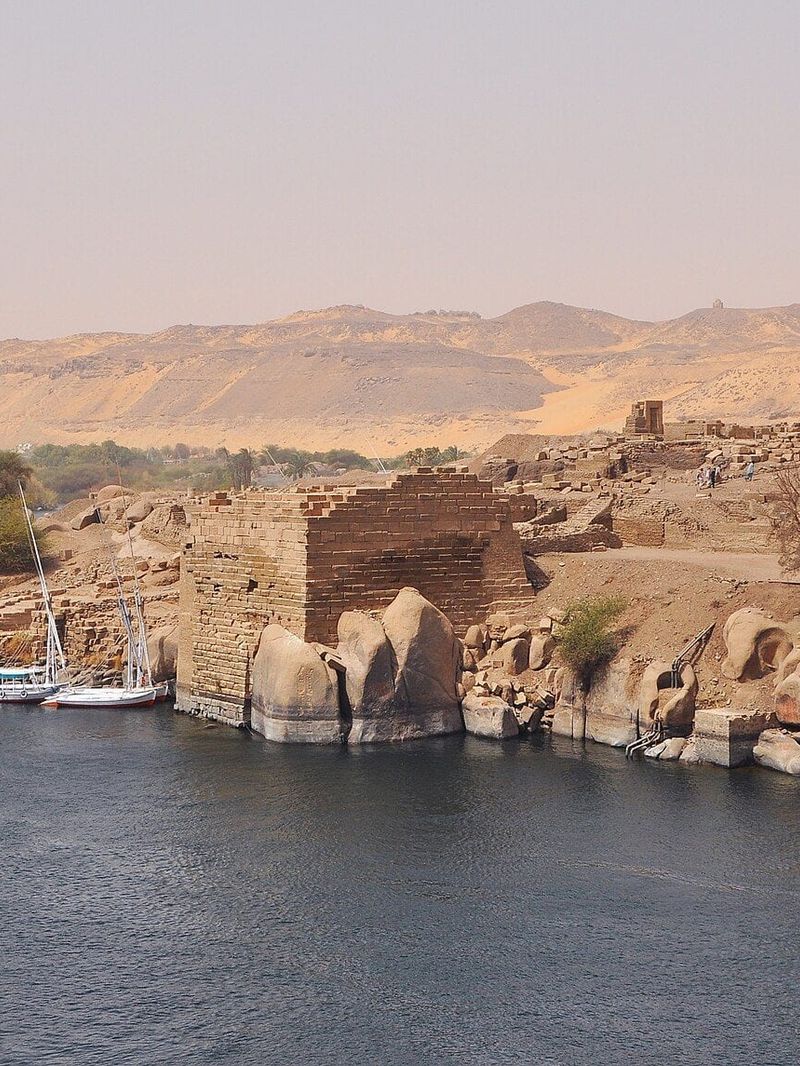
Elephantine Island
Ancient Abu at the First Cataract — temples of Khnum and Satet, a nilometer, Nubian villages and five thousand years of frontier history.
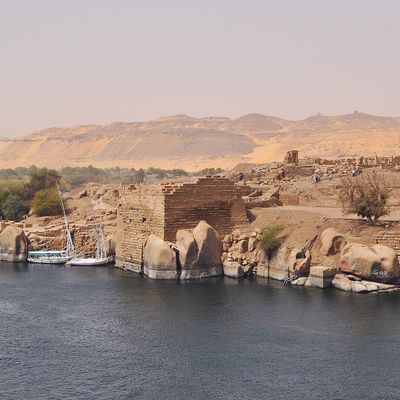
Elephantine is where Egypt used to end. Everything south of here was another country, another language, another trade route. The island was the customs post, the garrison and the temple all at once. It stayed all of these things for three thousand years. Walk through the excavations slowly. The ruins are layered like a cut cake, town on town on town. Then go down the nilometer stairs and look at the marks on the wall: this is where officials read the coming year's harvest in the height of the river. Finish in the Nubian village at the north end, among the painted doors. The frontier has moved. The island is still lived in.
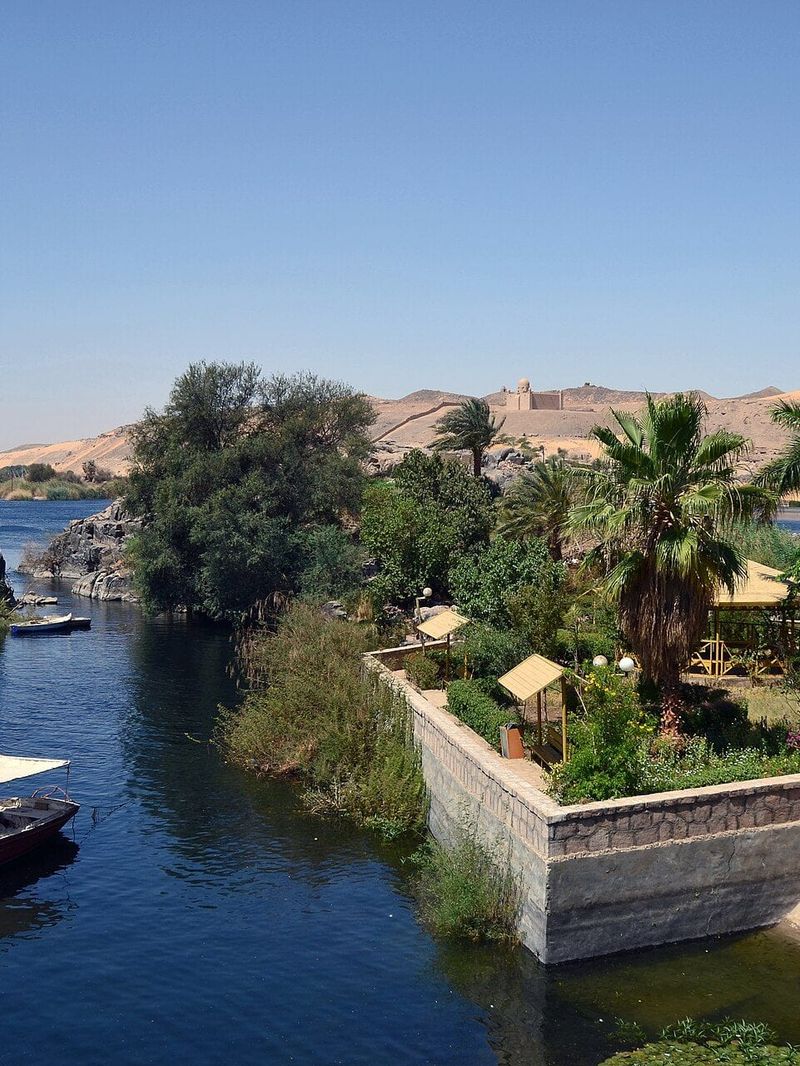
Aswan Botanical Garden (Kitchener's Island)
An island garden of exotic trees and plants in the middle of the Nile at Aswan, once owned by Lord Kitchener.
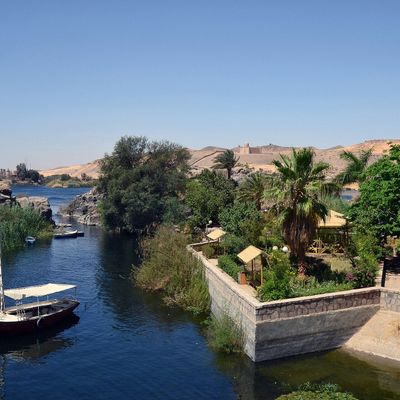
After a morning of granite, sand and heat, the island is pure relief. The boat noses into the landing, you walk under the first pergola and the temperature drops. Palms, figs, flowering trees, birds shouting in the branches, the river sliding past on both sides. It is a place to slow down, not to tick off. Kitchener built it as a hobby between military campaigns, which says something about the British in Egypt that no history book manages quite as neatly. Walk to the southern tip, find a bench in the shade and watch the feluccas tack between the islands. Then sail back at sunset.
Three Abu Simbels
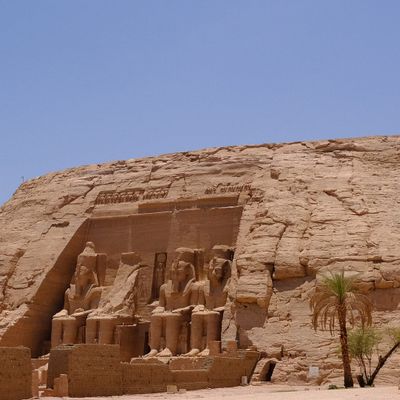
The Abu Simbel in the novel is the original one. The two temples of Ramesses II and Nefertari had been cut into a sandstone cliff on the west bank of the Nile around 1250 BC, facing the river. That is the setting her readers in 1937 were asked to picture: the river, the sand and the four seated kings under the cliff.
Thirty years later that landscape was going under. The Aswan High Dam was about to turn this stretch of Nubia into Lake Nasser. In 1960 UNESCO launched an international campaign to save the monuments of Nubia. Between 1964 and 1968 engineers cut the Abu Simbel temples into about 1,040 blocks of 20 to 30 tonnes each. They rebuilt them about 65 metres higher and 200 metres back from the old riverbank, inside an artificial hill. The temples were inaugurated on their new site on 22 September 1968.
The people of Nubia could not be moved as neatly. The new lake crossed the border, so two countries moved their Nubians separately. In Egypt, the villages of the flooded valley were resettled between 1963 and 1964 on newly reclaimed land near Kom Ombo, north of Aswan. In Sudan, old Wadi Halfa, where Christie's steamer turned round, disappeared under the water. Most of its people and those of the villages around it, about 50,000 in all, were taken by train to Khashm el-Girba in eastern Sudan, some 800 kilometres away, to a scheme later called New Halfa. A smaller new Wadi Halfa grew up on higher ground near the lake. The Nubian Museum in Aswan tells that story: the archaeology of Nubia, its living culture and the campaign that moved its temples. It is the best place to understand what the passengers of the Karnak were sailing through.
The other two Abu Simbels are on screen. They are the same monument seen twice more, once for real and once as a copy. The first is in John Guillermin's film of 1978, with Peter Ustinov as Poirot. According to accounts of the production, the crew spent about seven weeks in Egypt, four of them on board the Memnon, a historic paddle steamer playing the Karnak, with the rest at Aswan, Luxor, Abu Simbel and Cairo. By then Abu Simbel stood in its new place. The film also moved the boulder. In the novel it falls at Abu Simbel. In the film a block of stone is pushed off a column at Karnak and misses the couple by inches. Anyone who watches closely will notice the boat reaching Karnak, near Luxor, before Abu Simbel, hundreds of kilometres to the south. The script cared more about scenery than about the order of the river.
The second screen Abu Simbel never left England. Kenneth Branagh's film, released in 2022, was shot at Longcross Studios in Surrey. Its production designer, Jim Clay, said that filming in Egypt had been judged too risky. His team built the steamer on the studio lot and a towering replica of the façade of Abu Simbel out of polystyrene and plaster. A second unit filmed background plates around the pyramids and on the Nile. Some of the river scenery with birds was shot at a water park in the Cotswolds.
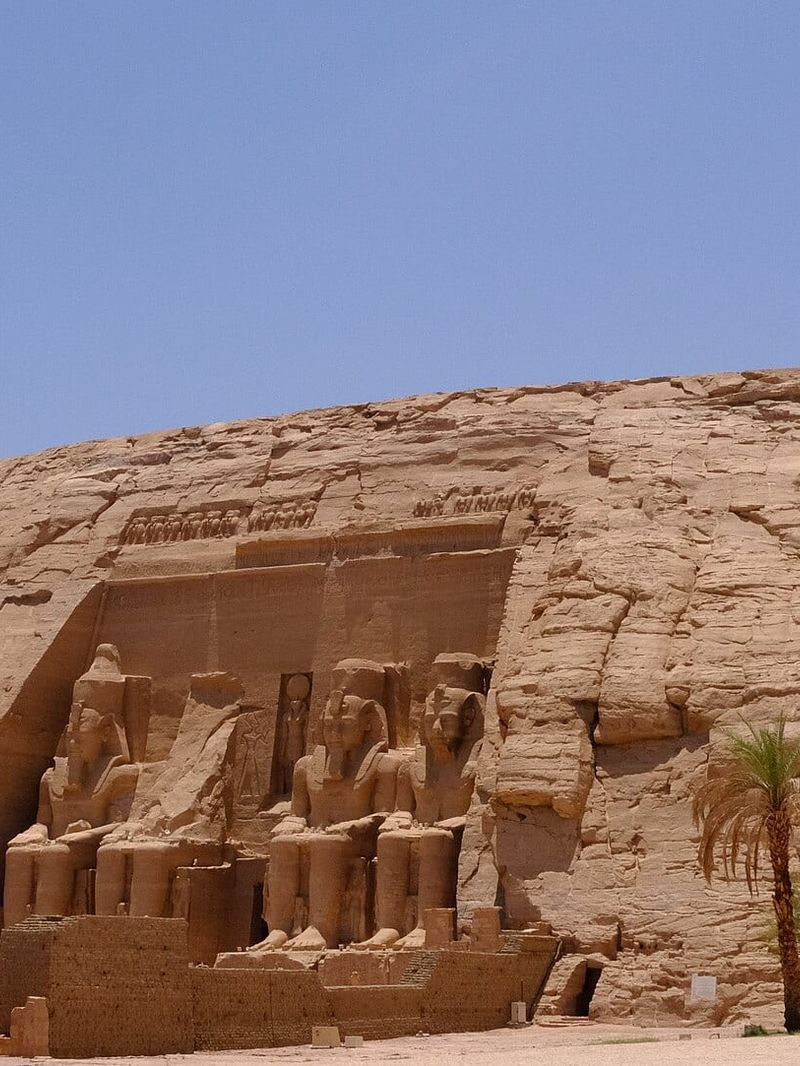
Abu Simbel Temples
Ramesses II's colossal rock temples on Lake Nasser — moved block by block in the 1960s and lit by the sun twice a year.
The first sight is the scale. Four kings the height of a seven-storey building sit with their hands on their knees, looking out over a lake that did not exist when they were carved. Then the second thought arrives. The whole mountain was moved. The cliff behind them is a concrete dome dressed in stone, assembled in the 1960s block by numbered block. Most visitors arrive early from Aswan, when the light is soft and the rock glows pink. Go into the Great Temple first and walk the 60 metres to the four gods at the back. Then cross to Nefertari's temple, where the queen stands as tall as the king. It is the gentlest room in Nubia.
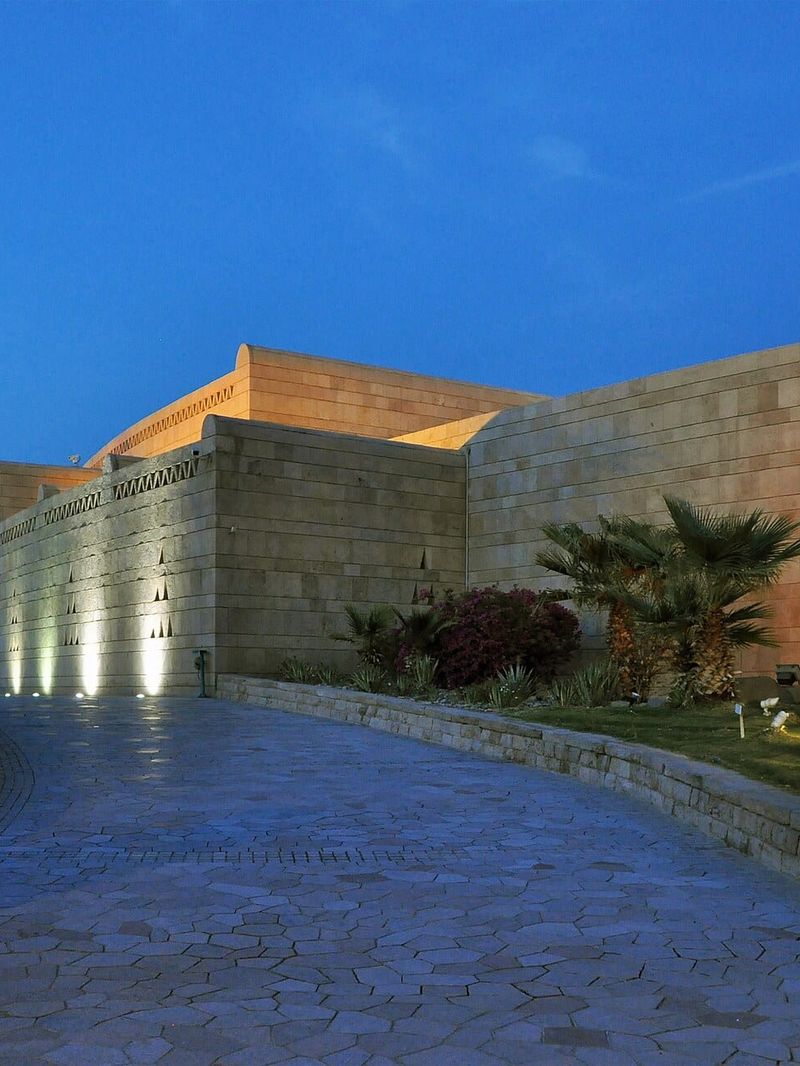
Nubian Museum
The Nubian Museum in Aswan tells the story of Nubia, the Nile valley of southern Egypt and northern Sudan, from prehistory to the present. It grew out of the international campaign to save the monuments of Nubia that UNESCO launched in 1960 at Egypt's request, before the lake of the High Dam flooded the valley. Work on the museum began in the early 1980s with specialists from the Supreme Council of Antiquities, Egyptian universities and UNESCO. The architect Mahmoud El-Hakim built it on a rocky hill in local sandstone and pink granite. Its plan draws on ancient temples, fortresses and the houses of the region. The Mexican designer Pedro Ramírez Vázquez planned the displays. The museum opened in 1997 and won the Aga Khan Award for Architecture in 2001. Three floors hold thousands of objects on the history of Egypt and Nubia, with a main hall and a large diorama on the crafts and customs of Nubian villages. The garden is an open-air museum. It has part of a Fatimid cemetery, a cave with prehistoric rock drawings, a water channel that stands for the Nile and a reconstructed Nubian house. There is also a library, a lecture hall, a theatre and an open amphitheatre for Nubian folklore.
A pharaoh in a drawer
Christie wrote something else in 1937, the same year Death on the Nile came out. Akhnaton is a play in three acts about Akhenaten, the pharaoh of the fourteenth century BC who put the sun disc, the Aten, at the centre of royal religion and pushed the old gods of Thebes aside. He built a new capital for the Aten in the desert of Middle Egypt.
The play is not a mystery. It is a tragedy about a king who believes he can remake the world and loses it. Christie wrote it with help from the Egyptologist Stephen Glanville, a friend of Mallowan's. It was never staged in her lifetime and stayed unpublished until 1973.
The city Akhenaten built still lies on the east bank of the Nile between Minya and Asyut. Tell el-Amarna, ancient Akhetaten, "Horizon of the Aten", was abandoned soon after his death. What remains are boundary stelae cut into the cliffs, the royal tomb and the rock tombs of his courtiers.
The most surprising trace of the king is in Luxor. Before he left Thebes, Akhenaten built temples for the Aten at Karnak. Archaeologists have identified the remains of four separate structures there. They went up fast, in small standard sandstone blocks about half a metre long, now called talatat. After his death his successors took the buildings apart. Horemheb packed the blocks into the cores of new pylons at Karnak as fill. Ramesses II used more of them inside a pylon at Luxor Temple. Hidden inside later walls, the carved and painted faces of the blocks survived.
When the pylons were restored in the twentieth century, tens of thousands of talatat came out. Each carried a fragment of a scene. From the mid-1960s the Akhenaten Temple Project photographed them to scale and tried to match them, with the help of early computers. One long wall, from a building called Teni-menu, was put back together from blocks found in the Ninth Pylon of Karnak. It now stands in the Luxor Museum: scenes of palace and domestic life, administration and royal ritual, including the king's first jubilee festival, rebuilt like a jigsaw. The Gem-pa-Aten, the largest of his Karnak temples, had a colossal standing statue of the king against each pillar of its court. Fragments of them were dug up from 1925 onwards. Most went to the Egyptian Museum in Cairo, where one stands in the ground-floor galleries. Another is in the Luxor Museum.
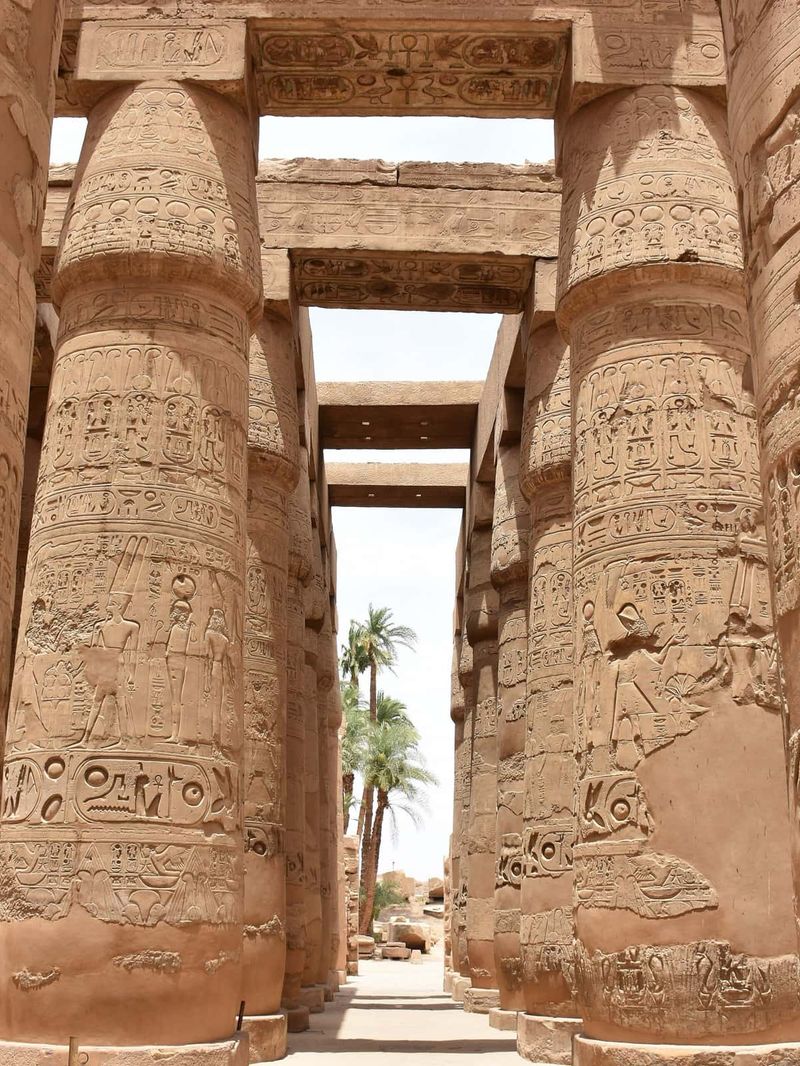
Karnak Temple Complex
The vast sanctuary of Amun, built and rebuilt over two thousand years — the largest religious complex of the ancient world.
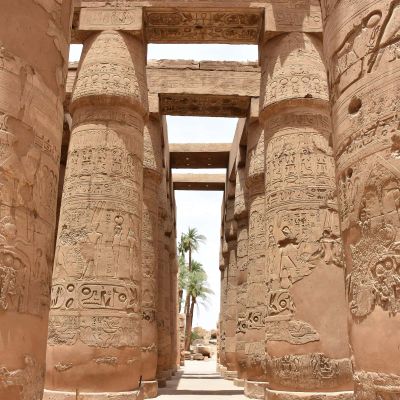
Nothing prepares you for the scale of the Hypostyle Hall. Photographs show columns; standing inside, you feel like an insect in a field of stone wheat. Look up and the capitals open into papyrus flowers some twenty metres above you and between them there are still patches of blue and red paint that someone mixed three thousand years ago. Karnak is easy to rush. Most people walk the main axis, take their pictures in the hall and leave. Go the other way. Turn off towards the sacred lake, find Hatshepsut's obelisk standing in a courtyard of broken walls, wander into the Open-Air Museum, where the White Chapel sits almost alone, as fine as jewellery. Come at opening time, before the coaches. In the first hour the light comes in low from the east, the columns throw long shadows across each other and the whole place sounds like a cathedral.
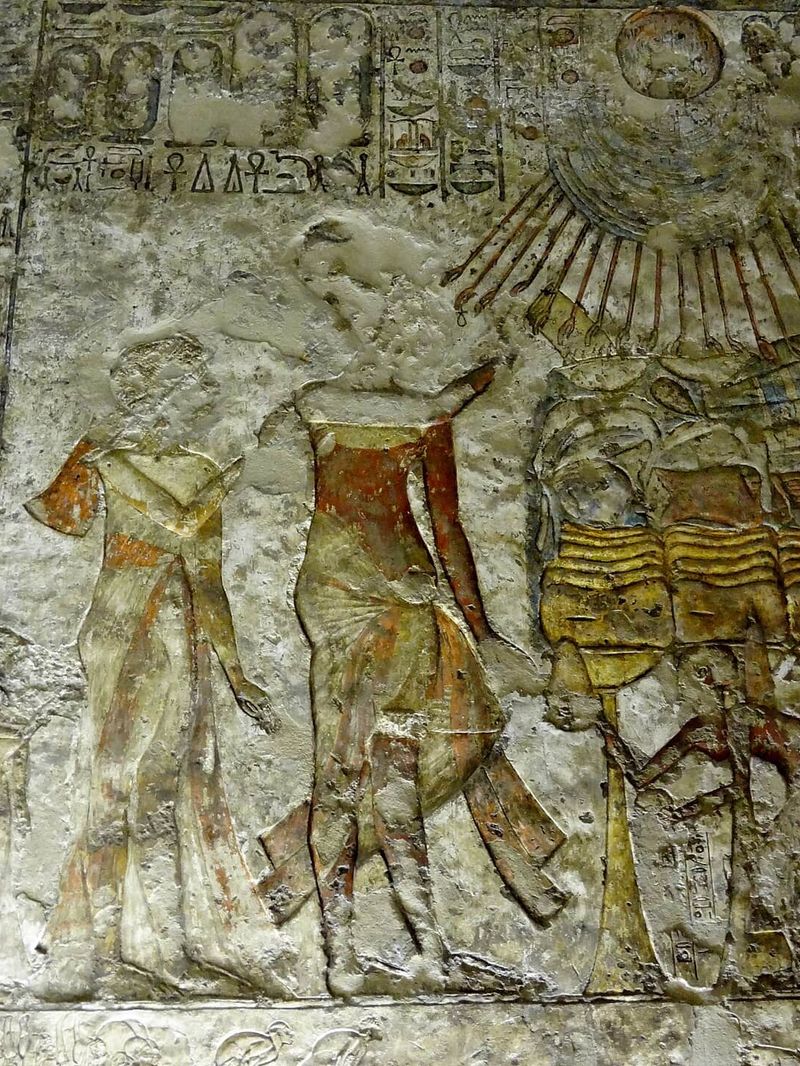
Tell el-Amarna (Akhetaten)
Akhenaten's short-lived capital of the sun disc — boundary stelae, a royal tomb and the rock tombs of his courtiers.
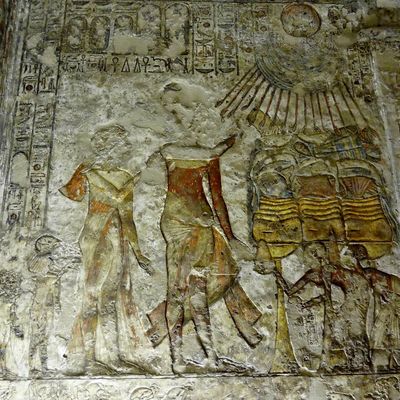
Amarna asks for imagination. Much of the city is foundations in the sand and a wide empty plain ringed by cliffs. But the emptiness is the point. This is where a pharaoh chose to start the world again around a single god of light. Fifteen years later it was abandoned. Go to the North Tombs in the morning and look at the royal family as Amarna drew them, long faces, the sun's rays reaching down with tiny hands. Then step outside and look across the bay where the city stood. It is one of the most haunting places in Egypt and almost free of crowds.
Luxor Museum
Opened in 1975 on the Nile Corniche and designed by the Egyptian architect Mahmoud El-Hakim, the Luxor Museum presents a selective collection of art from ancient Thebes. Highlights include statues of Amenhotep III and Thutmose III, the Akhenaten talatat wall from Karnak, objects from the tomb of Tutankhamun, and the Luxor Temple cache — statues discovered buried in the temple's court in 1989 and displayed in a dedicated hall. A New Kingdom wing presents Thebes' military history and two royal mummies, including Ahmose I.
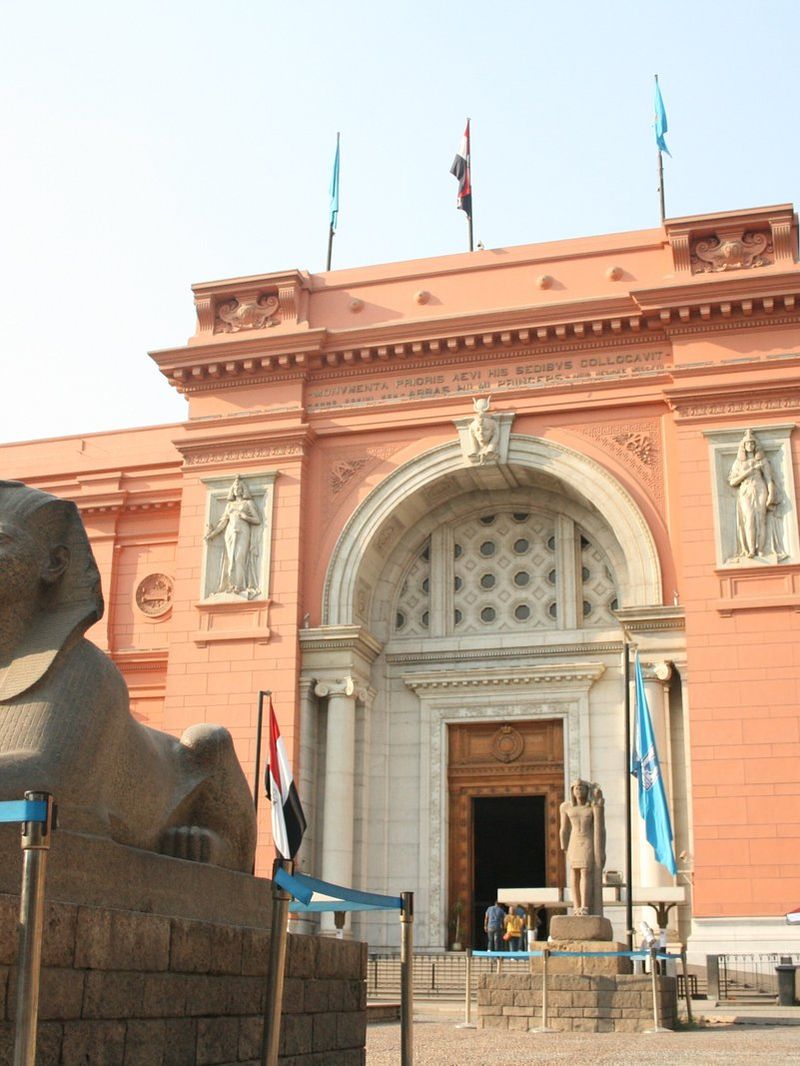
Egyptian Museum
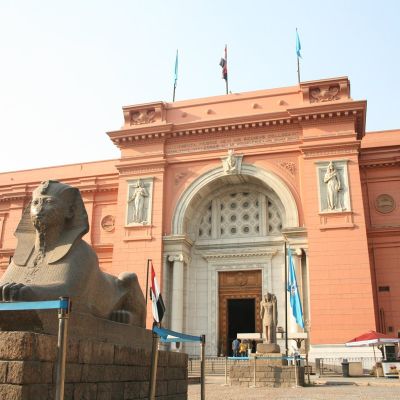
The Egyptian Museum on Tahrir Square in downtown Cairo is the oldest archaeological museum in the Middle East. Its collection runs from prehistory to the Greek and Roman period. It was also the first building in the Middle East and North Africa designed from the start as a museum. The collection began in the nineteenth century with the French archaeologist Auguste Mariette. In 1858 he settled in Egypt as conservator of monuments. He persuaded the viceroy to open a museum at Bulaq, on the Nile north of central Cairo. The collection later moved to a palace of Khedive Ismail in Giza. In 1895 the government launched an international competition for a new building, the first of its kind. The French architect Marcel Dourgnon won it. The cornerstone was laid on 1 April 1897. Khedive Abbas Helmy II opened the museum in 1902. Dourgnon chose not to imitate an ancient temple or tomb. His Beaux-Arts building covers about 13,600 square metres and holds more than 100 halls on a basement and two floors. A rotunda opens behind the entrance. Double-height rooms under skylights were planned so that daylight would fall on the objects, with natural ventilation instead of machinery. Over the entrance arch is a head of the goddess Isis. Two female figures on either side stand for Upper and Lower Egypt. Marble panels on the façade carry the names of Egyptologists. A monument to Mariette stands in the garden. The building is on Egypt's Tentative List for UNESCO World Heritage. In recent years two of its most famous groups have moved. On 3 April 2021 the Pharaohs' Golden Parade took 22 royal mummies across Cairo to the National Museum of Egyptian Civilization in Fustat. The Tutankhamun collection went to the Grand Egyptian Museum at Giza. Much of the core of Egyptology remains here. The Narmer Palette from Hierakonpolis, of about 3100 BC, carries some of the earliest hieroglyphic inscriptions found. A 7.5-centimetre ivory statuette from Abydos is the only confirmed contemporary statue of Khufu, builder of the Great Pyramid. Flinders Petrie found it in 1903 without its head. He ordered a search and the head turned up three weeks later. The Old Kingdom holdings include statues of Khafre, the triads of Menkaure and the wooden statue of the priest Ka-aper. In the family group of the dwarf official Seneb, the sculptor placed the two children where Seneb's legs would have been. The colossal limestone group of Amenhotep III, Queen Tiye and three of their daughters is the largest known ancient Egyptian family statue. The museum also keeps the burials of Yuya and Thuya, the treasures of Tanis including those of Psusennes I, papyri, coffins and jewellery. The museum is open daily from 9:00 to 17:00. The ticket office closes at 16:00.
The letters from Thebes
Glanville had a second idea for Christie. Why not a detective story set in ancient Egypt? The result was Death Comes as the End, first published in 1944, her only historical mystery and the only novel she set outside the twentieth century. It takes place on the west bank at Thebes around 2000 BC, in the household of a priest who also farms his land. The book is dedicated to Glanville. Christie wrote that it would not exist without him.
The household was real, or nearly. In the early 1920s the Metropolitan Museum of Art's Egyptian Expedition, led by Herbert Winlock, was digging in the cliffs above Deir el-Bahri, the bay where Hatshepsut's terraced temple stands. Not in Hatshepsut's temple but in the rock-cut tomb complex of the vizier Ipy nearby, they found a bundle of papyri. The documents had been kept in an unused chamber. When it was used for a burial, apparently while their owner was away, they were sealed inside. They were letters and accounts written for a man called Heqanakht, a ka-priest and landowner of the early Twelfth Dynasty, about 4,000 years ago.
The letters are the voice of an absent head of family. The harvest had just come in after a low Nile flood and Heqanakht had to make his grain last the year. He sent instructions home about land, rent and debts. He wrote out a list of rations for each member of the household: his mother Ipi, a woman called Hetepet, his sons, their dependants. While he was away he had put them on half rations. They wrote to complain that they were hungry.
One woman in the house was a particular worry. Heqanakht calls her by a word, hebsut, that scholars still argue about. James Allen, in the standard edition, reads it as "wife". Others have argued for "concubine". One of the letters deals with how the household was mistreating her. He warns them that whatever is done to her is done to him.
For a crime writer it was a cast list. Christie took the anxious, demanding father, the grown sons left in charge of the farm, the newcomer the household dislikes and the quarrels over food and property. She turned the woman into Nofret, a beautiful concubine whose arrival sets off a series of murders. In her author's note she said that the inspiration for both characters and plot came from the letters and that place and time were incidental. The murders are hers. The rations, the debts and the resentful household were already there.
The papyri themselves went to New York in the division of finds. They are in the collection of the Metropolitan Museum of Art, which published the full modern edition in 2002. A visitor to Deir el-Bahri today stands near where they were found, but the letters cannot be seen in Egypt.
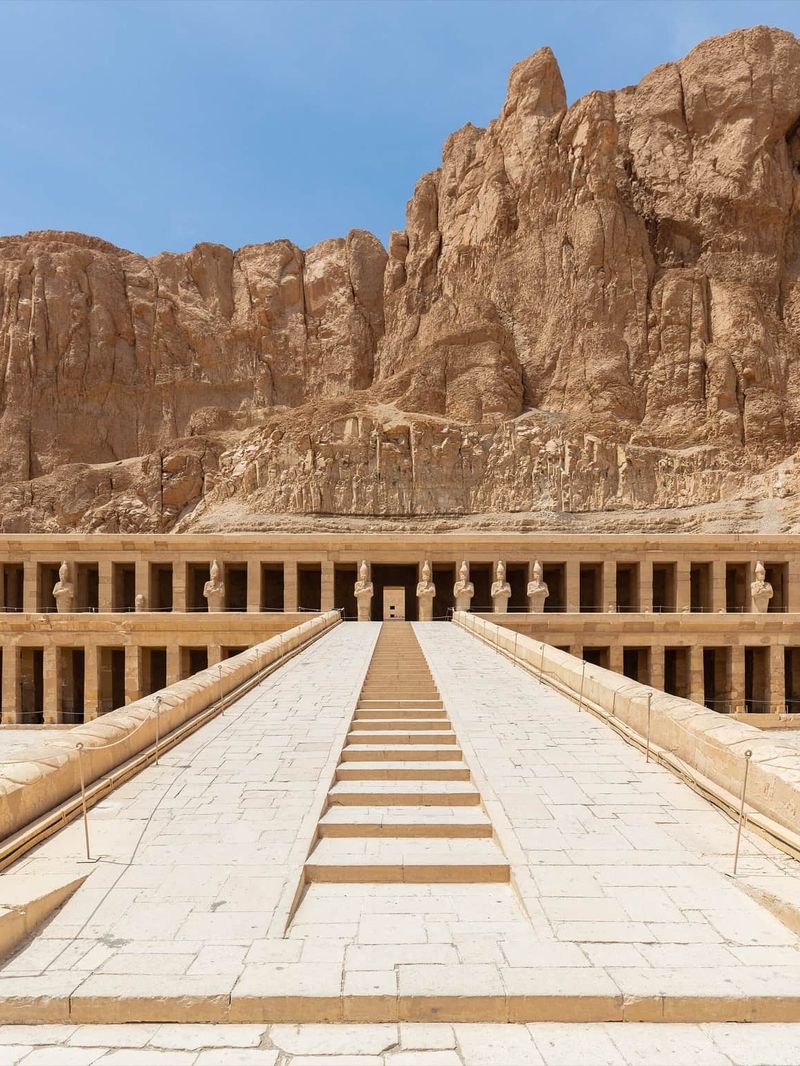
Temple of Hatshepsut (Deir el-Bahari)
The terraced temple of Egypt's great woman pharaoh, set against the cliffs of the west bank — with the reliefs of the expedition to Punt.
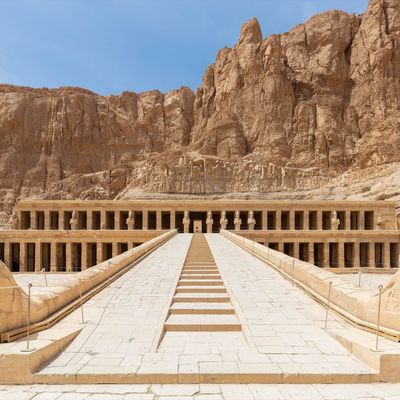
The first sight of Deir el-Bahari is the best one. You come round the bend and there it is, a long white building laid out in front of a sheer wall of golden rock, so clean and horizontal it looks almost modern. Then go close and look for her. Hatshepsut's successor tried to wipe her out. The gaps are still there: a chiselled patch where a face should be, a name scraped off a cartouche. Yet the Punt reliefs survive, with their ships and incense trees and the famously plump queen of Punt. So does the temple itself. She lost the faces. She kept the building. Go early. By ten the terraces are full of sun and the cliff throws the heat straight back at you.
Metropolitan Museum of Art
[communications@metmuseum.org](mailto:communications@metmuseum.org) · Manhattan (citywide). Institutional profile on Exhibo — claim to manage your public presence.
How the places fit together
The three stories sit at different points along the Nile. Aswan is the start of Death on the Nile: Elephantine Island, Kitchener's Island and the Nubian Museum are close together in the city, with Philae, the Temple of Isis that UNESCO also moved, just upstream. Abu Simbel is a separate trip, about 280 kilometres south of Aswan near the border with Sudan, by road or by air.
Luxor holds two of the books. Karnak and the Luxor Museum are on the east bank. Deir el-Bahri and the tomb of Ipy in the cliffs beside it, where Heqanakht's letters were found, are on the west bank. Tell el-Amarna is a journey of its own, several hundred kilometres north of Luxor in Minya province. Opening hours and access at archaeological sites change, Amarna especially, so check them with Egypt's antiquities ministry before you go.
Christie never set a mystery in the Egypt of her own winter in Cairo. She set one on a steamer full of tourists, one in the court of a pharaoh and one in a farmer's house four thousand years old. The farmer's letters are now in New York. The temple from the novel was dismantled and rebuilt on a hill that did not exist when she wrote it.
Sources and further reading
Agatha Christie, An Autobiography (1977).
Agatha Christie, Death Comes as the End (1944), author's note.
Agatha Christie Ltd, "Death Comes As The End" and "Akhnaton", agathachristie.com.
Smithsonian Magazine, "How Agatha Christie's Love of Archaeology Influenced Death on the Nile" (2022).
New Lines Magazine, "Agatha Christie Dug for Clues for Real in Egypt".
Collecting Christie, "Cairo".
The Conversation and UCL News, "Agatha Christie's world-first historical whodunnit was inspired by 4,000-year-old letters" (2018).
Metropolitan Museum of Art, Heqanakht papyri, collection records; James P. Allen, The Heqanakht Papyri (New York, 2002).
UNESCO World Heritage Centre, "The story of Abu Simbel".
National Geographic, "Epic engineering rescued colossal ancient Egyptian temples from floodwaters".
United Nations University Press, archive on the resettlement of the Nubians of Wadi Halfa at New Halfa.
New Lines Magazine, "How Egypt's Aswan Dam washed away Nubian heritage".
Egyptian Museum Cairo, "Colossus of Amenhotep IV (Akhenaten)", gallery 3.
The Nubians of Egypt: a displaced population (CNRS Éditions).
Penn Museum, Expedition, "The Akhenaten Temple Project and Karnak Excavations".
UC Santa Cruz, Digital Karnak, "Aten Temples".
Turner Classic Movies, "Death on the Nile" (1978).
Motion Picture Association, "Death on the Nile production designer Jim Clay delivers deadly decadence" (2022).
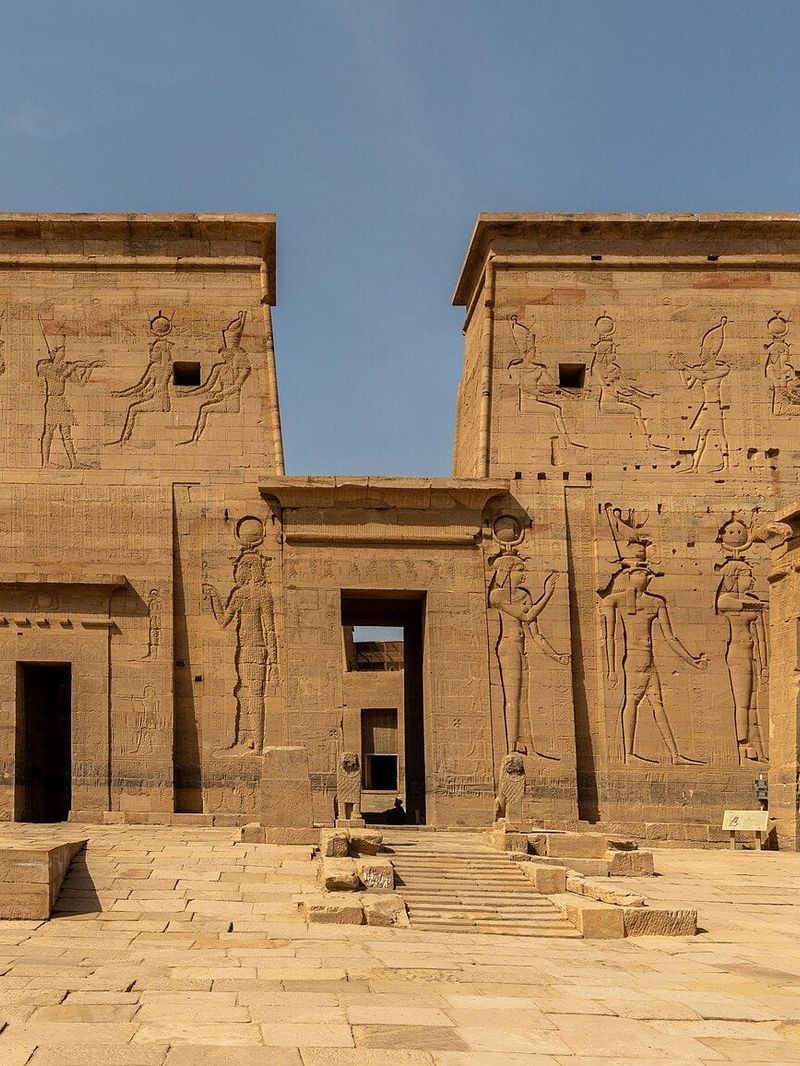
Philae Temple (Temple of Isis)
The island sanctuary of Isis, rescued from the rising Nile and rebuilt on Agilkia — the last stronghold of the ancient Egyptian religion.
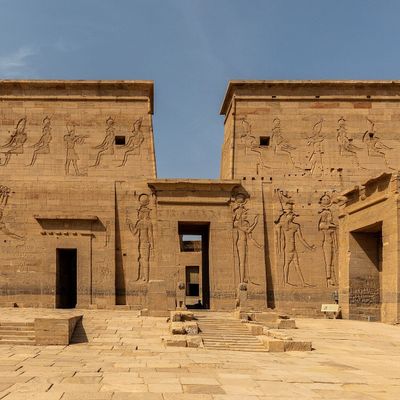
The approach does half the work. A small boat across dark water, granite boulders on every side, then the colonnades rising off the island ahead of you. No other temple in Egypt is reached like this. None sits better in its landscape. Go to Trajan's Kiosk at the water's edge first. Then look inside the temple for the Coptic crosses cut over the figures of the old gods: one religion handing over to the next, recorded on the same wall. Come early, before the light flattens. On the way back ask the boatman to go round the island so you can see it from every side.
Museums mentioned
Places mentioned
Related reading
The Real Oasis of The Alchemist: Al-Fayoum and the Dream Coelho Borrowed
Paulo Coelho sent his shepherd to a real place in Egypt. What Santiago would have found there and where the story of the treasure at home came from.
Sinbad and the Real Trade Routes of Oman and Basra
A ninth-century ship sewn together without nails, a hold of Chinese porcelain, and the sailors’ yarns of Basra, Siraf and Sohar: the real sea behind the fantasy.
Why the Middle East Keeps Building Venice
From the Red Sea to the Gulf, canal towns keep getting called Venice. The water was usually about something else — and Venice was never quite Venice either.