
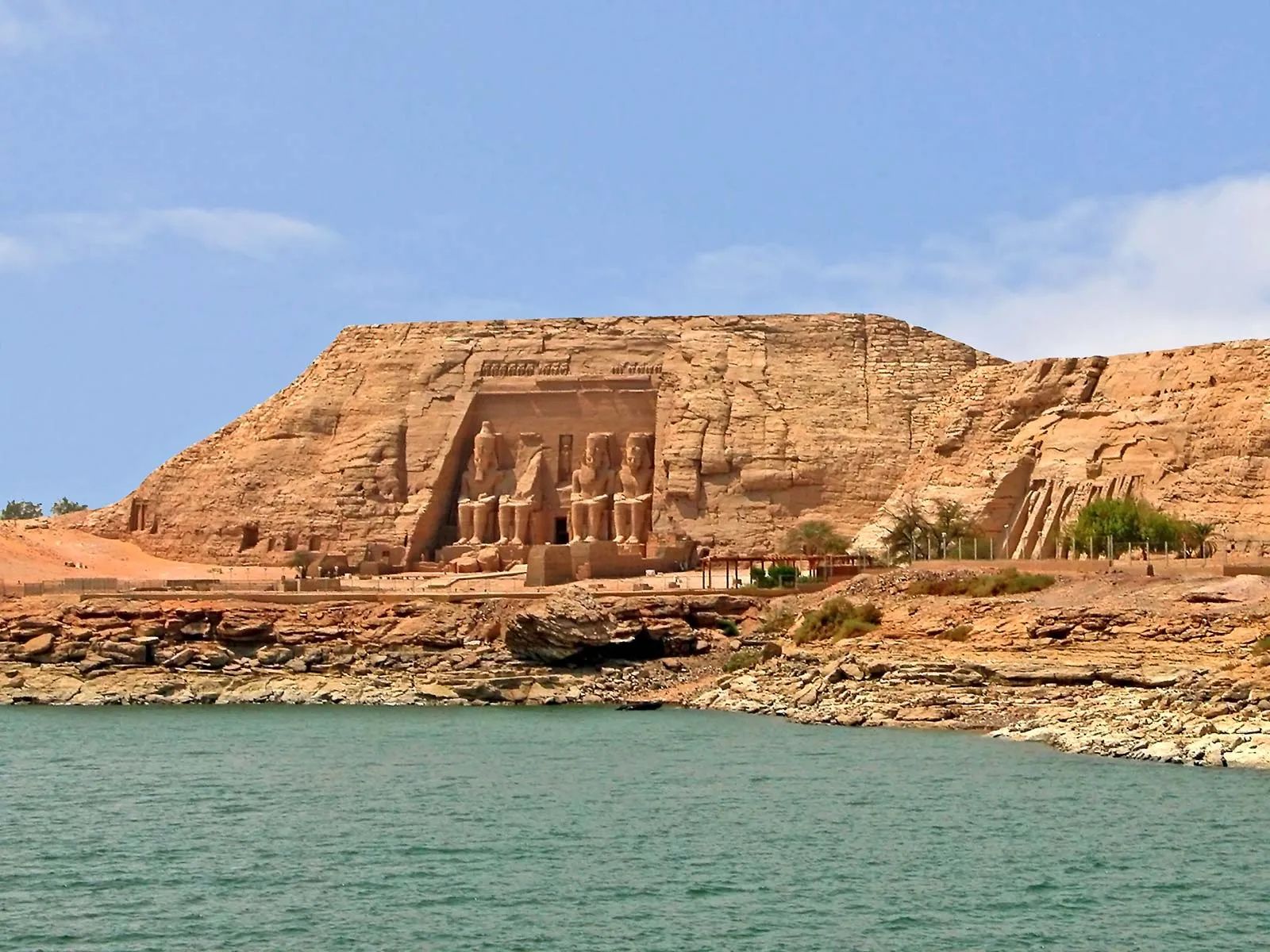
Abu Simbel Temples
Ramesses II's colossal rock temples on Lake Nasser — moved block by block in the 1960s and lit by the sun twice a year.
Temples carved from the mountain
Abu Simbel lies in Nubia, about 280 kilometres south of Aswan and close to the Sudanese border, on the shore of Lake Nasser. Here, in the thirteenth century BC, Ramesses II had two temples carved into the sandstone cliffs above the Nile: monuments to the gods and to his own divine kingship, and a powerful statement of Egyptian authority at the southern frontier. The Great Temple was dedicated to Amun-Ra, Ra-Horakhty, Ptah and the deified Ramesses himself; the Small Temple to the goddess Hathor and to his principal wife, Queen Nefertari.
The Great Temple
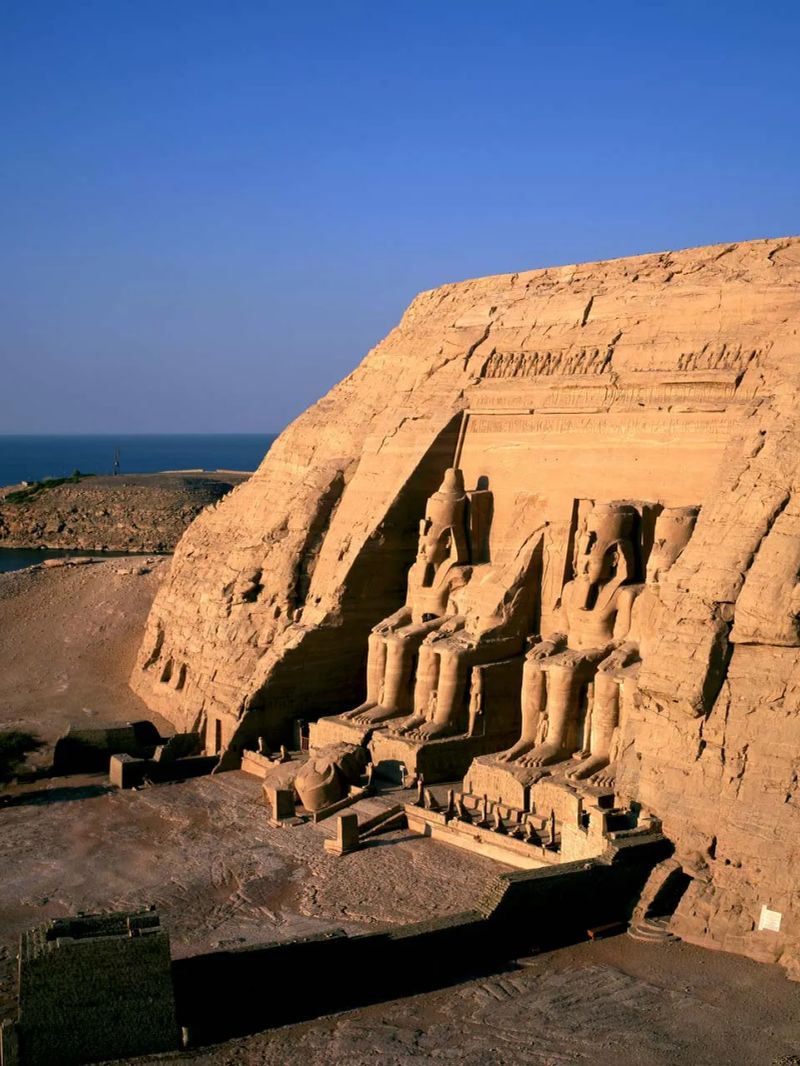
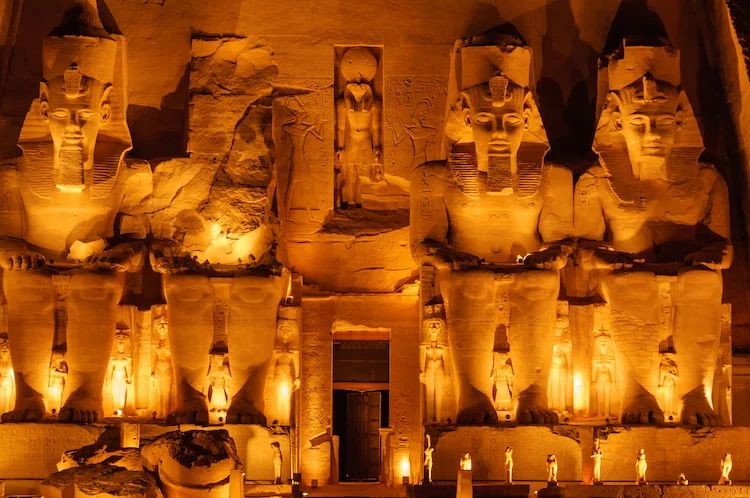
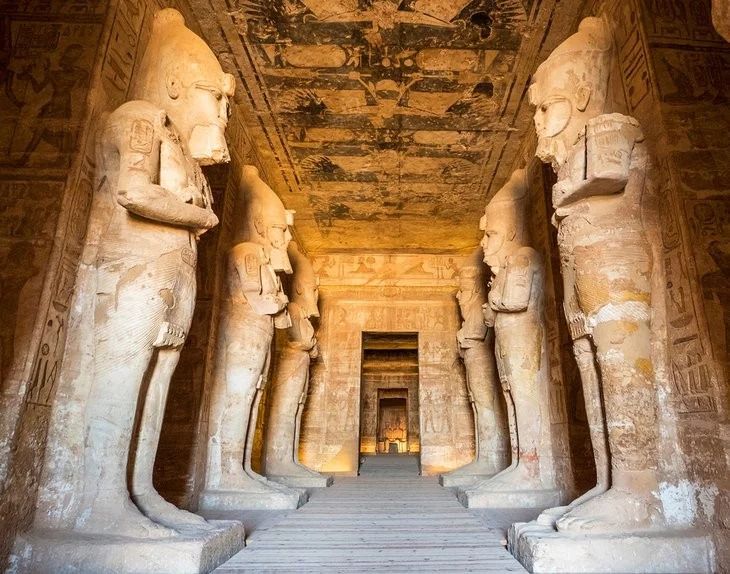
The façade of the Great Temple is dominated by four seated colossi of Ramesses II, each about 20 metres high, with smaller figures of members of his family at their feet; the upper part of one colossus fell in an ancient earthquake and lies before it. Inside, a great hall is lined with eight pillars fronted by statues of the king as Osiris, and its walls are carved with the Battle of Kadesh and other campaigns. At the far end, about 60 metres into the rock, the sanctuary holds statues of four seated gods. Twice a year, around 22 February and 22 October, the rising sun penetrates the full length of the temple and illuminates three of the four statues, leaving Ptah, a god associated with the underworld, in shadow — an alignment thought to mark important dates of the king's reign.
The Small Temple
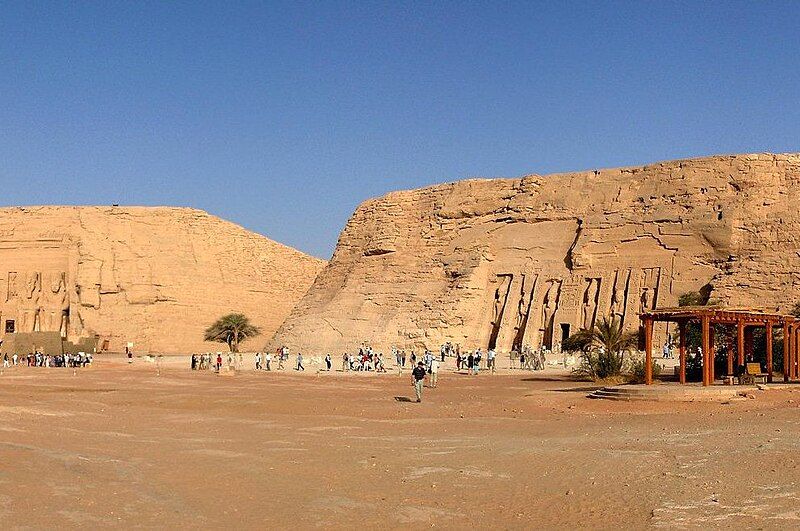
The Small Temple, nearby, has a façade of six standing colossi — four of the king and two of Nefertari, shown at the same scale, a rare honour for a queen. Inside, reliefs of Nefertari and Hathor have a grace that contrasts with the military scenes of the Great Temple.
Rediscovery and rescue
Buried by sand for centuries, the temples were rediscovered by the Swiss traveller Johann Ludwig Burckhardt in 1813, and the Italian explorer Giovanni Belzoni entered the Great Temple in 1817. When the Aswan High Dam threatened to drown them, an international team under the UNESCO International Campaign to Save the Monuments of Nubia cut both temples into more than a thousand blocks between 1964 and 1968 and reassembled them some 65 metres higher and about 200 metres back from the river, inside an artificial mountain. Abu Simbel is part of the UNESCO World Heritage Site of the Nubian Monuments from Abu Simbel to Philae.
Exhibo editorial
You arrive after hours of desert, at dawn if you are wise, and walk round the side of a hill — and there, facing the lake, are the four kings. Nothing about photographs prepares you for their calm, enormous faces, or for the fact that the entire mountain they sit in was moved, piece by numbered piece, in the 1960s.
Go inside before the groups catch up with you and walk the long axis to the sanctuary, where the sun reaches the gods twice a year. Then cross to Nefertari's temple, where the queen stands as tall as her husband — Ramesses' tenderest monument. If you can, stay overnight in Abu Simbel and see the temples at sunrise without the convoys: it's a different, almost private experience.
Gallery
How to find it
Abu Simbel is about 280 km (3–3.5 hours by road) south of Aswan; most visitors travel by private car or minibus early in the morning, or fly from Aswan to Abu Simbel airport. Some Lake Nasser cruises begin or end here. From the visitor centre, follow the path around the hill; the Great Temple comes into view first, with the Small Temple of Nefertari to its right.