
Tell el-Amarna (Akhetaten)
Akhenaten's short-lived capital of the sun disc — boundary stelae, a royal tomb and the rock tombs of his courtiers.
The city of the Aten
Tell el-Amarna, on the east bank of the Nile between Minya and Asyut, is the site of Akhetaten, "Horizon of the Aten", the new capital founded around 1346 BC by the pharaoh Akhenaten. Breaking with centuries of tradition, Akhenaten promoted the exclusive worship of the Aten, the sun disc, and left Thebes to build a city on virgin ground in a great bay of cliffs. For about fifteen years it was the seat of the royal court, with palaces, temples to the Aten, government offices, workshops and residential quarters for tens of thousands of people. After Akhenaten's death the court returned to Thebes and Memphis under Tutankhamun, the city was abandoned, and later kings dismantled its temples.
What survives
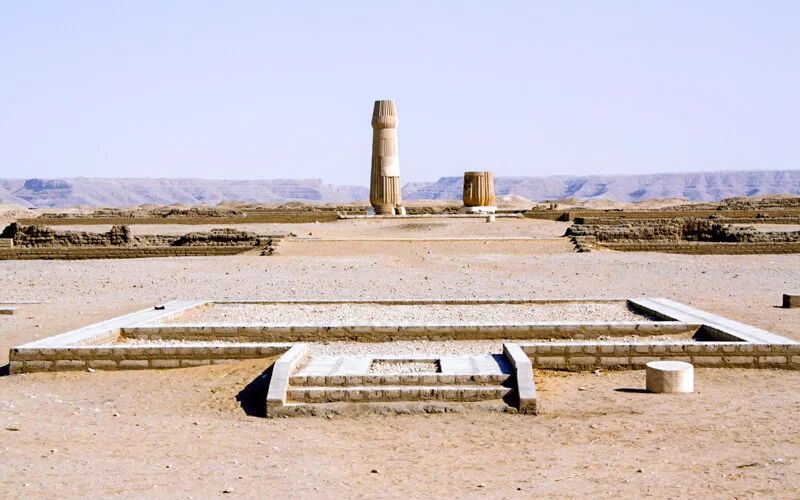
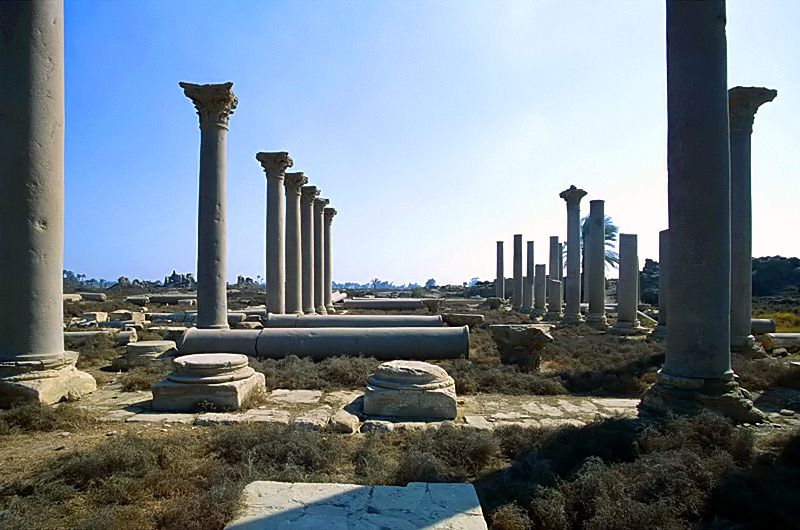
Because it was occupied so briefly, Amarna is one of the most complete examples of an ancient Egyptian city ever found. Its plan has been revealed by excavations, especially since the 1970s by the Amarna Project led by Barry Kemp. It was in a sculptor's workshop here — that of Thutmose — that German archaeologists led by Ludwig Borchardt discovered the painted bust of Queen Nefertiti in 1912, now in Berlin. On the ground today, visitors see the outlines of buildings and temples, partly reconstructed, as well as boundary stelae carved into the cliffs that marked the limits of the city and record Akhenaten's founding vows.
The tombs
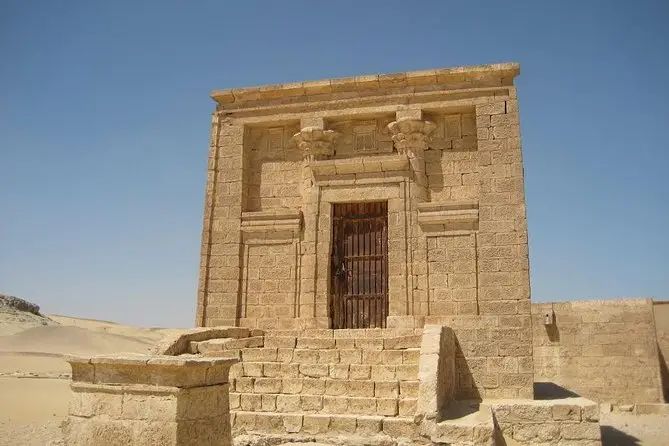
In the cliffs to the north and south are the rock tombs of the king's officials, decorated in the distinctive Amarna style with scenes of the royal family worshipping the Aten, whose rays end in hands offering life — including the tombs of the high priest Meryre and the steward Huya in the North Tombs, and that of Ay, Akhenaten's courtier and later king, in the South Tombs, which contains the longest version of the Great Hymn to the Aten. In a remote wadi lies the Royal Tomb, prepared for Akhenaten and members of his family, with scenes of mourning for his daughter Meketaten.
Exhibo editorial
Amarna asks for imagination: much of the city is foundations in the sand, a few reconstructed columns, a wide empty plain ringed by cliffs. But that emptiness is the point. This is the place a pharaoh chose to start the world again, devoted to a single god of light — and fifteen years later, it was abandoned.
Go to the North Tombs in the morning and look at the royal family in the Amarna style — elongated faces, the sun's rays reaching down with tiny hands — then stand outside and look over the bay where the city stood. It is one of the most haunting places in Egypt, and almost entirely free of crowds.
Gallery
How to find it
Amarna lies about 60 km south of Minya. From the west-bank town of Deir Mawas, cross the Nile by car ferry to the east bank village of el-Till, where the ticket office is located; from there, vehicles take visitors to the North Tombs, the central city, the South Tombs and the Royal Tomb, which lies several kilometres up a desert wadi.
Similar places
All places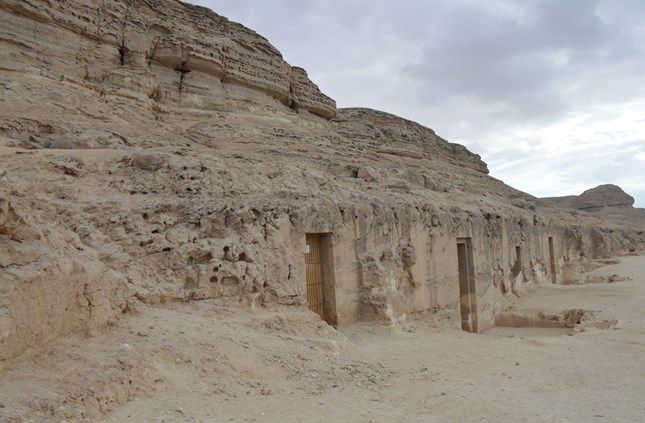
News by Exhibo
Editorial coverage on Exhibo

Why Disney Made the Genie Blue
The long material and colonial history behind the most recognizable blue body in popular culture.
Almost everyone remembers that Disney's genie is blue. Fewer ask why. The answer runs backward through five thousand years — Egyptian blue standing in for lapis, cobalt on a Mongol palace, the eye that guards against envy, the last color most languages learned to name, and a layout artist photographing Isfahan just before a war — to a color that was rarely, in this part of the world, quite what it claimed to be.
Ancient Egyptian Art
Images built to work for gods, kings and the dead: canon, craft and change along the Nile across nearly three millennia.
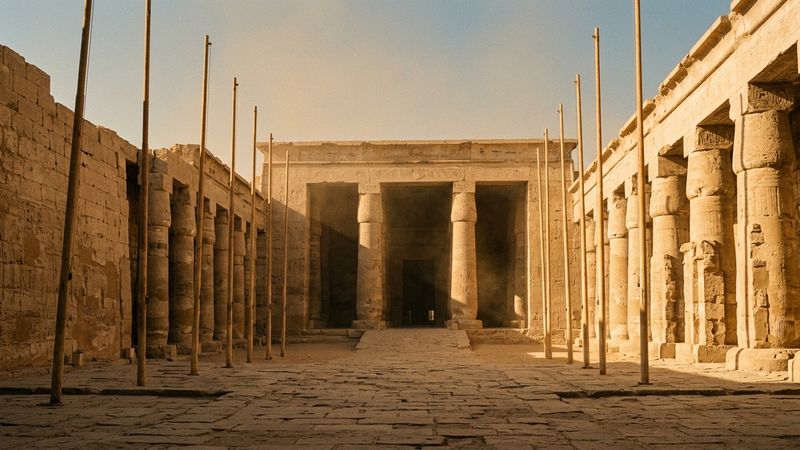
Ancient Egyptian art was rarely made for the museum wall alone. This period survey explains why statues and reliefs functioned as cult tools, how a stable visual canon held for centuries, where Old, Middle and New Kingdom styles diverge, and which collections still make those differences visible today.