
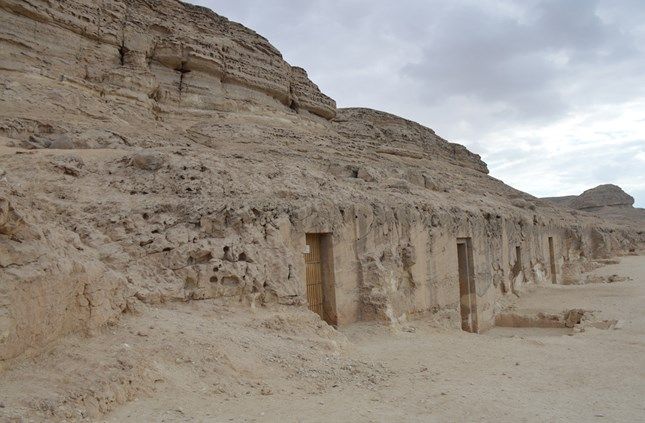
Beni Hasan Rock Tombs
Middle Kingdom tombs of the governors of the Oryx nome, cut into the cliffs above the Nile — with wrestlers and a caravan of Asiatics.
Tombs on the cliff
Beni Hasan lies on the east bank of the Nile about 20 kilometres south of Minya. Along the face of the limestone cliffs above the river, a terrace of thirty-nine rock-cut tombs was carved for the nomarchs (provincial governors) and officials of the sixteenth Upper Egyptian province, the Oryx nome, during the Middle Kingdom, around 2000–1800 BC. Below them lie hundreds of smaller shaft tombs. Several of the large tombs have porticoes with columns cut from the rock, and inside, their chapels are decorated with paintings that form one of the richest records of life in Middle Kingdom Egypt.
The paintings
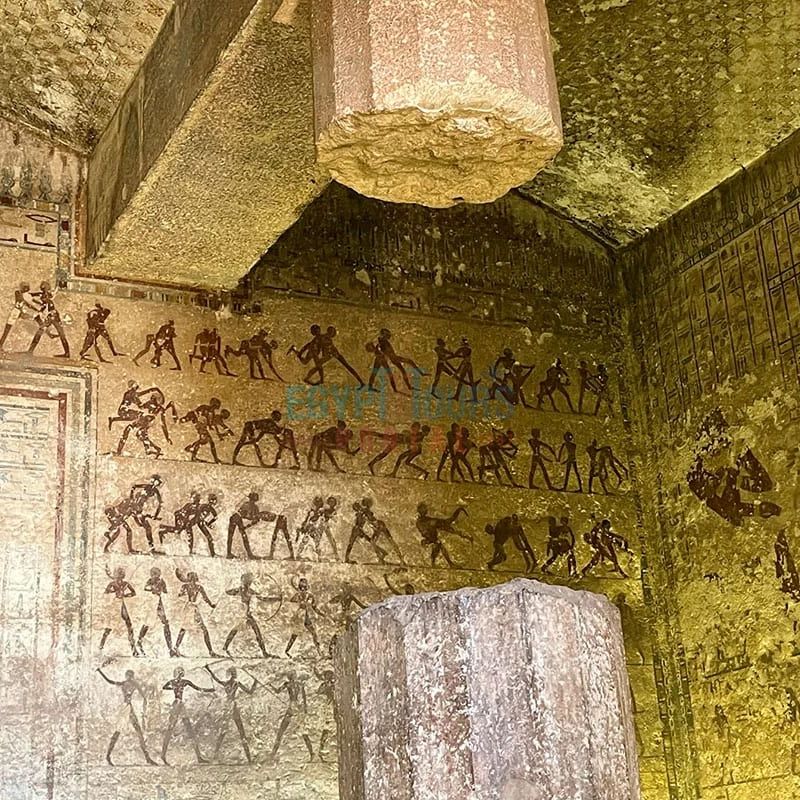
Four tombs are usually open to visitors. In the tomb of Khnumhotep II, a famous scene shows a caravan of Asiatic (Levantine) traders, led by a chief named Abisha, arriving in Egypt with their families, donkeys and goods, dressed in brightly patterned clothes — one of the most important images of contact between Egypt and the Near East. The tombs of Baqet III and Khety are famous for long sequences of wrestling pairs, shown move by move like a film strip, as well as scenes of military training, games and dancing. The tomb of Amenemhat, with its fluted columns, contains scenes of daily life, crafts and hunting, together with a long biographical inscription.
Visiting
Beni Hasan is the most visited site of Middle Egypt, though still quiet by Egyptian standards. Visitors in the region may be accompanied by a police escort. Nearby, at the entrance to a desert valley, stands the Speos Artemidos, a rock temple of Hatshepsut dedicated to the lion goddess Pakhet.
Exhibo editorial
Climb the long stairway up the cliff and turn around: the Nile valley spreads out below, a ribbon of green between the deserts, with palm groves and villages along the river. Then step into the tombs, and the walls show you the same world four thousand years ago — fishermen, weavers, dancers, and, in one long, wonderful sequence, hundreds of wrestlers grappling, throwing and pinning each other.
Look for the caravan of Asiatics in Khnumhotep's tomb, their striped robes and sandals painted with loving detail. It is one of those images that seem to collapse time. Beni Hasan is a long day from Cairo or Luxor; stay in Minya and give it a morning.
Gallery
How to find it
From Minya, drive about 20 km south and cross to the east bank (by bridge or local ferry) to the village of Beni Hasan. From the ticket office at the foot of the cliff, a long stairway climbs to the terrace of tombs; the four open tombs are signposted along the terrace.