
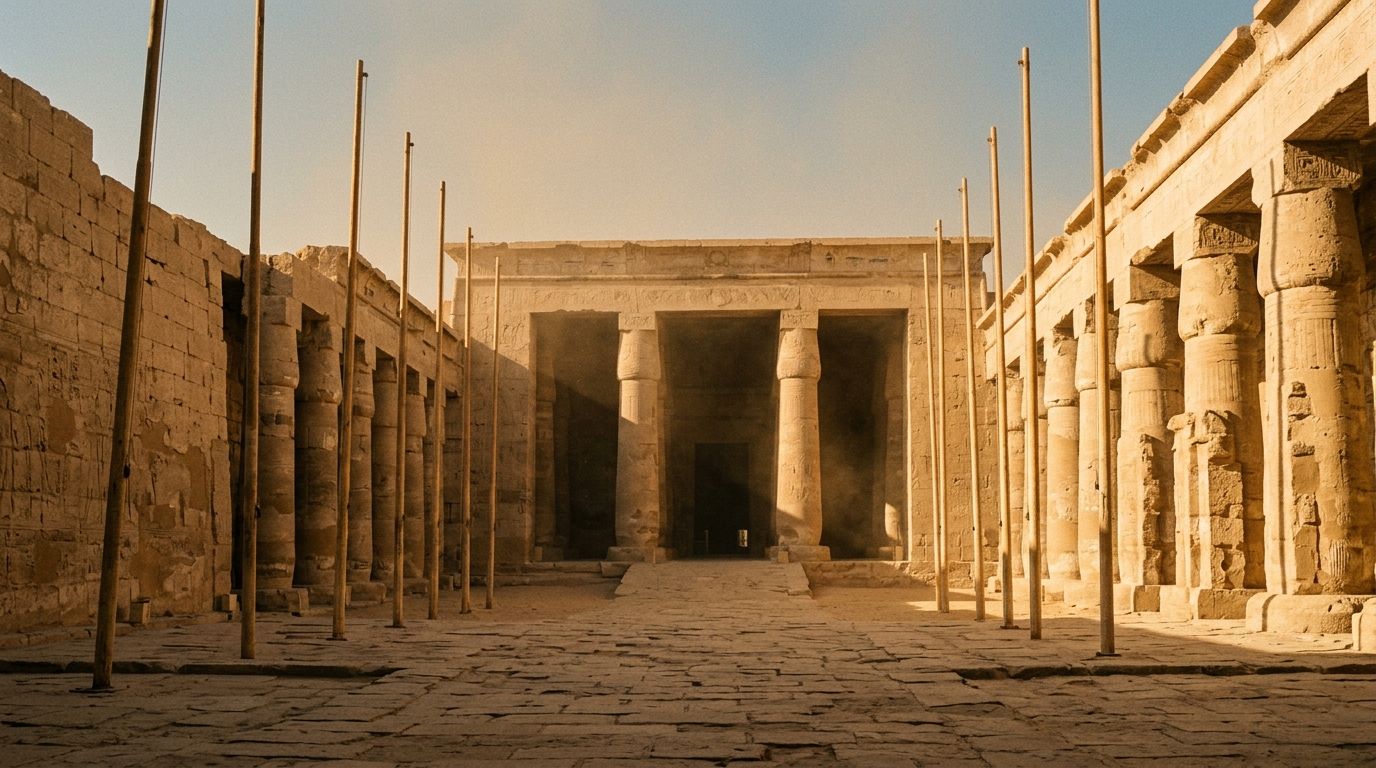
Exhibo Editorial
Ancient Egyptian Art
Images built to work for gods, kings and the dead: canon, craft and change along the Nile across nearly three millennia.
Ancient Egyptian art is the painting, sculpture, relief, jewellery, faience and temple decoration made for gods, kings and the dead along the Nile from roughly the late Predynastic period into the Roman centuries. Most of what survives was built to work: a statue housed a person's ka, a tomb painting supplied food forever, a temple relief kept cosmic order (ma'at) in force. Style stayed recognisable for millennia because consistency itself signalled that the system still held.
This survey maps that system across the Old, Middle and New Kingdoms, with a careful look at the short Amarna rupture and the later centuries that revived older forms. Dates below follow Metropolitan Museum of Art essays where possible; Egyptologists still disagree on many absolute years, so treat ranges as working approximations rather than fixed calendars. For the wider European period sequence this piece sits beside, see the Periods of Art History series hub. Sculpture process manuals and pigment chemistry belong elsewhere; here the question is what the images were for, and how their look changed when politics and religion did.
What Egyptian images were asked to do
Walk into a New Kingdom tomb chapel at Thebes and you meet walls that look decorative until you learn their job. Fishing scenes, offering tables and processions of cattle were not genre paintings in a modern sense. They were provisions. Once painted and captioned, they made those goods available to the deceased in the afterlife. The Cleveland Museum of Art, summarising British Museum material on kingship, puts the principle bluntly: Egyptian images functioned as substitutes, "magically efficient and alive." A royal statue stood in for the king and for his duty to maintain ma'at, chiefly by protecting the land and satisfying the gods.
That functional logic shaped almost every medium. Temple walls showed the king offering to deities so the exchange continued after the ceremony ended. Private stelae named family members so relatives stayed present. Ushebtis (servant figurines) answered for the deceased when the gods demanded labour. Even cosmetic palettes and jewellery could carry readable hieroglyphs that doubled as pictures; Cleveland notes a Middle Kingdom scarab ornament that spells a throne name through the combination of hill, scarab and sun disk. Text and image were not separate industries.
The Nile valley supplied the conditions for this long programme. Annual flood, desert edges and a sun that could kill as easily as it warmed gave Egyptians a natural world they read as full of divine force. Smarthistory's survey of that landscape stresses how animals became earthly manifestations of gods without being worshipped as pets: falcon for Horus, ibis for Thoth, jackal for Anubis. Hybrid deities with human bodies and animal heads follow from that observation. Art recorded the world in enough detail to keep it working after death, while royal images insisted that chaos stayed outside the ordered valley.
Because images acted, artists and patrons resisted casual change. After periods of political fracture, workshops often returned to Old Kingdom models as a "golden age" of correct form. What you see as sameness was, for them, evidence that ma'at still held. Variation did occur: provincial styles, Amarna elongation, Late Period archaism, Greek and Roman facial modelling. Those shifts matter more once you know the default was stability by design.
How the visual system worked
Before you name periods, you need the shared grammar that made a figure look Egyptian in 2500 BCE and still recognisable in 500 BCE. That grammar is not a single "style name" (despite People Also Ask queries fishing for one). Egyptologists describe conventions: a canon of proportions, composite view, hierarchical scale, registers, and a preference for balance and completeness. Smarthistory's introductions treat these as the durable core around which dynasties adjusted.
The system was taught in workshops, not invented anew for each commission. Unfinished stelae still show the squared grid that locked joints to fixed heights. Viewers who knew the code could read status, identity and ritual role at a glance. Visitors who arrive expecting Western naturalism often misread the same code as awkwardness. Once you see what each choice protects, the figures stop looking "wrong" and start looking complete.
Composite view and the complete body
On a flat wall, Egyptian draughtsmen combined viewpoints so that each body part appeared in its most informative aspect. The head usually turns in profile; the eye looks frontally; the shoulders face you; the torso twists; the legs stride in profile with the near foot forward. The aim was information, not optical illusion. A person shown this way was whole. Incomplete bodies raised theological and magical problems; the Berlin museum notes that true busts remained rare partly because a cut-off torso felt unfinished in a culture that needed images intact.
Minor figures and animals often escape the strictest rules. Captives collapse, cattle turn, dancers flex. The Narmer Palette already shows that contrast: the king is measured and composite; enemies and animal handlers move more freely. Hierarchy of importance and hierarchy of convention travel together. When you stand before a tomb wall, track who gets the full canonical treatment and who is allowed to break it.
Grids, scale and colour conventions
During the Old Kingdom, painters and relief carvers developed a squared canon of proportions so elite figures shared the same ratios. For much of pharaonic history an 18-square grid from ground to hairline standardised the standing human. Grid lines hit shoulder, waist, hips, knees and feet. The British Museum's unfinished Stela of Userwer still shows the lines under the lower register. In the Amarna period under Akhenaten, workshops shifted to a 20-square grid that lengthened neck and torso; UCLA Egyptology summaries following Gay Robins document that change as measurable, not metaphorical.
Hierarchical (or hieratic) scale marked status. Kings and gods tower over attendants. On Userwer's stela the owner, wife and parents sit larger than offering bearers. Size was politics made visible. Colour carried further codes: red-brown male skin and yellower female skin appear often in tomb painting, though the rule is not absolute and late or special contexts vary. Gold signalled divine flesh; blue and green linked to regeneration and the Nile. Treat these as workshop habits with meaning, not as a rigid paint-by-numbers chart for every object.
Registers stacked narrative into bands. Processions, offerings and smiting scenes read left to right or in paired directions depending on architecture. Balance mattered: empty space was rare in finished elite work, and symmetry around a vertical axis organised royal compositions. Together, grid, scale, composite view and registers produced the "Egyptian look" that outlasted individual kings.
Chronology: kingdoms, styles and what changed
Egyptian history is usually taught as alternating periods of strong central rule (kingdoms) and weaker or divided rule (intermediate periods), then Late, Ptolemaic and Roman phases. Absolute dates remain contested because king lists, radiocarbon and synchronisms with Near Eastern chronologies do not always align. The table below uses Metropolitan Museum of Art Heilbrunn Timeline essays as a public, citable baseline. Where Met pages themselves offer slightly different end-years for the same period, the range is marked as approximate.
| Period (Met baseline) | Approx. dates (BCE) | Dynasties (broad) | Art and visual markers |
|---|---|---|---|
| Predynastic to Early Dynastic | c. 6000–2649 | Predynastic; Dyn. 1–2 | Ceremonial palettes; early kingship imagery; conventions already forming by Narmer |
| Old Kingdom | c. 2649–2130 | Dyn. 3–6 | Stone pyramids; idealised royal sculpture; mastaba relief; Pyramid Texts by late Dyn. 5–6 |
| First Intermediate Period | c. 2150–2030 | Dyn. 8–mid-11 | Regional styles; competing centres at Herakleopolis and Thebes |
| Middle Kingdom | c. 2030–1650 | mid-Dyn. 11–13 | Reunification under Mentuhotep II; refined jewellery; Senwosret III's lined royal faces |
| Second Intermediate Period | c. 1650–1550 | incl. Hyksos Dyn. 15 | Political fracture; Theban recovery leads into New Kingdom |
| New Kingdom | c. 1550–1070 | Dyn. 18–20 | Empire wealth; Karnak expansions; rock-cut royal tombs; Amarna experiment; Deir el-Medina artisans |
| Third Intermediate to Late Period | c. 1070–332 | Dyn. 21–30 | Archaism; Nubian and Persian episodes; revived Old Kingdom forms |
| Ptolemaic to Roman | 332 BCE–4th c. CE | Macedonian–Roman rule | Temple building continues; Greek portrait habits meet Egyptian cult needs |
Read the table as a map of patronage and mood, not as a style switch every January. Old Kingdom court sculpture can look serene while late Dynasty 6 already experiments with large eyes and softer musculature (Met's "Second Style"). Middle Kingdom faces harden mid-Dynasty 12 without abandoning the canon. New Kingdom wealth floods temples with votive statues, then Amarna briefly rewrites proportions. Later periods often quote the past on purpose.
If you are comparing Egypt to later Mediterranean canons, the planned sibling on ancient Greek art (pending) will show how differently Greek workshops treated the living body. Continuity of cult architecture into Christian centuries also connects, at a remove, to later Mediterranean sacred imagery surveyed in Byzantine Art, Explained.
Old Kingdom: stone, cult and the first canons
The Old Kingdom (Met: ca. 2649–2130 BCE) is where many practices that define Egyptian art harden into durable form. Tara Prakash's Met essay stresses that origins lie earlier, yet Dynasty 3 to 6 turn those origins into the templates later generations copy. Knowledge of daily settlement life is thinner than funerary evidence; most of what you study in museums came from tombs and pyramid complexes.
Dynasty 3 opens with Netjerikhet, later called Djoser, and the Step Pyramid complex at Saqqara: Egypt's earliest large stone funerary structure, oriented north–south, with underground apartments and cult buildings. High officials still built mud-brick mastabas; offering niches grew into stone-lined chapels with the seated owner before a bread table. That offering scene, Prakash notes, magically provisioned the dead and remained ubiquitous for the rest of Egyptian history.
Pyramids, ideal kings and mastaba life
Dynasty 4 pushes pyramid building to its extreme. Snefru converts the stepped form into true smooth-sided pyramids at Meidum and Dahshur. Khufu's Great Pyramid at Giza anchors a standardised east–west complex: pyramid, adjacent mortuary temple, valley temple and connecting causeway. Temples and causeways carried painted relief; Khafre and Menkaure commissioned extensive royal sculpture. Met describes Dynasty 4 and early Dynasty 5 royal faces as smooth, fleshy and muscular: the court ideal of a living god at the apex of a stratified state.
Around the royal pyramids, planned cemeteries of stone mastabas housed officials, often royal relatives. Their afterlives may have depended on the king's cult. Inside chapels, relief programmes expanded. By mid-Dynasty 5, scenes of hunting, agriculture and butchering became common, ensuring provision for the next world. Statues multiplied: the same man as scribe, as young adult, in different stones. The Louvre's Seated Scribe (Old Kingdom, from Saqqara; limestone with inlaid eyes) concentrates that elite administrative world into one alert body. He is not a pharaoh; he is the literate machinery of the state, made permanent.
Late Old Kingdom shifts and collapse
Pyramid size shrinks after Menkaure while temple decoration grows richer. Sahure's complex at Abusir preserves relief types that show the king defeating enemies, meeting gods and receiving offering bearers. Solar temples appear under early Dynasty 5 kings. Then the balance tips: Osiris gains funerary ground; Unis has Pyramid Texts carved inside his pyramid; late Dynasty 5 and Dynasty 6 sculpture often adopts large eyes, upturned lips and narrower shoulders. Prakash links that "expressionistic" Second Style to broader cultural change.
Provincial rock-cut tombs expand as officials grow wealthy outside the capital. Scholars still argue whether that spread marks a weak crown or a deliberate extension of state presence. Either way, after Pepi II's long reign the central government fractures into the First Intermediate Period. Art does not vanish; it regionalises. When Mentuhotep II later reunites the country, workshops inherit both Old Kingdom memory and Theban local habits.
Middle Kingdom: recovery, intimacy and hard faces
The Middle Kingdom (Met: ca. 2030–1650 BCE, Dynasties 11–13) reimagines Old Kingdom principles after political collapse. Adela Oppenheim's Met essay calls it a transformation of kingship, society, religion and foreign relations, visible in architecture, sculpture, jewellery and literature. Many temples were replaced by later kings; mud-brick pyramid cores eroded once casing stones were robbed. That survival bias is why the period feels quieter in tourist memory than Giza or Karnak, despite work of high skill.
Early Theban art under Dynasty 11 shows attenuated limbs, emphasised eyes and dense interior patterning. Mentuhotep II's reunification pulls northern traditions south; Dynasty 12 kings Amenemhat I and Senwosret I revive Old Kingdom forms at a new northern capital near Lisht while keeping some Theban traits. Pyramid complexes and elite mastabas return. Royal patronage of gods' temples expands; Karnak's long history as Amun's precinct begins to matter at scale. Monumental sculpture becomes a tool for asserting dominion across the whole country, even when buildings are less massive than Old or New Kingdom peaks.
Mid- to late Dynasty 12 is the hinge. Faces of Senwosret III and Amenemhat III carry lined cheeks, heavy lids and a gravity that readers often call "realistic," though Oppenheim warns that no surviving text explains the shift. The change likely tracks new ideas about the king's political and religious role. Jewellery sets in royal women's burials grow symbolically dense; private monuments at Abydos and Elephantine multiply family groups; regional nomarch tombs with elaborate decoration fade as that office is suppressed or phased out. Workshop models of bakeries and boats, common earlier, taper off. Dynasty 13 then cycles through many short-reigning kings while still producing fine elite statues and stelae that mix idealising and humanising habits.
What you should take from Middle Kingdom art is not a single mood. Early work seeks continuity with the pyramid age. Mid-Dynasty 12 allows the royal face to age on purpose. Intimate craftsmanship ( chased backs of pectorals only the wearer saw) sits beside over-life-size royal stone. The period proves that Egyptian convention could absorb psychological weight without abandoning the grid.
New Kingdom: empire, artisans and the Amarna break
The New Kingdom (Met: ca. 1550–1070 BCE) begins when Ahmose I drives Hyksos rulers from the Delta and reunites Egypt. Catharine Roehrig's Met essay frames nearly five centuries of relative stability and wealth. Military campaigns extend influence into the Levant and deep into Nubia. Spoils and tribute fund gods, especially Amun-Re at Karnak, and fill temples with votive statues from kings and courtiers. Monumental architecture and royal statuary dominate the public imagination, yet non-royal masterpieces also surge: painted tomb chapels, furniture, glass, faience and private sculpture.
Thebes remains a religious and funerary centre even when Dynasty 19 administration sits in the Delta. Pharaohs cut huge tombs in the Valley of the Kings and decorate them with afterlife texts. A workmen's village at Deir el-Medina housed the artisans who built those tombs; their ostraca, letters and houses give rare documentation of a specialised craft community. If you want the human scale behind the gold mask, start there rather than with treasure photography alone.
Amarna: religion rewritten, bodies redrawn
Around the mid-fourteenth century BCE, Amenhotep IV renames himself Akhenaten, elevates the Aten sun disk, and founds a new capital at Akhetaten (el-Amarna). Smarthistory's teaching videos and essays treat the episode as a brief but sharp break: curvilinear forms replace rectilinear stiffness; intimate family scenes appear under the Aten's rays ending in hands that offer ankh signs of life. The royal couple become the sole earthly intermediaries of the god, sidelining traditional priesthoods.
Proportions change with theology. Workshops move from the familiar 18-square grid to a 20-square system that lengthens neck and torso. Akhenaten's images show narrow shoulders, full lips, swelling belly and elongated skull; whether that is pathology, theology, aesthetic rhetoric or all three remains debated. Nefertiti appears as co-regnant visual partner. The painted limestone bust from the sculptor Thutmose's workshop at Amarna (Neues Museum, Berlin; find dated 1912; ca. 1351–1334 BCE per Berlin) concentrates Amarna craft at its most precise: limestone core, modelled stucco, Egyptian blue and other pigments, one rock-crystal eye. Berlin's catalogue still leaves open whether the piece was a sculptor's model or a near-finished cult image; CT scans show fragility that now keeps it non-transportable.
After Akhenaten's death, traditional cults return. Tutankhamun's restoration of older gods is as much an art-political reset as a religious one. Amarna buildings are dismantled; talatat blocks later reused elsewhere. The visual experiment lasts little more than a generation, yet it proves Egyptian art could reinvent the body when the cosmos was redefined.
Empire style after the reset
Post-Amarna Dynasty 18 and the Ramesside Dynasties 19–20 restore and enlarge the older canon at colossal scale. Hatshepsut's earlier granite kneeling statues (Met) and Deir el-Bahri temple programme show how a female king negotiated male royal iconography. Nebamun's Theban tomb paintings (British Museum, c. 1350 BCE) give non-royal painting its most famous marsh hunt: birds, fish and cat rendered with observational energy inside a funerary brief. Ramesside temple reliefs return to smiting scenes and rows of bound enemies; Cleveland's discussion of Ramses II statue bases walking on "nine bows" shows how allegory of chaos control stayed built into royal sculpture.
Tutankhamun's burial mask (solid gold with inlaid stone and glass; Grand Egyptian Museum, Cairo) is the global shorthand for Egyptian art. It is also a cult object: the face merges the young king with Osiris and solar gold, while inscriptions map facial parts onto protective deities. Fame should not flatten the period into one tomb. New Kingdom art is an empire's surplus made visible across temples, houses and graves.
Four works that repay close looking
A period survey needs named objects you can check in museums or catalogues. The four below sit at different points of the timeline and answer different questions. None replaces standing in front of the piece; each trains you to read Egyptian images as instruments.
Palette of King Narmer (Egyptian Museum, Cairo; siltstone; early Dynastic, often dated c. 3100–3000 BCE). Ceremonial palette from Hierakonpolis showing Narmer in the White Crown smiting a captive and, on the reverse, in the Red Crown in procession above entwined serpopards. Early hieroglyphs name the king. Composite view, hierarchical scale and the 18-fist proportion already operate. Scholars still argue how literally to read unification and enemy counts; the art-historical point is firmer: the grammar of kingship imagery is already mature.
King Menkaure and Queen (Museum of Fine Arts, Boston; greywacke; Dynasty 4, c. 2490–2472 BCE). Pair statue from the Menkaure valley temple: striding king, queen's arm around him, polished hard stone, idealised youthful anatomy. Old Kingdom royal confidence in three dimensions. Compare the soft authority here with Senwosret III's lined Middle Kingdom face to feel what "unchanging Egypt" actually changed.
Seated Scribe (Louvre, Paris; painted limestone with rock-crystal eyes; Old Kingdom, Saqqara). Cross-legged official with papyrus on his lap, brush hand now empty. Inlaid eyes track viewers around the case. Elite literacy made permanent. Use him to remember that Egyptian art is not only pharaohs and gods.
Bust of Nefertiti (Neues Museum, Berlin; painted limestone and stucco; Amarna, ca. 1351–1334 BCE). Workshop precision, contested function, unfinished left eye, modern fame as a beauty icon. Pair it mentally with Amarna house altars showing the royal family under the Aten to keep the bust inside its theological moment rather than floating as timeless portraiture.
When you next visit a museum floor, ask of each Egyptian object: who does it serve, what must remain complete, and which period's politics shaped its face? Collections across Cairo, Berlin, Paris, London, New York and elsewhere are mapped for planning on exhibo.art/museums.
After the New Kingdom: quoting the past
Third Intermediate and Late Period workshops often look backward on purpose. Archaism revived Old Kingdom proportions and poses as a claim to legitimacy after foreign rule and internal division. Nubian Dynasty 25 kings commissioned Egyptianising monuments that asserted continuity with the pharaonic past. Persian periods interrupted and then yielded again to native dynasties before Alexander's conquest in 332 BCE.
Ptolemaic rulers funded Egyptian temples and appeared in traditional smiting and offering poses while Greek portrait habits entered the elite visual field. Roman-period mummy portraits from the Fayum marry panel painting faces to Egyptian burial practice; they belong to that hybrid end of the story rather than to a sudden break. Temple relief at places such as Dendera and Philae continues Egyptian cult grammar under imperial rule. The long arc ends not with a single stylistic death but with Christianity's rise and the slow closure of temple cults across the fourth century CE.
Across these centuries the functional premise often holds: images still serve gods and the dead. What changes is the political body commissioning them, and the degree to which Greek or Roman naturalism softens or sits beside the older composite body. Readers hunting a clean "end date" for ancient Egyptian art will not find one that all Egyptologists share; the Met and Smarthistory both treat the tradition as lasting into the Roman era with decreasing autonomy of native institutions.
Materials without a workshop manual
Limestone and sandstone dominated architecture and much relief; granite, greywacke and quartzite carried prestige sculpture that could take a high polish. Wood served for furniture, coffins and models when stone was unnecessary or unaffordable. Gold, electrum and inlaid stone marked divine and royal bodies. Faience (glazed non-clay ceramic) produced brilliant blues and greens for amulets, vessels and temple tiles such as those from Djoser's apartments. Papyrus held ink drawings and Books of the Dead; plaster and paint finished tomb walls and sculpture surfaces.
Pigments included ochres, carbon black, orpiment, green frit and manufactured Egyptian blue. Berlin's technical notes on the Nefertiti bust list that familiar set and document multi-layer paint application. Conservators and materials scientists publish the laboratory detail; this survey stops at naming the palette and its job. A full carving or casting textbook would breach the fence of this period article and belong with technique-focused siblings in the wider programme.
Workshop organisation mattered as much as materials. Royal and temple projects mobilised specialised teams; Deir el-Medina shows how tomb artisans lived as a monitored community. Unfinished pieces with grids reveal training methods. Quality varied with budget and urgency: provincial tombs can look hasty beside court work of the same reign. When museum labels say "Egyptian," ask which workshop class you are seeing.
Reception, collecting and modern myths
European Egyptomania after Napoleon's campaign and Champollion's decipherment of hieroglyphs (1822) filled Louvre, British Museum and later American collections through excavation shares, purchases and gifts. Jean-François Champollion helped shape the Louvre's Egyptian department as a teaching museum. Twentieth-century finds (Tutankhamun's tomb in 1922; Nefertiti in 1912) fixed popular icons that still outrank quieter masterpieces in public memory. Restitution debates around pieces such as the Nefertiti bust remain active; this article records where major works currently sit without adjudicating legal claims.
Modern viewers inherit several myths worth retiring. Egyptian art was not frozen for three thousand years; kingdoms and the Amarna decade prove otherwise. It was not "primitive perspective"; it was a different information system. It was not only funerary, though funerary contexts dominate survival. Kings were not the only patrons; officials, priests and artisans commissioned heavily in the New Kingdom. Colour was not optional decoration but part of identity and divinity; stripped stone in museums often reflects lost paint, not original taste.
Scholarship since the late twentieth century has pushed toward artisans' lived experience, gender and non-royal agency, technical imaging (CT of the Nefertiti bust), and critical histories of collecting. Gay Robins's work on proportion grids remains a standard reference for how figures were planned. Museum essays from the Met, British Museum, Louvre and Berlin now do much of the public teaching once left to outdated encyclopaedias. Prefer those institutional voices when dates or attributions conflict.
What the tradition left behind
Egyptian visual culture gave later Mediterranean and European art a vocabulary of kingship, sacred animals, obelisks, sphinxes and hieroglyphic romance that architects and painters reused from Rome to Art Deco. More tightly, it modelled how a civilisation can bind art to cosmology so firmly that style becomes theology. The composite body, the offering scene and the living statue are solutions to problems of permanence, not failures of drawing.
Inside art history as a teaching field, Egypt anchors the deep end of the survey course: a reminder that the Renaissance rediscovery of classical naturalism is one local story among others. Comparing Egyptian consistency with Greek experimentation clarifies both. Comparing temple cult images with later Christian icons (via the Byzantine sibling in this series) shows how sacred likeness travels across religions without identical rules.
For a reader standing in a gallery, the practical legacy is a set of questions. Who is this image feeding or protecting? Which period's politics shaped this face? What paint is missing? Which convention is being obeyed, and which quietly broken? Answer those, and ancient Egyptian art stops being a pile of famous treasures and becomes a working visual language you can follow across three millennia.
FAQ
What is ancient Egyptian art?
Ancient Egyptian art is the visual production of the Nile civilisation across painting, relief, sculpture, architecture, jewellery, faience and papyrus illustration, made chiefly for temples, tombs and royal display from Predynastic times into the Roman period. Its defining trait is functional imagery: statues and scenes were built to act for gods, kings and the dead, not merely to decorate.
Why does Egyptian art look so consistent?
Workshops used shared conventions (proportion grids, composite view, hierarchical scale, registers) because correct form supported ma'at and kept images magically effective. After chaos or division, patrons often revived Old Kingdom models on purpose. Consistency was a virtue, not a failure of imagination, though Amarna and other episodes show that major religious change could rewrite the body quickly.
What is the Amarna period in art?
Amarna art belongs to Akhenaten's mid-Dynasty 18 religious reform centred on the Aten, with a new capital at el-Amarna. Figures elongate under a 20-square grid; curving forms and intimate royal family scenes replace older stiffness. The experiment lasts roughly a generation before traditional cults and canons return under Tutankhamun and his successors.
What is the most famous piece of ancient Egyptian art?
Popular answers usually name Tutankhamun's gold burial mask (Grand Egyptian Museum), the Bust of Nefertiti (Berlin) or the Great Sphinx at Giza. Art historians often point instead to formative works such as the Narmer Palette or to less hyped masterpieces like the Louvre Seated Scribe. Fame tracks modern discovery stories as much as ancient importance.
Did Egyptian artists use a special style name?
There is no single ancient title equivalent to "Impressionism." Modern writers describe Egyptian conventions or period styles (Old Kingdom idealisation, Middle Kingdom lined royal faces, Amarna elongation). If a search result offers a catchy brand name for all Egyptian art, treat it as a teaching shorthand, not an ancient category.
How accurate are the dates for Egyptian kingdoms?
Absolute chronologies remain debated. Museum essays give rounded BCE ranges that differ slightly between publications even within one institution. Radiocarbon, king lists and Near Eastern synchronisms continue to be revised. Use ranges, name your source, and avoid false precision when two recent authorities disagree.
Where can I see major collections?
Cairo's Egyptian Museum and Grand Egyptian Museum hold core national holdings. Major collections also sit in Berlin, the British Museum, the Louvre, the Met, Boston's MFA and others. Check current locations before travel; loans and reinstallations move famous objects. A directory starting point is exhibo.art/museums.
Related reading
Van Lévé: Sovereign Caribbean Visions Take Shape at Harvard
A transnational survey charts twenty-five years of Creole and Maroon artistic practice across the French Caribbean and Amazonia.
Harvard's Alain Locke Gallery presents a landmark survey tracing contemporary production from Guadeloupe, Martinique, Guyane, and Haiti since two thousand and one.
Gustave Fayet: Collector—Artist Designer
A comprehensive survey at the Fondation Louis Vuitton reuniting collected masterpieces with the designer's own studio practice.
The Paris institution expands its patronage series with a dual-focused examination of Gustave Fayet, bringing together hundreds of acquired works and restored creations to chart his impact on early modernism.
Mohammad Alfaraj: The Heart Is a Bird's Nest, the Brain Is a Spider Web
First European institutional solo explores cross-species kinship and domestic ecologies
Mohammad Alfaraj's latest showcase at the Delfina Foundation merges multimedia installations with regional folklore to reimagine shared habitats.