
Exhibo Editorial
Byzantine Art, Explained
Constantinople to Ravenna: gold mosaics, icons and court craft that shaped Christian imagery for nearly a millennium.
Byzantine art is the Christian visual culture of the Eastern Roman Empire, centred on Constantinople from the fourth century until the Ottoman conquest of 1453. Painters, mosaicists, ivory carvers, metalworkers and architects worked for emperors, bishops and monasteries across a territory that at times reached from Italy to Egypt and from the Balkans to the Levant. The style that later viewers call “Byzantine” privileges frontal holy figures, gold grounds, hierarchical scale and symbolic clarity over classical illusion of flesh and depth.
If you stand under a dome glittering with tesserae, or face a panel of Christ staring straight at you, you meet that programme in the room. The same visual habits shaped church architecture, manuscripts, coins, textiles and portable icons. This article maps the conditions that produced the style, its periods, the media that carried it, and a handful of works you can still visit or see in museums. For the wider Western medieval frame that absorbed and remade much of this inheritance, see Medieval Art, Explained. The series hub for related periods sits at Periods of Art History.
What Byzantine art is
Modern historians use “Byzantine” for the Greek-speaking, Christian Roman state ruled from Constantinople. The people who lived there called themselves Romans (Rhomaioi). Constantine I (r. 306–337) transferred the imperial capital to the old city of Byzantion in 330 and renamed it Constantinople. From that foundation until 1453, the court and church sponsored a continuous artistic tradition that kept Roman law, Greek learning and Christian liturgy in the same civic space.
Chronologies differ at the edges. Many museum surveys treat Early Byzantine art as running from the fourth century into the eighth, interrupted by the iconoclast controversies of the eighth and ninth centuries; Middle Byzantine art as the revival after 843 until the Fourth Crusade of 1204; and Late Byzantine (Palaiologan) art as the restored empire from 1261 to the mid-fifteenth century. Those brackets organise patronage and style without pretending every province moved in lockstep.
Byzantine art is also wider than the capital. Ravenna under Justinian, monastic Sinai, Cappadocian rock churches, Venetian commissions after 1204, and later Orthodox centres in Serbia, Bulgaria and Russia all belong to the same conversation. What binds them is a shared grammar of sacred image-making: the holy person presented for encounter, not a genre scene staged for private delight.
You will still meet classical leftovers. Mythological silver, consular ivory, and palace floor mosaics of hunting and pastoral life sat beside Gospel books and sanctuary programmes. The “Byzantine” label in a museum gallery often gathers sacred and court objects from the same centuries. Treat the label as a political and liturgical frame first, a style second.
The conditions that shaped it
Late antique cities already mixed Roman portraiture, Greek myth, Egyptian funerary practice and Near Eastern court display. When Christianity became the empire’s official religion in the late fourth century, that mixed visual world had to serve new rituals: baptism, Eucharist, imperial ceremonial, monastic prayer. Bishops and emperors needed buildings that held crowds and images that taught doctrine without requiring literacy. Processions moved relics through streets; mosaics and textiles carried the same saints into fixed architecture.
Urban wealth concentrated in Constantinople’s harbour and palace quarter. Trade routes brought ivory, silk, pigments and glass. Workshops served both sacred and secular clients. Silver plate for banquets and silver for churches came from related craftsmen. Ivory diptychs announced consulships; the same medium later held Gospel scenes. The Met’s survey of Byzantium stresses how the bound codex replaced the scroll in these centuries, and how deluxe illustrated manuscripts of scripture, Virgil, Homer and medical texts survive from the fourth to sixth centuries. A reader holding a painted Gospel already rehearsed the wall programme of a church at the scale of a page.
Crisis sharpened patronage as much as prosperity. Germanic invasions emptied Western cities; Persian and Arab campaigns in the seventh century stripped eastern provinces. Justinian I (r. 527–565) briefly reconquered parts of Italy and North Africa and poured resources into building. Later emperors governed through military themes and fought over whether sacred images were lawful. Each shock left material traces: plaster over mosaics, reused marble, churches rebuilt on older footprints, portable icons carried into exile. Survival bias matters for you as a viewer. What remains is often what invaders missed, monks hid, or provinces outside the capital’s reach preserved.
Monasticism, expanding from fourth-century Egypt, created another patronage network. Monasteries commissioned wall programmes, manuscripts and panels for daily prayer. Mount Athos later became a durable centre of that life. Female monastic houses and aristocratic widows also funded churches; donor portraits and inscriptions keep some of those names. The viewer of Byzantine art is often a worshipper moving through a liturgical path, not a tourist circling a pedestal. Distance from the altar, sightlines to the dome, and the templon’s later icon screen all shaped what a body could see during the service.
Visual characteristics you can recognise
Gold grounds dominate many surviving church mosaics and painted panels. Mosaicists set gold-leaf tesserae at slight angles so candlelight and daylight flicker across the surface. The effect reads as divine light rather than outdoor weather. Figures stand frontal or near-frontal, with large eyes and controlled gesture. Scale marks rank: Christ or the emperor grows larger than attendants. Overlap can imply depth, but linear perspective of the Renaissance type is not the goal. Ground lines may tip upward; furniture can float. Those choices keep attention on the person depicted.
Colour carries meaning. Imperial purple signals court rank. Blue and green glass tesserae build robes and gardens of paradise. White marble faces catch light against darker contours. Inscriptions in Greek identify saints and quote scripture; naming is part of the image’s function. Without the name, a generic haloed man is harder to petition. Standard types recur: Christ Pantokrator (ruler of all), the Virgin as Theotokos (God-bearer), the Deesis (Christ flanked by the Virgin and John the Baptist as intercessors), narrative cycles of Christ’s life and the Virgin’s. Once you learn a handful of these types, you can read a church programme the way a regular of the liturgy already does.
Classical naturalism never fully disappears. Ivory carvers and silver engravers keep muscular bodies and antique drapery folds, especially in Early and Middle Byzantine court arts. Middle Byzantine patrons also staged conscious classicising revivals, copying ancient gems and literary subjects beside Gospel scenes. What changes is priority. The image’s job is presence and prayer. Anatomical display takes second place. When late mosaics soften cheeks and deepen shadows, as in the Hagia Sophia Deesis, they still keep the frontal address that lets you meet the figure’s gaze.
Critics once dismissed this as stagnation. Twentieth-century scholarship, and major exhibitions such as the Met’s Glory of Byzantium (1997) and Byzantium: Faith and Power (2004), rebuilt the case for intentional theology and technical sophistication. Flatness here is a choice with a brief: keep the holy figure available to the person standing before it.
Materials and media across the empire
Byzantine makers worked across media that modern museums often split into separate departments. The period’s coherence sits in shared iconography and workshop culture more than in a single “painting style.” Architecture, mosaic, panel painting, metalwork, enamel, ivory and books travelled together through liturgy and court ceremony. A coronation needed textiles, crowns, processional crosses and a building that could hold the crowd. Separating “architecture” from “art” in that setting invents a modern division. When you walk a museum suite labelled “Byzantine,” you are seeing fragments of that ensemble: a dome reduced to a photograph, a liturgy reduced to a case of metalwork, a prayer reduced to a panel under glass. The sections below keep wall and portable arts in one frame so the shared types stay visible.
Mosaic and wall painting
Wall mosaic is the medium most people picture first. Craftsmen cut glass and stone into tesserae, pressed them into wet mortar on vaults and apses, and built programmes that answer one another across the church. Designers planned how a Christ in the dome would meet saints on the walls below and narrative scenes in side vaults. Early programmes survive with unusual completeness in Ravenna, which largely escaped the capital’s later iconoclast damage. Middle Byzantine churches often used smaller, centrally planned volumes; curved surfaces let mosaicists stage drama in the dome and pendentives. Late Byzantine patrons also revived fresco for monasteries when mosaic budgets shrank. Fresco dries faster and costs less, yet it can still carry the same iconographic map.
Secular mosaic existed too. Fragments from the Great Palace in Constantinople show daily life and imperial abundance. Floor mosaics in provincial villas keep late Roman habits of personification and hunting. Most visitors today meet the religious programmes that monasteries and parish churches kept in continuous use, because worship conserved those surfaces even when palace floors vanished under later building.
Portable arts: ivory, metal, enamel, books
Ivory panels and caskets from Constantinople workshops show saints, imperial triumph and classical dancers with equal confidence. Cloisonné enamel reached a technical peak in the Middle Byzantine centuries: tiny gold cells filled with coloured glass. Silver and gold vessels served both altar and table. Manuscript painters illuminated Gospels, psalters and liturgical books with miniatures that replay monumental types at page scale. A psalter could place David beside New Testament antitypes; a Gospel book could open with evangelist portraits that echo wall saints. In the Late Byzantine period, as Helen C. Evans and colleagues have noted in Met catalogues, patrons often chose more economical materials while keeping the same sacred subjects; miniature mosaic icons set coloured stone and glass into wax or resin on wood offered luxury of surface without solid gold.
Icons belong in this media ecology. In Byzantium an eikon could be marble, mosaic, metal, enamel or painted wood. Panel icons for private and public devotion grew in importance before and after Iconoclasm, and later filled the templon barrier before the sanctuary. Processional icons went into battle; pendant icons hung at the neck; monumental icons held fixed places in the church. A full account of icon painting practice and theology sits with the sibling article planned for that topic; here the point is functional: the portable sacred image sat beside the wall programme, not apart from it.
A working chronology of Byzantine art
Period labels help you place a mosaic in Ravenna next to an ivory in New York without flattening a thousand years into one “medieval look.” Dates below follow the Met’s Heilbrunn Timeline framing (Brooks, revised 2009) with standard scholarly brackets for Iconoclasm.
| Period | Approximate dates | Political frame | Art and architecture to watch for |
|---|---|---|---|
| Early Byzantine | c. 330–c. 726 | Constantine’s capital; Justinianic reconquest; seventh-century losses in East | Domed churches (Hagia Sophia); Ravenna mosaics; ivory and silver; early icons at Sinai |
| Iconoclasm | 726–787; 815–843 | Imperial bans on figural religious images; cross promoted in churches | Destruction or plastering of images in capital and key centres; few Early icons survive |
| Middle Byzantine | 843–1204 | Macedonian and Komnenian dynasties; Slavic missions | Cross-in-square churches; enamel and ivory revival; standardised saint types; templon icons |
| Latin Occupation | 1204–1261 | Fourth Crusade takes Constantinople; Byzantine courts in exile (Nicaea, Epirus, Trebizond) | Hybrid Crusader–Byzantine works; looted treasures move west (e.g. Venice) |
| Late Byzantine (Palaiologan) | 1261–1453 | Restored but reduced empire; fall of Constantinople (1453), Mistra and Trebizond (1460) | Deesis mosaic in Hagia Sophia; Chora Monastery programmes; miniature mosaic icons |
These rows are tools, not laws. Cappadocian rock churches keep Early habits late. Venetian mosaicists after 1204 work in Byzantine modes for Latin patrons. Russian and Balkan workshops continue the grammar after the empire ends. Use the table to ask which crisis or court paid for the object in front of you. If a label says only “Byzantine, tenth century,” press for place: Constantinople workshop, provincial imitation, or later Orthodox continuation under another polity.
Patrons, workshops and the names we have
Named “masters” in the modern artist sense are scarce for much of the period. Contracts, inscriptions and chronicles privilege emperors, empresses, bishops and aristocrats. Justinian and Theodora dominate sixth-century memory because Procopius wrote about their buildings and because Ravenna’s mosaics put their faces in the sanctuary. Anthemius of Tralles and Isidore of Miletus enter the record as the designers Justinian hired for Hagia Sophia after the Nika revolt burned the previous church in 532; the new church was inaugurated on 27 December 537. Local funders matter too. At San Vitale, the banker Julianus Argentarius and Ravenna’s bishops appear in the building’s history beside the distant imperial couple on the walls.
Later patrons leave clearer paper trails. Middle Byzantine aristocrats and emperors funded manuscript workshops and enamel. After 1261, Theodore Metochites, statesman and scholar, sponsored the rebuilding and decoration of the Chora Monastery in Constantinople in the early fourteenth century. His donor portrait in the church states the late Byzantine bargain: a shrinking state still pouring intellect and money into sacred space. Komnenian and Palaiologan women of the court likewise appear as founders in typika (monastic foundation documents) and dedicatory inscriptions.
Workshop practice was collaborative. Mosaic teams included glassmakers, setters and designers. Ivory carvers reused classical figure types. Icon painters followed established portrait formulae so a saint remained recognisable from Sinai to Kiev. Anonymity here often signals liturgy and orthodoxy, not absence of skill. When a name does survive on a manuscript or fresco, treat it as rare evidence of workshop pride rather than the start of a Renaissance-style career narrative.
Four works to look at closely
Close looking beats checklist tourism. Survey chapters list dozens of monuments; four sustained readings teach you more about how Byzantine images work in space and in the hand. The examples below sample imperial mosaic, architectural ambition, late naturalism in the capital, and a portable court medium. Each sits in a public collection or a standing monument you can still enter. Take time with one surface: count how light moves across tesserae or ivory, who faces you, which inscriptions lock identity in place, and where your body would stand in the original ritual. Those habits transfer to any other Byzantine work you meet later.
Justinian and Theodora at San Vitale, Ravenna (c. 547)
San Vitale’s brick exterior hides an interior dense with mosaic. Flanking the apse, two panels show Emperor Justinian and Empress Theodora with their courts. Neither ruler ever visited Ravenna; the images declare Constantinopolitan authority after Belisarius took the city from the Ostrogoths in 540. Justinian wears purple and a jewelled stemma, holds a gold paten, and stands among clergy and soldiers. Maximianus, the local archbishop, is named; soldiers and officials fill the rank. Theodora mirrors Justinian with a chalice; the hem of her cloak carries a woven scene of the Magi. Both process toward the altar as liturgical donors, even while standing in a static line that denies ordinary walking space.
Tesserae catch light at angled settings. Gold surrounds the figures so they float free of ordinary ground. Frontal bodies and hierarchical scale turn court ceremony into theology: emperor and empress as intermediaries between God and people. Silk patterns on attendants’ robes may point to eastern luxury trade; purple reserves the imperial body as a rank apart. Because Ravenna lay outside the empire for long stretches of the eighth and ninth centuries, these mosaics escaped much of the iconoclast destruction that hit Constantinople. They remain the clearest large-scale window onto Justinianic court art. If you visit, stand between the two panels and face the apse Christ: the imperial gifts and the heavenly court complete one circuit.
Hagia Sophia, Constantinople (rebuilt 532–537)
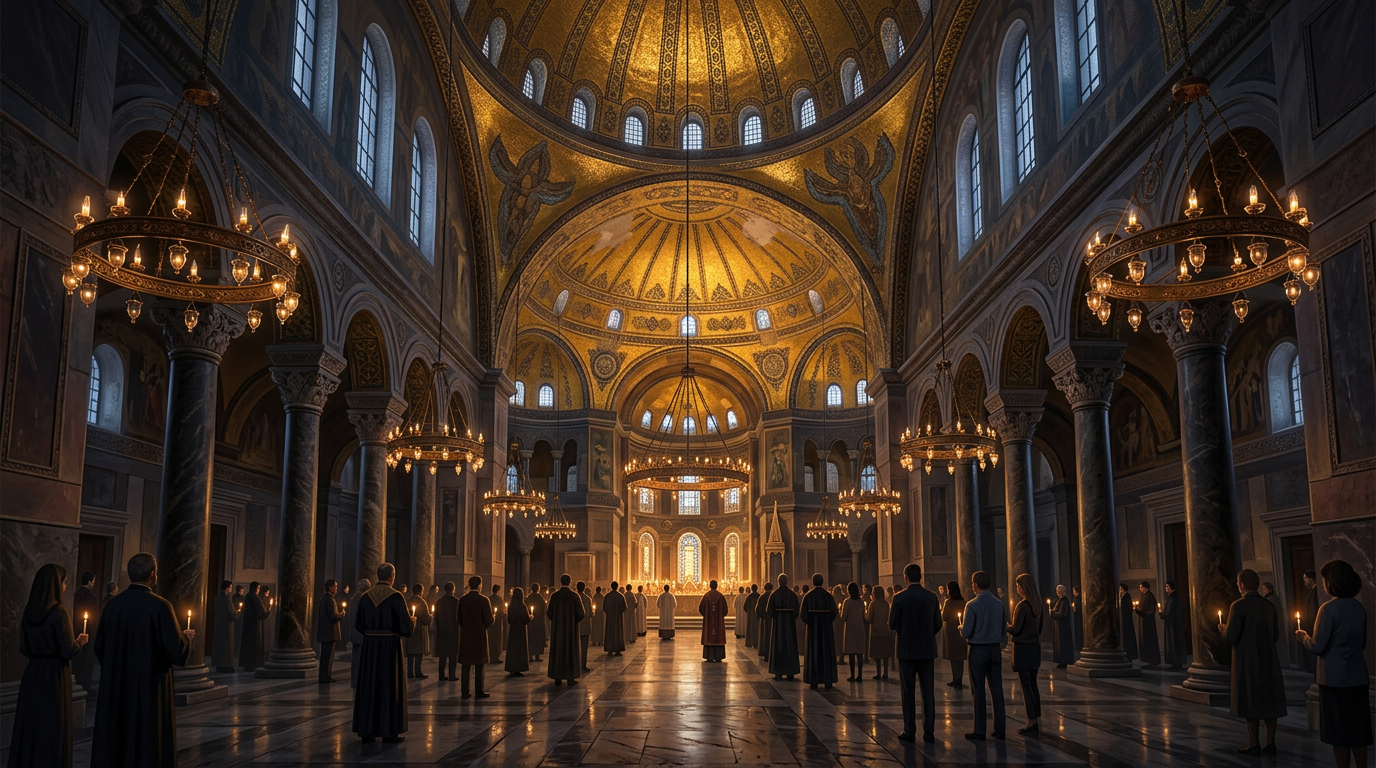
Justinian’s Hagia Sophia replaces two earlier churches on the site, the second destroyed in the Nika revolt. Anthemius of Tralles and Isidore of Miletus designed a vast nave crowned by a dome on pendentives: curved triangular sections that let a circular dome rise over a square bay. Light enters through windows at the dome’s base so the vault can seem to hover. Marble revetments, reused columns and later mosaic programmes made the interior a theatre of imperial liturgy. The building served as the patriarchal cathedral and the stage for coronations. Procopius’s account of the church stresses wonder at the dome; later legend gave Justinian a boast about surpassing Solomon. Whether or not he spoke the line, the political claim is clear: the Christian emperor builds a house of wisdom that rivals ancient temples.
Earthquakes forced repairs; Isidore the Younger rebuilt the dome after a collapse in 558. Later Armenian and Palaiologan repairs answered further damage. After 1453 the Ottomans converted the church to a mosque, added minarets and covered Christian mosaics. A secular museum phase in the twentieth century allowed mosaic conservation; the building functions again as a mosque while remaining a UNESCO-listed monument. For art history, Hagia Sophia is both structure and image field: architecture that made Byzantine sacred space imaginable for centuries. Later cross-in-square parish churches shrink that ambition into local stone, yet they still orbit the same idea of a luminous centre over gathered worshippers.
The Deesis mosaic, Hagia Sophia south gallery (often dated c. 1261)
In the south gallery, reserved for imperial use, a monumental Deesis shows Christ between the Virgin and John the Baptist. The faces carry a softness and modelled light that many viewers contrast with earlier, more abstract mosaics. Scholarship commonly links the panel to restoration after Michael VIII Palaiologos retook Constantinople in 1261, though dates proposed in the literature still range more widely and no contemporary text names the patron with certainty. Treat the “1261” tag as the prevailing working hypothesis, not a signed commission. Damage and loss around the lower bodies remind you that survival is partial; what you see is already an edited ruin.
The subject itself is older and flexible. Middle Byzantine ivories and processional crosses already show Christ with intercessors. What startles here is scale and flesh: a late imperial capital announcing return through an image of plea and mediation. Comparisons with Italian panel painting of the late thirteenth century appear often in teaching; influence likely moved in more than one direction across the Mediterranean. Stand where court elites once stood, and the mosaic’s quiet intensity reads as politics as much as piety.
Ivory and the portable court image
For a work you can study under museum light, take a Middle Byzantine ivory such as the Met’s Reliquary Casket with the Deesis, Archangels and the Twelve Apostles (950–1000, probably Constantinople). The lid stages Christ enthroned between the Virgin and John; apostles occupy the sides in pairs. Solid ivory construction and carved Greek inscriptions mark elite devotion in a handheld format. Related tenth-century triptychs, including the Harbaville Triptych in the Louvre, pack saints around a Deesis with traces of original colour and gilding. Early imperial ivories such as the Barberini ivory in the Louvre push the same court language backward into Justinianic triumph, with an emperor on horseback receiving homage beneath a bust of Christ.
These objects travel. Crusaders, diplomats and later collectors moved them west. They also prove that “Byzantine style” is not only wall glitter. The same frontal saints and intercessory logic operate at the scale of a book or a box. When you meet one in a museum case, ask who could open it, where it sat in a treasury, and which liturgy or private prayer it served.
Iconoclasm and the reinvention of sacred images
Iconoclasm (“image breaking”) names the Byzantine state’s campaigns against figural religious images in roughly 726–787 and 815–843. Imperial legislation barred production and use of such images; the cross became the preferred church decoration. Archaeology in Constantinople and Nicaea shows icons destroyed or plastered over. Very few Early Byzantine icons survive; exceptions include textiles, panels preserved at the Monastery of Saint Catherine on Mount Sinai, and images on coins. Provinces and border monasteries sometimes kept practices the capital tried to suppress. That uneven enforcement is why Sinai’s collection matters so much for Early painted panels.
The debate turned on whether honour paid to an image reached the holy person represented, or stuck idolatrously on wood and paint. Exodus prohibitions against graven images supplied scripture for the iconoclast side. Defenders of images argued for a distinction between worship due to God and relative honour paid through the image to the prototype. Causes remain contested: some scholars stress Islamic pressure and military crisis; others stress imperial control of church property and doctrine. After 843, the “Triumph of Orthodoxy” restored image veneration. Subsequent art shows tighter portrait types for saints, more standardised church programmes, and favoured subjects such as the Anastasis (Harrowing of Hell) and the Koimesis (Dormition of the Virgin).
Icons after Iconoclasm include biographical frames around a central saint, metal revetments over painted panels, and later miniature mosaics. Theology and workshop habit now justified the image as a channel of prayer. Church decoration settled into habits a visitor can still map: Pantokrator in the dome, Virgin in the apse, narrative feasts on walls, saints at reachable height. That story deserves its own full treatment; within this period survey, Iconoclasm is the hinge that separates Early abundance from Middle Byzantine system.
How Byzantine art travelled and mutated
Missionaries and marriage alliances carried Constantinople’s visual language into Slavic lands from the ninth century onward. Local painters adapted facial types, dress and architecture while keeping Greek inscriptions or translating them. Court centres at Kiev, Ohrid and later Moscow built churches that announce Orthodox belonging through dome, fresco and icon. After 1204, Crusader states and Venetian looting relocated relics, enamels and marble. Saint Mark’s in Venice became a western showcase of Byzantine spoils and mosaic skill. Western medieval painters borrowed gold grounds and Virgin types; Duccio and others reworked Byzantine models into Italian panel traditions.
Islamic courts also sat in dialogue with Byzantine makers. Middle Byzantine secular architecture absorbed eastern decorative ideas; luxury arts moved both ways across frontiers. Shared craft knowledge in glass, textiles and metalwork does not require shared theology. Diplomacy and gift exchange moved objects even when armies faced each other. Late Byzantine monasteries kept producing for Orthodox communities under Latin and then Ottoman rule. The empire’s political end in 1453 did not end the style. Cretan workshops of the fifteenth and sixteenth centuries trained painters who worked for both Orthodox and Latin clients; El Greco’s early formation belongs to that afterlife.
Mutation is not dilution. Each region selected what liturgy and patronage required. Ravenna’s sixth-century mosaics answer Justinianic politics. A fourteenth-century Serbian church answers a different court. Sicilian Norman kings hired mosaicists who could speak Byzantine visual Greek for Latin rulers. The shared grammar remains readable if you know the types.
Reception: critics then and now
Byzantine writers defended or attacked images in theological treatises more often than they wrote formal art criticism. After Iconoclasm, sermons and liturgical texts assume the restored icon. Western Renaissance and Enlightenment writers frequently ranked Byzantine art as a decline from Greece and Rome: flat, repetitive, priest-ridden. Vasari’s progressive story of art had little room for a millennium of sacred frontality. Collectors still prized enamels and ivories as curiosities while dismissing wall programmes as “primitive.”
Nineteenth-century travellers and early photographers changed access. Twentieth-century Byzantinists (Weitzmann, Mango, Krautheimer, Belting and others) rebuilt technical and historical study. Museum exhibitions reframed gold and enamel as court culture rather than curiosity. Conservators’ cleaning of mosaics in Istanbul and Ravenna altered what students see in textbooks. Debates continue over dating (the Hagia Sophia Deesis is one live file), over how much classical revival to read into Middle Byzantine art, and over how to discuss Ottoman and modern uses of former churches without erasing Christian or Islamic histories. Heritage politics now sits inside every visit to Hagia Sophia or the Chora; the art-historical task is to keep the Byzantine image programme legible without pretending later histories did not happen.
For a student today, the useful shift is simple. Ask what the image did in ritual, not whether it looks “advanced” by Renaissance standards. That question unlocks San Vitale as politics and Hagia Sophia as engineered light.
What Byzantine art left behind
Western medieval and Renaissance painting inherited gold grounds, hierarchical composition and Marian types through Venice, Sicily and the Crusader East. Orthodox lands kept the icon and the dome-centred church as living practice. Modern artists from the Symbolists to Matisse looked at icons and mosaics when they wanted frontality and colour freed from academic modelling. Architectural historians still treat Justinian’s Hagia Sophia as a structural landmark for pendentive domes. Even classroom posters of “medieval art” lean on Ravenna gold and Pantokrator faces more often than on obscure provincial frescoes.
Museum collections concentrate portable wealth: the Met, Louvre, British Museum, Vatican and many others hold ivories, enamels and icons that once moved in diplomatic gift networks. Standing monuments in Istanbul, Ravenna, Thessaloniki, Sicily and the Balkans remain the large-scale classroom. If you want to plan visits around holdings rather than a single famous name, Exhibo’s museum directory lists institutions by collection strengths.
The durable lesson of Byzantine art is continuity under pressure. Courts shrink, capitals fall, images get plastered and uncovered again. The frontal saint and the glittering vault keep returning because they solved a problem: how to make holiness present to a body in a room.
FAQ
What is Byzantine art in one sentence?
Byzantine art is the Christian art and architecture of the Eastern Roman Empire centred on Constantinople from the fourth century to 1453, known for gold-ground mosaics, sacred icons, domed churches and a frontal, symbolic figure style.
What is Byzantine art most famous for?
Mosaics in churches such as San Vitale in Ravenna and Hagia Sophia in Istanbul, portable icons, and the architectural type of the domed church. Ivory, enamel and illuminated manuscripts carry the same sacred types into smaller formats.
How is Byzantine art different from Roman art?
Roman art often pursued naturalistic portraiture and mythological narrative for civic and domestic settings. Byzantine makers kept Roman craft skills but redirected them toward Christian liturgy and imperial ceremony, favouring frontality, gold light and hierarchical clarity over illusionistic space.
Were Byzantines Greek or Roman?
Citizens of the empire called themselves Romans and saw their state as Rome continued. Greek became the dominant language of court and church, especially from the Middle Byzantine period. Modern labels (“Byzantine,” “Eastern Roman”) are historians’ tools for that Greek-speaking Christian Roman world.
When did the Byzantine art period end?
Political Byzantine rule ended with the Ottoman conquest of Constantinople in 1453 (Mistra and Trebizond followed in 1460). The artistic tradition continued in Orthodox and post-Byzantine workshops for centuries afterward.
What caused Byzantine Iconoclasm?
Exact causes are disputed. The controversy concerned whether religious images were lawful; Old Testament bans on idols were central texts. Scholars also weigh military crisis, contact with Islamic aniconism, and imperial bids to control church practice and wealth. Figural images returned to official favour after 843.
Where can you see Byzantine art today?
Istanbul (Hagia Sophia, Chora/Kariye), Ravenna’s churches, Saint Catherine’s Monastery on Sinai, and museums with strong medieval holdings such as the Metropolitan Museum of Art in New York and the Louvre in Paris. Many regional museums across the Balkans and Italy hold local Byzantine and post-Byzantine works.
Is Byzantine art the same as Orthodox icon painting?
Icons are central to Byzantine and later Orthodox practice, but Byzantine art also includes architecture, mosaic, fresco, manuscript illumination, metalwork, enamel and ivory. Icon painting continues after 1453 as a living tradition; it should not be collapsed into the historical empire alone.
Related reading
Van Lévé: Sovereign Caribbean Visions Take Shape at Harvard
A transnational survey charts twenty-five years of Creole and Maroon artistic practice across the French Caribbean and Amazonia.
Harvard's Alain Locke Gallery presents a landmark survey tracing contemporary production from Guadeloupe, Martinique, Guyane, and Haiti since two thousand and one.
Gustave Fayet: Collector—Artist Designer
A comprehensive survey at the Fondation Louis Vuitton reuniting collected masterpieces with the designer's own studio practice.
The Paris institution expands its patronage series with a dual-focused examination of Gustave Fayet, bringing together hundreds of acquired works and restored creations to chart his impact on early modernism.
Mohammad Alfaraj: The Heart Is a Bird's Nest, the Brain Is a Spider Web
First European institutional solo explores cross-species kinship and domestic ecologies
Mohammad Alfaraj's latest showcase at the Delfina Foundation merges multimedia installations with regional folklore to reimagine shared habitats.