
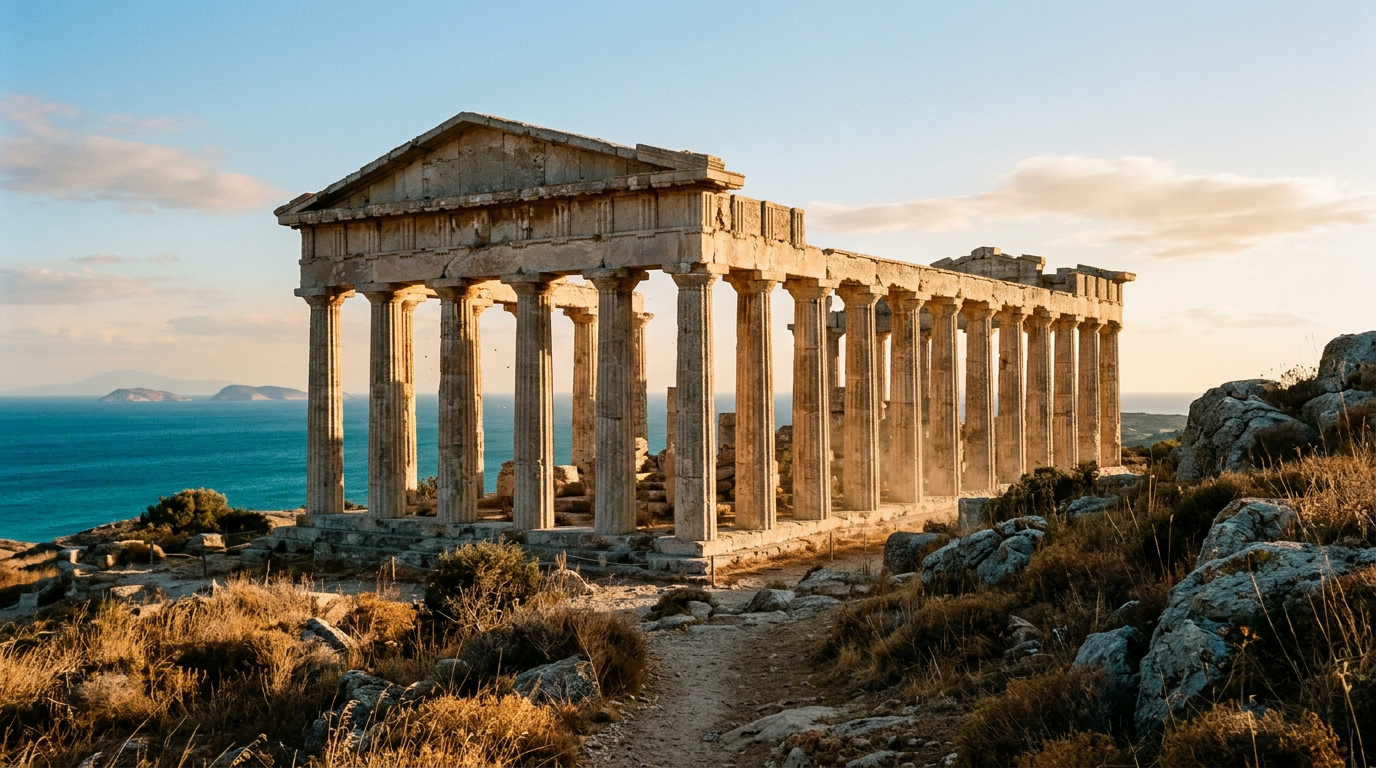
Exhibo Editorial
Ancient Greek Art
From Geometric grave markers to Hellenistic drama: how Greek workshops taught the Mediterranean world to see the human body
Ancient Greek art is the pottery, sculpture, metalwork, jewellery, painting and temple decoration produced by Greek-speaking communities from the early Iron Age through the Hellenistic centuries. Most museum surveys treat that span as four stylistic chapters: Geometric, Archaic, Classical and Hellenistic. The Art Institute of Chicago places the arc roughly between about 900 and 30 BCE; the Metropolitan Museum of Art’s Heilbrunn essays refine the same story with different start-years for Geometric patterning (from about 1050 BCE) and a conventional Hellenistic close at the Battle of Actium in 31 BCE. What ties the chapters together is a sustained interest in the human body, first as pattern and later as idealised, then dramatised, flesh.
This article follows that arc as a period survey. It asks what social and religious conditions put images to work, how styles change across pottery and stone, which named makers and workshops leave fingerprints, and how four objects repay close looking. Sculpture appears here as evidence of period taste, not as a casting or carving manual. For the wider sequence of Western periods this piece sits beside, see the Periods of Art History series hub. The sibling survey of ancient Egyptian art shows a different brief for the body; Greek contact with Egyptian and Near Eastern forms is noted where it matters, without retelling the Nile story.
The conditions that produced Greek image-making
Greek art grew inside city-states (poleis) separated by mountains and sea, yet linked by language, festivals and trade. From the Geometric centuries onward, communities founded sanctuaries, wrote with an alphabet adapted from Phoenician scripts, and planted colonies along coasts from Asia Minor to Sicily, North Africa and Spain. The Met’s essay on colonisation and trade stresses that those routes carried goods and craftsmen as well as settlers. A potter in Corinth or Athens could sell to Etruscan buyers; an island sculptor could take a commission for a mainland sanctuary. Regional dialects and alphabets differed, yet Greeks still gathered at Panhellenic sites such as Olympia and Delphi, where dedications from east and west shared the same sacred ground.
Wealth and rivalry drove building. Autonomous cities competed by raising stone temples, commissioning votive statues and filling sanctuaries with bronze figurines, armour and painted vessels. Rulers such as Peisistratos of Athens and Polykrates of Samos used architecture as civic advertising in the Archaic period. Later, after the Greek victories over Persia in 490 and 479 BCE, Athens turned the Delian League’s treasury into an imperial surplus. Under Perikles (active ca. 461–429 BCE), that surplus paid for the marble programme on the Akropolis, including the Parthenon dedicated to Athena. Politics funded style. Democracy for adult male citizens, oligarchy elsewhere, and royal courts in Macedonia each preferred different subjects, yet all needed images that made status and piety visible.
Daily life supplied other briefs. Banquets (symposia) used decorated cups and mixing bowls; athletes needed prize amphorae; funerals demanded grave markers that held memory in clay or stone. Myth and cult were not separate from these uses. A black-figure amphora showing Ajax and Achilles at a board game still sat on a table; a kore dedicated on the Akropolis still stood as a gift to a goddess. You meet Greek art, then, as objects with jobs: to mark a tomb, thank a god, celebrate a victory, or stage a story for drinkers who already knew the plot.
Survival bias shapes what you see. Bronze freestanding statues were preferred in the Classical centuries for their strength and sheen, yet few fifth-century originals remain; Roman marble copies and literary descriptions fill the gap. Wall painting is mostly lost. Pottery and architectural sculpture survive in greater bulk, which is why vase painters can look more familiar than the muralists ancient writers praised. Treat the museum case as a filter, not as the whole workshop floor.
Gender and class shaped who appeared and how. Citizen male nudes dominate the innovative edge of freestanding sculpture; elite women appear draped as korai or later as goddess types; enslaved and labouring bodies surface more often on pots than on temple pediments. Athletic victory, military equipment and symposium furniture all mark a world of free male leisure and competition. When Hellenistic art widens the cast to children, the elderly and genre “types,” it expands the market as much as it softens the ideal. Keep that social filter in view when a gallery wall seems to speak for “the Greeks” as a whole.
What ancient Greek art is
“Ancient Greek art” is a modern umbrella for visual production across those centuries and across a diaspora of cities rather than a single kingdom. Style periods are scholarly scaffolding. They help you place a stiff Geometric mourner beside an Archaic kouros, a High Classical temple figure, and a Hellenistic Nike with wind-pressed drapery. They do not mean every workshop flipped a switch in the same year. Provincial habits lagged; classicising revivals returned; Roman collectors later ordered copies that freeze Classical prototypes in later marble.
The four main periods used by museum education programmes and by the Art Institute of Chicago run as follows. Geometric art rebuilds figural imagery after the collapse of Bronze Age palace culture, using compass-drawn patterns and stick-like humans on monumental grave vessels. Archaic art absorbs Near Eastern and Egyptian contact, invents large stone kouroi and korai, and perfects black-figure then red-figure vase painting. Classical art, conventionally from the Persian Wars to the death of Alexander the Great in 323 BCE, pursues naturalistic yet idealised bodies, architectural sculpture of measured grandeur, and theoretical systems of proportion such as Polykleitos’s lost Canon. Hellenistic art, from Alexander’s successors to Actium, widens subjects, intensifies emotion and movement, and serves royal courts from Macedonia to Egypt and western Asia.
| Period | Approx. dates (BCE) | Visual markers | Typical find contexts |
|---|---|---|---|
| Geometric | ca. 900–700 (patterning from ca. 1050) | Meanders, concentric circles; stick figures; chariots and horses | Grave markers (kraters, amphorae); early sanctuary bronzes |
| Orientalising / early Archaic | ca. 700–600 | Near Eastern animals, griffins, sphinxes; denser narrative | Trade hubs; Crete, Rhodes, Corinthian exports |
| Archaic | ca. 600–480 | Kouros/kore types; Archaic smile; black- then red-figure | Sanctuary dedications; Attic cemeteries; temple pediments |
| Early Classical (“Severe”) | ca. 480–450 | Quieter faces; early contrapposto; sober drapery | Post-Persian Akropolis debris; temple sculpture |
| High / Late Classical | ca. 450–323 | Ideal proportion; Parthenon programme; Praxitelean softness | Civic temples; grave stelai; Roman copies of bronzes |
| Hellenistic | 323–31 | Drama, pathos, genre types, royal portraiture | Royal capitals (Pergamon, Alexandria); sanctuaries; private luxury |
Those brackets match Met essays for Classical (ca. 480–323) and Hellenistic (to 31 BCE) and the museum’s Geometric and Archaic surveys for the earlier centuries. Absolute years still shift slightly between handbooks; use them as working ranges. If you want Egyptian comparisons for how a different civilisation locked the body into a long-lived canon, the ancient Egyptian art survey is the place; Greek workshops borrowed poses and motifs without adopting that funerary theology.
Media and visual habits you can recognise
Before named masters matter, you need the habits that make an object read as Greek in a gallery. Greek makers worked clay, marble, limestone, bronze, gold, ivory and (mostly lost) paint on walls and wood. Architecture ordered those media: a Doric or Ionic temple was a machine for sculpture, offering and festival procession. Across media, the human figure remains the main carrier of meaning, whether reduced to a Geometric silhouette or inflated to Hellenistic pathos. Myth supplies plots; athletics and war supply bodily ideals; gods take human shape more often than animal hybrids, though hybrids arrive with eastern motifs in the seventh century.
Colour is part of the story and often missing from the room. Marble statues and temple details carried paint; bronzes held inset eyes and coloured details; vases already announce their palette. Nineteenth-century taste preferred “pure” white stone, and that preference still trains the eye. When you stand before a stripped marble youth, you are seeing a survivor, not the finished surface the ancient viewer met.
Painted pottery as the densest archive
Attic and Corinthian pottery give you the largest continuous archive of Greek drawing. Corinthian workshops of the seventh and sixth centuries filled fields with animals and plant motifs in silhouette. Athenian painters preferred myth and daily life. Black-figure technique paints figures in glossy black slip against the clay ground, with details cut through the black; red-figure reverses the relationship so the body stays the colour of the clay and the background goes black, freeing the brush for musculature and gesture. The Met dates the invention of red-figure to about 530 BCE in the workshop of the potter Andokides. By the mid-sixth century, Attic black-figure already dominated Mediterranean export markets; red-figure then carried the Classical body’s new fluency onto cups, kraters and amphorae.
Painters such as Sophilos, Exekias, the Amasis Painter, Euphronios, Douris, Makron and the Berlin Painter leave recognisable hands even when signatures are absent. Subjects range from gods and heroes to athletes, musicians, armouring scenes and funerary visits. Panathenaic prize amphorae, tied to games established at Athens about 566 BCE, keep black-figure Athena on one side as a conservative brand even after red-figure wins elsewhere. When wall painting vanishes, these vessels become your proxy for how Greeks staged narrative in two dimensions.
Sculpture as period evidence, not a technique course
Freestanding sculpture tracks the same chronology with different survival rates. Archaic kouroi stand frontal, left foot forward, fists clenched, hair patterned; korai wear drapery and often hold offerings. The New York kouros in the Met (Attic, ca. 590–580 BCE) still shows Egyptianising proportions and pose, as the museum’s Archaic essay notes, while later kouroi loosen the grid. Early Classical works shift weight onto one leg (contrapposto), drop the Archaic smile, and treat flesh as bone and muscle under skin. High Classical bronze originals rarely survive; Roman marble copies of Polykleitos’s Diadoumenos or Doryphoros type circulate the lost canons. Hellenistic sculpture then multiplies types: sleeping Eros, aged genre figures, royal portraits, and victory monuments with wind-driven cloth.
Architectural sculpture binds figure to building. Pediments, metopes and friezes turn myths into civic statements. The Parthenon’s mid-fifth-century programme remains the textbook case: Athena’s temple as imperial Athens made stone. Later, the Great Altar at Pergamon (sculptural frieze now in Berlin’s Pergamonmuseum; often placed in the first half of the second century BCE) pushes Gigantomachy into baroque turmoil. Treat these programmes as evidence of what patrons wanted seen in public. How a bronze was cast or a block carved belongs to a separate technique brief, not this survey.
Key figures and workshop personalities
Greek art rarely hands you a Vasari-style biography. Many vase painters are modern names of convenience (“Berlin Painter”) built from stylistic clusters; others sign. Sculptors known from ancient literature often survive only as Roman copies or as architectural supervisors. Still, a short cast of names orients you.
Among potters and painters, Exekias (active mid-to-late sixth century BCE) compresses myth into taut black-figure drama. The Andokides Painter stands at the red-figure invention. Early Classical and High Classical red-figure hands such as the Berlin Painter and the Kleophrades Painter refine anatomy while keeping pot shapes readable from a distance. These artisans worked for export as much as for local use; their “audience” included drinkers in Italy who never saw the Akropolis.
Among sculptors, Kritios and Nesiotes are tied to the Tyrannicides group that replaced statues the Persians removed; the so-called Kritios Boy on the Akropolis is associated with that circle by resemblance, not by signature. Pheidias directed the Parthenon’s sculptural ambition and made the chryselephantine Athena Parthenos inside the cella (lost; known from descriptions and small reflections). Polykleitos of Argos wrote the Canon and modelled athletic males whose Roman copies still teach contrapposto. Praxiteles, in the fourth century, broke the draped-female convention with the Aphrodite of Knidos type: a slender nude whose fame ancient writers amplify even though the original is gone. Skopas of Paros worked across the eastern Mediterranean, including on the Mausoleum at Halicarnassus. Lysippos, court sculptor to Alexander, stretched proportions and set a heroic ruler type that Hellenistic kings reused.
Workshops matter as much as genius. Island marble yards on Naxos and Samos; Rhodian goldsmiths; Lakonian bronzeworkers; Corinthian and Attic potters: each region specialised. Signatures on vases sometimes name potter and painter separately, a reminder that a “masterpiece” could be a collaboration between thrower and decorator. Sanctuary inventories and dedicatory inscriptions add patrons’ names even when the carver stays silent. By the Hellenistic age, kings at Pergamon and Alexandria funded libraries, museums and court luxury, and Greek artists travelled farther for commissions. The Met’s Hellenistic essay notes that Rome itself became a production centre by the first century BCE as collectors imported Greek taste. That Roman appetite is the hinge into a later story; this survey stops before Roman art takes the lead.
Four works that repay close looking
Period labels stay abstract until you spend time with objects you can check in catalogues. Surveys that only list “famous statues” leave you with names and no method. The four works below sit at different points of the timeline and in different media, chosen so you can move from Geometric clay to Archaic marble, Early Classical balance and Hellenistic drama without treating sculpture as a craft manual. Each answers a distinct question: how Geometric funerals looked in public; how Archaic stone first monumentalised the youth as dedication or grave marker; how Early Classical weight-shift changed the standing body; how Hellenistic victory turned drapery into weather on a sanctuary terrace.
Locations and dates follow museum and excavation records. Where scholars disagree on year or patron, both positions are named rather than forced into a single legend. None of these readings replaces standing in the room; each trains you to ask what job the object had, who paid for it, and what later viewers stripped away when paint, arms or context vanished. If you use them as a museum itinerary, start with the Met’s Geometric and Archaic galleries, then Athens for the Kritios Boy, then Paris for the Nike.
Hirschfeld Workshop krater (Metropolitan Museum of Art)
The monumental terracotta krater attributed to the Hirschfeld Workshop (Met 14.130.14; Late Geometric I, ca. 750–735 BCE; height 108.3 cm) stood as a grave marker in Attica. The main frieze shows the deceased on a bier, household members beside him, mourners at either side. The checkered shroud that would cover the body is lifted into a rectangular pattern so the corpse remains visible. Below, chariots and foot soldiers process. The museum notes that hourglass shields and chariots evoke ancestral heroics more than literal contemporary warfare. Empty of inscriptions, the scene still teaches Geometric priorities: clarity over illusion, status through ritual display, the dead man as the centre of a public performance of grief.
Stand back and the vase is architecture in clay: stacked registers, repeated meanders, a silhouette language that turns people into signs. Lean in and you see how early narrative already wants sequence: mourning above, honour parade below. This is Greek figural art rebuilding itself after the Bronze Age collapse, centuries before the Classical body becomes famous.
New York kouros (Metropolitan Museum of Art)
The Met’s marble kouros (32.11.1; Attic, ca. 590–580 BCE) is an early large-scale freestanding youth of the Archaic type: nude, frontal, left foot advanced, arms at the sides. The museum’s Archaic survey cites Egyptian influence in pose and proportions. Patterned hair, schematic knees and a rigid symmetry still dominate. Such statues served as sanctuary dedications or grave markers for aristocratic families, especially for the young dead. They are less portraits than statements that a body of a certain class stood here and deserved memory.
Compare him to later Classical athletes and you see what Archaic workshops valued: order, frontal address, the figure as a durable offering. The famous “Archaic smile” on many korai and kouroi is a carving convention for liveliness, not a mood diary. This youth’s job was permanence in a cemetery or temenos, not psychological confession.
Kritios Boy (Acropolis Museum, Athens)
The Kritios Boy (Acropolis Museum, Acr. 698; Parian marble; under life-size) marks the Early Classical turn. The torso was found in 1865 on the Akropolis; the head turned up in 1888 in debris linked to the Persian destruction of 480 BCE. Scholars still debate whether the statue was made just before or just after that sack; the Acropolis Museum presents it as characteristic of work after the Persian Wars and associates it with Kritios (or Kritias) or that sculptor’s circle. Perseus Project notes the dating dispute and the resemblance to Harmodios in the Tyrannicides group by Kritios and Nesiotes.
What you see is the point either way. Weight settles on one leg; the other softens. The spine responds; the head turns slightly; the Archaic smile is gone. Kenneth Clark later called related shifts “the first beautiful nude in art,” a modern verdict that captures the shock without explaining the ancient brief. For a period survey, the boy shows Greek sculpture learning to stage a standing body as a living balance system. He is period evidence of a new grammar of pose, not a how-to lesson in marble carving.
Nike of Samothrace (Louvre Museum, Paris)
The Nike of Samothrace (Louvre; marble; generally placed in the early or mid-second century BCE) alights on a stone ship’s prow. Excavated in the Sanctuary of the Great Gods on Samothrace, she was made as a victory monument whose exact historical dedication remains argued: Rhodian, Pergamene, Macedonian and even Roman naval contexts have been proposed in specialist literature. The sculpture’s force does not depend on settling that debate. Wind presses the drapery against the torso and whips the mantle behind; the missing arms and head do not cancel the body’s forward surge. Hellenistic art here chooses drama, movement and site-specific theatre over Classical calm.
Seen after the Kritios Boy, she shows how far Greek workshops travelled in three centuries: from a quiet weight-shift on the Akropolis to a goddess of victory riding weather itself in a northern Aegean sanctuary. Colour once sharpened the effect; the Louvre’s white display is again a modern condition of viewing.
How Greek styles spread and mutated
Greek art was never only Athenian. From the Geometric period, colonies and trade planted workshops overseas. Southern Italy and Sicily (Magna Graecia) adopted Greek temple forms and later produced their own painted pottery. Eastern Greeks on the Asia Minor coast refined Ionic architecture and large marble sculpture. Contact with Lydia, the Levant and Egypt in the seventh century introduced motifs Greeks remade into local myth. The Archaic “Orientalising” phase is that absorption, not a loss of identity.
Classical Athens exported taste through empire, festival culture and potters’ markets. After Alexander’s conquests (334–323 BCE), the map changes scale. The Met’s Hellenistic essay traces how the Diadochoi carved kingdoms: Seleucids in the Near East, Ptolemies in Egypt, Antigonids in Macedonia, Attalids at Pergamon, and further dynasties in Asia Minor and Bactria. Court festivals, palace decoration and royal portraiture pull artists into new subjects. Aphrodite types secularise older religious imagery; children, the elderly and “grotesque” bodies enter the repertoire; precious stones travel new trade routes into jewellery. Alexandria and Pergamon build libraries and collections that treat art as historical inheritance as well as commission.
Mutation also means revival. Hellenistic makers copy earlier styles while inventing new ones. Affluent private buyers order garden sculpture and luxury bronzes. By the first century BCE, Roman elites become the most avid collectors, filling villas with Greek originals and copies. Wall paintings from sites such as Boscoreale echo lost Macedonian court painting. Octavian’s victory at Actium in 31 BCE ends Ptolemaic rule and, by convention, the Hellenistic period. What follows is Roman art’s absorption and remaking of Greek models: a sibling story reserved for the planned Roman art survey, not expanded here.
Critics then and now
Ancient writers already ranked artists. Pliny the Elder, Pausanias and others preserve names, anecdotes and lost masterpieces, often filtered through Roman collecting culture. They praise technical marvels and famous nudes; they also transmit hierarchies that later Europe treats as gospel. When the originals vanish, those texts become both evidence and distorting lens. A modern reader of Pliny meets Greek art as a Roman shopping list of wonders as much as a Greek workshop history.
Modern criticism reinvented Greek art for its own needs. Johann Joachim Winckelmann’s eighteenth-century histories enthroned Classical Greek sculpture as the peak of noble simplicity and quiet grandeur, often through Roman copies and through a preference for unpainted marble. Neoclassical academies taught that preference as law. Twentieth- and twenty-first-century archaeology and conservation have pushed back. Traces of pigment on statues and architecture, experimental reconstructions, and museum displays of polychromy argue that the “white Greek” is a reception myth. Debates continue about how saturated ancient colour was and how to show it without turning galleries into speculative theatre. The argument matters because it changes what “Classical harmony” looked like in lived ritual light.
Other disputes sit at the edge of this survey. Dating of transitional works such as the Kritios Boy remains contested. Attributions of unsigned vases are scholarly constructs that can shift. The Parthenon sculptures, divided between Athens and London, sit inside a live restitution and museum-ethics conflict; any close looking at those blocks now happens inside that politics. Hellenistic victory monuments such as the Samothrace Nike attract competing historical readings of who paid and why. Good practice is to separate what the object shows from what later empires claimed while owning it.
Popular summaries sometimes flatten Greek art into “the invention of naturalism” or “perfect beauty.” The Geometric mourner and the Hellenistic drunk old woman (a type known through copies) refuse that flatten. Idealisation was a Classical project with a social address: citizen male bodies, athletic excellence, gods in human form. Other centuries had other jobs for the figure. Read critics with their century attached.
What Greek art left behind
Greek workshops left a toolkit later cultures kept reopening: contrapposto; architectural orders; myth as figure cycle; the nude as a vehicle for ideas about virtue, desire and power; the habit of naming makers. Roman art copied and relocated that toolkit across the Mediterranean. Medieval and Byzantine artists selectively preserved and remade classical forms inside Christian briefs. Renaissance and Neoclassical academies treated Greek (often via Roman) sculpture as the school of drawing. Modern and contemporary artists still quote kouroi, Nike drapery and red-figure silhouettes, sometimes to honour them, sometimes to break them.
In museums, Greek galleries train the Western eye to expect periods, masterpieces and white stone. That training is historically produced. Visiting museums with Greek collections, you can correct it in person: look for paint traces, read labels for “Roman copy after,” compare a Geometric krater’s abstraction with a Hellenistic baroque frieze, and keep Egyptian and Near Eastern rooms in the conversation as sources of contact rather than as foils for a unique miracle.
The durable residue is less a single style than a set of problems Greeks kept working: how a city shows piety and power; how a body stands so that viewers believe in weight; how myth stays legible on a pot across the sea; how victory and grief become public form. Those problems outlast Actium. They are why “ancient Greek art” remains a live search term and a live argument, not a closed chapter.
FAQ
Searchers ask the same handful of period and fame questions that People Also Ask panels recycle: what Greek art is known for, how many periods to memorise, whether statues were white, who the big names were, and where to see the objects. The answers below stay inside this survey’s fence. They define periods, looking habits and afterlives. They do not turn into a casting or carving lesson, and they do not hand the story to Rome beyond the hinge at Actium. Use them as a quick reset after the long arc above, then return to the named works when you want proof in clay or marble.
What is ancient Greek art known for?
Museum and encyclopaedia summaries stress naturalistic yet idealised human bodies, especially innovative male nudes, alongside temple architecture and narrative pottery. That fame tracks Classical and Hellenistic sculpture more than Geometric pattern or Archaic rigidity. Across the whole span, Greek art is also known for turning myth and civic religion into portable and architectural images that travelled with trade and colonisation.
What are the four main periods of ancient Greek art?
Geometric, Archaic, Classical and Hellenistic. Exact year ranges vary by handbook; a common teaching frame runs from about 900 BCE to the later first century BCE, with Classical brackets often given as ca. 480–323 BCE and Hellenistic as 323–31 BCE. Some surveys insert an Orientalising phase between Geometric and mature Archaic to mark seventh-century Near Eastern influence.
Did Greek statues always look white?
No. Scientific and conservation work documents paint and other surface finishes on many sculptures and architectural members. White marble galleries reflect later taste, collecting habits and loss of pigment, not a universal ancient preference for bare stone. Bronzes likewise used coloured inlays that rarely survive.
What is the difference between Archaic and Classical Greek sculpture?
Archaic freestanding figures favour frontal kouros and kore types, patterned hair and the so-called Archaic smile. Classical sculpture develops weight-shift (contrapposto), quieter facial planes and idealised anatomy tied to civic and athletic ideals. Early Classical (“Severe”) style sits between them after the Persian Wars.
Who were the most important ancient Greek artists?
Names survive unevenly. Vase painters such as Exekias and the Berlin Painter are known from signatures and stylistic attribution. Sculptors such as Pheidias, Polykleitos, Praxiteles, Skopas and Lysippos dominate literary accounts; their bronzes often survive only as Roman copies or reflections. Many works remain anonymous workshop products.
How did Greek art influence later periods?
Roman collectors and artists copied Greek types at scale. Renaissance and Neoclassical academies rebuilt training around classical proportion and myth. Modern museums still organise Western art history with Greek periods as a foundational chapter. Influence includes architecture (orders), sculpture (nude and contrapposto) and the habit of treating the human body as the central expressive problem.
Where can you see major works of ancient Greek art today?
National Archaeological Museum and Acropolis Museum in Athens; the Louvre; the British Museum; the Pergamonmuseum in Berlin; the Metropolitan Museum of Art in New York; MFA Boston; and regional museums such as Reggio Calabria for the Riace bronzes. Many “Greek” gallery pieces are Roman copies; labels usually say so.
Is Hellenistic art part of ancient Greek art?
Yes. Hellenistic art is the Greek and Greek-speaking production of the kingdoms after Alexander until the Roman defeat of the last major Hellenistic dynasty at Actium (31 BCE). It belongs inside the ancient Greek survey even when capitals sit in Egypt or Asia Minor, because the visual language remains Greek while absorbing new subjects and court briefs.
Related reading
Van Lévé: Sovereign Caribbean Visions Take Shape at Harvard
A transnational survey charts twenty-five years of Creole and Maroon artistic practice across the French Caribbean and Amazonia.
Harvard's Alain Locke Gallery presents a landmark survey tracing contemporary production from Guadeloupe, Martinique, Guyane, and Haiti since two thousand and one.
Gustave Fayet: Collector—Artist Designer
A comprehensive survey at the Fondation Louis Vuitton reuniting collected masterpieces with the designer's own studio practice.
The Paris institution expands its patronage series with a dual-focused examination of Gustave Fayet, bringing together hundreds of acquired works and restored creations to chart his impact on early modernism.
Mohammad Alfaraj: The Heart Is a Bird's Nest, the Brain Is a Spider Web
First European institutional solo explores cross-species kinship and domestic ecologies
Mohammad Alfaraj's latest showcase at the Delfina Foundation merges multimedia installations with regional folklore to reimagine shared habitats.