
Exhibo Editorial
Roman Art, Explained
From Republic verism to imperial marble: how Romans used portraits, reliefs, mosaics and painted walls as political tools.
Roman art is the sculpture, painting, mosaic, luxury craft and monumental architecture made for Roman patrons from the Republic through late antiquity, across Italy and the provinces of an expanding empire. Workshops borrowed heavily from Etruscan and Greek precedents, then put those forms to Roman jobs: ancestral display, civic honour, imperial messaging, temple cult and the decoration of houses and baths. The result is not one “style name” but a set of habits you can recognise: faces that argue character, reliefs that narrate campaigns, and interiors that turn walls into marble, gardens or myth.
This survey follows that toolkit from late Republican verism through Augustan classicism, Flavian and Trajanic historical relief, Hadrianic Greek taste, third-century abstraction and Constantinian revival. Dates below lean on Metropolitan Museum of Art Heilbrunn essays and related museum catalogues; absolute years for some buildings remain debated, so treat ranges as working brackets. For the Nile valley programme that preceded Mediterranean classicism in museum galleries, see Ancient Egyptian Art. The planned sibling on ancient Greek art (pending) will carry the Hellenic takeover this piece only cites. Broader period context sits in the Periods of Art History series hub. Collections holding related material appear across the museums directory.
Conditions that made Roman art possible
Rome began as a cluster of settlements on the Tiber. By the late Republic it governed provinces from Spain to Asia. That political scale created demand for images that could travel: coin portraits of magistrates and emperors, marble busts shipped to municipal forums, silver plate and cameos for elite households. The Metropolitan Museum’s essay on the Republic stresses how conquest and diplomacy filled Rome with loot, wealth and Greek-trained craftsmen. Generals brought statues home after triumphs. Collectors ordered marble replicas of famous Greek types for gardens and baths. Greek artists moved to the capital as patrons paid.
Etruscan practice already shaped Roman habits before that Greek flood. Tomb painting, terracotta temple sculpture and elite funerary display taught Romans to treat images as social instruments. Wax ancestor masks (imagines) worn in funeral processions, then kept in the household shrine, made likeness a political asset. Rosemarie Trentinella’s Met essay on Roman portraiture traces how private busts and tomb reliefs grew from that funerary root: a face proved lineage, office and virtus (duty, bravery, sober morality). Public statues ordered by the Senate for commanders carried inscriptions listing career and ancestry (cursus honorum). Image and text worked as a pair.
Urban engineering supplied the architectural stage. From the third century BCE Roman builders exploited concrete (opus caementicium) with pozzolana mortar that set under water and allowed vaults and domes without a forest of columns. Brick-faced concrete made baths, amphitheatres, warehouses and apartment blocks cheaper and faster than cut-stone masonry alone. Domitian’s palace on the Palatine, the Colosseum, Trajan’s markets and Hadrian’s Pantheon all depend on that material logic. Decoration then clad the shells: marble veneer, mosaic floors, painted plaster, freestanding sculpture. Art and infrastructure shared a budget.
Luxury crafts rode the same trade routes. Glassblowing, spreading in the first century BCE, flooded the market with cups, unguentaria and window panes that undercut older ceramic tableware. Cameo glass and sardonyx gems served court circles who wanted Hellenistic sparkle without always importing eastern stone. Silver hoards such as the Tivoli material in Met galleries show domestic display grade metalwork sitting beside political sculpture. Colour completed almost everything you now see as white: paint on marble statues, gilding on architectural detail, dyed textiles on cult images. When you meet a bare stone torso in a museum, you are looking at a stripped survivor of a polychrome object.
Crisis sharpened patronage as much as prosperity. Civil wars of the first century BCE, Julio-Claudian succession dramas, the Year of the Four Emperors, third-century military pressure and Diocletian’s Tetrarchy each forced new portrait types and monument programmes. When the Senate condemned an emperor after death (damnatio memoriae in modern scholarly shorthand), workshops chiselled names from inscriptions and recarved busts for the next regime. Recycled marble with flattened ears or odd hairlines still shows that violence. Survival bias matters for you as a viewer: Campanian houses buried in 79 CE preserve wall painting that Rome’s own later rebuilds erased; Egyptian mummy portraits survive where wooden panel paintings of triumphs do not. Portable loot moved faster than taste manuals. A single triumph could dump Greek bronzes into Roman forums and reset what a senator thought a garden should contain.
What Roman art is, and how to recognise it
Modern museums group “Roman art” as the visual culture of the Republic and Empire, roughly from the mid-Republic into the fourth century CE, with provincial production continuing longer. Artsy and survey textbooks sometimes stretch the label toward Byzantine Constantinople; for Christian imperial imagery after Constantine’s eastern capital, see Byzantine Art, Explained. Here the focus stays on pagan and early imperial civic programmes, domestic decoration and the portrait system that made emperors recognisable from Britain to Syria.
There is no single Roman look. Late Republican aristocrats favoured wrinkled, thin-lipped faces that signalled experience. Augustus (r. 27 BCE–14 CE) reset the official type toward classical Greek youth. Flavians returned to fleshy realism; Trajan quoted Augustan calm; Hadrian grew a philosopher’s beard; Caracalla set a military scowl; Constantine enlarged the eyes and smoothed the planes. The Met’s “stylistic cycle” essay treats those swings as deliberate political rhetoric, not fashion alone. Architecture adds another register: concrete vaults, arches and domes that Greek post-and-lintel temples never required.
When you walk a gallery, track function before beauty. A bust may be funerary, honorific or cultic. A mythological Venus may decorate a bath, not a temple. A mosaic of fish belongs underfoot in a bathing suite. Romans treated Greek models as a repertoire they could quote, remix and recontextualise. Copying was industry, not failure. Pliny the Elder’s Natural History and later archaeological catalogues show how Roman demand preserved Greek compositions we would otherwise know only from literary description. The recognition skills below are tools for that walk: faces first, then narrative stone, then the decorated room and the vaulted shell that held it.
Portraiture: verism, idealism and the imperial type
Republican elite portraits stress age. Wrinkles, thinning hair, sunken cheeks and tight mouths stage virtus as visible labour. The Met educator volume on Roman art notes that classical Greek portraiture often idealised, Hellenistic work grew more naturalistic, and Republican Romans pushed physiognomy further because they located individuality in the face. Bodies could be generic or borrowed from Greek athletic types; the head carried identity. Busts cut at the chest or shoulders became a Roman specialty. Funerary reliefs of freedmen and their families line tomb facades with similar sober faces, claiming civic belonging after manumission.
Augustus changed the public grammar. Official types show him forever young, with locks arranged over the forehead in a recognisable pattern. Successors in the Julio-Claudian house echoed that hair and bone structure so viewers linked their rule to his peace. Caligula’s few surviving portraits still read as family members of that programme; many others were destroyed or recarved after his death. Private cameos could go further: a Met sardonyx of Augustus with aegis and spear borrows Hellenistic royal divinity for a court circle, while public statues kept him primus inter pares, first among equals.
Later emperors used hair, beard and expression as readable brands. Hadrian’s beard advertised Greek culture. Antonine portraits keep curly hair and calm adulthood. Marcus Aurelius and Commodus push psychological modelling; Caracalla’s furrowed brow and turned head broadcast military urgency in a strained empire. Constantinian heads combine third-century large eyes with Trajanic short hair and clean shave. Once you learn a handful of these types, coins and marble start to date themselves. Women’s portraits track empress coiffures with equal precision: stacked curls under the Flavians, elaborate braids under Severan court fashion. Hairstyle is a dating device as reliable as an inscription when the stone still holds drill work in the locks.
Relief, mosaic and the painted room
Historical relief is Rome’s clearest public narrative medium. Processions, sacrifices and battle scenes wrap altars, arches and columns so a walking viewer can follow a story in stone. The Ara Pacis and Trajan’s Column (treated below) are the textbook peaks. Arch of Titus reliefs of the Jerusalem spoils and the Arch of Constantine’s reused panels show how emperors also mined older monuments for legitimacy. Spoils, standards and bound captives teach politics to a crowd that may not read the Latin on the attic.
Mosaic turned floors and, later, walls and vaults into durable pictures. Hellenistic pebble and tessellated floors taught the craft; Romans of the late Republic placed ambitious emblemata (fine central panels) inside coarser borders. The Alexander Mosaic from the House of the Faun at Pompeii copies a late-fourth-century BCE painting of Issus in stone. Under the Empire, black-and-white geometric and marine floors filled baths and apartments at scale; glass tesserae climbed onto vaults. Subject often matched room: sea creatures underfoot where you bathed. North African and Syrian houses later favour dense figured carpets of hunting and myth that differ in drawing from Italian black-and-white suites while sharing the same social brief: show that the owner can afford a picture under every step.
Wall painting survives best from Campania and a handful of Roman and provincial houses. August Mau’s nineteenth-century classification of four Pompeian Styles remains the teaching scaffold, with overlaps and regional exceptions. First Style (c. 200–60 BCE in many Italian chronologies) imitates coloured marble veneer. Second Style opens illusory architecture and vistas (Boscoreale’s Met cubiculum, c. 50–40 BCE, is a high example). Third Style (Augustan into early first century CE) flattens the wall into ornamental fields with small central pictures. Fourth Style (mid-first century into 79 CE and beyond) remixes architecture, myth panels and decorative fantasy. Vitruvius already complained that painters invented architecture that could not stand. Treat the walls as evidence of taste and status, not as a how-to of plaster chemistry; technique manuals belong elsewhere in this programme.
Architecture as public sculpture
Roman builders treated large interiors as experiences you enter with your body. The bath complex is the clearest case: cold, warm and hot rooms sequenced under vaults, floors raised on hypocaust piers, walls thick with marble and mosaic. Caracalla’s baths in Rome held thousands; their vaulted halls later inspired museum spaces, including the Met’s Great Hall proportions. The amphitheatre and circus organised crowds around spectacle; the basilica organised law and commerce under a nave. Temple fronts kept Greek columnar language, while the cella behind might open into concrete vaults Greeks never needed.
Look for the join between structure and ornament. Coffers lighten a dome and create rhythm. Engaged columns and pilasters articulate a wall that is already load-bearing concrete. Coloured stone from Egypt, Asia Minor and North Africa maps empire onto the floor. Architecture here is not a silent container for “the art.” It is one of the primary arts Romans exported.
Patrons, workshops and named makers
Roman art history names patrons more often than painters. Emperors, senators, freedmen and municipal elites commissioned the work; workshops executed it, often anonymously. Augustus boasted that he found Rome a city of brick and left it marble; Agrippa’s building list (baths, Pantheon precursor, aqueducts) shows how a lieutenant could share that programme. Domitian hired the architect Rabirius for the Palatine palace. Trajan worked with Apollodorus of Damascus on forum, markets and the bridge over the Danube. Hadrian toured the provinces as a building emperor and filled his Tibur villa with Egyptianising and Greek quotations. Nero’s Domus Aurea employed the painter Fabullus (also spelled Famulus in some sources), one of the rare wall painters ancient writers mention by name. Signatures appear on some mosaics, gems and luxury silver, yet the market did not centre artist celebrity the way later Europe would.
Workshop organisation mattered more than genius myths. Official imperial portrait types seem to have been designed in Rome, then copied by provincial carvers who adjusted details for local taste. Coins moved the face faster than marble. Cameo cutters and glassmakers served court luxury; brick stamps and quarry marks track the industrial side of building. Women appear as patrons and as portrait subjects who copy empresses’ hairstyles as status signals. Livia’s villa network and later Severan court women funded and modelled taste. Plautilla’s rare surviving heads, including a Getty example of c. 200–205 CE, show how quickly a condemned empress could vanish from the visual record after exile and murder. Freedmen commissioned tomb reliefs that advertise newly won names and trades; those modest limestone plaques are as Roman as any forum statue.
Greek artists and models remain the background hum. Romans collected, copied and displayed Greek sculpture so widely that our knowledge of classical bronze originals often depends on Roman marble versions. That habit is reception, not a full account of Greek art itself. Keep the Greek story for its own survey; here the point is Roman use: a Diadoumenos type in a garden, a Venus in a bath, a philosopher bust in a library niche.
Chronology at a glance
The table below maps political brackets to visual habits you can test in museums. Dates follow common museum teaching ranges; brick-stamp debates around the Pantheon and similar buildings mean some monuments sit on disputed edges.
| Phase | Approx. dates | Political frame | Visual markers |
|---|---|---|---|
| Mid–late Republic | c. 200–27 BCE | Expansion; civil war | Veristic portraits; First–Second Style walls; early historical relief; Greek loot and copies |
| Augustan / Julio-Claudian | 27 BCE–68 CE | Principate; dynasty | Classicising emperor types; Ara Pacis programme; Third Style court taste; cameo luxury |
| Flavian | 69–96 CE | Post-civil-war dynasty | Fleshy realism; Colosseum and Palatine building; Arch of Titus spoils relief |
| Trajanic–Hadrianic | 98–138 CE | High Empire | Spiral historical narrative; Pantheon dome; Hadrianic beard and Greek revival |
| Antonine–Severan | 138–235 CE | Dynastic then military stress | Psychological portraiture; Caracalla type; bath complexes; provincial mosaic floors |
| Tetrarchic–Constantinian | 284–337 CE | Shared rule; Christian turn | Abstract group portraits; large-eyed Constantine; reused relief on arches; shift toward Christian capital arts |
Read the rows as patronage climates. A Hadrianic villa in Tivoli and a Severan mosaic in Antioch share an empire without sharing a workshop recipe. Provincial stone carvers and painters kept local habits inside Roman genres.
Four works that repay close looking
Named monuments beat abstract lists. A period label only becomes usable when you can test it against objects with findspots, dates and current homes. The four below sit at different points of the Roman system: a dynastic altar that sells peace as ceremony, a cuirassed emperor who wears diplomacy on his chest, a spiral column that turns two wars into continuous stone narrative, and a concrete rotunda that makes light itself the subject. Each still stands in Rome or sits in a major collection with published catalogue entries. None replaces standing in front of the piece; each trains you to ask what political or social job the image was hired to do, and which Greek or earlier Roman habit it quoted to get that job done.
Ara Pacis Augustae, Rome
The Senate commissioned the Altar of Augustan Peace on 4 July 13 BCE to mark Augustus’s return from Gaul and Spain; dedication fell on 30 January 9 BCE. Ovid and Augustus’s own Res Gestae record the event. The marble enclosure and altar originally stood in the Campus Martius near the emperor’s mausoleum; silt buried it, and the reassembled monument now occupies the Museo dell’Ara Pacis. Processional friezes show members of the imperial family and priests in measured strides. Mythological panels include Aeneas sacrificing and a personification often read as Tellus or Pax amid abundance. Acanthus scrolls fill lower registers with controlled natural growth.
What the altar argues is peace as dynasty. Bodies stay calm; drapery falls in classical folds; children appear in the procession as promises of succession. Compared with later Trajanic battle spirals, the Ara Pacis prefers ceremony over combat. Polychromy once brightened the white marble you see today. Stand at a corner and track how floral ornament and human frieze lock into one Augustan brand: fertility, piety, ordered return. Twentieth-century reconstruction and Mussolini-era siting added a modern political layer to the monument’s afterlife; the marble programme itself remains an Augustan brief about restored rites after civil war.
Augustus of Prima Porta, Vatican Museums
The marble statue found at Livia’s villa at Prima Porta (Vatican Museums) shows the emperor in military cuirass, arm raised as if addressing troops. Scholars usually date the type to the early empire, often around the last decades BCE into the early first century CE, as a marble version of a bronze prototype. The face follows the official youthful Augustan formula. Relief on the breastplate stages the return of Parthian standards, a diplomatic victory dressed as cosmic order: celestial figures above, personifications of provinces and the earth below.
The bare feet and Cupid on a dolphin at the support nod toward divine Venus ancestry claimed by the Julian line. Public portraits avoided full god-costume; this statue still elevates the body through Greek contrapposto and idealised anatomy. Compare it with a late Republican wrinkled bust in the same museum wing and you see the political reset in one glance: experience versus forever-young authority. The breastplate rewards slow looking. Each figure is a caption in stone for viewers who already knew the Parthian story from coins and speeches.
Trajan’s Column, Rome
Erected in Trajan’s Forum and completed by 113 CE (Britannica gives the building window as 106–113), the column rises about 38 metres with its pedestal. A continuous spiral frieze more than 200 metres long narrates the Dacian wars in stacked episodes: river crossings, fort building, embassies, battles, sacrifices. Apollodorus of Damascus is linked to Trajan’s building programme; the column’s designer remains discussed, yet the visual brief is clear. Viewers originally read bands from surrounding libraries’ galleries at several heights. Trajan’s ashes were placed in the base; a statue of the emperor once crowned the shaft (replaced in the sixteenth century by St Peter).
The relief invents a documentary tone. Dacians receive distinct costume and physiognomy; Roman soldiers build as often as they fight. Continuous narration without chapter breaks forces you to climb the story with your eyes. Later emperors reused the idea (Marcus Aurelius’s column). Cast collections in European museums isolate single bands for classroom study; the standing monument in Rome remains the primary text. Notice how Trajan recurs as a recognisable type inside the spiral, a moving portrait threaded through logistics and combat.
Pantheon, Rome
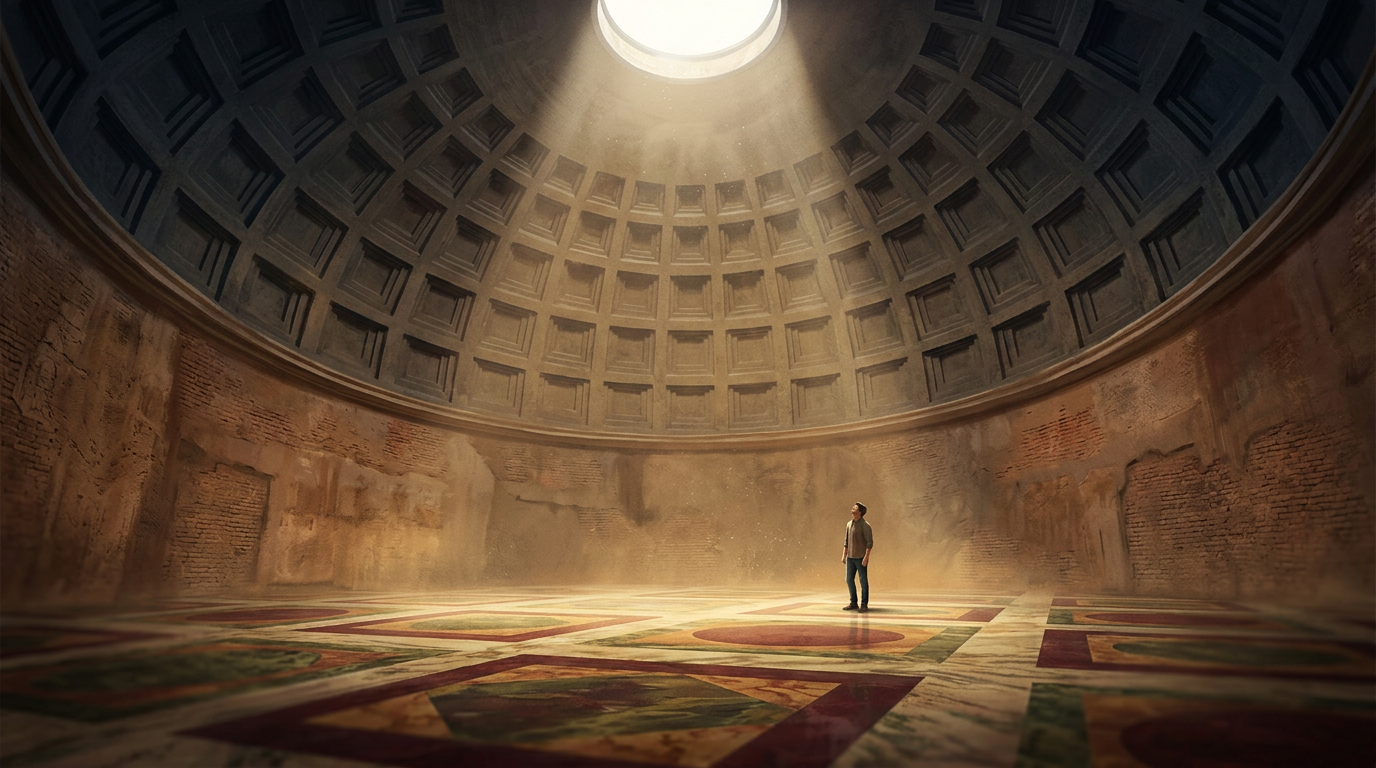
Marcus Agrippa’s Augustan temple on this site burned; the present rotunda is usually credited to Hadrian and often dated around the 120s CE, though brick-stamp studies still argue for Trajanic starts. The porch keeps Agrippa’s inscription, a deliberate historical fiction. Inside, a concrete dome about 43 metres across opens at an oculus that tracks daylight across coloured marble and coffers. The interior sphere sits in a cylinder: height equals diameter. No forest of inner columns interrupts the volume.
As art, the Pantheon is light, proportion and cladding as much as engineering. Floor and wall marbles from across the empire turn geology into imperial map. Bronze fittings and sculpture programmes changed with later Christian use (consecrated 609 CE as a church), yet the spatial idea survived. Thomas Jefferson later quoted the dome for the University of Virginia library; countless civic rotundas followed. Concrete here is not a hidden skeleton. It is the form. Stand under the oculus at different hours if you can: the moving disc of light is part of the design, not an accident of ruin.
How Roman art spread and mutated
Empire turned local workshops into a network. Gaulish, North African, Syrian and British floor mosaics share Roman genres while keeping regional drawing habits. Antioch’s villa floors (some now in American museums, including a Met Spring-type bust from Daphne) show Greek myth and abundance themes for wealthy holiday houses. Egyptian mummy portraits from the Fayum fuse Roman panel painting habits with funerary needs under imperial rule. Palmyrene reliefs blend Roman bust formats with local dress and Aramaic inscriptions. In Britain, villa mosaics at sites such as Bignor and Lullingstone adapt Mediterranean myth to northern floors; the drawing can look stiffer than Campanian work while the social claim stays the same: this house participates in Roman culture.
Architecture travelled as typology. Amphitheatres, basilicas, baths and aqueduct arcades marked towns as Roman. Provincial capitals raised imperial cult temples (sebasteia) with standard portrait types. At the same time, local stone and labour altered proportions. Soft limestone versus imported marble changes surface finish; paint and metal attachments that once completed statues rarely survive, so provincial pieces can look harsher than they did in use. Military camps and frontier towns needed functional baths and shrines first; decorative ambition followed wealth. Trade in sarcophagi from Attic and Asiatic workshops shows how even death could be ordered from a catalogue of mythological chests.
Late antiquity mutates the classical body. Tetrarchic porphyry groups (Venice’s Portrait of the Four Tetrarchs) lock rulers in near-identical military embrace, faces schematic. Constantinian art revives Augustan and Trajanic hair while enlarging eyes and flattening planes. Christian patronage then redirects mosaic and basilica design toward sacred narrative. Ravenna’s later churches and Constantinople’s court arts inherit Roman craft channels under new theology. That Christian Roman afterlife is the start of Byzantine art, not its full history: link out rather than absorb the icons brief.
Critics then and now
Ancient writers already argued about taste. Vitruvius mocked fantastical Second Style architecture that “neither is, nor can be, nor has been.” Pliny catalogued Greek artists and Roman collecting with a mix of admiration and moral worry about luxury. Elite voices such as Cato the Elder framed Greek elegance as a threat to Roman austerity even as Roman patrons bought Greek art by the shipload. The tension is the point: verism advertised Republican virtue while villas around the Bay of Naples staged Hellenistic pleasure. Satirists mocked social climbers who bought Greek statues by the lot without knowing the subjects. Collecting could look like virtue or like vanity depending on who wrote the paragraph.
Early modern Europe rediscovered Rome as a school. Renaissance artists measured columns and copied sarcophagi; Vasari’s lives still treat antique Rome as a quarry of models. Winckelmann later privileged Greek originals over Roman copies, casting Rome as secondary and training generations of travellers to apologise for the marble replicas they actually met. Nineteenth-century archaeology at Pompeii and Herculaneum flooded Europe with wall painting evidence and tourist cliché alike. Mau’s four styles organised that flood for classrooms. Grand Tour diaries and early photography further fixed a white, ruined Rome in the public mind, stripping paint and context.
Twentieth-century scholarship rebuilt Roman originality: historical relief, portrait cycles, concrete vaulting and the political intelligence of “copies.” Conservators recovered traces of polychromy; exhibitions stressed how painted marble changes the meaning of “classical.” Educator volumes from the Met and peer institutions now put function, provincial agency and workshop practice beside the famous names. Popular summaries still flatten Rome into “they copied Greece” or “Pompeii but pretty.” Both miss the brief. Romans ran a visual administration for an empire, and they used Greek forms the way a modern state uses classical columns on a courthouse: as usable authority, not as tribute alone.
What Roman art left behind
Neoclassical facades, museum casts of the Apollo Belvedere type, and civic domes all descend from Roman mediation of the classical past. Historical narrative relief feeds later victory monuments and national columns. Portrait busts remain a Western default for statesmen and donors. Mosaic floors reappear in medieval churches and modern lobbies. Even the word “palace” tracks back to the Palatine. Fascist and other authoritarian regimes of the twentieth century also quoted Roman arches and eagle standards; that afterlife is part of the monument history you meet in Rome’s modern fabric, including around the Ara Pacis.
For working artists and designers, Roman art offers durable lessons in rhetoric: how a face sells character, how a continuous frieze manages time, how a room’s decoration assigns behaviour. For students, the period trains you to separate Greek invention from Roman deployment without treating either as a moral contest. For visitors, the practical path is concrete. Walk the Ara Pacis and Pantheon in Rome; compare Augustan and Caracallan busts in the Met or Vatican; read a Campanian wall as social theatre rather than as a postcard. The museums directory helps locate public collections with Greek and Roman holdings. Keep fresco chemistry and Greek sculpture technique for their own explainers; this period survey stops where those fences begin.
FAQ
Searchers asking about Roman art tend to want a usable definition, a short list of media, and clarity on whether Rome only copied Greece. People Also Ask panels add questions about painting “styles,” famous artists and the difference from later Christian imperial art. Classroom quizzes push for numbered trait lists that history itself never issued as a manifesto.
The answers below follow those patterns and the confusions that show up beside museum labels. They stay direct on purpose; the sections above already carry the dates, monuments and source anchors you can verify against collection catalogue pages before you trust a one-line summary.
What is Roman art known for?
Portraiture that advertises character and office, historical relief that narrates campaigns and ceremonies, mosaic floors, painted domestic interiors, and concrete architecture at civic scale. Luxury media (cameos, silver, glass) carried the same political and social messages into private hands. Propaganda is a fair modern word for much imperial imagery, provided you remember funerary and decorative uses ran in parallel.
What are the four styles of Roman painting?
August Mau’s four Pompeian Styles describe changing wall decoration from the late Republic into 79 CE: masonry imitation (First), architectural illusion (Second), ornamental flat fields with small pictures (Third), and a complex mix of architecture and narrative panels (Fourth). Dates flex by site; later houses outside Campania continue related habits. The scheme is a teaching tool, not a law of nature.
Did Romans only copy Greek art?
They copied, bought, looted and commissioned Greek-style works at volume, and that industry preserves many compositions otherwise lost. They also developed portrait verism, spiral historical narrative, concrete vaulted architecture and a portrait-coin system tuned to imperial succession. Greek art supplies models; Roman patrons set new jobs.
Who is the most famous Roman artist?
Few painters or sculptors enjoy modern name recognition. Patrons dominate the record: Augustus, Trajan, Hadrian. Architects such as Apollodorus of Damascus and Rabirius, and the Domus Aurea painter Fabullus, appear in literary sources. Many of the best-known “Roman” statues in museums are anonymous workshop products or copies after Greek types.
What is the Roman art style called?
There is no single style name equivalent to “Impressionism.” Scholars speak of Republican verism, Augustan classicism, Flavian realism, Tetrarchic abstraction and so on, or of “Roman art” as a period label. Wall painting uses Mau’s four styles; sculpture follows political portrait cycles.
How is Roman art different from Byzantine art?
Roman art in the usual museum sense centres on pagan civic, funerary and domestic imagery under the Republic and early–high Empire. Byzantine art names the Christian visual culture of the Eastern Roman state centred on Constantinople, with gold-ground mosaics, icons and liturgical space as priorities. Constantine sits on the hinge; treat the Christian centuries as a successor survey.
Related reading
Van Lévé: Sovereign Caribbean Visions Take Shape at Harvard
A transnational survey charts twenty-five years of Creole and Maroon artistic practice across the French Caribbean and Amazonia.
Harvard's Alain Locke Gallery presents a landmark survey tracing contemporary production from Guadeloupe, Martinique, Guyane, and Haiti since two thousand and one.
Gustave Fayet: Collector—Artist Designer
A comprehensive survey at the Fondation Louis Vuitton reuniting collected masterpieces with the designer's own studio practice.
The Paris institution expands its patronage series with a dual-focused examination of Gustave Fayet, bringing together hundreds of acquired works and restored creations to chart his impact on early modernism.
Mohammad Alfaraj: The Heart Is a Bird's Nest, the Brain Is a Spider Web
First European institutional solo explores cross-species kinship and domestic ecologies
Mohammad Alfaraj's latest showcase at the Delfina Foundation merges multimedia installations with regional folklore to reimagine shared habitats.