
Abu Dhabi · United Arab Emirates
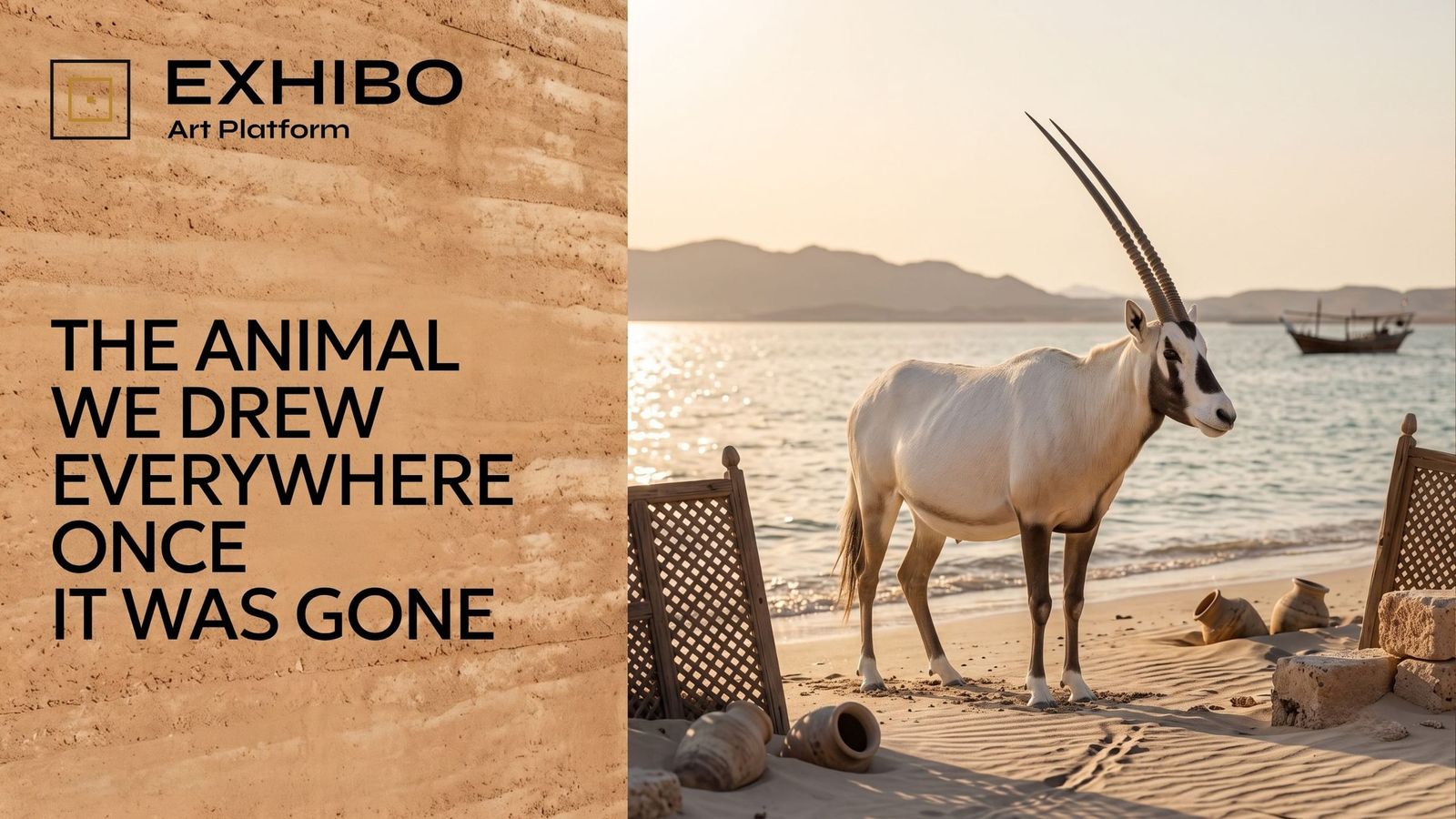
The Animal We Drew Everywhere Once It Was Gone
From Neolithic rock to airline tailfin — how the Arabian oryx vanished from the desert, came back from nine animals, and multiplied everywhere as a symbol in the very decades it was gone.
Look at the tailfin of a Qatar Airways plane as it turns onto the runway and you will see an oryx. Not a photograph of one — a silhouette, head and shoulders, the two long horns swept back into a maroon circle, stripped down to the few lines a logo can carry. The airline had carried the oryx in its identity since its relaunch in the 1990s, but the large head that now defines the tailfin arrived with the 2006 rebrand. Animal and lettering read as one clean mark. The oryx here reads as speed. It reads as reach, ambition, a small desert nation with a global carrier. It is a very good logo.
It is also almost the opposite of the animal it was drawn from.
The real oryx does not survive by speed alone. It survives by economy — standing still in the noon shade, going long stretches without drinking, getting much of its moisture from the plants it eats, wearing a white coat that reflects the sun by day. It endures by patience and by disappearing. And there is a harder fact folded into that tailfin, one worth sitting with: the oryx began to multiply as a symbol in the same decades in which it disappeared from the wild. It was declared extinct in the wild in 1972; the imagery that now marks Gulf airlines, currencies and stadiums took hold across the years when there were none left in the sand. The picture flourished while the animal itself was absent from the wild. Its image multiplied as its body vanished.
This is a piece about that gap — between the sign and the creature — and about a history that does not run in a straight line but in a circle: carved, mistranslated, hunted, extinguished, resurrected, franchised. The oryx is unusual among Gulf symbols: its story includes its own disappearance and return. That turns out to change everything about how you read it.
The animal on the rock
Start where the images start, on sandstone.
Arabia contains one of the world's great concentrations of prehistoric rock art — cliffs and outcrops recording thousands of years of shifting climate, animals and human life, from the Neolithic through to the first alphabets. At Jubbah and Shuwaymis in the north, at Bir Hima near the Yemen border, at AlUla, the rock is crowded with a whole desert bestiary: ibex, ostrich, gazelle, cattle, camels, hunting dogs. And among them, again and again, the oryx.
You can go and find a specific panel. At Ghowtah, a few kilometres east of Jubbah, there is a night-lit scene — recorded by the archaeologists who work the site — with three pairs of warriors and two oryxes near the top, a camel and her calf below, two ostriches tracked by a wolf, and an inscription in Thamudic — an early Arabian script of the first millennium BCE — cut alongside. This is not a one-off. A team of archaeologists has done the unglamorous work of counting: analysing the frequency of each animal across the panels of Jubbah, Shuwaymis and Al-Quwaiyah, sorting the game animals from the herded ones. The oryx sits squarely among the game — the hunted, the pursued, the prize.
That is the first thing the rock tells you, and it is worth being careful about. The oryx was carved, among other things, as something worth pursuing. We do not fully know why these animals were cut into the cliffs — the images may be a record of the hunt, or a claim of status, or something ritual we can only partly recover — but the oryx sits with the hunted, not the herded. The Neolithic carver and the poacher who shot the last wild oryx in 1972 were drawn to the same animal, even if we can no longer be sure they wanted the same thing from it. The panel is not simply a nature idyll. It is, at the very least, the opening page of a long relationship between this animal and human desire — the same appetite for the oryx that would, eventually, be amplified beyond all survivable limits by cars and high-powered rifles. Thousands of years of returning to this creature, carved in stone before anyone thought to worry about the returning.
One caution the archaeologists themselves insist on, and it is a useful discipline: not every horned figure on the rock is Oryx leucoryx. Researchers distinguish species by the coat pattern — at Bir Hima in the southwest, one specialist identified a scimitar-horned oryx, a species of wetter, steppe-like country, the first time it had been documented in Arabia at all. Some of the animals on these rocks belong to a greener past. The oryx we are following is a survivor of a landscape that dried out around it. It was drawn while the lakes were still there — which is to say it has been outlasting the end of its own world for a very long time.
The oryx did not stay on the rock. It walked into the visual record of every civilisation that touched the peninsula. The Egyptians captured it and kept it in managed enclosures — it turns up in tomb painting among the herded animals, a desert antelope brought into the ordered world of the estate. It appears in Assyrian relief, in the hunt scenes where kingship is performed through the killing of powerful beasts. And it appears, closer to home, on the Grand Tomb at Hili, in what is now Al Ain — a Bronze Age monument, part of a UNESCO site, carrying an image of an oryx in the same soil where, much later, the animal would be brought back from nothing. Keep Hili in mind. The oryx returns to that ground at the end of this story.
The animal seen wrong
Before the oryx was a national symbol it was a different kind of symbol, and getting there means a short detour through one of the most durable mistakes in the Western imagination.
One of the most persistent explanations for the unicorn is that it began, in part, as an oryx seen from the side.
This is not a whimsical claim; it runs straight through the serious literature of antiquity, though it is worth saying at the outset that the unicorn has several tangled roots — Indian travellers' tales, the rhinoceros, the biblical re'em — and the oryx is one strand among them, not the whole rope. But it is a strong strand. Aristotle describes a one-horned animal he calls the oryx — twice, in the History of Animals and On the Parts of Animals — and Pliny the Elder repeats the tradition in the Naturalis Historia. Whether the creature they had in mind was exactly the animal we now call Oryx leucoryx is itself a matter of interpretation, but to the Greeks and Romans this was not myth; it was natural history, and coming from Aristotle it carried the weight of the most respected naturalist alive. The proposed mechanism is almost banal once you see it, if the animal in question was indeed an oryx: it has two long, nearly straight horns, and glimpsed in profile the near horn hides the far one, so the animal appears to carry a single blade rising from its brow. Add the individuals that had genuinely lost a horn — snapped in a fight, worn down — and the illusion writes itself.
Then the mistake crossed a language, and stuck. When Jewish scholars in Alexandria translated the Hebrew Bible into Greek — the Septuagint, third to second century BCE — they met the word re'em, some powerful untamable beast, and rendered it monokeros, "one-horn." Jerome's Latin carried it as unicornis. The King James Bible printed it, in English, as unicorn. What the Hebrew re'em actually was has never been settled — wild ox, aurochs, rhinoceros and oryx have all been proposed — but the philologist Samuel Bochart, working through the animal names of scripture, identified it with the Arabic rim, which he understood as the Arabian oryx. Follow that one thread and the biblical unicorn — the medieval beast whose horn purified poisoned water, the creature only a virgin could capture — acquires an ancestor standing in the Arabian sand chewing saltbush.
Sit with what that means. The magic here is not invention out of nothing. It is an accurate observation — a real animal, a real profile — read at the wrong angle and passed down, in one of its strands, through a chain of translations until it hardened into a creature that never existed. The oryx did not inspire the unicorn the way a muse inspires a poem. It fed the unicorn, by mistranslation, optical and literal at once. Conservation groups repeat the connection warmly now — the straight horns "gave rise to the legend" — and the warmth is not wrong, but it skips the sharper point. For two thousand years, people looked at the oryx and saw something else. They still do. That is the through-line of the whole story, and we are only at the second turn of it.
There is a closer symbol than the unicorn, and it never left home. In Arabic the oryx is al-maha, and for as long as there has been Arabic poetry the animal has stood for beauty — specifically for the eyes. To praise a beloved, the poets reached for ʿuyūn al-mahā, the eyes of the oryx: large, dark, luminous, ringed in white, the highest standard of the gaze. The image runs from the pre-Islamic nasib, the amatory prelude of the desert ode, down through the Abbasid poets — one of them, Ali ibn al-Jahm, built a whole famous verse around the phrase — and it is still alive in the everyday: Maha remains one of the most common girls' names across the Gulf, carrying the oryx's eyes in it, and the word doubles as a name for the crescent moon, after the sweep of the horns. So while Europe was turning the oryx into a monster it had never seen, Arabia was keeping it as the measure of the most beautiful thing it knew. Two cultures met the same animal and made, from the same horns, a unicorn and a love poem.
The disappearance
Here is where the line snaps, and it is worth being precise about how, because the tidy version gets the cause wrong.
Traditional hunting had pursued the oryx for millennia, and the animal persisted through it — hunted on foot and by camel, and still there. What changed in the twentieth century was the efficiency of the hunt. After the Second World War came the car and modern firearms, and hunting parties crossed the sand with motorised machine guns. The animal that had outlasted the spear met the jeep and was gone inside a generation. This is the pattern behind almost every large-animal collapse of the century, and it is worth naming plainly: it was not the appetite that changed — the rock shows the appetite is ancient — it was the range and the rate. The desert had always been the oryx's protection. The engine cancelled the desert.
The rescue that followed is genuinely one of the strange, brave episodes of twentieth-century conservation, and it deserves telling without sanding off its edges. In 1962 the Fauna Preservation Society — a British body, now Fauna & Flora International — launched Operation Oryx. A team went into the deserts of southern Arabia to catch what were thought to be among the last wild animals. They came back with three. Looking at the expedition now, it reads like something from another age: a homemade "catching car," beer donated by a brewery to get the men through the heat, a telegram from the Duke of Edinburgh calling it a Noah's Ark operation. Three oryx, flown to Phoenix, Arizona — chosen for its desert climate — and joined there by animals from the London Zoo, from King Saud of Saudi Arabia, and from private hands. Nine animals in all formed the founding stock; the herd that grew from them became known as the World Herd.
There is something worth pausing on in that image, before the happy ending arrives. One of the last safety nets for an Arabian animal was a zoo in Arizona. The rescue was real, and it worked, and it was also shaped like its era — a largely British and American effort that saved the oryx by removing it to the other side of the planet, its survival held in trust nine thousand kilometres from the sand it came from. None of that is a reason to withhold the credit. It is a reason to notice who was holding the animal, and where, when the desert went empty.
The timing was exact, in the way that only disasters are. A decade after the expedition, in October 1972, the last known wild herd — reported as six animals — was killed or captured in the Jiddat al-Harasis in Oman. With that, the Arabian oryx was declared extinct in the wild. It existed, at that moment, only in Arizona and in a handful of private collections. A desert animal, kept alive on the far side of the Earth, as insurance against the desert.
And the insurance paid out. From nine founders the World Herd bred, and bred. In 1982, captive-bred oryx were released back into Oman. Other reintroduction programmes followed — Jordan had in fact begun its own as early as 1978, with Saudi Arabia, Israel and the UAE later joining the effort. By 2011 it had become the first species ever to recover from Extinct in the Wild to Vulnerable — a jump of three full Red List categories, unmatched by any animal before it. The Arabian oryx, as one conservationist put it, was basically gone and is now back in the game.
Two things get lost in the celebration, and both belong in an honest account. The first is genetic. Much of the modern conservation population descends from a remarkably small founding base — the herds are large, but the ancestry runs through a narrow gate. (The picture is not uniformly bleak: a 2022 study found that the Oman population alone still carried 58% of the species' globally observed mitochondrial diversity, drawn from more than one ancestral source.) Still, the shape of the thing is worth holding: the population is large; its founding history is not. The second loss is quieter and stranger. Fauna & Flora note the paradox themselves: the hard part was never breeding the oryx in captivity. It was returning it to the wild — because the wild it had been taken from was still the wild that killed it. You can manufacture the animal. You cannot so easily manufacture the place that will keep it alive. That sentence is the hinge of the whole conservation story, and most retellings hurry past it.
The island Sheikh Zayed built for it
Which is where an island comes in, because someone decided that if the wild could not be trusted to hold the animal, he would build a wild that could.
Off the coast of the Al Dhafra region lies Sir Bani Yas — an 87-square-kilometre island off Abu Dhabi. In the early 1970s it was desert scrubland with a scatter of archaeology on it. Sheikh Zayed bin Sultan Al Nahyan, the founding president of the UAE, set it aside for conservation around 1971, intending, in what one account calls, inevitably, a Noah's-Ark-like move, to build a refuge for the nearly extinct oryx and the animals that would follow it. He had, in the words of a guide who works there now, searched the world to see whether any oryx survived in captivity, found a handful, and started a breeding programme. The first oryx would arrive on the island later that decade — but before they could, he had to give them somewhere to live.
But you cannot keep a desert antelope on bare scrubland, so first he built it a landscape. In the late 1970s Sheikh Zayed began the island’s extraordinary programme of greening, and the numbers are the kind the voice of this piece likes to leave standing without comment: several million trees, many hand-planted — acacia, ghaf, frankincense, gum, mangrove — irrigated by desalinated water pumped out to the island through an undersea pipeline from the mainland. Millions of trees on a desert island, watered by a pipe under the sea. And the trees were not decoration. They were habitat, planted so that the oryx would have a world to be released into. This is the paradox from the last section, answered in the most literal way imaginable: if the wild that keeps the animal alive no longer exists, you desalinate the Gulf and grow one.
That same year, 1977, Zayed banned hunting across the country. The engine had cancelled the desert; the law tried to switch the engine off.
The island today is the strange, moving thing that project became. It is now the Arabian Wildlife Park, holding more than 17,000 free-roaming animals across dozens of species, among them one of the largest herds of Arabian oryx in the world — the few animals Zayed started with, now numbering in the hundreds, and part of the breeding stock that has fed reintroductions across the peninsula. There are giraffes stretching for the acacia, cheetahs — reintroduced in 2009 — under the ghaf trees, hyenas, gazelles, ostriches. The waters around it are a no-fishing zone. Development is deliberately capped, on the principle, as one writer put it, that the island belongs to the animals and the humans are an addendum, allowed to observe respectfully.
There is a deeper layer under the wildlife park, and it is worth a beat because it complicates the too-simple story of a brand-new country inventing itself. When they excavated the island they found, among dozens of archaeological sites, a Christian monastery dating to roughly the seventh and eighth centuries — a community of the Church of the East. As recently as 2025, a fresh excavation turned up a 1,400-year-old stucco cross that confirmed the adjacent courtyard houses had belonged to the monastic settlement — the kind of proof, one archaeologist noted, they had never quite had before. The island where an Arab Muslim ruler rebuilt a desert to save an antelope turns out to have been, thirteen centuries earlier, home to desert monks. Sir Bani Yas has been a place people came to make a life in an impossible landscape for a very long time. The oryx is only the latest thing brought here and kept alive against the odds.
Al Ain, and the return to the oldest ground
The island was the ark. The mainland is where the animal touched down.
The UAE's oryx programme did not begin on Sir Bani Yas but slightly inland, at Al Ain, where Sheikh Zayed started a conservation breeding programme in 1968 — four years before the last wild oryx was shot, which is the detail that matters. He was building the lifeboat before the ship went down. In 1978, four animals were moved from Al Ain out to Sir Bani Yas, and the island herd began. By 1999 the island held 311; by 2011, 450. In 2007 the first UAE herd was released into protected desert at Umm Al Zumul. By 2023 the country counted 8,016 Arabian oryx, most of them in the Abu Dhabi emirate, in the wild and in managed herds.
Now stand back and look at where this happened. Al Ain is the ground around Hili — the same oasis landscape whose Bronze Age Grand Tomb carries an image of an oryx. The animal was set into a monument here when the peninsula's people were first building in stone. It was hunted out of this landscape entirely by the twentieth century. And it was bred back into existence and released into the same wider landscape that still holds Hili and its carved oryx. The image and the animal came home to the same ground. Very few symbols get to complete that circuit. The rock waited four thousand years for the referent to return.
Arabia returns the favour
There is a second oryx, and its story rhymes with the first so closely it feels almost scripted.
The scimitar-horned oryx — Oryx dammah, named for the long curved blades on its head — belonged to the Sahara, not Arabia. And it did worse than the Arabian oryx: it was classified as Extinct in the Wild by the IUCN in 2000, with no last-minute herd hanging on in the sand. Gone.
What happened next reverses the direction of the first story. Abu Dhabi had kept and bred scimitar-horned oryx for decades — part of the conservation vision associated with Sheikh Zayed — building herds on Sir Bani Yas alongside the Arabian ones. Decades later the Environment Agency – Abu Dhabi assembled, out of the world's scattered zoo populations, a new World Herd — this one in Arabia, not Arizona. And in 2016, working with the Zoological Society of London, the Sahara Conservation Fund, the Smithsonian and the government of Chad, they began releasing scimitar-horned oryx back into the Ouadi Rimé-Ouadi Achim reserve in Chad — one of the most ambitious large-mammal reintroductions ever attempted, aiming at a self-sustaining wild herd of five hundred, with rangers recruited from local villages to hold the ground.
Watch the direction reverse. Half a century ago, Arabia's oryx survived because an international effort flew it out to Arizona, its safety held for a while on another continent. The scimitar programme runs the same machinery the other way: the world's scattered zoo populations gathered into a herd in the Gulf, then sent back to Africa. Both are international collaborations rather than any one nation's rescue — the 1962 herd drew on London, Riyadh, Kuwait and a US zoo; the Chad release runs through ZSL, the Smithsonian, a Chadian reserve and Emirati funding. What has changed is not that the credit passed from one civilisation to another, but that the Gulf, once a place where much of the rescue infrastructure was assembled elsewhere, is now also a place from which reintroduction is organised. The technique is identical — capture, breed, release, the Noah's Ark logic of 1962. The base of operations moved.
The first to be saved, the first to be struck off
But the wild that killed the oryx did not disappear when the animal came back, and the sharpest version of that fact lives in Oman — in the very ground where the last wild oryx died and the first reintroduced one was released.
Oman had, after all, earned the triumphant half of this story as much as anyone. It took the first reintroduced oryx in 1982 and gave the species back its actual desert; in 1994 the Arabian Oryx Sanctuary in the Jiddat al-Harasis — 27,500 square kilometres of it — became the first natural World Heritage Site inscribed on the Arabian Peninsula, the first place on the whole peninsula the world agreed to hold in trust. This was the ground the World Herd came home to. By 1996 it held around 450 oryx.
Then the same desert produced the other kind of first. On 28 June 2007, the Arabian Oryx Sanctuary became the first site ever removed from UNESCO's World Heritage List — not placed in danger, not warned, but struck off entirely, a thing that had never happened before in the history of the Convention. The reason was blunt: oil had been found, and Oman had cut the protected area by ninety per cent to allow prospecting. The oryx population on the site had collapsed from 450 in 1996 to 65, with four breeding pairs left, under poaching and habitat loss. UNESCO ruled that a sanctuary reduced by ninety per cent was no longer a sanctuary, and drew the line.
Hold the two firsts together, because the symmetry is almost unbearable. The Arabian oryx was the first species brought back from extinction in the wild through captive breeding and reintroduction. And the Arabian Oryx Sanctuary is the first place in history stripped of World Heritage status. The same animal, the same desert, the same decade's worth of headlines — the salvation and the forfeit written in the same hand. Nature and development argued over one stretch of sand, and that time, development won out — though the record UNESCO cites is broader than oil alone, taking in poaching, habitat loss and the sheer difficulty of holding a sanctuary together.
It is worth setting the decision in context, because the outside version flattens into a morality tale and the reality was a harder trade-off. It needs to be understood against Oman's development priorities at the time: the country was balancing hydrocarbon revenue against a conservation commitment that had acquired international standing. This is not a story of villains. It is a story of a real conflict — development against preservation — playing out in a place that had every reason to want both. The oryx just happened to be standing on top of the oil.
The symbol and the beast
Which brings us back to the tailfin, and to the gap we started with.
The oryx is everywhere in the Gulf now, as an image. Qatar made it one of its most visible national symbols — on the currency, the stamps, the emblem of the Olympic committee — but it belongs to a much wider Arabian landscape, serving as a national animal or emblem across the UAE, Oman, Jordan and Bahrain too. It is Orry, the ten-metre mascot of the 2006 Asian Games, still standing on the Doha Corniche in a sports vest with a torch in his hand, watching the skyline — a cartoon of the animal, given a makeover and left up as a landmark long after the games ended. The oryx gives its name to a football club, to hotels, to an international school, to a gas-to-liquids company. On Qatar's National Day, children dress as oryxes. The animal has been abstracted into a font-friendly silhouette and sent out to mean purity, freedom, endurance, ambition, the spirit of the desert — the qualities a brand wants, and the qualities a nation wants said about itself.
None of this is cynical, and it is worth being careful here rather than clever. A country choosing the oryx as its emblem is choosing an animal that genuinely embodies desert survival, and choosing, too, to be associated with one of the few unambiguous conservation victories the region can point to. That is a fair thing to want, and a true thing to celebrate. But the gap is real, and it is the most interesting thing about the whole story. The symbol was built from the animal's look — the elegant profile, the straight horns that once made a unicorn. The animal survives by everything the symbol leaves out: the stillness, the water drawn from its food and hoarded against the heat, the coat that works by not being seen, the ability to smell rain a hundred kilometres off and walk toward it across an empty plain. We made a logo of speed out of a creature whose whole genius is patience.
And the deepest version of the gap is the one the tailfin started us on. The oryx reached the height of its symbolic career — logos, mascots, national emblems — across the exact decades it was absent from the wild. The picture flourished while the animal was nowhere. And the same region holds both sides of the contradiction at once: the development decisions that have repeatedly competed with habitat protection — the Oman sanctuary was cut by ninety per cent to open it to hydrocarbon prospecting — and some of the most ambitious conservation programmes now trying to repair the loss, the reserves and breeding herds and cross-continental releases. The oryx is the perfect emblem of that doubleness — an animal the region nearly lost and then laboured to bring back — and the honest thing is to leave it as a contradiction, not to file it down into either a triumph or an indictment.
So look at the tailfin again. It is a beautiful mark, and it is telling the truth and missing it at the same time. The oryx it shows is fast, sharp, ascendant — a nation's idea of itself, drawn in two horns and a circle. The animal it was taken from has descendants in the Jiddat al-Harasis again, in the grass at Umm Al Zumul, and on an island greened with water piped under the sea — not moving, in the shade, waiting out the heat, descended in part from the founding animals that once lived in Arizona. Both are real. We have spent thousands of years drawing this animal — on the rock at Hili, into a unicorn, onto a fuselage — and so often the picture has been about something else. The oryx has almost always been made to stand for something we wanted. What it wanted was only ever the shade, and the water in the grass, and to be left in the sand.
Related reading
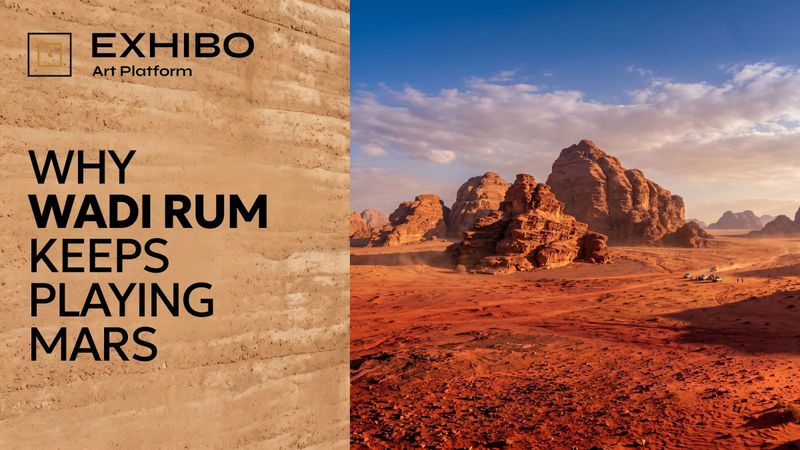
Why Wadi Rum Keeps Playing Mars: A Desert That Is Right About the Wrong Planet
A valley in southern Jordan has become cinema's favourite Mars — not because it is like the planet, but because it looks like the one we carry in our heads.
Put Wadi Rum beside a rover photograph and you can't tell which is Mars. But the desert shares almost nothing with the real planet except its colour — and lately, the illusion has grown powerful enough that real space missions have come to Jordan to rehearse.
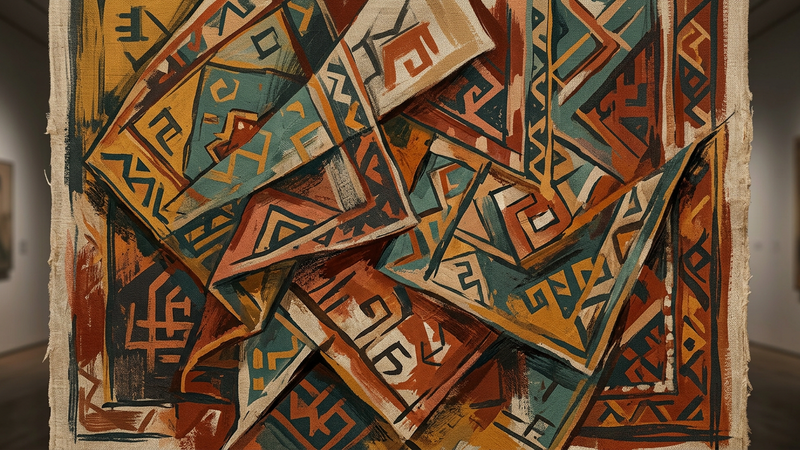
Threads of Heritage: Batima Zaurbekova's Woven Legacy
A survey of Kazakh tapestry pioneers redefines fibre art at Almaty's Kasteyev Museum
Eight decades after her birth, Batima Zaurbekova's textile innovations take centre stage in a major retrospective that bridges Central Asian craft and contemporary visual culture.
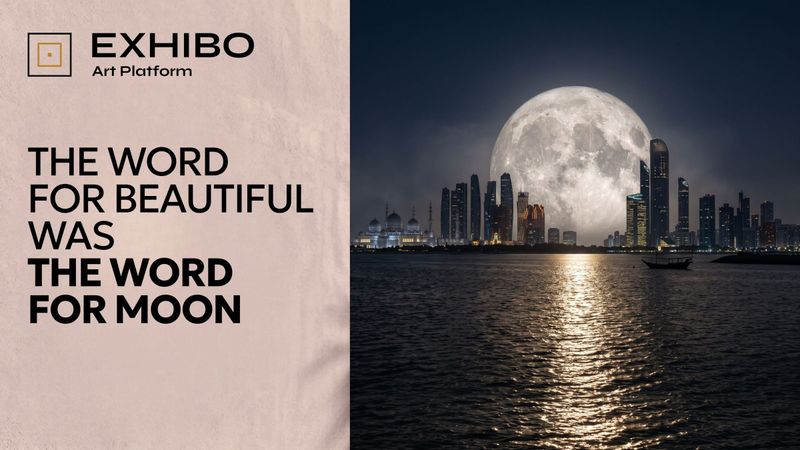
The Word for Beautiful Was the Word for Moon
The moon has been the measure of a beautiful face in Arabic verse for fifteen centuries — but beauty was only one of the things that light was ever asked to carry. A history of one disc, from a pre-Islamic ode to a glowing sphere over an Abu Dhabi harbour.
Ya qamar — you moon — is the oldest compliment in Arabic, and almost nothing about it means what we assume. The moon it praised was not always a woman, not always even a kindness, and in the end not only about beauty at all.