
Amman · Jordan
Why Wadi Rum Keeps Playing Mars: A Desert That Is Right About the Wrong Planet
A valley in southern Jordan has become cinema's favourite Mars — not because it is like the planet, but because it looks like the one we carry in our heads.
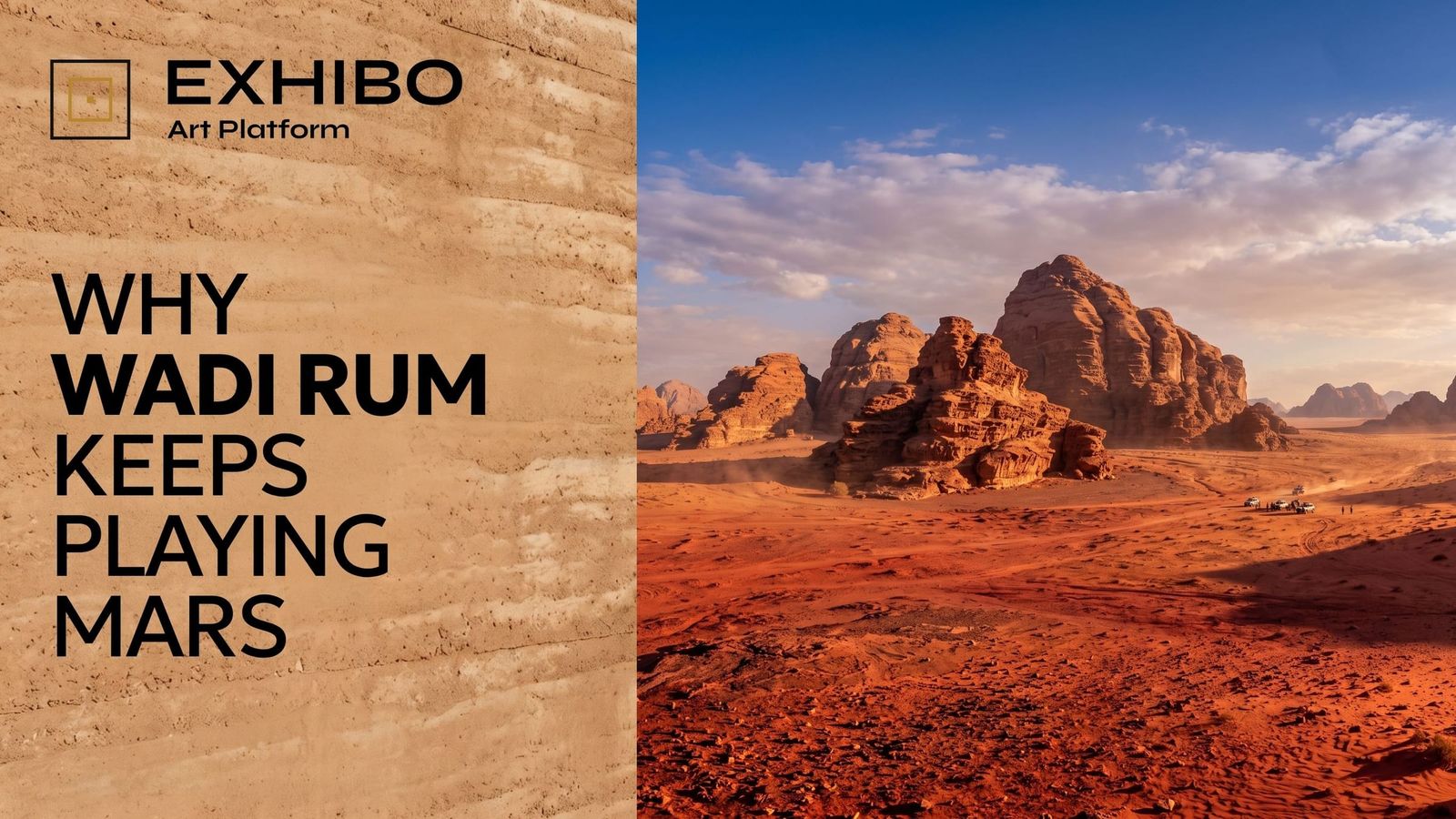
In the early summer of 2014, the production designer Arthur Max laid two photographs on a table in Ridley Scott's Los Angeles office. Both showed the same thing: a vast, rusted, copper-coloured emptiness, rock and sand the colour of dried blood, not a green thing anywhere, a place that looked as though it wanted you dead. One picture had been taken by NASA's Curiosity rover on the floor of Gale Crater, on Mars. The other was a desert in southern Jordan called Wadi Rum. According to the Hollywood Reporter, the two looked much the same. Scott shot the Mars scenes of The Martian in Wadi Rum, and later said of the location, with a shrug that has become slightly famous: "I didn't do anything but shoot it at the right time, from the right positions."
It is a good story, and like a lot of good stories about this desert it is true and misleading at once. Wadi Rum really does pass the blind test. Put its cliffs beside a rover panorama and a layperson cannot reliably say which planet they are looking at. But the reason it passes is not the reason you would assume. Wadi Rum is not, in any rigorous scientific sense, an especially good analogue of Mars — at least not the kind that matters most to a geologist. The word "analogue" covers a lot of ground: a place can stand in for Mars in its mineralogy, its chemistry, its climate, its isolation, or the way a crew behaves inside it, and these are different kinds of likeness that send researchers to different places. For the geology and surface chemistry of Mars, the scientists who need a piece of Earth that behaves like the Red Planet do not, on the whole, go to Jordan; they go to a naturally acidic river in Spain, or a frozen island in the Canadian Arctic, or a lava field in Idaho. Wadi Rum has been Mars in several films and an alien world in several more, and it has done it not because it shares Mars's chemistry, its gravity, its air or its temperature — it shares none of these — but because it gives a camera the specific handful of things we have decided Mars is supposed to look like. Red. Empty. Silent. Enormous. Old.
This is a piece about that gap: the difference between looking like a place and being like it, and what it means that a valley in Jordan has become the world's most convincing stand-in for a planet it resembles almost only in colour. Because the strange thing about Wadi Rum's second career is not that it fools us. It is that it fools us so completely, and stays so wrong underneath, and that the wrongness turns out to be the interesting part. Wadi Rum is an analogue of the image of Mars, not of the planet. And lately, in a twist nobody quite planned, the image has grown so authoritative that real space researchers have started coming to Jordan to rehearse what life on another planet might feel like.
What the desert gives away for free
Start with what is actually there, because everything the camera loves is real and none of it needs a computer.
The colour comes from rust. The sandstones of Wadi Rum were laid down hundreds of millions of years ago, when the region sat under an ancient sea, on top of a basement of granite more than half a billion years old. Iron in the rock and, more importantly, in the loose sand that drifts against it has oxidised over geological time, and the result is the deep brick-and-blood palette that reads, instantly, as Martian. Mars is red for a broadly kindred reason — oxidised iron in its surface dust — which makes the resemblance more than a lucky coincidence of appearance: two dry worlds whose iron-rich surfaces went, over deep time, the colour of oxidation. The colour is the one thing the two bodies come by honestly and independently, and it is worth noticing that it is also very nearly the only thing.
Then there is the shape of the place. Wadi Rum's floor is flat and open, and out of it rise sheer-sided massifs — inselbergs, "island mountains," rising several hundred metres almost straight from the sand — separated by wide corridors of sand. Later tectonic uplift and faulting, followed by long ages of wind and water erosion, carved the sandstone into the towers, arches and canyons that now stand alone on the plain. It is a landscape with almost no middle distance: you get foreground rock, a floor, and then the next wall of rock a long way off, with nothing human-scaled in between to tell your eye how big anything is. That absence of scale cues is exactly what makes it read as not Earth. There are no trees for reference, no fences, no telegraph poles, nothing your brain can use to measure the space, and so the space becomes unmeasurable, and an unmeasurable landscape feels like another planet.
And there is the emptiness itself, which photographs as sterility. Stand in the right part of Wadi Rum with the camera pointed away from the road and there is no visible life at all — no scrub in frame, no birds, no movement but wind-shifted sand. NASA's own Earth Observatory, describing the valley, reached for the word before Hollywood did: "so alien is this landscape, it's nicknamed 'Valley of the Moon.'" That nickname is worth holding onto, because it tells you the desert was being imagined as another world well before Mars became its most famous role. It read as somewhere off Earth — the pale light on the rock, the silence, the airless look — and film simply gave that otherworldliness a specific address. The same valley plays whichever heavenly body the century happens to be dreaming about. The rock does not change. The projection does.
And there is a fourth ingredient, hidden inside Scott's shrug, that is easy to miss: the light, and the time of day. When he said he did nothing "but shoot it at the right time, from the right positions," the qualification is the whole craft. Wadi Rum photographs as Mars in the low, raking light of early morning and late afternoon, when the sun comes in almost horizontally and every cliff throws a long hard shadow, the rock glows at its most saturated red, and the shadows carve the terrain into the high-contrast, sculptural relief that reads as airless and severe. Shoot the same valley at noon, under a high sun, and it flattens into an ordinary bright desert, obviously and comfortably terrestrial. The Martian-ness is not simply there in the rock; it has to be caught, in a narrow window, at the hours when Earth's light happens to fall the way we imagine another planet's would. The productions that use Wadi Rum shoot around dawn and dusk partly to escape the heat, but also because those are the hours when its light most readily becomes the light of another world. Mars is a matter of timing.
Put those things together — the rusted colour, the scaleless shape, the photographed sterility, the borrowed hour of light — and you have almost the entire recipe. Ridley Scott was not being falsely modest when he said he mostly just pointed the camera. The desert did the work, because the desert already looked like the picture in everyone's head. And that is the first clue that something odd is going on, because the picture in everyone's head is not, it turns out, an accurate picture of Mars.
What the desert quietly lies about
Everything Wadi Rum gives the camera for nothing is real. Everything that makes Mars actually Mars — the set of facts that would make unprotected human survival impossible — Wadi Rum conceals, because it possesses none of them. The desert is honest about surfaces and silent about physics.
Consider what the two places do not share. Mars has almost no atmosphere: surface pressure averages around six millibars, less than one per cent of Earth's at sea level, which is why an astronaut needs a pressure suit not merely to breathe but to keep their blood from boiling. The air that exists is ninety-five per cent carbon dioxide. Gravity on Mars is about thirty-eight per cent of Earth's, so that a person, a thrown rock, and a settling veil of dust all fall differently, more slowly, more floatingly, than anything can fall in Jordan. The average surface temperature is roughly minus sixty degrees Celsius. And the rock itself is a different kind of rock: much of Mars's crust is volcanic basalt — though it has vast sedimentary regions too, ancient lakebeds and sulphate flats the rovers have spent years reading — whereas Wadi Rum's great exposed formations are quartz-rich sandstone laid down under an ancient sea, over a granite basement. The rust on top may rhyme; the stone underneath does not.
Here is the same comparison laid out plainly:
Wadi Rum | Mars | |
|---|---|---|
Why it's red | Iron-oxide in sandstone and wind-blown sand | Iron-oxide dust over basalt |
Underlying rock | Quartz sandstone over granite (sea-laid) | Largely volcanic basalt (plus sedimentary regions) |
Air pressure | ~1,013 mbar (Earth sea level) | ~6 mbar (under 1% of Earth's) |
Atmosphere | 78% nitrogen, 21% oxygen — breathable | ~95% carbon dioxide — lethal |
Gravity | 1 g | ~0.38 g |
Daytime sky | Blue | Butterscotch / tan |
Sky at sunset | Red-gold | Blue |
Typical temperature | up to +40°C by day | global mean about −60°C |
Sunlight | Full Earth daylight | ~43% of Earth's irradiance |
Human presence | Evidence spanning at least 12,000 years | None known |
Read down that column and you see how thin the resemblance actually is, and how much of it lives in a single row: colour. Nearly everything else diverges, and one divergence in particular turns out to be the hinge on which the whole illusion swings. The sky.
Because Mars has so little air, the Rayleigh scattering that paints Earth's daytime sky blue barely operates there. Instead the sky is governed by fine iron-rich dust suspended in the thin atmosphere, and that dust is roughly the size of the wavelengths of visible light, which makes it behave very differently from air molecules. It scatters the longer red and yellow wavelengths broadly across the whole sky, and it lets blue light through more efficiently while throwing it forward, close to the direction it was already travelling. The net effect by day is a dull tan — the colour NASA's people tend to call "butterscotch." Wadi Rum, sitting under Earth's full atmosphere, has an ordinary blue sky. And so, when Ridley Scott's visual-effects house came to turn Jordan into Mars, the single most systematic thing they had to do — the one lie the desert could not tell on its own — was to kill the blue overhead.
They took it seriously enough to build a tool for it. Conventional methods left ugly edges, so a compositing supervisor at the effects house MPC, Lev Kolobov, wrote a bespoke piece of software in Nuke and called it, with unimprovable literalness, EarthToMars. Its entire job was to find every trace of blue in the Jordanian plates and remove it, re-grading the sky to bronze and butterscotch while preserving the atmospheric haze on the distant mountains, which the crew wanted to keep. One of the supervisors called it, admiringly, "the most awesome de-spill in the world." Everything below the horizon line, the crew let stand: the rock, the sand, the light on the cliffs, all of it Jordan, shot straight. Everything above the horizon, they had to invent. The horizon of Wadi Rum is, quite precisely, the line between what the desert can honestly play and what it cannot.
And now the detail that turns the whole thing into a small dark joke. What the effects team was chasing was the Martian daytime sky — the butterscotch noon. But the most famous fact about the sky on Mars is what it does at the other end of the day. Because that same fine dust throws blue light forward, toward the direction of the sun, sunsets on Mars glow blue: as the sun nears the horizon the forward-scattered blue gathers into a cool halo around it, while the rest of the sky keeps its dusty tan — a rough inversion of Earth, where the day is blue and the sunset red. It is worth being precise that this is not Earth's physics run backwards; it is a different optical process — dust of a particular size, scattering in a particular geometry — that happens to produce a superficially opposite result. NASA's rovers have been photographing these blue Martian sunsets for two decades, from Spirit at Gusev Crater in 2005 to Curiosity at Gale in 2015. So the blue that MPC laboured to erase from the Jordanian sky — the blue that reads, to us, as unmistakably, disqualifyingly Earth — is the very colour the real Martian sky turns at dusk. The blue overhead that the film paid an engineer to delete is, at the other end of the Martian day, exactly the colour Mars puts back. The desert was closer to the truth than the effect that corrected it. It was simply closer at the wrong time of day.
The career of a planet
Wadi Rum did not become Mars in a single film. It built the part slowly, over a quarter of a century, and the shape of that career tells you something about how a place turns into a symbol.
The red-planet run began around the millennium, and even here the desert's role is easy to overstate. Brian De Palma's Mission to Mars (2000) built most of its Martian surface as a huge outdoor set near Vancouver — one of the largest ever constructed — while also shooting landscape material in Jordan and the Canary Islands; it was Antony Hoffman's Red Planet, the same year, that leaned on Wadi Rum as a primary Martian location, canyon sequences and all. Then The Last Days on Mars (2013), and The Martian (2015), the film that fixed the identification in the popular mind for good. A run of Mars pictures across fifteen years leaning, to varying degrees, on the same Jordanian valley, until the desert and the planet became, for a filmgoing generation, more or less interchangeable.
But the more revealing list is the other one — the films that used Wadi Rum not as Mars but as a wholly invented world. Ridley Scott's Prometheus (2012) made it an unnamed moon at the far edge of the galaxy. Rogue One (2016) turned it into the Star Wars planet Jedha, and The Rise of Skywalker (2019) into another, Pasaana — which quietly links this desert to the same fictional galaxy that southern Tunisia had served as Tatooine four decades earlier. And Denis Villeneuve's Dune films (2021 onward) made it Arrakis — though here the desert shares the role, and how it shares it is instructive. Wadi Rum supplied the rock: the canyons and caves at Um Ishrin and Khazali that stand in for the sietches, the Fremen's warren-like shelters carved into stone. The vast open dune-fields — the shots that make Arrakis feel like a world that could swallow a person whole — were filmed not in Jordan but three countries away, in the Rub' al Khali, the Empty Quarter's Emirati edge at Liwa. One fictional planet, assembled from two real deserts, each contributing what the other lacked — Rum the vertical drama of stone, the Empty Quarter the horizontal terror of sand. NASA's own summary of Wadi Rum's screen life reaches for a telling phrase: filmmakers use it "as a stand-in for Mars or other fictional desert planets." Not Mars, specifically. A desert planet — any of them. Wadi Rum's real role is more abstract than Mars. It is the all-purpose elsewhere, the default surface onto which a film can project whatever uninhabited world it needs — and, when one desert isn't enough, half of one.
What is striking is the reason directors keep giving for choosing it, because it is the opposite of what you would expect from a place valued for special-effects potential. They choose it for being real. Villeneuve made it a condition of directing Dune that Arrakis be built from actual deserts rather than a green-screen stage — "I wanted to shoot in the real desert," he insisted — and Timothée Chalamet reckoned he played perhaps two scenes of the whole film against green screen; everything else was ground you could stand on. Scott's whole account of The Martian is a boast about how little he had to add. There is a paradox folded into this that goes to the heart of why Wadi Rum works: it is prized precisely for its authenticity, and hired precisely to be somewhere it is not. The desert's realness is what sells the unreality. A convincing lie about Mars, it turns out, is built mostly from an honest photograph of Jordan.
And yet even the most committed of these productions could not stay entirely in the desert, and where they retreated to is its own quiet admission. The habitat where Matt Damon's astronaut actually lives — the pressurised interior, the human part of Mars — was not built in Wadi Rum at all but on a soundstage outside Budapest, one of the largest in the world, floored with tonnes of colour-matched artificial soil. Dune did the same, shooting its interiors at a Hungarian studio. The pattern is consistent and revealing: the desert supplies the surface of another world, the wide shot, the horizon, the emptiness — but the moment a story needs an interior, a shelter, a place where a human being is kept alive, the production leaves Jordan for a controlled room in Europe. Wadi Rum can play the face of a hostile planet. It cannot, by itself, play the keeping-alive. Even in fiction, the desert gives you the look of survival and outsources the fact of it.
Where scientists actually go
If Wadi Rum is not really a piece of Mars, what is? The question matters, because the answer marks the exact border between resembling a place and being like it — between the camera's kind of truth and the instrument's.
Planetary scientists use the phrase "Mars analogue" for a terrestrial site whose value, as one review puts it, rests on genuine similarity to the target: in mineralogy and geochemistry, or in physical and chemical conditions. Not in appearance. A place can look nothing like a postcard of Mars and still be a far better analogue than Wadi Rum, because what a geologist needs is not a view but a process — rock that formed the way Martian rock formed, chemistry that runs the way Martian chemistry runs.
The clearest example is a river in southern Spain the colour of tea and blood. The Río Tinto drains the Iberian Pyrite Belt, and its water is naturally acidic — a mean pH of around 2.3 — and saturated with iron, not from industrial pollution but from microbes living off the sulphide rock, an "underground bioreactor." It is spectacularly unlovely, and it is one of the most important Mars analogues on Earth, because the iron minerals it precipitates — jarosite, goethite, hematite — are the same minerals NASA's Opportunity rover identified in the Meridiani Planum region of Mars, and the spectroscopic fingerprints match. Two international drilling campaigns bored into the Río Tinto valley specifically to study how life might survive in exactly such chemistry beneath the Martian surface. Nobody films science fiction there. It does not look like Mars; it looks like a polluted Spanish river. But it is like Mars, in the way that counts to an instrument, far more than Wadi Rum will ever be.
There are others, and none of them are chosen for beauty. The Mars Desert Research Station in Utah sits among shales and sandstones whose iron-oxide concretions — nicknamed "marbles" — mirror the little hematite spheres, the "blueberries," that Opportunity found on Mars. The basalt plains of Idaho's Snake River and the lava fields of Hawaii are used as terrestrial analogues for aspects of Martian basaltic volcanism. Devon Island, in the Canadian High Arctic — a cold polar desert built around an impact crater — is a training ground precisely because its geology and its brutal isolation approximate the thing itself.
It is worth being clear that these are not all the same kind of analogue, because the distinction is the whole point. Río Tinto is a mineralogical and geochemical analogue; the Utah sites, geological ones; Devon Island, an environmental and operational one, valued as much for its isolation as its rock. What unites them is that not one was picked for how it photographs. They were picked for what they are made of, how they behave, or how hard they are to live in.
Wadi Rum does not reproduce the mineralogy or the physical conditions that make those sites scientifically valuable. It has aridity, wind-cut sediment and iron-rich sand, and that is not nothing — but its rock is the wrong rock, and its air, gravity and temperature are Earth's. What it offers is the third thing, the thing none of the scientific sites can match: the look. And for a very long time the two kinds of resemblance — the camera's and the instrument's — stayed politely separate. Geologists went to Spain. Film crews went to Jordan. Nobody confused the two, because they wanted different things from the idea of Mars.
And then, recently, the line between them began to blur — and it blurred in Jordan.
When the set became a training ground
The strangest chapter in Wadi Rum's Martian career is the one being written now, and it inverts the whole story. For a century the desert borrowed the idea of another world to sell fiction. Now the idea has become so established that real space programmes have started using the desert to prepare for the actual planet — not for its chemistry, which is wrong, but for something the films were right about all along.
Since 2024 the Jordan Space Research Initiative has run a series of analogue missions in Wadi Rum under the name PETRA — Psychological, Environmental and Technological Research Analog, a nod to Jordan's other great desert monument. Crews seal themselves into a habitat and live, for a week or more, as though the valley outside were Mars: rationed contact with the world, planned excursions in simulated suits, the daily psychological grind of isolation and confinement. In October 2025 the second mission, PETRA-2, ran as part of the Austrian-coordinated "World's Biggest Analog," sixteen habitats on several continents operating at once, and fielded the first all-Arab, all-female analogue crew, drawn from Jordan and Palestine. And when Jordan signed NASA's Artemis Accords in April 2026, as the sixty-third signatory, it was NASA's own announcement that made the connection: Jordan's growing interest in space, the agency wrote, "includes a privately operated analog research facility in Wadi Rum, where the Jordan Space Research Initiative conducted its PETRA1 and PETRA2 missions." The desert Hollywood hired to fake Mars now appears, by name, in a NASA statement about reaching it.
Notice what these missions are for, because it is the whole point. They are not pretending the sand is chemically Martian; nobody is drilling for jarosite. They are studying human factors — how people cope, sleep, argue, plan and endure inside a sealed habitat in a red, silent, scaleless emptiness. Which is to say they are using Wadi Rum for exactly the qualities the film cameras used: the colour, the isolation, the alien scalelessness, the psychological weight of a place that looks like nowhere on Earth. If Río Tinto is a geochemical analogue and Devon Island an operational one, this is a third kind of likeness again — call it experiential, the analogue not of Mars's chemistry but of what it might feel like to be stranded on it. The valley is a poor analogue of the Martian surface and a genuinely useful analogue of one part of the Martian experience: the isolation, the confinement, the human business of coping in a place that looks like the end of the world. The films were never testing Mars's geology either. They were staging its solitude. The scientists have simply arrived at the same desert for the same reason, with better instruments and a straighter face.
There is one more thing worth saying about the PETRA missions, because it closes a circle this series has been drawing for a while. The people who make them possible are the Bedouin of Wadi Rum, whose camps host the crews and whose knowledge of the terrain runs the logistics. The initiative is pointed about this. JSRI explicitly frames its model as a departure from a pattern it criticises in its own field — that analogue habitats, in its words, "are often built on Indigenous lands without consent or involvement from the local communities." Here the local community is not scenery. It is infrastructure, host and partner. The last time this desert was cast as somewhere else — as Lawrence's Arabia, in the film that first made it famous — the landscape became the story's subject while the people who lived in it were largely reduced to the background of someone else's historical fantasy. The film scholar Daniel Mann, writing about the parade of science-fiction productions shot in Wadi Rum, argues that casting the Jordanian desert as one ravaged, lawless dead world after another quietly extends an old colonial habit of seeing such places as wasteland — emptied of their specificity, and of the people in them. The PETRA missions run the other way. This time, when the desert plays Mars, the people it belongs to are running the tent that stands in for mission control.
The oldest inhabited planet
Which brings the whole thing back to the joke at the centre of it, the one that has been sitting quietly under every frame.
Wadi Rum is cast, again and again, as a dead world. That is its entire function on screen — the sterile red waste where a stranded astronaut grows potatoes in his own waste because nothing else will grow, the empty planet that has never known a footprint. Every film that uses it needs it to read as lifeless. And it is a desert landscape with evidence of human presence spanning at least twelve thousand years. Its cliffs carry tens of thousands of petroglyphs and inscriptions; its springs have supported herding and movement across the desert for millennia; the Bedouin communities who now guide the film crews and host the analogue missions are part of a far longer human history of living with this landscape. The place we use to imagine a planet with no past is a place with almost nothing but past. It is a trick these Arabian deserts play more than once: the Empty Quarter that stood in for the dune-planet of Dune was itself a freshwater lake in deep time, and Wadi Rum, hired to be a world where nothing lives, is one of the more thoroughly lived-in deserts on Earth.
That is the deepest way Wadi Rum is right about the wrong planet. It gets the colour of Mars right and the rock wrong; it gets the emptiness right for the camera and the physics wrong for the body; and it gets the great fact of Mars — that it is, so far as we know, a world without life — exactly backwards, because it is a landscape with twelve thousand years of human presence behind it. When you watch Matt Damon claw across that red floor believing himself the only living thing for fifty million miles, you are watching one of the region's long-inhabited deserts, dressed up as the loneliest place in the solar system. A Bedouin guide could have walked into shot at any moment and broken the spell entirely, which is presumably why, between takes, they made sure none did.
Go back to the two photographs on Ridley Scott's table. A layperson cannot tell them apart, and that failure is the whole illusion in miniature: the eye, given colour and emptiness and scale, is satisfied, and stops asking questions. But the questions are all still there, under the horizon line the effects team could not touch. One photograph is a sterile world where an unprotected human could not survive at all, thin-aired and frozen and still. The other is warm, breathable, blue-skied at noon and red-gold at dusk, and has supported human life for twelve thousand years. They look the same. They could not be more different. And the reason Wadi Rum keeps getting the part is not that it is like Mars, but that it is like the Mars we carry in our heads — a red idea of somewhere else — which a real desert in Jordan, full of springs and inscriptions and living families, happens to resemble from exactly the right angle, in exactly the right light, for exactly as long as the camera is running.
Related reading
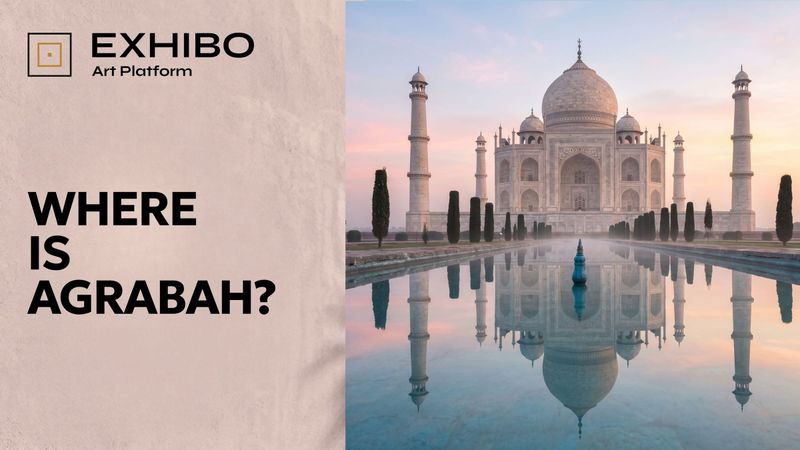
Where Is Agrabah? The City Disney Assembled From Real Places
Agrabah was going to be Baghdad. A war made it fictional — and then Disney built it back out of real places, from a tomb in Agra to a valley in Jordan that usually plays Mars.
The Sultan's palace where Princess Jasmine feels trapped has the silhouette of the Taj Mahal — which is not a palace at all, but a tomb. That is how Agrabah works. Disney's fairy-tale city was going to be Baghdad, until the Gulf War made the name impossible; the studio invented a place that could not be found on a map, then quietly rebuilt it out of real ones — Isfahan and Agra, Marrakesh and Mandalay, a Jordanian desert that has played both Arabia and Mars.
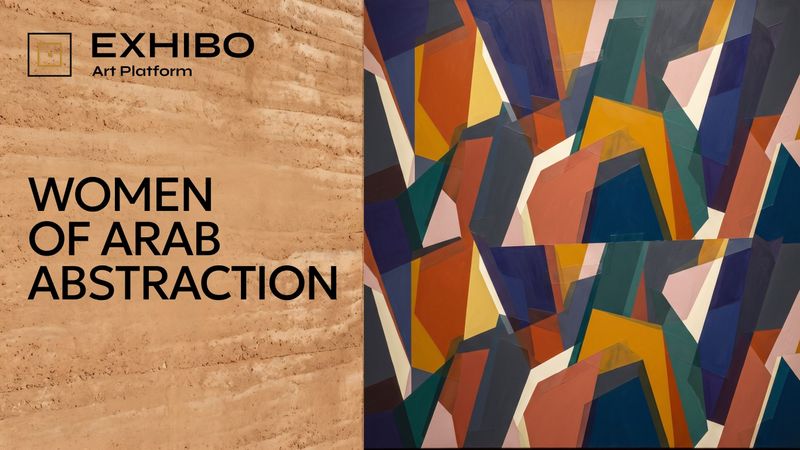
Women of Arab Abstraction
The letter set loose, the line woven, the arabesque the West once threw away — and the women who built modern abstraction out of all three, then got written out of it.
Abstraction is usually told as a Western invention that arrived elsewhere late. Saloua Raouda Choucair, Etel Adnan, Madiha Umar and a room of others tell it differently — often as the only woman in the movement, building modern form from the geometry, craft and calligraphy their own culture already held.
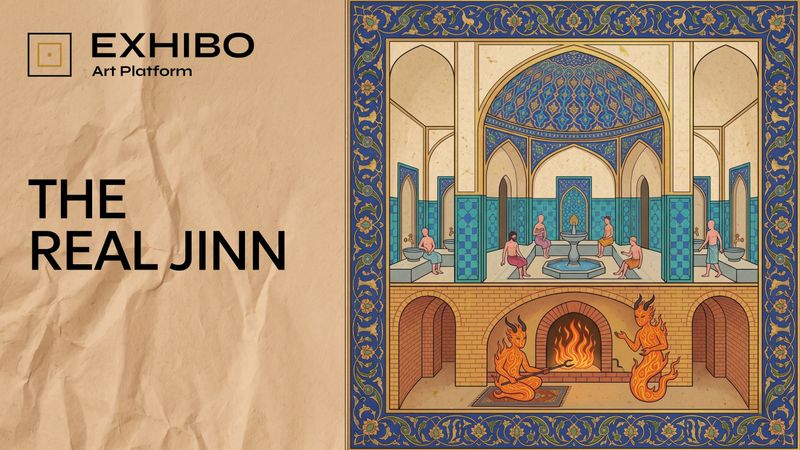
The Real Jinn: How the Middle East Imagined Them Before Disney
Seven kings, one for each day of the week. A portrait of Fever. Two spirits keeping a bathhouse warm. What the manuscripts actually show — and what the lamp replaced.
Folio 35v of a manuscript in Oxford shows the public baths at Tiberias in cutaway. Upstairs, people washing. Downstairs, two jinn tending the furnace, mid-conversation. It is not what most of the world expects — and it is much closer to what the unseen was actually understood to be for. A long read across twelve centuries of manuscripts, fieldwork, survey data and horror cinema.