
Jeddah · Saudi Arabia
Why Jeddah Was Built From Coral
A treeless port with no stone quarried its whole city out of the reef offshore — then oil and concrete let it walk away from the sea that built it.
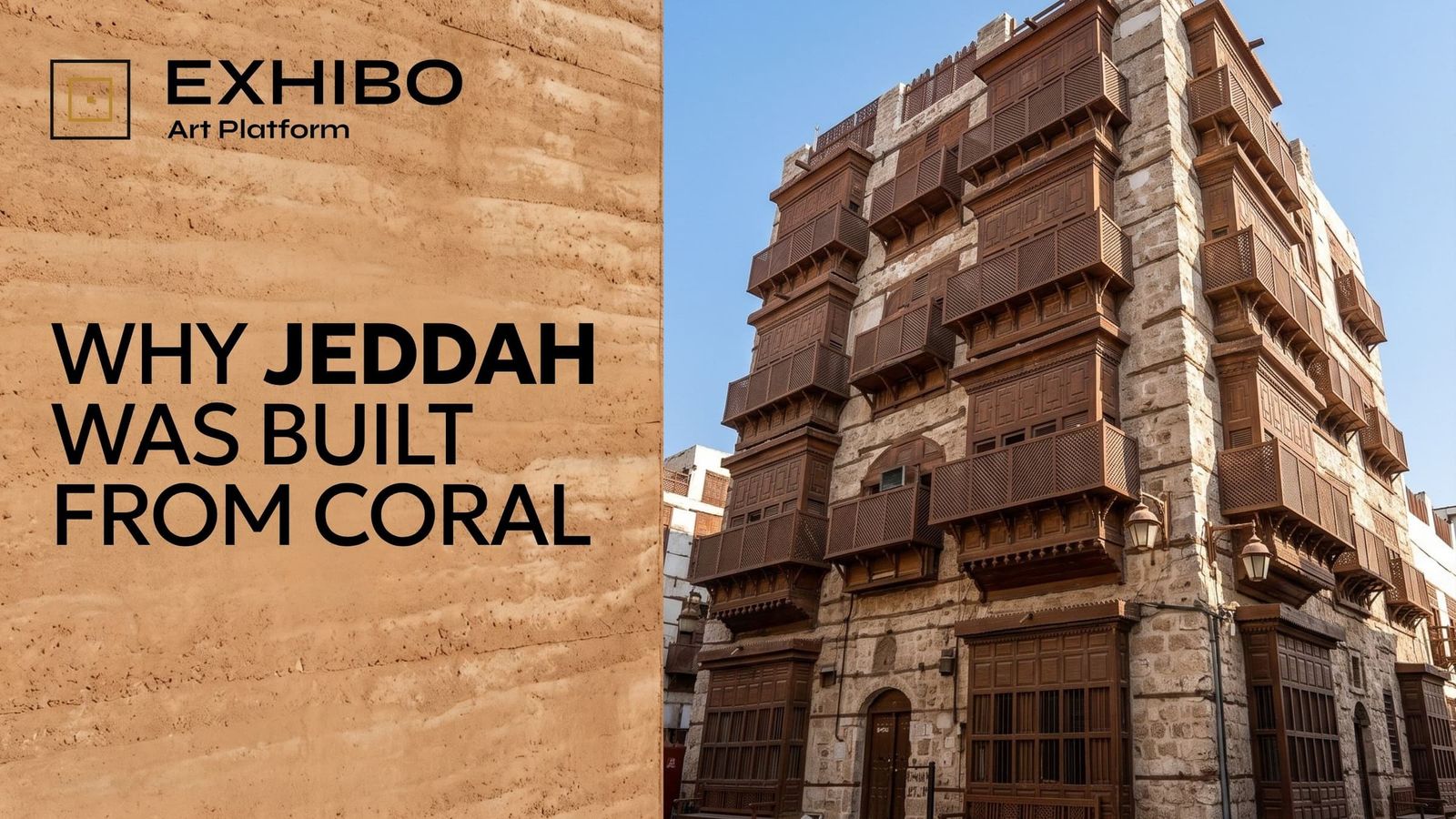
There is a wall in the old town of Jeddah where the plaster has fallen away, and what stands behind it stops you. The block is pale, salt-white going to grey, and it is full of shells — whole ones, broken ones, the ghosts of things that once lived. It is not stone pretending to be coral, or coral used as ornament. It is coral rock — reef quarried off the shore, cut into blocks and stacked into a house.
That is the plain, strange fact under everything else in Historic Jeddah, the district everyone still calls Al-Balad, the town: the city was quarried from the sea. Its merchant towers — five and six storeys of them — are built of coral stone, reef rock cut off the shore, so soft when it came up out of the water that a saw went through it, and hard only once it had met the air. Much of it was cut from the reef while still soft and damp — easy to shape fresh, hardening only after it had dried in the sun — so the masons worked fast, before the stone finished hardening back into what it had been before anyone touched it: the floor of the Red Sea, lifted out and stood on end.
A city with nothing to build with
You have to start with what Jeddah did not have. Stand on that coast in July and the case for building nothing at all is strong: the heat arrives with a wet weight off the water, fresh water was scarce and hard to secure, and there was — famously — barely a tree. The neem that still shades the courtyard of the Nassif house is said to have been the only tree in the whole city until the 1920s. No forest, then. And little to build with on land either: the Hijaz shore offers scant easily worked building stone, and almost no local timber tall or strong enough for the houses a rich port meant to raise.
What it gives you instead is the reef. Just offshore, running the length of the Red Sea, lies a bank of coral limestone — a coquina the builders called manqabi, after the Manqabah lagoon it was cut from, though much of it also came off the reefs along the coast and a beach then called Al-Ruwais. It is not, strictly, the living coral the name conjures. It is reef rock: an organic stone of packed shell and skeleton and crust, quarried in slabs that come up soft and harden in the sun. It is porous, light, easily worked, a fair insulator against the salt air — and it carries the sea's salt inside it, which is a gift and a curse in the same breath. The salt is why the stone had to be sealed under lime; the salt, a century on, is what would help bring the empty houses down. A city with no stone was sitting beside an inexhaustible one. So Jeddah did the obvious thing and the astonishing thing in a single motion. It quarried the sea.
The port that paid for it
None of it would have happened without the sea's other gift, which was traffic. Jeddah was the port of Mecca — the gate through which, for more than a thousand years, the pilgrims bound for the holy city came ashore, and through which the Indian Ocean trade was funnelled up to the interior. Two roles, one quay, and both of them poured people and goods into a town that grew almost nothing and mined almost nothing of its own. Merchants settled from India and Yemen, from Egypt and the Swahili coast, the Levant and the ports of Southeast Asia, until Jeddah spoke a dozen tongues along a single street and had coined a proverb about itself — Jeddah ghair, Jeddah is different — a coastal, mercantile, half-foreign city standing with its back to a kingdom of desert. The spine of the old town, the Souq Al-Alawi, was the pilgrim's road up from the harbour to the Mecca gate, Bab Makkah, and it was along that road that the merchants built.
That is the money that raised the coral towers: not farms, not conquest, but the tariff on everything that passed. A great Hijazi house was a balance sheet you could walk into — the height of it, the depth of its carving, the reach of the woods it was made from, all of it a statement of how much of the passing world its owner had managed to hold on to. And the first thing that money bought, in a town with no trees, was wood.
What the coral could not do
Coral will hold a city up, but it will not do it alone. The stone is strong when you press on it and weak the instant you pull; it is soft, it is riddled with salt, it cannot span a gap or carry a floor or hold itself together in a beam. For everything the reef could not do, Jeddah reached for the other thing the sea brought.
So the timber came in by ship, in three tiers of ambition. At the bottom was the palm — the one wood the region itself grew, short and weak, the poor man's beam. Above it, for anyone who could pay, came the imports the port existed to move: teak shipped up from the East Indies for the doors and the window screens; a hard timber from India the builders knew as gandal, for the floor joists, which is the piece that actually made the tall houses possible; heavier wood off the African coast. And when even the imports ran short, the houses were framed from ships — salvaged beams pulled from retired and wrecked vessels, the bones of the trade folded straight into the walls of the town it had made rich. What little timber the land offered came from inland valleys like Wadi Fatimah; everything better arrived by sea. The stone was local. The forest was the whole ocean.
The lacing
The join between the two is the cleverest thing in the building, and you would walk straight past it. Every metre or so up a coral wall the masons broke off and laid a course of timber clean through the stone — horizontal beams, taglilat, running the width of the wall like the rungs of a ladder. The coral takes the weight; the timber takes the pull the coral cannot, and gives with it as the stone swells and shrinks in the heat. It is reinforcement in the plainest sense — a masonry wall laced with a second material able to bear the stresses the stone handles poorly — an idea far older and more widespread than the steel-in-concrete it might put a modern reader in mind of. Set the floor beams into the top of each timber course, span up to five metres with a rough pole no thicker than your arm, and you can send the whole thing skyward: five storeys, six, forty rooms.
And over all of it, a skin of lime. The plaster on a Jeddah house is not decoration first — it is armour, a limewash coat sealing the porous coral against the salt and the sandstorms and the wet, renewed as it wears through. Which tells you something that will matter a great deal later: a coral house is only ever as alive as its upkeep. Stop tending the skin, and the sea begins, quietly, to take the stone back.
A machine for a hot, wet coast
Now put a family inside it, on a coast where the afternoon is an ordeal, and watch the building go to work. The signature of a Jeddah house is the rowshan — the projecting wooden bay window, a screen of turned and latticed teak leaning out over the street, and the reason half of Al-Balad seems to be watching you pass. The name is usually traced to Persian, for light or brightness, though its origins are not settled. What it does is four things at once. It shades the room behind it. It draws the sea breeze in through its lattice and cools whoever sits in the bay. It hides the household — those inside see out, those outside see nothing in — and, with a porous water jar set in the draught, it chills the passing air by evaporation. Curtain, window, air-conditioner and modesty screen, all carved from a tree that had crossed an ocean to get there. The grander the house, the more elaborate the screen, until a merchant's rowshan was also a ledger hung on the street — every worked panel of imported teak a quiet notice of how far his ships reached.
The coral does its part: porous stone, thick walls, high ceilings, narrow shaded lanes, a courtyard drawing air up through the middle of the house. You can read the whole logic in one building. The Nassif house went up between 1872 and 1881 for a merchant who governed the town — four floors, forty rooms, its staircase built so wide and shallow-stepped that, the story goes, a camel could carry provisions all the way up towards the kitchen near the top, the rain off the roof run down into cisterns at its base, and, decades later, one of the first houses in Jeddah to carry an electric light. King Abdulaziz would lodge there from 1925. A coral tower like that was not a simple shelter. It was a small vertical economy, a machine with a household living inside it.
And then the subtlest move of all — the household itself could move. Across the year a family might shift up and down its own tower, chasing the bearable floor: the roof and the airy upper rooms for the summer nights, the lower, heavier, cooler rooms through the winter. They did not cool the house so much as live it, floor by floor, season by season. It was not a box you sealed and chilled. It was an instrument you played against the weather — and, like any instrument, it went silent the moment nobody remembered how to play it.
The reef taught a dozen coasts
None of this was Jeddah's alone, and that is the part the postcard misses. Coral building runs the whole warm rim of these waters — up and down the Red Sea at Suakin and Massawa, Aden and Mokha, and on down the Swahili coast to Lamu and Zanzibar and Kilwa, and out to the Maldives. It is one of the great shared technologies of the Indian Ocean, a way of turning reef into architecture that thousands of miles of coastline arrived at because the coastline offered the same bargain everywhere: no stone on the land, an endless supply of it just under the water. There were real contacts along that rim — Red Sea and Yemeni links reach down the Swahili shore — but the deeper truth is convergence rather than a single origin. Nobody exported the idea from Jeddah. A dozen maritime societies, handed the same problem by the same kind of shoreline, reached the same answer on their own. The reef did not spread from one city so much as teach every coast that had one the same lesson: build from what the water gives.
Closer to home, the same logic sorts an entire country by its ground. Saudi Arabia is not one architecture but four or five, each the honest answer to a landscape: mud brick baked in the interior at Najd, palm-frond barasti and wind-towers on the Gulf, the black goat-hair tent out in the desert — and, on the Red Sea, coral. Nobody chose these palettes for their looks. Each place built from what lay under its feet, or, in Jeddah's case, just under its water.
The turn from the sea
And then, in a single generation, Jeddah turned away from all of it.
What loosened the first thread was the pair of inventions that has undone a hundred vernaculars the world over: reinforced concrete and the air-conditioner. Between them they could do anywhere, in any climate, what coral and teak and the rowshan and the shifting between floors had done only here, and only with constant work. You no longer needed the reef, or the imported wood, or the lacing, or the lime skin, or the inherited knowledge of which floor to sleep on in August. You needed a compressor and a wall socket. The Hijazi house did not fail so much as become optional, and then old-fashioned.
No single thing emptied Al-Balad; a dozen did, together. The old city walls, thrown up in the sixteenth century against Portuguese raiders, were pulled down in 1947 to let Jeddah spread. When T.E. Lawrence had passed through twenty years earlier and photographed its streets, the coral city was still whole, still lived-in, still the whole of Jeddah there was; within a few decades of the walls coming down, much of it was a ruin or a memory. Oil money built new districts; cars wanted roads the old lanes could not give them; the merchant families left through the 1970s for villas with cooling ducts, and the coral towers passed to poorer tenants or to no one at all. And coral, remember, does not keep without tending. The salt inside it and the wet around it went to work on the unmaintained houses; the lime skin cracked and was not repaired, roofs opened, timber rotted, walls slumped and, now and then, simply came down. The reef, meanwhile, stopped being a quarry and became something a country protects, and dives on for pleasure. There is a small, often-told irony in the record: the American oil company whose product would make the coral obsolete is said to have kept one of its first Jeddah offices in a coral house — the future setting up, at the very start, inside the walls it was going to empty.
Buying back what the sea gave for nothing
You can see where this ends, because it is happening now. Serious efforts to preserve old Jeddah began in the 1970s, and for decades achieved little; for a long stretch the country's own recent past was worth less to it than the future it was busy pouring in concrete. Then the valuation flipped. In 2014 UNESCO placed Historic Jeddah on the World Heritage list; a Ministry of Culture, the country's first, followed only in 2018; and a SR50 million donation from the crown prince — some thirteen million dollars of his own money — funded the restoration of fifty-six of the most dilapidated buildings, the first of many. Under Vision 2030 the Jeddah Historic District Programme is now spending on a scale the old masons could never have pictured to hold the coral town up — surveying, stabilising and restoring the more than six hundred historic buildings still standing, by strict rule, and hunting down the last craftsmen who can cut a rowshan and slake the right lime, of whom there are fewer every year. During Ramadan the restored quarter fills again: in 2024 some two and a half million people came through it over the month, walking the lanes their grandparents left.
Sit with the shape of that. A city built almost for nothing from the sea at its door, abandoned the moment a cheaper way arrived, is now being restored at enormous cost as heritage — preserved, by a country made rich on the very fuel that rendered the coral pointless, into a thing you visit rather than a way you live. This is not a scandal; it is simply what happens to a material once it stops being the obvious answer and becomes a choice. It turns from habit into heritage, from the thing you build with into the thing you preserve. Al-Balad is being saved. It is also, in the saving, becoming something it never was — a place you tour rather than inhabit, a careful record of how Jeddah used to meet its own coast.
Go back, then, to that broken wall and the block of reef behind the plaster. It was cut from the water soft enough to saw, and it hardened in the air into the corner of a house, and it has stood there long enough to watch the city forget how it was made and begin, at great expense, to remember. Out past the corniche the reef it came from is something to protect now, and to dive on for pleasure, rather than something to quarry. The sea that built Jeddah is behind glass. And the city that was quarried out of it is learning, wall by wall, to keep what it once simply cut.
Galleries mentioned
Museums mentioned
Exhibitions mentioned
Related reading
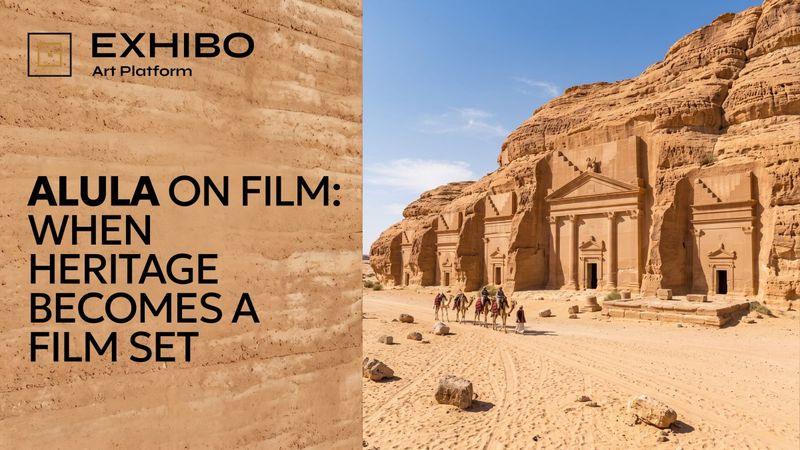
AlUla on Film: When Heritage Becomes a Film Set
Hollywood came to AlUla to build Iraq and Afghanistan. Saudi Arabia is using the same landscape to build AlUla itself — destination, museum, cultural stage — and the old stone is being asked to say something new.
Hollywood built Iraq and Afghanistan in AlUla; Saudi Arabia is building AlUla into itself. On carved kings, a warning old as scripture, a mirror the size of a building, and who gets to author a place.
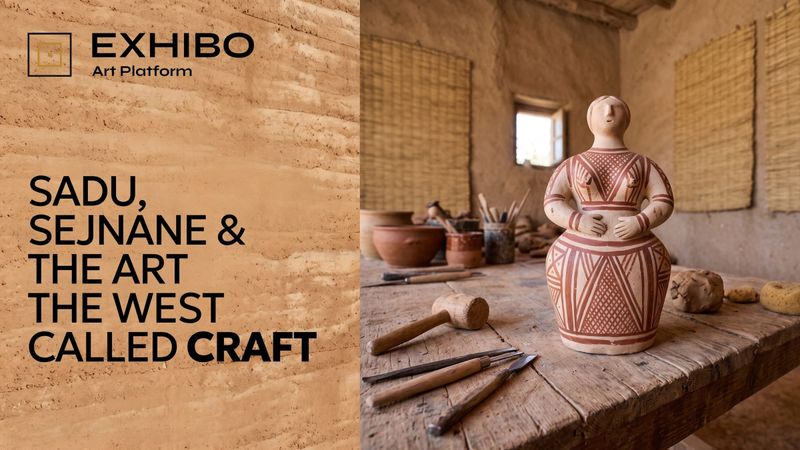
Women Makers: Sadu, Sejnane and the Art the West Called Craft
How the women of Sejnane and the Sadu tents made a world of geometric art the museum system had no shelf for — and how it is finally being called by its name.
Two women's traditions — the clay of Sejnane in Tunisia, the woven tents of the Arabian Peninsula — share no bloodline, only a rhyme: the same spare geometry, held and passed down by women, in whatever material their world gave them. This is the story of the visual knowledge the West filed under "craft," the makers it kept downstairs, and the contemporary artists now carrying it back up into the room where "art" is defined.
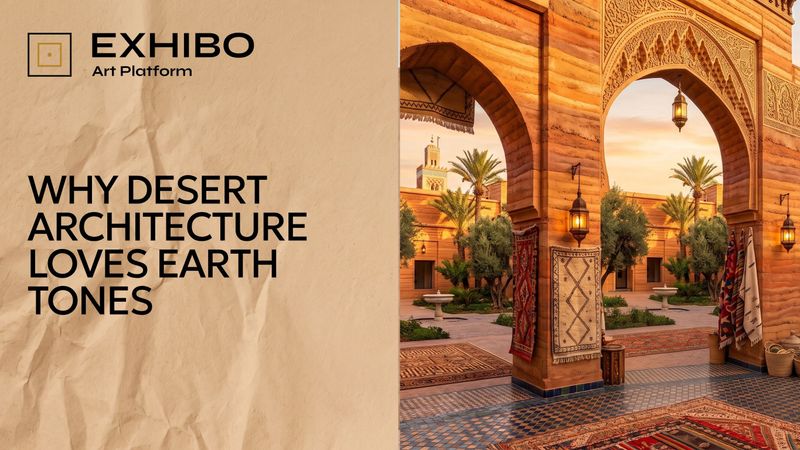
Why Desert Architecture Loves Earth Tones
In the deserts of North Africa and Arabia, ochre and terracotta were never a palette choice — they were what the wall was made of.
In most cities, colour is something you apply. In the old desert towns it was something you excavated — the red of Marrakech, the brown of Shibam and the gold of Diriyah all pulled straight from the ground underfoot. From iron-oxide chemistry to Hassan Fathy to the rammed-earth revival in Saudi Arabia, this is the story of a colour that outlived the place it came from.