
Tunis · Tunisia
Women Makers: Sadu, Sejnane and the Art the West Called Craft
How the women of Sejnane and the Sadu tents made a world of geometric art the museum system had no shelf for — and how it is finally being called by its name.
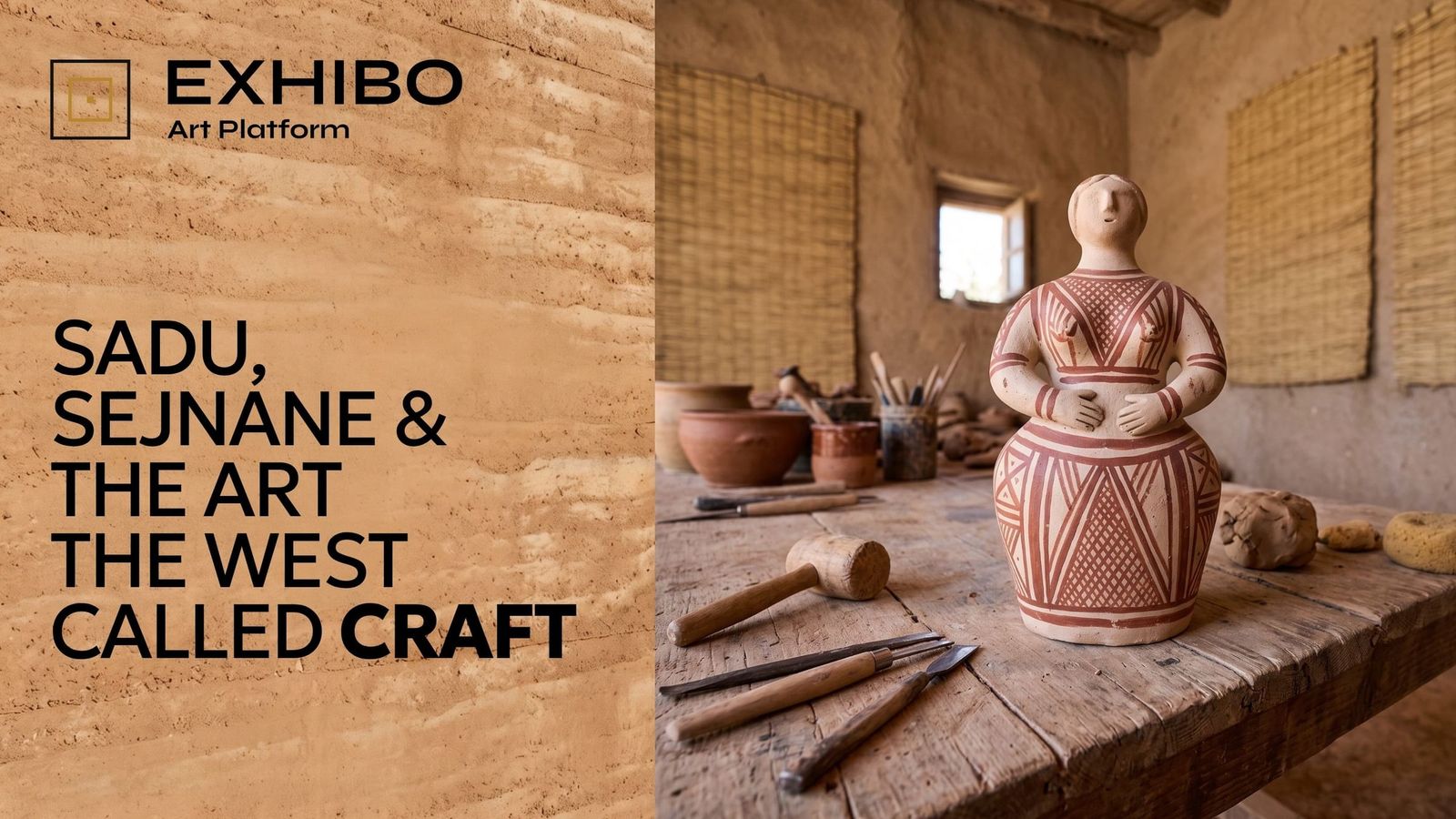
In a lean-to in northern Tunisia, a woman is painting a small clay doll with the juice of a leaf.
The doll is clay — red and white earth Sabiha Ayari dug from the bed of a nearby wadi, kneaded with crushed brick for strength, dried in the sun for days, coated in a thin layer of white clay. There is no wheel in the room. There is no kiln in the modern sense. She shapes the figure with her hands, burnishes the surface smooth with the sole of an old shoe, and draws the pattern with a stick dipped in a dark infusion of mastic-tree leaves, which goes on green and turns black only later, in the heat of an open hearth fired with dung. The marks she is making — triangles, crosshatch, little descending rows of chevrons running down the figure's body — rhyme, across otherwise distinct traditions, with forms you would find if you knew where to look: in the tattoos on the chin of a woman two generations older, and in the woven bands of a Bedouin tent far to the east, across the deserts of the Arabian Peninsula.
That is the thing worth slowing down for. Not the doll. The marks.
We have a habit, in the art world, of asking who made a thing and expecting a name. The canvas is signed. The sculpture has a maker. The wall label tells you whose hand, and when, and sometimes what they were feeling. But there is an enormous body of work across the Middle East and North Africa — geometric, abstract, made continuously for centuries, genuinely breathtaking when you stop and actually look at it — that carries no single signature. Not because the makers were unknown to their own communities; within a village a great weaver or potter was known precisely, and her work was prized as hers. It is that the modern Western system of art came to privilege a particular unit — the signed, autonomous, non-functional object made by one named genius — while much of what these women made runs on a different unit entirely: continuity, material knowledge, use, collective transmission, variation within a shared vocabulary. When that system met this work, it had a category ready for the mismatch — one that repeatedly placed women's making, functional objects and non-European traditions on the far side of the same line: craft.
This is a piece about that word, and about the women whose work it kept out. Two traditions will carry it. Al-Sadu, the Bedouin weaving of the Arabian Peninsula. And the pottery of Sejnane, the terracotta of Amazigh women in Tunisia. One is thread and one is clay, and they come from two different worlds — the deep desert of the Peninsula and the green hills of North Africa, cultures that were never one culture. What lets them share an essay is not a bloodline. It is a rhyme: in both, and in a dozen women's traditions around them, the same spare geometric repertoire keeps recurring, and the same kind of person keeps being the one who holds it. A woman, working in whatever material her world gave her, in a language the fine-art system would take a very long time to read.
The mark that moves
Look again at what Ayari is drawing on the doll's flank, and then look at everywhere else it lives.
UNESCO, describing Sejnane, notes almost in passing that the potters' painted motifs are "reminiscent of traditional tattoos and Berber weaving." Ayari herself says it without the hedge: "These are Berber motifs, the same as those found on traditional outfits and tattoos." Within her own Amazigh world, the same triangle, the same lozenge, the same broken line move between the fired clay of a pot, the woven wool of a garment, and the skin of the women around her. The vocabulary does not stay in one material.
The art historian Cynthia Becker gave one version of this pattern a scholar's name. She spent more than two years living among the Ait Khabbash, an Amazigh group in the southeastern Moroccan Sahara, watching how their visual culture was actually made and transmitted, and what she found there was not a scatter of unrelated folk crafts but an interconnected set of women's practices — a complex through which a whole community's identity was carried. Across women's textiles, tattoos, jewelry and dress, Becker identified what one reviewer of her work called a shared symbolism that traverses various women's art forms across different media — the same marks, she notes, that women weave into cloth are also painted onto ceramics. And — this is the part the word craft is designed to obscure — the custodians of that system, the people who carried it, selected from it, deployed it and passed it to their daughters, were overwhelmingly the women. Controlling the visual symbols of a group's identity, Becker argues, is exactly what gave these women real social standing. They were not decorating the culture from the edges. They were composing a good part of how it looked.
Becker's claim is specific and local — one Amazigh community, closely observed — and it would be a mistake, the kind this essay is trying not to make, to inflate it into a single ancient visual language stretching unbroken from the Atlantic to the Gulf. What we have instead is quieter and, to me, more interesting. Look at three particular worlds — the Ait Khabbash of the Moroccan Sahara, the potters of Sejnane in northern Tunisia, the Bedouin weavers of the Peninsula — and you can see a family resemblance in a handful of spare geometric forms, triangle and lozenge and zigzag, recurring across skin and thread and clay, and in each case held and passed on largely by women. That recurrence is a rhyme, not a genealogy. Not one lexicon handed down from a single source, and not proof of some pan-regional women's alphabet, but distinct local traditions in which some of the same simple shapes recur, entrusted, again and again, to the same hands.
Hold onto that, because it quietly dismantles the question we started with. The triangle on the doll is not ornament applied to a household object. It is one instance of a visual vocabulary that women learn, transmit and continually adapt. And when a later system calls the pot "craft," and calls a canvas of interlocking triangles by a man in mid-century Paris "abstraction," the label is not measuring two different levels of achievement. Classification rarely does. It is recording who did the making, and where, and in what material — and then deciding, on those grounds and not on the work's, which shelf it goes on.
The mark moves. The question this whole essay is really asking is why, for so long, only some of the surfaces it moved across were allowed to count as art.
The house that two women wove in ten months
Go east now, from the clay to the thread, and from Tunisia to the deep desert of the Peninsula. Go to the tent.
The Bedouin tent has a name that tells you what it is made of before you even step inside: bayt al-sha'ar, the house of hair. It is traditionally woven from animal hair — above all goat hair — on a ground loom staked flat along the earth in the technique called al-Sadu, from the Arabic for weaving done horizontally. The work is shared, in the way UNESCO's own citation lays out: the men shear the animals; the women clean and prepare the wool, spin it on a drop spindle, dye it, and weave it. The loom is theirs. Durable enough to be a home in a place that tries to kill you with heat by day and cold by night, the cloth carries its design in narrow bands — black, white, brown, beige, red — geometry in rhythmic, symmetrical repetition, and UNESCO's description says those bands carry tribal identity, the elements of the desert, and the weaver's own creative self-expression. Not a code passed down untouched. A composition, made by a specific woman, who chose.
Here is the detail I have not been able to stop turning over. By one account from a heritage village in the Emirates, in the old days it took two women a couple of hours a day for around eight to ten months to weave a single strip of tent cloth about seven metres long — and a family tent large enough for about five people needed thirteen to fifteen of those strips. Sit with that arithmetic. A house measured not in bricks or in dinars but in the months of two women's hands, moving in the cool of the evenings, while — as UNESCO notes — they exchanged the day's family news across the loom and sometimes chanted and recited poetry as they worked. They wove the outer walls. They wove the qata, the dividing curtain that partitioned the tent into a public side and a private one. They wove the walls and the partitions that made the room where the coffee hearth was dug and the guests were received — the majlis, that entire social architecture of Bedouin hospitality, staged inside a structure that women had spun and stitched from raw fibre.
Read that back and the ordinary hierarchy inverts. The craft that built the house was not hung on the walls as an afterthought. It was the walls. Al-Sadu is not a decorative flourish on Bedouin existence but the material record of it — the shelter, the storage bags, the camel trappings, the cushions of the majlis, the material infrastructure of a whole mobile civilisation, all of it made by women whose work the modern art system would not have known where to file, because the word it reached for was craft.
And it very nearly disappeared. Which is why there is an Al Sadu Society in Kuwait at all. It grew out of a preservation project begun in the late 1970s by a group of Kuwaiti women who could see the nomadic life receding and the weaving going with it, and it now runs Sadu House on Kuwait City's Gulf Road — a museum, archive and workshop where master weavers teach and keep the craft alive — chaired by Sheikha Bibi Duaij Al-Sabah. In 2022, per WIPO's own account, it became one of the first Kuwaiti NGOs accredited to provide advisory services to UNESCO's intergovernmental committee on intangible heritage, and was granted observer status at the World Intellectual Property Organization — beginning to do something that would have been unthinkable to the grandmothers who wove the first tents: reaching for intellectual-property tools, including a collective mark, to protect the traditional techniques and qualities of a shared, historically unattributed women's craft.
A women's institution, built by women, to save a women's art. That sentence is the whole series in miniature.
When the weaving crossed into the register of the world's official heritage, it did so in careful, revealing stages. The United Arab Emirates went first, in 2011, placing its Al Sadu on the list of traditions in urgent need of safeguarding — the register for a practice judged at real risk of vanishing. Kuwait and Saudi Arabia entered the main Representative List, jointly, in 2020. In 2025 that joint file was widened into a new inscription that added Qatar and formally replaced the earlier one; and in the same session, its long safeguarding programme having done its work, the Emirates' own element was itself moved off the urgent list and onto the Representative List, a heritage no longer thought to be dying. Different states, arriving at the same recognition at different moments and by different routes. The women had known the value all along. It only became official once the certificates arrived.
What the marks don't say
There is a temptation waiting at this point in the essay, and the honest version of the argument has to name it out loud and then deliberately step around it.
Once you learn that the triangle and the lozenge and the zigzag travel across skin and thread and clay, the next move is almost irresistible: to reach for a decoder ring. The triangle means fertility. The diamond wards off the evil eye. The zigzag is water, or a serpent, or lightning. You can find that decoder everywhere online, one clean meaning assigned to each shape, tidy as a phrasebook — and it is enormously satisfying, and it is mostly not to be trusted.
It is a reflex worth resisting — the orientalist habit of reading a deep, fixed symbolic meaning into every single mark, when a great many of the women who actually made these patterns may simply have found them beautiful, or used them the way you might hum a tune you grew up with, as a working memory carried over from the loom into the clay. Becker's own fieldwork is a useful antidote. Where meanings do attach, they turn out to be local and specific and slippery — a particular motif carrying a particular association for a particular group, a reading that belongs to those women in that valley and does not transfer, cleanly or at all, to a weaver in the Nafud or a potter in Sejnane. There is no continental alphabet. There are dialects, families, individual hands.
And this is not a disappointing footnote. It is the centre of the whole argument. Because reduce the pattern to a codebook — one shape, one meaning, look it up — and you quietly turn the woman back into a channel: a conduit passing an inherited signal down the line, adding nothing, choosing nothing, a piece of living transmission equipment. Let the pattern instead be a language she composes in — one she has mastered so completely she can improvise, quote, vary, invent, make a thing that has never existed before out of elements far older than she is — and she becomes what the label craft had obscured: an author of the thing, not a conduit for it.
An artist.
The refusal to over-explain the marks is not scholarly caution for its own sake. It is the act that gives her back the authorship the word craft was quietly taking away.
The vanishing line on the chin
The most intimate surface in this story is human skin. It is also the surface that is disappearing fastest, and the way it is disappearing is its own careful, uncomfortable story.
Across a number of Amazigh communities in North Africa, for generations, women were the principal bearers of a tradition of facial and body tattooing — marks on the chin, the forehead, between the brows, across the hands and ankles, geometric and applied, in the Ait Khabbash community Becker studied, around the passages of a woman's life, and in that community especially at puberty. (Men in some groups were tattooed too, but the facial marks discussed here were carried mainly by women.) Becker documents them among the arts she studied, sitting in the same visual family as the woven cloth and the chased silver, part of a public language of identity that a woman wore on her own body. The line on the chin was not, in its own world, exotic or transgressive. It was legible. In the communities where it was read, it could carry where a woman was from, what stage of life she had reached, sometimes which group claimed her — meanings that were local and specific, not a single code shared from Morocco to Libya.
And Becker is careful, in a way the travel blogs racing to romanticise it are not, about why it faded — in the community she actually studied. Among the Ait Khabbash, she traces a sharp decline from around the 1970s to several forces arriving at once, none of them sufficient alone: exposure to Islamic teachings that in many Sunni traditions regard permanent tattooing as impermissible, an alteration of the body's given form; the settling of once-nomadic life and wider access to formal religious education; the pull of post-independence national projects that privileged an Arab and Islamic identity; and the long aftershocks of French colonial rule, which had imposed its own categories on "Berber" and "Arab" and left classifications that went on shaping debates about language, ethnicity and belonging for decades. Elsewhere across North Africa the causes and the timing differed; there is no single story of the tattoo's disappearance. Where Becker's community is concerned, though, the shape is clear enough: not one villain but a convergence, religious and national and colonial and generational, pressing on the same practice from several sides.
In the communities Becker studied, the marks now survive mostly on the faces of the oldest generation, growing quieter each year as those women pass. But there is a coda, and it is the complicated, alive kind. In the wider Amazigh cultural-revival movements of recent decades, the old facial geometry has begun to reappear — less often tattooed permanently into the skin than quoted, in henna, in silver, in jewellery and design that carry the shapes forward. A reclaiming that reads as memory and identity rather than a replication of the original practice. The grandmother wore the mark because her world assigned it to her. The granddaughter who quotes it has decided, for herself, that it means something to carry.
It matters to get this precise, because the loose version does real damage in two opposite directions. Flatten it to religion banned it and you erase the colonial hand, the social pressure, and the women's own evolving choices — you turn a tangled human history into a single accusing sentence. Romanticise it as a tragic lost mystic art and you patronise the actual living women who let it go, deliberately, for reasons that were entirely their own. The careful version holds the discomfort exactly where it belongs, and lets the women in the story keep their full agency — including the agency, which is real and must be respected, to stop.
One surface goes quiet. The grammar does not die with it. It moves to the surfaces that remain.
The clay that all the women share
Return to Sejnane, and go deeper into the clay than the doll's painted face, because the town is a rare thing: a place where the making itself, from digging to firing, sits in women's hands.
UNESCO's citation is unusually direct about this. In Sejnane, it notes, women occupy a prominent place in the community, and every stage of the pottery — extracting the red and white clay from the wadi beds, crushing and purifying and soaking and kneading it, shaping it entirely by hand without any wheel, firing it in the open, painting it with the two-tone geometric patterns — is performed by the women, who also sell their pieces themselves, in the village and along the neighbouring roads. Men take part chiefly in the selling. It is described, with a certain dry precision, as a family-based craft, transmitted from mother to daughter across generations, taught not in a school but in a courtyard, by watching and then doing.
The process itself is a small marvel of making something from almost nothing. As Ayari has described it, she mixes her clay with crushed brick — in the old days it was ground-up shards of broken pots — to give the body strength. She shapes it, dries it for days, coats it in a thin layer of white clay, then decorates it with red ochre and with that infusion of mastic-tree leaves that reads green on the surface and only blackens in the fire. There is no gas kiln. The pieces are fired in an open hearth on dried dung, the most ordinary fuel imaginable, and out of that comes the two-colour, hard-edged geometry that a museum in another country will one day put behind glass. She works alongside her sister-in-law Khadija, whom she taught; her mother does the burnishing. A household of women, one object at a time.
And the objects that made Sejnane famous are the figures. Alongside the cooking pots and the water vessels, the women make dolls and stylised animals — tortoises, horses, birds — and above all the Sejnane doll, a hand-built terracotta female figure painted with those same tattoo-and-weaving marks. Look at what that doll actually is, structurally, and it is astonishing: a clay body, a skin of woven-and-tattooed pattern, in the form of a woman — the three surfaces of the whole grammar collapsed into a single object you can hold in two hands.
It is tempting, and many have given in to the temptation, to run a straight genealogical line from that doll back into deep antiquity — to Tanit, the great Carthaginian goddess of fertility, to the terracotta female figures that Mediterranean cultures have shaped for literally thousands of years, to a Tunisian rain-making ritual, Ommek Tannou, in which a doll is carried through the village in times of drought and the women pour water over it while chanting for rain. The resonance is real and it is haunting. But the honest thing to say is that the resonance is not a proven descent, and the sources drawing the direct line are thin. The better, truer register is the one a museum curator reached for when describing ancient Middle Eastern terracotta women: that their exact purpose remains, in the end, open to interpretation — while what they unmistakably demonstrate is the importance of women in the cultures that made them. The Sejnane doll does not need a certified bloodline back to a goddess to matter. It belongs to a much longer Mediterranean history of making female forms in clay — not one unbroken thread, but a recurring human practice. That is enough.
The economics of an under-attributed art
Now the part that the word heritage, with its warm museum glow, tends to leave out. Because being inscribed by UNESCO is not the same as being paid, or protected, and the honest account of this canon has to hold both the pride and the precarity in the same hand.
Sejnane is a poor region in a country under economic strain, and its celebrated craft is fragile in ways the certificate does not fix. Scholars who study Tunisian women's heritage name the central tension without flinching: commercialisation can, on one hand, guarantee these women a fixed and genuinely needed income — and, on the other, the very same market pressure can hollow out the authenticity of what is being made, pushing the potters toward whatever sells fastest to tourists and away from the slower, richer tradition. An intangible heritage, one study puts it, trying at the same time to survive and to preserve itself. Those two goals are not always friends.
The economic reality underneath is starker still. A Tunisian investigation into the potters found them working, in effect, as unregulated labour — remunerated, yes, but outside any formal economic framework, without the social protections that a recognised job would carry. The inscription brought the craft new visibility, and reporting since suggests demand has grown alongside it; but recognition did not, by itself, formalise the women's work or put a secure floor under their income. This in a country where, by the OECD's 2023 Social Institutions and Gender Index, women spend on average 5.3 hours a day on unpaid care and domestic work against men's 0.6 — a female-to-male ratio of 8.1 to one. The recognition is real. So is the fact that recognition, on its own, has not put a floor under anyone.
And then there was 2011, and the years of instability that followed the revolution, when — as Euronews and others have reported — armed groups took control of parts of the Sejnane region and targeted the pottery, the figurative dolls above all, claiming they were forbidden statues; the tourism the potters relied on collapsed, and women who had been scraping a living from the clay lost even that. The instability eventually passed, and the craft came back. It is a genuinely painful chapter, and it deserves to be told plainly and locally, as something a specific town lived through and survived, rather than inflated into a sweeping verdict about faith or nation.
What the women did next is the part that earns the telling. They organised. A group in the area — the Sejnenia Group — that its project manager Zaineb Frahat says began with thirty-five potters in 2012 and has grown to around a hundred women; coordinators appeared to manage orders and exhibitions; development programmes came in to renovate the roadside sales booths and build an online catalogue; designers arrived wanting to collaborate rather than simply to buy cheap and mark up. Plans for a museum and training centre of the town's own have been discussed for years — the ambition, at least, to curate their own heritage rather than wait to be curated. The doll that was smashed came back, painted with the same marks, dug from the same wadi, made by the same hands. When Warda Michrigui, a potter in her forties, says of the craft — "this is the only source of income here for us women" — she is naming the fragility and the power in a single breath. The clay is precarious. The clay is also, unmistakably, theirs.
The word itself
Step back far enough from Sejnane and the Sadu tents and the pattern beneath the pattern finally comes into view — and it turns out not to be a MENA story at all. It is a hierarchy, and it is global, and it is old.
The curator and theorist Glenn Adamson has named the core of it about as cleanly as anyone: a lopsided scheme in which craft is ranked below the hegemonic category of art. To my mind the hierarchy was never only about gender — it ran along function versus contemplation, the manual versus the intellectual, the workshop versus the lone genius, the useful versus the autonomous, and, when it looked beyond Europe, the ethnographic versus the fine. But women's work sat at the crossing point of nearly every one of those axes, which is why the category caught it so completely. Easel over loom. Signed over unattributed. The dated and framed over the used and worn. Oil on canvas over eight months of two women's hands. It was never that some committee sat down and formally ruled the tent out of art history. It is subtler and more durable than that: the categories themselves were built, long before anyone thought to ask these women, around a unit of authorship their work did not share.
And here is the irony that ought to be sharpened until it draws blood. When the Western art world began to take weaving seriously as modern art — when Anni Albers, the Bauhaus weaver, in 1949 became the first textile artist given a solo exhibition at the Museum of Modern Art — her work was profoundly shaped by her study of ancient Andean weaving, the textiles of pre-Columbian Peru. Albers did not conjure her woven geometry from nowhere; she reached it in large part through her study of textile traditions — the ancient Andean weaving of pre-Columbian Peru above all — that Western art history had long filed as ethnographic, decorative or anonymous, even as the institutions kept those source traditions on the far side of the very line she was being invited to cross. A generation later, several overlapping feminist and American art projects of the 1970s and after — Judy Chicago and Miriam Schapiro's feminist art, the Pattern and Decoration movement, and, a little later, the British critic Rozsika Parker's The Subversive Stitch — went to open war on this exact hierarchy, hauling embroidery and quilting and china-painting and what Schapiro named "femmage" into the gallery precisely to expose the line the art world had drawn between what men made and what women made. They were entirely right about the line. Some of that movement's rhetoric could also make the crossing sound like a new discovery. It was not. The women of Sejnane and the weavers of the Sadu tents had been making work, generation after generation, in forms this later system would file under craft — a standing refutation, in clay and in wool, of the line itself, though no one asked them; unheard not because their work was weaker but because no one with the power to define art had yet decided their unit of making counted.
The correction the art world is living through right now — textile moving decisively into the biennials, fibre acquired by the great museums, craft finally waved upstairs into the galleries it was kept out of — is real, and it is decades overdue. And the women in this essay are not late arrivals to that correction, hurrying to catch a train that left without them. They are its oldest standing evidence. They were the argument all along.
The clay returns to the pavilion
Which brings the grammar, at last, all the way up into the rooms that were built to keep it out — carried there, fittingly, by a woman who trained in the old crafts on purpose.
The Palestinian-Saudi artist Dana Awartani did something deliberate and unusual: she took a conventional fine-art degree at Central Saint Martins in London and then went further, into a master's at the Prince's School of Traditional Arts and an apprenticeship in illumination with a master in Turkey, until she could work as a craftswoman inside the traditional Islamic arts — geometry, manuscript illumination, pigment-making, the disciplines the modern academy had long shunted into the "decorative" basement. She has described the gap between the two educations exactly. At Saint Martins, as she tells it, the materiality did not matter; it was about the concept. At the Prince's School, she has recalled, they told her they did not care about her voice or her message — she was there as a craftswoman. It took her years afterward to fit the two halves together. And when she has wanted to speak about the cultural heritage being erased across Syria, Iraq, Lebanon and Palestine — the mosques and monuments and libraries reduced to rubble by war — she has not painted the destruction, or photographed it. She has reached for craft.
At the main exhibition of the 2024 Venice Biennale she showed Come, Let Me Heal Your Wounds, Let Me Mend Your Broken Bones, a work of silk dyed with dozens of herb- and spice-based medicinal dyes, torn at the locations of destroyed heritage sites and then, using a traditional darning technique, mended by hand. Mending as a language. The needle doing the thing the news cannot: not reporting the wound but sitting with it, closing it stitch by stitch, insisting on repair as an act that takes a human hand and human time.
Two years later she went further, and closer to the earth. For Saudi Arabia's national pavilion at the 2026 Biennale she built May your tears never dry, you who weep over stones — a floor you walk across, a vast mosaic landscape assembled from 29,221 sunbaked clay-earth bricks, its patterns drawn from mosaic traditions documented across twenty-three heritage sites in Syria, Lebanon and Palestine that have been damaged or destroyed through conflict and war. The title comes from a line of eighth-century Arabic poetry. It took close to thirty thousand hours of artisanal labour, and Awartani has been explicit that the point is the labour: the "many hands," the co-authorship, the craft knowledge carried across generations, placed at the centre of the work rather than hidden beneath it.
Look at what she has actually done there. Clay, dug and shaped by hand. Geometry, inherited and composed. A grammar of pattern, made collectively, carrying memory and loss. Ayari makes pottery within a household network of women — her sister-in-law, her mother — of a kind the village has long used; Awartani works with a collective of master craftspeople, making a conceptual installation for a national pavilion. They are not the same work — one is domestic and inherited, the other is contemporary art with all its discourse and commission behind it. But they are recognisably close in the one thing the hierarchy has trained us not to see: the intelligence of the making. Both are women laying down geometry in earth, working within visual traditions they have learned and made their own. One kind of practice was called craft and kept downstairs for a very long time. One is standing, this year, in a national pavilion in Venice. The distance between them was never in the intelligence of the hand.
It was only ever in who the art world was willing to call an artist.
Ayari is still in the lean-to, painting. The leaf-juice goes on green and will turn black in the fire. The triangle taking shape under her stick is older than every museum that will eventually compete to own it, and she is not thinking about any of them. She is thinking about the next mark, and the one after that, composing in a visual vocabulary whose elements long predate the museums that might one day want it, and which she happens to have mastered completely. Pick it up. It holds.
Related reading
The Real Aladdin: The Story That Belonged to No Country
Aladdin has no Arabic manuscript older than its French translation. Behind the gap stands a young man from Aleppo, catalogued for a century as anonymous.
The most famous "Arabian" tale in the world is missing from the oldest Arabic manuscript of the Thousand and One Nights — because before a French translator wrote it down in Paris, there was no manuscript of it to be missing from.
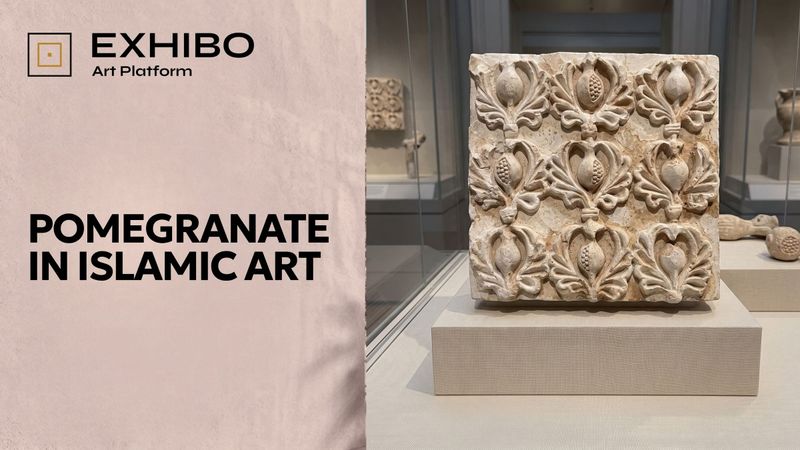
The Fruit We Are Sure We Recognize
How the pomegranate became one of the most confidently named motifs in Islamic ornament — and one of the least confidently identified — across a thousand years of tile, silk and stucco, with meanings we mostly attached later.
A slab of sixth-century plaster in the Met shows a fruit you recognise at a glance: a pomegranate, and surely it means paradise. Hold that certainty up to the light and it dissolves. Across a thousand years of tile, silk and stucco, the pomegranate is the shape we name most confidently and identify least — blurring into the artichoke and the palmette, its meanings attached by later viewers, its very name partly a nineteenth-century invention
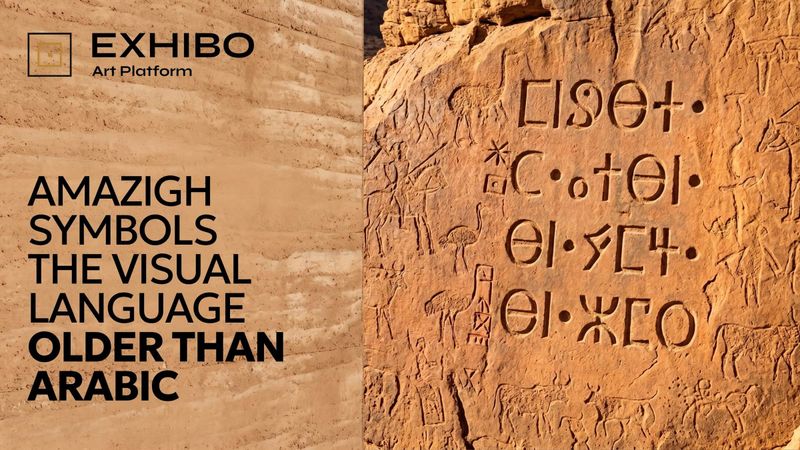
The Visual Language Older Than Arabic
How one of North Africa's oldest writing traditions survived conquest, colonial classification and the loss of its readers — and why, for much of it, we still cannot say what the marks mean.
A flat rock in southern Morocco is covered in a script you can see is writing and still cannot read a word of. It belongs to the Amazigh — a visual language older in North Africa than the Arabic alphabet, carried onto skin and wool and silver, nearly erased, and now reassembled into an alphabet on ministry walls. This is the story of what survived, what didn't, and why almost everything we "know" these signs mean was added later.