
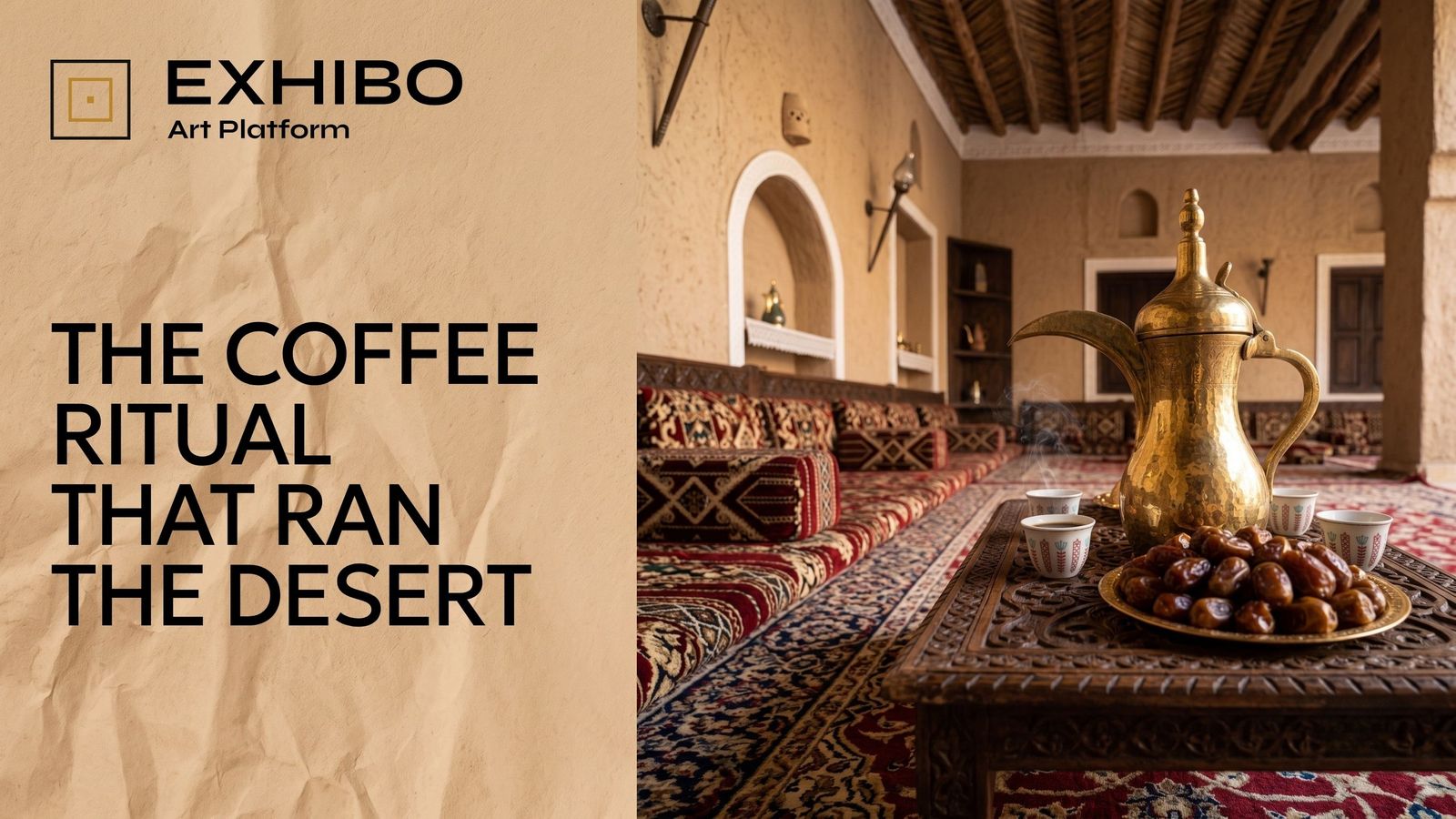
Riyadh · Saudi Arabia
The Coffee Ritual That Ran the Desert
A cup of coffee in the desert was a contract, a test, a truce, and a promise of protection — a whole social order in the tilt of a small white cup.
Somewhere in the Gulf, in a room built for the purpose, a man pours a cup of coffee and, in several Bedouin traditions, drinks it himself before he offers you anything. This looks like rudeness. It is the opposite. He is vouching for the coffee — that it is good, that it is fresh, that it is offered in good faith — putting himself first not to serve himself but to open the ceremony with his own mouth as the guarantee. The first cup, where this custom holds, is the host's own, and only after it does he pour yours.
That small act tells you what kind of thing you are actually looking at. The Arabic coffee ceremony is not an old-fashioned way to serve a hot drink. It is a code — a dense, precise system for managing the most dangerous situation the desert produced: the arrival of a stranger. Some of its grammar is remarkably stable across the whole region: the right hand, the shake of the cup to decline, the order of serving by seniority, the dallah, the majlis itself. Other parts — the names of the cups, how many there are, how full to pour, what the last cup means — are regional, varying from tribe to tribe. But stable or local, the gestures are read as language, and most of it is unspoken. In a culture where, as one account puts it, what is unsaid carries as much weight as what is said, coffee is, in many Bedouin settings, how you say the things too important to leave to words.
To understand why a beverage came to carry all that, you have to start with the problem it was built to solve.
The stranger at the edge of the fire
Picture the situation the code was written for. Open desert, immense distances, a traveler who has run out of water and shelter and arrives at your tent with nothing to offer and no way to compel your kindness. In that world, hospitality was not a nicety. It was a matter of life and death, and not only for the guest — because the host, tomorrow, might be the one arriving thirsty at someone else's fire. A society without central authority — no state to police it, no standing courts to compel anyone — and no reliable water had to run on something, and what it ran on was a fiercely enforced obligation to take the stranger in.
The obligation had a name — diyafa — and a startling reach, and it is well documented in the classic desert ethnographies: Dickson's The Arab of the Desert and Wilfred Thesiger's Arabian Sands, both written from years spent living among the tribes, return again and again to hospitality and honor as the load-bearing beams of Bedouin society. Under what is often called the three-day rule, a guest who arrived at a Bedouin tent — a stranger, a traveler, even an enemy — was to be fed, sheltered, and protected, in the fullest tellings for three days and three nights, held as the ideal of perfect hospitality rather than a uniform law. To press a guest too quickly was a discourtesy. To harm one under your roof was to destroy your own honor, and honor — sharaf — was the currency that mattered most, the thing a man could not afford to lose in a society where reputation was the only collateral anyone had.
This is the machinery underneath the coffee. The ceremony is diyafa made visible — the exact, repeatable performance of an ethic that the whole society depended on. It is worth being precise about that society: the Bedouin had no centralized state, but they were not without law. They had sheikhs, tribal arbitrators, mediators, customary norms ('urf), and elaborate systems of compensation. What they lacked was a central authority to enforce any of it — which is exactly why so much weight fell on honor, reputation, and ritual to hold the peace. And much of it happened in a specific place. Not a kitchen but the majlis, the "place of sitting," the room where a household received the world: guests welcomed, disputes heard, news traded, alliances made. The majlis was, in many respects, something like the desert's parliament and its courthouse at once, and coffee was the thing that opened every session. Set a dallah on the fire pit, and the smoke itself was an invitation — anyone could see it and know they would be received.
The cups have names
Here is where the code becomes astonishing, because in several Bedouin traditions — especially the Najdi and northern Arabian ones — the cups are not interchangeable. In the fullest form of the ceremony each round has a name, and the names are a map of the entire relationship between host and guest, from suspicion to alliance.
None of this is a single pan-Arabian canon, and it matters to say so. Bedouin custom differs across the Najd, the Hijaz, Ha'il, the Gulf states, Oman, Jordan, and the tribes of northern Arabia and southern Iraq; the number of cups, their names, and their meanings shift from region to region and telling to telling. What follows is one of the fuller and more widely attested versions — an oral tradition, not a fixed rulebook — and the striking thing is how consistent its shape stays even as the details move. It runs something like this.
First, in several Bedouin traditions — strongest in the Najd, northern Arabia, and parts of Jordan and Kuwait — comes al-haif: the host's own cup, the one he drinks in front of you. In many accounts he does this to demonstrate trust and vouch for the coffee — that it is good, that it is fresh, that it carries no ill intent — the host putting himself first not to serve himself but to open the ceremony with his own mouth as the guarantee. (The popular gloss that he is proving the coffee "isn't poisoned" is the dramatic version; the likelier truth is broader and quieter — quality, warmth, good faith, and the simple act of beginning.)
Then al-dhaif: the guest's cup, poured for you, offered first to the eldest or most honored person present and then moving clockwise around the circle. This one you do not refuse. To wave away the guest's cup is to wave away the host's generosity itself — an insult cut straight to the bone of sharaf. You drink it. That is the price and the grace of being received.
Then al-kaif: the cup of pleasure, for enjoyment, for the taste of the thing — the cup that says the urgent business of welcome and safety is settled and now you may simply sit, and be, and enjoy.
And then, in some tribal traditions, the one that stops you cold: al-saif — the cup of the sword. In these accounts it was offered once host and guest had reached a pledge of mutual loyalty — a promise to stand by one another, and if necessary to defend one another, should either's people be threatened. The bond it marks is documented in the classic ethnography of the region: H.R.P. Dickson, the British political agent who lived among the tribes of Kuwait and eastern Arabia in the 1930s, recorded the sacred host-guest ties — the "salt bond" of mutual protection — in The Arab of the Desert. Its force was more symbolic than legal: not a signed treaty but a bond of honor, understood by everyone in the majlis, sealed with coffee rather than ink. Somewhere in the Gulf, men affirmed that they would stand together over a cup poured from a long-necked pot — and it was understood by those present as a pledge of honor, which, in a world running on sharaf, carried real weight.
Read those four names in a row and you see the whole arc of how strangers become allies: safety, welcome, pleasure, loyalty. Other traditions recognize fewer cups, or order them differently, or assign them different meanings — in many regions there is no cup of the sword at all. But where the fuller sequence survives, the ceremony can be read as the journey itself, performed in miniature, in the time it takes to drink a few small cups of coffee.
Everything you say without speaking
The genius of the code is that it lets both people negotiate delicate things without anyone having to say them aloud — which, in a culture built on honor, is exactly the point. Naming a problem directly can wound. A gesture can carry the same message and leave everyone's dignity intact.
So the ceremony is full of switches, and everyone fluent in it can read them. The amount poured is itself a sentence: the host fills the little finjan only partway — a third, or two-thirds — and that is the courteous pour, the one that keeps the coffee hot and quietly invites you to have more. But in many Gulf traditions, filling a guest's cup to the brim flips the message: a full cup becomes a polite dismissal — drink this and go — delivered without a single discourteous word. (Not everywhere: in some places a fuller cup is simply generosity, which is exactly why the code has to be read in its own regional dialect.) The same act, more coffee, can mean welcome or farewell depending on where you are sitting.
And you, the guest, have your own moves. When you have had enough, you do not announce it. You tilt and shake the empty cup — a small side-to-side flick of the wrist — and the pourer reads it and stops. This one is near-universal. Skip that gesture and, out of sheer hospitality, he is obliged to keep filling it, and filling it, indefinitely. The shake is how you release him. And some oral traditions describe a graver signal still: setting your cup down on the ground to tell the host you have something serious to raise — that you have not come only to drink, but to ask, to plead, to negotiate. The cup goes down, and the room understands the register has changed.
One rule sits above all the others and never bends: you take the cup with your right hand. Always. The left hand, by long convention across the region, is considered unclean, and to reach for the cup with it is a real breach. Everything else in the ceremony flexes by tribe and region and occasion. The right hand does not.
The faith underneath
It would be a mistake to read all this as merely practical — a clever social contract and nothing more. For the people who kept it, the duty to the guest ran straight into the sacred.
The obligation is anchored in a saying of the Prophet Muhammad that circulates through the tradition in various forms: that whoever believes in God and the Last Day should honor his guest. Hospitality, in that light, is not just how you treat a traveler. It is how you demonstrate faith — a way of honoring God by honoring the person He sent to your door. This is why the poorest household would still, without hesitation, produce coffee and dates for a stranger, and why even extreme poverty was no excuse to fall short of the three-day duty. To be unable to give was a hardship. To be unwilling was a disgrace, and something close to a sin.
That fusion — of survival ethic, tribal honor, and religious command — is what gave the coffee ritual its weight. It was doing several kinds of work at once: keeping travelers alive, keeping the peace between tribes, keeping a man's reputation intact, and keeping faith with God. No wonder it hardened into something so exact. A system carrying that much could not afford to be casual.
From the tent to the museum
The nomadic life has largely given way to settled society now, and with it much of the open desert the code was written for. So what happens to a social contract when the world that needed it moves into cities and air-conditioning?
It becomes heritage — consciously, deliberately kept. Coffee is still the first thing offered in a Gulf home and the anchor of the modern majlis, which survives as a room and a social institution even where the tent is a memory. Children are taught the etiquette. In 2015, UNESCO inscribed the whole tradition — the beans, the pot, the pouring — on its list of the intangible cultural heritage of humanity under the title Arabic coffee, a symbol of generosity, a joint inscription by Saudi Arabia, the UAE, Oman, and Qatar, extended in 2024 to include Jordan. Five states have put their names to the ceremony. Dubai built a coffee museum in the old quarter of Al Fahidi. The gesture that once kept strangers alive in the sand is now taught, funded, and displayed.
Something is inevitably lost in that shift, and it would be dishonest not to say so. When the sword cup rarely seals an actual pact of mutual defense — when for most people at the table no one will really be called to stand for anyone else — the ceremony becomes, in part, a performance of a code rather than the code itself. The gestures remain; the stakes that once made them matter have softened for most. (Not entirely: at tribal reconciliations, weddings, and formal gatherings, the older symbolism can still carry real weight.) That is what happens when a survival ethic outlives the conditions that required it. It becomes, mostly, a moving memory of the seriousness it used to carry — and, sometimes, still does.
But not entirely. Watch closely the next time coffee is poured in a Gulf majlis, and the old grammar is all still there. The host still pours his own cup first. The guest still takes it with the right hand. The full cup still means you may go, and the shaken cup still means enough, and the first cup still cannot be refused without insult. The pact behind the sword cup may have faded, but the language survived it — and the message underneath every cup is the one it always was.
What the ritual left in the art
A code that ran a society for centuries does not vanish when the tents come down. It migrates — into paint, metal, museum programs, and the arguments a culture has with itself. And in the Gulf, the coffee ritual has become one of the region's most worked-over subjects in contemporary art and design.
Sometimes literally, at monumental scale. The dallah sculptures that stand on roundabouts and corniches across the Gulf belong, as scholars of the region note, to an "early phase of public art" in the 1980s — a moment when the young, newly wealthy Gulf states reached for abstracted versions of their own heritage and cast them in bronze and steel, decades before the region became home to an ambitious international art scene. The coffee pot was one of the first things these nations chose to make monumental. It was how a young country pointed at itself and said this is who we are. The anthropologist Laila Prager has described how the Emirates' national museums did the same work indoors, "selecting specific traditions and values believed to transcend time" — and the material culture of coffee features in all seven emirates' museums, the ritual turned into display.
Individual artists have taken it somewhere less official. The Emirati artist Jamal Habroush Al Suwaidi built an installation called The Coffee Beans — seven metal forms, each a different shape and shade, stripped of ornament to near-geometric simplicity, the number seven chosen as a nod to coffee's standing as a near-universal sign of friendship. The humblest object of daily hospitality, enlarged and abstracted into sculpture. And the institutions have folded the ritual into how they teach art itself: Abu Dhabi's Zayed National Museum runs workshops — Patterns in Hospitality — where visitors paint and decorate a finjan, and embroider cushions inspired by the majlis, learning traditional pattern by remaking the ritual's own objects by hand.
The most telling gesture, though, is when the ritual becomes the front door itself. At Al Shindagha Museum on the Dubai Creek — the largest heritage museum in the UAE, a sprawling complex of more than twenty restored houses, each its own small museum of Emirati life — visitors have been welcomed in a styled majlis with Arabic coffee and dates before they reach the exhibits. There is something fitting in that choice: an institution built to preserve the culture opening not with a placard but by performing the culture's oldest gesture of welcome. Before the museum explains hospitality, it offers some. The exhibit and the etiquette become, for a moment, the same thing.
The majlis itself is treated as a work of design, and increasingly as art. Its architecture — the low seating that puts everyone at eye level, the horseshoe arrangement that turns a room into a circle of equals — carries meaning, and its walls often carry Arabic calligraphy, lines of poetry and Qur'anic verse that make the space of hospitality also a space of text and contemplation. When UNESCO inscribed the coffee ritual in 2015, it inscribed Al Majlis alongside it — the gathering place recognized as heritage in its own right, not just the cup poured inside it.
And then there is the argument, which is itself a kind of cultural production. Younger Gulf artists, designers, and café-owners are pulling the ritual in new directions — majlis-style cafés with poetry nights and gahwa-based drinks, brass and calligraphy redeployed as aesthetic rather than obligation — while a 2023 survey found more than half of young Saudis calling the traditional gahwa ritual "outdated." That tension — reverence and restlessness, the sacred cup and the cortado — is not a sign the tradition is dying. It is a sign it is still alive enough to fight over. Living traditions are the ones that get reinterpreted; only dead ones stay fixed. The coffee that once bound strangers into allies now binds a culture to the ongoing question of what it wants to keep.
What the cup was always saying
Go back to that first strange gesture — the host drinking before his guest — and you can finally read it for what it is.
It was never about the coffee. It was a man saying, in the grammar the desert trusted: you are safe here. I vouch for it with my own mouth. I will feed you before I ask your name, and shelter you before I know your business — and in the fullest form of the pact, in the traditions that kept the cup of the sword, if we drink far enough down the cups, I will stand beside you against whatever comes. All of that, folded into a bitter mouthful of cardamom-scented coffee, handed across a fire to someone who arrived with nothing.
The world now drinks coffee for a jolt, a habit, a moment to itself. In the desert it meant something larger and harder: the whole apparatus by which people who had every reason to fear each other decided, cup by named cup, to become something other than strangers. The drink was small. What it carried was not.
You take the cup with your right hand. You do not refuse the first. And you never, ever, let it be said that a guest came to your fire and left unwelcomed.
Museums mentioned

Related reading
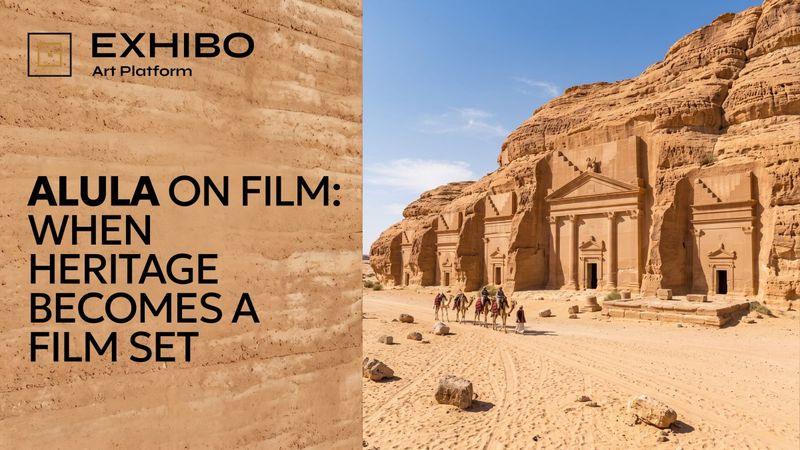
AlUla on Film: When Heritage Becomes a Film Set
Hollywood came to AlUla to build Iraq and Afghanistan. Saudi Arabia is using the same landscape to build AlUla itself — destination, museum, cultural stage — and the old stone is being asked to say something new.
Hollywood built Iraq and Afghanistan in AlUla; Saudi Arabia is building AlUla into itself. On carved kings, a warning old as scripture, a mirror the size of a building, and who gets to author a place.
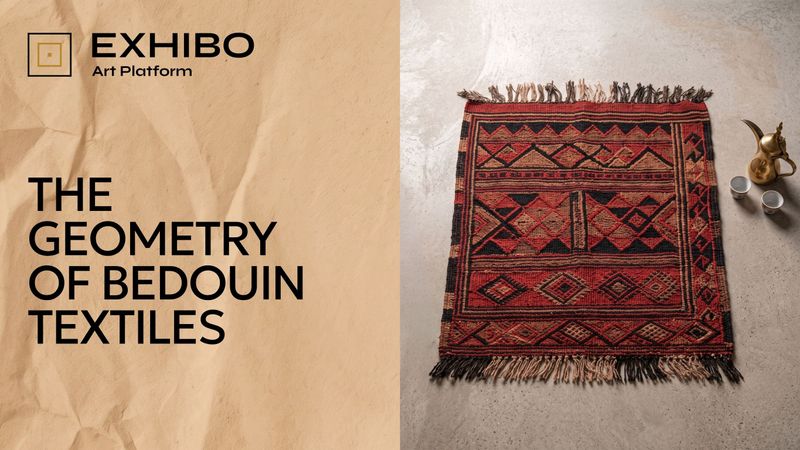
Sadu Weaving: The Geometry of Bedouin Textiles
The geometry the Bedouin wove, and the women who carried it in memory because nothing was written down.
On a loom you stake into the sand, Bedouin women wove the interior world of the Gulf — tents, dividers, camel trappings — and threaded through the wool a geometry that carried tribe, family and meaning. A story of Sadu: the patterns and their names, the women who transmitted them without a single written word, and the quiet work of keeping the craft alive.
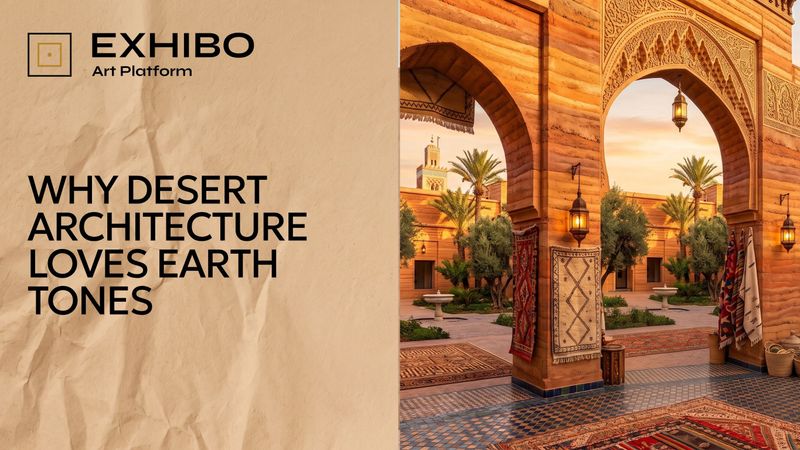
Why Desert Architecture Loves Earth Tones
In the deserts of North Africa and Arabia, ochre and terracotta were never a palette choice — they were what the wall was made of.
In most cities, colour is something you apply. In the old desert towns it was something you excavated — the red of Marrakech, the brown of Shibam and the gold of Diriyah all pulled straight from the ground underfoot. From iron-oxide chemistry to Hassan Fathy to the rammed-earth revival in Saudi Arabia, this is the story of a colour that outlived the place it came from.