
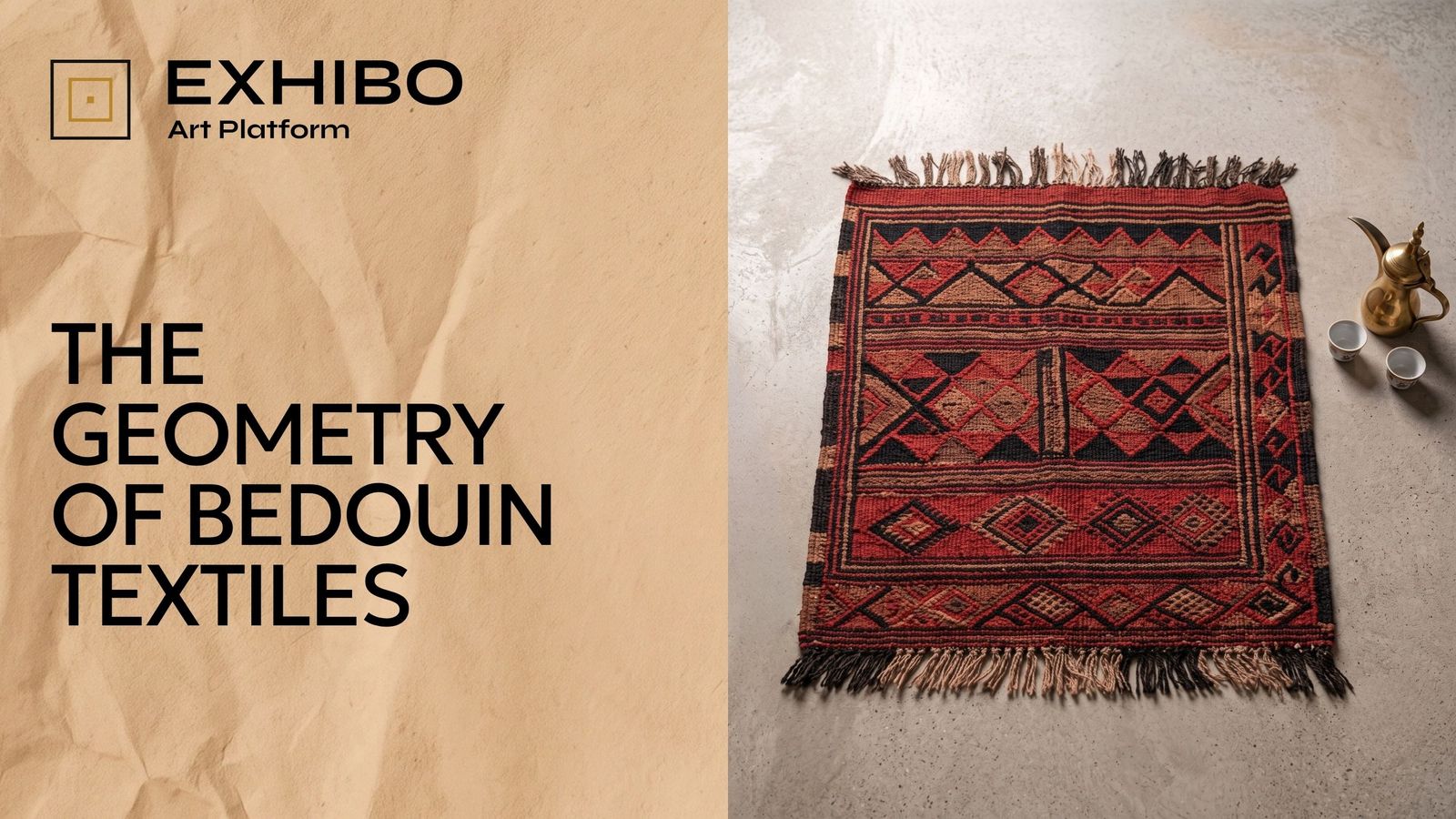
Kuwait City · Kuwait
Sadu Weaving: The Geometry of Bedouin Textiles
The geometry the Bedouin wove, and the women who carried it in memory because nothing was written down.
There is a kind of loom you do not stand at. You sit on the ground beside it, legs folded, and the work stretches away from you between two beams pegged into the earth. Roll it up, and it fits on the back of a camel. Unroll it at the next camp, drive the stakes back in, and you are weaving again. The loom is the technology of people who move.
This is the loom of Sadu, and for most of the history of the Arabian Peninsula it produced the interior world of the Bedouin — the tent itself, the dividing curtain that split the men's side from the women's, the cushions, the saddlebags, the camel trappings that made a moving household legible as this family, this tribe. Wool against wind. Wool against sand. And woven into the wool, in tight bands of red and black and undyed brown, a geometry that carried meaning for anyone who knew how to read it.
Almost no one wrote any of it down. That is the first thing to understand about Sadu, and the thing that shapes everything else. The knowledge lived in women, and it passed between women, and for a long time that was the only place it lived at all.
What the word carries
Start with the word, because the word is already doing more than it looks.
Sadu gets translated, correctly enough, as "weaving done in a horizontal style" — a description of the low ground loom and the long horizontal cloth it makes. But push on the Arabic root and it opens: in its widest sense it means to extend, to stretch, to spread out. Which is exactly what the warp does, pulled taut between the stakes. And exactly what the patterns do — running on in bands without a frame to close them, the way the desert itself runs on. The same word covers the loom, the act, and the finished cloth. One word for the tool, the making, and the made thing. That is not a vocabulary keeping three ideas apart. It is one that sees them as a single thing.
The cloth is a warp-faced plain weave, which sounds technical and means something simple and clever. In most weaving you see both the lengthwise threads and the crosswise ones. Here the lengthwise threads — the warp — are packed so densely that they cover the weft entirely. The colored warp is the pattern; the weft you never see, working invisibly underneath to hold the whole thing together and make it strong enough to keep rain and wind and sand out of a tent. The beauty is on the surface. The strength is hidden inside it. You could build a small philosophy out of that and the weavers would probably tell you not to overthink it.
From the animal to the thread
Before anyone weaves, there is a season of work most tellings skip straight past, and it is worth slowing down for, because it is where the craft actually begins.
The wool comes off the sheep, the goats, the camels in the late spring. In the traditional division of labor the men do the shearing; everything after that is women's work. The washing. The carding. Then the spinning, done on a maghzal, a wooden drop-spindle you can work while you walk, while you talk, while you watch a pot — the fibers pulled and twisted into a single strand that gets wound into a ball, coiled off into a skein, soaked in dye, dried, then plied into the double-strand yarn that is finally ready for the loom. Each stage has its own name. Each name is a small proof of how central this was: you do not develop precise vocabulary for things that don't matter to you.
The color came from the land the wool crossed. Deep red from madder root. Black from acacia. Brown from walnut husk. And a whole warmer range coaxed out of henna, saffron, turmeric, indigo — plants and spices that were also food, also medicine, also trade. The classic Sadu palette is narrow and sure of itself: black, white, brown, beige, red. Later, trade routes and then synthetic dyes pushed it wider — greens, blues, a louder red — but the old restraint is still what the eye reads as Sadu.
The loom itself, staked in the sand
Here is the loom in full, and it is almost aggressively humble.
Two end beams, held under tension. A single heddle bar, lifted on props so that half the warp threads can be raised at once to let the weft pass. In the desert the props might be a tripod of sticks or an empty oil can; in a town, a cinderblock, a brick, a purpose-built stand. The frame was traditionally split palm trunk lashed with palm-fiber twine; a later generation rebuilt it in galvanized pipe tied with nylon rope. It does not matter. The loom is not the point. The loom is whatever holds the warp straight long enough for the hands to work.
And the hands used tools that outlived their owners. A wooden sword-beater, slid into the gap in the warp and turned on its edge to open the shed. A pointed pick for driving each row of weft down tight. And — the detail I keep coming back to — a smooth length of gazelle horn, used to compact the cloth, worn glossy by decades of palms. Women inherited these tools from their mothers and grandmothers. The horn in your hand had been in your grandmother's hand, doing exactly this, and the smoothness was her work as much as the animal's. The tool was already an heirloom before you were born.
Because the loom is narrow, big pieces get built from parts. A tent divider ten meters long is woven as four or five narrow strips — filjan — and then sewn edge to edge into one great curtain. You do not weave the whole; you weave the pieces and assemble the whole. Which means you have to hold the finished thing in your head the entire time, strip by strip, before it exists. That is not a small cognitive feat. That is design without a drawing.
And there is more than one way to make the surface speak. A technique called ragoum runs extra threads across the top of the weft so the pattern lifts slightly off the plane of the cloth — a different texture you can feel as well as see. Weavers used it to build a bright raised badge along the outer edge of a tent divider, in a spot chosen precisely to catch the eye. The cloth was not only warmth and shelter. It was also, on its outward face, a sign — meant to be looked at, meant to announce.
The geometry, and the panel that speaks
Now the part that makes Sadu more than a beautiful textile.
Run your eye across a piece and most of it is stripes and simple bands — pretty, rhythmic, restrained. But in the tent divider, down the center, runs a denser panel where the real information lives. It is called the shajarah — the tree. And it is, in the most literal sense the weavers could manage, a language.
The vocabulary starts small and physical. The motifs a girl learns first are the border patterns, and their names are a walk through the world she lives in: hubub, seeds. Dealla, the ribs. Eein, the eye. Dhurs el-khail, horse teeth. Uwairjan, little triangles set facing each other. Later come the harder motifs that go into the long central panel — the ones that let a weaver say something particular. And sometimes, worked right into the shajarah, a wasm: the branding mark a tribe burned onto its camels, now woven into cloth. A signature. The textile telling you whose it is.
I want to be careful here, because this is exactly the kind of material that gets prettied up online into a tidy dictionary — snake means healing, zigzag means lightning, and so on. The honest picture is more interesting and less certain than that. The scholar who has done the most to record this language, Keireine Canavan, working with Kuwaiti master weavers, puts it plainly: the patterns all have names and specific meanings — though little is documented. The lexicon is real. It was also, until very recently, almost entirely unwritten, held in individual women's memories, and it varied from weaver to weaver, tribe to tribe, hand to hand. What Canavan and her colleagues did was sit with the last generation who carried it whole — women recorded by name, Muteira Thafeeree, Umm Turki, Umm Saleh and others — and write down what they said before it went quiet. That is not the same as a fixed code. It is a language caught in the act of nearly being lost.
And there is a threshold inside it. A young weaver starts on the borders — the seeds, the eye, the ribs. Only once she can weave the shajarah, the full central panel with its collection of motifs, is she recognized as thafrah: accomplished, victorious. The word is a graduation. It marks the moment the language became fully yours.
The technique is one thing across the peninsula; the accent is not. In the Najd, the heartland of what is now Saudi Arabia, the weaving tends toward bolder, interlocking motifs scaled up for the great tent panels — several meters of pattern at a stretch. Toward the coast of Oman it softens and mixes, the desert forms picking up maritime habits and local turns. Kuwait and the Emirates run tighter, smaller formats. One craft, spoken in dialects — the same seeds and eyes and horse-teeth, arranged by a Najdi hand or a coastal one into something a knowing eye could place. Which is the whole point of it: the pattern does not just say this is beautiful. It says this is where I am from.
How it moved between women
Nothing was written, so everything depended on being present.
Girls learned by watching, from very young, and were handed the work in pieces — sort this wool, wind this ball — long before they were trusted with the loom. Competence arrived slowly, task by task, until one day the hands simply knew. There was no manual because there could be no manual; the whole system ran on a girl sitting close enough to a woman to see what her fingers did, for years. The transmission and the craft were the same act. You did not learn Sadu and then join the women weaving. You learned it by being among the women weaving.
And they wove together, in groups, and while they worked they talked and they chanted — exchanging news, and sometimes composing poetry aloud. The poetry has a name too, and a surprising one: al-Taghrooda, the improvised Bedouin verse that UNESCO recognized in 2012. At its root it is a men's form — call-and-response chanted between two groups of riders on camelback, timed to the animals' walk. But the record is explicit that women took the same form and made it theirs at the loom: some Bedouin women compose and chant while engaged in collective work, such as Al-Sadu weaving. Not a separate women's genre. The shared one, carried into the women's own space and set to the rhythm of the beater.
If that rhymes with something, it should. The pearl divers of this same coast had their work songs too, the fidjeri, timing the haul from the seabed. Song threaded through labor, holding the rhythm and holding the people together — on the water and at the loom both. Two halves of one culture, and today both halves sit on the same UNESCO lists.
What settling cost, and what nearly ended it
The tent made of hair is no longer made. That plain sentence holds most of the twentieth century.
When the Gulf moved from the tent to the town — a shift the oil economy accelerated hard — the reason to weave a home out of wool simply went away. You do not need a ten-meter divider for a concrete house. The functional heart of Sadu stopped beating, and the knowledge, which had never lived anywhere but in practicing hands, began to thin out with the generation that still had it. By the time researchers went looking in earnest, most of the master weavers left in Kuwait were elderly, and very little of what they held had ever been recorded.
Then it nearly ended in a single blow. The Gulf War came, and Kuwait's weaving project almost went under — weavers scattered, grieving, rebuilding their lives, with little room left for the loom. A craft that had survived centuries of desert was very nearly finished off by one invasion and the modern world arriving at the same time.
That it wasn't is largely the work of a small number of women who decided it would not be.
The house that kept it
In 1978, a Kuwaiti anthropologist named Sheikha Altaf Salem Al-Ali Al-Sabah started, with a handful of like-minded people, a private effort to document Bedouin weaving before it disappeared. By 1980 it had a home: a 1936 merchant's house on the old Kuwait City seafront, repurposed as Sadu House — museum, workshop, and archive of a way of making. After the invasion, she went back to it with what she describes as a new mission: to bring the desert weaving and the city together, to move the loom from the sand into the museum without letting it die on the way.
She was clear-eyed about what the weaving had actually been. These women, she has said, were not professional artisans weaving for the market. They wove because it was part of running a household — one more chore beside the cooking and the children — and then, having to do it anyway, they made it beautiful. "They had this genius in them," she puts it, and turned "very basic functional items" into art. That is the truer story of most folk art, and it resists both of the easy versions — the romantic one that makes every weaver a mystic, and the dismissive one that files this under "handicraft" and moves on.
The rescue also had an outside hand worth naming, because it connects Kuwait to a much larger story. When Sheikha Altaf turned to UNESCO for help, they sent her Jasleen Dhamija — the Indian textile historian known internationally as the "Philosopher of Living Cultural Traditions," who had spent decades reviving craft in India, Iran and across Africa. The woman who helped save Bedouin weaving in Kuwait was part of the same twentieth-century movement that saved the handloom in India. Craft revival, it turns out, has its own diaspora of expertise, moving between deserts.
By 1991 the project had become the Al Sadu Weaving Cooperative Society — owned by the weavers themselves, honoring the master weavers as its members rather than its subjects. The women who carried the craft became the shareholders in the institution built to keep it.
The pattern, still spreading
Sadu did not stay a museum piece, and this is where the story turns unexpectedly forward.
Some of it is still just a woman at a loom. At the edge of Doha's Souq Waqif, the women who keep the little weaving shops are Bedouin weavers, and one of them, Umm Hamad, works a small frame loom right there. Her large tent-wall pieces are the whole craft at once — every traditional pattern present, the blue-and-red drus al-khail, the pebbly ouerjan in three colors, and down the middle the black-and-white shajarah picked up entirely by hand, one warp thread at a time, row by row, according to whatever she has decided that row should say. Some of the designs, she says, are learned; others she invents on the spot, and you can see it in the way the pattern refuses to quite repeat. The motif nearest her hand is the shape of a traditional incense burner. And she works a thread of silver into the weave — a modern yarn, not a desert one, the tradition quietly taking on whatever the present hands it. It is not frozen. It is still being made.
Beyond the loom, the geometry has come loose in the wider world. A public installation threading the old patterns through Kuwait's urban fabric. Sadu House running a program to teach the teachers — training school art teachers so the craft enters the national curriculum, and working with UN refugee agencies to bring weaving to displaced communities in Egypt. An artists' initiative, SADI, putting weavers in a room with contemporary designers year after year. A Dubai designer, Katya Kovtunovich, building a fashion line out of Sadu cloth back in 2012. And in 2020, the Saudi presidency of the G20 taking a Sadu-inspired motif as its logo — the women's desert geometry standing in for the whole Kingdom on the largest economic stage there is.
The recognition kept arriving, in stages that are easy to blur together and worth keeping straight. The UAE got Sadu onto UNESCO's Urgent Safeguarding list in 2011 — urgent being the operative word, a craft flagged as at risk of vanishing. In 2020 Saudi Arabia and Kuwait secured a joint inscription on the main Representative List. In 2025 Qatar joined that inscription, and the UAE's original listing was upgraded off the urgent register. In fourteen years the craft moved, on paper, from endangered to celebrated across four nations. The paper is not the same as the practice — a listing is not a living weaver — but the direction is real.
What changed, and this is the honest center of the revival, is what Sadu is for. UNESCO says it directly: the weaving has become less a functional object and more a thing signifying tradition and deep culture. No one weaves a tent to live in anymore. They weave to hold onto something — an identity, a lineage, a grandmother's hand on a gazelle horn. The craft that once made the walls of a home now does something less tangible and maybe more difficult: it keeps a people legible to itself.
What the cloth was always doing
Come back, at the end, to the thing itself. A band of geometry in red and black and undyed brown, packed tight enough to turn a sandstorm, woven in strips on a loom you stake into the ground, by a woman sitting on the earth beside it, chanting, while a girl beside her watches the hands and learns without being taught.
Every part of that was information. The pattern told you the tribe. The wasm told you the family. The skill told you the weaver had crossed into thafrah, had earned her place. A home, a passport, and a poem at once — and it carried all of it without a single written word, across generations, in the memory of women, which is the most fragile way to keep anything and, as it turns out, one of the most durable.
The tents are gone. The desert is mostly highway now. And the geometry kept spreading anyway, exactly the way the old word always promised it would — to extend, to stretch, to spread out. Off the loom and onto a museum wall. Onto a hoodie. Onto the logo of a summit of the twenty largest economies on earth. What the women wove into the wool was never only cloth. It was a way of saying we were here, this is who we are — and that, unlike the tents, was built to travel.
Galleries mentioned
Museums mentioned

Related reading
Women Makers: Sadu, Sejnane and the Art the West Called Craft
How the women of Sejnane and the Sadu tents made a world of geometric art the museum system had no shelf for — and how it is finally being called by its name.
Two women's traditions — the clay of Sejnane in Tunisia, the woven tents of the Arabian Peninsula — share no bloodline, only a rhyme: the same spare geometry, held and passed down by women, in whatever material their world gave them. This is the story of the visual knowledge the West filed under "craft," the makers it kept downstairs, and the contemporary artists now carrying it back up into the room where "art" is defined.
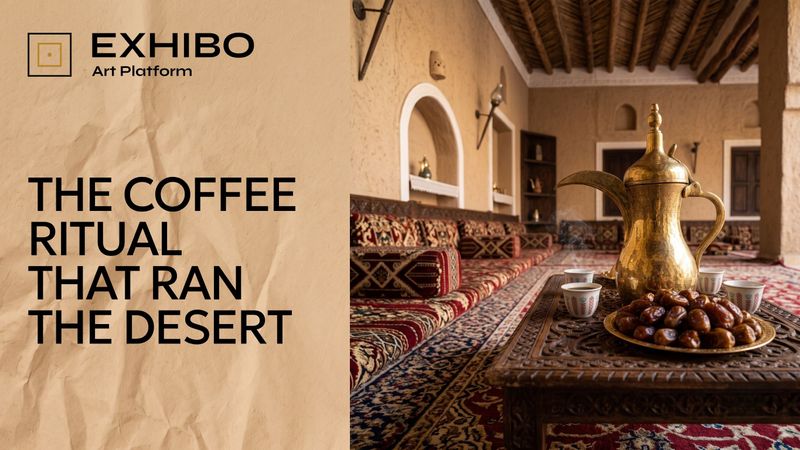
The Coffee Ritual That Ran the Desert
A cup of coffee in the desert was a contract, a test, a truce, and a promise of protection — a whole social order in the tilt of a small white cup.
Among the Bedouin of Arabia, serving coffee was never just hospitality — it was a code. The order of the cups, the amount poured, the shake of the wrist that says enough: a whole unwritten language for turning a dangerous stranger into a guest, and sometimes an ally. The story of Arabic coffee as the social law of the desert — and how it lives on in the region's museums and art.
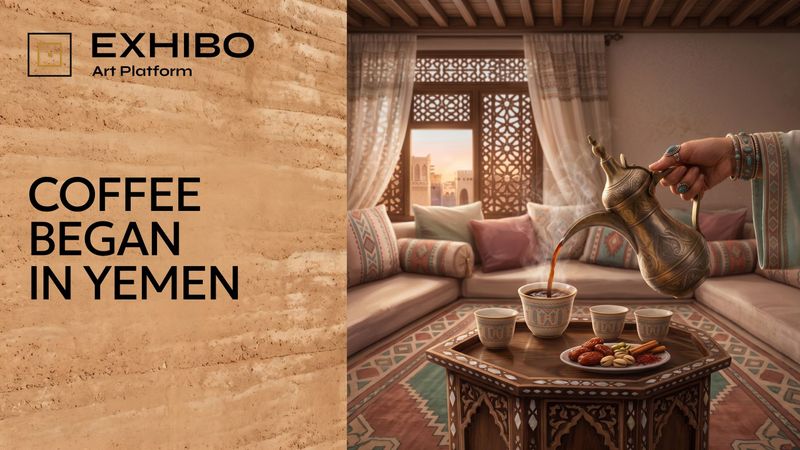
Coffee Began in Yemen
The coffee plant is Ethiopian. But the drink — roasted, brewed, and made the center of a culture — is Yemeni.
Before the espresso machine, before the café, a Sufi in Yemen brewed a bean to stay awake for God. This is the story of how coffee became coffee — from the prayer lodges of the Shadhili order to the Red Sea port of Mocha that named a drink, and finally to the shape the Gulf poured all of it into: the dallah on the one-dirham coin.