
Yerevan · Armenia
Karen Ohanyan: Delicate Matter at the National Gallery of Armenia
Exploring concealment, materiality, and memory in new triptychs
The National Gallery of Armenia has opened Karen Ohanyan's latest survey, Delicate Matter, running from early August until early September 2026. Organised under the Prospectations initiative, which spotlights emerging voices within contemporary Armenian practice, the show emerges from a partnership between Atamian Hovsepian Curatorial Practice and the institution itself. Following its domestic debut, the selected pieces will travel to the United Arab Emirates for Sharjah Biennial 17: What Remains, sits restive, opening in January 2027 and concluding in June of the following year.
Material Alchemy and Concealed Narratives
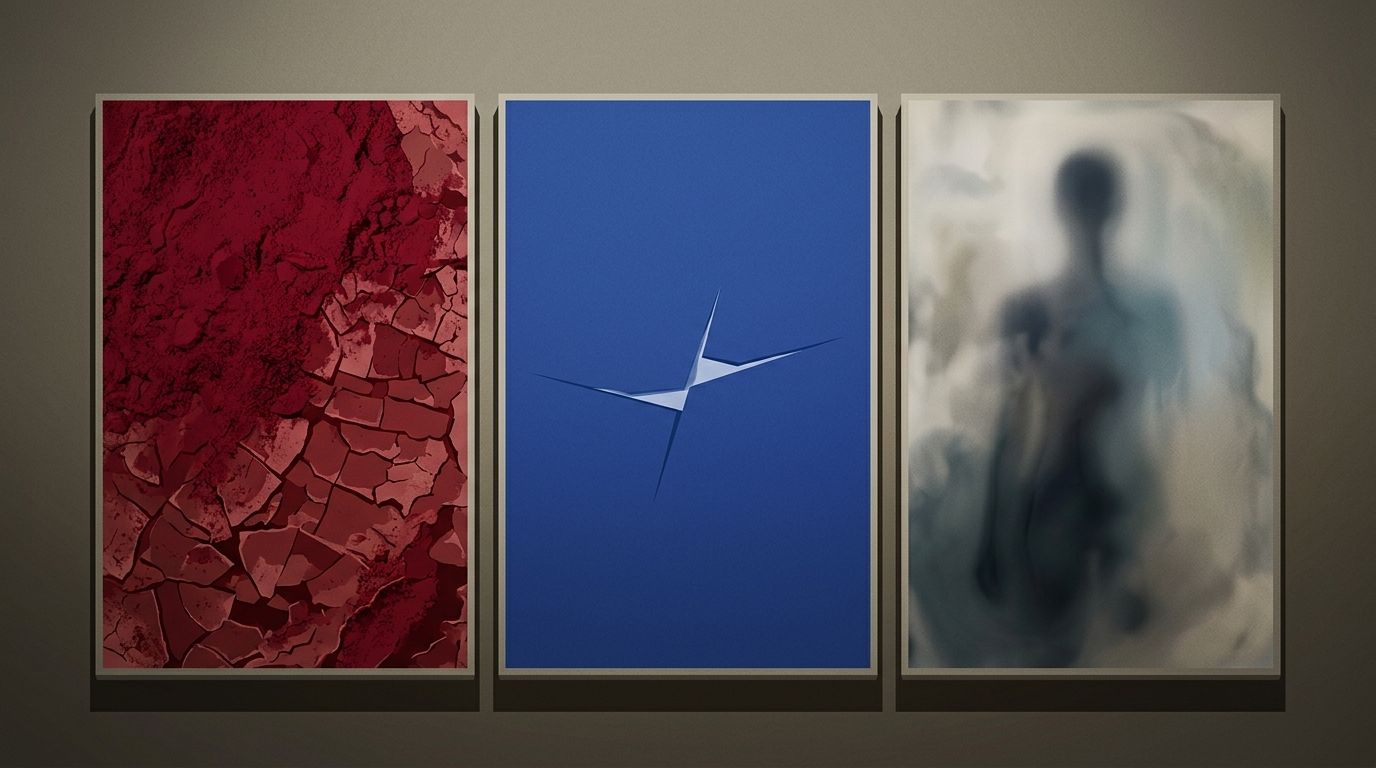
Ohanyan constructs his investigation around the dual resonance of physical substance and unspoken social tensions. By layering traditional media alongside industrial adhesives and candle wax harvested from local religious sites, he builds surfaces that feel both monumental and transient. Each triptych comprises three substantial panels, measuring precisely two hundred and two by two hundred and seventy-three centimetres. One configuration receives a dusting of ground chilli, while its counterpart is submerged beneath a dense cobalt wash. The colour selection deliberately references primary tones, drawing upon the golden hue of liturgical wax to establish a foundational palette from which every other shade derives.
The structural choice of three connected canvases inevitably evokes ecclesiastical altarpieces, yet the artist subverts this tradition through deliberate obfuscation. A sweeping monochromatic field dominates the exterior, fractured only by calculated ruptures that disclose hidden narratives underneath. Beneath these veils lies a fully realised figurative schema, partially melted and sealed with translucent resin. This technique forces the viewer to navigate between abstraction and representation, suggesting that what appears solid frequently depends upon fragile foundations. The tension between concealment and revelation operates as the central mechanism driving the work forward.
The Architecture of Memory
Within the blue configuration, the final compartment abandons partial hiding entirely. A complete female figure emerges through the semi-opaque coating, her direct stare challenging conventional spectatorship. Positioned with a journal across her lap, she operates simultaneously as archivist, matriarch, and emblem of cultural continuity. Her presence anchors the broader meditation on how societies process trauma without resorting to graphic exposure. Ohanyan utilises opacity as a protective mechanism, allowing the canvas to function as both archive and shield against sensationalism.
The red variant approaches similar inquiries through a different material vocabulary. The abrasive texture of the spice introduces a tactile urgency that contrasts sharply with the smooth viscosity of the blue surface. Together, the paired installations examine how communities endure systemic pressures while maintaining internal cohesion. Rather than documenting historical rupture directly, the painter explores how memory survives through indirect channels. The interplay between gestural marks and concealed forms demonstrates that resilience often originates from acknowledged weakness. As the works prepare for their international itinerary, they underscore a persistent question regarding the capacity of paint to hold space for what remains unsaid.
From Yerevan to Sharjah
Following its Armenian debut, the exhibition will continue its journey across the Middle East. Sharjah Biennial 17 invites viewers to consider how artistic practices adapt when removed from their initial contexts. The upcoming presentation ensures that Ohanyan's meditations on fragility and endurance reach a global audience before concluding their tour.
Related reading
Hockney and Wu Guanzhong in Dialogue at Christie's Hong Kong
A pioneering non-selling exhibition explores shared landscapes and cross-cultural influences
Christie's Hong Kong presents the first joint showing of David Hockney and Wu Guanzhong, exploring shared landscapes and cross-cultural visual traditions.
M+M: The Day of the Mantis at the 16th Gwangju Biennale
Luxembourg Pavilion's immersive insect-centric film trilogy explores ecological anxiety and non-human perspectives
A new cinematic installation by Marc Weis and Martin De Mattia refracts contemporary unease through the eyes of arthropods at South Korea's premier contemporary art festival.
Birke Gorm: the evening and the morning and the night at the Gwangju Biennale
Austria's national pavilion reimagines a museum loft as a living archive of repurposed sculpture and hidden histories.
The Austrian Pavilion transforms an upper-floor gallery into a tactile attic, exploring material memory and marginalised narratives through sculpture and sound.