
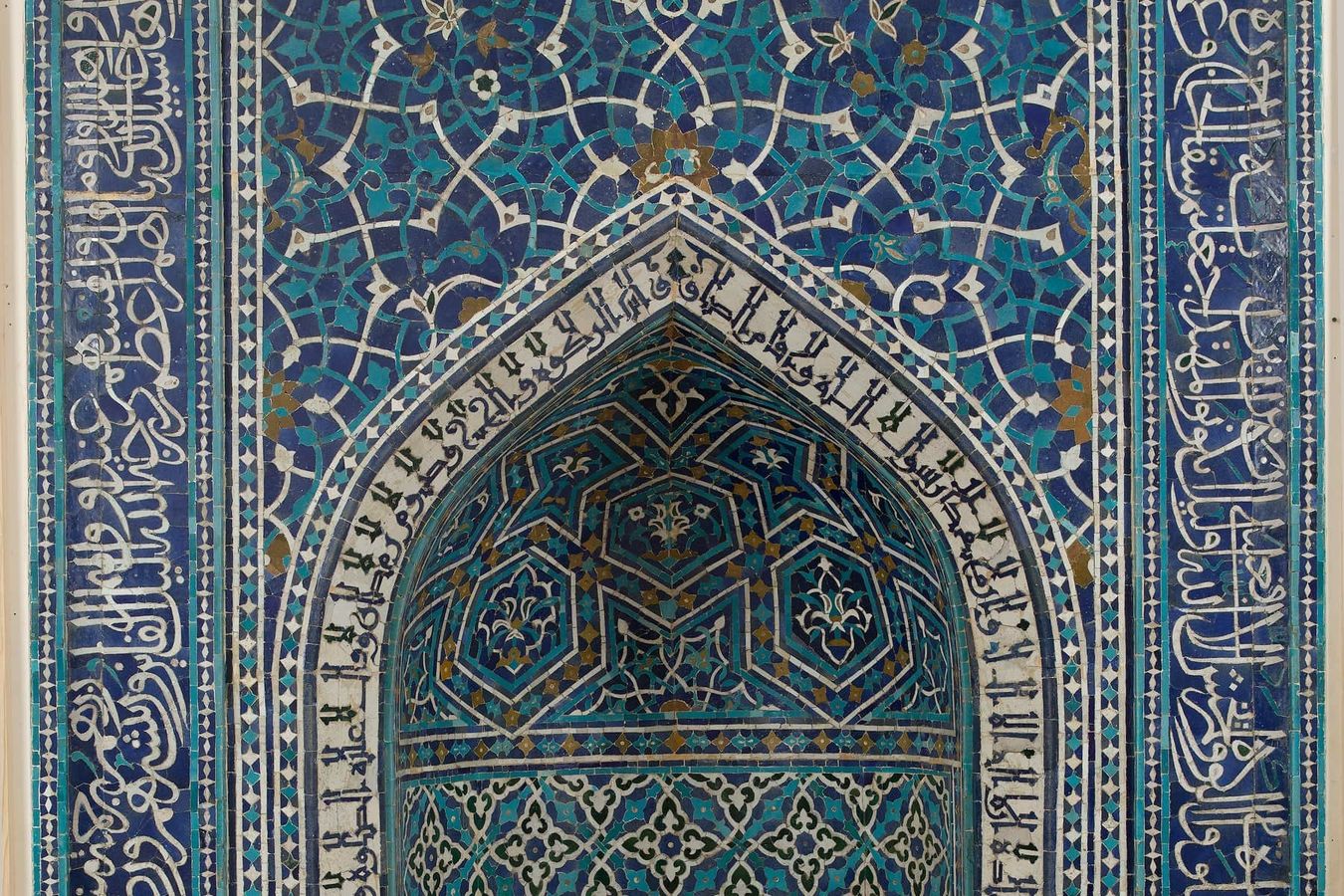
Exhibo Editorial
56 English Words With Arabic Roots: Art, Colour, Fabric and Architecture
Azure lost a letter, alcohol was once eye make-up, and a sofa was a carpeted platform. A field guide to the art words English borrowed from Arabic — and how sure we can be about each one.
Short answer: Depending on what counts as a borrowing, reference works list anywhere from a few hundred to a few thousand English words connected to Arabic. The totals differ because some count only direct loans, while others include words that came through other languages, derived forms and phrases. Many of these words belong to art and design: azure, crimson, lilac, saffron, cotton, sequin, sofa, alcove, magazine. Of the 56 below, 47 reached English through at least one other language — Spanish, Italian, French, Latin, Turkish, Persian or Hindustani — picking up new spellings and sounds on the way. That long relay is one reason their Arabic origins are rarely obvious today.
Your sofa has Arabic roots. So does the mattress you slept on, the cotton of your shirt, the sequins on a party dress, the jar in the kitchen and the magazine on the table.
So does the alcohol in your glass. It began as the name of a fine powder used to darken the eyes.
None of these words looks foreign, and that's the interesting part. They are traces of trade — in dyes, minerals, cloth, ceramics, medicine and building — that crossed the Mediterranean and beyond for centuries. The goods moved, and their names moved with them, through Andalusian Spanish, Venetian Italian, the Latin of apothecaries and alchemists, Ottoman Turkish and the French of the cloth trade. Each language reshaped them a little.
This is a field guide to 56 of those words from the world of art. First, ten with the best stories. Then a compact table of all 56, with how sure we can be about each one. Then the disputed cases — because some of the most repeated etymologies in this field are less certain than they look — and a closer look at colour, cloth, architecture and the studio.
The 10 best stories: English art words from Arabic
1. Alcohol — from kohl, the powder for the eyes
Alcohol comes from Arabic al-kuḥl: a fine powder, especially of antimony, used to darken the eyes.
Medieval Latin took the word for fine metallic powders. Chemists later stretched it to the essence of a substance obtained by refining or distillation, and eventually to the spirit in wine; Merriam-Webster dates the English word to 1672. Kohl, the cosmetic, came into English separately and kept the original sense. One Arabic noun, two English words.
2. Azure — the blue that lost a letter
Azure comes from Arabic lāzaward, "lapis lazuli", from Persian lājward.
As the word passed through medieval Latin and Romance forms, the initial l was lost — possibly because it was reanalysed as an article, as if lazur were l'azur. The stone came to Europe from Badakhshan, in today's Afghanistan, one of the very few places it occurs naturally. Ground and purified, it became ultramarine, a pigment the National Gallery in London says "has sometimes been even more expensive than gold", because the stone was hard to obtain and the blue needed long, careful processing. Lapis lazuli kept the l: Latin lapis, stone, plus Medieval Latin lazulī, from the same Arabic word.
3. Crimson — a red named after a dye insect
Crimson comes, through Old Spanish or Italian, from Arabic qirmizī, from qirmiz: kermes, the insect crushed to make red dye.
Its relatives took different roads. Kermes, the insect's name, reached English through French. Carmine probably belongs to the same family too, blended in Medieval Latin with minium, cinnabar — though the carmine sold today is made from cochineal, a different insect. Further back, qirmiz is most often traced to Sanskrit kṛmi-ja, "produced by worms". A red named not after a rose or a ruby, but after what had to be crushed to make it.
4. Mummy — and the paint made from mummies
Mummy comes, through Medieval Latin mumia, from Arabic mūmiyā, a kind of bitumen — itself from Persian mūm, wax.
The word first named a substance, not a body. In Middle English a mummie was a drug: powdered parts of an embalmed corpse, taken as medicine. From the apothecary it reached the paintbox. "This pigment consists of the parts of an Egyptian mummy, typically ground up with a drying oil such as walnut," wrote Raymond White in the National Gallery Technical Bulletin in 1986, noting that it was also sold as "Egyptian brown" and used as a warm glaze.
Not every painter was comfortable with that. In his autobiography, Rudyard Kipling remembered his uncle, the Pre-Raphaelite Edward Burne-Jones, descending "in broad daylight with a tube of 'Mummy Brown' in his hand, saying that he had discovered it was made of dead Pharaohs and we must bury it accordingly." The family did. "To this day," Kipling wrote, "I could drive a spade within a foot of where that tube lies."
5. Azulejo — the tile that probably isn't named after blue
Azulejo most likely comes from Arabic az-zulayj, "polished stone".
Portuguese and Spanish tiles are so often blue and white that everyone assumes the word comes from azul, blue. Wiktionary's Spanish and Portuguese entries treat that as a folk etymology and derive the tile from Arabic az-zulayj, the polished stone — the same word behind Moroccan zellige. An azulejo is a glazed decorative tile, not necessarily a blue one.
6. Sofa — first a raised, carpeted bench
Sofa comes from Arabic ṣuffa — a raised bench or platform spread with carpets — through Turkish sofa, and then Italian or French.
Merriam-Webster notes that the word first meant a raised, carpeted part of the floor; the upholstered seat is dated to 1717. Its neighbour, mattress, is Arabic maṭraḥ, "a place where something is thrown down" — a mat or cushion.
7. Magazine — a storehouse before it was a publication
Magazine comes from Arabic maḵāzin, "storehouses", through Old Occitan or Italian and then French.
It first meant a storehouse, then a store of ammunition, then a printed store of articles. The metaphor is still sitting in the word. In French, a magasin is still a shop.
8. Sequin — a coin before it was a sparkle
Sequin comes from Italian zecchino, a Venetian gold coin, named after zecca, the mint — from Arabic sikka, the die used to strike coins.
English had sequin for the coin by 1617. The shiny disc on a dress came later. Sew on enough of them and you're wearing a very old word for money.
9. Arsenal — the Arabic name inside the Venice Biennale
Arsenal comes from Arabic dār aṣ-ṣināʕa, "house of manufacture", through Venetian Italian.
La Biennale di Venezia describes its Arsenale as the largest production centre of pre-industrial Venice, employing up to 2,000 workers a day at its busiest, building the Republic's fleets. Since 1980 it has been one of the Biennale's exhibition sites. A house for making things, now used for showing them.
10. Mashrabiya — a window with more than one explanation
Mashrabiya is the Arabic word mašrabiyya: a projecting window or balcony enclosed by carved wooden lattice.
The most common explanation links it to the root š-r-b, "to drink": the screen began as a shelf at the window where water jars were kept cool. A second theory derives it from mašrafiyya, from a verb meaning "to overlook". Architectural historians have read still more into it: Bechir Kenzari and Yasser Elsheshtawy, writing in the Journal of Architectural Education in 2003, link the device to weaving, the veil and the gaze — while warning against "excessive interpretations". The function of the screen is well documented. What its name originally meant is still open.
All 56 words at a glance
"Arabic link" rates how sure we can be about the Arabic connection — not every earlier step. Firm: Merriam-Webster (MW) and the American Heritage Dictionary (AHD) both give it. Probable: only one of them gives it, or one hedges. Disputed: authorities disagree. Arabic term: an Arabic word used in English as a technical term, not listed in MW or AHD. The full dataset — with deeper origins, first known uses and sources for every row — is available on Kaggle.
| Word | From Arabic (meaning) | Route into English | Arabic link |
|---|---|---|---|
| crimson | qirmizī, from qirmiz: kermes, the dye insect | Old Spanish (or Old Italian / Medieval Latin) | Firm |
| kermes | qirmiz: kermes, the dye insect | French | Firm |
| carmine | qirmiz: kermes | Medieval Latin carminium → French | Probable |
| azure | lāzaward: lapis lazuli | Medieval Latin / Old Spanish → Old French | Firm |
| lapis lazuli | lāzaward: lapis lazuli | Medieval Latin | Firm |
| lilac | līlak: lilac | French | Firm |
| orange | nāranj: orange (tree, fruit) | Old Occitan / Old Italian → Old French | Firm |
| saffron | zaʕfarān: saffron | Medieval Latin → Old French | Firm |
| safflower | ʕuṣfur: safflower | Old Italian saffiore → Middle French | Firm |
| aubergine | al-bāḏinjān: the aubergine | Catalan → French | Firm |
| nacarat | naqqāra: drum, source of Spanish nácar, nacre | Old Spanish nácar / nacarado → French | Probable |
| realgar | rahj al-ġār: powder of the cave, or of the mine | Catalan → Medieval Latin | Firm |
| amber | ʕanbar: ambergris | Medieval Latin → Old French | Firm |
| henna | ḥinnāʔ: the henna plant | direct | Firm |
| kohl | kuḥl: powdered antimony | direct | Firm |
| alcohol | al-kuḥl: the powdered antimony | Old Spanish → Medieval Latin → New Latin | Firm |
| sumac | summāq: the sumac tree | Medieval Latin → Old French | Firm |
| mummy | mūmiyā: bitumen; mummy | Medieval Latin mumia → Old French | Firm |
| tutty | tūtiyāʔ: zinc oxide | Middle French | Firm |
| talc | ṭalq: talc | Medieval Latin / Old Spanish → French | Firm |
| borax | būraq: borax | Medieval Latin → Anglo-French | Firm |
| natron | naṭrūn: natron, niter | Spanish → French | Firm |
| alkali | al-qily: the ashes; lye, potash | Medieval Latin | Firm |
| marcasite | marqašīṯā: marcasite | Medieval Latin | Probable |
| alembic | al-ʔinbīq: the still | Medieval Latin / Middle French | Firm |
| amalgam | al-malḡam: an emollient | Medieval Latin | Probable |
| cotton | quṭn: cotton | Old Italian → Old French | Firm |
| satin | zaytūnī (hypothesis): 'of Zaytūn', Quanzhou | Old French | Disputed |
| tabby | ʕattābī: after al-ʕAttābiyya, a quarter of Baghdad | Medieval Latin → French | Firm |
| gauze | qazz (hypothesis): raw silk | (Spanish?) → French | Disputed |
| macramé | miqrama: coverlet; embroidered veil | Turkish → Italian → French | Firm |
| sequin | sikka: coin die | Italian → French | Firm |
| camlet | ḫamla(t): woollen plush, nap | Old / Middle French | Probable |
| sash | šāš: muslin | direct | Firm |
| djellaba | jallāba: the robe | French | Firm |
| abrash | abraš: mottled, speckled | Turkish | Firm |
| sofa | ṣuffa: raised carpeted bench; carpet, divan | Turkish → Italian / French | Firm |
| mattress | maṭraḥ: place where something is thrown; mat, cushion | Medieval Latin / Old Italian → Old French | Firm |
| alcove | al-qubba: the vault, the arch | Spanish → French | Firm |
| jar | jarra: earthen water vessel | Old Occitan → Middle French | Firm |
| alcarraza | al-karrāz: the jar | Spanish | Probable |
| azulejo | az-zulayj: polished stone | Spanish / Portuguese | Probable |
| mashrabiya | mašrabiyya: root š-r-b, 'drink' (most common theory) | French, later re-borrowed | Arabic term |
| muqarnas | muqarnaṣ: stalactite vaulting | direct | Arabic term |
| mihrab | miḥrāb: prayer niche | direct | Firm |
| minaret | manāra: lighthouse, beacon | Ottoman Turkish → French | Firm |
| riad | riyāḍ: gardens | direct | Arabic term |
| turbeh | turba: tomb | Turkish | Probable |
| qalam | qalam: pen | direct | Arabic term |
| rasm | rasm: outline, trace | direct | Arabic term |
| nuqta | nuqṭa: dot | Persian → Hindustani | Arabic term |
| ream | rizma: bundle | (Catalan?) → Old French | Firm |
| magazine | maḵāzin: storehouses | Old Occitan / Old Italian → French | Firm |
| arsenal | dār aṣ-ṣināʕa: house of manufacture | Venetian Italian → Middle French | Firm |
| carat | qīrāṭ: carob pod; a small weight | Italian / Medieval Latin → French | Firm |
| talisman | ṭilsam: talisman | French / Spanish / Italian | Firm |
Two more cloths are named after Arab cities rather than borrowed Arabic words: muslin, from Arabic mawṣilī, "of Mosul", via Italian and French; and damask, from Damascus.
The disputed ones: how an etymology gets argued
Some of the best-known stories about Arabic words in English are not settled. They are worth telling anyway, because the argument shows how word histories are actually established: forms are compared, dates are lined up, and evidence for trade is kept separate from evidence for a word.
Satin: a Chinese port, or Latin silk?
One explanation derives satin from Arabic zaytūnī, "of Zaytūn" — the Arabic name of Quanzhou, a major medieval port in southern China. Merriam-Webster and the American Heritage Dictionary both accept it as probable. There is evidence that the phrase existed: when the Persian envoy ʕAbd al-Razzāq visited the king of Vijayanagara in 1441, he described him dressed in aṭlas-i zaytūnī, "satin of Zaytun", and the historians Henry Yule and Wilhelm Heyd were convinced of the link.
But a phrase in Persian is not proof of an English word's ancestry. Etymonline reports that the Oxford English Dictionary finds the Arabic connection untenable and derives satin instead from Latin seta, silk. Two major American dictionaries say probably; the largest English one says no. We mark it Disputed.
Gauze: possibly silk
The American Heritage Dictionary traces gauze, through French gaze, to Arabic qazz, raw silk. Merriam-Webster stops at French gaze and gives no Arabic source. A popular alternative links the word to the city of Gaza; neither dictionary supports it. Gauze stays on this list as possible, not proven.
Mashrabiya and muqarnas: Arabic words, open questions
Both are Arabic words used in English as architectural terms. Their Arabic origin is not in doubt; what lies behind it is. Mashrabiya has at least two competing explanations (see above). Muqarnas, the honeycomb vaulting of Islamic architecture, is sometimes traced to Greek korōnís, "curved", and sometimes to Persian. For how muqarnas actually works, see Muqarnas vaulting: geometry, history and key sites.
Frieze: why it isn't on this list
Frieze appears in some lists of Arabic loanwords, traced to Arabic ifrīz, a cornice. We left it out: Merriam-Webster and the American Heritage Dictionary both derive it from Latin Phrygium, "Phrygian work", an embroidered cloth, and neither mentions Arabic.
How colour got its names
Colour words rarely start as colour words. They start as the name of a stone, a plant, an insect or a fruit, and the colour is borrowed from the thing. The Arabic-derived colours in English show every one of those routes.
From a stone: azure and lapis lazuli (above). From an insect: crimson and kermes. From a fruit: orange, Arabic nāranj, from Persian nārang — the fruit was named first, the colour much later, and the French town of Orange only influenced the spelling. From a vegetable: aubergine, which still hides the Arabic article: al-bāḏinjān became Catalan albergínia, and French turned al- into au-.
From plants used as dyes: saffron (zaʕfarān), safflower (ʕuṣfur, its form later influenced by Italian fiore, flower), henna (ḥinnāʔ) and sumac (summāq, from an Aramaic word for dark red). Lilac is a plant name too, from Arabic līlak, which goes back to Persian nīlak, "bluish".
From a substance whose meaning drifted: amber, Arabic ʕanbar, first meant ambergris, and only later fossil resin and its colour.
And from minerals and pigments, with odder names. Realgar, an orange-red arsenic mineral, is Arabic rahj al-ġār, usually glossed as "powder of the cave" or "of the mine". Nacarat, a bright red-orange, comes from Spanish nacarado, "nacre-coloured"; Merriam-Webster traces Spanish nácar, nacre, to Arabic naqqāra, a drum. That last step is the uncertain one, so we mark nacarat Probable.
The colours of North African cities have their own histories: see why Marrakech is red and Fez is ochre and why Chefchaouen is blue.
Cloth: names that travelled with the textile trade
Textile words are among the clearest traces of trade, because cloth was named after where it came from or what it was made of.
Cotton is Arabic quṭn, carried into English by Old Italian and French. (That's the history of the word, not of the plant, which was grown long before and far beyond the Arab world.) Tabby comes, through French and Medieval Latin, from Arabic ʕattābī, after al-ʕAttābiyya, a quarter of Baghdad associated with a heavy watered silk; the name later passed from the striped silk to the striped cat. Two cloths are named after cities outright: muslin after Mosul, damask after Damascus.
Some words describe how cloth was worn or worked. Sash comes from Arabic šāš, muslin; English first had it as shash, and Merriam-Webster dates the waistband sense to about 1678. Djellaba, the hooded robe of North Africa, came through French from Arabic jallāba. Macramé came into English in 1865, through French, Italian and Turkish makrama, a napkin or towel, from Arabic miqrama, a coverlet or embroidered veil. Camlet, a fine cloth, is traced by Merriam-Webster to Arabic ḫamlat, woollen plush; the American Heritage Dictionary says only "perhaps".
And one word belongs to the rug collector. Abrash names the variation in colour across a rug. It came through Turkish from Arabic abraš, mottled or speckled.
Architecture: from vault to alcove, lighthouse to minaret
In this list, architectural words keep their Arabic shape more often than colour or cloth words do — several arrived late, as technical terms, directly or through Turkish.
An alcove was a vault: Arabic al-qubba, the vault or arch, became Spanish alcoba and French alcôve. A minaret is, by its Arabic name, a lighthouse — manāra, a beacon — and came into English in 1682 through Turkish and French. A mihrab, the niche that marks the direction of prayer, is borrowed straight from Arabic miḥrāb. A turbeh, a small domed tomb, came through Turkish türbe from Arabic turba.
Riad is Arabic riyāḍ, "gardens". In Morocco the word names a house built around an interior garden; the building type and the meaning of the word are related, not identical. It's worth reading alongside why North African cities turn inward.
The potter's shelf has its own: jar is Arabic jarra, an earthen water vessel, through Old Occitan and French; alcarraza, the porous Spanish water jug, is Arabic al-karrāz, "the jar".
The studio: materials that travelled with Arabic science
Many substances used in painting, gilding, glazing and conservation reached Europe with Arabic names — often names that Arabic had itself taken from Persian, Greek or Sanskrit. That is the real pattern here: Arabic as a channel through which knowledge moved, not necessarily the place where every material or idea began.
Talc (ṭalq) and borax (būraq) came from Persian through Arabic. Tutty, a zinc-oxide polishing powder, is Arabic tūtiyāʔ, ultimately from Sanskrit. Natron, the salt used in ancient Egyptian embalming, came through French and Spanish from Arabic naṭrūn, from Greek nítron. Alkali is Arabic al-qily, ashes or lye — the ashes of the saltwort plant, Merriam-Webster specifies. Marcasite, the glittering mineral of old jewellery, is traced by the American Heritage Dictionary to Arabic marqašīṯā.
Two words show the Arabic article attaching itself to Greek. Alembic, the alchemist's still, is Arabic al-ʔinbīq, from Greek ámbix. Amalgam, a mercury alloy, probably goes back to Greek málagma, a soft mass, through Arabic al-malḡam — probably, because the American Heritage Dictionary gives the Greek without the Arabic step.
On the page: a qalam is the calligrapher's reed pen, Arabic qalam, from Greek kálamos, reed. Rasm is the bare outline of Arabic letters before the dots are added. Nuqta, a dot, went from Arabic through Persian into Hindustani. A ream of paper is Arabic rizma, a bundle. For art built from letters, see calligraphy and hurufiyya in Arab modernism.
And in the vitrine: a carat is Arabic qīrāṭ, from Greek kerátion, a carob seed used as a small weight. A talisman is Arabic ṭilsam, from Greek télesma.
How to recognise a possible Arabic word in English
There is no reliable shortcut to an etymology, but a few patterns can help you recognise possible Arabic connections. The Arabic definite article al- survives in words such as alcohol, alcove, alkali and alembic. In other words it was absorbed or altered, as in aubergine, or a sound was lost along the way, as with azure.
These patterns are clues, not proof. Plenty of English words begin with al- and have nothing to do with Arabic, and plenty of Arabic-derived words show no trace of the article. The route of each word has to be checked individually.
Where to see these words in real life
A word list can also be a map. Mashrabiya screens and muqarnas vaults are part of the old houses and mosques of Cairo; as of 23 October 2026, Exhibo lists 45 galleries and 35 museums in Cairo. Riads and zellige are everywhere in Marrakech, where Exhibo lists 23 galleries and 28 museums on its Marrakech page. The Arsenale opens to visitors during the Biennale.
Some of the vocabulary of European art and material culture took shape where trade routes and languages crossed: the colour on the palette, the cloth on the model, the tile on the wall, the pen in the hand. The words still carry those routes, even when nobody mentions them.
FAQ: English words from Arabic
How many English words come from Arabic?
It depends on what counts. An Oxford English Dictionary–based study by Pierre Fournier and Rim Latrache (2021) found 409 direct loans, about 40% of them first recorded in the 19th century. Garland Cannon's 1994 historical dictionary lists 2,338 words and phrases, direct and indirect. Wiktionary's category of English terms derived from Arabic held 3,077 entries on 23 October 2026.
Is sofa an Arabic word?
Its root is: Arabic ṣuffa, a raised carpeted bench, which reached English through Turkish and then Italian or French.
Does alcohol come from Arabic?
Yes. It comes from Arabic al-kuḥl, a fine powder of antimony used to darken the eyes.
Where does the word azure come from?
From Arabic lāzaward, "lapis lazuli", from Persian lājward.
Where does the word crimson come from?
From Arabic qirmizī, from qirmiz, the kermes insect used for red dye.
Is satin from Arabic?
Possibly. Merriam-Webster and the American Heritage Dictionary say it probably comes from Arabic zaytūnī, "of Zaytūn" (Quanzhou, China); the Oxford English Dictionary, as reported by Etymonline, rejects the link.
Does azulejo mean blue?
Probably not. The likeliest source is Arabic az-zulayj, "polished stone"; the link with azul, blue, is considered a folk etymology.
Was mummy brown really made from mummies?
Yes. The National Gallery Technical Bulletin describes it as parts of an Egyptian mummy ground with a drying oil.
What does mashrabiya mean?
It is an Arabic word for a latticed wooden window or balcony. The most common theory links it to drinking water kept cool there; another links it to a verb meaning "to overlook".
Why do some English words start with "al"?
In words like alcohol, alcove and alkali, al- is the Arabic definite article, borrowed together with the noun. Not every English word beginning with al- is Arabic.
Sources and method
What we checked. Every word was checked against Merriam-Webster (MW) and the American Heritage Dictionary, 5th edition (AHD), consulted on 23 October 2026, with Wiktionary (kaikki.org extraction of 21 October 2026) as a starting point. These sources are not fully independent — dictionaries often draw on the same etymological tradition — so agreement means consensus, not three separate proofs. Words supported by a single source were left out. We could not consult the Oxford English Dictionary or Etymonline directly; where we report their view (satin), we say so.
What "Arabic link" means. It rates the Arabic connection only. A word can have a well-established Arabic intermediary and a disputed deeper origin; the downloadable dataset rates those separately. Firm: MW and AHD both give an Arabic source. Probable: only one of them gives it, or one hedges. Disputed: authorities disagree. Arabic term: an Arabic word used as a technical term in English and not listed in MW or AHD (mashrabiya, muqarnas, riad, qalam, rasm, nuqta).
Direct and indirect. A word counts as indirect if MW or AHD (or Wiktionary, for the six Arabic terms) gives at least one non-Arabic language between Arabic and English. By that rule, 47 of the 56 words are indirect, 8 are direct (henna, kohl, sash, mihrab, muqarnas, riad, qalam, rasm) and one is mixed (mashrabiya, first borrowed through French, later re-borrowed from Arabic).
Dates. First-use dates are Merriam-Webster's earliest recorded uses. They are not necessarily the moment a word entered English, and earlier examples may still be found.
Other sources. Raymond White, "Brown and Black Organic Glazes, Pigments and Paints", National Gallery Technical Bulletin 10 (1986), p. 59. Rudyard Kipling, Something of Myself (1937), chapter 1. La Biennale di Venezia, "Arsenale" (venue page). The National Gallery, London, "The Wilton Diptych: Ultramarine" (Google Arts & Culture). Bechir Kenzari and Yasser Elsheshtawy, "The Ambiguous Veil: On Transparency, the Mashrabiy'ya, and Architecture", Journal of Architectural Education 56:4 (2003), pp. 17–25 (abstract). Paul Pelliot, Notes on Marco Polo, entry "Çaiton" (Toyo Bunko, Digital Silk Road edition). Wikipedia, "Mashrabiya" (etymology section). Counts: Pierre Fournier and Rim Latrache, "Arabic Loanwords in English: a Lexicographical Approach", EURALEX Proceedings 2020–21; Garland Cannon, The Arabic Contributions to the English Language: An Historical Dictionary (Harrassowitz, 1994); Wiktionary category "English terms derived from Arabic" (3,077 pages on 23 October 2026).
Related reading
A Submerged Archive of Early Bronze Age Commerce
Newly uncovered ceramic cargo near Kekova rewrites prehistoric navigation records
Gladiator and Game of Thrones: Inside Aït Benhaddou
The earthen ksar that has played Rome, Jerusalem and Yunkai survives only because people keep rebuilding it. What cinema films as eternity is, wall by wall, a work of constant repair.
Nasreddin: The Trickster Everyone Claims
A padlocked gate with no walls, two rival graves, and stories told among two dozen peoples: how the wise fool of the Islamic world became a shape every culture fills with itself.