
Casablanca · Morocco
Why Chefchaouen Is Blue
Why the Rif's famous blue is not an ancient inheritance but a colour the town has to keep repainting — and what all that repainting is really for.
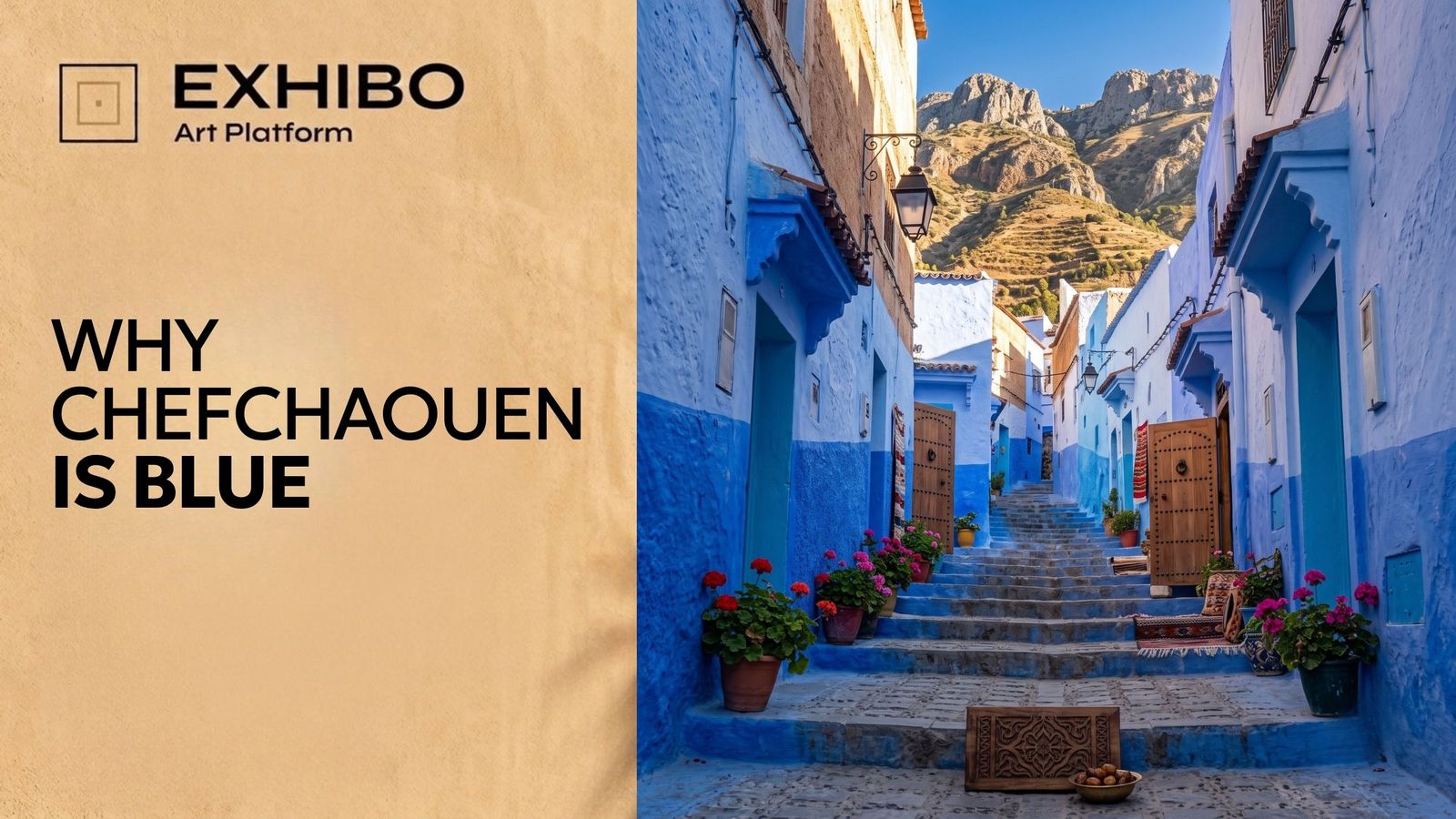
The wall is already going. Look closely at any lane in the Chefchaouen medina and you can see it: the blue is not a surface but a sediment, coat over coat, the newest bright and the older ones chalking off in flakes the size of a fingernail. And it is never one blue. Along a single flight of steps the colour runs from a chalky powder to a deep marine cobalt and back, shifting again as the mountain light moves over it through the day, so that a lane photographed at nine in the morning and again at five is not obviously the same lane. Somewhere up a side street someone — as often as not a woman — is keeping it that way: a bucket of slaked lime with the pigment stirred through it, a brush of dried grass bound at the neck, the wash going on thin and watery, drying pale and then deepening as the water leaves. By next spring it will want doing again. It always wants doing again.
That is the first thing to understand about the blue city, and the thing the photographs never tell you. The blue is not baked into the stone. It is not a material the town is made of. It is a wash — lime and water and a little colour — laid over the walls by hand, and gone within a season or two if nobody renews it. Chefchaouen is blue the way a garden is green: because someone keeps making it so.
Which turns the usual question inside out. People come wanting to know where the blue came from, as though there were a first cause to be found somewhere back in the town's past — a founding decision, a decree, a legend that settles it. There isn't. The more useful question is not where the blue came from but why it keeps being renewed, because that is the thing actually happening, every dry season, on every wall. To answer it you have to look past the colour to the things underneath it: the mountain, the lime, the shape of the streets, and the long closure that kept the outside world at arm's length.
Look at the horns
Start with the name, because the name points the wrong way. Chefchaouen — Chaouen, to the people who live there — is Berber and Arabic braided together, and it is usually taken to mean look at the horns. The horns are two peaks of the Rif, Tisouka and Megou, that rise over the town like the tips of something enormous half-buried in the mountain. The name is an instruction. Look up. Look at the rock.
Nobody does. They look at the walls.
The town was founded in 1471 by Moulay Ali ibn Rashid, a sharif who wanted a base in the mountains from which to harry the Portuguese, who had taken Ceuta on the coast and were pushing inland. What he built first was a kasbah — a fort — at around 560 metres, wedged into the hillside where the two peaks lean together. The site was not chosen for beauty. It was chosen because it was difficult to reach and easy to defend, a fold in the Rif that an army would have to want very badly to bother with. A town accreted around the fort. Ali ibn Rashid's own family threaded it into the wider north: his daughter, Sayyida al-Hurra, would go on to govern Tetouan down the road and is remembered, fairly or not, as a corsair queen of the western Mediterranean — a reminder that this was not a sleepy backwater but a node in a network of ports, raids and refugees.
And then, for the better part of four and a half centuries, the town turned its face away from the foreign world.
Chefchaouen was closed. Not metaphorically — shut to Christian outsiders on pain of something a good deal worse than a stern word. Before Spanish troops finally walked in in 1920, the record preserves only a handful of Europeans who got inside, and the ones it names went in disguise. Charles de Foucauld came in 1883 dressed as a rabbi, lasted — by the usual account — about an hour, and went on to a second life as a desert hermit, a century later to be made a saint. The British journalist Walter Harris rode in from Tangier got up as a Moorish merchant, got out again, and wrote afterwards, in The Land of an African Sultan, that the whole appeal had been that entering was reckoned an utter impossibility for a Christian. An American missionary, William Summers, is reported to have been poisoned in the town in 1892, dying some years afterwards of the effects. Sealed, though, is too total a word: inside its walls the place went on trading with Fez and Tetouan, drawing Muslim pilgrims to the saints of the Rif, and housing its own Jews. What it was closed to was the Christian foreigner — and to the outside eye.
That long closure matters more than any legend, because it is the reason the blue could later mean anything at all. A town kept apart for four hundred years does not develop like its neighbours. It keeps an old street plan that busier places rebuild, an old way of doing things, an intactness. When Chefchaouen finally opened, it opened as somewhere that felt preserved — distinct, whole, unlike the rest of Morocco — and that distinctness was the raw material a later century would learn to sell. But first, note the plainer fact. None of their accounts describes a blue city.
There wasn't one to see.
The white underneath
Because the town those men crept into was white. This is the fact the romance tends to skip. In the photographs from the early Spanish years — the 1920s, when the seal had just broken — Chefchaouen is a white mountain medina, lime-washed and earth-toned, indistinguishable at a glance from a dozen others in the Rif.
Whitewash is the deep material of this whole coast, and it arrived with the town's founders. When Granada fell in 1492, Muslims and Jews were pushed out of al-Andalus, and a great many crossed the strait and settled the Moroccan north, carrying the architecture of the places they had lost. Lime came with them, in the walls and in the habit. It is worth being plain about why, because the whole town rests on it. Limestone is burned in a kiln, slaked with water into a paste, thinned into a wash and brushed onto a wall, where over days it pulls carbon dioxide back out of the air and turns, slowly, to stone again — a thin skin of reconstituted rock. It is cheap and local. It throws off the sun. It kills what grows on a damp wall. It goes down over rubble and mud-brick and makes a poor wall read as a clean one. Polished hard with a stone and sealed with soap it becomes tadelakt, the waterproof plaster of the hammams; brushed on loose and often it becomes the everyday whitewash of every medina from here to the Cyclades. White is not a decision. White is what lime does when you leave it alone.
Blue is the decision. It is the same lime, the same wall, the same brush — with a pinch of colour stirred in, and a reason to bother. And that pinch of colour is the entire mystery, because it is the one part of the recipe that was never necessary, never structural, never free. Everything under the blue explains itself. The blue is the thing that has to be accounted for.
A town built to be looked down on
Before the accounting, walk the body the colour sits on, because the shape of Chefchaouen is doing quiet work in this story too.
The medina is Andalusian in its bones, which means it is not the organic sprawl of most Moroccan old towns but something closer to a plan: narrow lanes angled for shade and privacy, houses turned inward around courtyards, blank walls to the street and the life kept behind them. Onto that plan the mountain imposes its own logic. The streets do not run so much as climb; a walk across the medina is a walk uphill, and the lanes break constantly into flights of steps, kinking around the slope. In the hottest lanes residents have trained grapevines overhead into a green ceiling, shade you can eat. Everything drains, eventually, toward Ras el-Maa — the spring that comes off the mountain at the edge of the old town, where the public laundry still is, and where the town has drawn its water for as long as there has been a town. The kasbah and the Grand Mosque, with its odd octagonal minaret, anchor the one real opening in all this density, Plaza Uta el-Hammam, and everything else folds in tight around them.
Two things follow from that form, and both feed the colour. The first is that a dense, vertical, inward town is mostly wall. There is very little else to see at street level — no gardens spilling out, no grand façades, just the sheer painted sides of houses rising on either side as you climb. The wall is the visual field. Whatever colour it is, it is overwhelming, because it is nearly all there is.
The second is the view from above. Climb the hillside to the old Spanish mosque on the ridge — built during the Protectorate, never really used, left there like a piece of stage scenery — and look back, and the whole medina resolves into a single blue drift of flat rooftops running down the mountain. Chefchaouen is one of those rare towns that has a natural vantage built into its setting, a place you are meant to stand and take it in whole. A white town seen from up there is pretty. A blue one is unforgettable. The landscape hands you the frame; the colour fills it. Long before postcards, the mountain had already framed the town.
The town that stayed white
To feel how strange the blue really is, drive an hour north to Tetouan.
Tetouan had everything Chefchaouen had, and more of it. It took the same wave of Andalusian exiles after 1492 — the same craftsmen, the same memory of Granada, the same lime and courtyards and inward-turning lanes. It had a Jewish quarter so large and so learned that the town was nicknamed the little Jerusalem. Ali ibn Rashid's own daughter ruled it. It sits in the same mountains, under the same sun. Its medina is now a UNESCO site, preserved precisely for the Andalusian bones it shares with its smaller neighbour.
And Tetouan is white — overwhelmingly so. They call it the White Dove. It has its blue doors and painted shutters, like any Moroccan town, but it never turned blue as a whole, and nobody there feels the lack.
This is the detail that complicates most of what you will be told about why Chefchaouen is blue. If the blue were simply what Andalusian settlers did, Tetouan would be blue. If it were simply the sacred colour of a Jewish community, Tetouan — with far more Jews — would be bluer still. The two towns were not identical, of course: five centuries gave each its own crafts, its own quarters, its own local habits, and something particular to Chefchaouen may yet have tipped it toward blue. But the comparison is enough to make the tidy origin stories insufficient on their own. Whatever seeded the colour here, it was not the bare fact of Andalusian or Jewish settlement, because the town that had more of both stayed white. So the question is not why is an Andalusian mountain town blue. It is narrower and odder: why did one white Andalusian town, alone among its neighbours, keep choosing blue — wall by wall, year after year, long enough for the choice to look like fate.
The stories the walls collect
Ask in Chefchaouen and you will not get one answer. You will get all of them, offered with varying conviction, and the town seems comfortable holding several at once.
The most beloved is the Jewish story. Blue — tekhelet, the dye of the fringe on the prayer shawl — is a sacred colour, the sky standing in for heaven, and the account goes that Jewish residents washed their walls blue to keep the divine in the corner of the eye. It is lovely, and it may hold a grain. But the grain is small. Chefchaouen's Jewish community was always a relatively small one, clustered in the mellah, the Jewish quarter, where such blue as there was seems to have stayed. Older residents will tell you the rest of the medina was white when they were young. And the town's blue became comprehensive only after most of the community had gone: the last Jewish families left by the late 1960s, and the medina turned thoroughly blue after that, not before. Whatever the mellah began, it did not paint the hillside. This squares with what historians of Morocco's Jewish quarters, foremost among them Susan Gilson Miller, have shown: the mellah was an integral part of the medina rather than a place apart, its houses the same courtyard type as their neighbours', its Jewishness carried in surface ornament and ritual space rather than in a distinct way of building. A community like that leaves its trace in a doorway or a synagogue, not in the colour of a whole town. The tenderest version of the story asks the colour to carry a whole vanished community on its back, and the dates simply won't let it.
Then the practical stories, the ones people reach for when the sacred one feels too neat. Blue keeps the mosquitoes off — a claim entomologists meet with polite doubt, since mosquitoes hunt by heat and breath, not by the colour of a wall. Blue keeps the house cool — true of any pale wash, no more true of blue than of white. There is a sturdier version buried in there, though, and it lives in the pigment. The blue was got, at different times, from nila — indigo, the same dye that travelled the Sahara on the backs of Tuareg traders — and some washes may have used copper sulphate, the blue-green salt that is half of the Bordeaux mixture vineyards still spray on their vines. Copper sulphate is, in itself, a fungicide, so a wall washed with it would resist mould as a side effect, whatever the painter intended — no small thing through a damp Rif winter. Whether anyone here ever chose it for that reason is not recorded. But it means the folklore about insects, wrong as it probably is about the mechanism, may be a garbled memory of something real: a blue wash that happened also to be a cleaner one.
There is a fourth story, quieter and older than all of them, and it does not belong to Chefchaouen alone. Across the Maghreb blue is the colour you put at a threshold to turn away the eye — a blue door, a blue shutter, a blue bead against envy and the harm a look can do. It is a habit shared by Muslim and Jew, older than either community's arrival here, and it may be the truest answer to the narrow question of why blue and not green or ochre: because blue was already the colour that guarded a house. But notice what even this cannot explain. A protective blue door is one thing. A town washed blue from step to lintel to rooftop is another entirely, and no amount of folk custom about thresholds gets you from the one to the other.
And the water story, which I find hardest to dismiss and impossible to prove. The town drinks from Ras el-Maa; blue, some will say, is simply the colour of the thing that let the town exist at all. There is no evidence for it and none against it. It is the kind of explanation a place offers about itself, and it tells you more about how Chefchaouen would like to be understood than about who first lifted a brush.
Each of these stories is doing something real. None of them can carry the whole town, and the town is wise enough not to ask any single one to.
What the twentieth century actually did
Here is the part that is documented, and it is not romantic.
Much of the town's now-familiar blue appears to have spread across the twentieth century — surviving photographs and the memory of older residents put the real saturation in its later decades. The simplest explanation may also be the likeliest: it paid. The pieces were already in place. The Spanish arrived in 1920 and stayed until independence in 1956, and the Protectorate did what colonial administrations tend to do to a picturesque town — tidied it, framed it, taught it to see itself as a view. Then the sealed centuries paid off in reverse: a town that had been forbidden was now, for exactly that reason, alluring. Over the second half of the twentieth century the name the Blue City turned out to be a far better thing to sell than a town in the Rif, and by the 1990s residents well beyond the old mellah were washing their walls blue for the plain reason that visitors had begun arriving specifically to see it. The blue spread the way a good idea spreads through a market — house to house, because the house next door had done it, and it had worked.
You can call that an invented tradition — Eric Hobsbawm's term for a practice that feels timeless but turns out to be recent — and it is, but invented does no useful work as an insult. Every tradition was invented by someone; most had the decency to do it before anyone was watching. Chefchaouen's happened late enough to be legible — and the material keeps the whole thing on display in a way most heritage manages to hide. Because the blue is a wash and not a pigment, it does not last. It has to be renewed, often once a year and, according to local custom, sometimes before Ramadan, when the town scrubs itself fresh. There is no law dictating the shade, whatever the guidebooks imply; there is restoration guidance and, far stronger than any guidance, the knowledge that a blue wall lets a room and a blue lane fills a café. The town is held blue by thousands of small decisions a year, most of them economic, a great many of them made — as the whitewashing traditionally was — by women with buckets and grass brushes, though the work is no longer only theirs. The tradition is not maintained despite the tourism. It is maintained by it. The camera is now part of the recipe, as surely as the lime.
Which returns us to the wall we started at. The blue is not something Chefchaouen is. It is something Chefchaouen does, continuously, or it would not be blue by the spring.
The blue that photographs best
There is one more turn, and it belongs to the last few decades alone. The blue you see today is not only more widespread than the blue of the mid-century photographs. In many lanes it is more intense — a deeper, wetter cobalt where the older wash tended to a chalky, powdery pale. Some of that is only fashion, the drift any colour makes over time. But some of it may have a mechanism, and the likeliest mechanism is the camera.
What follows is inference, not documented history — nobody hands a homeowner a swatch, and I have found no study that measures the drift. But the incentive is not subtle, and it points one way. Chefchaouen is now one of the most photographed towns in Morocco, an Insta-famous name that pulls day-trippers and influencers to jostle for the same few staircases at the same hour of the same light. And a phone camera is not a neutral witness: its processing pushes saturation and contrast, so a colour tends to come back stronger than it left — the same reason a holiday sky looks bluer on the screen than it did overhead. A pale, honest lime-blue can read as washed-out in a photograph; a deep cobalt reads as the blue people came for. It is hard not to wonder whether a town that lives by being photographed has, season after season, been reaching for the shade that photographs best — and whether that makes a loop: the deeper the blue, the better the picture; the better the picture, the more the visitors; the more the visitors, the deeper the next coat.
Even the origin, retold now, bends toward the camera. Some local guides will tell you the blue only really took over in the early 2000s, in the wake of a television programme filmed here in the late 1990s — a story that may say less about what happened than about how the town has learned to explain itself in the age of the screen. The colour did not only spread. It learned, slowly, to pose.
The colour and the people behind it
There is a cost folded into this, and the town understands it better than any visitor. A town of forty-odd thousand now takes in many times its own number in visitors every year, a great many of them there to photograph a single colour. In the medina the day has a rhythm to it: the early hours belong to the people who live there — the water carried, the bread taken to the oven, the wash left out to dry — and the later hours belong to the cameras. Rents climb. Ground floors turn into shops selling the same blue-and-white paintings of the same blue lanes. The colour a family once mixed for a few dirhams becomes, slowly, an asset managed for an audience: a blue that belongs a little less to the wall and a little more to the image of the wall.
That is not a scandal and it is not unique. It is what happens to any small beautiful place the wider world decides it wants, and Chefchaouen has managed it better than most — it is still a working town, not yet a stage set. But it sharpens the question of ownership in a way the sacred stories never do. The blue was always a thing the town told itself. Now it is also a thing the town performs for others. Both are real. They are simply not the same thing, and Chefchaouen lives in the gap between them, repainting.
The name still says look at the horns. Above the last blue roof, Tisouka and Megou are exactly where they were in 1471 — the fixed thing, the thing that named the place and asks nothing of anyone. Nobody looks. They look at the walls, which are the one part of Chefchaouen that is never fixed, that will chalk and flake and fade by the next dry season, that exist as they are only for as long as somebody keeps climbing the ladder with a bucket of lime and a little blue.
Ask why the city is blue, and the honest answer is a verb. It is blue because it is being made blue — again, right now, up a lane you cannot see.
Related reading
The Visual Language Older Than Arabic
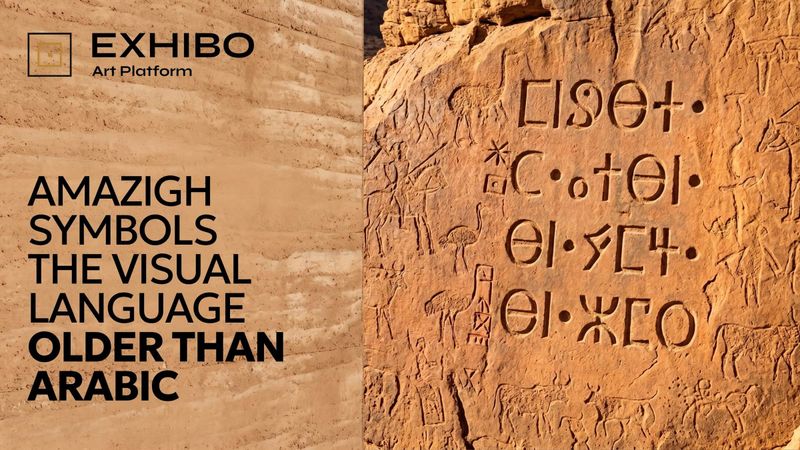
How one of North Africa's oldest writing traditions survived conquest, colonial classification and the loss of its readers — and why, for much of it, we still cannot say what the marks mean.
A flat rock in southern Morocco is covered in a script you can see is writing and still cannot read a word of. It belongs to the Amazigh — a visual language older in North Africa than the Arabic alphabet, carried onto skin and wool and silver, nearly erased, and now reassembled into an alphabet on ministry walls. This is the story of what survived, what didn't, and why almost everything we "know" these signs mean was added later.
Women of Arab Abstraction
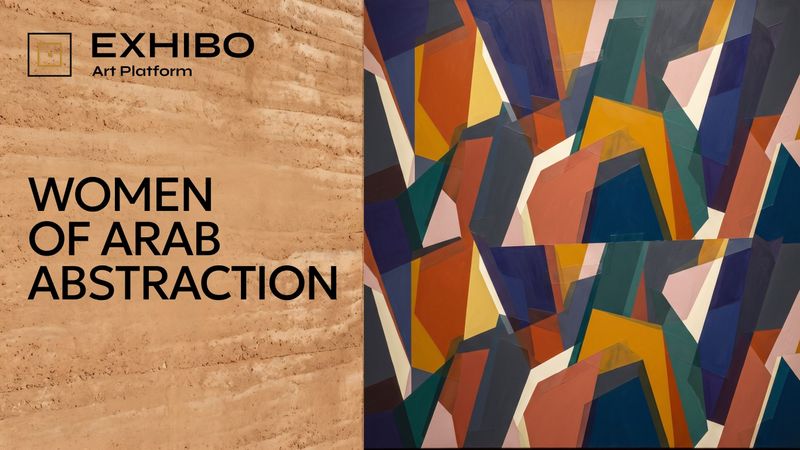
The letter set loose, the line woven, the arabesque the West once threw away — and the women who built modern abstraction out of all three, then got written out of it.
Abstraction is usually told as a Western invention that arrived elsewhere late. Saloua Raouda Choucair, Etel Adnan, Madiha Umar and a room of others tell it differently — often as the only woman in the movement, building modern form from the geometry, craft and calligraphy their own culture already held.
The Hand That Everyone Named After Their Own
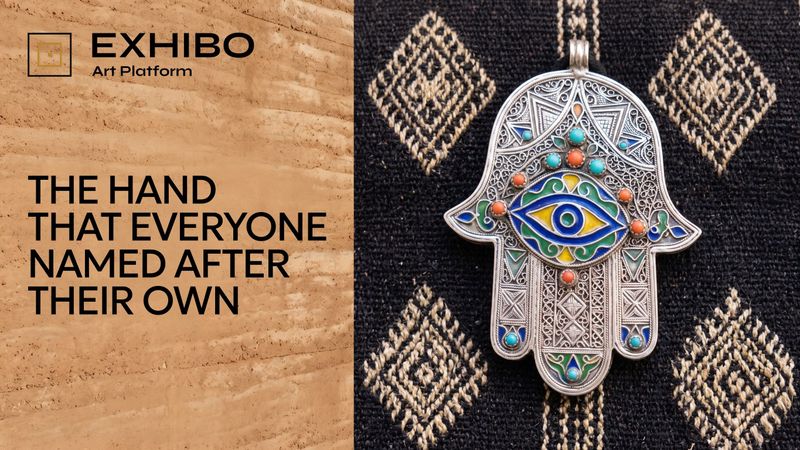
The Khamsa across North Africa — Marrakech, Tunis, Algiers — and why the oldest thing about it is the shape, not the story.
Everyone calls it something different — the Hand of Fatima, the Hand of Miriam, the Hand of Mary. One five-fingered shape, several holy names, each written onto it by a community that made it its own. From a carved hand over the Alhambra's gate to Kabyle silver, synagogue lamps and a boy on a Marseille motorway, this is the story of a symbol older than the names it carries — and shared by more people than any one of them.