
Marrakech · Morocco
Why Marrakech Is Red and Fez Is Ochre
Two imperial cities, one element in the ground — and the difference between a red city and an ochre one turns out to be half geology, half planning law.
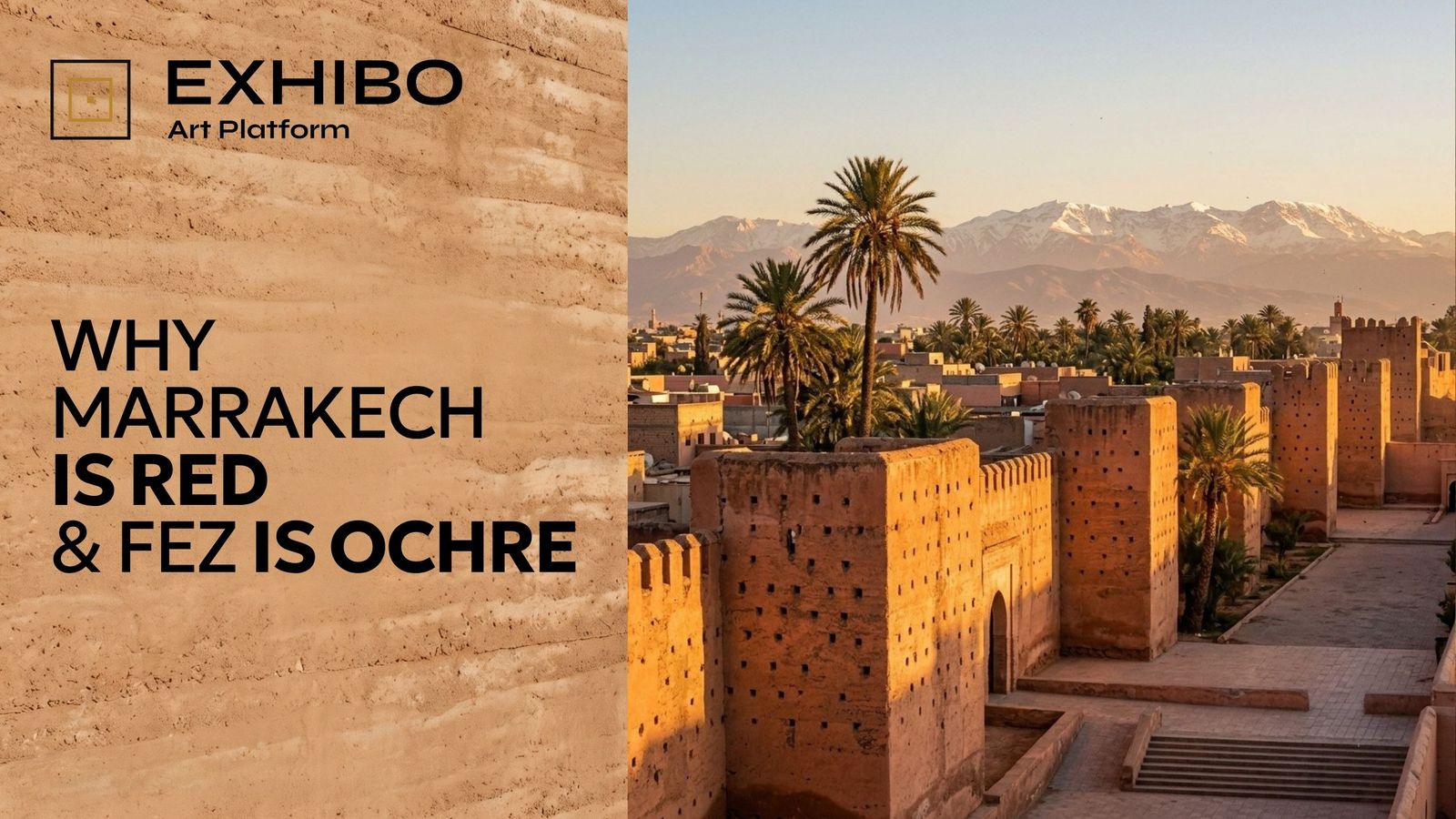
Put your hand on the old rampart of Marrakech at the end of the day and the wall is warm, faintly rough, and pocked all over with small square holes where the scaffolding once went. It runs for nineteen kilometres like this — nine metres high, the colour of a terracotta pot left too long in the sun. And the first thing worth noticing is that the colour is not on the wall. It is the wall. Nobody painted this red. The red is what the ground was when they lifted it, rammed it damp into wooden forms and let it dry: the earth of the Haouz plain, stacked up and standing. Rub hard and a little comes away on your fingers, dry and rusty, and you are holding the same red you were just looking at.
Drive north — a long day of it, right across the country — and the same trick of the earth has produced something else entirely. The medina of Fez is not red. It is ochre: a pale, dusty, biscuit-and-honey brown, the colour of a lion in winter. Where Marrakech shows you bare earth, Fez shows you a skin of lime over brick, plastered smooth and tinted the soft yellow of the ground it stands on. Two cities, one country, a few hundred kilometres apart. One is the colour of dried blood and the other the colour of straw.
They are, underneath, the same element. That is where this has to start.
The same iron, twice
Here is a trick worth doing before any of the chemistry. Take a handful of the pale ochre earth of Fez — the colour of dust and dry straw — and put it in a hot fire. It darkens as it heats, and then, somewhere in the flames, it turns. What you rake out of the embers is not yellow. It is red: close enough to the red of Marrakech, made from a fistful of Fez. Nothing was added and nothing mixed in. The same earth simply changed colour in the heat.
That is the whole story in miniature, and this is what sits behind it. The red and the ochre are made by the same thing — iron, in the ground, oxidising — and what separates them is not whether the iron is there but which mineral it has become, and how much water is locked inside it. Dry, anhydrous iron oxide, hematite, reads red. The same iron with water bound into its structure, goethite, reads yellow-brown, the colour we call ochre. The fire only drove the water off and flipped one into the other. It is the same reason a fired brick comes out redder than the mud it was moulded from, and why the sun-struck crust of a field can be redder than the shaded earth a foot beneath it.
Soil scientists have a word for the reddening of ground, rubefaction, and a whole literature on the red soils of the Mediterranean — terra rossa, the red belt that runs the warm dry rim of the sea from the Levant to Iberia, wherever the climate favours hematite over goethite and the hills run the colour of an old flowerpot. The Haouz plain around Marrakech is red earth of exactly this kind: rubefied, hematite-rich, red long before anyone thought to build with it. Lift it, wet it, ram it, and the wall is red because the plain was red. The city is the plain, stood upright.
So far this looks like it settles the question. It doesn't. Because the earth under Fez is not short of iron either. Published analyses of local clays find hematite in them as well — a fair share of some samples — so by the simple soil rule Fez ought to come out reddish. What holds it back is not a lack of iron but a crowd of paler minerals riding along with it — kaolinite, the white clay of porcelain, and calcite, which is lime in the ground before it is ever burned — and a colour, on a surface, is a matter of what light comes back off it, not only of what the rock is made of. Here the iron is optically overwhelmed. And then, as we will see, it is covered over. Fez is not the story of an earth without iron. It is the story of an iron that never gets to show.
Shown, and veiled
What the builders of Marrakech did with their red earth was, in effect, nothing. Nothing to the colour, at least. They cut it with a little lime and straw and gravel, rammed it in layers into timber shuttering — the technique is pisé, tabia in Arabic, rammed earth in English — and struck the forms once it dried, leaving the wall exactly as it came out of the mould, holes and all. Those small square holes are where the putlogs held the shuttering; on an old rampart they run in level courses like a calendar, one line per lift of earth, and the rain has been widening them for eight hundred years. The great circuit of walls, medieval chronicles claim, was thrown around the growing city in under a year in the 1120s — laid out with ropes and, the same chronicles say, blessed by astrologers, ahead of an advancing enemy. The ramparts are that earth. So are the houses behind them, and the monumental gates, and — with a change of material to the same end — the Koutoubia minaret, which is red sandstone, traditionally said to have been cut from a hill just outside the walls, laced through with brick. The stone reaches the same hue as the mud because the stone of this country is iron-tinted too. What lime Marrakech does use, it turns inward, polished to the deep waterproof sheen the Moroccans call tadelakt, the plaster of the hammam and the riad wall. The outside is left as ground. The medina is one long variation on a single fact — the local earth, the local stone — and its red is the red of not covering anything up.
Fez covered it up. The medina is built of fired brick — lajour, baked in kilns in their tens of thousands to a firing — and the brick is mostly not what you see. What you see is plaster: a lime-stabilised earthen render, jir, floated across the façades, tinted the pale ochre of the local ground and skimmed on again as it weathers. Here the two cities' shared material, lime, does opposite work. In Marrakech, as tadelakt, it seals and darkens an interior to a glossy red-brown. In Fez, as jir on an exterior, it does what lime does best in the open: it pales. Whatever iron is in that render is held under the lime the way a colour is held under tracing paper. You can catch the undressed version at the tanneries, where the great honeycomb of dye-pits lies open to the sky in raw ochre and white and indigo, earth colours stripped for work — but the city that climbs away from them is the earth clothed: brick under render under a wash of lime. Marrakech is the ground, bare. Fez is the ground, dressed. Same body — one nude, one covered — and the whole distance between red and ochre is the lime laid in between.
Two capitals
It is tempting to stop at the materials, and mostly you can. But the two colours sit on top of two very different cities, and the difference rhymes in a way worth pausing on — as resonance, not proof.
Marrakech is a desert city, or the last city before the desert. It was founded around 1070 by the Almoravids, Saharan Berbers who came up out of the far south and raised an imperial capital at the foot of the Atlas, a hinge between the palm groves and the caravan roads running down to Timbuktu. Its founder, Abu Bakr ibn Umar, and the cousin who built it into a capital after him, Yusuf ibn Tashfin, were men of the desert and the camel, and the empire they ran reached at its height from Senegal to Spain. They brought craftsmen up from Córdoba to cut the plaster and set the tile, so that a city of the African plain wears, in its detailing, the memory of Andalusia. But its body is the plain, and it wears the plain's red earth like a uniform.
Fez is older and faces the other way. Founded between 789 and 808 by the Idrisids, it grew up in a green river valley in the north, split by its wadi into two banks — one settled by refugees from Córdoba, the other by refugees from Kairouan in Tunisia — and became the scholarly and spiritual capital of the country. Its Qarawiyyin, endowed in the ninth century by a woman named Fatima al-Fihri, is often called the oldest continuously running university in the world. The two cities spent five centuries trading the crown between them: Almoravid and then Almohad Marrakech, then Marinid Fez rising to eclipse it in the thirteenth century, the seat of the kingdom sliding north and south with the dynasties like weather. And the colours fall along the same line. The warrior capital of the plain is the colour of the ground it rose from. The scholar capital of the river is the colour of lime and fired brick and patient trade. I would not push this far — earth is earth, the chemistry is the chemistry, and a city does not pick its geology to suit its character. But the country's two great rivals really do wear their two grounds, and it is hard to stand between them and not read the old rivalry in the walls.
The hill called Gueliz
The sandstone of the Koutoubia is traditionally said to have come from a low hill on the western edge of Marrakech called Jbel Gueliz. Hold on to that name; it comes back.
Eight hundred years after the Almohads quarried their minaret there, the French arrived, and it was at the foot of that same hill that they chose to plant their new city — near enough to keep the medina under its eye, far enough to feel apart. They named the district after the hill: Gueliz. The name's own origin is disputed — one popular story hears in it a worn-down French église, church, after the chapel the French built at its centre, though the hill carried the name long before any Frenchman arrived, and other readings trace it to Amazigh or older roots. Whatever its source, the stone of the great mosque and the name of the colonial town come off the same rise of ground. Which is a small thing, and also the whole argument in miniature: in Marrakech the old and the new keep turning out to be made of the same material, called by the same name, wearing the same colour. And some of that sameness, it turns out, was not an accident of the earth at all. It was written down.
The colour of a decree
Here the usual story turns inside out. Because the thing that makes Marrakech so relentlessly, so entirely red — every wall, every villa, the petrol station and the airport and the ochre McDonald's out on the ring road — is not the medieval earth. It is a twentieth-century plan.
When France made Morocco a protectorate in 1912, the resident-general, Marshal Lyautey, governed by a doctrine he imposed across the country and which later scholars — Paul Rabinow among them, in his study of France's colonial urbanism as a kind of social laboratory — would treat as a landmark in the history of city planning: build the modern European town beside the old Moroccan one, never on top of it. His planner Henri Prost, who drew the new quarters of Casablanca, Rabat, Fez and Meknès as well, laid out the ville nouvelle of Marrakech — Gueliz — on a grid of wide avenues set a careful distance from the medina, the two halves separated by a boulevard the French called, without embarrassment, the cordon sanitaire. And into the building rules for that new quarter went a set of prescriptions: heights held down to a few storeys — no higher, people still say, than a palm — silhouettes kept low, and façades held to the warm ochre of the old town. Prost had fallen for the tone the low sun threw across the medina and the mountains, and rather than lose it to a European white he wrote it into the code. The sense that everything in Marrakech is one colour — the Red City as a total condition, not just an old medina — dates from around that decision, not from the eleventh century.
Sit with what that means. The most French part of Marrakech — the modern quarter built by and for Europeans, held off behind a sanitary cordon — was required to wear the colour of the Moroccan earth it had been designed to stand apart from. The coloniser drew a line between himself and the medina, and then painted his own side the medina's colour, to keep a harmony he could admire from the hill. It was never a single famous "law of ochre," and it is worth being exact: the colour lives inside the ordinary machinery of planning — the development plan, the architectural prescriptions, the colour guidance a façade must still satisfy in planning review at the Agence Urbaine, reinforced by the protection of the medina as a World Heritage site. But the effect is a rule, and the rule is roughly a century old. The red you photograph is partly a thousand-year-old plain and partly a colonial aesthete's idea of what that plain should look like, kept up ever since by the planning office. Both are true at once, and the honest version holds both: Marrakech is red because the earth is red — and because, for a hundred years, it has not been permitted to be anything else.
It matters which way round this runs. The medina had been built in the colour of its own earth for eight centuries before Prost drew a line on a map; the red was the city's mark long before it was anyone's rule. What the twentieth century did was not invent the colour but universalise it — carry it across the cordon into the new European quarter, hold the spreading city to it, and turn a material fact into a maintained one. The French did not make Marrakech red. They made all of Marrakech red, and then made it stay.
Fez's other road
Fez was never handed that rule, and this is the quiet difference that matters most. There is no ochre charter in Fez, no colonial colour code, no counter where an official matches your wall to a swatch. Its uniformity is every bit as complete as Marrakech's, and it arrived without a law.
What holds Fez to its ochre is older and slower: the material itself, and the men who keep working it. The brick is still fired in the same kilns. The jir is still slaked and floated onto the walls by maalems, master craftsmen, much as it was under the Marinids, the colour carried not in a paint-tin but in the pale local earth the lime is mixed with. And since 1981, when the medina was listed by UNESCO with a great part of it at real risk of collapse, a conservation agency — ADER-Fès — has spent decades and something on the order of six hundred million dollars not painting the city a colour but keeping its houses upright, its water moving and its trades alive. The result reads as one continuous ochre, but it is the uniformity of a shared technique, not a shared decree. Much of the historic fabric is the same colour because so much of it is the same handful of materials — brick, earth, lime, with cedar and stone and tile kept for the trim — worked the same way, by hands trained in the same workshops, rather than because any authority requires it.
So the two cities reach the same place — a whole town locked to a single colour — by different roads. Both are governed now; Fez, listed and studied and restored under UNESCO and its own Ministry of Culture, is governed heavily. But the centre of gravity differs. Marrakech's red is held, above all, by planning regulation — the permit, the palette, the approved range. Fez's ochre survives chiefly through conservation and the persistence of a craft — the kiln, the lime, the maalem. One colour leans on the office; the other leans on the hand. And if you want to know which is the more fragile, ask two questions. Ask what becomes of Marrakech's red the day its code is quietly relaxed. Then ask what becomes of Fez's ochre the day the last master who can read a batch of jir by eye decides not to pass it on.
The one that refused
There is a single place in Marrakech that said no. In 1924 — the same decade Prost was writing ochre into the rules a few streets away — a French painter named Jacques Majorelle bought a plot on the edge of Gueliz, built a studio, and painted its walls and pergolas and pots a cobalt so saturated it now carries his name: Majorelle Blue. In a city legislated red, he made a garden that is nothing but blue and green, and after Yves Saint Laurent and Pierre Bergé bought and rescued it from developers, it became one of the most visited places in the country. Marrakech taught me colour, Saint Laurent liked to say — a curious thing to say of a city whose public palette had, by then, been regulated for decades. The blue works precisely because everything around it does not. It is the exception that lets you see the rule was there.
The light does the rest, for both of them. These are cities at a latitude where the sun sits low and warm at each end of the day, and warm low light is kind to iron: it deepens the red of Marrakech to something molten and lifts the ochre of Fez to gold. Churchill came back to Marrakech more than fifty times to paint the half-hour after the sun drops behind the Atlas. He was painting the light — but the light had something to work with, a whole city already the colour of the ground, waiting for the hour that would set it alight. The light is not why the cities are coloured. It is only why we can't stop looking.
Go back, then, to the two walls. The rampart in Marrakech, warm and red and pocked with holes, that gives up a little red dust between your fingers. The plastered façade in Fez, cool and smooth and pale, that a maalem will re-skin come spring. Under both is the same iron in the same North African ground, oxidising in the same sun — shown in the south, veiled in the north. Neither city is quite as natural as it looks. The earth chose the hue; the twentieth century chose how much of it there would be, and held the choice in place — here chiefly by permit, there chiefly by craft. Ask why Marrakech is red and Fez is ochre and the first answer is geology, and the truer one is that a colour, past a certain point, is something a place has decided to keep. One is maintained chiefly through planning regulation. The other, chiefly through conservation and craft.
Related reading
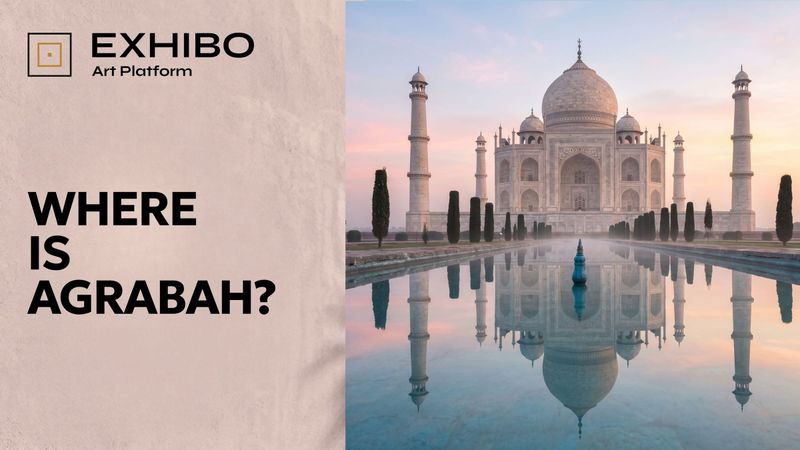
Where Is Agrabah? The City Disney Assembled From Real Places
Agrabah was going to be Baghdad. A war made it fictional — and then Disney built it back out of real places, from a tomb in Agra to a valley in Jordan that usually plays Mars.
The Sultan's palace where Princess Jasmine feels trapped has the silhouette of the Taj Mahal — which is not a palace at all, but a tomb. That is how Agrabah works. Disney's fairy-tale city was going to be Baghdad, until the Gulf War made the name impossible; the studio invented a place that could not be found on a map, then quietly rebuilt it out of real ones — Isfahan and Agra, Marrakesh and Mandalay, a Jordanian desert that has played both Arabia and Mars.
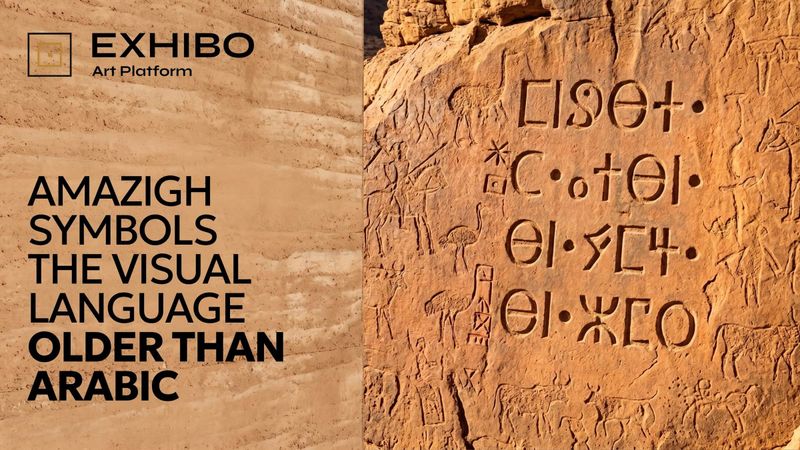
The Visual Language Older Than Arabic
How one of North Africa's oldest writing traditions survived conquest, colonial classification and the loss of its readers — and why, for much of it, we still cannot say what the marks mean.
A flat rock in southern Morocco is covered in a script you can see is writing and still cannot read a word of. It belongs to the Amazigh — a visual language older in North Africa than the Arabic alphabet, carried onto skin and wool and silver, nearly erased, and now reassembled into an alphabet on ministry walls. This is the story of what survived, what didn't, and why almost everything we "know" these signs mean was added later.
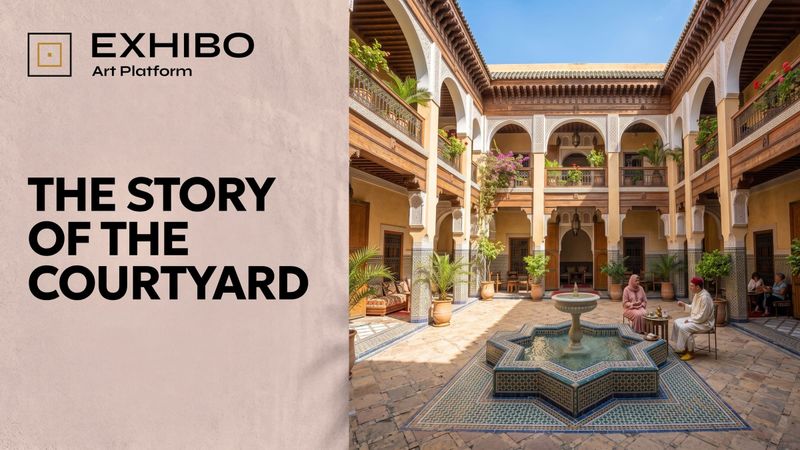
Why North African Cities Turn Inward: The Story of the Courtyard
A courtyard plan far older than Islam turned North African houses — and the medinas built from them — to face inward. Climate and religion only half-explain why, and what finally displaced the courtyard says the rest.
The blank walls and inward courtyards of Fez, Tunis, Algiers and Cairo are usually explained by heat or religion. Both are true; neither is the whole story. The clue is in what eventually pushed the courtyard out of the modern city.