Exhibo Editorial
Understanding Calligraphy and Hurufiyya in Arab Modernism
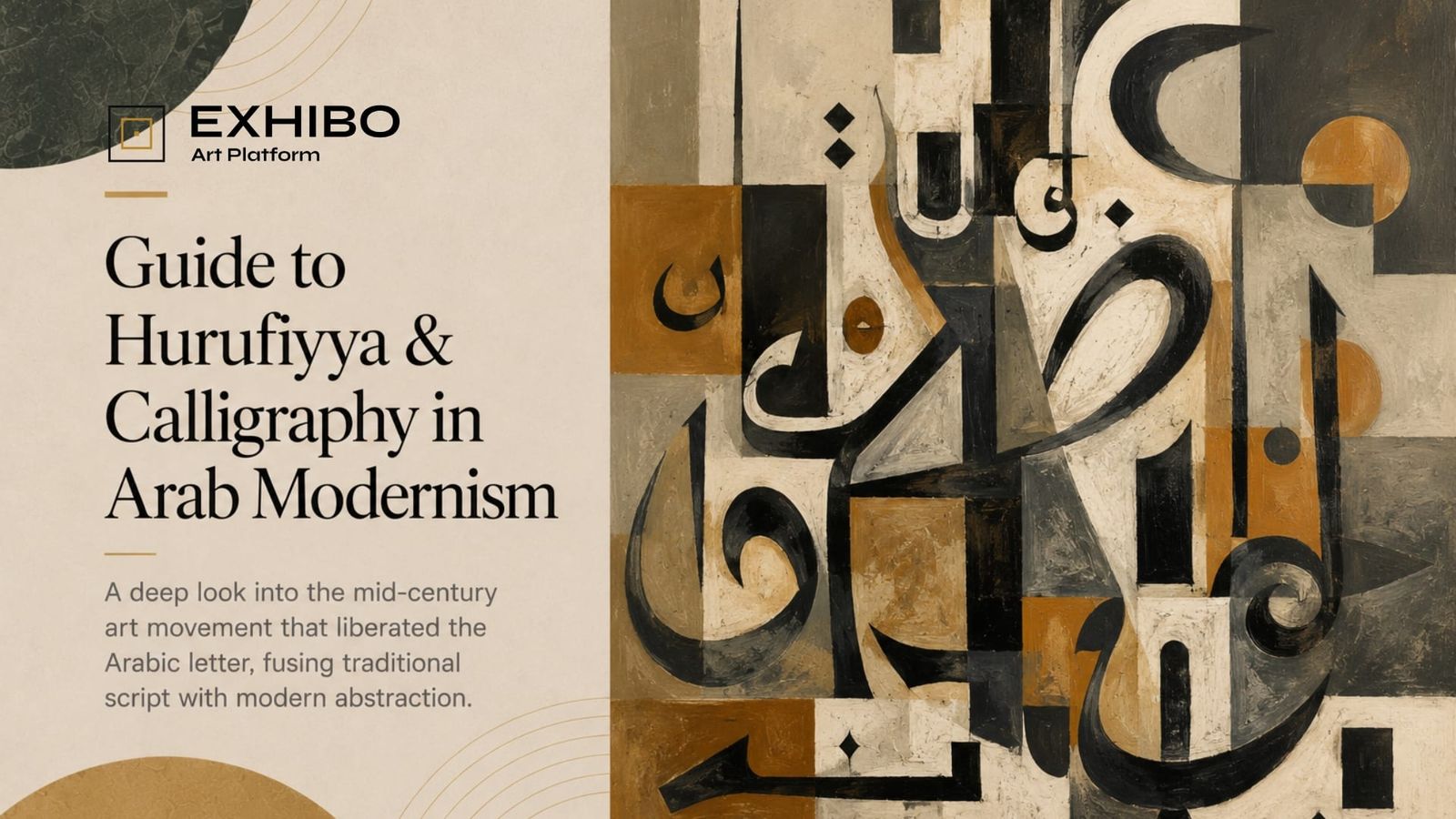
A deep look into the mid-century art movement that liberated the Arabic letter, fusing traditional script with modern abstraction.
During the mid-twentieth century, as nations across the Middle East and North Africa were shaking off colonial rule and establishing their independence, a revolutionary art movement began to take shape. Arab artists, returning from training in European capitals, found themselves caught in a difficult position: how to participate in the global language of modern abstraction without merely imitating Western styles. Their answer lay in the structural and spiritual potential of their own native script, leading to the birth of the Hurufiyya movement.
Hurufiyya, loosely translated as "letterism," represents a deliberate effort to reclaim regional heritage by deconstructing traditional Arabic calligraphy into modern abstract painting. Rather than using letters to write literal texts, the pioneers of this movement broke the alphabet down into its basic visual components—such as curves, lines, and loops—using them as graphic design units on the canvas. To help you navigate the rich history of this movement, the Exhibo online discovery platform serves as your digital guide, mapping out the galleries, museums, and exhibitions where these historic modernist works can be experienced physically today.
The post-colonial search for cultural authenticity
The emergence of Hurufiyya was deeply linked to the political and social movements of decolonisation that swept the Arab world in the 1950s and 1960s. For newly independent nations like Iraq, Sudan, and Egypt, building a distinct visual identity was a matter of national importance. Artists felt that continuing to paint in the academic, figurative styles imported by European colonial powers was a form of intellectual submission, yet they also recognized that traditional Islamic art needed to evolve to reflect the modern world.
By choosing the Arabic letter as their primary subject, these modernists found a form of abstraction that was already native to their culture. Unlike Western abstract painters, who had to deliberately reject figurative representation to achieve pure form, Arab artists realized that their calligraphic traditions had always prioritized the visual rhythm and geometry of the line over literal imagery. This unique realization allowed them to participate in the global avant-garde while remaining deeply rooted in their regional heritage.
For collectors and art enthusiasts looking to explore these abstract movements, the Exhibo online discovery platform provides a comprehensive global directory. By listing current exhibitions and active galleries showing modernist works in cities like Dubai, Riyadh, and Doha, the platform makes it easier to track the ongoing legacy of the Hurufiyya movement. It helps contemporary viewers find where these rare, mid-century masterworks are currently on display, bridging the gap between historical research and physical viewing.
The theoretical foundations of Hurufiyya
The term Hurufiyya is derived from the Arabic word huruf, meaning "letters." Coined by the Lebanese poet and critic Charbel Dagher in his 1991 book Al-Hurufiyya al-Arabiya: Fan wa Hawiya (Arabic Hurufiyya: Art and Identity), the term describes a diverse range of artistic approaches that developed across different Arab capitals, rather than a single, organized school with a rigid manifesto.
Madiha Umar and the initial liberation of the letter
The Iraqi artist Madiha Umar is widely credited as the pioneer of calligraphic abstraction, organizing the first exhibition of Hurufiyya art in Georgetown, Washington D.C., in the late 1940s. In 1949, she published a groundbreaking essay titled "The Arabic Letter: An Element of Abstraction," in which she argued that the Arabic script had been confined to traditional calligraphy for too long. Umar declared that the alphabet possessed an inherent design intelligence that was ripe for modern abstraction.
Umar’s early paintings liberated the individual Arabic letters from their literal functions within words, allowing them to exist as pure visual forms. She was particularly fascinated by the curves and loops of characters like the ’ayn (ع) and the laam (ل), stretching and overlapping them to create dynamic compositions that felt both modern and ancient. Her work proved that the Arabic script could be used as a secular, modern design element, free from religious constraints.
By demonstrating that the visual qualities of letters could exist purely as fine art, Umar laid the groundwork for a broader pan-Arab movement. Her pioneering experiments showed her contemporaries that they did not need to choose between modernism and heritage; instead, they could use their native script to build a completely new visual vocabulary that was both culturally authentic and globally relevant.
Shakir Hassan Al Said and the One Dimension
In Baghdad, the movement took a deeply philosophical and spiritual turn through the work of Shakir Hassan Al Said, a major figure in Iraqi modernism. Al Said, who co-founded the Baghdad Modern Art Group in 1951, went on to establish the One Dimension Group (Al-Bu'd al-Wahad) in 1971. He believed that the Arabic letter was not just a visual shape, but a spiritual and cosmological signifier that could connect the modern canvas to the divine.
Al Said's approach merged calligraphic deconstruction with Sufi mysticism, viewing the act of painting as a form of meditation. He began to strip his canvases of bright colours, focusing instead on the textures of cracked plaster, wood, and paper, onto which he carved or painted single letters, numbers, and words. For Al Said, the "one dimension" represented the spiritual space between the physical canvas and the infinite presence of God, where language dissolved into pure spirit.
His work went far beyond simple graphic design, treating the physical destruction and ageing of his materials as a metaphor for the passage of time and the temporary nature of human life. By deconstructing the letter until it became a simple, worn mark on a wall, Al Said created a post-colonial aesthetic that offered a powerful alternative to the Western-centric art history of his day.
The distinction from traditional Arabic calligraphy
It is essential to understand that Hurufiyya is not the same as traditional Arabic calligraphy, known as Khatt al-Arabi. Traditional calligraphy is a highly disciplined, sacred craft that requires years of study to master. Calligraphers must adhere to strict geometric rules and proportions established in the medieval period, where the size and shape of every letter are determined by the width of the reed pen (qalam) used to write them.
Hurufiyya, on the other hand, is defined by its complete rejection of these traditional rules in favour of formal freedom. Artists did not need to be trained calligraphers to participate in the movement; in fact, many deliberately avoided formal calligraphic scripts to prevent their work from looking too traditional. Instead, they treated the letters as raw material, bending, layering, and distorting them to suit their personal abstract compositions.
This formal freedom meant that Hurufiyya often embraced complete illegibility. The letters were not meant to be read; they were meant to be felt. By separating the visual form of the letter from its linguistic meaning, the artists turned the Arabic alphabet into a universal language of abstract lines and shapes, allowing viewers from different cultural backgrounds to appreciate the work without needing to read Arabic.
Pioneers of the movement across regional schools
As the movement spread across the Middle East and North Africa, different regional schools began to develop, with artists adapting calligraphic abstraction to reflect their specific national histories, landscapes, and local craft traditions.
Ibrahim El-Salahi and the Khartoum School
In Sudan, the modern master Ibrahim El-Salahi became a leading force in both Arab and African modernism. After studying at the Slade School of Fine Art in London in the 1950s, El-Salahi returned to Khartoum and realized that his Western art education had alienated him from his local audience. To bridge this gap, he began to study the Arabic calligraphy he had learned as a child in Quranic schools, deconstructing the characters to find their primary geometric lines.
El-Salahi co-founded the Khartoum School, where he combined Arab calligraphic loops with traditional African masks, patterns, and his own Sufi religious practice. His paintings from this period are characterized by quiet, earthy colour palettes of browns, ochres, and blacks, featuring skeletal, elongated figures that seem to dissolve into calligraphic lines. This unique combination of Arab-Islamic and African heritages created a highly original modernist style.
His work showed that calligraphic modernism did not have to be a closed, regional style; instead, it could operate as a global bridge, uniting different cultural traditions into a cohesive visual language. El-Salahi’s achievements have earned him international recognition, with his works being acquired by major public museums worldwide, establishing him as one of the most innovative artists of the twentieth century.
Hamed Abdalla and the "creative word"
In Egypt, the revolutionary painter Hamed Abdalla developed a highly personal approach to Hurufiyya that he termed al-kalima al-mubdi'a, meaning "the creative word." Unlike his contemporaries who used letters as purely abstract shapes, Abdalla was interested in the physical relationship between the written word, the human body, and the emotional theme of his paintings.
In his famous 1975 work Ishkan (meaning "to make dwell" or "habitation"), Abdalla did not merely paint letters across the canvas. Instead, he contorted the shape of the word itself so that it resembled a huddled group of human figures seeking shelter. The word became the body, and the body became the word, fusing physical form and linguistic meaning into a single, powerful abstract composition that expressed the pain of displacement and war.
I remember standing in front of Hamed Abdalla's work during an exhibition in Dubai. It wasn't just a painting; the canvas felt like it was physically breathing. The letters were stretched and contorted in a way that felt incredibly urgent, showing that calligraphy could be used to express raw human pain rather than just decorative beauty. His revolutionary letterism remains a major contribution to Arab modernism.
Abdulqader Al Rais and contemporary Emirati abstraction
The principles of Hurufiyya continue to evolve in the twenty-first century, as demonstrated by the work of Emirati master Abdulqader Al Rais. His major 2026 retrospective exhibition, Al Nayed, held at Opera Gallery in Dubai, offered a comprehensive look at how calligraphic abstraction has shaped the modern visual identity of the United Arab Emirates.
Al Rais is celebrated for his ability to integrate flowing, floating Arabic letters with soft, atmospheric watercolours and his signature geometric square motifs. In his Calligraphy Series, the individual letters are painted with a delicate, translucent quality, appearing to float like clouds across a desert landscape. This contrast between the fluid curves of the script and the sharp lines of his geometric squares reflects the tension between traditional heritage and rapid modern urbanisation in the Gulf.
His work proves that Hurufiyya is not a historical museum movement frozen in the mid-twentieth century. By adapting these principles to contemporary mediums and themes, Al Rais provides a valuable template for younger generations of Gulf artists, showing how regional traditions can be continuously re-imagined to express modern identities.
The material and spiritual dimensions of the letter
For many Hurufiyya artists, the exploration of the Arabic letter was never a purely formal exercise. It carried deep philosophical, material, and spiritual implications that connected the physical canvas to the invisible worlds of regional folklore and mysticism.
The letter as a spiritual talisman
Many artists within the movement drew direct inspiration from popular folk practices, Sufi mysticism, and the historic use of Islamic talismans. In regional folklore, specific letters and numbers were believed to carry protective qualities, acting as cosmic symbols that could ward off evil or bring good fortune. These talismans were often written in complex geometric grids or magic squares on paper, metal, and cloth.
By incorporating these symbolic shapes and letter combinations into their abstract paintings, modernists like Hamed Abdalla and the Iranian artist Charles Hossein Zenderoudi brought a sense of the sacred and the mysterious onto the modern canvas. They were not interested in the literal power of the charms, but rather in how these ancient visual forms could evoke a deep, spiritual atmosphere.
This connection to the unseen allowed the artists to create abstract paintings that felt deeply spiritual without relying on traditional, figurative religious imagery. It allowed them to explore the mystical dimensions of their culture in a modern, secular way, turning the canvas into a space of visual meditation and contemplation.
Earth, clay, and the material of the script
The physical materials used by Hurufiyya artists were often as important as the letterforms themselves, serving to ground the abstract script in the earth and local craft history. Many artists rejected the standard oil paints and canvas of European art schools, choosing instead to work with traditional, organic materials sourced from their local environments.
In Morocco, for example, the master modernist Farid Belkahia abandoned oil paint entirely, choosing to work on stretched lambskin using raw, local materials like henna, saffron, and natural dyes. His compositions featured stylized, abstract letterforms and Berber tattoos applied directly to the skin, creating a highly textured, organic surface that felt deeply connected to the soil of North Africa.
This focus on raw, local materials was a political and aesthetic act of resistance against Western modernist standards. It emphasized that a painting’s cultural identity is determined not just by the symbols painted on its surface, but by the physical materials used to construct it. It turned the artwork into a physical extension of the land itself.
The deconstruction of language and meaning
By deconstructing letters until they became completely unrecognizable, Hurufiyya artists questioned the limits of human language and literal comprehension. They showed that the Arabic alphabet possessed an internal design intelligence—a balance of curve, weight, and angle—that could be appreciated purely as a visual form, separate from any written message.
This deconstruction turned the canvas into a space of visual music, where the rhythm of the lines, the weight of the strokes, and the layering of the characters expressed emotion far more directly than written words ever could. It invited viewers to abandon their logical desire to read and comprehend, encouraging them instead to experience the painting through their senses.
This focus on the visual music of the line allowed Hurufiyya to operate as a universal language, connecting Arab artists with global abstraction movements. It demonstrated that by looking deeply into their own regional traditions, these modernists had discovered a modern form of expression that could speak to viewers across different cultures and eras.
The political dimension: Hurufiyya and decolonisation
The use of the Arabic letter in modernist painting was a deeply political act during the era of decolonisation. In a region that was actively rebuilding its political, social, and economic systems after decades of foreign rule, cultural expression was a central front in the struggle for self-determination. Using the Arabic script on a large-scale canvas was a powerful way to assert an independent, modern Arab-Islamic identity that did not depend on Western colonial models.
Furthermore, because the Arabic alphabet is shared by multiple countries across the Middle East, North Africa, and parts of Asia, the Hurufiyya movement naturally developed a pan-Arab character. Artists in Baghdad, Cairo, Rabat, and Khartoum were often dealing with the same questions of identity and modernism, and their shared use of the letter allowed them to build strong cultural alliances across national borders.
This political dimension turned the art movement into a form of cultural resistance, proving that modernism was not the exclusive property of Western Europe. By deconstructing their script and using it to build a new visual language, these artists showed that their heritage was not a static relic of the past, but a living, changing resource that could be used to navigate the complexities of the modern world.
Contemporary developments in calligraphic abstraction
The legacy of Hurufiyya remains highly active in the twenty-first century, continuing to influence new generations of artists working across public spaces, contemporary galleries, and digital platforms. The movement has moved beyond the traditional boundaries of the gallery frame, entering daily life through large-scale public murals and digital installations.
A prominent example of this contemporary evolution is the work of Tunisian-French artist eL Seed, who coined the term "calligraffiti" to describe his blend of traditional Arabic calligraphy and street art. Using bold colours and fluid, sweeping letterforms, eL Seed paints massive public murals on buildings, bridges, and monuments worldwide, from the slums of Cairo to the modern skyscrapers of Dubai. His public interventions use the beauty of the Arabic script to bring diverse communities together and challenge negative cultural perceptions.
At the same time, contemporary galleries and museums across the Gulf continue to host major surveys of historical and modern Hurufiyya art. Discovering these fast-moving contemporary and modern exhibitions requires reliable information. By using digital discovery platforms like Exhibo, art lovers and collectors can easily trace where these calligraphic abstraction shows are currently happening, ensuring they can experience the physical textures of these historic modernist works firsthand.
Key characteristics of Hurufiyya artworks
While the artists associated with Hurufiyya worked across different capital cities and decades, their creations share several defining formal and conceptual characteristics. These common threads help collectors and art historians identify and appreciate the unique visual language of the movement.
To help you identify these works in galleries and museums, look for these common characteristics:
The deconstruction of the Arabic alphabet, using individual letters as purely graphic, abstract design elements rather than literal text.
A focus on visual rhythm, where the curves, loops, and angles of the script are repeated or layered to create a sense of movement.
The integration of local craft traditions, folk talismans, and Sufi mysticism, grounding the modern canvas in regional spirituality.
The use of organic, regional materials—such as raw henna, wood, plaster, and stretched lambskin—to reject Western oil-on-canvas standards.
A deliberate use of illegibility, where the literal meaning of the characters is dissolved to focus the viewer's attention on pure visual form.
By paying attention to these key characteristics, you can begin to appreciate the deep formal and conceptual research that went into every Hurufiyya composition, moving beyond simple decorative appreciation.
Comparing traditional calligraphy with Hurufiyya
Understanding the difference between traditional calligraphy and modern Hurufiyya is necessary for any first-time collector. The table below compares these two practices across four key areas, illustrating how modernists broke away from traditional rules to build a new visual language.
Aspect | Traditional Calligraphy (Khatt al-Arabi) | Hurufiyya / Lettrism |
Rules & Proportions | Based on strict geometric calculations, established proportions (using the rhombic dot), and formal script styles (e.g., Kufic, Naskh, Thuluth). | Rejects strict rules in favour of free-form expression; deconstructs letters to explore abstract shapes, lines, and textures. |
Legibility | Essential; the text must be perfectly readable and typically communicates Quranic verses, poetry, or historical records. | Secondary or entirely absent; letters are often layered, distorted, or abstracted until they become illegible. |
Primary Function | Preserving sacred texts, decorating religious architecture, and documenting official historical manuscripts. | Exploring personal identity, post-colonial nationalism, spiritual meditation, and modern abstract design. |
Physical Mediums | Traditional ink, reed pens (qalam), parchment, ceramics, and architectural masonry. | Acrylic, oil paint, mixed media, plaster, wood, raw henna, stretched lambskin, and public murals. |
Frequently asked questions
Who is considered the pioneer of the Hurufiyya movement?
The Iraqi painter Madiha Umar is widely considered the pioneer of the Hurufiyya movement. In 1949, she published a groundbreaking essay titled "The Arabic Letter: An Element of Abstraction" and held the first formal exhibition of calligraphic abstraction in Washington D.C., liberating the Arabic script from traditional, literal constraints.
Is Hurufiyya a religious art movement?
While some artists like Shakir Hassan Al Said and Ibrahim El-Salahi incorporated Sufi mysticism and Islamic spirituality into their work, Hurufiyya itself is a secular, modernist art movement. Artists used the Arabic alphabet as a design element to express national identity, post-colonial politics, and formal abstract theories, rather than solely to produce religious decoration.
Why are the letters in Hurufiyya paintings often illegible?
Artists deliberately deconstructed and distorted the letters to separate their visual beauty from their linguistic meaning. By making the script illegible, they turned the alphabet into a universal language of abstract shapes and lines, allowing viewers from different cultural backgrounds to experience the artwork through their senses rather than reading a literal message.
How can Exhibo help me find exhibitions of Arab Modernism?
Exhibo serves as a comprehensive online directory and contemporary art discovery platform. By listing up-to-date exhibition schedules, gallery locations, and opening hours, Exhibo helps you find modern art galleries and museum collections showing historical and contemporary Hurufiyya works in major cultural hubs like Dubai, Riyadh, and Doha.
Galleries mentioned
Museums mentioned
Exhibitions mentioned
Related reading
Sharjah Biennial 17 Unveils Curatorial Vision and Opening Schedule
Angela Harutyunyan and Paula Nascimento frame the 2027 edition around archival residue and spatial memory
The seventeenth iteration of the Sharjah Biennial runs from January to June 2027, presenting a dual curatorial methodology that examines historical legacies and infrastructural critique across multiple emirate locations.
One Thousand and One Nights as a Visual Network
The book that taught Europe to picture the East arrived with no pictures at all. Three centuries of illustrators — Dutch, Egyptian, Persian, French, German, Iraqi — each gave it a face, and every face was a self-portrait.
Open Galland's Thousand and One Nights, the edition that conquered Europe, and there is nothing to look at: no genie, no lamp, not one illustration. The most visually imagined book in the world began blind — and because its text was never fixed either, no picture of it could ever be a copy.
Curating Tomorrow's Archive: Hamburger Kunsthalle Seeks Contemporary Collections Lead
A new permanent appointment will steer the museum's post-1960 holdings across paper, photography, and media formats.
The Hamburger Kunsthalle is inviting applications for a senior curatorial position focused on contemporary acquisitions, exhibition strategy, and digital collection management. Applications close October 2026 for a January 2027 start.