Wadi el-Hitan (Valley of the Whales)
A UNESCO desert valley of 40-million-year-old whale skeletons with legs — and a museum of fossils and climate change.
Whales in the desert
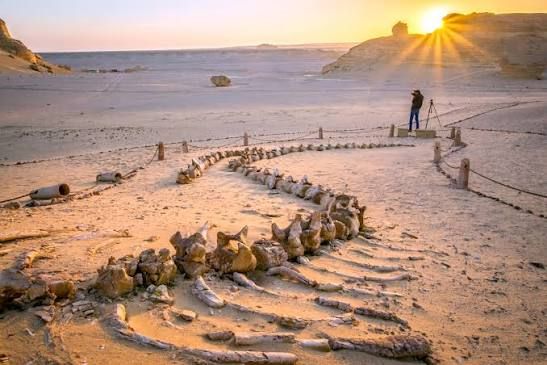
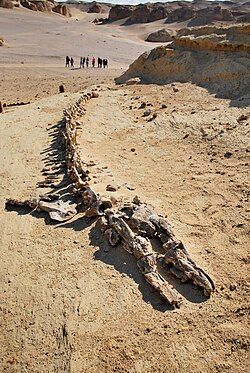
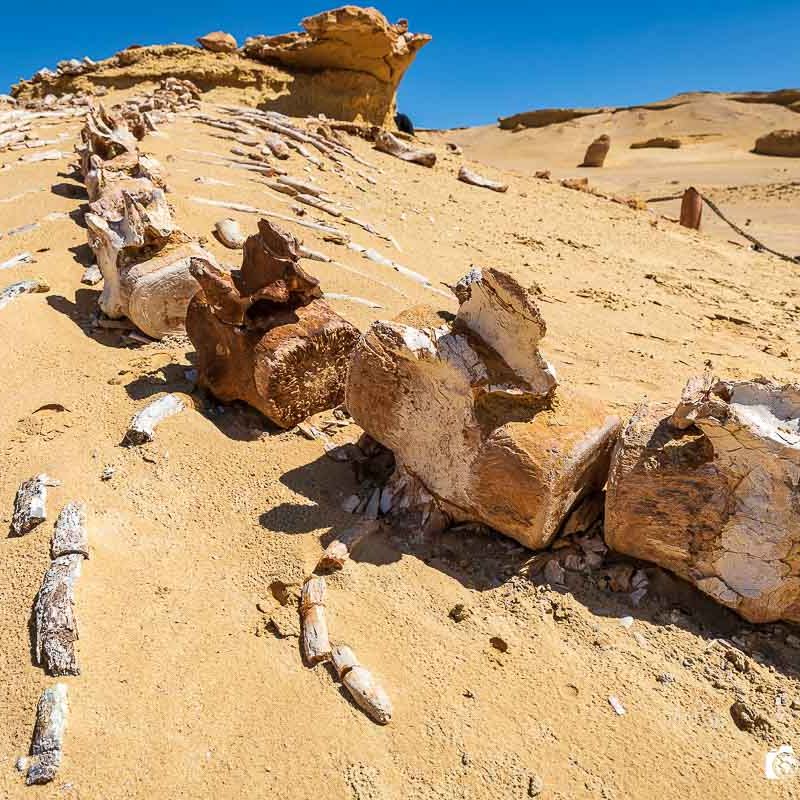
Wadi el-Hitan, the Valley of the Whales, lies in the Western Desert south-west of the Fayoum, within the Wadi el-Rayan Protected Area. Some forty million years ago, during the Eocene epoch, this desert was the bottom of a shallow sea, the Tethys. The valley contains hundreds of fossil skeletons of early whales, especially Basilosaurus and Dorudon, together with fossils of sharks, crocodiles, sawfish, turtles and sea cows. Many of the whale skeletons still have small hind legs, feet and even toes — vestiges of the land-dwelling ancestors from which whales evolved — making the site one of the most important places in the world for understanding the evolution of whales from land mammals to marine animals.
World Heritage
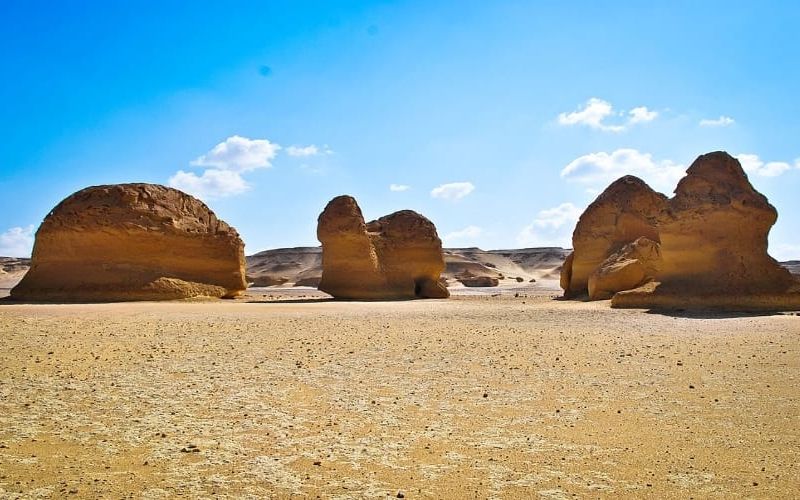
The first fossils were recognised in the early twentieth century, and systematic research since the 1980s has revealed the richness of the site. In 2005, Wadi el-Hitan was inscribed by UNESCO as a World Heritage Site, the first in Egypt to be listed for its natural, rather than cultural, value. The skeletons lie in a landscape of wind-eroded rock formations and dunes, linked by a marked trail with shaded rest points.
The museum
A Fossils and Climate Change Museum, built of local materials and partly underground, opened at the site in the 2010s. Its centrepiece is a complete skeleton of Basilosaurus isis around eighteen metres long, together with other fossils and displays on the region's geology and on how climate has changed over millions of years.
Exhibo editorial
Imagine walking across a desert and finding, half-buried in the sand, the skeleton of a whale the length of a bus — complete with tiny legs. That is Wadi el-Hitan, and it is one of the most extraordinary places in Egypt: an open-air museum of evolution set in a landscape of wind-sculpted rock that looks like another planet.
Start in the museum to understand what you're seeing, then walk the trail in the late afternoon, when the light turns the rocks gold and the shadows stretch across the fossils. If you can, stay for sunset or camp nearby: the night sky over the valley is spectacular.
Gallery
How to find it
From Fayoum city, drive to the Wadi el-Rayan Protected Area entrance and continue past the Wadi el-Rayan lakes; the final 30–40 km to Wadi el-Hitan is a desert track requiring a four-wheel-drive vehicle, best arranged with a local driver or tour. Start at the Fossils and Climate Change Museum, then follow the marked trail among the fossils.