Exhibo Editorial

Blog

Latest articles from Exhibo: city guides, market reports, gallery news, and art world coverage across Dubai, London, New York, and global hubs.

RSS feed

Regions

Editorial

All editorial
An Arabian oryx, white with long nearly straight ringed horns and dark facial markings, standing in pale desert sand.
Editorial

The Animal We Drew Everywhere Once It Was Gone

From Neolithic rock to airline tailfin — how the Arabian oryx vanished from the desert, came back from nine animals, and multiplied everywhere as a symbol in the very decades it was gone.

The last wild Arabian oryx was shot in 1972. By then it was already a picture — carved on Bronze Age tombs, mistaken by the ancients for a unicorn, praised by poets as the eyes of the beloved. This is the story of an animal that went extinct in the wild and was brought back from nine survivors, and of the strange gap between the creature and the emblem it became: fast, sharp and ascendant on a nation's tailfin, while the animal itself survives by standing still in the shade.

A massive granite column shaft under a stone arch, seen from below, with the dome springing above it.
Editorial

Seventy Thousand Solomons: The Empire That Performed a Legend

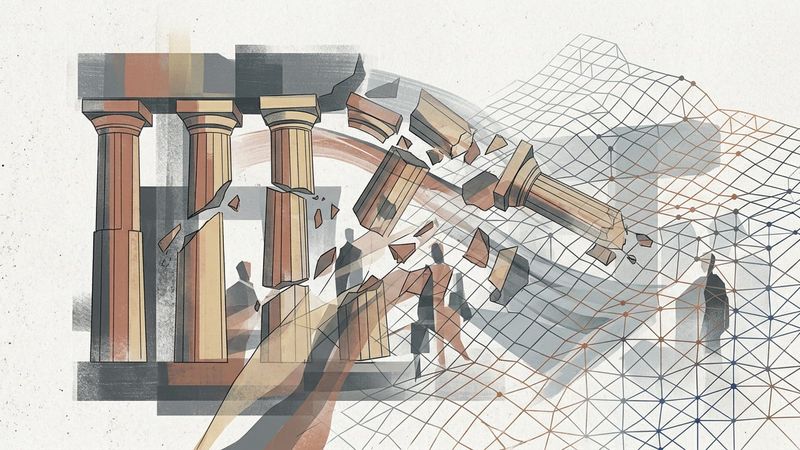
A demon catalogue in the conqueror's library, a sixteenth-century text where kingship is an office held seventy thousand times, and the columns a sultan dragged across three provinces to prove he held it.

Mehmed II kept a Greek catalogue of demons in his library at Topkapı. Seventy years later a sultan named for a prophet was rebuilding the walls of Jerusalem and hauling Roman columns out of Egypt and the Lebanon into a mosque above the Golden Horn. In between, Ottoman writers turned Solomon from a warning into a job — and the empire applied for it in stone.

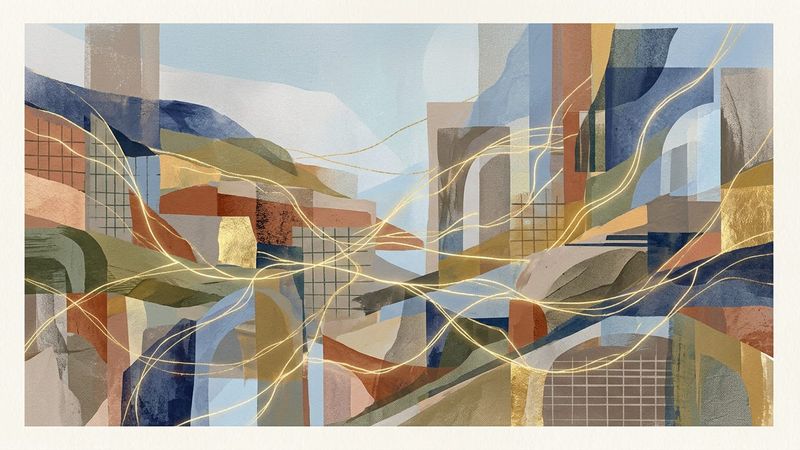
Abstract geometric composition of interlocking angular forms in layered planes of colour.
Editorial

Women of Arab Abstraction

The letter set loose, the line woven, the arabesque the West once threw away — and the women who built modern abstraction out of all three, then got written out of it.

Abstraction is usually told as a Western invention that arrived elsewhere late. Saloua Raouda Choucair, Etel Adnan, Madiha Umar and a room of others tell it differently — often as the only woman in the movement, building modern form from the geometry, craft and calligraphy their own culture already held.

A geometric khamsa — an open five-fingered hand with an eye at its centre — in the Kabyle silver style of North Africa.
Editorial

The Hand That Everyone Named After Their Own

The Khamsa across North Africa — Marrakech, Tunis, Algiers — and why the oldest thing about it is the shape, not the story.

Everyone calls it something different — the Hand of Fatima, the Hand of Miriam, the Hand of Mary. One five-fingered shape, several holy names, each written onto it by a community that made it its own. From a carved hand over the Alhambra's gate to Kabyle silver, synagogue lamps and a boy on a Marseille motorway, this is the story of a symbol older than the names it carries — and shared by more people than any one of them.

Guides

All guides
Dim museum gallery with lowered blinds, sealed display cases and a small climate sensor on a plinth, cool north light, no readable labels
Guide

Preventive Conservation, Explained

How museums slow collection damage with climate, pests and risk, using sourced ranges rather than a single 50% RH target

Staff keep collections usable by managing climate, pests, storage and risk at room scale. This guide sets out ICOM-CC and AIC definitions, CCI’s ten agents of deterioration, and museum humidity, temperature and light bands with their source caveats. It covers risk ranking, historic-house limits, monitoring costs and when to hire a specialist.

Conservation-science still life with linen canvas scrap, oak panel end-grain, and bowls of white and blue pigment on a north-lit bench
Guide

Radiocarbon and Pigment Dating

How carbon-14, pigment first-use dates and tree rings date a painting, and why those laboratory results still cannot name the artist

A date on a painting is a date on a material: flax in the canvas, oil in the binder, a growth ring in a panel, a pigment that did not exist before a given year. This guide covers radiocarbon including the bomb peak, pigment terminus post quem, dendrochronology and lead isotopes, then the failure modes that keep a calendar from proving authorship.

Close-up of linseed oil, amber resin tears and green copper pigment on a scarred oak bench, with a yellowed varnish film catching raking light
Guide

Why Paintings Darken and Yellow

Linseed oil, aged varnish, dirt and unstable pigments each yellow or darken a picture, and cleaning reverses only some of those changes

Old pictures look brown for mixed reasons: soot, oxidised varnish, yellowed linseed oil, and pigments that have changed in the film. Conservators can lift dirt and later varnish in many cases. They cannot restore copper greens gone brown or lead white turned transparent. The chemistry, the history of noticing it, and the limits of treatment.

Latest articles

Interior of the New York Society Library showing walnut panelling, sculpted fireplace mantels and glass-partitioned offices after renovation.

New York Society Library completes major renovation of historic Upper East Side home

The city’s oldest library has expanded its stacks, added member spaces and opened a conservation lab while staying open throughout the works.

The New York Society Library has completed its most extensive building-wide renovation since the 1980s, expanding stacks, creating a conservation lab and adding study and events space within its 1937 Italianate townhouse on Manhattan’s Upper East Side.

What Makes a Strong Gallery Profile A Practical Checklist

What Makes a Strong Gallery Profile: A Practical Checklist

Most gallery profiles fail in the same few ways. Here is what separates the ones collectors trust from the ones they scroll past — and a checklist to fix yours in an afternoon.

A collector lands on your profile. They have maybe twenty seconds before they decide whether you are a serious gallery worth an inquiry or a half-finished listing to scroll past. Most of that decision is made before they have read a single word properly — it is made on whether the page looks complete, current, and like someone is actually behind it.

How Galleries Get Discovered Online in 2026

How Galleries Get Discovered Online in 2026

Collectors now start with a search bar — increasingly, an AI one — long before they reach a gallery door. A practical guide to how discovery actually works now, and what a gallery can do about it.

The journey to a gallery almost never begins at its door any more. It begins in a search field — someone typing "contemporary art gallery Dubai", "buy abstract sculpture", or the name of an artist they read about — and, increasingly, it begins inside an AI assistant that answers the question directly without ever showing a list of links. For galleries, this is both an opportunity and a quiet threat.