
Cairo · Egypt
The Museum of Everything That Became a Tomb
Egypt built a museum to tell the story of an entire civilisation — seven thousand years of it, from flint tools to the present. The public knows it for one thing: the room where twenty dead kings lie in the dark.
The first face you meet in the dark is a broken one.
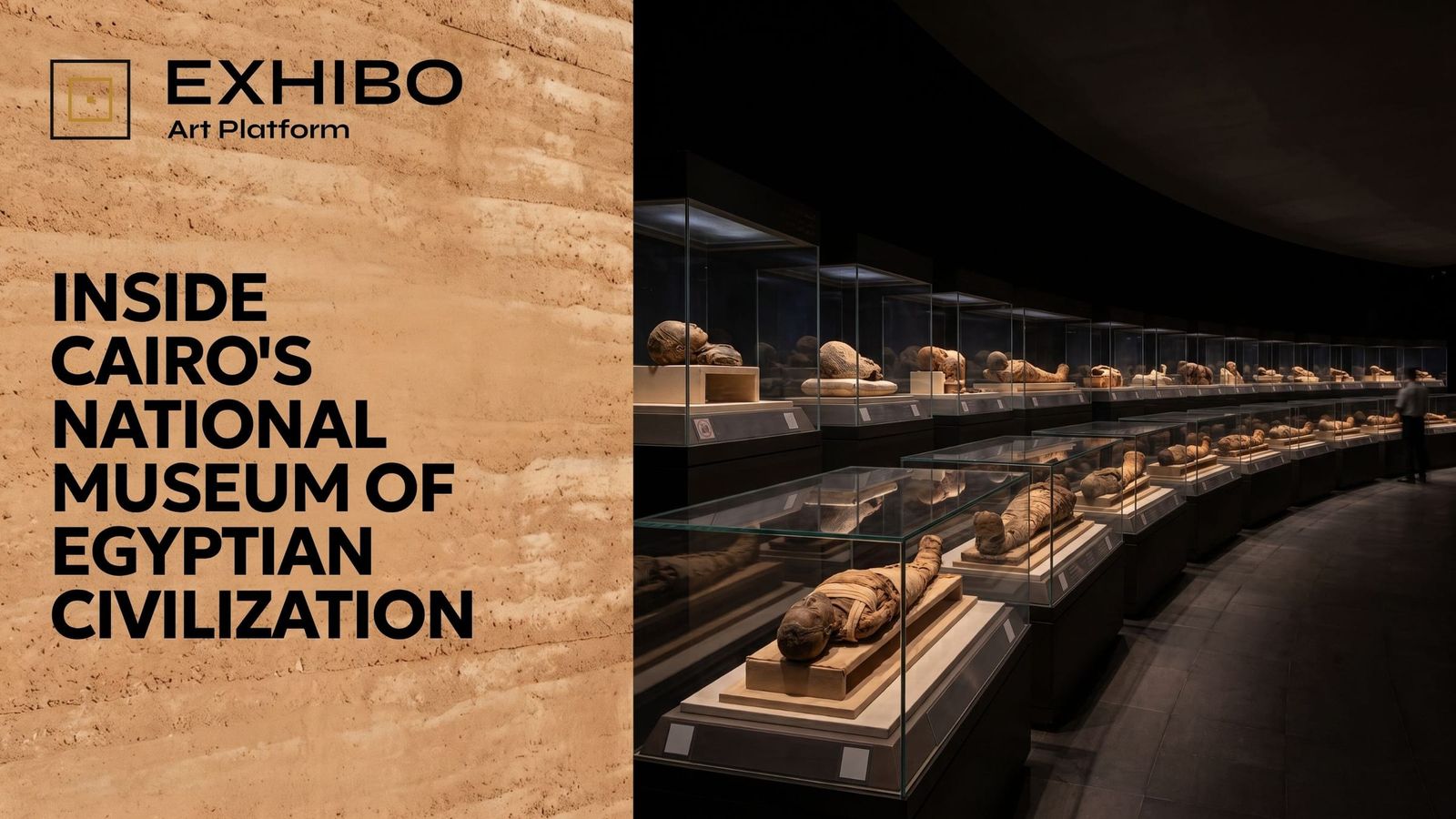
You have come down into the Royal Mummies Hall of the National Museum of Egyptian Civilization, in the Fustat district of Old Cairo, and the light has dropped away behind you. The room is deliberately black, cool, and hushed: the lighting low, the signage minimal, visitors asked to keep their voices down and their cameras still. And there, in the first case, lit so that only he emerges from the darkness, is Seqenenre Tao, a king who ruled in Upper Egypt around 1600 BC and died, by the evidence still visible on his skull, very badly.
The wounds are there to see, and they are terrible. An injury consistent with an axe blow above the forehead. A perforating wound behind the ear, probably from a spear. A crushing blow across the cheek, the kind a heavy blunt weapon makes. A CT study published in 2021 found no defensive fractures on his arms and read the position of his hands as possibly bound, leading the researchers to propose that he was set upon by several assailants at once, though they are careful to say the order of the blows, and which one killed him, cannot be recovered. What the study also found is quieter and stranger: the body had begun to decay before it was embalmed, as though it had spent time away from the embalmers' hands after death, and the embalmers appear to have worked to hide the injuries rather than display them, tucking the damage out of sight beneath the wrappings. He is thought to have died in the war against the Hyksos, the rulers of western Asian origin who then controlled northern Egypt, a conflict his sons Kamose and Ahmose would finish and win. He is not a statue. He is not a golden mask. He is the actual body of a particular man who fought and lost, three and a half thousand years ago, his last bad moments still legible on his face, and he is the thing the museum has chosen to greet you with, first, before any king in gold.
It is a strange choice, and a deliberate one, and it tells you almost everything about what this museum is trying to be — and about the gap between what it was built to say and what the world decided it was for.
The house of the dead kings
The Royal Mummies Hall is the museum's headline attraction, and the museum makes no secret of it: its own literature calls the hall the crown jewel of the collection, and it is what the guidebooks lead with. Twenty royal mummies lie in the dark, kings and queens of the 17th through the 20th Dynasties, each in a climate-controlled case, each lit alone. Twenty-two were carried here in the parade; twenty are currently listed by the museum as displayed. Among them are the greatest names of the New Kingdom: Ramesses II, who reigned sixty-seven years and built Abu Simbel; Seti I, his father, whose tomb is among the finest in the Valley of the Kings; Hatshepsut, one of the few women ever to rule as pharaoh; Thutmose III, the conqueror later ages called the Napoleon of Egypt; and Seqenenre Tao, the war-killed king who meets you at the door.
The hall was designed to feel like a tomb. That was the explicit intention. Mahmoud Mabrouk, the ministry's display designer, has described a philosophy built on two ideas: that the architecture should echo the royal tombs of the Valley of the Kings, with kings set in their own chambers as if in the originals, and that the lighting should be modern and severe, pulling each mummy out of a surrounding blackness so that the body seems almost to float in the air. Mabrouk has said he grouped the mummies by period and family — the Thutmosids together, the Ramessids together — so that a visitor moves through the hall roughly as one might move through the necropolis at Thebes, from dynasty to dynasty, chamber to chamber. The result is a space that reviewers keep describing in the same register, reaching for the same word: not museum but mausoleum. Low light, minimal signage, an almost monastic stillness. You lower your voice. The room is, by design, less a gallery than a reconstructed Valley of the Kings, transplanted from the Luxor cliffs to a basement in Old Cairo.
It helps to know that most of these bodies came, in fact, from just two ancient hiding places. The great majority were found in a single concealed cache at Deir el-Bahari, opened in 1881; a second group came from the tomb of Amenhotep II in the Valley of the Kings, uncovered in 1898, another chamber into which the ancient priests had gathered and hidden their kings. The mummies in the Fustat hall are, in other words, a group first brought together not by any modern curator but by a priesthood three thousand years ago — though the ancient caches held not only kings but queens, royal relatives, and the high priests of Amun themselves, gathered in together for safekeeping. Exactly how they were arranged we will never fully know: the caches were emptied too fast, in 1881, for anyone to record the original order. But the deeper fact holds — the impulse to gather the royal dead into one protected place is not a modern invention. The museum has, knowingly or not, inherited it.
It is worth being honest about the strangeness of this. Nowhere else in Egypt's grand new museum-building spree is the register anything like it. The Grand Egyptian Museum out at Giza has been presented on a scale of spectacle: Tutankhamun's gold under bright light, the boy king reassembled into a blockbuster, crowds and phones and gift shops. The old Egyptian Museum on Tahrir is a crowded scholar's attic. But here, in Fustat, the state has built something that behaves less like a museum than like a shrine — a dim, hushed chapel for the physical remains of the men and women who ruled the Nile. The dead kings have been given not the look of a display but the visual language of a resting place, staged with the gravity of a reburial.
The visitors feel it, and their reactions are not uniform. Some arrive expecting a gallery and find, instead, a confrontation. You are standing a pane of glass away from the actual face of Ramesses II — his hair still on his head, his teeth, the set of his jaw, three thousand two hundred years after he died, and the ordinary museum reflex, the drift and the glance and the move-along, stops working. People go quiet. A few are unsettled, and say so; these are, after all, human corpses displayed for a ticket price, and the discomfort is honest. Others fall into something like the hush of a church. And some, endearingly, just marvel at the plain physical fact of it — a young Dutch visitor, on the hall's opening day, blurted to a reporter that the pharaohs all had "pretty nice, fair white teeth," and that after only ever hearing their names, it was "pretty cool to see all of them in one place." Awe and reverence and mild delighted disbelief, all in the same dark room. The design is pushing hard toward the sacred; the visitors meet it halfway, or don't, and the gap between those responses is part of what makes the hall so odd to stand in.
Which, if you know where these bodies have been, is a stranger echo than it first appears.
The kings who never stopped moving
Seqenenre Tao has been on the move for three thousand years.
When he died in battle, he was buried, as kings of his line were, at Dra Abu el-Naga — the northernmost cemetery of the Theban necropolis, where the rulers of the 17th Dynasty were laid, a little apart from the great Valley of the Kings that later pharaohs would make famous. But no royal cemetery at Thebes stayed safe for long. By the end of the New Kingdom, with central authority weakening and the treasury empty, tomb robbery had become almost systematic; the great rock-cut sepulchres were being stripped of their gold, the royal bodies torn apart on the spot for the amulets and precious fittings wrapped against their skin. And so the priests did something remarkable, and to modern eyes almost unbearably tender. Rather than leave their kings to be desecrated, the high priests of the 21st Dynasty gathered the royal dead, dozens of them, the greatest names of the New Kingdom, and took them into their care. They unwrapped the damaged mummies, restored and rewrapped them as best they could, sometimes more than once across the generations. On the linen and the coffins they wrote small administrative notes — dockets — recording what they had done: whose body this was, which king's men had restored it, in which year. The mummy of Amenhotep I was rewrapped twice, once by a high priest named Pinedjem and again, a decade later, by his son. These are among the most quietly moving documents in all of Egyptian archaeology: bureaucratic receipts for acts of devotion, the paperwork of a priesthood trying to keep its dead kings whole against a rising tide of robbery.
And then, in the Twenty-first Dynasty, in the late tenth century BC, they hid them.
The place they chose was a shaft tomb in the cliffs at Deir el-Bahari, above the temple of Hatshepsut. Into it went dozens of royal and priestly mummies — Seqenenre, Ahmose I who founded the New Kingdom, Amenhotep I, Thutmose I and II and III, Seti I, Ramesses II and III: a whole dynasty's worth of pharaohs, sealed in a single hidden passage, the entrance covered over with rubble and left to the desert. The secret held for nearly three thousand years.
The cache entered the modern record through a family from the village of Gurna already involved in the illicit antiquities trade. As the story is usually told, the Abd el-Rassul clan came upon the shaft around 1871 and, grasping what they had found, told no one — quietly selling off papyri and small objects on the market for a decade while the authorities tried to work out where the steady trickle of royal artefacts was coming from. When the trail finally led back to the shaft in 1881, it was Émile Brugsch, deputy to the French Egyptologist Gaston Maspero, who was lowered into the tomb. What he found in the torchlight staggered him:
a cluster of mummy cases came into view in such numbers as to stagger me.
He was looking, by his own account, at the mummies of royal personages of both sexes, packed into a passage in the cliff. The clearance was less an excavation than a rescue: it was done in a frantic two days, too fast to record where anything lay, fast enough to damage some of the coffins — which is a large part of why so little is known about how the priests originally arranged the cache. Dozens of mummies and thousands of funerary objects were loaded onto a steamer and carried down the Nile to Cairo, to the museum at Bulaq. The kings sailed north like cargo — and later accounts describe villagers lining the banks and mourning as the mummies were taken away, because a departure of the dead was, in a sense, exactly what it was.
From Bulaq they moved again, to a palace at Giza. Then, in 1902, to the new Egyptian Museum on Tahrir Square, where they lay for over a century. And then, in 2021, they moved one more time, to Fustat, to the dark hall built to receive them.
Count it up, and the arithmetic is astonishing. The body of Seqenenre Tao has been buried, robbed, restored, hidden, rediscovered, shipped, reinstalled, and moved again — five documented relocations in the chain we can reconstruct, and probably more that left no record. From his original tomb at Dra Abu el-Naga to the great cache at Deir el-Bahari, where the priests concealed him; from the cache down the Nile to Bulaq in 1881; from Bulaq to a palace at Giza; from Giza to the Egyptian Museum at Tahrir in 1902; and from Tahrir, in 2021, to the dark hall at Fustat. The stated logic of those moves was remarkably consistent: to protect and preserve him.
And here is the turn worth holding onto. The priests of the 21st Dynasty hid the kings so that no one would ever find them — darkness, secrecy, a sealed shaft, three thousand years of intended oblivion. The Egypt of the 21st century AD has laid the same kings in a hall engineered so that everyone will find them — darkness again, but this time a curated, ticketed, air-conditioned darkness, the tomb rebuilt as a stage. It is the same underlying impulse, protect the royal dead, turned precisely inside out. Not the same act (the priests reburied, the museum exhibits) but an eerily similar logic of preservation. Concealment then, display now; the same bodies carried through the same imitated dark toward opposite purposes. The mummies have spent three millennia being hidden to be saved. Now they are shown to be saved. Whether that is reverence or its opposite is a question the hall leaves very deliberately open.
The parade
The last of these moves was the only one the whole world watched.
On the evening of 3 April 2021, twenty-two royal mummies were carried out of the Egyptian Museum on Tahrir Square and driven, in a televised procession the government called the Pharaohs' Golden Parade, across Cairo to Fustat. It was staged as national theatre; the Egyptian government said that as many as four hundred television networks would carry the event around the world. Each mummy travelled in its own specially designed vehicle, the bodies sealed into nitrogen-filled cases to hold them at the conditions of a laboratory, the route resurfaced in advance to protect them from vibration. The kings and queens travelled in the order they had reigned: Seqenenre Tao, the oldest, in the lead; Ramesses IX at the rear, their names inscribed on the carriages in Arabic, English and hieroglyphs. Motorcycle outriders and mounted horses escorted the convoy. A pharaonic music ensemble under a celebrated conductor. A twenty-one-gun salute. President Abdel Fattah el-Sisi waited to receive them at the doors of the new museum, and the procession circled the obelisk in Tahrir Square before turning south along the Nile toward Fustat.
It was magnificent, and it was also, some Egyptians felt, slightly beside the point. One Cairo resident, interviewed as she watched the livestream, came away feeling the pageantry had been dazzling but that the actual people inside the caskets — who they were, what they had done, why they mattered, had somehow been lost in the choreography. It is a fair worry, and it points at something real about all of Egypt's new museums: the risk that the spectacle of moving the treasures ends up upstaging the treasures. There is a version of the Golden Parade that is less about twenty-two ancient dead than about one very present state, using the pharaohs as a backdrop for a night of national self-projection. That reading is available, and it would be naive to pretend the pageant had no politics in it.
But the parade did one thing that no gallery label and no cynicism can quite dissolve. It made visible, for a single televised evening, the oldest continuous fact about these particular bodies — that they are moved, and moved again, by each age that inherits them, according to what that age believes the dead are owed. The priests moved them by torchlight, in secret, to save their souls from robbers. Egypt moved them under floodlight, before hundreds of television networks, to inaugurate a museum and tell the world a story about itself. Both processions were, in their way, acts of stewardship dressed in the ceremony their century had to offer. Between those two — the whispered reburial and the broadcast parade — lies the whole distance this building is trying to cover.
The museum that meant to tell a bigger story
Here is the part that gets lost, and it is the part the museum's own mission most clearly wants you to know.
The National Museum of Egyptian Civilization was never conceived as a house for mummies. It was conceived as something far more ambitious, and far harder to photograph: the museum describes itself as the first of its kind in Egypt and the Arab world, one that would tell the entire story of Egyptian civilisation, from the first flint tools of prehistory straight through the pharaohs, the Greeks and Romans, the Coptic Christian centuries, the coming of Islam, and on into the Egypt of the present day. Not a treasury of one golden dynasty. A single continuous argument about a civilisation that never actually stopped — that changed language and religion and rulers again and again and remained, underneath, recognisably itself.
The idea is old. It goes back to a UNESCO campaign launched in 1982, at the Egyptian government's request, an outgrowth of the same extraordinary international effort that had, in the 1960s, saved the temples of Nubia from the rising waters of the new Aswan dam, cutting Abu Simbel from the cliff and lifting it, block by block, to higher ground. That campaign had produced the Nubia Museum in Aswan; its Cairo counterpart was always meant to be grander, a museum of the whole civilisation rather than one threatened region. The design was chosen by international competition, and it went to the Egyptian architect El-Ghazali Koseiba, with the exhibition spaces shaped by the Japanese architect Arata Isozaki, a detail worth pausing on in a country whose two most famous museums, the old one on Tahrir and the Museum of Islamic Art, were designed by a Frenchman and shaped by an Austro-Hungarian. The building for Egyptian civilisation was, this time, drawn by an Egyptian hand, though still, like almost everything in this story, through an international collaboration rather than in isolation. The foundation stone was laid in 2002, after years of archaeological excavation on the site itself, and a preview hall opened in 2017; the full museum, and the mummies, arrived in 2021.
And the site was chosen to make the argument for continuity before you even walked in. Fustat is the settlement founded in 641 AD as the first capital of Muslim Egypt, the garrison city from which Arab rule spread; its mosque of Amr ibn al-As, traditionally regarded as the first mosque founded in Egypt, stands near the remains of the Roman fortress of Babylon, amid Coptic churches, on ground with older Egypt beneath. The planners could have built downtown, on the site once earmarked near the opera. The choice of Fustat made the argument visible before the visitor even entered: a place where successive regimes and religious communities accumulated their layers without fully erasing what came before.
Inside, the museum tries to live up to that. Its main galleries combine chronological periods — prehistoric, pharaonic, Greco-Roman, Coptic, Islamic, modern — with thematic sections rather than following a simple dynastic sequence: the dawn of civilisation, the Nile, writing, the state and society, material culture, belief and thought. It shows how Egyptians farmed and cooked and dressed, what games they played, what instruments they made music on, how they treated the sick. Some of its quietest objects are its most arresting. There is the Nazlet Khater skeleton, the remains of a man who lived and died in Upper Egypt some thirty-five thousand years ago — one of the oldest human bodies ever found in North Africa, and, in its own way, a mirror of the kings downstairs: another Egyptian body, nameless, unmasked, kept. There is the painted coffin of Sennedjem, a craftsman from the village that built the royal tombs, an ordinary working man given a burial of extraordinary beauty. There is what may be the world's oldest prosthesis, a carved wood-and-leather big toe, still bearing the wear of the foot it was strapped to, made so that one Egyptian could walk. Among its themes, the museum treats Egyptian writing as a single unbroken human activity, tracing the long road from hieroglyphs through Demotic and Coptic and Greek to Arabic — one continuous act of a people learning and relearning how to set language down. It gives the Coptic Christian centuries and the Islamic centuries their own weight and their own rooms, rather than treating everything after Cleopatra as an appendix to the "real" Egypt of the pharaohs. A collection of some fifty thousand objects underpins the museum, arranged to make a single argument: that the interesting thing about Egypt is not any one golden age but the astonishing fact of its continuity, a civilisation that changed its gods and its language and its rulers over and over and remained, underneath, itself.
This is a genuinely radical proposition in a country whose global brand is pharaonic gold. It is a museum insisting that ancient Egypt is one chapter of Egypt, not the whole book — that the Copt copying scripture and the Fatimid potter and the modern Cairo street are not footnotes to Tutankhamun but the continuing story of the same place. It is, in its quiet way, the most intellectually ambitious museum in the country.
You can feel that argument at its most concrete in one of the museum's least famous corners: a preserved Fatimid-era dye house, a working fragment of medieval Cairo's textile trade, lifted into the building and set down among the galleries. Stand in front of it and the abstraction of "continuity" turns briefly physical — the vats and channels where a thousand years ago someone stained cloth for a living, a few rooms away from the linen that wrapped the kings and the looms of the Coptic weavers, all of it the same long story of Egyptian hands making things. It is not the sort of thing anyone photographs. It is exactly the sort of thing the museum was built to show.
And it is not, in the public imagination, what the museum is best known for.
The beautiful story, tested
The official version is not a lie, and it is worth stating plainly, because it is genuinely admirable. Egypt built a museum to argue that its civilisation is continuous and whole — prehistoric, pharaonic, Coptic, Islamic, modern, all one story — and placed it on the most layered ground in Cairo to prove the point. It is a museum of the living, in a sense: of how people actually lived across seven thousand years, not just how their kings were buried.
But in the public imagination the building has been, quietly, redefined — by what draws the crowds, by the spectacle of the parade, and by the sheer gravitational pull of the dead. The museum meant to be about everything has become known, above all, for one thing: the mummies. The thematic halls of daily life, the writing that runs from hieroglyph to Arabic, the Coptic textiles and Islamic ceramics — these are the parts many people walk through on their way to the dark chamber where the kings are. The most ambitious idea in modern Egyptian museum-building, the idea of continuity itself, turns out to be a harder thing to make famous than twenty preserved bodies in a room dressed like a tomb.
There is no scandal in this, and it would be cheap to pretend the museum failed. It is one of the finest cultural institutions in the region, and the mummies deserve their reverence. But it is worth sitting with the irony, because it is a version of the same irony that shadows every museum in Cairo. For generations, Tutankhamun's golden mask was the defining global image of the old museum on Tahrir. The Grand Egyptian Museum, for all its vast encyclopaedic ambition, has been marketed and remembered in large part through the same boy king. And the National Museum of Egyptian Civilization, conceived as the one museum that would finally refuse to reduce Egypt to its pharaohs, has ended up best known for the most literal pharaohs of all: their actual corpses. Each of these institutions set out, in its way, to be about a civilisation. Each has been drawn, in the popular imagination, back to its most famous dead.
Maybe that is not a failure so much as a fact about how memory works. A civilisation is easier to feel through a single ruined face than through a vitrine of cooking pots. Seqenenre Tao, with his shattered skull, does something to a visitor in ten seconds that a thousand years of documented continuity, however true and however important, cannot. The mind does not hold "seven millennia of unbroken cultural development" the way it holds the sight of a man's actual face, the wounds that killed him still visible, the hair still on his head. The museum wanted to show you how Egypt lived — the farming and the writing and the music and the long, patient overlapping of faiths. What stops you in your tracks is how its kings died, and how tenderly, across three thousand years and five migrations, their broken bodies were carried and kept.
And perhaps there is no contradiction there at all, only a hierarchy of feeling the planners underestimated. The continuity is the argument. The mummies are the proof you can stand in front of. A visitor who comes for the dead kings and leaves having also walked, almost by accident, through seven thousand years of a living culture has not misunderstood the museum. They have been caught by exactly the hook a museum of continuity needed, and led — whether they noticed or not — through the longer story the hook was guarding.
The place where nothing was erased
And yet the bigger story is not gone. It is simply outside, in the ground the museum stands on.
Walk out of the dark hall and back into the light, and Fustat is still there — the first capital of Muslim Egypt, founded in 641 by the conquering general Amr ibn al-As, its mosque traditionally counted the first in the country, standing near the old Roman fortress of Babylon, next door to the Coptic churches and the historic Ben Ezra Synagogue, all of it occupying the same layered landscape in which pharaonic, Greek, Roman, Christian, Jewish and Muslim histories accumulated over one another. There is a reason UNESCO and the Egyptian planners chose this specific patch of ground over the alternative site downtown. The whole of the country's history is arranged around it: the pyramids of Giza across the Nile to the west and the older necropolis of Saqqara stretching south beyond them, the Roman walls and the Coptic churches a few minutes' walk away, the minarets of Islamic Cairo to the north, the Nile sliding past the way it has since before any of it. Within a short walk you can stand where Egypt was Roman, where it became Christian, where it became Muslim, with pharaonic Egypt on the horizon beyond. Few places anywhere hold so many layers of continuous settlement so close together.
The museum's argument about continuity, in other words, is not really made by its wall texts. It is made by its address. You could take away every label in the building and the case would still stand, written into the layered dirt of Old Cairo: that here, again and again, new urban layers accumulated around the old ones: Fustat beside the Roman fortress, later capitals beside and over Fustat, modern Cairo over all of them. It is, as one Egyptian description of the site puts it, among the best evidence anywhere of the long coexistence of Egypt's faiths — pharaonic, Jewish, Christian, Muslim, layered into the same few streets.
That is the quiet triumph the mummies overshadow. The kings in the dark are the draw, and they earn it; there is nothing else in Egypt quite like standing in that reverent blackness among the preserved faces of Ramesses and Hatshepsut and the war-killed Seqenenre. But the museum around them is making a subtler and more generous claim, one that the pharaohs, for once, are not the point of. Its great idea is not that nothing in Egypt ever changed — the conquests and collapses and conversions are half the story — but that the change itself belongs to Egypt: that this is a living, changing civilisation whose story was never contained by a single dynasty, still here, still layered, still writing itself.
The dead kings came home to Fustat after three thousand years of moving. The living civilisation that made them, and outlived them, never left.
National Museum of Egyptian Civilization
National archaeology, heritage, or specialty museum. Institutional profile on Exhibo — claim to manage your public presence.
Related reading
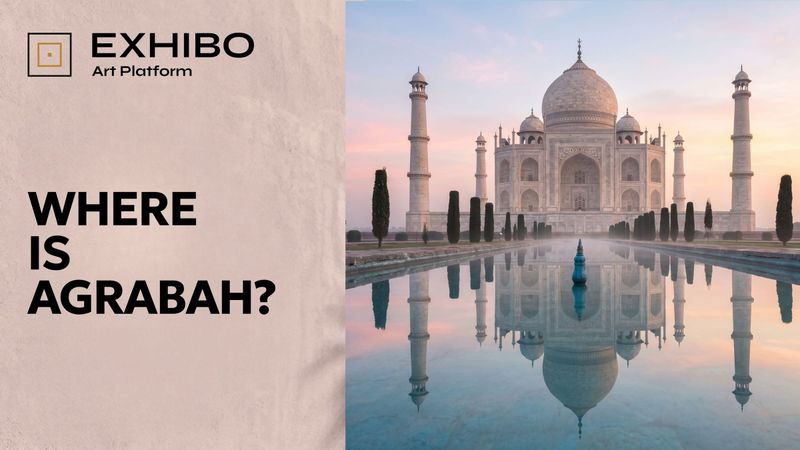
Where Is Agrabah? The City Disney Assembled From Real Places
Agrabah was going to be Baghdad. A war made it fictional — and then Disney built it back out of real places, from a tomb in Agra to a valley in Jordan that usually plays Mars.
The Sultan's palace where Princess Jasmine feels trapped has the silhouette of the Taj Mahal — which is not a palace at all, but a tomb. That is how Agrabah works. Disney's fairy-tale city was going to be Baghdad, until the Gulf War made the name impossible; the studio invented a place that could not be found on a map, then quietly rebuilt it out of real ones — Isfahan and Agra, Marrakesh and Mandalay, a Jordanian desert that has played both Arabia and Mars.
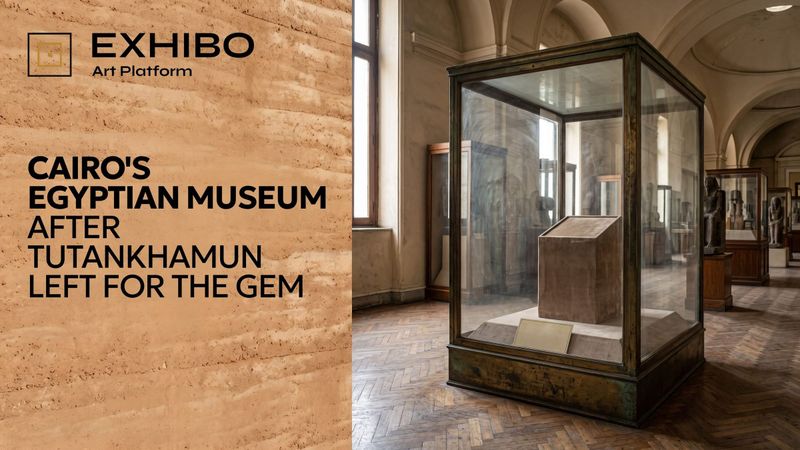
The House Whose Famous Guests All Moved Out
When Tutankhamun's mask left Cairo's Egyptian Museum for the Grand Egyptian Museum, it took the crowds with it — but not the collection. What remains in the old building on Tahrir Square turns out to be a stranger and more interesting museum than the one that emptied.
For most of a century, the golden mask of Tutankhamun stood behind glass on the upper floor of the Egyptian Museum in Cairo. In October 2025 it was driven out to Giza, and it was not the only thing to go: the royal mummies, the whole Tutankhamun collection, tens of thousands of objects have left the old museum for Egypt's gleaming new institutions.
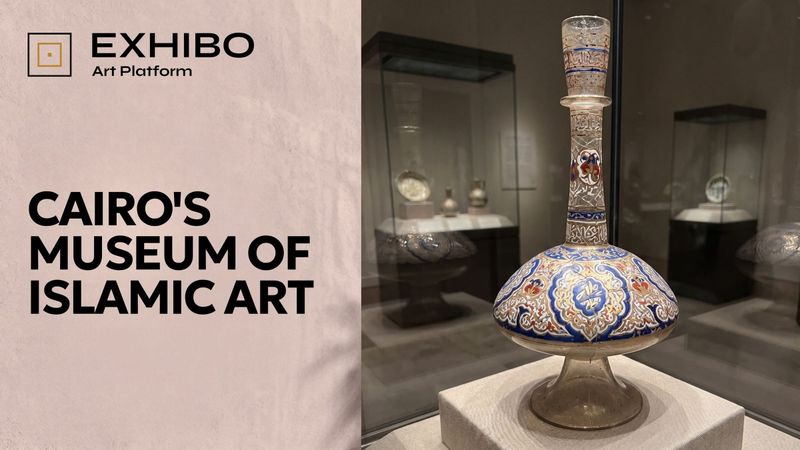
The Bottle That Was in Pieces on the Floor
A car bomb left one of the world's great collections of Islamic art in fragments on the floor. What the Museum of Islamic Art chose to do with the repair — mark it, rather than hide it — turns out to be the most quietly radical decision in the building.
Near the entrance of Cairo's Museum of Islamic Art stands an eight-hundred-year-old Syrian glass bottle with a small gold mark on its label. The mark does not mean the bottle is precious, though it is. It means it was broken — shattered on the floor by the 2014 bombing across the street, then patiently glued back into a single shape.