

Venice · Italy
Digital Horizons at the Venice Biennale's Collateral Shows
How independent pavilions are redefining technology-driven practice beyond the main competition
Digital Horizons at the Floating City
Contemporary discourse frequently frames technology-driven practice as either commercially hollow or creatively sterile. Yet visitors navigating the sixty-first iteration of the Venice Biennale, which runs until late November, might find their assumptions challenged by a cluster of independent projects situated away from the crowded central routes. Rather than leaning into algorithmic hype or defensive theorising, these collateral spaces present measured, materially grounded explorations of computational culture.
VCUarts Qatar's Inventive Laboratories
The exhibition Aghrab Idrāk: Thresholds of Perception, running until 22 November, emerges from the research studios affiliated with Virginia Commonwealth University’s Qatar campus. Dean Amir Berbić notes that the institution’s flat organisational model naturally encourages cross-pollination between teaching staff, learners, and graduates. This collaborative framework yields works that feel less like polished product launches and more like genuine inquiries. Mesh Lab contributes a brooding, single-eyed robotic figure that operates as a mechanical oracle, while Boost Lab, directed by Syed Erzum Naqvi, presents Chrysalis, an expansive ventilation apparatus that mimics respiratory rhythms. My own attention was captured by xLab’s Preceding Emptiness, a towering luminescent arrangement that converts the electrical hum of failing tube lighting into a deliberate sonic element. By confronting the technical limitations of rendering Arabic calligraphy through segmented LED matrices, the piece quietly questions how digital translation reshapes heritage systems built on handcraft. The overall atmosphere remains notably open, sidestepping the heavy-handed manifestos that often accompany screen-based work today.
Sabotage and Simulation in Palazzo Franchetti
Over at the Autotelic Foundation, Eva and Franco Mattes developed RAGE BAIT, displayed between early May and the end of June. The installation opens onto the canal with a preserved feline specimen resting on the exterior ledge, immediately drawing pedestrian interest. Inside, the curatorial team replaced traditional flooring with raised plastic grating, allowing glossy yellow conduit boxes to protrude upwards. This spatial intervention evokes a hybridised vision of early twenty-first-century speculative design and contemporary internet liminal aesthetics. At its core, the project involves continuously feeding corrupted imagery derived from viral animal memes into public datasets, effectively attempting to degrade machine learning models through repetitive contamination. Ironically, the grotesque yet playful motifs introduced here feel surprisingly restorative against the backdrop of modern network toxicity. Accompanying vertical monitors broadcast animated figures reciting crisis helpline transcripts over dissonant electronic tones. Despite the confrontational nomenclature, the presentation ultimately reads as a wry observation rather than an aggressive provocation.
Curated Dialogues at Palazzo Diedo
The Berggruen Foundation hosts Strange Rules, a survey running until 22 November co-curated by Mat Dryhurst, Holly Herndon, Hans Ulrich Obrist, and Adriana Rispoli. More than two dozen practitioners contribute to this wide-ranging investigation. Ken Stanley’s backlit panels utilise his Picbreeder software to generate fluid, vehicle-like silhouettes that recall pre-AI generative experiments. Joshua Citarella collaborates with New Models to construct a faux retail environment called Online Marketplace of Ideas. By translating ephemeral web vernacular into tangible objects like apparel and printed matter, the installation examines how digital subcultures mutate when extracted from their native platforms. Perhaps the most politically resonant contribution comes from Lawrence Abu Hamdan. Waterfalls consists of illuminated topographical sculptures mapping the phonetic contours of regional speech patterns deliberately erased by corporate voice-recognition systems. The piece exposes how automated standardisation quietly enforces cultural homogenisation, challenging viewers to consider whose linguistic norms become default settings in globalised software.
Redirecting the Conversation
These independent initiatives demonstrate that technological engagement within fine art need not rely on either uncritical adoption or blanket rejection. Instead, they foster nuanced dialogue about preservation, manipulation, and acoustic equity. As the season progresses, such projects may well steer criticism away from polarised online debates toward more substantive artistic inquiry.
Related reading
A Defiant Stance on Global Participation at the Venice Biennale
Pietrangelo Buttafuoco justifies Russian inclusion amid sanctions and political backlash
The Biennale president addresses EU funding cuts and government boycotts while defending the institution's commitment to open cultural exchange.
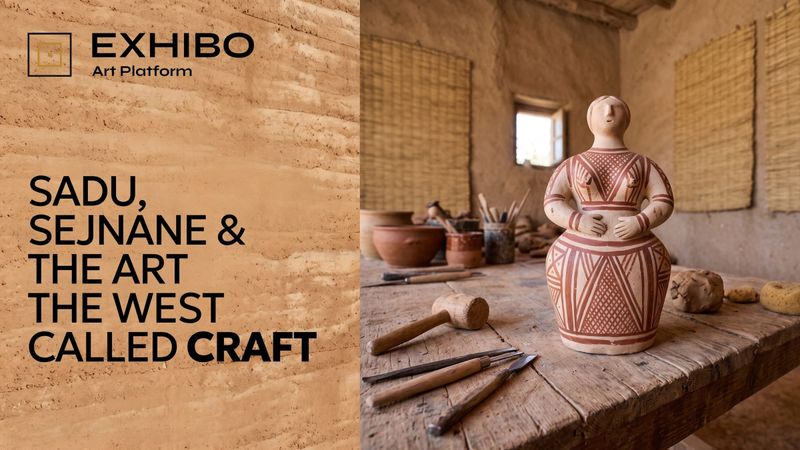
Women Makers: Sadu, Sejnane and the Art the West Called Craft
How the women of Sejnane and the Sadu tents made a world of geometric art the museum system had no shelf for — and how it is finally being called by its name.
Two women's traditions — the clay of Sejnane in Tunisia, the woven tents of the Arabian Peninsula — share no bloodline, only a rhyme: the same spare geometry, held and passed down by women, in whatever material their world gave them. This is the story of the visual knowledge the West filed under "craft," the makers it kept downstairs, and the contemporary artists now carrying it back up into the room where "art" is defined.

Taus Makhacheva's Gossip-Inspired Performance Opens at UAE Pavilion for Venice Biennale
The artist's new commission explores how rumour circulates through bodies and communities in a two-part work combining dance and sound installation.
As part of the Washwasha exhibition at the 61st Venice Biennale, Taus Makhacheva presents a performance examining gossip as both cultural practice and embodied experience.