
Venice · Italy
A Defiant Stance on Global Participation at the Venice Biennale
Pietrangelo Buttafuoco justifies Russian inclusion amid sanctions and political backlash
A Defiant Stance on Global Participation
The leadership of the 61st iteration of the Venice Biennale has faced considerable scrutiny since its spring inauguration. Pietrangelo Buttafuoco, who serves as the institution's president, has firmly articulated his rationale for maintaining Russian representation within the prestigious showcase. His position centres on a straightforward assertion: cultural exchange ultimately triumphs over geopolitical conflict. This perspective emerged prominently following weeks of demonstrative pushback directed at both Israeli and Russian national pavilions. While some political figures viewed the inclusion as a concession to authoritarian regimes, Buttafuoco maintains that the exhibition space must remain a neutral ground for international dialogue. He emphasised that excluding nations based on their current governmental policies would fundamentally undermine the event's foundational purpose of fostering worldwide artistic convergence. Such a stance reflects a longstanding tradition among major international showcases, which historically prioritise artistic merit above diplomatic tensions.
Diplomatic Friction and Financial Consequences
The controversy quickly escalated beyond gallery walls, drawing sharp rebukes from state authorities. Italy's minister for culture, Alessandro Giuli, deliberately skipped the inaugural ceremony, publicly declaring that the political leader in question had effectively achieved a victory through the institution's choices. Simultaneously, regulatory bodies across Europe raised alarms regarding potential violations of existing trade restrictions. Brussels issued formal warnings that facilitating the Russian national display might contravene established economic penalties. The financial repercussions followed swiftly; by July, European authorities terminated a two-million-euro funding allocation designated for the organisation. Consequently, the Russian presentation within the Giardini grounds shut down shortly after its initial viewing periods concluded, leaving many visitors without access to the curated works. This sequence of events highlights the increasingly complex intersection between cultural programming and transnational policy enforcement.
Institutional Legacy and Regulatory Compliance
In a recent discussion with Corriere della Sera, released on 1 September, Buttafuoco reiterated his unwavering commitment to the venue's historical precedent. He noted that over more than a century and a quarter of operation, the organisation has consistently welcomed diverse voices, even throughout periods of intense global warfare. When questioned whether he would alter his approach given the subsequent political fallout, the president offered a resounding negative. He stressed that every administrative decision aligns perfectly with domestic and international legal frameworks, pointing out that official documentation contains no discrepancies with statutory requirements. Furthermore, he challenged the European Union's methodology, arguing that restricting creative output according to citizenship directly opposes fundamental human rights principles enshrined in continental charters. Beyond the ongoing debates, the administration highlighted several cultural undertakings designed to broaden public engagement. These initiatives encompass a freshly revived quarterly publication drawing upon archival materials, alongside a new podcast titled Biennale on Air. As biennials navigate an era of heightened political awareness, such institutional resilience will undoubtedly shape future discourse.
Related reading

Digital Horizons at the Venice Biennale's Collateral Shows
How independent pavilions are redefining technology-driven practice beyond the main competition
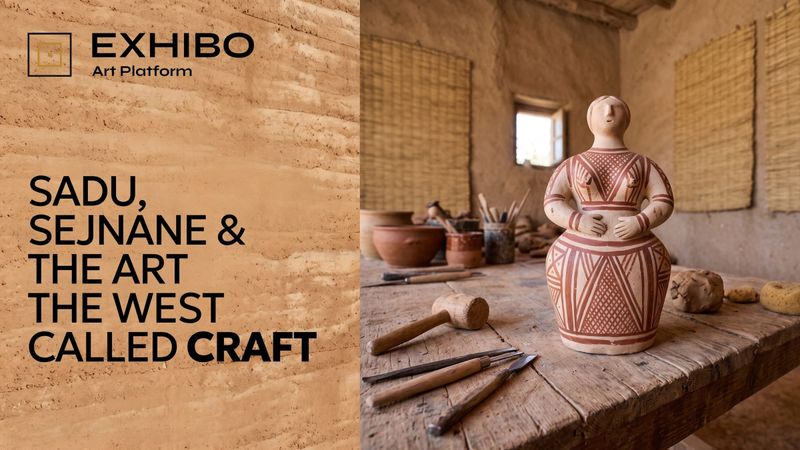
Women Makers: Sadu, Sejnane and the Art the West Called Craft
How the women of Sejnane and the Sadu tents made a world of geometric art the museum system had no shelf for — and how it is finally being called by its name.
Taus Makhacheva's Gossip-Inspired Performance Opens at UAE Pavilion for Venice Biennale
The artist's new commission explores how rumour circulates through bodies and communities in a two-part work combining dance and sound installation.