
Dubai · United Arab Emirates
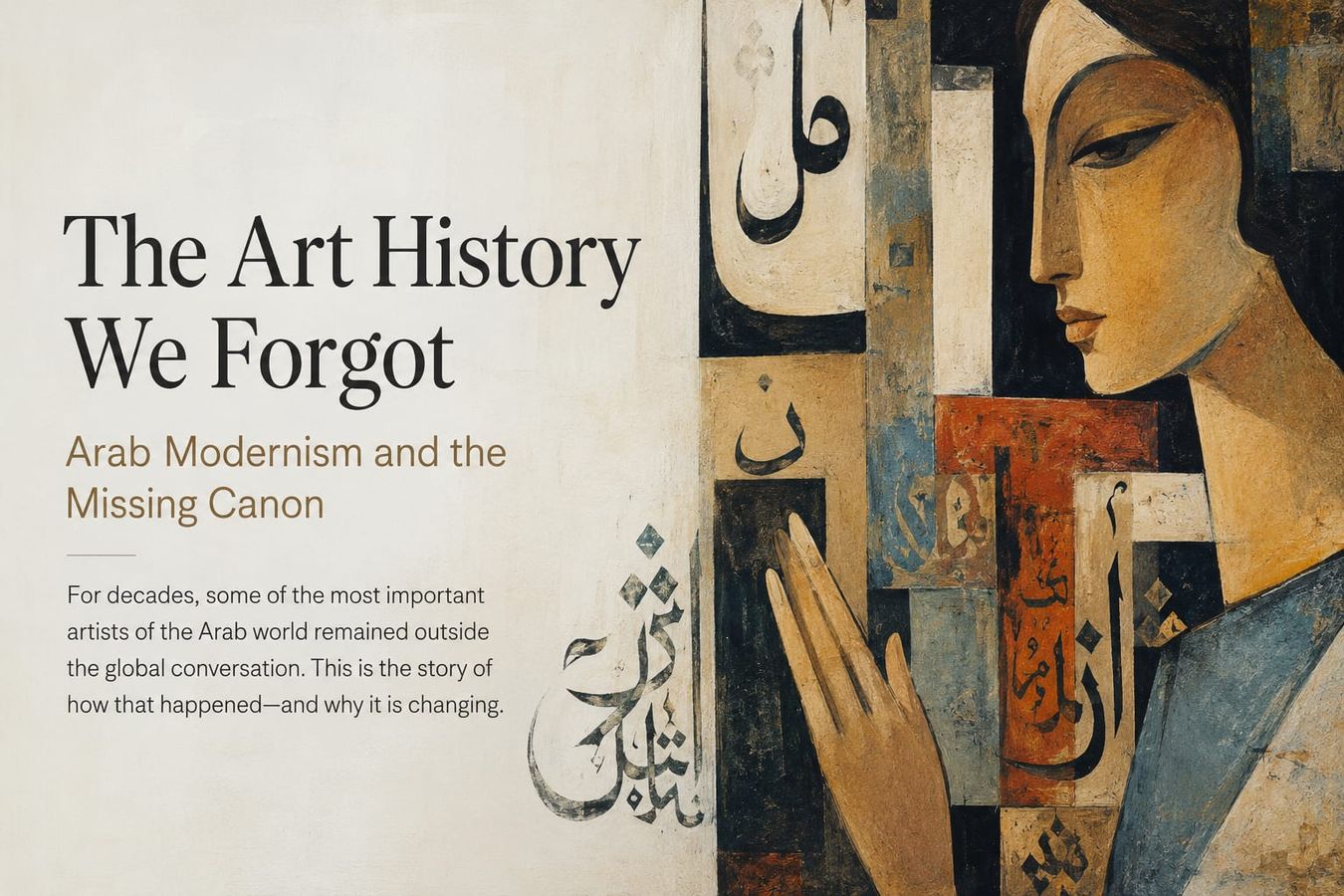
Arab Modernism 101: The Movement That Western Art History Forgot
An entire century of extraordinary painting, sculpture and radical thinking got written out of the global canon. Someone made that decision. And now the market — and the collectors who pay attention — are making a different one.
In the 1950s, painters and sculptors in Baghdad, Khartoum, Beirut and Casablanca were making work of genuine radicalism — work that asked the same questions as Picasso and Pollock and the Abstract Expressionists, at the same historical moment, but from completely different cultural coordinates. This work was extraordinary. It was being shown, discussed, argued about, collected.
Almost none of it made it into the history books. Into the museums. Into the syllabi of the art schools that shaped how the Western world thinks about what modern art is.
Arab Modernism is one of the great under-recognised stories of twentieth-century art. Not suppressed in the sense of hidden — the work was always there, in the galleries of Baghdad and the collections of Beirut, in the studios of Casablanca and the museums of Cairo. But suppressed in the sense of excluded — systematically absent from the global narrative of Modernism that Western institutions constructed and exported as the authoritative version of what happened in art between 1950 and 1980.
The exclusion was not an accident. It had structural reasons — linguistic barriers, colonial knowledge structures, limited circulation of works, the absence of world-class archives and museums in the region, political conflict, and the particular dynamics of the Cold War cultural economy. But structural effects can be as consequential as deliberate choices, and the consequences here were enormous.
This is the story of how that happened. And what it means if you're paying attention — because some of the most significant painting of the twentieth century remains historically undervalued by Western institutions, and that gap between cultural significance and market recognition is one that the current moment is closing fast.
The Art That Existed While Nobody Was Looking
To understand what was lost, you have to understand what was actually being made.
In 1951, an Iraqi sculptor named Jawad Saleem stood at the first public exhibition of the Baghdad Modern Art Group and read a manifesto. He was thirty-two years old, had studied in Paris, Rome and London, had stood in front of the same paintings as his Western contemporaries — and had decided that the question he actually wanted to answer was one that no European education had prepared him for: what does a modern Arab art look like?
Not a nostalgic Arab art. Not a imitation-Western Arab art. Something genuinely new — rooted in Mesopotamian heritage, open to international dialogue, refusing to choose between modernity and identity. The manifesto the group published is now considered by many scholars the formal beginning of the Iraqi Modern Art movement. Saleem died ten years later — at forty-two, of a heart attack — while still working on his masterpiece: the Freedom Monument in Baghdad's Liberation Square, a fifty-metre bronze relief that drew simultaneously on Babylonian wall friezes and the formal language of mid-century Western sculpture. By any measure, a major work of twentieth-century art. Standing in the centre of one of the Arab world's great capitals. Almost entirely unknown in the West.
The movement he started didn't die with him. Dia Al-Azzawi, born in Baghdad in 1939, went further — founding the New Vision Group in the late 1960s with an explicitly ideological programme: to create an Arab Modernism united not by style but by intellectual conviction. Dense, layered, drawing simultaneously on ancient Sumerian imagery and the urgency of a region living through war and political upheaval, his paintings have been collected by the British Museum, the Tate, and major private collections across three continents. He is, by any measure, one of the most important Arab modernists of the twentieth century — and one whose significance the Western market is only now beginning to reflect in prices.
In Sudan, Ibrahim El-Salahi was learning calligraphy at a Quranic school run by his father, then going to study at the Slade in London, then coming back to Khartoum to develop a practice that fused Islamic letterforms with painterly abstraction unlike anything produced in either tradition independently. He became part of a pan-Arabic movement called Hurufiyya — literally "letterism" — that stretched from Baghdad to Cairo to Beirut: artists using Arabic script not as decoration but as raw material, asking what happens when the vehicle of meaning is stripped of its communicative function and turned purely visual. These were not calligraphers. They were conceptual artists. They just weren't being covered in Artforum.
In Beirut, Saloua Raouda Choucair had been to Paris, encountered Le Corbusier and Fernand Léger, and come back convinced that Arabic poetry and Islamic geometry contained a visual logic more radical than anything the Bauhaus had proposed. Her sculptures — modular, interlocking, decomposable into parts like the verses of an Arabic poem — are now in the permanent collections of MoMA, the Metropolitan Museum, the Centre Pompidou, Tate Modern and the Guggenheim Abu Dhabi. She had a Tate retrospective in 2013. She was ninety-seven years old. She had been making extraordinary work for six decades before the institution noticed. And in Syria, artists like Fateh Moudarres and Louay Kayyali — whose psychologically dense figurative paintings of the 1960s and 1970s have become some of the most sought-after works at MENA auctions — were building a practice that Ayyam Gallery has spent two decades preserving and presenting, through displacement and conflict, to collectors who are only now beginning to understand what they are looking at.
In Morocco, Farid Belkahia, Mohammed Chebaa and Mohammed Melehi had taken over the École des Beaux Arts of Casablanca and turned it into something genuinely avant-garde: post-colonial in its insistence on local visual culture, Modernist in its commitment to abstraction, and — as the position statement Chebaa wrote for a 1966 exhibition makes clear — fiercely conscious of the difference between making work for a decolonised Arab public and making work that aspired to Western institutional recognition.
In Egypt, Mahmoud Said — son of a prime minister, trained in Florence, possessed of a technique that would have made him a celebrated figure in any European context — spent his career painting what he actually saw: the women of Alexandria, the Nile at dusk, the street outside his window. And Inji Efflatoun, who was simultaneously a Marxist activist, a feminist, a modernist painter, and — for six years of her life — a political prisoner, producing from all of those conditions work of remarkable density and power.
In Algeria, Baya Mahieddine began painting at thirteen and was shown by Aimé Maeght — Picasso's gallerist — in Paris in 1947. André Breton wrote about her. Henri Matisse paid attention. She was sixteen years old and had received no formal art training. Her vision — women, birds, flowers, a world of intense colour and private mythology — was so singular that it defied every available category. In Lebanon, Fahrelnissa Zeid was painting canvases five metres wide that fused Byzantine mosaic, Islamic architecture and European abstraction into something the School of Paris had never seen. She showed at the Institute of Contemporary Arts in London in 1954. Tate called her, in 2017, "one of the greatest female artists of the 20th century."
All of this was happening. Simultaneously. Across a dozen countries. Over four decades.
According to AramcoWorld's survey of the movement, the first Arab Modernist institution was Cairo's School of Fine Arts, founded in 1908. By the 1950s and 1960s, the movement had spread across the entire region. Artists were holding exhibitions, publishing manifestos, arguing with each other about the relationship between tradition and modernity, forming groups, dissolving groups, going to Paris and coming back changed, staying in Baghdad and changing anyway.
The Western art world largely overlooked it — not because the work wasn't there, but because the structures for recognising it weren't. When Western institutions did look, they rarely looked with sustained attention.
The omission of Arab Modernism from the global canon was not a simple oversight. It emerged from a set of institutional, political and cultural structures that shaped what counted as Modernism — and what did not.
Modern Art in the Arab World: Primary Documents, the landmark 2018 MoMA publication edited by Anneka Lenssen, Sarah Rogers and Nada Shabout, is the most important scholarly reckoning with this history. Its central argument — built from a century of manifestos, essays, letters and exhibition texts, many appearing in English for the first time — is that Arab artists were engaged in exactly the same debates that Western art history claims as its defining questions. Debates about originality, about the relationship between abstraction and meaning, about the politics of exhibition, about what it means to make art after colonialism. These debates were rich, sophisticated and ongoing. They just weren't visible to Western institutions because they were happening in Arabic, and in cities that Western art institutions weren't paying attention to.
But there was a more specific and more damaging reason for the exclusion. During the Cold War, American Abstract Expressionism was promoted globally as a form of cultural soft power — the freedom of the individual artist as counterpoint to Soviet collectivism. Exhibitions of American abstract painting were funded through international cultural programmes, with institutions including the Museum of Modern Art playing a central role in this project. The narrative that project required — American Abstract Expressionism as the triumphant culmination of the Western modernist tradition — left no room for the idea that artists in Baghdad or Khartoum or Casablanca were independently developing parallel practices that drew on entirely different traditions and asked entirely different questions. It wasn't that the Western art world looked at Arab Modernism and dismissed it. It never looked at all.
As Northwestern professor Rebecca Johnson put it at the opening of Taking Shape: Abstraction from the Arab World at the Block Museum in 2022: these were artists "written out of dominant narratives about history." Not because the work wasn't good enough. Because the narrative didn't have room for them.
Then there was a third layer, specific to women. If Arab Modernism was excluded from Western art history, the women within it were excluded twice — once for being Arab, once for being women. Choucair spent decades making work that Le Corbusier admired and that MoMA eventually acquired, while remaining largely unknown outside a small circle of Beirut collectors. Efflatoun navigated prison, political censorship and the competing demands of socialist realism and formal modernism while producing paintings of genuine originality — and remained, until very recently, almost entirely absent from international discussion. Fahrelnissa Zeid showed in London and Paris in the 1950s, was reviewed by major critics, and then disappeared from the Western conversation for fifty years.
The book Alcove: Intimate Essays on Arab Modernist Artists, edited by Myrna Ayad with a foreword by Nada Shabout, gathers essays on thirty artists from the 1950s through the 1980s — Shafic Abboud, Huguette Caland, Louay Kayyali, Baya Mahieddine, Hassan Sharif and many others. It reads less like an art history book and more like an act of rescue. Artists pulled from institutional amnesia, one essay at a time. The sheer number of major figures who required rescuing tells you everything about the scale of what was lost.
The People Who Kept Looking Anyway
While Western institutions were constructing their version of Modernist history, a different archive was being built.
Collectors in Cairo who bought Mahmoud Said in the 1950s because they loved the paintings — not because they thought they were making a smart market play. Families in Beirut who held on to Choucair's early sculptures through decades of civil war. The Dalloul family, who spent fifty-five years assembling what became one of the most significant private collections of Arab Modernism in the world — pieces of which were sold at Christie's in 2023, forty-eight works achieving around $3 million. As Christie's specialist Hala Khayat described it: "A lot of the works we are selling now from collectors are the fruits of friendship. Someone believed in the artist back in the 1950s when no one was looking at his work. It takes a long time — you have to be passionate, and not look for the monetary value."
And then there is Sultan Sooud Al Qassemi — Emirati writer, Columbia professor, and since 2002 the single person most responsible for rescuing Arab Modernism from invisibility at institutional scale. The Barjeel Art Foundation, which he established in Sharjah in 2010, now holds over 1,800 works, with Al Qassemi and his team actively sourcing forgotten pieces by Arab Modernists to build the fullest possible picture of the tradition. The collection has been lent to MoMA, Tate, the Permanent Mission of the UAE to the United Nations. A dedicated Barjeel museum is under construction in Sharjah, due to open in January 2028.
What Al Qassemi is building is not a collection. It is a counter-argument — to the idea that the history of modern art was made in New York and Paris, and that everywhere else was marginal.
In 2010, Mathaf: Arab Museum of Modern Art opened in Doha as the first museum in the Arab world dedicated entirely to this tradition. Its inaugural exhibition, Sajjil: A Century of Modern Art, drew on 6,000 works and made the argument that could no longer be avoided: this was not a regional phenomenon. This was a global story that had been told with half the evidence.
The Tate retrospectives followed. El-Salahi in 2013 — first ever retrospective of an African artist at Tate Modern, eighty-three years old. Choucair in 2013 — ninety-seven years old. Fahrelnissa Zeid in 2017. Each one a landmark. Each one, in its way, an apology for taking so long.
The Taking Shape: Abstraction from the Arab World, 1950s–1980s exhibition — drawing on nearly ninety works from the Barjeel collection — toured five American institutions between 2020 and 2022. Its curator described it as an attempt to "rethink art-historical canons and expand conversations around global modernisms." The argument the exhibition made was not that Western art was less significant — but that the history of twentieth-century art was richer, more complex and more global than the dominant narrative had allowed.
What the Market Understood Before the Institutions Did
Markets move faster than institutions. Collectors with good eyes and genuine conviction recognise significance before the retrospectives happen, before the museum acquisitions, before the art history textbooks are rewritten. The collectors who bought Arab Modernist work in the 1950s and 1960s weren't anticipating the market. They were just looking at the work and understanding that it was extraordinary.
Now the institutions have caught up. And the market is following.
At Sotheby's 2023 autumn MENA sale, Mohammed Al Saleem's desert landscape sold for $1.1 million. Huguette Caland achieved $565,000 — a record. Palestinian abstract artist Samia Halaby's Seventh Cross No 229 reached $485,000. Mahmoud Said's Vue de la plage à Cassata en Grèce — one of the last paintings he made before his death in 1964 — sold at Christie's for over $1 million against an estimate of $470,000. Fahrelnissa Zeid's Towards a Sky went for just under £1 million.
Sotheby's 2025 MENA sale drew collectors from 23 countries — 33% of them new to the platform. In 2025, Sotheby's opened its first permanent office in Saudi Arabia, in Riyadh's Al Faisaliah Tower, where Origins sales achieved a combined $10 million for Modern and Contemporary Middle Eastern art. Christie's reports that 15% of its new global clients over the past three years came from the Middle East and Africa.
These are not the numbers of a regional market finding its footing. These are the numbers of a global market that has finally started asking the right questions about what it missed.
And yet — and this is the point worth holding onto — Arab Modernism remains significantly underpriced relative to comparable Western work. A Mahmoud Said selling at $1 million is extraordinary by the standards of where the market was ten years ago. It is modest by the standards of what a comparable European figurative painter of the same period would achieve. The gap between institutional recognition and market price is closing. It has not closed yet.
The collectors who understood Dia Al-Azzawi in 1970 were right about the work. The collectors looking at it now — at Lawrie Shabibi in Alserkal Avenue, at Tabari Artspace in DIFC, at Ayyam Gallery with its two decades of commitment to Syrian and regional modernism, at the Art Dubai Modern section, at Sotheby's and Christie's MENA auctions — are making the same bet at a different point in the cycle.
Works by Arab Modernists whose institutional credentials are established but whose market recognition hasn't caught up are still available in the $20,000–$80,000 range. The galleries in Dubai are the best places to build context before buying. The Barjeel Foundation's collection in Sharjah, viewable by appointment, is the single best education in the tradition.
But the deeper point is not about price. It is about what becomes visible when you build the infrastructure for a different kind of looking. For most of the twentieth century, cultural significance was recognised by museums — slowly, through acquisitions and retrospectives, on timescales measured in decades. Then auction results accelerated the process: price became a proxy for significance.
Both mechanisms had the same structural bias: they were best at recognising what had already been recognised.
The recovery of Arab Modernism happened because collectors, curators, institutions and gallerists built something different — the Barjeel collection, Mathaf, Taking Shape, decades of work in Beirut, Cairo, Sharjah and Dubai before the broader market was paying attention.
The work was always there. The question was whether anyone was looking.
Related reading
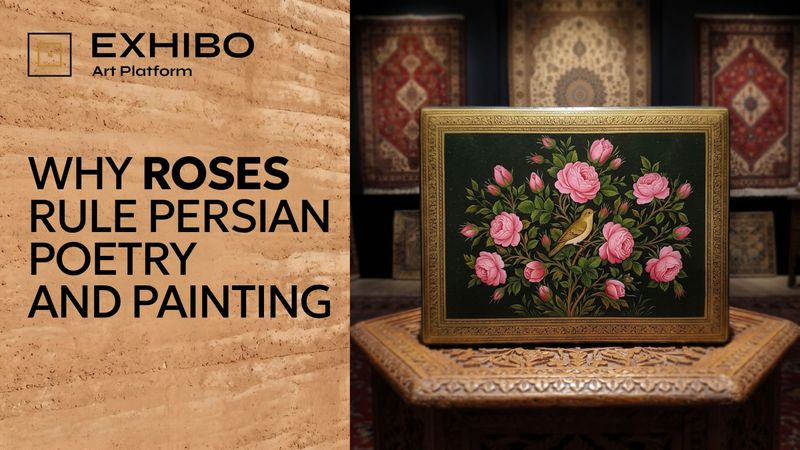
The Flower That Was Never Only Beautiful
The rose rules Persian poetry and painting — but under the sweetness sits a thorn, a bleeding bird, and a national emblem quietly assembled out of Chinese, European and Persian parts. A history of gol o bolbol, from a medieval still to a Dubai gallery.
Gol o bolbol — the rose and the nightingale — is among the most beautiful images in a thousand years of Persian art, and in modern Persian it also means sweet, empty talk. Under the tile, the picture is darker: a bird singing in blood for a flower that will not answer and will not last.
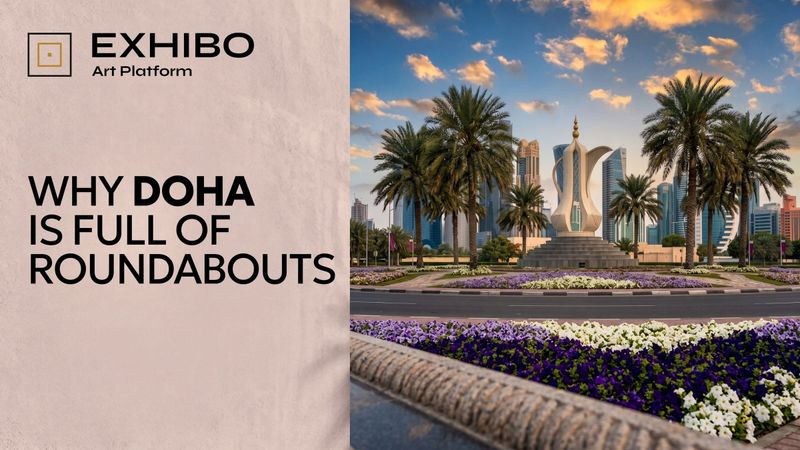
Why Doha Is Full of Roundabouts
An old circle at a crossroads, sharpened by British road engineering, became the way an Arabian city found its way and remembered itself — and it took the bulldozers to reveal it.
In a city where a landmark was more useful than an address, Doha's roundabouts became its navigation, its landscaping and its national image all at once. Now they're being torn out for signalled junctions — and the affection for them arrived, as one scholar put it, only posthumously.
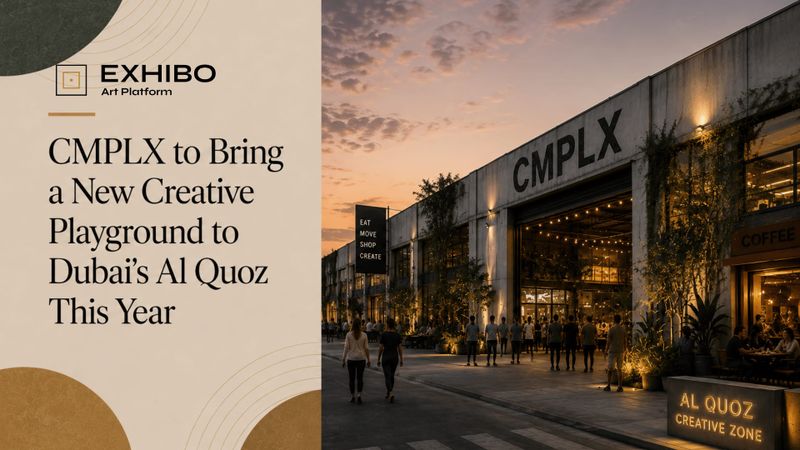
CMPLX to Bring a New Creative Playground to Dubai's Al Quoz This Year
A seven-warehouse lifestyle hub combining food, wellness, retail and creative studios is set to open in Al Quoz Creative Zone by the end of 2026, adding a new anchor to the neighbourhood built around Alserkal Avenue.
CMPLX, a new warehouse-style lifestyle destination combining food, wellness, retail and creative studios, is set to open in Dubai's Al Quoz Creative Zone by the end of 2026 — adding a fresh anchor to a neighbourhood already defined by Alserkal Avenue's galleries and cultural spaces.